Chapter
4-1
Chapter
4-2
CHAPTERCHAPTER 44
COMPLETING THECOMPLETING THE
ACCOUNTINGACCOUNTING
CYCLECYCLE
Accounting Principles, Eighth Edition
Chapter
4-3
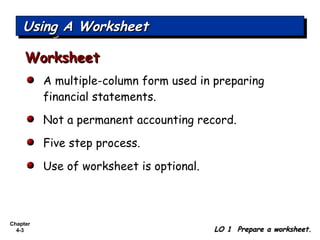
A multiple-column form used in preparing
financial statements.
Not a permanent accounting record.
Five step process.
Use of worksheet is optional.
Using A WorksheetUsing A WorksheetUsing A WorksheetUsing A Worksheet
LO 1 Prepare a worksheet.LO 1 Prepare a worksheet.
WorksheetWorksheet
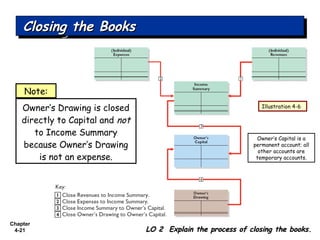
Chapter
4-4
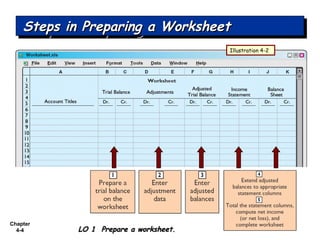
Steps in Preparing a WorksheetSteps in Preparing a WorksheetSteps in Preparing a WorksheetSteps in Preparing a Worksheet
LO 1 Prepare a worksheet.LO 1 Prepare a worksheet.
Illustration 4-2
Chapter
4-5
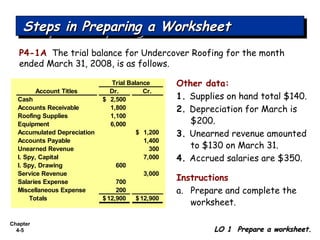
P4-1A The trial balance for Undercover Roofing for the month
ended March 31, 2008, is as follows.
Steps in Preparing a WorksheetSteps in Preparing a WorksheetSteps in Preparing a WorksheetSteps in Preparing a Worksheet
Account Titles Dr. Cr.
Cash 2,500$
Accounts Receivable 1,800
Roofing Supplies 1,100
Equipment 6,000
Accumulated Depreciation 1,200$
Accounts Payable 1,400
Unearned Revenue 300
I. Spy, Capital 7,000
I. Spy, Drawing 600
Service Revenue 3,000
Salaries Expense 700
Miscellaneous Expense 200
Totals 12,900$ 12,900$
Trial Balance Other data:
1. Supplies on hand total $140.
2. Depreciation for March is
$200.
3. Unearned revenue amounted
to $130 on March 31.
4. Accrued salaries are $350.
Instructions
a. Prepare and complete the
worksheet.
LO 1 Prepare a worksheet.LO 1 Prepare a worksheet.
Chapter
4-6
Account Titles Dr. Cr. Dr. Cr. Dr. Cr. Dr. Cr. Dr. Cr.
Cash 2,500
Accounts Receivable 1,800
Roofing Supplies 1,100
Equipment 6,000
Accumulated Depreciation 1,200
Accounts Payable 1,400
Unearned Revenue 300
I. Spy, Capital 7,000
I. Spy, Drawing 600
Service Revenue 3,000
Salaries Expense 700
Miscellaneous Expense 200
Totals 12,900 12,900
Balance Sheet
Adjusted Income
Trial Balance Adjustments Trial Balance Statement
Steps in Preparing a WorksheetSteps in Preparing a WorksheetSteps in Preparing a WorksheetSteps in Preparing a Worksheet
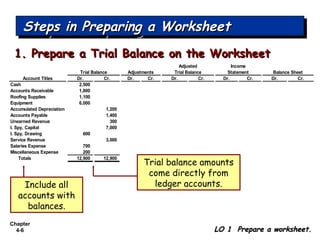
1. Prepare a Trial Balance on the Worksheet1. Prepare a Trial Balance on the Worksheet
Trial balance amounts
come directly from
ledger accounts.Include all
accounts with
balances.
LO 1 Prepare a worksheet.LO 1 Prepare a worksheet.
Chapter
4-7
Account Titles Dr. Cr. Dr. Cr. Dr. Cr. Dr. Cr. Dr. Cr.
Cash 2,500
Accounts Receivable 1,800
Roofing Supplies 1,100 960
Equipment 6,000
Accumulated Depreciation 1,200 200
Accounts Payable 1,400
Unearned Revenue 300 170
I. Spy, Capital 7,000
I. Spy, Drawing 600
Service Revenue 3,000 170
Salaries Expense 700 350
Miscellaneous Expense 200
Totals 12,900 12,900
Supplies Expense 960
Depreciation Expense 200
Salaries Payable 350
Totals 1,680 1,680
Balance Sheet
Adjusted Income
Trial Balance Adjustments Trial Balance Statement
Steps in Preparing a WorksheetSteps in Preparing a WorksheetSteps in Preparing a WorksheetSteps in Preparing a Worksheet
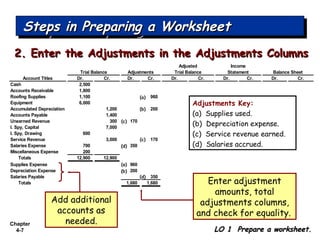
2. Enter the Adjustments in the Adjustments Columns2. Enter the Adjustments in the Adjustments Columns
Enter adjustment
amounts, total
adjustments columns,
and check for equality.
(a)
(a)
(b)
(b)
(d)
(d)
(c)
(c)
LO 1 Prepare a worksheet.LO 1 Prepare a worksheet.
Add additional
accounts as
needed.
Adjustments Key:
(a) Supplies used.
(b) Depreciation expense.
(c) Service revenue earned.
(d) Salaries accrued.
Chapter
4-8
Account Titles Dr. Cr. Dr. Cr. Dr. Cr. Dr. Cr. Dr. Cr.
Cash 2,500 2,500
Accounts Receivable 1,800 1,800
Roofing Supplies 1,100 960 140
Equipment 6,000 6,000
Accumulated Depreciation 1,200 200 1,400
Accounts Payable 1,400 1,400
Unearned Revenue 300 170 130
I. Spy, Capital 7,000 7,000
I. Spy, Drawing 600 600
Service Revenue 3,000 170 3,170
Salaries Expense 700 350 1,050
Miscellaneous Expense 200 200
Totals 12,900 12,900
Supplies Expense 960 960
Depreciation Expense 200 200
Salaries Payable 350 350
Totals 1,680 1,680 13,450 13,450
Balance Sheet
Adjusted Income
Trial Balance Adjustments Trial Balance Statement
Steps in Preparing a WorksheetSteps in Preparing a WorksheetSteps in Preparing a WorksheetSteps in Preparing a Worksheet
LO 1 Prepare a worksheet.LO 1 Prepare a worksheet.
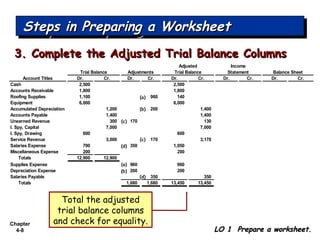
3. Complete the Adjusted Trial Balance Columns3. Complete the Adjusted Trial Balance Columns
Total the adjusted
trial balance columns
and check for equality.
(a)
(a)
(b)
(b)
(d)
(d)
(c)
(c)
Chapter
4-9
Account Titles Dr. Cr. Dr. Cr. Dr. Cr. Dr. Cr. Dr. Cr.
Cash 2,500 2,500
Accounts Receivable 1,800 1,800
Roofing Supplies 1,100 960 140
Equipment 6,000 6,000
Accumulated Depreciation 1,200 200 1,400
Accounts Payable 1,400 1,400
Unearned Revenue 300 170 130
I. Spy, Capital 7,000 7,000
I. Spy, Drawing 600 600
Service Revenue 3,000 170 3,170 3,170
Salaries Expense 700 350 1,050 1,050
Miscellaneous Expense 200 200 200
Totals 12,900 12,900
Supplies Expense 960 960 960
Depreciation Expense 200 200 200
Salaries Payable 350 350
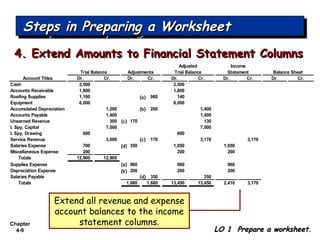
Totals 1,680 1,680 13,450 13,450 2,410 3,170
Balance Sheet
Adjusted Income
Trial Balance Adjustments Trial Balance Statement
Steps in Preparing a WorksheetSteps in Preparing a WorksheetSteps in Preparing a WorksheetSteps in Preparing a Worksheet
LO 1 Prepare a worksheet.LO 1 Prepare a worksheet.
4. Extend Amounts to Financial Statement Columns4. Extend Amounts to Financial Statement Columns
Extend all revenue and expense
account balances to the income
statement columns.
(a)
(a)
(b)
(b)
(d)
(d)
(c)
(c)
Chapter
4-10
Account Titles Dr. Cr. Dr. Cr. Dr. Cr. Dr. Cr. Dr. Cr.
Cash 2,500 2,500 2,500
Accounts Receivable 1,800 1,800 1,800
Roofing Supplies 1,100 960 140 140
Equipment 6,000 6,000 6,000
Accumulated Depreciation 1,200 200 1,400 1,400
Accounts Payable 1,400 1,400 1,400
Unearned Revenue 300 170 130 130
I. Spy, Capital 7,000 7,000 7,000
I. Spy, Drawing 600 600 600
Service Revenue 3,000 170 3,170 3,170
Salaries Expense 700 350 1,050 1,050
Miscellaneous Expense 200 200 200
Totals 12,900 12,900
Supplies Expense 960 960 960
Depreciation Expense 200 200 200
Salaries Payable 350 350 350
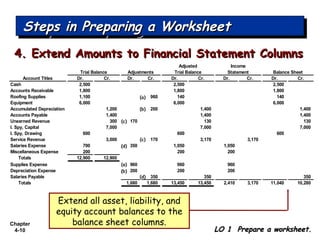
Totals 1,680 1,680 13,450 13,450 2,410 3,170 11,040 10,280
Balance Sheet
Adjusted Income
Trial Balance Adjustments Trial Balance Statement
Steps in Preparing a WorksheetSteps in Preparing a WorksheetSteps in Preparing a WorksheetSteps in Preparing a Worksheet
LO 1 Prepare a worksheet.LO 1 Prepare a worksheet.
4. Extend Amounts to Financial Statement Columns4. Extend Amounts to Financial Statement Columns
Extend all asset, liability, and
equity account balances to the
balance sheet columns.
(a)
(a)
(b)
(b)
(d)
(d)
(c)
(c)
Chapter
4-11
Account Titles Dr. Cr. Dr. Cr. Dr. Cr. Dr. Cr. Dr. Cr.
Cash 2,500 2,500 2,500
Accounts Receivable 1,800 1,800 1,800
Roofing Supplies 1,100 960 140 140
Equipment 6,000 6,000 6,000
Accumulated Depreciation 1,200 200 1,400 1,400
Accounts Payable 1,400 1,400 1,400
Unearned Revenue 300 170 130 130
I. Spy, Capital 7,000 7,000 7,000
I. Spy, Drawing 600 600 600
Service Revenue 3,000 170 3,170 3,170
Salaries Expense 700 350 1,050 1,050
Miscellaneous Expense 200 200 200
Totals 12,900 12,900
Supplies Expense 960 960 960
Depreciation Expense 200 200 200
Salaries Payable 350 350 350
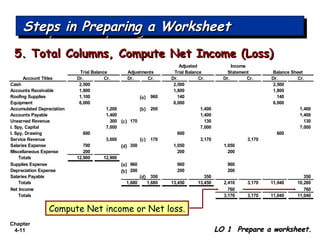
Totals 1,680 1,680 13,450 13,450 2,410 3,170 11,040 10,280
Net Income 760 760
Totals 3,170 3,170 11,040 11,040
Balance Sheet
Adjusted Income
Trial Balance Adjustments Trial Balance Statement
Steps in Preparing a WorksheetSteps in Preparing a WorksheetSteps in Preparing a WorksheetSteps in Preparing a Worksheet
LO 1 Prepare a worksheet.LO 1 Prepare a worksheet.
5. Total Columns, Compute Net Income (Loss)5. Total Columns, Compute Net Income (Loss)
Compute Net income or Net loss.
(a)
(a)
(b)
(b)
(d)
(d)
(c)
(c)
Chapter
4-12
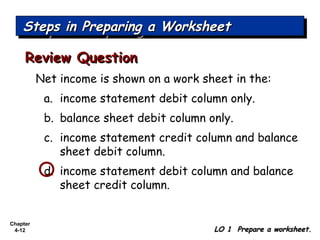
Net income is shown on a work sheet in the:
a. income statement debit column only.
b. balance sheet debit column only.
c. income statement credit column and balance
sheet debit column.
d. income statement debit column and balance
sheet credit column.
Review QuestionReview Question
Steps in Preparing a WorksheetSteps in Preparing a WorksheetSteps in Preparing a WorksheetSteps in Preparing a Worksheet
LO 1 Prepare a worksheet.LO 1 Prepare a worksheet.
Chapter
4-13
Income statement is prepared from the
income statement columns.
Balance sheet and owner’s equity statement
are prepared from the balance sheet columns.
Companies journalize and post adjusting entries.
Preparing Financial Statements from a WorksheetPreparing Financial Statements from a WorksheetPreparing Financial Statements from a WorksheetPreparing Financial Statements from a Worksheet
LO 1 Prepare a worksheet.LO 1 Prepare a worksheet.
WorksheetWorksheet
Chapter
4-14
Preparing Financial Statements from a WorksheetPreparing Financial Statements from a WorksheetPreparing Financial Statements from a WorksheetPreparing Financial Statements from a Worksheet
LO 1 Prepare a worksheet.LO 1 Prepare a worksheet.
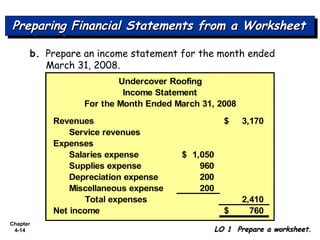
Revenues 3,170$
Service revenues
Expenses
Salaries expense 1,050$
Supplies expense 960
Depreciation expense 200
Miscellaneous expense 200
Total expenses 2,410
Net income 760$
Undercover Roofing
Income Statement
For the Month Ended March 31, 2008
b. Prepare an income statement for the month ended
March 31, 2008.
Chapter
4-15
Preparing Financial Statements from a WorksheetPreparing Financial Statements from a WorksheetPreparing Financial Statements from a WorksheetPreparing Financial Statements from a Worksheet
LO 1 Prepare a worksheet.LO 1 Prepare a worksheet.
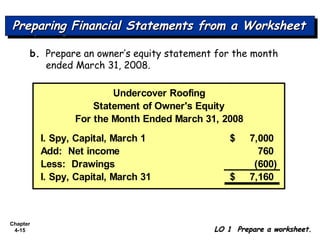
b. Prepare an owner’s equity statement for the month
ended March 31, 2008.
I. Spy, Capital, March 1 7,000$
Add: Net income 760
Less: Drawings (600)
I. Spy, Capital, March 31 7,160$
Undercover Roofing
Statement of Owner's Equity
For the Month Ended March 31, 2008
Chapter
4-16
Preparing Financial Statements from a WorksheetPreparing Financial Statements from a WorksheetPreparing Financial Statements from a WorksheetPreparing Financial Statements from a Worksheet
LO 1 Prepare a worksheet.LO 1 Prepare a worksheet.
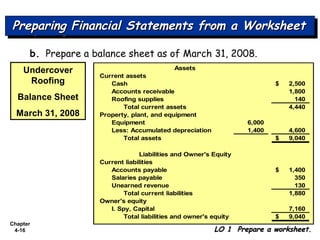
b. Prepare a balance sheet as of March 31, 2008.
Current assets
Cash 2,500$
Accounts receivable 1,800
Roofing supplies 140
Total current assets 4,440
Property, plant, and equipment
Equipment 6,000
Less: Accumulated depreciation 1,400 4,600
Total assets 9,040$
Current liabilities
Accounts payable 1,400$
Salaries payable 350
Unearned revenue 130
Total current liabilities 1,880
Owner's equity
I. Spy, Capital 7,160
Total liabilities and owner's equity 9,040$
Liabilities and Owner's Equity
AssetsUndercover
Roofing
Balance Sheet
March 31, 2008
Chapter
4-17
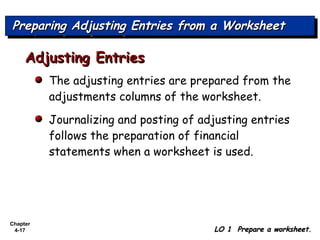
The adjusting entries are prepared from the
adjustments columns of the worksheet.
Journalizing and posting of adjusting entries
follows the preparation of financial
statements when a worksheet is used.
Preparing Adjusting Entries from a WorksheetPreparing Adjusting Entries from a WorksheetPreparing Adjusting Entries from a WorksheetPreparing Adjusting Entries from a Worksheet
LO 1 Prepare a worksheet.LO 1 Prepare a worksheet.
Adjusting EntriesAdjusting Entries
Chapter
4-18
Preparing Financial Statements from a WorksheetPreparing Financial Statements from a WorksheetPreparing Financial Statements from a WorksheetPreparing Financial Statements from a Worksheet
LO 1 Prepare a worksheet.LO 1 Prepare a worksheet.
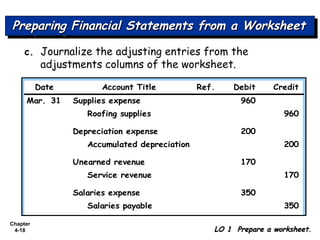
c. Journalize the adjusting entries from the
adjustments columns of the worksheet.
Account Title Ref. Debit Credit
Mar. 31 Supplies expense 960
Roofing supplies 960
Depreciation expense 200
Accumulated depreciation 200
Unearned revenue 170
Service revenue 170
Salaries expense 350
Salaries payable 350
Date
Chapter
4-19
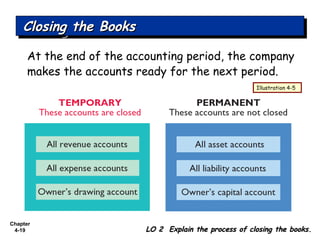
At the end of the accounting period, the company
makes the accounts ready for the next period.
Closing the BooksClosing the BooksClosing the BooksClosing the Books
LO 2 Explain the process of closing the books.LO 2 Explain the process of closing the books.
Illustration 4-5
Chapter
4-20
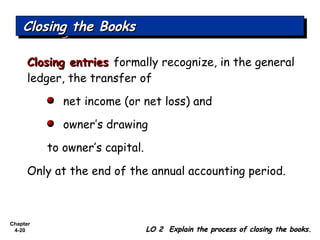
Closing entriesClosing entries formally recognize, in the general
ledger, the transfer of
net income (or net loss) and
owner’s drawing
to owner’s capital.
Closing the BooksClosing the BooksClosing the BooksClosing the Books
LO 2 Explain the process of closing the books.LO 2 Explain the process of closing the books.
Only at the end of the annual accounting period.
Chapter
4-21
Closing the BooksClosing the BooksClosing the BooksClosing the Books
LO 2 Explain the process of closing the books.LO 2 Explain the process of closing the books.
Illustration 4-6
Owner’s Capital is a
permanent account; all
other accounts are
temporary accounts.
Owner’s Drawing is closed
directly to Capital and not
to Income Summary
because Owner’s Drawing
is not an expense.
Note:
Chapter
4-22
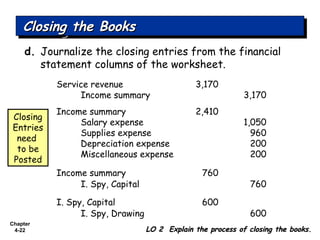
Service revenue 3,170
Income summary 3,170
Income summary 2,410
Salary expense 1,050
Supplies expense 960
Depreciation expense 200
Income summary 760
I. Spy, Capital 760
I. Spy, Capital 600
I. Spy, Drawing 600
Miscellaneous expense 200
d. Journalize the closing entries from the financial
statement columns of the worksheet.
Closing the BooksClosing the BooksClosing the BooksClosing the Books
LO 2 Explain the process of closing the books.LO 2 Explain the process of closing the books.
Closing
Entries
need
to be
Posted
Chapter
4-23
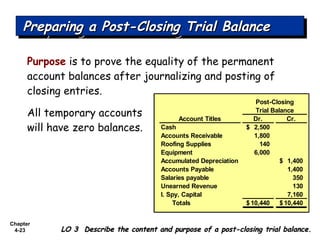
Purpose is to prove the equality of the permanent
account balances after journalizing and posting of
closing entries.
Preparing a Post-Closing Trial BalancePreparing a Post-Closing Trial BalancePreparing a Post-Closing Trial BalancePreparing a Post-Closing Trial Balance
LO 3 Describe the content and purpose of a post-closing trial balance.LO 3 Describe the content and purpose of a post-closing trial balance.
Account Titles Dr. Cr.
Cash 2,500$
Accounts Receivable 1,800
Roofing Supplies 140
Equipment 6,000
Accumulated Depreciation 1,400$
Accounts Payable 1,400
Salaries payable 350
Unearned Revenue 130
I. Spy, Capital 7,160
Totals 10,440$ 10,440$
Trial Balance
Post-Closing
All temporary accounts
will have zero balances.
Chapter
4-24
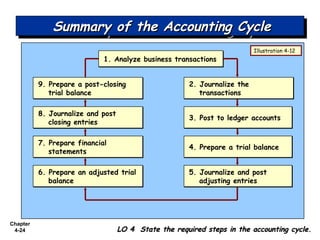
Summary of the Accounting CycleSummary of the Accounting CycleSummary of the Accounting CycleSummary of the Accounting Cycle
1. Analyze business transactions1. Analyze business transactions
2. Journalize the
transactions
2. Journalize the
transactions
6. Prepare an adjusted trial
balance
6. Prepare an adjusted trial
balance
7. Prepare financial
statements
7. Prepare financial
statements
8. Journalize and post
closing entries
8. Journalize and post
closing entries
9. Prepare a post-closing
trial balance
9. Prepare a post-closing
trial balance
4. Prepare a trial balance4. Prepare a trial balance
3. Post to ledger accounts3. Post to ledger accounts
5. Journalize and post
adjusting entries
5. Journalize and post
adjusting entries
Illustration 4-12
LO 4 State the required steps in the accounting cycle.LO 4 State the required steps in the accounting cycle.
Chapter
4-25
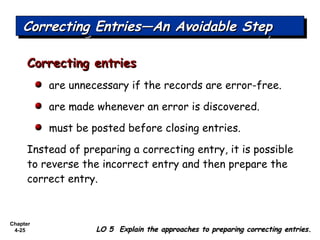
Correcting entriesCorrecting entries
are unnecessary if the records are error-free.
are made whenever an error is discovered.
must be posted before closing entries.
Instead of preparing a correcting entry, it is possible
to reverse the incorrect entry and then prepare the
correct entry.
Correcting Entries—An Avoidable StepCorrecting Entries—An Avoidable StepCorrecting Entries—An Avoidable StepCorrecting Entries—An Avoidable Step
LO 5 Explain the approaches to preparing correcting entries.LO 5 Explain the approaches to preparing correcting entries.
Chapter
4-26
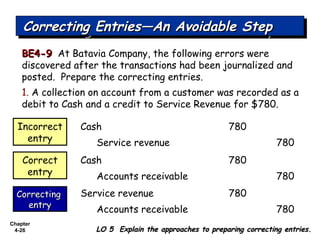
BE4-9BE4-9 At Batavia Company, the following errors were
discovered after the transactions had been journalized and
posted. Prepare the correcting entries.
1. A collection on account from a customer was recorded as a
debit to Cash and a credit to Service Revenue for $780.
Correcting Entries—An Avoidable StepCorrecting Entries—An Avoidable StepCorrecting Entries—An Avoidable StepCorrecting Entries—An Avoidable Step
LO 5 Explain the approaches to preparing correcting entries.LO 5 Explain the approaches to preparing correcting entries.
Cash 780Incorrect
entry Service revenue 780
Cash 780Correct
entry Accounts receivable 780
Service revenue 780CorrectingCorrecting
entryentry
Accounts receivable 780
Chapter
4-27
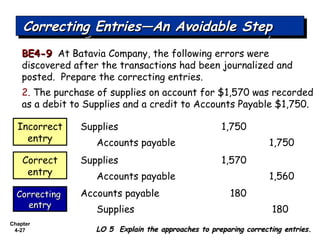
BE4-9BE4-9 At Batavia Company, the following errors were
discovered after the transactions had been journalized and
posted. Prepare the correcting entries.
2. The purchase of supplies on account for $1,570 was recorded
as a debit to Supplies and a credit to Accounts Payable $1,750.
Correcting Entries—An Avoidable StepCorrecting Entries—An Avoidable StepCorrecting Entries—An Avoidable StepCorrecting Entries—An Avoidable Step
LO 5 Explain the approaches to preparing correcting entries.LO 5 Explain the approaches to preparing correcting entries.
Supplies 1,750Incorrect
entry Accounts payable 1,750
Supplies 1,570Correct
entry Accounts payable 1,560
Accounts payable 180CorrectingCorrecting
entryentry
Supplies 180
Chapter
4-28
The Classified Balance SheetThe Classified Balance SheetThe Classified Balance SheetThe Classified Balance Sheet
LO 6 Identify the sections of a classified balance sheet.LO 6 Identify the sections of a classified balance sheet.
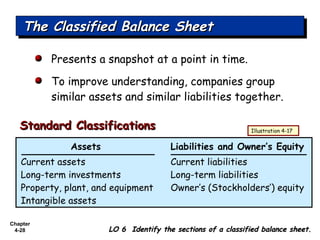
Presents a snapshot at a point in time.
To improve understanding, companies group
similar assets and similar liabilities together.
Assets Liabilities and Owner’s Equity
Current assets Current liabilities
Long-term investments Long-term liabilities
Property, plant, and equipment Owner’s (Stockholders’) equity
Intangible assets
Illustration 4-17
Standard ClassificationsStandard Classifications
Chapter
4-29
The Classified Balance SheetThe Classified Balance SheetThe Classified Balance SheetThe Classified Balance Sheet
LO 6 Identify the sections of a classified balance sheet.LO 6 Identify the sections of a classified balance sheet.
Assets that a company expects to convert to
cash or use up within one year or the
operating cycle, whichever is longer.
Operating cycle is the average time it takes
from the purchase of inventory to the
collection of cash from customers.
Current AssetsCurrent Assets
Chapter
4-30
The Classified Balance SheetThe Classified Balance SheetThe Classified Balance SheetThe Classified Balance Sheet
LO 6 Identify the sections of a classified balance sheet.LO 6 Identify the sections of a classified balance sheet.
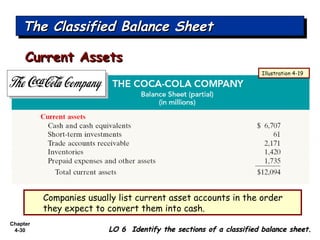
Companies usually list current asset accounts in the order
they expect to convert them into cash.
Illustration 4-19
Current AssetsCurrent Assets
Chapter
4-31
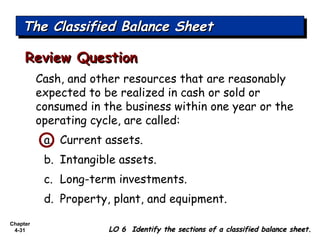
Cash, and other resources that are reasonably
expected to be realized in cash or sold or
consumed in the business within one year or the
operating cycle, are called:
a. Current assets.
b. Intangible assets.
c. Long-term investments.
d. Property, plant, and equipment.
Review QuestionReview Question
The Classified Balance SheetThe Classified Balance SheetThe Classified Balance SheetThe Classified Balance Sheet
LO 6 Identify the sections of a classified balance sheet.LO 6 Identify the sections of a classified balance sheet.
Chapter
4-32
The Classified Balance SheetThe Classified Balance SheetThe Classified Balance SheetThe Classified Balance Sheet
LO 6 Identify the sections of a classified balance sheet.LO 6 Identify the sections of a classified balance sheet.
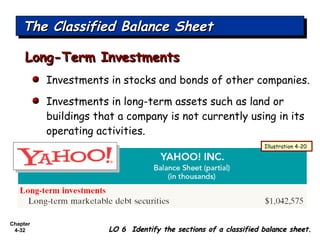
Investments in stocks and bonds of other companies.
Investments in long-term assets such as land or
buildings that a company is not currently using in its
operating activities.
Long-Term InvestmentsLong-Term Investments
Illustration 4-20
Chapter
4-33
The Classified Balance SheetThe Classified Balance SheetThe Classified Balance SheetThe Classified Balance Sheet
LO 6 Identify the sections of a classified balance sheet.LO 6 Identify the sections of a classified balance sheet.
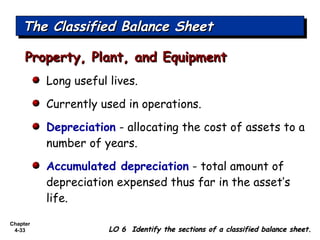
Long useful lives.
Currently used in operations.
Depreciation - allocating the cost of assets to a
number of years.
Accumulated depreciation - total amount of
depreciation expensed thus far in the asset’s
life.
Property, Plant, and EquipmentProperty, Plant, and Equipment
Chapter
4-34
The Classified Balance SheetThe Classified Balance SheetThe Classified Balance SheetThe Classified Balance Sheet
LO 6 Identify the sections of a classified balance sheet.LO 6 Identify the sections of a classified balance sheet.
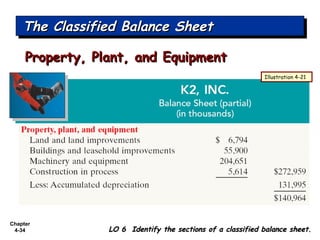
Illustration 4-21
Property, Plant, and EquipmentProperty, Plant, and Equipment
Chapter
4-35
The Classified Balance SheetThe Classified Balance SheetThe Classified Balance SheetThe Classified Balance Sheet
LO 6 Identify the sections of a classified balance sheet.LO 6 Identify the sections of a classified balance sheet.
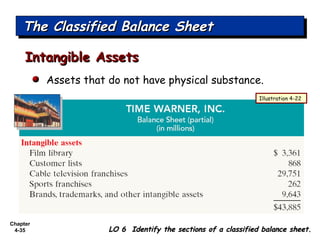
Assets that do not have physical substance.
Intangible AssetsIntangible Assets
Illustration 4-22
Chapter
4-36
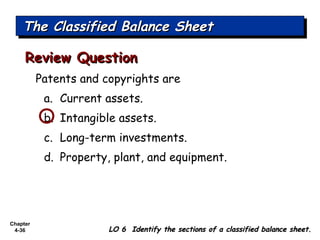
Patents and copyrights are
a. Current assets.
b. Intangible assets.
c. Long-term investments.
d. Property, plant, and equipment.
Review QuestionReview Question
The Classified Balance SheetThe Classified Balance SheetThe Classified Balance SheetThe Classified Balance Sheet
LO 6 Identify the sections of a classified balance sheet.LO 6 Identify the sections of a classified balance sheet.
Chapter
4-37
The Classified Balance SheetThe Classified Balance SheetThe Classified Balance SheetThe Classified Balance Sheet
LO 6 Identify the sections of a classified balance sheet.LO 6 Identify the sections of a classified balance sheet.
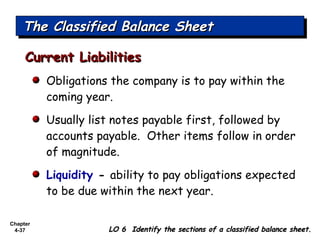
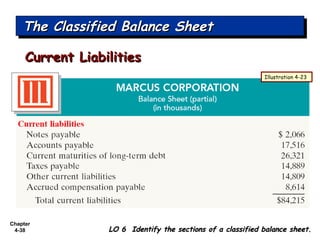
Obligations the company is to pay within the
coming year.
Usually list notes payable first, followed by
accounts payable. Other items follow in order
of magnitude.
Liquidity - ability to pay obligations expected
to be due within the next year.
Current LiabilitiesCurrent Liabilities
Chapter
4-38
The Classified Balance SheetThe Classified Balance SheetThe Classified Balance SheetThe Classified Balance Sheet
LO 6 Identify the sections of a classified balance sheet.LO 6 Identify the sections of a classified balance sheet.
Illustration 4-23
Current LiabilitiesCurrent Liabilities
Chapter
4-39
The Classified Balance SheetThe Classified Balance SheetThe Classified Balance SheetThe Classified Balance Sheet
LO 6 Identify the sections of a classified balance sheet.LO 6 Identify the sections of a classified balance sheet.
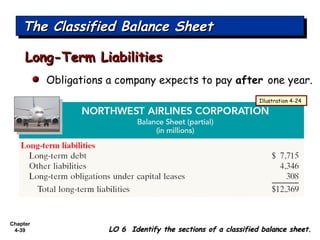
Obligations a company expects to pay after one year.
Long-Term LiabilitiesLong-Term Liabilities
Illustration 4-24
Chapter
4-40
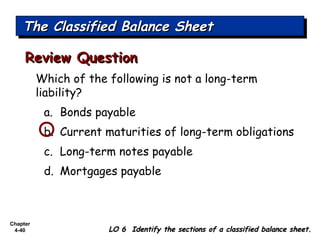
Which of the following is not a long-term
liability?
a. Bonds payable
b. Current maturities of long-term obligations
c. Long-term notes payable
d. Mortgages payable
Review QuestionReview Question
The Classified Balance SheetThe Classified Balance SheetThe Classified Balance SheetThe Classified Balance Sheet
LO 6 Identify the sections of a classified balance sheet.LO 6 Identify the sections of a classified balance sheet.
Chapter
4-41
The Classified Balance SheetThe Classified Balance SheetThe Classified Balance SheetThe Classified Balance Sheet
LO 6 Identify the sections of a classified balance sheet.LO 6 Identify the sections of a classified balance sheet.
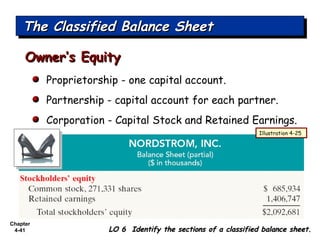
Proprietorship - one capital account.
Partnership - capital account for each partner.
Corporation - Capital Stock and Retained Earnings.
Owner’s EquityOwner’s Equity
Illustration 4-25

NSU EMB 501 Accounting Ch04

  • 1.
  • 2.
    Chapter 4-2 CHAPTERCHAPTER 44 COMPLETING THECOMPLETINGTHE ACCOUNTINGACCOUNTING CYCLECYCLE Accounting Principles, Eighth Edition
  • 3.
    Chapter 4-3 A multiple-column formused in preparing financial statements. Not a permanent accounting record. Five step process. Use of worksheet is optional. Using A WorksheetUsing A WorksheetUsing A WorksheetUsing A Worksheet LO 1 Prepare a worksheet.LO 1 Prepare a worksheet. WorksheetWorksheet
  • 4.
    Chapter 4-4 Steps in Preparinga WorksheetSteps in Preparing a WorksheetSteps in Preparing a WorksheetSteps in Preparing a Worksheet LO 1 Prepare a worksheet.LO 1 Prepare a worksheet. Illustration 4-2
  • 5.
    Chapter 4-5 P4-1A The trialbalance for Undercover Roofing for the month ended March 31, 2008, is as follows. Steps in Preparing a WorksheetSteps in Preparing a WorksheetSteps in Preparing a WorksheetSteps in Preparing a Worksheet Account Titles Dr. Cr. Cash 2,500$ Accounts Receivable 1,800 Roofing Supplies 1,100 Equipment 6,000 Accumulated Depreciation 1,200$ Accounts Payable 1,400 Unearned Revenue 300 I. Spy, Capital 7,000 I. Spy, Drawing 600 Service Revenue 3,000 Salaries Expense 700 Miscellaneous Expense 200 Totals 12,900$ 12,900$ Trial Balance Other data: 1. Supplies on hand total $140. 2. Depreciation for March is $200. 3. Unearned revenue amounted to $130 on March 31. 4. Accrued salaries are $350. Instructions a. Prepare and complete the worksheet. LO 1 Prepare a worksheet.LO 1 Prepare a worksheet.
  • 6.
    Chapter 4-6 Account Titles Dr.Cr. Dr. Cr. Dr. Cr. Dr. Cr. Dr. Cr. Cash 2,500 Accounts Receivable 1,800 Roofing Supplies 1,100 Equipment 6,000 Accumulated Depreciation 1,200 Accounts Payable 1,400 Unearned Revenue 300 I. Spy, Capital 7,000 I. Spy, Drawing 600 Service Revenue 3,000 Salaries Expense 700 Miscellaneous Expense 200 Totals 12,900 12,900 Balance Sheet Adjusted Income Trial Balance Adjustments Trial Balance Statement Steps in Preparing a WorksheetSteps in Preparing a WorksheetSteps in Preparing a WorksheetSteps in Preparing a Worksheet 1. Prepare a Trial Balance on the Worksheet1. Prepare a Trial Balance on the Worksheet Trial balance amounts come directly from ledger accounts.Include all accounts with balances. LO 1 Prepare a worksheet.LO 1 Prepare a worksheet.
  • 7.
    Chapter 4-7 Account Titles Dr.Cr. Dr. Cr. Dr. Cr. Dr. Cr. Dr. Cr. Cash 2,500 Accounts Receivable 1,800 Roofing Supplies 1,100 960 Equipment 6,000 Accumulated Depreciation 1,200 200 Accounts Payable 1,400 Unearned Revenue 300 170 I. Spy, Capital 7,000 I. Spy, Drawing 600 Service Revenue 3,000 170 Salaries Expense 700 350 Miscellaneous Expense 200 Totals 12,900 12,900 Supplies Expense 960 Depreciation Expense 200 Salaries Payable 350 Totals 1,680 1,680 Balance Sheet Adjusted Income Trial Balance Adjustments Trial Balance Statement Steps in Preparing a WorksheetSteps in Preparing a WorksheetSteps in Preparing a WorksheetSteps in Preparing a Worksheet 2. Enter the Adjustments in the Adjustments Columns2. Enter the Adjustments in the Adjustments Columns Enter adjustment amounts, total adjustments columns, and check for equality. (a) (a) (b) (b) (d) (d) (c) (c) LO 1 Prepare a worksheet.LO 1 Prepare a worksheet. Add additional accounts as needed. Adjustments Key: (a) Supplies used. (b) Depreciation expense. (c) Service revenue earned. (d) Salaries accrued.
  • 8.
    Chapter 4-8 Account Titles Dr.Cr. Dr. Cr. Dr. Cr. Dr. Cr. Dr. Cr. Cash 2,500 2,500 Accounts Receivable 1,800 1,800 Roofing Supplies 1,100 960 140 Equipment 6,000 6,000 Accumulated Depreciation 1,200 200 1,400 Accounts Payable 1,400 1,400 Unearned Revenue 300 170 130 I. Spy, Capital 7,000 7,000 I. Spy, Drawing 600 600 Service Revenue 3,000 170 3,170 Salaries Expense 700 350 1,050 Miscellaneous Expense 200 200 Totals 12,900 12,900 Supplies Expense 960 960 Depreciation Expense 200 200 Salaries Payable 350 350 Totals 1,680 1,680 13,450 13,450 Balance Sheet Adjusted Income Trial Balance Adjustments Trial Balance Statement Steps in Preparing a WorksheetSteps in Preparing a WorksheetSteps in Preparing a WorksheetSteps in Preparing a Worksheet LO 1 Prepare a worksheet.LO 1 Prepare a worksheet. 3. Complete the Adjusted Trial Balance Columns3. Complete the Adjusted Trial Balance Columns Total the adjusted trial balance columns and check for equality. (a) (a) (b) (b) (d) (d) (c) (c)
  • 9.
    Chapter 4-9 Account Titles Dr.Cr. Dr. Cr. Dr. Cr. Dr. Cr. Dr. Cr. Cash 2,500 2,500 Accounts Receivable 1,800 1,800 Roofing Supplies 1,100 960 140 Equipment 6,000 6,000 Accumulated Depreciation 1,200 200 1,400 Accounts Payable 1,400 1,400 Unearned Revenue 300 170 130 I. Spy, Capital 7,000 7,000 I. Spy, Drawing 600 600 Service Revenue 3,000 170 3,170 3,170 Salaries Expense 700 350 1,050 1,050 Miscellaneous Expense 200 200 200 Totals 12,900 12,900 Supplies Expense 960 960 960 Depreciation Expense 200 200 200 Salaries Payable 350 350 Totals 1,680 1,680 13,450 13,450 2,410 3,170 Balance Sheet Adjusted Income Trial Balance Adjustments Trial Balance Statement Steps in Preparing a WorksheetSteps in Preparing a WorksheetSteps in Preparing a WorksheetSteps in Preparing a Worksheet LO 1 Prepare a worksheet.LO 1 Prepare a worksheet. 4. Extend Amounts to Financial Statement Columns4. Extend Amounts to Financial Statement Columns Extend all revenue and expense account balances to the income statement columns. (a) (a) (b) (b) (d) (d) (c) (c)
  • 10.
    Chapter 4-10 Account Titles Dr.Cr. Dr. Cr. Dr. Cr. Dr. Cr. Dr. Cr. Cash 2,500 2,500 2,500 Accounts Receivable 1,800 1,800 1,800 Roofing Supplies 1,100 960 140 140 Equipment 6,000 6,000 6,000 Accumulated Depreciation 1,200 200 1,400 1,400 Accounts Payable 1,400 1,400 1,400 Unearned Revenue 300 170 130 130 I. Spy, Capital 7,000 7,000 7,000 I. Spy, Drawing 600 600 600 Service Revenue 3,000 170 3,170 3,170 Salaries Expense 700 350 1,050 1,050 Miscellaneous Expense 200 200 200 Totals 12,900 12,900 Supplies Expense 960 960 960 Depreciation Expense 200 200 200 Salaries Payable 350 350 350 Totals 1,680 1,680 13,450 13,450 2,410 3,170 11,040 10,280 Balance Sheet Adjusted Income Trial Balance Adjustments Trial Balance Statement Steps in Preparing a WorksheetSteps in Preparing a WorksheetSteps in Preparing a WorksheetSteps in Preparing a Worksheet LO 1 Prepare a worksheet.LO 1 Prepare a worksheet. 4. Extend Amounts to Financial Statement Columns4. Extend Amounts to Financial Statement Columns Extend all asset, liability, and equity account balances to the balance sheet columns. (a) (a) (b) (b) (d) (d) (c) (c)
  • 11.
    Chapter 4-11 Account Titles Dr.Cr. Dr. Cr. Dr. Cr. Dr. Cr. Dr. Cr. Cash 2,500 2,500 2,500 Accounts Receivable 1,800 1,800 1,800 Roofing Supplies 1,100 960 140 140 Equipment 6,000 6,000 6,000 Accumulated Depreciation 1,200 200 1,400 1,400 Accounts Payable 1,400 1,400 1,400 Unearned Revenue 300 170 130 130 I. Spy, Capital 7,000 7,000 7,000 I. Spy, Drawing 600 600 600 Service Revenue 3,000 170 3,170 3,170 Salaries Expense 700 350 1,050 1,050 Miscellaneous Expense 200 200 200 Totals 12,900 12,900 Supplies Expense 960 960 960 Depreciation Expense 200 200 200 Salaries Payable 350 350 350 Totals 1,680 1,680 13,450 13,450 2,410 3,170 11,040 10,280 Net Income 760 760 Totals 3,170 3,170 11,040 11,040 Balance Sheet Adjusted Income Trial Balance Adjustments Trial Balance Statement Steps in Preparing a WorksheetSteps in Preparing a WorksheetSteps in Preparing a WorksheetSteps in Preparing a Worksheet LO 1 Prepare a worksheet.LO 1 Prepare a worksheet. 5. Total Columns, Compute Net Income (Loss)5. Total Columns, Compute Net Income (Loss) Compute Net income or Net loss. (a) (a) (b) (b) (d) (d) (c) (c)
  • 12.
    Chapter 4-12 Net income isshown on a work sheet in the: a. income statement debit column only. b. balance sheet debit column only. c. income statement credit column and balance sheet debit column. d. income statement debit column and balance sheet credit column. Review QuestionReview Question Steps in Preparing a WorksheetSteps in Preparing a WorksheetSteps in Preparing a WorksheetSteps in Preparing a Worksheet LO 1 Prepare a worksheet.LO 1 Prepare a worksheet.
  • 13.
    Chapter 4-13 Income statement isprepared from the income statement columns. Balance sheet and owner’s equity statement are prepared from the balance sheet columns. Companies journalize and post adjusting entries. Preparing Financial Statements from a WorksheetPreparing Financial Statements from a WorksheetPreparing Financial Statements from a WorksheetPreparing Financial Statements from a Worksheet LO 1 Prepare a worksheet.LO 1 Prepare a worksheet. WorksheetWorksheet
  • 14.
    Chapter 4-14 Preparing Financial Statementsfrom a WorksheetPreparing Financial Statements from a WorksheetPreparing Financial Statements from a WorksheetPreparing Financial Statements from a Worksheet LO 1 Prepare a worksheet.LO 1 Prepare a worksheet. Revenues 3,170$ Service revenues Expenses Salaries expense 1,050$ Supplies expense 960 Depreciation expense 200 Miscellaneous expense 200 Total expenses 2,410 Net income 760$ Undercover Roofing Income Statement For the Month Ended March 31, 2008 b. Prepare an income statement for the month ended March 31, 2008.
  • 15.
    Chapter 4-15 Preparing Financial Statementsfrom a WorksheetPreparing Financial Statements from a WorksheetPreparing Financial Statements from a WorksheetPreparing Financial Statements from a Worksheet LO 1 Prepare a worksheet.LO 1 Prepare a worksheet. b. Prepare an owner’s equity statement for the month ended March 31, 2008. I. Spy, Capital, March 1 7,000$ Add: Net income 760 Less: Drawings (600) I. Spy, Capital, March 31 7,160$ Undercover Roofing Statement of Owner's Equity For the Month Ended March 31, 2008
  • 16.
    Chapter 4-16 Preparing Financial Statementsfrom a WorksheetPreparing Financial Statements from a WorksheetPreparing Financial Statements from a WorksheetPreparing Financial Statements from a Worksheet LO 1 Prepare a worksheet.LO 1 Prepare a worksheet. b. Prepare a balance sheet as of March 31, 2008. Current assets Cash 2,500$ Accounts receivable 1,800 Roofing supplies 140 Total current assets 4,440 Property, plant, and equipment Equipment 6,000 Less: Accumulated depreciation 1,400 4,600 Total assets 9,040$ Current liabilities Accounts payable 1,400$ Salaries payable 350 Unearned revenue 130 Total current liabilities 1,880 Owner's equity I. Spy, Capital 7,160 Total liabilities and owner's equity 9,040$ Liabilities and Owner's Equity AssetsUndercover Roofing Balance Sheet March 31, 2008
  • 17.
    Chapter 4-17 The adjusting entriesare prepared from the adjustments columns of the worksheet. Journalizing and posting of adjusting entries follows the preparation of financial statements when a worksheet is used. Preparing Adjusting Entries from a WorksheetPreparing Adjusting Entries from a WorksheetPreparing Adjusting Entries from a WorksheetPreparing Adjusting Entries from a Worksheet LO 1 Prepare a worksheet.LO 1 Prepare a worksheet. Adjusting EntriesAdjusting Entries
  • 18.
    Chapter 4-18 Preparing Financial Statementsfrom a WorksheetPreparing Financial Statements from a WorksheetPreparing Financial Statements from a WorksheetPreparing Financial Statements from a Worksheet LO 1 Prepare a worksheet.LO 1 Prepare a worksheet. c. Journalize the adjusting entries from the adjustments columns of the worksheet. Account Title Ref. Debit Credit Mar. 31 Supplies expense 960 Roofing supplies 960 Depreciation expense 200 Accumulated depreciation 200 Unearned revenue 170 Service revenue 170 Salaries expense 350 Salaries payable 350 Date
  • 19.
    Chapter 4-19 At the endof the accounting period, the company makes the accounts ready for the next period. Closing the BooksClosing the BooksClosing the BooksClosing the Books LO 2 Explain the process of closing the books.LO 2 Explain the process of closing the books. Illustration 4-5
  • 20.
    Chapter 4-20 Closing entriesClosing entriesformally recognize, in the general ledger, the transfer of net income (or net loss) and owner’s drawing to owner’s capital. Closing the BooksClosing the BooksClosing the BooksClosing the Books LO 2 Explain the process of closing the books.LO 2 Explain the process of closing the books. Only at the end of the annual accounting period.
  • 21.
    Chapter 4-21 Closing the BooksClosingthe BooksClosing the BooksClosing the Books LO 2 Explain the process of closing the books.LO 2 Explain the process of closing the books. Illustration 4-6 Owner’s Capital is a permanent account; all other accounts are temporary accounts. Owner’s Drawing is closed directly to Capital and not to Income Summary because Owner’s Drawing is not an expense. Note:
  • 22.
    Chapter 4-22 Service revenue 3,170 Incomesummary 3,170 Income summary 2,410 Salary expense 1,050 Supplies expense 960 Depreciation expense 200 Income summary 760 I. Spy, Capital 760 I. Spy, Capital 600 I. Spy, Drawing 600 Miscellaneous expense 200 d. Journalize the closing entries from the financial statement columns of the worksheet. Closing the BooksClosing the BooksClosing the BooksClosing the Books LO 2 Explain the process of closing the books.LO 2 Explain the process of closing the books. Closing Entries need to be Posted
  • 23.
    Chapter 4-23 Purpose is toprove the equality of the permanent account balances after journalizing and posting of closing entries. Preparing a Post-Closing Trial BalancePreparing a Post-Closing Trial BalancePreparing a Post-Closing Trial BalancePreparing a Post-Closing Trial Balance LO 3 Describe the content and purpose of a post-closing trial balance.LO 3 Describe the content and purpose of a post-closing trial balance. Account Titles Dr. Cr. Cash 2,500$ Accounts Receivable 1,800 Roofing Supplies 140 Equipment 6,000 Accumulated Depreciation 1,400$ Accounts Payable 1,400 Salaries payable 350 Unearned Revenue 130 I. Spy, Capital 7,160 Totals 10,440$ 10,440$ Trial Balance Post-Closing All temporary accounts will have zero balances.
  • 24.
    Chapter 4-24 Summary of theAccounting CycleSummary of the Accounting CycleSummary of the Accounting CycleSummary of the Accounting Cycle 1. Analyze business transactions1. Analyze business transactions 2. Journalize the transactions 2. Journalize the transactions 6. Prepare an adjusted trial balance 6. Prepare an adjusted trial balance 7. Prepare financial statements 7. Prepare financial statements 8. Journalize and post closing entries 8. Journalize and post closing entries 9. Prepare a post-closing trial balance 9. Prepare a post-closing trial balance 4. Prepare a trial balance4. Prepare a trial balance 3. Post to ledger accounts3. Post to ledger accounts 5. Journalize and post adjusting entries 5. Journalize and post adjusting entries Illustration 4-12 LO 4 State the required steps in the accounting cycle.LO 4 State the required steps in the accounting cycle.
  • 25.
    Chapter 4-25 Correcting entriesCorrecting entries areunnecessary if the records are error-free. are made whenever an error is discovered. must be posted before closing entries. Instead of preparing a correcting entry, it is possible to reverse the incorrect entry and then prepare the correct entry. Correcting Entries—An Avoidable StepCorrecting Entries—An Avoidable StepCorrecting Entries—An Avoidable StepCorrecting Entries—An Avoidable Step LO 5 Explain the approaches to preparing correcting entries.LO 5 Explain the approaches to preparing correcting entries.
  • 26.
    Chapter 4-26 BE4-9BE4-9 At BataviaCompany, the following errors were discovered after the transactions had been journalized and posted. Prepare the correcting entries. 1. A collection on account from a customer was recorded as a debit to Cash and a credit to Service Revenue for $780. Correcting Entries—An Avoidable StepCorrecting Entries—An Avoidable StepCorrecting Entries—An Avoidable StepCorrecting Entries—An Avoidable Step LO 5 Explain the approaches to preparing correcting entries.LO 5 Explain the approaches to preparing correcting entries. Cash 780Incorrect entry Service revenue 780 Cash 780Correct entry Accounts receivable 780 Service revenue 780CorrectingCorrecting entryentry Accounts receivable 780
  • 27.
    Chapter 4-27 BE4-9BE4-9 At BataviaCompany, the following errors were discovered after the transactions had been journalized and posted. Prepare the correcting entries. 2. The purchase of supplies on account for $1,570 was recorded as a debit to Supplies and a credit to Accounts Payable $1,750. Correcting Entries—An Avoidable StepCorrecting Entries—An Avoidable StepCorrecting Entries—An Avoidable StepCorrecting Entries—An Avoidable Step LO 5 Explain the approaches to preparing correcting entries.LO 5 Explain the approaches to preparing correcting entries. Supplies 1,750Incorrect entry Accounts payable 1,750 Supplies 1,570Correct entry Accounts payable 1,560 Accounts payable 180CorrectingCorrecting entryentry Supplies 180
  • 28.
    Chapter 4-28 The Classified BalanceSheetThe Classified Balance SheetThe Classified Balance SheetThe Classified Balance Sheet LO 6 Identify the sections of a classified balance sheet.LO 6 Identify the sections of a classified balance sheet. Presents a snapshot at a point in time. To improve understanding, companies group similar assets and similar liabilities together. Assets Liabilities and Owner’s Equity Current assets Current liabilities Long-term investments Long-term liabilities Property, plant, and equipment Owner’s (Stockholders’) equity Intangible assets Illustration 4-17 Standard ClassificationsStandard Classifications
  • 29.
    Chapter 4-29 The Classified BalanceSheetThe Classified Balance SheetThe Classified Balance SheetThe Classified Balance Sheet LO 6 Identify the sections of a classified balance sheet.LO 6 Identify the sections of a classified balance sheet. Assets that a company expects to convert to cash or use up within one year or the operating cycle, whichever is longer. Operating cycle is the average time it takes from the purchase of inventory to the collection of cash from customers. Current AssetsCurrent Assets
  • 30.
    Chapter 4-30 The Classified BalanceSheetThe Classified Balance SheetThe Classified Balance SheetThe Classified Balance Sheet LO 6 Identify the sections of a classified balance sheet.LO 6 Identify the sections of a classified balance sheet. Companies usually list current asset accounts in the order they expect to convert them into cash. Illustration 4-19 Current AssetsCurrent Assets
  • 31.
    Chapter 4-31 Cash, and otherresources that are reasonably expected to be realized in cash or sold or consumed in the business within one year or the operating cycle, are called: a. Current assets. b. Intangible assets. c. Long-term investments. d. Property, plant, and equipment. Review QuestionReview Question The Classified Balance SheetThe Classified Balance SheetThe Classified Balance SheetThe Classified Balance Sheet LO 6 Identify the sections of a classified balance sheet.LO 6 Identify the sections of a classified balance sheet.
  • 32.
    Chapter 4-32 The Classified BalanceSheetThe Classified Balance SheetThe Classified Balance SheetThe Classified Balance Sheet LO 6 Identify the sections of a classified balance sheet.LO 6 Identify the sections of a classified balance sheet. Investments in stocks and bonds of other companies. Investments in long-term assets such as land or buildings that a company is not currently using in its operating activities. Long-Term InvestmentsLong-Term Investments Illustration 4-20
  • 33.
    Chapter 4-33 The Classified BalanceSheetThe Classified Balance SheetThe Classified Balance SheetThe Classified Balance Sheet LO 6 Identify the sections of a classified balance sheet.LO 6 Identify the sections of a classified balance sheet. Long useful lives. Currently used in operations. Depreciation - allocating the cost of assets to a number of years. Accumulated depreciation - total amount of depreciation expensed thus far in the asset’s life. Property, Plant, and EquipmentProperty, Plant, and Equipment
  • 34.
    Chapter 4-34 The Classified BalanceSheetThe Classified Balance SheetThe Classified Balance SheetThe Classified Balance Sheet LO 6 Identify the sections of a classified balance sheet.LO 6 Identify the sections of a classified balance sheet. Illustration 4-21 Property, Plant, and EquipmentProperty, Plant, and Equipment
  • 35.
    Chapter 4-35 The Classified BalanceSheetThe Classified Balance SheetThe Classified Balance SheetThe Classified Balance Sheet LO 6 Identify the sections of a classified balance sheet.LO 6 Identify the sections of a classified balance sheet. Assets that do not have physical substance. Intangible AssetsIntangible Assets Illustration 4-22
  • 36.
    Chapter 4-36 Patents and copyrightsare a. Current assets. b. Intangible assets. c. Long-term investments. d. Property, plant, and equipment. Review QuestionReview Question The Classified Balance SheetThe Classified Balance SheetThe Classified Balance SheetThe Classified Balance Sheet LO 6 Identify the sections of a classified balance sheet.LO 6 Identify the sections of a classified balance sheet.
  • 37.
    Chapter 4-37 The Classified BalanceSheetThe Classified Balance SheetThe Classified Balance SheetThe Classified Balance Sheet LO 6 Identify the sections of a classified balance sheet.LO 6 Identify the sections of a classified balance sheet. Obligations the company is to pay within the coming year. Usually list notes payable first, followed by accounts payable. Other items follow in order of magnitude. Liquidity - ability to pay obligations expected to be due within the next year. Current LiabilitiesCurrent Liabilities
  • 38.
    Chapter 4-38 The Classified BalanceSheetThe Classified Balance SheetThe Classified Balance SheetThe Classified Balance Sheet LO 6 Identify the sections of a classified balance sheet.LO 6 Identify the sections of a classified balance sheet. Illustration 4-23 Current LiabilitiesCurrent Liabilities
  • 39.
    Chapter 4-39 The Classified BalanceSheetThe Classified Balance SheetThe Classified Balance SheetThe Classified Balance Sheet LO 6 Identify the sections of a classified balance sheet.LO 6 Identify the sections of a classified balance sheet. Obligations a company expects to pay after one year. Long-Term LiabilitiesLong-Term Liabilities Illustration 4-24
  • 40.
    Chapter 4-40 Which of thefollowing is not a long-term liability? a. Bonds payable b. Current maturities of long-term obligations c. Long-term notes payable d. Mortgages payable Review QuestionReview Question The Classified Balance SheetThe Classified Balance SheetThe Classified Balance SheetThe Classified Balance Sheet LO 6 Identify the sections of a classified balance sheet.LO 6 Identify the sections of a classified balance sheet.
  • 41.
    Chapter 4-41 The Classified BalanceSheetThe Classified Balance SheetThe Classified Balance SheetThe Classified Balance Sheet LO 6 Identify the sections of a classified balance sheet.LO 6 Identify the sections of a classified balance sheet. Proprietorship - one capital account. Partnership - capital account for each partner. Corporation - Capital Stock and Retained Earnings. Owner’s EquityOwner’s Equity Illustration 4-25