AAccccoouunnttiinngg 
PPrriinncciipplleess 
SSeeccoonndd CCaannaaddiiaann EEddiittiioonn 
Weygandt · Kieso · Kimmel · Trenholm 
Prepared by: 
Carole Bowman, Sheridan College
CCHHAAPPTTEERR 
22 
TTHHEE RREECCOORRDDIINNGG PPRROOCCEESSSS
TTHHEE AACCCCOOUUNNTT 
 An account is an individual accounting 
record of increases and decreases in a 
specific asset, liability, or owner’s equity 
item. 
 A company will have separate accounts for 
such items as cash, salaries expense, 
accounts payable, and so on.
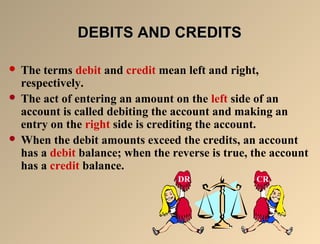
DDEEBBIITTSS AANNDD CCRREEDDIITTSS 
 The terms debit and credit mean left and right, 
respectively. 
 The act of entering an amount on the left side of an 
account is called debiting the account and making an 
entry on the right side is crediting the account. 
 When the debit amounts exceed the credits, an account 
has a debit balance; when the reverse is true, the account 
has a credit balance. 
DR CR
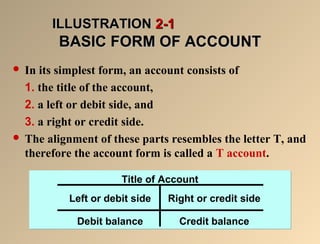
IILLLLUUSSTTRRAATTIIOONN 22--11 
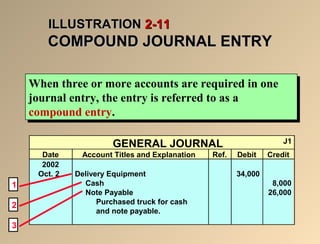
BBAASSIICC FFOORRMM OOFF AACCCCOOUUNNTT 
 In its simplest form, an account consists of 
1. the title of the account, 
2. a left or debit side, and 
3. a right or credit side. 
 The alignment of these parts resembles the letter T, and 
therefore the account form is called a T account. 
Title of Account 
Left or debit side 
Right or credit side 
Debit balance Credit balance
IILLLLUUSSTTRRAATTIIOONN 22--22 
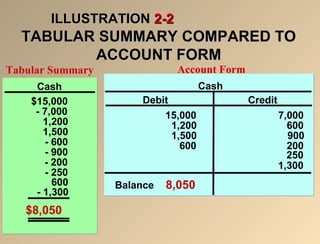
TTAABBUULLAARR SSUUMMMMAARRYY CCOOMMPPAARREEDD TTOO 
AACCCCOOUUNNTT FFOORRMM 
Tabular Summary 
Cash 
$15,000 
- 7,000 
1,200 
1,500 
- 600 
- 900 
- 200 
- 250 
Cash 
Debit Credit 
15,000 
1,200 
1,500 
600 
7,000 
600 
200 
900 
Balance 
Account Form 
8,050 
600 
- 1,300 
$8,050 
250 
1,300
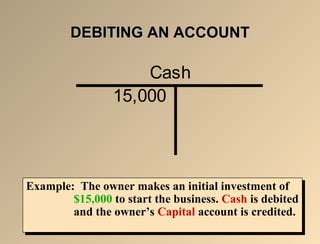
DDEEBBIITTIINNGG AANN AACCCCOOUUNNTT 
Cash 
15,000 
Example: The owner makes an initial investment of 
$15,000 to start the business. Cash is debited 
and the owner’s Capital account is credited. 
$15,000 to start the business. Cash is debited 
and the owner’s Capital account is credited.
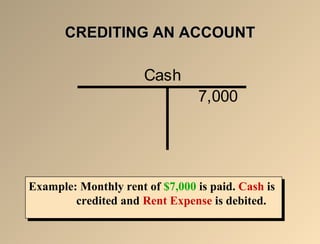
CCRREEDDIITTIINNGG AANN AACCCCOOUUNNTT 
7,000 
Cash 
Example: Monthly rent of $7,000 is paid. Cash is 
credited and Rent Expense is debited. 
credited and Rent Expense is debited.
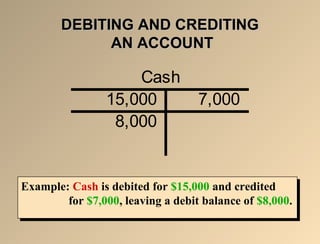
DDEEBBIITTIINNGG AANNDD CCRREEDDIITTIINNGG 
AANN AACCCCOOUUNNTT 
Cash 
15,000 7,000 
8,000 
Example: Cash is debited for $15,000 and credited 
for $7,000, leaving a debit balance of $8,000. 
for $7,000, leaving a debit balance of $8,000.
DDOOUUBBLLEE--EENNTTRRYY SSYYSSTTEEMM 
In a double-entry system, equal debits and 
credits are made in the accounts for each 
transaction. 
Thus, the total debits will always equal the 
total credits and the accounting equation 
will always stay in balance. 
Assets Liabilities Equity
NNOORRMMAALL BBAALLAANNCCEE 
Every account classification has a normal 
balance, whether it is a debit or credit.
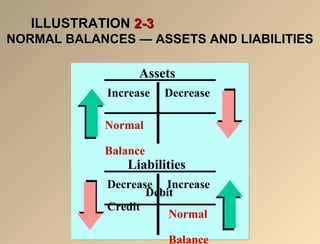
IILLLLUUSSTTRRAATTIIOONN 22--33 
NNOORRMMAALL BBAALLAANNCCEESS —— AASSSSEETTSS AANNDD LLIIAABBIILLIITTIIEESS 
Assets 
Increase Decrease 
Normal 
Balance 
Liabilities 
Decrease Increase 
Debit 
Credit 
Normal 
Balance
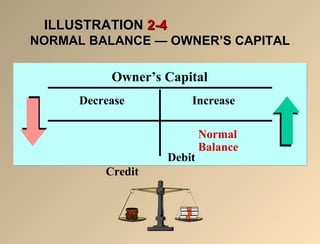
IILLLLUUSSTTRRAATTIIOONN 22--44 
NNOORRMMAALL BBAALLAANNCCEE —— OOWWNNEERR’’SS CCAAPPIITTAALL 
Owner’s Capital 
Decrease Increase 
Debit 
Credit 
Normal 
Balance
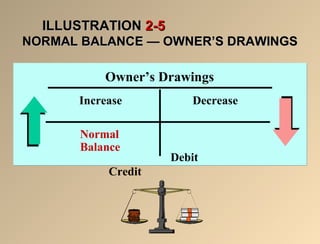
IILLLLUUSSTTRRAATTIIOONN 22--55 
NNOORRMMAALL BBAALLAANNCCEE —— OOWWNNEERR’’SS DDRRAAWWIINNGGSS 
Owner’s Drawings 
Increase Decrease 
Normal 
Balance 
Debit 
Credit
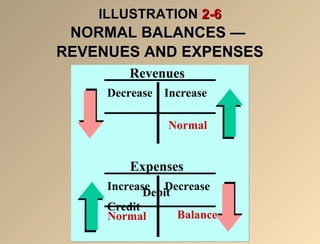
IILLLLUUSSTTRRAATTIIOONN 22--66 
NNOORRMMAALL BBAALLAANNCCEESS —— 
RREEVVEENNUUEESS AANNDD EEXXPPEENNSSEESS 
Revenues 
Decrease Increase 
Expenses 
Increase Decrease 
Debit 
Credit 
Normal 
Normal Balance
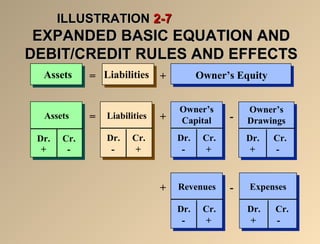
IILLLLUUSSTTRRAATTIIOONN 22--77 
EEXXPPAANNDDEEDD BBAASSIICC EEQQUUAATTIIOONN AANNDD 
DDEEBBIITT//CCRREEDDIITT RRUULLEESS AANNDD EEFFFFEECCTTSS 
Assets Liabilities Owner’s Equity 
= + 
Owner’s 
Capital 
= + - 
+ - 
Assets 
Dr. Cr. 
+ - 
Liabilities 
Dr. Cr. 
- + 
Owner’s 
Drawings 
Dr. Cr. 
+ - 
Revenues 
Dr. Cr. 
- + 
Expenses 
Dr. Cr. 
+ - 
Dr. Cr. 
- +
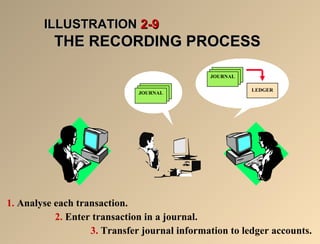
IILLLLUUSSTTRRAATTIIOONN 22--99 
TTHHEE RREECCOORRDDIINNGG PPRROOCCEESSSS 
1. Analyse each transaction. 
JOURNAL 
2. Enter transaction in a journal. 
JOURNAL 
LEDGER 
3. Transfer journal information to ledger accounts.
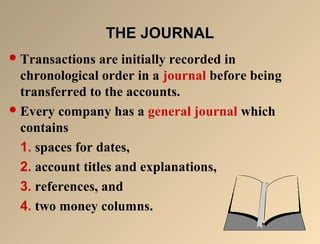
TTHHEE JJOOUURRNNAALL 
Transactions are initially recorded in 
chronological order in a journal before being 
transferred to the accounts. 
Every company has a general journal which 
contains 
1. spaces for dates, 
2. account titles and explanations, 
3. references, and 
4. two money columns.
TTHHEE JJOOUURRNNAALL 
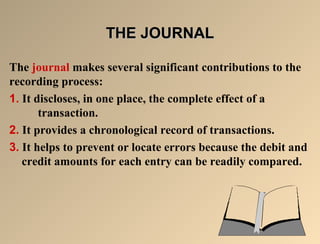
The journal makes several significant contributions to the 
recording process: 
1. It discloses, in one place, the complete effect of a 
transaction. 
2. It provides a chronological record of transactions. 
3. It helps to prevent or locate errors because the debit and 
credit amounts for each entry can be readily compared.
JJOOUURRNNAALLIIZZIINNGG 
Entering transaction data in the journal is known 
as journalizing. 
Separate journal entries are made for each 
transaction. 
A complete entry consists of 
1. the date of the transaction, 
2. the accounts and amounts to be debited and 
credited, and 
3. a brief explanation of the transaction.
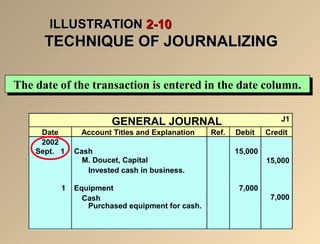
IILLLLUUSSTTRRAATTIIOONN 22--1100 
TTEECCHHNNIIQQUUEE OOFF JJOOUURRNNAALLIIZZIINNGG 
TThhee ddaattee ooff tthhee ttrraannssaaccttiioonn iiss eenntteerreedd iinn tthhee ddaattee ccoolluummnn.. 
GENERAL JOURNAL J1 
Date Account Titles and Explanation Ref. Debit Credit 
2002 
Sept. 1 Cash 15,000 
M. Doucet, Capital 15,000 
Invested cash in business. 
1 Equipment 7,000 
Cash 7,000 
Purchased equipment for cash.
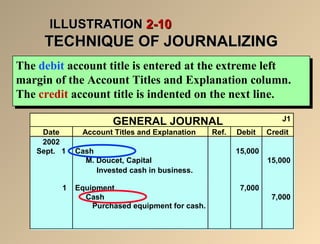
IILLLLUUSSTTRRAATTIIOONN 22--1100 
TTEECCHHNNIIQQUUEE OOFF JJOOUURRNNAALLIIZZIINNGG 
The debit account title is entered at the extreme left 
margin of the Account Titles and Explanation column. 
The credit account title is indented on the next line. 
The debit account title is entered at the extreme left 
margin of the Account Titles and Explanation column. 
The credit account title is indented on the next line. 
GENERAL JOURNAL J1 
Date Account Titles and Explanation Ref. Debit Credit 
2002 
Sept. 1 Cash 15,000 
M. Doucet, Capital 15,000 
Invested cash in business. 
1 Equipment 7,000 
Cash 7,000 
Purchased equipment for cash.
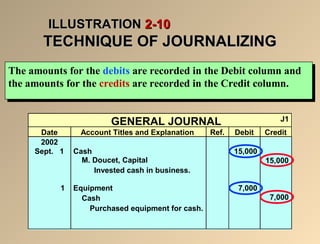
IILLLLUUSSTTRRAATTIIOONN 22--1100 
TTEECCHHNNIIQQUUEE OOFF JJOOUURRNNAALLIIZZIINNGG 
The amounts for the debits are recorded in the Debit column and 
the amounts for the credits are recorded in the Credit column. 
The amounts for the debits are recorded in the Debit column and 
the amounts for the credits are recorded in the Credit column. 
GENERAL JOURNAL J1 
Date Account Titles and Explanation Ref. Debit Credit 
2002 
Sept. 1 Cash 15,000 
M. Doucet, Capital 15,000 
Invested cash in business. 
1 Equipment 7,000 
Cash 7,000 
Purchased equipment for cash.
IILLLLUUSSTTRRAATTIIOONN 22--1100 
TTEECCHHNNIIQQUUEE OOFF JJOOUURRNNAALLIIZZIINNGG 
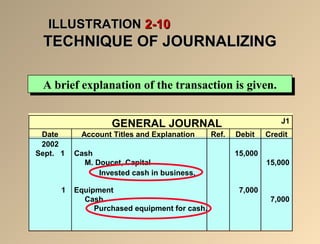
AA bbrriieeff eexxppllaannaattiioonn ooff tthhee ttrraannssaaccttiioonn iiss ggiivveenn.. 
GENERAL JOURNAL J1 
Date Account Titles and Explanation Ref. Debit Credit 
2002 
Sept. 1 Cash 15,000 
M. Doucet, Capital 15,000 
Invested cash in business. 
1 Equipment 7,000 
Cash 7,000 
Purchased equipment for cash.
IILLLLUUSSTTRRAATTIIOONN 22--1100 
TTEECCHHNNIIQQUUEE OOFF JJOOUURRNNAALLIIZZIINNGG 
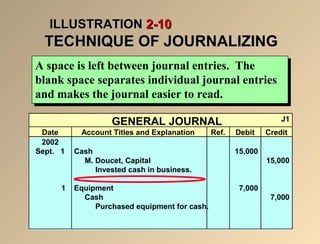
A space is left between journal entries. The 
blank space separates individual journal entries 
and makes the journal easier to read. 
A space is left between journal entries. The 
blank space separates individual journal entries 
and makes the journal easier to read. 
GENERAL JOURNAL J1 
Date Account Titles and Explanation Ref. Debit Credit 
2002 
Sept. 1 Cash 15,000 
M. Doucet, Capital 15,000 
Invested cash in business. 
1 Equipment 7,000 
Cash 7,000 
Purchased equipment for cash.
IILLLLUUSSTTRRAATTIIOONN 22--1100 
TTEECCHHNNIIQQUUEE OOFF JJOOUURRNNAALLIIZZIINNGG 
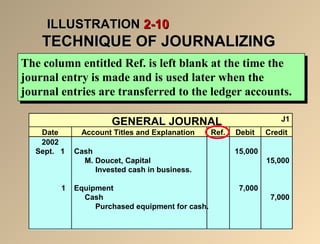
The column entitled Ref. is left blank at the time the 
journal entry is made and is used later when the 
journal entries are transferred to the ledger accounts. 
The column entitled Ref. is left blank at the time the 
journal entry is made and is used later when the 
journal entries are transferred to the ledger accounts. 
GENERAL JOURNAL J1 
Date Account Titles and Explanation Ref. Debit Credit 
2002 
Sept. 1 Cash 15,000 
M. Doucet, Capital 15,000 
Invested cash in business. 
1 Equipment 7,000 
Cash 7,000 
Purchased equipment for cash.
SSIIMMPPLLEE AANNDD CCOOMMPPOOUUNNDD 
JJOOUURRNNAALL EENNTTRRIIEESS 
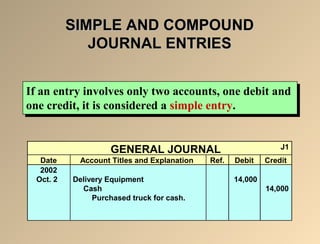
If an entry involves only two accounts, one debit and 
one credit, it is considered a simple entry. 
If an entry involves only two accounts, one debit and 
one credit, it is considered a simple entry. 
GENERAL JOURNAL J1 
Date Account Titles and Explanation Ref. Debit Credit 
2002 
Oct. 2 Delivery Equipment 14,000 
Cash 14,000 
Purchased truck for cash.
IILLLLUUSSTTRRAATTIIOONN 22--1111 
CCOOMMPPOOUUNNDD JJOOUURRNNAALL EENNTTRRYY 
When three or more accounts are required in one 
journal entry, the entry is referred to as a 
compound entry. 
When three or more accounts are required in one 
journal entry, the entry is referred to as a 
compound entry. 
GENERAL JOURNAL J1 
Date Account Titles and Explanation Ref. Debit Credit 
2002 
Oct. 2 Delivery Equipment 34,000 
Cash 8,000 
Note Payable 26,000 
Purchased truck for cash 
and note payable. 
1 
2 
3
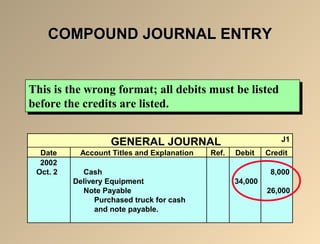
CCOOMMPPOOUUNNDD JJOOUURRNNAALL EENNTTRRYY 
This is the wrong format; all debits must be listed 
before the credits are listed. 
This is the wrong format; all debits must be listed 
before the credits are listed. 
GENERAL JOURNAL J1 
Date Account Titles and Explanation Ref. Debit Credit 
2002 
Oct. 2 Cash 8,000 
Delivery Equipment 34,000 
Note Payable 26,000 
Purchased truck for cash 
and note payable.
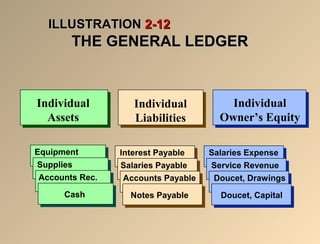
TTHHEE LLEEDDGGEERR 
The entire group of accounts maintained by a 
company is referred to collectively as the ledger. 
A general ledger contains all the assets, liabilities, 
and owner’s equity accounts. 
GENERAL 
LEDGER
Individual 
Liabilities 
Individual 
Assets 
Individual 
Owner’s Equity 
IILLLLUUSSTTRRAATTIIOONN 22--1122 
TTHHEE GGEENNEERRAALL LLEEDDGGEERR 
Equipment 
Supplies 
Accounts Rec. 
Cash 
Interest Payable 
Salaries Payable 
Accounts Payable 
Notes Payable 
Salaries Expense 
Service Revenue 
Doucet, Drawings 
Doucet, Capital
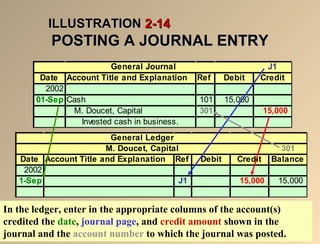
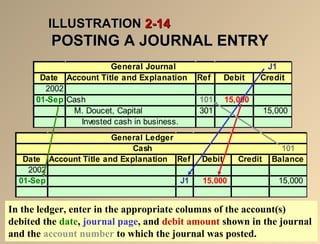
IILLLLUUSSTTRRAATTIIOONN 22--1144 
PPOOSSTTIINNGG AA JJOOUURRNNAALL EENNTTRRYY 
J1 
General Journal 
Date Account Title and Explanation Ref Debit Credit 
2002 
01-Sep Cash 101 15,000 
M. Doucet, Capital 301 15,000 
Invested cash in business. 
101 
General Ledger 
Cash 
Date Account Title and Explanation Ref Debit Credit Balance 
2002 
01-Sep J1 15,000 15,000 
In the ledger, enter in the appropriate columns of the account(s) 
debited the date, journal page, and debit amount shown in the journal 
and the account number to which the journal was posted.
IILLLLUUSSTTRRAATTIIOONN 22--1144 
PPOOSSTTIINNGG AA JJOOUURRNNAALL EENNTTRRYY 
J1 
General Journal 
Date Account Title and Explanation Ref Debit Credit 
2002 
01-Sep Cash 101 15,000 
M. Doucet, Capital 301 15,000 
Invested cash in business. 
301 
General Ledger 
M. Doucet, Capital 
Date Account Title and Explanation Ref Debit Credit Balance 
2002 
1-Sep J1 15,000 15,000 
In the ledger, enter in the appropriate columns of the account(s) 
credited the date, journal page, and credit amount shown in the 
journal and the account number to which the journal was posted.
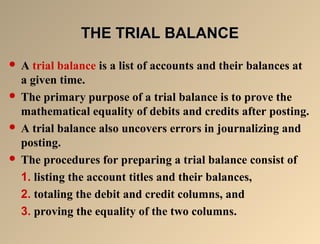
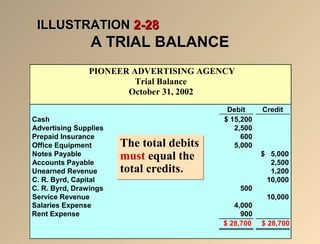
TTHHEE TTRRIIAALL BBAALLAANNCCEE 
 A trial balance is a list of accounts and their balances at 
a given time. 
 The primary purpose of a trial balance is to prove the 
mathematical equality of debits and credits after posting. 
 A trial balance also uncovers errors in journalizing and 
posting. 
 The procedures for preparing a trial balance consist of 
1. listing the account titles and their balances, 
2. totaling the debit and credit columns, and 
3. proving the equality of the two columns.
IILLLLUUSSTTRRAATTIIOONN 22--228 
AA TTRRIIAALL BBAALLAANNCCEE 
PIONEER ADVERTISING AGENCY 
Trial Balance 
October 31, 2002 
Debit Credit 
Cash $ 15,200 
Advertising Supplies 2,500 
Prepaid Insurance 600 
Office Equipment 5,000 
Notes Payable $ 5,000 
Accounts Payable 2,500 
Unearned Revenue 1,200 
C. R. Byrd, Capital 10,000 
C. R. Byrd, Drawings 500 
Service Revenue 10,000 
Salaries Expense 
900 
$ 28,700 $ 28,700 
The total debits 
must equal the 
total credits. 
Rent Expense 
4,000
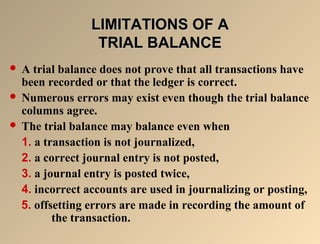
LLIIMMIITTAATTIIOONNSS OOFF AA 
TTRRIIAALL BBAALLAANNCCEE 
 A trial balance does not prove that all transactions have 
been recorded or that the ledger is correct. 
 Numerous errors may exist even though the trial balance 
columns agree. 
 The trial balance may balance even when 
1. a transaction is not journalized, 
2. a correct journal entry is not posted, 
3. a journal entry is posted twice, 
4. incorrect accounts are used in journalizing or posting, 
5. offsetting errors are made in recording the amount of 
the transaction.
CCOOPPYYRRIIGGHHTT 
Copyright © 2002 John Wiley & Sons Canada, Ltd. All rights reserved. 
Reproduction or translation of this work beyond that permitted by 
CANCOPY (Canadian Reprography Collective) is unlawful. Request for 
further information should be addressed to the Permissions Department, 
John Wiley & Sons Canada, Ltd. The purchaser may make back-up copies for 
his / her own use only and not for distribution or resale. The author and the 
publisher assume no responsibility for errors, omissions, or damages, caused 
by the use of these programs or from the use of the information contained 
herein.

Chapter 2: The Recording Process

  • 1.
    AAccccoouunnttiinngg PPrriinncciipplleess SSeeccoonnddCCaannaaddiiaann EEddiittiioonn Weygandt · Kieso · Kimmel · Trenholm Prepared by: Carole Bowman, Sheridan College
  • 2.
    CCHHAAPPTTEERR 22 TTHHEERREECCOORRDDIINNGG PPRROOCCEESSSS
  • 3.
    TTHHEE AACCCCOOUUNNTT An account is an individual accounting record of increases and decreases in a specific asset, liability, or owner’s equity item.  A company will have separate accounts for such items as cash, salaries expense, accounts payable, and so on.
  • 4.
    DDEEBBIITTSS AANNDD CCRREEDDIITTSS  The terms debit and credit mean left and right, respectively.  The act of entering an amount on the left side of an account is called debiting the account and making an entry on the right side is crediting the account.  When the debit amounts exceed the credits, an account has a debit balance; when the reverse is true, the account has a credit balance. DR CR
  • 5.
    IILLLLUUSSTTRRAATTIIOONN 22--11 BBAASSIICCFFOORRMM OOFF AACCCCOOUUNNTT  In its simplest form, an account consists of 1. the title of the account, 2. a left or debit side, and 3. a right or credit side.  The alignment of these parts resembles the letter T, and therefore the account form is called a T account. Title of Account Left or debit side Right or credit side Debit balance Credit balance
  • 6.
    IILLLLUUSSTTRRAATTIIOONN 22--22 TTAABBUULLAARRSSUUMMMMAARRYY CCOOMMPPAARREEDD TTOO AACCCCOOUUNNTT FFOORRMM Tabular Summary Cash $15,000 - 7,000 1,200 1,500 - 600 - 900 - 200 - 250 Cash Debit Credit 15,000 1,200 1,500 600 7,000 600 200 900 Balance Account Form 8,050 600 - 1,300 $8,050 250 1,300
  • 7.
    DDEEBBIITTIINNGG AANN AACCCCOOUUNNTT Cash 15,000 Example: The owner makes an initial investment of Example: The owner makes an initial investment of $15,000 to start the business. Cash is debited and the owner’s Capital account is credited. $15,000 to start the business. Cash is debited and the owner’s Capital account is credited.
  • 8.
    CCRREEDDIITTIINNGG AANN AACCCCOOUUNNTT 7,000 Cash Example: Monthly rent of $7,000 is paid. Cash is Example: Monthly rent of $7,000 is paid. Cash is credited and Rent Expense is debited. credited and Rent Expense is debited.
  • 9.
    DDEEBBIITTIINNGG AANNDD CCRREEDDIITTIINNGG AANN AACCCCOOUUNNTT Cash 15,000 7,000 8,000 Example: Cash is debited for $15,000 and credited Example: Cash is debited for $15,000 and credited for $7,000, leaving a debit balance of $8,000. for $7,000, leaving a debit balance of $8,000.
  • 10.
    DDOOUUBBLLEE--EENNTTRRYY SSYYSSTTEEMM Ina double-entry system, equal debits and credits are made in the accounts for each transaction. Thus, the total debits will always equal the total credits and the accounting equation will always stay in balance. Assets Liabilities Equity
  • 11.
    NNOORRMMAALL BBAALLAANNCCEE Everyaccount classification has a normal balance, whether it is a debit or credit.
  • 12.
    IILLLLUUSSTTRRAATTIIOONN 22--33 NNOORRMMAALLBBAALLAANNCCEESS —— AASSSSEETTSS AANNDD LLIIAABBIILLIITTIIEESS Assets Increase Decrease Normal Balance Liabilities Decrease Increase Debit Credit Normal Balance
  • 13.
    IILLLLUUSSTTRRAATTIIOONN 22--44 NNOORRMMAALLBBAALLAANNCCEE —— OOWWNNEERR’’SS CCAAPPIITTAALL Owner’s Capital Decrease Increase Debit Credit Normal Balance
  • 14.
    IILLLLUUSSTTRRAATTIIOONN 22--55 NNOORRMMAALLBBAALLAANNCCEE —— OOWWNNEERR’’SS DDRRAAWWIINNGGSS Owner’s Drawings Increase Decrease Normal Balance Debit Credit
  • 15.
    IILLLLUUSSTTRRAATTIIOONN 22--66 NNOORRMMAALLBBAALLAANNCCEESS —— RREEVVEENNUUEESS AANNDD EEXXPPEENNSSEESS Revenues Decrease Increase Expenses Increase Decrease Debit Credit Normal Normal Balance
  • 16.
    IILLLLUUSSTTRRAATTIIOONN 22--77 EEXXPPAANNDDEEDDBBAASSIICC EEQQUUAATTIIOONN AANNDD DDEEBBIITT//CCRREEDDIITT RRUULLEESS AANNDD EEFFFFEECCTTSS Assets Liabilities Owner’s Equity = + Owner’s Capital = + - + - Assets Dr. Cr. + - Liabilities Dr. Cr. - + Owner’s Drawings Dr. Cr. + - Revenues Dr. Cr. - + Expenses Dr. Cr. + - Dr. Cr. - +
  • 17.
    IILLLLUUSSTTRRAATTIIOONN 22--99 TTHHEERREECCOORRDDIINNGG PPRROOCCEESSSS 1. Analyse each transaction. JOURNAL 2. Enter transaction in a journal. JOURNAL LEDGER 3. Transfer journal information to ledger accounts.
  • 18.
    TTHHEE JJOOUURRNNAALL Transactionsare initially recorded in chronological order in a journal before being transferred to the accounts. Every company has a general journal which contains 1. spaces for dates, 2. account titles and explanations, 3. references, and 4. two money columns.
  • 19.
    TTHHEE JJOOUURRNNAALL Thejournal makes several significant contributions to the recording process: 1. It discloses, in one place, the complete effect of a transaction. 2. It provides a chronological record of transactions. 3. It helps to prevent or locate errors because the debit and credit amounts for each entry can be readily compared.
  • 20.
    JJOOUURRNNAALLIIZZIINNGG Entering transactiondata in the journal is known as journalizing. Separate journal entries are made for each transaction. A complete entry consists of 1. the date of the transaction, 2. the accounts and amounts to be debited and credited, and 3. a brief explanation of the transaction.
  • 21.
    IILLLLUUSSTTRRAATTIIOONN 22--1100 TTEECCHHNNIIQQUUEEOOFF JJOOUURRNNAALLIIZZIINNGG TThhee ddaattee ooff tthhee ttrraannssaaccttiioonn iiss eenntteerreedd iinn tthhee ddaattee ccoolluummnn.. GENERAL JOURNAL J1 Date Account Titles and Explanation Ref. Debit Credit 2002 Sept. 1 Cash 15,000 M. Doucet, Capital 15,000 Invested cash in business. 1 Equipment 7,000 Cash 7,000 Purchased equipment for cash.
  • 22.
    IILLLLUUSSTTRRAATTIIOONN 22--1100 TTEECCHHNNIIQQUUEEOOFF JJOOUURRNNAALLIIZZIINNGG The debit account title is entered at the extreme left margin of the Account Titles and Explanation column. The credit account title is indented on the next line. The debit account title is entered at the extreme left margin of the Account Titles and Explanation column. The credit account title is indented on the next line. GENERAL JOURNAL J1 Date Account Titles and Explanation Ref. Debit Credit 2002 Sept. 1 Cash 15,000 M. Doucet, Capital 15,000 Invested cash in business. 1 Equipment 7,000 Cash 7,000 Purchased equipment for cash.
  • 23.
    IILLLLUUSSTTRRAATTIIOONN 22--1100 TTEECCHHNNIIQQUUEEOOFF JJOOUURRNNAALLIIZZIINNGG The amounts for the debits are recorded in the Debit column and the amounts for the credits are recorded in the Credit column. The amounts for the debits are recorded in the Debit column and the amounts for the credits are recorded in the Credit column. GENERAL JOURNAL J1 Date Account Titles and Explanation Ref. Debit Credit 2002 Sept. 1 Cash 15,000 M. Doucet, Capital 15,000 Invested cash in business. 1 Equipment 7,000 Cash 7,000 Purchased equipment for cash.
  • 24.
    IILLLLUUSSTTRRAATTIIOONN 22--1100 TTEECCHHNNIIQQUUEEOOFF JJOOUURRNNAALLIIZZIINNGG AA bbrriieeff eexxppllaannaattiioonn ooff tthhee ttrraannssaaccttiioonn iiss ggiivveenn.. GENERAL JOURNAL J1 Date Account Titles and Explanation Ref. Debit Credit 2002 Sept. 1 Cash 15,000 M. Doucet, Capital 15,000 Invested cash in business. 1 Equipment 7,000 Cash 7,000 Purchased equipment for cash.
  • 25.
    IILLLLUUSSTTRRAATTIIOONN 22--1100 TTEECCHHNNIIQQUUEEOOFF JJOOUURRNNAALLIIZZIINNGG A space is left between journal entries. The blank space separates individual journal entries and makes the journal easier to read. A space is left between journal entries. The blank space separates individual journal entries and makes the journal easier to read. GENERAL JOURNAL J1 Date Account Titles and Explanation Ref. Debit Credit 2002 Sept. 1 Cash 15,000 M. Doucet, Capital 15,000 Invested cash in business. 1 Equipment 7,000 Cash 7,000 Purchased equipment for cash.
  • 26.
    IILLLLUUSSTTRRAATTIIOONN 22--1100 TTEECCHHNNIIQQUUEEOOFF JJOOUURRNNAALLIIZZIINNGG The column entitled Ref. is left blank at the time the journal entry is made and is used later when the journal entries are transferred to the ledger accounts. The column entitled Ref. is left blank at the time the journal entry is made and is used later when the journal entries are transferred to the ledger accounts. GENERAL JOURNAL J1 Date Account Titles and Explanation Ref. Debit Credit 2002 Sept. 1 Cash 15,000 M. Doucet, Capital 15,000 Invested cash in business. 1 Equipment 7,000 Cash 7,000 Purchased equipment for cash.
  • 27.
    SSIIMMPPLLEE AANNDD CCOOMMPPOOUUNNDD JJOOUURRNNAALL EENNTTRRIIEESS If an entry involves only two accounts, one debit and one credit, it is considered a simple entry. If an entry involves only two accounts, one debit and one credit, it is considered a simple entry. GENERAL JOURNAL J1 Date Account Titles and Explanation Ref. Debit Credit 2002 Oct. 2 Delivery Equipment 14,000 Cash 14,000 Purchased truck for cash.
  • 28.
    IILLLLUUSSTTRRAATTIIOONN 22--1111 CCOOMMPPOOUUNNDDJJOOUURRNNAALL EENNTTRRYY When three or more accounts are required in one journal entry, the entry is referred to as a compound entry. When three or more accounts are required in one journal entry, the entry is referred to as a compound entry. GENERAL JOURNAL J1 Date Account Titles and Explanation Ref. Debit Credit 2002 Oct. 2 Delivery Equipment 34,000 Cash 8,000 Note Payable 26,000 Purchased truck for cash and note payable. 1 2 3
  • 29.
    CCOOMMPPOOUUNNDD JJOOUURRNNAALL EENNTTRRYY This is the wrong format; all debits must be listed before the credits are listed. This is the wrong format; all debits must be listed before the credits are listed. GENERAL JOURNAL J1 Date Account Titles and Explanation Ref. Debit Credit 2002 Oct. 2 Cash 8,000 Delivery Equipment 34,000 Note Payable 26,000 Purchased truck for cash and note payable.
  • 30.
    TTHHEE LLEEDDGGEERR Theentire group of accounts maintained by a company is referred to collectively as the ledger. A general ledger contains all the assets, liabilities, and owner’s equity accounts. GENERAL LEDGER
  • 31.
    Individual Liabilities Individual Assets Individual Owner’s Equity IILLLLUUSSTTRRAATTIIOONN 22--1122 TTHHEE GGEENNEERRAALL LLEEDDGGEERR Equipment Supplies Accounts Rec. Cash Interest Payable Salaries Payable Accounts Payable Notes Payable Salaries Expense Service Revenue Doucet, Drawings Doucet, Capital
  • 32.
    IILLLLUUSSTTRRAATTIIOONN 22--1144 PPOOSSTTIINNGGAA JJOOUURRNNAALL EENNTTRRYY J1 General Journal Date Account Title and Explanation Ref Debit Credit 2002 01-Sep Cash 101 15,000 M. Doucet, Capital 301 15,000 Invested cash in business. 101 General Ledger Cash Date Account Title and Explanation Ref Debit Credit Balance 2002 01-Sep J1 15,000 15,000 In the ledger, enter in the appropriate columns of the account(s) debited the date, journal page, and debit amount shown in the journal and the account number to which the journal was posted.
  • 33.
    IILLLLUUSSTTRRAATTIIOONN 22--1144 PPOOSSTTIINNGGAA JJOOUURRNNAALL EENNTTRRYY J1 General Journal Date Account Title and Explanation Ref Debit Credit 2002 01-Sep Cash 101 15,000 M. Doucet, Capital 301 15,000 Invested cash in business. 301 General Ledger M. Doucet, Capital Date Account Title and Explanation Ref Debit Credit Balance 2002 1-Sep J1 15,000 15,000 In the ledger, enter in the appropriate columns of the account(s) credited the date, journal page, and credit amount shown in the journal and the account number to which the journal was posted.
  • 34.
    TTHHEE TTRRIIAALL BBAALLAANNCCEE  A trial balance is a list of accounts and their balances at a given time.  The primary purpose of a trial balance is to prove the mathematical equality of debits and credits after posting.  A trial balance also uncovers errors in journalizing and posting.  The procedures for preparing a trial balance consist of 1. listing the account titles and their balances, 2. totaling the debit and credit columns, and 3. proving the equality of the two columns.
  • 35.
    IILLLLUUSSTTRRAATTIIOONN 22--228 AATTRRIIAALL BBAALLAANNCCEE PIONEER ADVERTISING AGENCY Trial Balance October 31, 2002 Debit Credit Cash $ 15,200 Advertising Supplies 2,500 Prepaid Insurance 600 Office Equipment 5,000 Notes Payable $ 5,000 Accounts Payable 2,500 Unearned Revenue 1,200 C. R. Byrd, Capital 10,000 C. R. Byrd, Drawings 500 Service Revenue 10,000 Salaries Expense 900 $ 28,700 $ 28,700 The total debits must equal the total credits. Rent Expense 4,000
  • 36.
    LLIIMMIITTAATTIIOONNSS OOFF AA TTRRIIAALL BBAALLAANNCCEE  A trial balance does not prove that all transactions have been recorded or that the ledger is correct.  Numerous errors may exist even though the trial balance columns agree.  The trial balance may balance even when 1. a transaction is not journalized, 2. a correct journal entry is not posted, 3. a journal entry is posted twice, 4. incorrect accounts are used in journalizing or posting, 5. offsetting errors are made in recording the amount of the transaction.
  • 37.
    CCOOPPYYRRIIGGHHTT Copyright ©2002 John Wiley & Sons Canada, Ltd. All rights reserved. Reproduction or translation of this work beyond that permitted by CANCOPY (Canadian Reprography Collective) is unlawful. Request for further information should be addressed to the Permissions Department, John Wiley & Sons Canada, Ltd. The purchaser may make back-up copies for his / her own use only and not for distribution or resale. The author and the publisher assume no responsibility for errors, omissions, or damages, caused by the use of these programs or from the use of the information contained herein.