Consolidated
financial statement:
Acquisition at more
than book value
Arthik Davianti
What’s coming:
Differential
Complex differential
Consolidation
procedures
Illustrations
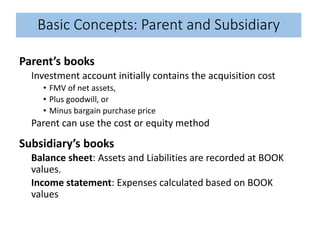
Basic Concepts: Parent and Subsidiary
Parent’s books
Investment account initially contains the acquisition cost
• FMV of net assets,
• Plus goodwill, or
• Minus bargain purchase price
Parent can use the cost or equity method
Subsidiary’s books
Balance sheet: Assets and Liabilities are recorded at BOOK
values.
Income statement: Expenses calculated based on BOOK
values
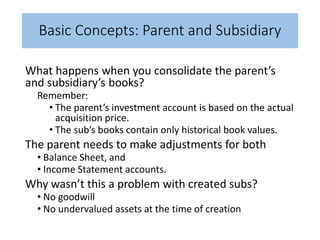
Basic Concepts: Parent and Subsidiary
What happens when you consolidate the parent’s
and subsidiary’s books?
Remember:
• The parent’s investment account is based on the actual
acquisition price.
• The sub’s books contain only historical book values.
The parent needs to make adjustments for both
• Balance Sheet, and
• Income Statement accounts.
Why wasn’t this a problem with created subs?
• No goodwill
• No undervalued assets at the time of creation
Differential:
Investment Cost over
the Underlying Book
Value of Equity
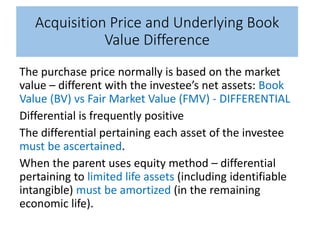
Acquisition Price and Underlying Book
Value Difference
The purchase price normally is based on the market
value – different with the investee’s net assets: Book
Value (BV) vs Fair Market Value (FMV) - DIFFERENTIAL
Differential is frequently positive
The differential pertaining each asset of the investee
must be ascertained.
When the parent uses equity method – differential
pertaining to limited life assets (including identifiable
intangible) must be amortized (in the remaining
economic life).
Basic Concepts:
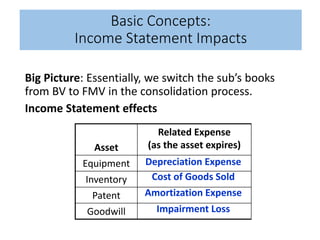
Income Statement Impacts
Big Picture: Essentially, we switch the sub’s books
from BV to FMV in the consolidation process.
Income Statement effects
Asset
Related Expense
(as the asset expires)
Equipment
Inventory
Patent
Goodwill
Depreciation Expense
Cost of Goods Sold
Amortization Expense
Impairment Loss
Basic Concepts:
Income Statement Impacts
Income Statement Effects
When Acquisition Price > Book Value
Asset
Related Expense
(as the asset expires)
Income Statement
Effect
Equipment
Inventory
Patent
Goodwill
Depreciation Expense
Cost of Goods Sold
Amortization Expense
Impairment Loss
Too Low
(understated)
If expenses are UNDERSTATED, then income is too high (OVERSTATED).
To fix the problem, Parent needs to INCREASE expenses (but how?)
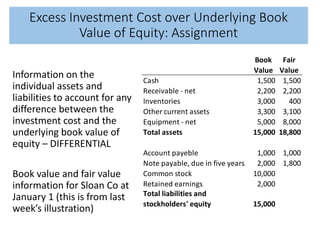
Excess Investment Cost over Underlying Book
Value of Equity: Assignment
Information on the
individual assets and
liabilities to account for any
difference between the
investment cost and the
underlying book value of
equity – DIFFERENTIAL
Book value and fair value
information for Sloan Co at
January 1 (this is from last
week’s illustration)
Book
Value
Fair
Value
Cash 1,500 1,500
Receivable - net 2,200 2,200
Inventories 3,000 400
Other current assets 3,300 3,100
Equipment - net 5,000 8,000
Total assets 15,000 18,800
Account payeble 1,000 1,000
Note payable, due in five years 2,000 1,800
Common stock 10,000
Retained earnings 2,000
Total liabilities and
stockholders' equity 15,000
Excess Investment Cost over Underlying Book
Value of Equity: Assignment
5,000
(3,600)
1,400
Fair
Value
Book
Value
Differential
% Interest
Acquired
Amount
Assigned
Inventories 4,000 3,000 1,000 30% 300
Other current assets 3,100 3,300 (200) 30% (60)
Equipment 8,000 5,000 3,000 30% 900
Note payable 1,800 2,000 200 30% 60
Total assigned to identifiable net assets 1,200
Remainder assigned to goodwill 200
Total excess of cost over book value acquired 1,400
Assignment to identifiable net assets and goodwill
Investment in Sloan
Book value of the interest acquired (30% X $12,000,000 equity of Sloan)
Total excess of cost over book value acquired
Excess Investment Cost over Underlying Book
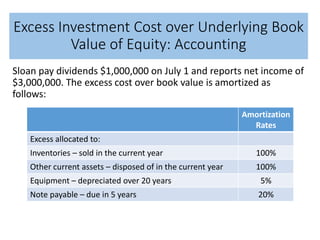
Value of Equity: Accounting
Sloan pay dividends $1,000,000 on July 1 and reports net income of
$3,000,000. The excess cost over book value is amortized as
follows:
Amortization
Rates
Excess allocated to:
Inventories – sold in the current year 100%
Other current assets – disposed of in the current year 100%
Equipment – depreciated over 20 years 5%
Note payable – due in 5 years 20%
Excess Investment Cost over Underlying Book
Value of Equity: Accounting
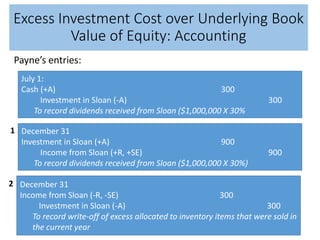
Payne’s entries:
July 1:
Cash (+A) 300
Investment in Sloan (-A) 300
To record dividends received from Sloan ($1,000,000 X 30%
December 31
Investment in Sloan (+A) 900
Income from Sloan (+R, +SE) 900
To record dividends received from Sloan ($1,000,000 X 30%)
December 31
Income from Sloan (-R, -SE) 300
Investment in Sloan (-A) 300
To record write-off of excess allocated to inventory items that were sold in
the current year
1
2
Excess Investment Cost over Underlying Book
Value of Equity: Accounting
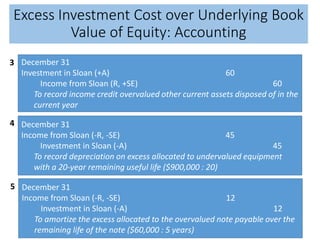
December 31
Investment in Sloan (+A) 60
Income from Sloan (R, +SE) 60
To record income credit overvalued other current assets disposed of in the
current year
December 31
Income from Sloan (-R, -SE) 12
Investment in Sloan (-A) 12
To amortize the excess allocated to the overvalued note payable over the
remaining life of the note ($60,000 : 5 years)
December 31
Income from Sloan (-R, -SE) 45
Investment in Sloan (-A) 45
To record depreciation on excess allocated to undervalued equipment
with a 20-year remaining useful life ($900,000 : 20)
5
4
3
Excess Investment Cost over Underlying Book
Value of Equity: Accounting
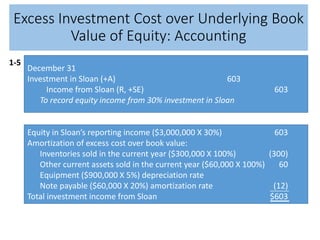
December 31
Investment in Sloan (+A) 603
Income from Sloan (R, +SE) 603
To record equity income from 30% investment in Sloan
1-5
Equity in Sloan’s reporting income ($3,000,000 X 30%) 603
Amortization of excess cost over book value:
Inventories sold in the current year ($300,000 X 100%) (300)
Other current assets sold in the current year ($60,000 X 100%) 60
Equipment ($900,000 X 5%) depreciation rate
Note payable ($60,000 X 20%) amortization rate (12)
Total investment income from Sloan $603
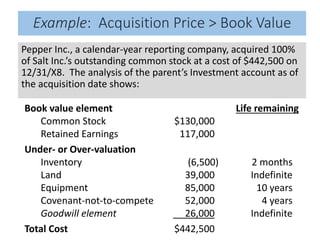
Book value element Life remaining
Common Stock $130,000
Retained Earnings 117,000
Under- or Over-valuation
Inventory (6,500) 2 months
Land 39,000 Indefinite
Equipment 85,000 10 years
Covenant-not-to-compete 52,000 4 years
Goodwill element 26,000 Indefinite
Total Cost $442,500
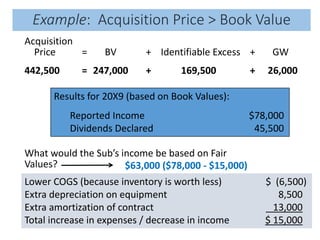
Example: Acquisition Price > Book Value
Pepper Inc., a calendar-year reporting company, acquired 100%
of Salt Inc.’s outstanding common stock at a cost of $442,500 on
12/31/X8. The analysis of the parent’s Investment account as of
the acquisition date shows:
Acquisition
Price = BV + Identifiable Excess + GW
Results for 20X9 (based on Book Values):
Reported Income $78,000
Dividends Declared 45,500
What would the Sub’s income be based on Fair
Values?
Lower COGS (because inventory is worth less) $ (6,500)
Extra depreciation on equipment 8,500
Extra amortization of contract 13,000
Total increase in expenses / decrease in income $ 15,000
$63,000 ($78,000 - $15,000)
Example: Acquisition Price > Book Value
442,500 = 247,000 + 169,500 + 26,000
Consolidation in
Equity Method for
Diffeential
Consolidation procedures differ
when there is a differential.
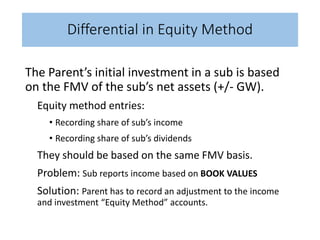
Differential in Equity Method
The Parent’s initial investment in a sub is based
on the FMV of the sub’s net assets (+/- GW).
Equity method entries:
• Recording share of sub’s income
• Recording share of sub’s dividends
They should be based on the same FMV basis.
Problem: Sub reports income based on BOOK VALUES
Solution: Parent has to record an adjustment to the income
and investment “Equity Method” accounts.
Results for 20X9 (based on Book Values):
Reported Income $78,000
Dividends Declared 45,500
Adjustment to Salt’s 20X9 income on Parent’s books:
Lower COGS (because inventory is worth less) $ (6,500)
Extra depreciation on equipment 8,500
Extra amortization of contract 13,000
Total increase in expenses / decrease in income $ 15,000
What entries would Pepper record in its general ledger related to
Salt’s income and dividends for 20X9 under the equity method?
Example: Differential in Equity Method
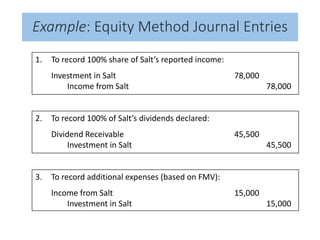
Example: Equity Method Journal Entries
1. To record 100% share of Salt’s reported income:
Investment in Salt 78,000
Income from Salt 78,000
2. To record 100% of Salt’s dividends declared:
Dividend Receivable 45,500
Investment in Salt 45,500
3. To record additional expenses (based on FMV):
Income from Salt 15,000
Investment in Salt 15,000
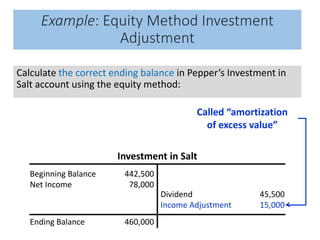
Called “amortization
of excess value”
Example: Equity Method Investment
Adjustment
Calculate the correct ending balance in Pepper’s Investment in
Salt account using the equity method:
Investment in Salt
Beginning Balance 442,500
Net Income 78,000
Ending Balance 460,000
Dividend 45,500
Income Adjustment 15,000
Simple Example
P
S
Stock
Sub
Shareholders
$
Book value of
net assets = $800
Excess value of
identifiable assets
= $200
Goodwill = $500
Assume the BV of Sub’s net assets is $800 and that the FMV of
the net assets is $1,000. Finally, assume that the acquisition
price was $1,500. The acquisition price consists of three parts:
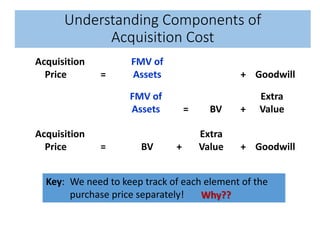
Understanding Components of
Acquisition Cost
Acquisition FMV of
Price = Assets + Goodwill
Key: We need to keep track of each element of the
purchase price separately! Why??
FMV of Extra
Assets = BV + Value
Acquisition Extra
Price = BV + Value + Goodwill
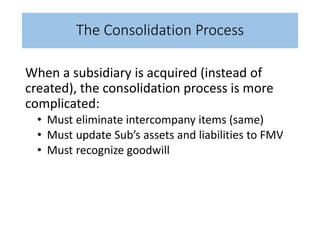
The Consolidation Process
When a subsidiary is acquired (instead of
created), the consolidation process is more
complicated:
• Must eliminate intercompany items (same)
• Must update Sub’s assets and liabilities to FMV
• Must recognize goodwill
Summary of Consolidation Entries
1. The basic elimination entry:
2. The excess value reclassification entry:
Asset 1 XX
Asset 2 XX
Goodwill XX
Investment in Sub Excess
Common Stock (S) XX
Additional Paid-in Capital (S) XX
Retained Earnings, Beginning Balance (S) XX
Income from Sub XX
Investment in Sub BV
Dividends Declared XX
Summary of Consolidation Entries
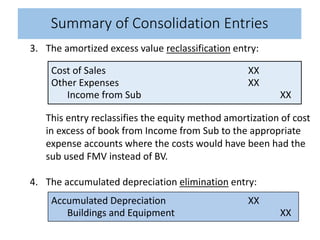
3. The amortized excess value reclassification entry:
This entry reclassifies the equity method amortization of cost
in excess of book from Income from Sub to the appropriate
expense accounts where the costs would have been had the
sub used FMV instead of BV.
4. The accumulated depreciation elimination entry:
Cost of Sales XX
Other Expenses XX
Income from Sub XX
Accumulated Depreciation XX
Buildings and Equipment XX
Understand and explain how
consolidation process differ when
there is a differential
Wholly-owned Subsidiary (100 Percent)
at More than Book Value (Baker p. 162)
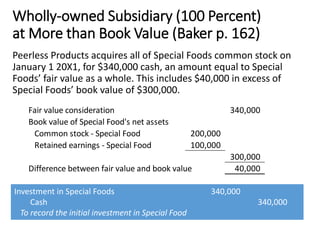
Peerless Products acquires all of Special Foods common stock on
January 1 20X1, for $340,000 cash, an amount equal to Special
Foods’ fair value as a whole. This includes $40,000 in excess of
Special Foods’ book value of $300,000.
Fair value consideration 340,000
Book value of Special Food's net assets
Common stock - Special Food 200,000
Retained earnings - Special Food 100,000
300,000
Difference between fair value and book value 40,000
Investment in Special Foods 340,000
Cash 340,000
To record the initial investment in Special Food
Book value of
net assets
CS + RE =
300,000
Identifiable
assets =
40,000
$340,000
Initial
Investment
Special
Foods
Goodwill =
0
1/1/X1
Wholly-owned Subsidiary (100 Percent)
at More than Book Value
Wholly-owned Subsidiary (100 Percent Ownership)
at more than Book Value
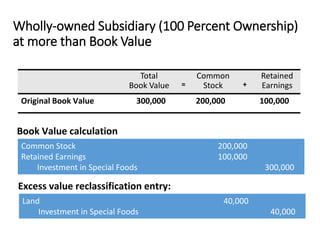
Book Value calculation
Total Common Retained
Book Value Stock Earnings
Original Book Value 300,000 200,000 100,000
= +
Common Stock 200,000
Retained Earnings 100,000
Investment in Special Foods 300,000
Excess value reclassification entry:
Land 40,000
Investment in Special Foods 40,000
Wholly-owned Subsidiary (100 Percent Ownership)
at more than Book Value
Excess value reclassification entry:
Land 40,000
Investment in Special Foods 40,000
In this example, the differential is the additional $40,000
payment, because of Special Foods’ land was worth $40,000
more than its book value at acquisition date.
A second elimination entry is required to re-assign the $40,000
from the investment account to the land account.
Wholly-owned Subsidiary (100 Percent Ownership) at
More than Book Value at Acquisition Date –
Worksheet (Baker p. 164)
Peerless
Product
Special
Foods
Consolidated
Assets
Cash 10,000 50,000 60,000
Account receivable 75,000 50,000 125,000
Inventory 100,000 60,000 160,000
Investment in Special Food 340,000 300,000 0
40,000
Land 175,000 40,000 40,000 255,000
Buildings and equipment 800,000 600,000 1,400,000
Accumulated depreciation (400,000) (300,000) (700,000)
Total assets 1,100,000 500,000 40,000 340,000 1,300,000
Liabilities and stockholder's equity
Account payable 100,000 100,000 200,000
Bonds payable 200,000 100,000 300,000
Common stock 500,000 200,000 200,000 500,000
Retained earnings 300,000 100,000 100,000 300,000
Total liabilities and equity 1,100,000 500,000 300,000 0 1,300,000
Elimination Entries
Existence of Goodwill
Excess value reclassification entry:
Goodwill 40,000
Investment in Special Foods 40,000
For example, assume in the Peerless Product and Special Foods
illustration the acquisition-date fair value of Special Foods’
assets and liabilities equal to their book values, then the
$40,000 difference between the $340,000 consideration
exchanged and the $300,000 fair value of the subsidiary’s net
identifiable assets should be attributed to goodwill
Treatment of
a Complex Differential
Make calculation and prepare elimination
entries for the consolidation of a wholly
owned subsidiary when there is a
complex positive differential at the
acquisition date.
Wholly-owned Subsidiary (100 Percent)
at More than Book Value (Baker p. 166)
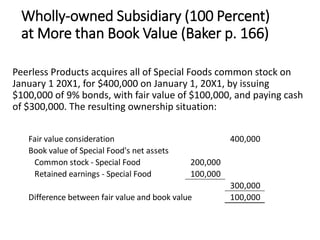
Peerless Products acquires all of Special Foods common stock on
January 1 20X1, for $400,000 on January 1, 20X1, by issuing
$100,000 of 9% bonds, with fair value of $100,000, and paying cash
of $300,000. The resulting ownership situation:
Fair value consideration 400,000
Book value of Special Food's net assets
Common stock - Special Food 200,000
Retained earnings - Special Food 100,000
300,000
Difference between fair value and book value 100,000
Wholly-owned Subsidiary (100 Percent)
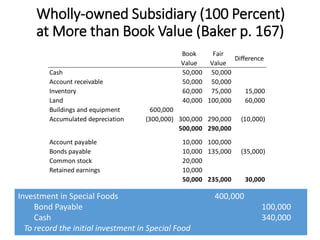
at More than Book Value (Baker p. 167)
Investment in Special Foods 400,000
Bond Payable 100,000
Cash 340,000
To record the initial investment in Special Food
Book
Value
Fair
Value
Difference
Cash 50,000 50,000
Account receivable 50,000 50,000
Inventory 60,000 75,000 15,000
Land 40,000 100,000 60,000
Buildings and equipment 600,000
Accumulated depreciation (300,000) 300,000 290,000 (10,000)
500,000 290,000
Account payable 10,000 100,000
Bonds payable 10,000 135,000 (35,000)
Common stock 20,000
Retained earnings 10,000
50,000 235,000 30,000
Book value of
net assets
CS + RE =
300,000
Identifiable
assets =
30,000
$400,000
Initial
Investment
Special
Foods
Goodwill =
70,000
1/1/X1
Wholly-owned Subsidiary (100 Percent)
at More than Book Value
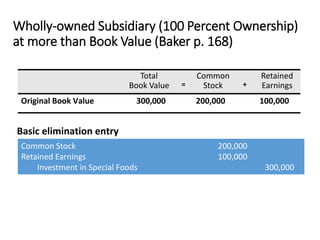
Wholly-owned Subsidiary (100 Percent Ownership)
at more than Book Value (Baker p. 168)
Basic elimination entry
Total Common Retained
Book Value Stock Earnings
Original Book Value 300,000 200,000 100,000
= +
Common Stock 200,000
Retained Earnings 100,000
Investment in Special Foods 300,000
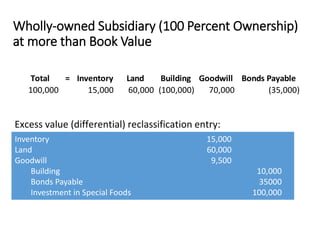
Wholly-owned Subsidiary (100 Percent Ownership)
at more than Book Value
Total = Inventory Land Building Goodwill Bonds Payable
100,000 15,000 60,000 (100,000) 70,000 (35,000)
Excess value (differential) reclassification entry:
Inventory 15,000
Land 60,000
Goodwill 9,500
Building 10,000
Bonds Payable 35000
Investment in Special Foods 100,000
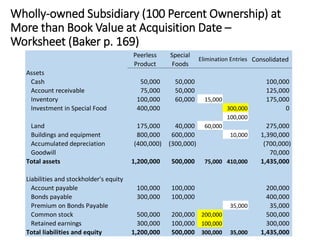
Wholly-owned Subsidiary (100 Percent Ownership) at
More than Book Value at Acquisition Date –
Worksheet (Baker p. 169)
Peerless
Product
Special
Foods
Consolidated
Assets
Cash 50,000 50,000 100,000
Account receivable 75,000 50,000 125,000
Inventory 100,000 60,000 15,000 175,000
Investment in Special Food 400,000 300,000 0
100,000
Land 175,000 40,000 60,000 275,000
Buildings and equipment 800,000 600,000 10,000 1,390,000
Accumulated depreciation (400,000) (300,000) (700,000)
Goodwill 70,000
Total assets 1,200,000 500,000 75,000 410,000 1,435,000
Liabilities and stockholder's equity
Account payable 100,000 100,000 200,000
Bonds payable 300,000 100,000 400,000
Premium on Bonds Payable 35,000 35,000
Common stock 500,000 200,000 200,000 500,000
Retained earnings 300,000 100,000 100,000 300,000
Total liabilities and equity 1,200,000 500,000 300,000 35,000 1,435,000
Elimination Entries
Situation 2 Worksheet
at the Date of Acquisition
(100% ownership)
Prepare equity method journal entries,
elimination entries, and the consolidated
worksheet for a wholly owned subsidiary
when there is a complex positive
differential.
Wholly-owned Subsidiary (100 Percent)
at More than Book Value – Initial Year
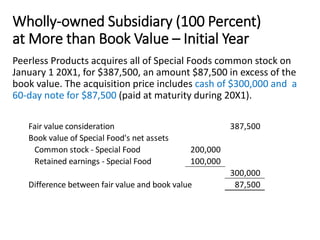
Peerless Products acquires all of Special Foods common stock on
January 1 20X1, for $387,500, an amount $87,500 in excess of the
book value. The acquisition price includes cash of $300,000 and a
60-day note for $87,500 (paid at maturity during 20X1).
Fair value consideration 387,500
Book value of Special Food's net assets
Common stock - Special Food 200,000
Retained earnings - Special Food 100,000
300,000
Difference between fair value and book value 87,500
Wholly-owned Subsidiary (100 Percent)
at More than Book Value
Fair values of Special Foods’ assets and liabilities:
Book Value Fair Value Differential
Inventory 60,000 65,000 5,000
Land 40,000 50,000 10,000
Buildings and Equipment 300,000 360,000 60,000
400,000 475,000 75,000
• The remaining $12,500 is goodwill
• The entire amount of inventory is sold during 20X1
• The buildings and equipment have 10 years remaining economic
life and depreciated using straight line depreciation
Wholly-owned Subsidiary (100 Percent Ownership)
at More than Book Value – Initial Year of Ownership
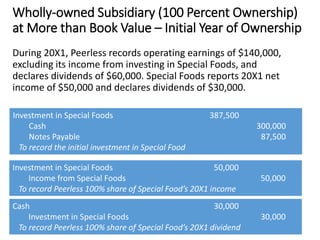
Investment in Special Foods 50,000
Income from Special Foods 50,000
To record Peerless 100% share of Special Food’s 20X1 income
During 20X1, Peerless records operating earnings of $140,000,
excluding its income from investing in Special Foods, and
declares dividends of $60,000. Special Foods reports 20X1 net
income of $50,000 and declares dividends of $30,000.
Cash 30,000
Investment in Special Foods 30,000
To record Peerless 100% share of Special Food’s 20X1 dividend
Investment in Special Foods 387,500
Cash 300,000
Notes Payable 87,500
To record the initial investment in Special Food
Wholly-owned Subsidiary (100 Percent Ownership) at
Book Value – Initial Year of Ownership (Baker p.173)
Parent Company Entry
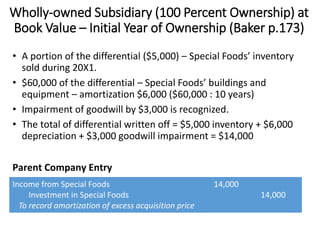
Income from Special Foods 14,000
Investment in Special Foods 14,000
To record amortization of excess acquisition price
• A portion of the differential ($5,000) – Special Foods’ inventory
sold during 20X1.
• $60,000 of the differential – Special Foods’ buildings and
equipment – amortization $6,000 ($60,000 : 10 years)
• Impairment of goodwill by $3,000 is recognized.
• The total of differential written off = $5,000 inventory + $6,000
depreciation + $3,000 goodwill impairment = $14,000
Book value of
net assets
CS + RE =
300,000
Identifiable
assets =
75,000
$387,500
Initial
Investment
Special
Foods
Goodwill =
12,500
Wholly-owned Subsidiary (100 Percent Ownership)
at Book Value – Initial Year of Ownership
Book value of
net assets
CS + RE =
320,000
Identifiable
assets =
64,000
$393,500
Net
Investment
Special
Foods
Goodwill =
9,500
1/1/X1 31/12/X1
Wholly-owned Subsidiary (100 Percent Ownership)
at Book Value – Initial Year of Ownership
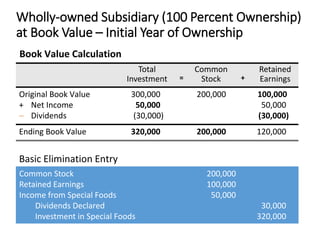
Basic Elimination Entry
Total Common Retained
Investment Stock Earnings
Original Book Value 300,000 200,000 100,000
+ Net Income 50,000 50,000
 Dividends (30,000) (30,000)
Ending Book Value 320,000 200,000 120,000
= +
Common Stock 200,000
Retained Earnings 100,000
Income from Special Foods 50,000
Dividends Declared 30,000
Investment in Special Foods 320,000
Book Value Calculation
Wholly-owned Subsidiary (100 Percent Ownership)
at Book Value – Initial Year of Ownership
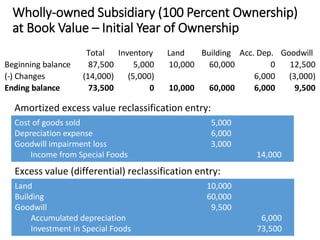
Amortized excess value reclassification entry:
Cost of goods sold 5,000
Depreciation expense 6,000
Goodwill impairment loss 3,000
Income from Special Foods 14,000
Total Inventory Land Building Acc. Dep. Goodwill
Beginning balance 87,500 5,000 10,000 60,000 0 12,500
(-) Changes (14,000) (5,000) 6,000 (3,000)
Ending balance 73,500 0 10,000 60,000 6,000 9,500
Excess value (differential) reclassification entry:
Land 10,000
Building 60,000
Goodwill 9,500
Accumulated depreciation 6,000
Investment in Special Foods 73,500
Do…
the Working Sheet for 20X1
and self-practice for 20X2
Consolidation Process
on a More than Book
Value Acquisitions with
(less than 100%
ownership)
Understand and explain how the
consolidation process differs when the
subsidiary is less-than-wholly owned and
there is a differential.
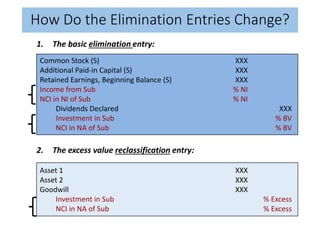
How Do the Elimination Entries Change?
1. The basic elimination entry:
2. The excess value reclassification entry:
Asset 1 XXX
Asset 2 XXX
Goodwill XXX
Investment in Sub % Excess
NCI in NA of Sub % Excess
Common Stock (S) XXX
Additional Paid-in Capital (S) XXX
Retained Earnings, Beginning Balance (S) XXX
Income from Sub % NI
NCI in NI of Sub % NI
Dividends Declared XXX
Investment in Sub % BV
NCI in NA of Sub % BV
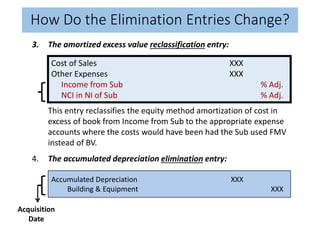
3. The amortized excess value reclassification entry:
This entry reclassifies the equity method amortization of cost in
excess of book from Income from Sub to the appropriate expense
accounts where the costs would have been had the Sub used FMV
instead of BV.
4. The accumulated depreciation elimination entry:
Accumulated Depreciation XXX
Building & Equipment XXX
Cost of Sales XXX
Other Expenses XXX
Income from Sub % Adj.
NCI in NI of Sub % Adj.
Acquisition
Date
How Do the Elimination Entries Change?
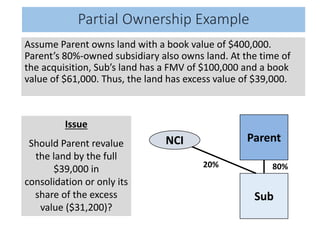
Issue
Should Parent revalue
the land by the full
$39,000 in
consolidation or only its
share of the excess
value ($31,200)?
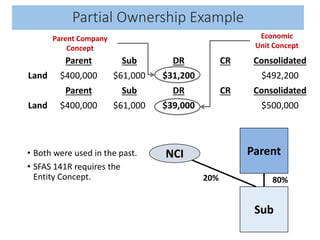
Partial Ownership Example
Assume Parent owns land with a book value of $400,000.
Parent’s 80%-owned subsidiary also owns land. At the time of
the acquisition, Sub’s land has a FMV of $100,000 and a book
value of $61,000. Thus, the land has excess value of $39,000.
Parent
Sub
80%20%
NCI
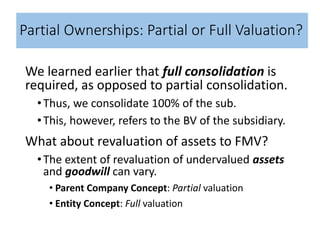
Partial Ownerships: Partial or Full Valuation?
We learned earlier that full consolidation is
required, as opposed to partial consolidation.
•Thus, we consolidate 100% of the sub.
•This, however, refers to the BV of the subsidiary.
What about revaluation of assets to FMV?
•The extent of revaluation of undervalued assets
and goodwill can vary.
• Parent Company Concept: Partial valuation
• Entity Concept: Full valuation
Partial Ownership Example
• Both were used in the past.
• SFAS 141R requires the
Entity Concept.
Parent
Sub
80%20%
NCI
Parent Sub DR CR Consolidated
Land $400,000 $61,000 $31,200 $492,200
Parent Sub DR CR Consolidated
Land $400,000 $61,000 $39,000 $500,000
Parent Company
Concept
Economic
Unit Concept
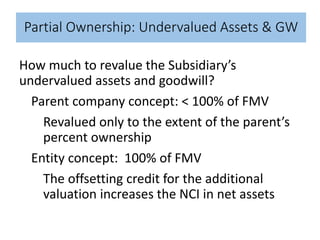
Partial Ownership: Undervalued Assets & GW
How much to revalue the Subsidiary’s
undervalued assets and goodwill?
Parent company concept: < 100% of FMV
Revalued only to the extent of the parent’s
percent ownership
Entity concept: 100% of FMV
The offsetting credit for the additional
valuation increases the NCI in net assets
Situation 2 Worksheet
at the Initial Year
(less than 100% ownership)
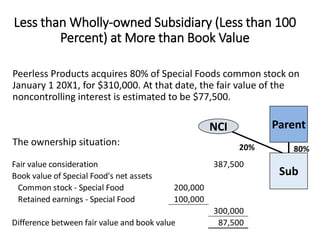
Less than Wholly-owned Subsidiary (Less than 100
Percent) at More than Book Value
Peerless Products acquires 80% of Special Foods common stock on
January 1 20X1, for $310,000. At that date, the fair value of the
noncontrolling interest is estimated to be $77,500.
The ownership situation:
Fair value consideration 387,500
Book value of Special Food's net assets
Common stock - Special Food 200,000
Retained earnings - Special Food 100,000
300,000
Difference between fair value and book value 87,500
Parent
Sub
80%20%
NCI
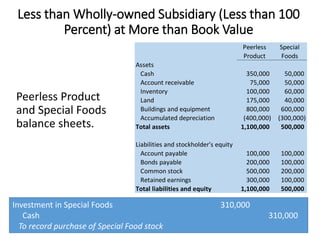
Peerless Product
and Special Foods
balance sheets.
Peerless
Product
Special
Foods
Assets
Cash 350,000 50,000
Account receivable 75,000 50,000
Inventory 100,000 60,000
Land 175,000 40,000
Buildings and equipment 800,000 600,000
Accumulated depreciation (400,000) (300,000)
Total assets 1,100,000 500,000
Liabilities and stockholder's equity
Account payable 100,000 100,000
Bonds payable 200,000 100,000
Common stock 500,000 200,000
Retained earnings 300,000 100,000
Total liabilities and equity 1,100,000 500,000
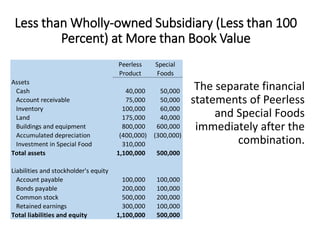
Less than Wholly-owned Subsidiary (Less than 100
Percent) at More than Book Value
Investment in Special Foods 310,000
Cash 310,000
To record purchase of Special Food stock
Peerless
Product
Special
Foods
Assets
Cash 40,000 50,000
Account receivable 75,000 50,000
Inventory 100,000 60,000
Land 175,000 40,000
Buildings and equipment 800,000 600,000
Accumulated depreciation (400,000) (300,000)
Investment in Special Food 310,000
Total assets 1,100,000 500,000
Liabilities and stockholder's equity
Account payable 100,000 100,000
Bonds payable 200,000 100,000
Common stock 500,000 200,000
Retained earnings 300,000 100,000
Total liabilities and equity 1,100,000 500,000
The separate financial
statements of Peerless
and Special Foods
immediately after the
combination.
Less than Wholly-owned Subsidiary (Less than 100
Percent) at More than Book Value
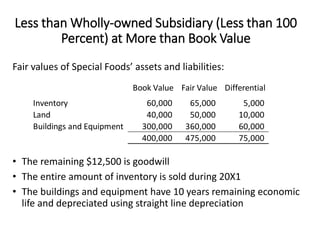
Fair values of Special Foods’ assets and liabilities:
Book Value Fair Value Differential
Inventory 60,000 65,000 5,000
Land 40,000 50,000 10,000
Buildings and Equipment 300,000 360,000 60,000
400,000 475,000 75,000
• The remaining $12,500 is goodwill
• The entire amount of inventory is sold during 20X1
• The buildings and equipment have 10 years remaining economic
life and depreciated using straight line depreciation
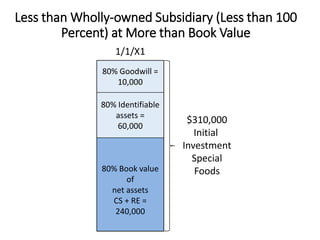
Less than Wholly-owned Subsidiary (Less than 100
Percent) at More than Book Value
80% Book value
of
net assets
CS + RE =
240,000
80% Identifiable
assets =
60,000
$310,000
Initial
Investment
Special
Foods
80% Goodwill =
10,000
1/1/X1
Less than Wholly-owned Subsidiary (Less than 100
Percent) at More than Book Value
Less than wholly-owned Subsidiary (80 Percent
Ownership) at Book Value –
Investment Elimination Entry
Basic investment account elimination entry
Common Stock 200,000
Retained Earnings 100000
Investment in Special Foods 240,000
NCI in NA of Special Foods 60,000
Book Value Calculations
Investment
Account Common Retained
NCI (20%) (80%) Stock Earnings
Original book value 60,000 240,000 200,000 100,000
=
NCI 20%
Peerless
80%
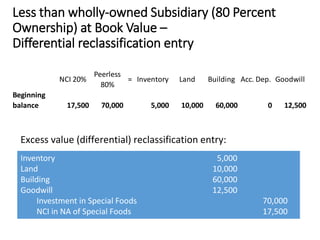
= Inventory Land Building Acc. Dep. Goodwill
Beginning
balance 17,500 70,000 5,000 10,000 60,000 0 12,500
Less than wholly-owned Subsidiary (80 Percent
Ownership) at Book Value –
Differential reclassification entry
Excess value (differential) reclassification entry:
Inventory 5,000
Land 10,000
Building 60,000
Goodwill 12,500
Investment in Special Foods 70,000
NCI in NA of Special Foods 17,500
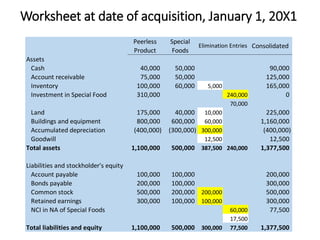
Worksheet at date of acquisition, January 1, 20X1
Peerless
Product
Special
Foods
Consolidated
Assets
Cash 40,000 50,000 90,000
Account receivable 75,000 50,000 125,000
Inventory 100,000 60,000 5,000 165,000
Investment in Special Food 310,000 240,000 0
70,000
Land 175,000 40,000 10,000 225,000
Buildings and equipment 800,000 600,000 60,000 1,160,000
Accumulated depreciation (400,000) (300,000) 300,000 (400,000)
Goodwill 12,500 12,500
Total assets 1,100,000 500,000 387,500 240,000 1,377,500
Liabilities and stockholder's equity
Account payable 100,000 100,000 200,000
Bonds payable 200,000 100,000 300,000
Common stock 500,000 200,000 200,000 500,000
Retained earnings 300,000 100,000 100,000 300,000
NCI in NA of Special Foods 60,000 77,500
17,500
Total liabilities and equity 1,100,000 500,000 300,000 77,500 1,377,500
Elimination Entries
Peerless
Products
Special
Foods
20X1:
Separate operating income, Peerless
Net income, Special Foods
Dividends
140,000
60,000
50,000
30,000
20X2:
Separate operating income, Peerless
Net income, Special Foods
Dividends
160,000
60,000
75,000
40,000
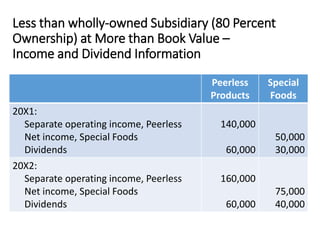
Less than wholly-owned Subsidiary (80 Percent
Ownership) at More than Book Value –
Income and Dividend Information
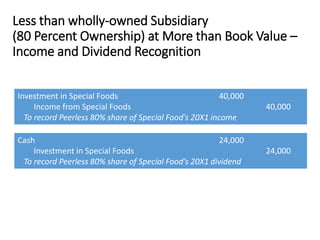
Less than wholly-owned Subsidiary
(80 Percent Ownership) at More than Book Value –
Income and Dividend Recognition
Investment in Special Foods 40,000
Income from Special Foods 40,000
To record Peerless 80% share of Special Food’s 20X1 income
Cash 24,000
Investment in Special Foods 24,000
To record Peerless 80% share of Special Food’s 20X1 dividend
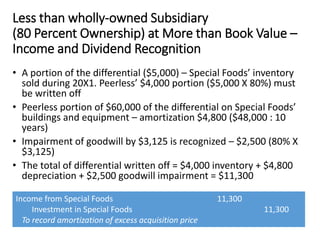
Less than wholly-owned Subsidiary
(80 Percent Ownership) at More than Book Value –
Income and Dividend Recognition
Income from Special Foods 11,300
Investment in Special Foods 11,300
To record amortization of excess acquisition price
• A portion of the differential ($5,000) – Special Foods’ inventory
sold during 20X1. Peerless’ $4,000 portion ($5,000 X 80%) must
be written off
• Peerless portion of $60,000 of the differential on Special Foods’
buildings and equipment – amortization $4,800 ($48,000 : 10
years)
• Impairment of goodwill by $3,125 is recognized – $2,500 (80% X
$3,125)
• The total of differential written off = $4,000 inventory + $4,800
depreciation + $2,500 goodwill impairment = $11,300
80% Book value
of
net assets
CS + RE =
240,000
80% Identifiable
assets =
60,000
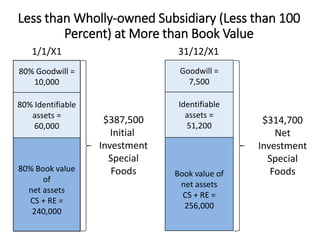
$387,500
Initial
Investment
Special
Foods
80% Goodwill =
10,000
Goodwill =
7,500
1/1/X1
Book value of
net assets
CS + RE =
256,000
Identifiable
assets =
51,200
$314,700
Net
Investment
Special
Foods
31/12/X1
Less than Wholly-owned Subsidiary (Less than 100
Percent) at More than Book Value
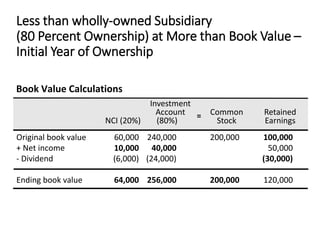
Book Value Calculations
Investment
Account Common Retained
NCI (20%) (80%) Stock Earnings
Original book value 60,000 240,000 200,000 100,000
+ Net income 10,000 40,000 50,000
- Dividend (6,000) (24,000) (30,000)
Ending book value 64,000 256,000 200,000 120,000
=
Less than wholly-owned Subsidiary
(80 Percent Ownership) at More than Book Value –
Initial Year of Ownership
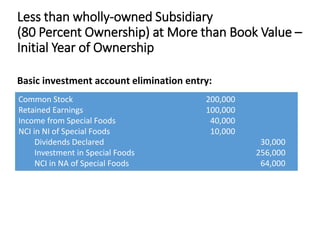
Basic investment account elimination entry:
Common Stock 200,000
Retained Earnings 100,000
Income from Special Foods 40,000
NCI in NI of Special Foods 10,000
Dividends Declared 30,000
Investment in Special Foods 256,000
NCI in NA of Special Foods 64,000
Less than wholly-owned Subsidiary
(80 Percent Ownership) at More than Book Value –
Initial Year of Ownership
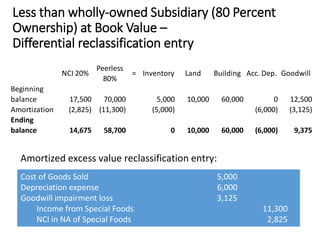
NCI 20%
Peerless
80%
= Inventory Land Building Acc. Dep. Goodwill
Beginning
balance 17,500 70,000 5,000 10,000 60,000 0 12,500
Amortization (2,825) (11,300) (5,000) (6,000) (3,125)
Ending
balance 14,675 58,700 0 10,000 60,000 (6,000) 9,375
Less than wholly-owned Subsidiary (80 Percent
Ownership) at Book Value –
Differential reclassification entry
Amortized excess value reclassification entry:
Cost of Goods Sold 5,000
Depreciation expense 6,000
Goodwill impairment loss 3,125
Income from Special Foods 11,300
NCI in NA of Special Foods 2,825
Less than wholly-owned Subsidiary (80 Percent
Ownership) at Book Value –
Differential reclassification entry
Excess value (differential) reclassification entry:
Land 10,000
Building 60,000
Goodwill 9,375
Accumulated depreciation 6,000
Investment in Special Foods 58,700
NCI in NA of Special Foods 14,675
Do…
the Working Sheet for 20X1
and self-practice for 20X2
Excess of Book
Value over Cost
Acquired at Less than Fair Value
of Net Assets
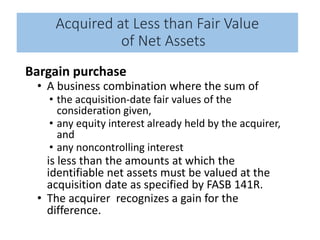
Bargain purchase
• A business combination where the sum of
• the acquisition-date fair values of the
consideration given,
• any equity interest already held by the acquirer,
and
• any noncontrolling interest
is less than the amounts at which the
identifiable net assets must be valued at the
acquisition date as specified by FASB 141R.
• The acquirer recognizes a gain for the
difference.
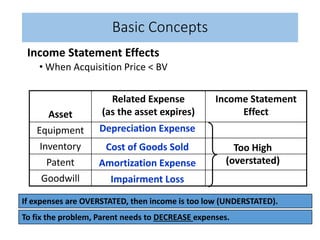
Basic Concepts
Income Statement Effects
• When Acquisition Price < BV
Asset
Related Expense
(as the asset expires)
Income Statement
Effect
Equipment
Inventory
Patent
Goodwill
Depreciation Expense
Cost of Goods Sold
Amortization Expense
Impairment Loss
Too High
(overstated)
If expenses are OVERSTATED, then income is too low (UNDERSTATED).
To fix the problem, Parent needs to DECREASE expenses.
God Blesses Us
All

Consolidated Financial Statement - At More than Book Value

  • 1.
    Consolidated financial statement: Acquisition atmore than book value Arthik Davianti
  • 2.
  • 3.
    Basic Concepts: Parentand Subsidiary Parent’s books Investment account initially contains the acquisition cost • FMV of net assets, • Plus goodwill, or • Minus bargain purchase price Parent can use the cost or equity method Subsidiary’s books Balance sheet: Assets and Liabilities are recorded at BOOK values. Income statement: Expenses calculated based on BOOK values
  • 4.
    Basic Concepts: Parentand Subsidiary What happens when you consolidate the parent’s and subsidiary’s books? Remember: • The parent’s investment account is based on the actual acquisition price. • The sub’s books contain only historical book values. The parent needs to make adjustments for both • Balance Sheet, and • Income Statement accounts. Why wasn’t this a problem with created subs? • No goodwill • No undervalued assets at the time of creation
  • 5.
    Differential: Investment Cost over theUnderlying Book Value of Equity
  • 6.
    Acquisition Price andUnderlying Book Value Difference The purchase price normally is based on the market value – different with the investee’s net assets: Book Value (BV) vs Fair Market Value (FMV) - DIFFERENTIAL Differential is frequently positive The differential pertaining each asset of the investee must be ascertained. When the parent uses equity method – differential pertaining to limited life assets (including identifiable intangible) must be amortized (in the remaining economic life).
  • 7.
    Basic Concepts: Income StatementImpacts Big Picture: Essentially, we switch the sub’s books from BV to FMV in the consolidation process. Income Statement effects Asset Related Expense (as the asset expires) Equipment Inventory Patent Goodwill Depreciation Expense Cost of Goods Sold Amortization Expense Impairment Loss
  • 8.
    Basic Concepts: Income StatementImpacts Income Statement Effects When Acquisition Price > Book Value Asset Related Expense (as the asset expires) Income Statement Effect Equipment Inventory Patent Goodwill Depreciation Expense Cost of Goods Sold Amortization Expense Impairment Loss Too Low (understated) If expenses are UNDERSTATED, then income is too high (OVERSTATED). To fix the problem, Parent needs to INCREASE expenses (but how?)
  • 9.
    Excess Investment Costover Underlying Book Value of Equity: Assignment Information on the individual assets and liabilities to account for any difference between the investment cost and the underlying book value of equity – DIFFERENTIAL Book value and fair value information for Sloan Co at January 1 (this is from last week’s illustration) Book Value Fair Value Cash 1,500 1,500 Receivable - net 2,200 2,200 Inventories 3,000 400 Other current assets 3,300 3,100 Equipment - net 5,000 8,000 Total assets 15,000 18,800 Account payeble 1,000 1,000 Note payable, due in five years 2,000 1,800 Common stock 10,000 Retained earnings 2,000 Total liabilities and stockholders' equity 15,000
  • 10.
    Excess Investment Costover Underlying Book Value of Equity: Assignment 5,000 (3,600) 1,400 Fair Value Book Value Differential % Interest Acquired Amount Assigned Inventories 4,000 3,000 1,000 30% 300 Other current assets 3,100 3,300 (200) 30% (60) Equipment 8,000 5,000 3,000 30% 900 Note payable 1,800 2,000 200 30% 60 Total assigned to identifiable net assets 1,200 Remainder assigned to goodwill 200 Total excess of cost over book value acquired 1,400 Assignment to identifiable net assets and goodwill Investment in Sloan Book value of the interest acquired (30% X $12,000,000 equity of Sloan) Total excess of cost over book value acquired
  • 11.
    Excess Investment Costover Underlying Book Value of Equity: Accounting Sloan pay dividends $1,000,000 on July 1 and reports net income of $3,000,000. The excess cost over book value is amortized as follows: Amortization Rates Excess allocated to: Inventories – sold in the current year 100% Other current assets – disposed of in the current year 100% Equipment – depreciated over 20 years 5% Note payable – due in 5 years 20%
  • 12.
    Excess Investment Costover Underlying Book Value of Equity: Accounting Payne’s entries: July 1: Cash (+A) 300 Investment in Sloan (-A) 300 To record dividends received from Sloan ($1,000,000 X 30% December 31 Investment in Sloan (+A) 900 Income from Sloan (+R, +SE) 900 To record dividends received from Sloan ($1,000,000 X 30%) December 31 Income from Sloan (-R, -SE) 300 Investment in Sloan (-A) 300 To record write-off of excess allocated to inventory items that were sold in the current year 1 2
  • 13.
    Excess Investment Costover Underlying Book Value of Equity: Accounting December 31 Investment in Sloan (+A) 60 Income from Sloan (R, +SE) 60 To record income credit overvalued other current assets disposed of in the current year December 31 Income from Sloan (-R, -SE) 12 Investment in Sloan (-A) 12 To amortize the excess allocated to the overvalued note payable over the remaining life of the note ($60,000 : 5 years) December 31 Income from Sloan (-R, -SE) 45 Investment in Sloan (-A) 45 To record depreciation on excess allocated to undervalued equipment with a 20-year remaining useful life ($900,000 : 20) 5 4 3
  • 14.
    Excess Investment Costover Underlying Book Value of Equity: Accounting December 31 Investment in Sloan (+A) 603 Income from Sloan (R, +SE) 603 To record equity income from 30% investment in Sloan 1-5 Equity in Sloan’s reporting income ($3,000,000 X 30%) 603 Amortization of excess cost over book value: Inventories sold in the current year ($300,000 X 100%) (300) Other current assets sold in the current year ($60,000 X 100%) 60 Equipment ($900,000 X 5%) depreciation rate Note payable ($60,000 X 20%) amortization rate (12) Total investment income from Sloan $603
  • 15.
    Book value elementLife remaining Common Stock $130,000 Retained Earnings 117,000 Under- or Over-valuation Inventory (6,500) 2 months Land 39,000 Indefinite Equipment 85,000 10 years Covenant-not-to-compete 52,000 4 years Goodwill element 26,000 Indefinite Total Cost $442,500 Example: Acquisition Price > Book Value Pepper Inc., a calendar-year reporting company, acquired 100% of Salt Inc.’s outstanding common stock at a cost of $442,500 on 12/31/X8. The analysis of the parent’s Investment account as of the acquisition date shows:
  • 16.
    Acquisition Price = BV+ Identifiable Excess + GW Results for 20X9 (based on Book Values): Reported Income $78,000 Dividends Declared 45,500 What would the Sub’s income be based on Fair Values? Lower COGS (because inventory is worth less) $ (6,500) Extra depreciation on equipment 8,500 Extra amortization of contract 13,000 Total increase in expenses / decrease in income $ 15,000 $63,000 ($78,000 - $15,000) Example: Acquisition Price > Book Value 442,500 = 247,000 + 169,500 + 26,000
  • 17.
  • 18.
    Consolidation procedures differ whenthere is a differential.
  • 19.
    Differential in EquityMethod The Parent’s initial investment in a sub is based on the FMV of the sub’s net assets (+/- GW). Equity method entries: • Recording share of sub’s income • Recording share of sub’s dividends They should be based on the same FMV basis. Problem: Sub reports income based on BOOK VALUES Solution: Parent has to record an adjustment to the income and investment “Equity Method” accounts.
  • 20.
    Results for 20X9(based on Book Values): Reported Income $78,000 Dividends Declared 45,500 Adjustment to Salt’s 20X9 income on Parent’s books: Lower COGS (because inventory is worth less) $ (6,500) Extra depreciation on equipment 8,500 Extra amortization of contract 13,000 Total increase in expenses / decrease in income $ 15,000 What entries would Pepper record in its general ledger related to Salt’s income and dividends for 20X9 under the equity method? Example: Differential in Equity Method
  • 21.
    Example: Equity MethodJournal Entries 1. To record 100% share of Salt’s reported income: Investment in Salt 78,000 Income from Salt 78,000 2. To record 100% of Salt’s dividends declared: Dividend Receivable 45,500 Investment in Salt 45,500 3. To record additional expenses (based on FMV): Income from Salt 15,000 Investment in Salt 15,000
  • 22.
    Called “amortization of excessvalue” Example: Equity Method Investment Adjustment Calculate the correct ending balance in Pepper’s Investment in Salt account using the equity method: Investment in Salt Beginning Balance 442,500 Net Income 78,000 Ending Balance 460,000 Dividend 45,500 Income Adjustment 15,000
  • 23.
    Simple Example P S Stock Sub Shareholders $ Book valueof net assets = $800 Excess value of identifiable assets = $200 Goodwill = $500 Assume the BV of Sub’s net assets is $800 and that the FMV of the net assets is $1,000. Finally, assume that the acquisition price was $1,500. The acquisition price consists of three parts:
  • 24.
    Understanding Components of AcquisitionCost Acquisition FMV of Price = Assets + Goodwill Key: We need to keep track of each element of the purchase price separately! Why?? FMV of Extra Assets = BV + Value Acquisition Extra Price = BV + Value + Goodwill
  • 25.
    The Consolidation Process Whena subsidiary is acquired (instead of created), the consolidation process is more complicated: • Must eliminate intercompany items (same) • Must update Sub’s assets and liabilities to FMV • Must recognize goodwill
  • 26.
    Summary of ConsolidationEntries 1. The basic elimination entry: 2. The excess value reclassification entry: Asset 1 XX Asset 2 XX Goodwill XX Investment in Sub Excess Common Stock (S) XX Additional Paid-in Capital (S) XX Retained Earnings, Beginning Balance (S) XX Income from Sub XX Investment in Sub BV Dividends Declared XX
  • 27.
    Summary of ConsolidationEntries 3. The amortized excess value reclassification entry: This entry reclassifies the equity method amortization of cost in excess of book from Income from Sub to the appropriate expense accounts where the costs would have been had the sub used FMV instead of BV. 4. The accumulated depreciation elimination entry: Cost of Sales XX Other Expenses XX Income from Sub XX Accumulated Depreciation XX Buildings and Equipment XX
  • 28.
    Understand and explainhow consolidation process differ when there is a differential
  • 29.
    Wholly-owned Subsidiary (100Percent) at More than Book Value (Baker p. 162) Peerless Products acquires all of Special Foods common stock on January 1 20X1, for $340,000 cash, an amount equal to Special Foods’ fair value as a whole. This includes $40,000 in excess of Special Foods’ book value of $300,000. Fair value consideration 340,000 Book value of Special Food's net assets Common stock - Special Food 200,000 Retained earnings - Special Food 100,000 300,000 Difference between fair value and book value 40,000 Investment in Special Foods 340,000 Cash 340,000 To record the initial investment in Special Food
  • 30.
    Book value of netassets CS + RE = 300,000 Identifiable assets = 40,000 $340,000 Initial Investment Special Foods Goodwill = 0 1/1/X1 Wholly-owned Subsidiary (100 Percent) at More than Book Value
  • 31.
    Wholly-owned Subsidiary (100Percent Ownership) at more than Book Value Book Value calculation Total Common Retained Book Value Stock Earnings Original Book Value 300,000 200,000 100,000 = + Common Stock 200,000 Retained Earnings 100,000 Investment in Special Foods 300,000 Excess value reclassification entry: Land 40,000 Investment in Special Foods 40,000
  • 32.
    Wholly-owned Subsidiary (100Percent Ownership) at more than Book Value Excess value reclassification entry: Land 40,000 Investment in Special Foods 40,000 In this example, the differential is the additional $40,000 payment, because of Special Foods’ land was worth $40,000 more than its book value at acquisition date. A second elimination entry is required to re-assign the $40,000 from the investment account to the land account.
  • 33.
    Wholly-owned Subsidiary (100Percent Ownership) at More than Book Value at Acquisition Date – Worksheet (Baker p. 164) Peerless Product Special Foods Consolidated Assets Cash 10,000 50,000 60,000 Account receivable 75,000 50,000 125,000 Inventory 100,000 60,000 160,000 Investment in Special Food 340,000 300,000 0 40,000 Land 175,000 40,000 40,000 255,000 Buildings and equipment 800,000 600,000 1,400,000 Accumulated depreciation (400,000) (300,000) (700,000) Total assets 1,100,000 500,000 40,000 340,000 1,300,000 Liabilities and stockholder's equity Account payable 100,000 100,000 200,000 Bonds payable 200,000 100,000 300,000 Common stock 500,000 200,000 200,000 500,000 Retained earnings 300,000 100,000 100,000 300,000 Total liabilities and equity 1,100,000 500,000 300,000 0 1,300,000 Elimination Entries
  • 34.
    Existence of Goodwill Excessvalue reclassification entry: Goodwill 40,000 Investment in Special Foods 40,000 For example, assume in the Peerless Product and Special Foods illustration the acquisition-date fair value of Special Foods’ assets and liabilities equal to their book values, then the $40,000 difference between the $340,000 consideration exchanged and the $300,000 fair value of the subsidiary’s net identifiable assets should be attributed to goodwill
  • 35.
  • 36.
    Make calculation andprepare elimination entries for the consolidation of a wholly owned subsidiary when there is a complex positive differential at the acquisition date.
  • 37.
    Wholly-owned Subsidiary (100Percent) at More than Book Value (Baker p. 166) Peerless Products acquires all of Special Foods common stock on January 1 20X1, for $400,000 on January 1, 20X1, by issuing $100,000 of 9% bonds, with fair value of $100,000, and paying cash of $300,000. The resulting ownership situation: Fair value consideration 400,000 Book value of Special Food's net assets Common stock - Special Food 200,000 Retained earnings - Special Food 100,000 300,000 Difference between fair value and book value 100,000
  • 38.
    Wholly-owned Subsidiary (100Percent) at More than Book Value (Baker p. 167) Investment in Special Foods 400,000 Bond Payable 100,000 Cash 340,000 To record the initial investment in Special Food Book Value Fair Value Difference Cash 50,000 50,000 Account receivable 50,000 50,000 Inventory 60,000 75,000 15,000 Land 40,000 100,000 60,000 Buildings and equipment 600,000 Accumulated depreciation (300,000) 300,000 290,000 (10,000) 500,000 290,000 Account payable 10,000 100,000 Bonds payable 10,000 135,000 (35,000) Common stock 20,000 Retained earnings 10,000 50,000 235,000 30,000
  • 39.
    Book value of netassets CS + RE = 300,000 Identifiable assets = 30,000 $400,000 Initial Investment Special Foods Goodwill = 70,000 1/1/X1 Wholly-owned Subsidiary (100 Percent) at More than Book Value
  • 40.
    Wholly-owned Subsidiary (100Percent Ownership) at more than Book Value (Baker p. 168) Basic elimination entry Total Common Retained Book Value Stock Earnings Original Book Value 300,000 200,000 100,000 = + Common Stock 200,000 Retained Earnings 100,000 Investment in Special Foods 300,000
  • 41.
    Wholly-owned Subsidiary (100Percent Ownership) at more than Book Value Total = Inventory Land Building Goodwill Bonds Payable 100,000 15,000 60,000 (100,000) 70,000 (35,000) Excess value (differential) reclassification entry: Inventory 15,000 Land 60,000 Goodwill 9,500 Building 10,000 Bonds Payable 35000 Investment in Special Foods 100,000
  • 42.
    Wholly-owned Subsidiary (100Percent Ownership) at More than Book Value at Acquisition Date – Worksheet (Baker p. 169) Peerless Product Special Foods Consolidated Assets Cash 50,000 50,000 100,000 Account receivable 75,000 50,000 125,000 Inventory 100,000 60,000 15,000 175,000 Investment in Special Food 400,000 300,000 0 100,000 Land 175,000 40,000 60,000 275,000 Buildings and equipment 800,000 600,000 10,000 1,390,000 Accumulated depreciation (400,000) (300,000) (700,000) Goodwill 70,000 Total assets 1,200,000 500,000 75,000 410,000 1,435,000 Liabilities and stockholder's equity Account payable 100,000 100,000 200,000 Bonds payable 300,000 100,000 400,000 Premium on Bonds Payable 35,000 35,000 Common stock 500,000 200,000 200,000 500,000 Retained earnings 300,000 100,000 100,000 300,000 Total liabilities and equity 1,200,000 500,000 300,000 35,000 1,435,000 Elimination Entries
  • 43.
    Situation 2 Worksheet atthe Date of Acquisition (100% ownership)
  • 44.
    Prepare equity methodjournal entries, elimination entries, and the consolidated worksheet for a wholly owned subsidiary when there is a complex positive differential.
  • 45.
    Wholly-owned Subsidiary (100Percent) at More than Book Value – Initial Year Peerless Products acquires all of Special Foods common stock on January 1 20X1, for $387,500, an amount $87,500 in excess of the book value. The acquisition price includes cash of $300,000 and a 60-day note for $87,500 (paid at maturity during 20X1). Fair value consideration 387,500 Book value of Special Food's net assets Common stock - Special Food 200,000 Retained earnings - Special Food 100,000 300,000 Difference between fair value and book value 87,500
  • 46.
    Wholly-owned Subsidiary (100Percent) at More than Book Value Fair values of Special Foods’ assets and liabilities: Book Value Fair Value Differential Inventory 60,000 65,000 5,000 Land 40,000 50,000 10,000 Buildings and Equipment 300,000 360,000 60,000 400,000 475,000 75,000 • The remaining $12,500 is goodwill • The entire amount of inventory is sold during 20X1 • The buildings and equipment have 10 years remaining economic life and depreciated using straight line depreciation
  • 47.
    Wholly-owned Subsidiary (100Percent Ownership) at More than Book Value – Initial Year of Ownership Investment in Special Foods 50,000 Income from Special Foods 50,000 To record Peerless 100% share of Special Food’s 20X1 income During 20X1, Peerless records operating earnings of $140,000, excluding its income from investing in Special Foods, and declares dividends of $60,000. Special Foods reports 20X1 net income of $50,000 and declares dividends of $30,000. Cash 30,000 Investment in Special Foods 30,000 To record Peerless 100% share of Special Food’s 20X1 dividend Investment in Special Foods 387,500 Cash 300,000 Notes Payable 87,500 To record the initial investment in Special Food
  • 48.
    Wholly-owned Subsidiary (100Percent Ownership) at Book Value – Initial Year of Ownership (Baker p.173) Parent Company Entry Income from Special Foods 14,000 Investment in Special Foods 14,000 To record amortization of excess acquisition price • A portion of the differential ($5,000) – Special Foods’ inventory sold during 20X1. • $60,000 of the differential – Special Foods’ buildings and equipment – amortization $6,000 ($60,000 : 10 years) • Impairment of goodwill by $3,000 is recognized. • The total of differential written off = $5,000 inventory + $6,000 depreciation + $3,000 goodwill impairment = $14,000
  • 49.
    Book value of netassets CS + RE = 300,000 Identifiable assets = 75,000 $387,500 Initial Investment Special Foods Goodwill = 12,500 Wholly-owned Subsidiary (100 Percent Ownership) at Book Value – Initial Year of Ownership Book value of net assets CS + RE = 320,000 Identifiable assets = 64,000 $393,500 Net Investment Special Foods Goodwill = 9,500 1/1/X1 31/12/X1
  • 50.
    Wholly-owned Subsidiary (100Percent Ownership) at Book Value – Initial Year of Ownership Basic Elimination Entry Total Common Retained Investment Stock Earnings Original Book Value 300,000 200,000 100,000 + Net Income 50,000 50,000  Dividends (30,000) (30,000) Ending Book Value 320,000 200,000 120,000 = + Common Stock 200,000 Retained Earnings 100,000 Income from Special Foods 50,000 Dividends Declared 30,000 Investment in Special Foods 320,000 Book Value Calculation
  • 51.
    Wholly-owned Subsidiary (100Percent Ownership) at Book Value – Initial Year of Ownership Amortized excess value reclassification entry: Cost of goods sold 5,000 Depreciation expense 6,000 Goodwill impairment loss 3,000 Income from Special Foods 14,000 Total Inventory Land Building Acc. Dep. Goodwill Beginning balance 87,500 5,000 10,000 60,000 0 12,500 (-) Changes (14,000) (5,000) 6,000 (3,000) Ending balance 73,500 0 10,000 60,000 6,000 9,500 Excess value (differential) reclassification entry: Land 10,000 Building 60,000 Goodwill 9,500 Accumulated depreciation 6,000 Investment in Special Foods 73,500
  • 52.
    Do… the Working Sheetfor 20X1 and self-practice for 20X2
  • 53.
    Consolidation Process on aMore than Book Value Acquisitions with (less than 100% ownership)
  • 54.
    Understand and explainhow the consolidation process differs when the subsidiary is less-than-wholly owned and there is a differential.
  • 55.
    How Do theElimination Entries Change? 1. The basic elimination entry: 2. The excess value reclassification entry: Asset 1 XXX Asset 2 XXX Goodwill XXX Investment in Sub % Excess NCI in NA of Sub % Excess Common Stock (S) XXX Additional Paid-in Capital (S) XXX Retained Earnings, Beginning Balance (S) XXX Income from Sub % NI NCI in NI of Sub % NI Dividends Declared XXX Investment in Sub % BV NCI in NA of Sub % BV
  • 56.
    3. The amortizedexcess value reclassification entry: This entry reclassifies the equity method amortization of cost in excess of book from Income from Sub to the appropriate expense accounts where the costs would have been had the Sub used FMV instead of BV. 4. The accumulated depreciation elimination entry: Accumulated Depreciation XXX Building & Equipment XXX Cost of Sales XXX Other Expenses XXX Income from Sub % Adj. NCI in NI of Sub % Adj. Acquisition Date How Do the Elimination Entries Change?
  • 57.
    Issue Should Parent revalue theland by the full $39,000 in consolidation or only its share of the excess value ($31,200)? Partial Ownership Example Assume Parent owns land with a book value of $400,000. Parent’s 80%-owned subsidiary also owns land. At the time of the acquisition, Sub’s land has a FMV of $100,000 and a book value of $61,000. Thus, the land has excess value of $39,000. Parent Sub 80%20% NCI
  • 58.
    Partial Ownerships: Partialor Full Valuation? We learned earlier that full consolidation is required, as opposed to partial consolidation. •Thus, we consolidate 100% of the sub. •This, however, refers to the BV of the subsidiary. What about revaluation of assets to FMV? •The extent of revaluation of undervalued assets and goodwill can vary. • Parent Company Concept: Partial valuation • Entity Concept: Full valuation
  • 59.
    Partial Ownership Example •Both were used in the past. • SFAS 141R requires the Entity Concept. Parent Sub 80%20% NCI Parent Sub DR CR Consolidated Land $400,000 $61,000 $31,200 $492,200 Parent Sub DR CR Consolidated Land $400,000 $61,000 $39,000 $500,000 Parent Company Concept Economic Unit Concept
  • 60.
    Partial Ownership: UndervaluedAssets & GW How much to revalue the Subsidiary’s undervalued assets and goodwill? Parent company concept: < 100% of FMV Revalued only to the extent of the parent’s percent ownership Entity concept: 100% of FMV The offsetting credit for the additional valuation increases the NCI in net assets
  • 61.
    Situation 2 Worksheet atthe Initial Year (less than 100% ownership)
  • 62.
    Less than Wholly-ownedSubsidiary (Less than 100 Percent) at More than Book Value Peerless Products acquires 80% of Special Foods common stock on January 1 20X1, for $310,000. At that date, the fair value of the noncontrolling interest is estimated to be $77,500. The ownership situation: Fair value consideration 387,500 Book value of Special Food's net assets Common stock - Special Food 200,000 Retained earnings - Special Food 100,000 300,000 Difference between fair value and book value 87,500 Parent Sub 80%20% NCI
  • 63.
    Peerless Product and SpecialFoods balance sheets. Peerless Product Special Foods Assets Cash 350,000 50,000 Account receivable 75,000 50,000 Inventory 100,000 60,000 Land 175,000 40,000 Buildings and equipment 800,000 600,000 Accumulated depreciation (400,000) (300,000) Total assets 1,100,000 500,000 Liabilities and stockholder's equity Account payable 100,000 100,000 Bonds payable 200,000 100,000 Common stock 500,000 200,000 Retained earnings 300,000 100,000 Total liabilities and equity 1,100,000 500,000 Less than Wholly-owned Subsidiary (Less than 100 Percent) at More than Book Value Investment in Special Foods 310,000 Cash 310,000 To record purchase of Special Food stock
  • 64.
    Peerless Product Special Foods Assets Cash 40,000 50,000 Accountreceivable 75,000 50,000 Inventory 100,000 60,000 Land 175,000 40,000 Buildings and equipment 800,000 600,000 Accumulated depreciation (400,000) (300,000) Investment in Special Food 310,000 Total assets 1,100,000 500,000 Liabilities and stockholder's equity Account payable 100,000 100,000 Bonds payable 200,000 100,000 Common stock 500,000 200,000 Retained earnings 300,000 100,000 Total liabilities and equity 1,100,000 500,000 The separate financial statements of Peerless and Special Foods immediately after the combination. Less than Wholly-owned Subsidiary (Less than 100 Percent) at More than Book Value
  • 65.
    Fair values ofSpecial Foods’ assets and liabilities: Book Value Fair Value Differential Inventory 60,000 65,000 5,000 Land 40,000 50,000 10,000 Buildings and Equipment 300,000 360,000 60,000 400,000 475,000 75,000 • The remaining $12,500 is goodwill • The entire amount of inventory is sold during 20X1 • The buildings and equipment have 10 years remaining economic life and depreciated using straight line depreciation Less than Wholly-owned Subsidiary (Less than 100 Percent) at More than Book Value
  • 66.
    80% Book value of netassets CS + RE = 240,000 80% Identifiable assets = 60,000 $310,000 Initial Investment Special Foods 80% Goodwill = 10,000 1/1/X1 Less than Wholly-owned Subsidiary (Less than 100 Percent) at More than Book Value
  • 67.
    Less than wholly-ownedSubsidiary (80 Percent Ownership) at Book Value – Investment Elimination Entry Basic investment account elimination entry Common Stock 200,000 Retained Earnings 100000 Investment in Special Foods 240,000 NCI in NA of Special Foods 60,000 Book Value Calculations Investment Account Common Retained NCI (20%) (80%) Stock Earnings Original book value 60,000 240,000 200,000 100,000 =
  • 68.
    NCI 20% Peerless 80% = InventoryLand Building Acc. Dep. Goodwill Beginning balance 17,500 70,000 5,000 10,000 60,000 0 12,500 Less than wholly-owned Subsidiary (80 Percent Ownership) at Book Value – Differential reclassification entry Excess value (differential) reclassification entry: Inventory 5,000 Land 10,000 Building 60,000 Goodwill 12,500 Investment in Special Foods 70,000 NCI in NA of Special Foods 17,500
  • 69.
    Worksheet at dateof acquisition, January 1, 20X1 Peerless Product Special Foods Consolidated Assets Cash 40,000 50,000 90,000 Account receivable 75,000 50,000 125,000 Inventory 100,000 60,000 5,000 165,000 Investment in Special Food 310,000 240,000 0 70,000 Land 175,000 40,000 10,000 225,000 Buildings and equipment 800,000 600,000 60,000 1,160,000 Accumulated depreciation (400,000) (300,000) 300,000 (400,000) Goodwill 12,500 12,500 Total assets 1,100,000 500,000 387,500 240,000 1,377,500 Liabilities and stockholder's equity Account payable 100,000 100,000 200,000 Bonds payable 200,000 100,000 300,000 Common stock 500,000 200,000 200,000 500,000 Retained earnings 300,000 100,000 100,000 300,000 NCI in NA of Special Foods 60,000 77,500 17,500 Total liabilities and equity 1,100,000 500,000 300,000 77,500 1,377,500 Elimination Entries
  • 70.
    Peerless Products Special Foods 20X1: Separate operating income,Peerless Net income, Special Foods Dividends 140,000 60,000 50,000 30,000 20X2: Separate operating income, Peerless Net income, Special Foods Dividends 160,000 60,000 75,000 40,000 Less than wholly-owned Subsidiary (80 Percent Ownership) at More than Book Value – Income and Dividend Information
  • 71.
    Less than wholly-ownedSubsidiary (80 Percent Ownership) at More than Book Value – Income and Dividend Recognition Investment in Special Foods 40,000 Income from Special Foods 40,000 To record Peerless 80% share of Special Food’s 20X1 income Cash 24,000 Investment in Special Foods 24,000 To record Peerless 80% share of Special Food’s 20X1 dividend
  • 72.
    Less than wholly-ownedSubsidiary (80 Percent Ownership) at More than Book Value – Income and Dividend Recognition Income from Special Foods 11,300 Investment in Special Foods 11,300 To record amortization of excess acquisition price • A portion of the differential ($5,000) – Special Foods’ inventory sold during 20X1. Peerless’ $4,000 portion ($5,000 X 80%) must be written off • Peerless portion of $60,000 of the differential on Special Foods’ buildings and equipment – amortization $4,800 ($48,000 : 10 years) • Impairment of goodwill by $3,125 is recognized – $2,500 (80% X $3,125) • The total of differential written off = $4,000 inventory + $4,800 depreciation + $2,500 goodwill impairment = $11,300
  • 73.
    80% Book value of netassets CS + RE = 240,000 80% Identifiable assets = 60,000 $387,500 Initial Investment Special Foods 80% Goodwill = 10,000 Goodwill = 7,500 1/1/X1 Book value of net assets CS + RE = 256,000 Identifiable assets = 51,200 $314,700 Net Investment Special Foods 31/12/X1 Less than Wholly-owned Subsidiary (Less than 100 Percent) at More than Book Value
  • 74.
    Book Value Calculations Investment AccountCommon Retained NCI (20%) (80%) Stock Earnings Original book value 60,000 240,000 200,000 100,000 + Net income 10,000 40,000 50,000 - Dividend (6,000) (24,000) (30,000) Ending book value 64,000 256,000 200,000 120,000 = Less than wholly-owned Subsidiary (80 Percent Ownership) at More than Book Value – Initial Year of Ownership
  • 75.
    Basic investment accountelimination entry: Common Stock 200,000 Retained Earnings 100,000 Income from Special Foods 40,000 NCI in NI of Special Foods 10,000 Dividends Declared 30,000 Investment in Special Foods 256,000 NCI in NA of Special Foods 64,000 Less than wholly-owned Subsidiary (80 Percent Ownership) at More than Book Value – Initial Year of Ownership
  • 76.
    NCI 20% Peerless 80% = InventoryLand Building Acc. Dep. Goodwill Beginning balance 17,500 70,000 5,000 10,000 60,000 0 12,500 Amortization (2,825) (11,300) (5,000) (6,000) (3,125) Ending balance 14,675 58,700 0 10,000 60,000 (6,000) 9,375 Less than wholly-owned Subsidiary (80 Percent Ownership) at Book Value – Differential reclassification entry Amortized excess value reclassification entry: Cost of Goods Sold 5,000 Depreciation expense 6,000 Goodwill impairment loss 3,125 Income from Special Foods 11,300 NCI in NA of Special Foods 2,825
  • 77.
    Less than wholly-ownedSubsidiary (80 Percent Ownership) at Book Value – Differential reclassification entry Excess value (differential) reclassification entry: Land 10,000 Building 60,000 Goodwill 9,375 Accumulated depreciation 6,000 Investment in Special Foods 58,700 NCI in NA of Special Foods 14,675
  • 78.
    Do… the Working Sheetfor 20X1 and self-practice for 20X2
  • 79.
  • 80.
    Acquired at Lessthan Fair Value of Net Assets Bargain purchase • A business combination where the sum of • the acquisition-date fair values of the consideration given, • any equity interest already held by the acquirer, and • any noncontrolling interest is less than the amounts at which the identifiable net assets must be valued at the acquisition date as specified by FASB 141R. • The acquirer recognizes a gain for the difference.
  • 81.
    Basic Concepts Income StatementEffects • When Acquisition Price < BV Asset Related Expense (as the asset expires) Income Statement Effect Equipment Inventory Patent Goodwill Depreciation Expense Cost of Goods Sold Amortization Expense Impairment Loss Too High (overstated) If expenses are OVERSTATED, then income is too low (UNDERSTATED). To fix the problem, Parent needs to DECREASE expenses.
  • 82.