TOPIC 7: AUDIT PLANNING
References: Chapter 8 & 9
AUD390 2014
AUDITING AND ASSURANCE
SERVICES
IN MALAYSIA
LEARNING OUTCOMES
AUD390 2014
 ENGAGEMENT LETTER
 PLANNING ACTIVITIES
 UNDERSTANDING THE CLIENT’S BUSINESS &
INDUSTRY
 FUNDAMENTAL CONCEPTS OF MATERIALITY &
AUDIT RISK
 RELATIONSHIP BETWEEN MATERIALITY VALUE &
EVIDENCE
 PREPARATION OF AUDIT PROGRAMME
 DETERMINATION OF AUDIT OBJECTIVES
 ANALYTICAL PROCEDURES - PLANNING,
FIELDWORK & COMPLETION STAGE
OVERVIEW OF AUDIT
PLANNING
 Definition: involves general strategy and detail
approach for the expected nature, timing and extent of
an audit
 Reasons for Audit Planning
 To enable the auditor to obtain sufficient competent
evidence for the circumstances
 To help keep audit costs reasonable
 To avoid misunderstandings with the client
AUD390 2014
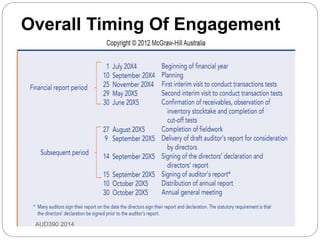
Overall Timing Of Engagement
AUD390 2014
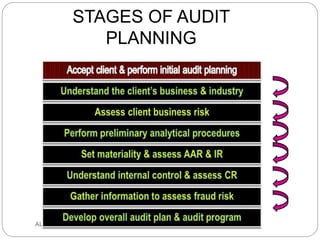
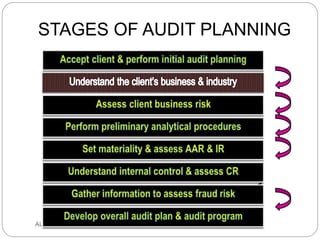
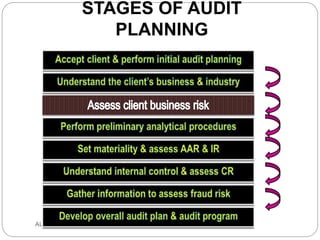
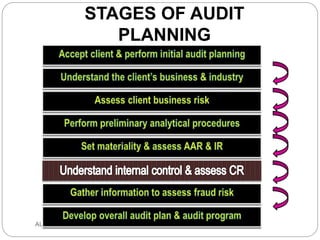
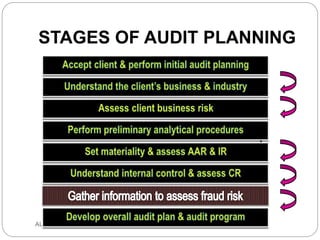
STAGES OF AUDIT
PLANNING
AUD390 2014
Accept Client & Perform
Initial Audit Planning
 Initial Audit Planning:
1. Decides whether to accept a new or continue
serving an existing one
2. Identifies why the client wants or needs an audit
3. Obtains an understanding with the client about the
terms of the engagement
4. Select the staff for the engagement
AUD390 2014
1. Client Acceptance & Continuance
 New Client Investigation
 Reasons for investigation:
Prospective client’s standing in the business
community
Financial stability
Relations with previous auditor
 Procedure to communicate with predecessor auditor
1. The successor auditor should get the prospective
client’s permission to communicate with the existing
predecessor auditor. If the permission is not given,
the successor auditor should decline the
appointment.
AUD390 2014
Cont…
2. The successor auditor should inquire the predecessor
auditor whether there is any professional reason for the
proposed change. If there are such reasons, the
successor auditor should request the predecessor
auditor to provide him with all necessary details in order
to decide the acceptance of the appointment.
3. If the successor auditor does not receive a reply to his
inquiry, he is required to send a reminder to the
predecessor auditor or communicate with him through
other means.
4. If no response within a reasonable period after sending
of 2 reminders, the successor auditor should inform the
predecessor auditor of his attention to accept the
engagement.
AUD390 2014
Cont…
 Continuing Clients
 Determine reason for not continuing to do the audit
Is there any previous conflicts over scope of audit, the
type of opinion to issue or audit fees?
AUD390 2014
2. Identify Client’s Reason for Audit
 Statutory requirements
 Financial statement audit
 Compliance audit
 Weaknesses noted in the operations
 Operations audit
 Audit on Internal Control System
AUD390 2014
3. Obtain an Understanding With the Client
 ISA210 requires that auditors must document their
understanding of an engagement in the audit files, including
the engagement’s objectives, the responsibility of the auditor
& management, and the engagement’s limitations
 Engagement Letter (refer pp. 199)
 An agreement between the CA firm and the client for the
conduct of the audit and related services
 Contents:
Specify job performed by the auditor (audit, review,
compilation, tax return, etc.)
Restriction to be imposed on the auditor’s work
Deadlines for completing the audit
Assistance to be provided by clients
Schedules of audit to be performed by auditor
Audit fees
AUD390 2014
4. Select Staff for Engagement
 MIA By-Laws stated
 A member should carry out his work with a proper
regard for the technical & professional standards
expected of him as a member and should not
undertake or continue professional work which he is
not himself competent to perform unless he obtains
such advice and assistance as will enable him
competently to carry out his work
AUD390 2014
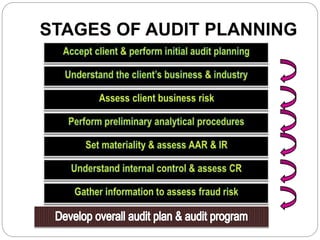
STAGES OF AUDIT PLANNING
AUD390 2014
Understand The Client’s
Business & Industry
 Factors that increased the importance of understanding
the client’s business & industry:
 IT connects client companies with major customers &
suppliers
 Clients have expanded operations globally
 IT affects internal client process, improving the quality
& timeliness of accounting information
 The increased importance of human capital & other
intangible assets has increased accounting complexity
and the importance of management judgments and
estimates
AUD390 2014
Cont…
 Auditors need to understand client’s business & industry
to provide additional value-added services to clients.
 Tools to understand the client's business & industry:
Strategic Systems Approach
1. Industry & External Environment
2. Business Operations & Processes
3. Management & Governance
4. Objectives & Strategies
5. Measurement & Performance
AUD390 2014
1. Industry & External Environment
 Reasons for understanding the client’s business &
industry:
 There are risk associated with specific industry
 There are inherent risk that are typically common to all
clients in certain industry
 Many industries have unique accounting requirement
that the auditor must understand before start to audit
AUD390 2014
2. Business Operations & Processes
 Factors to understand:
 Sources of revenues
 Key customers & suppliers
 Sources of financing
 Information about related parties that may indicate areas
of increased client business risk
 According to FRS 124, require to disclose transactions
with related parties in the financial statements if they are
materials
 Related party: “Parties are considered to be related if one party
has the ability to control the other party or exercise significant
influence over the other party in making financial decisions”
 A Related transaction: any transaction between the client and
related party
 E.g. sales or purchase transactions between a parents company &
its subsidiary, exchanges of equipment between 2 companiesAUD390 2014
3. Management & Governance
 Areas that require auditor to understand
 Management’s philosophy & operating style
Memorandum & Article of Association
Minutes of Meeting
 Ability to identify & respond to risk
 Significant impact the risk of material misstatement in
the financial statements
E.g. significant annual increase in sales and earnings
reported by the company was ultimately determined to
be based on various improper accounting technique
encouraged by the CEO
AUD390 2014
4. Objectives & Strategies
 Auditors should understand client objectives related to:
 Reliability of financial reporting
 Effectiveness & efficiency of operations
 Compliance with laws and regulations
AUD390 2014
5. Measurement & Performance
 Performance measurement systems: the key
performance indicators that management uses to
measure progress towards objectives
 E.g. market share & sales per employee, unit sales
growth, unique visitors to a Web site, sales per square
foot for a retailer, ratio analysis, benchmarking against
key competitors
AUD390 2014
STAGES OF AUDIT
PLANNING
AUD390 2014
Assess Client Business Risk
 Audit Risk :
 Risk that the auditor gives an inappropriate opinion when
the FS are materially misstated
 Risk that the auditor delivers an incorrect audit opinion –
an opinion which states that the account presents a true
& fair view while in reality they do not
 Measure of how willing the auditor is to accept that the
FS may be materially misstated after the audit is
completed & unqualified audit opinion has been issued
 Factors result in uncertainty in audit performance
 Nature of audit test
 Inherent limitations of an audit
 Inherent limitations of the effectiveness of client’s internal
control systemAUD390 2014
Cont…
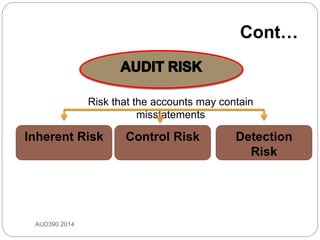
AUD390 2014
Inherent Risk
Risk that the accounts may contain
misstatements
Detection
Risk
Control Risk
 Risk related to the characteristics of the business that may
cause material FS
 Factors used in assessing inherent risks
 Nature of client’s business
 Integrity of management
 Client motivation
 Client’s knowledge of accounting standards
 Results of previous audit
 Susceptibility of defalcation
 Nature of client’s inventory & technological development
 For example external factors such as technological
development might make a particular product obsolete
 IR is high if no internal control system & IR is low of
internal control existAUD390 2014
Inherent Risk (IR)
Control Risk (CR)
 Risk that the client’s internal control will not prevent or
detect material errors or misstatements in the account
balance
 Control risk exist due to the inherent limitation of internal
control system & inadequacy of the segregation of duties
such as human error, faulty judgment
 CR high if internal control system is not effective & CR low
if internal controls system is effective
AUD390 2014
Detection Risk (Dr)
 Risk that any remaining material misstatements after
assessing IR & CR will not be detected by auditor
 Risk that the auditor’s substantive procedures & review FS
will not detect material errors misstatements
 DR high if the auditors are not competent & due care & DR
low if the auditors are competent & exercise due care
AUD390 2014
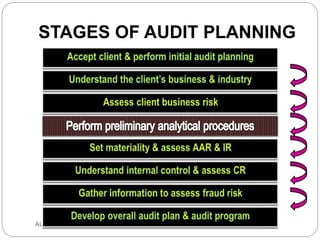
STAGES OF AUDIT PLANNING
AUD390 2014
Perform
Preliminary Analytical
Procedures
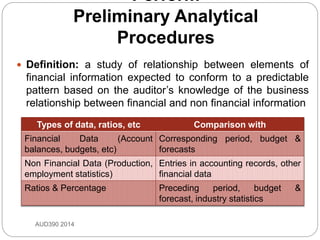
 Definition: a study of relationship between elements of
financial information expected to conform to a predictable
pattern based on the auditor’s knowledge of the business
relationship between financial and non financial information
AUD390 2014
Types of data, ratios, etc Comparison with
Financial Data (Account
balances, budgets, etc)
Corresponding period, budget &
forecasts
Non Financial Data (Production,
employment statistics)
Entries in accounting records, other
financial data
Ratios & Percentage Preceding period, budget &
forecast, industry statistics
Cont…
 Types of analytical procedures:
1. Compare client data & industry data
2. Compare client data with similar prior-period data
3. Compare client data client-determined expected
results
4. Compare client data & auditor-determined expected
results
5. Compare client data with expected results, using
non financial data
AUD390 2014
 Common financial ratios
1. Short-term Debt-Paying Ability
 E.g. Cash ratio, quick ratio & current ratio
2. Liquidity Activity Ratios
 E.g. Accounts receivable turnover, Days to collect
receivables, Inventory turnover, Days to sell
inventory
3. Ability to meet Long-term Debt Obligations
 E.g. Debt to equity, Times interest earned
4. Profitability Ratios
 E.g. Earnings per share, Gross profit margin, Profit
margin, Return on assets, Return on common equity
AUD390 2014
Cont…
Cont…
AUD390 2014
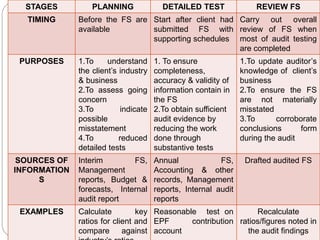
STAGES PLANNING DETAILED TEST REVIEW FS
TIMING Before the FS are
available
Start after client had
submitted FS with
supporting schedules
Carry out overall
review of FS when
most of audit testing
are completed
PURPOSES 1.To understand
the client’s industry
& business
2.To assess going
concern
3.To indicate
possible
misstatement
4.To reduced
detailed tests
1. To ensure
completeness,
accuracy & validity of
information contain in
the FS
2.To obtain sufficient
audit evidence by
reducing the work
done through
substantive tests
1.To update auditor’s
knowledge of client’s
business
2.To ensure the FS
are not materially
misstated
3.To corroborate
conclusions form
during the audit
SOURCES OF
INFORMATION
S
Interim FS,
Management
reports, Budget &
forecasts, Internal
audit report
Annual FS,
Accounting & other
records, Management
reports, Internal audit
reports
Drafted audited FS
EXAMPLES Calculate key
ratios for client and
compare against
Reasonable test on
EPF contribution
account
Recalculate
ratios/figures noted in
the audit findings
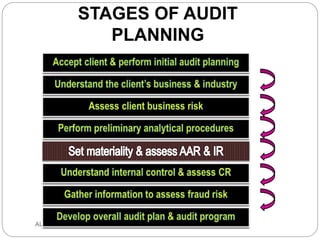
STAGES OF AUDIT
PLANNING
AUD390 2014
Set Materiality And Assess AAR
& IR
 MATERIALITY
 Definition: A misstatement or omission of financial
information that may influence or affect the decision
made by the user of financial statements
 Factors effecting preliminary judgment about materiality
 Materiality is a relative rather than an absolute
concept
 Bases is needed for evaluating materiality
 Qualitative factors will affect materiality decisions
 Expected dissemination (various types of users) of
FS
 The level of acceptable audit riskAUD390 2014
Cont…
 Assessment of audit risk & materiality
 The assessment of audit risk & materiality is a matter
of the auditor’s professional judgment
 Factors that auditor consider to decide whether an item
is material or not:
 Its absolute size
 Its nature
 Its relative size
AUD390 2014
STAGES OF AUDIT
PLANNING
AUD390 2014
Understand IC & Assess CR
 Refer topic on Internal Control System & Control Risk
AUD390 2014
STAGES OF AUDIT PLANNING
AUD390 2014
Gather Information
To Assess Fraud Risk
 Definition : Intentional misstatement of the FS
 Types of fraud:
 Misappropriation of assets, often called as defalcation or
employee fraud
 E.g. a clerk taking case at the time a sale is made
 Fraudulent financial reporting, often called as
management fraud
 E.g. intentional overstatement of sales near the balance
sheet date to increase reported earnings
AUD390 2014
STAGES OF AUDIT PLANNING
AUD390 2014
Types Of Audit Tests
1. Procedure to obtain an understanding of internal
control
2. Tests of controls
3. Substantive tests of transactions
4. Analytical procedures
5. Tests of detailed of balances
AUD390 2014
Audit Program
AUD390 2014
 It is the list of audit procedures for an audit area
 It normally includes a list of the audit procedures,
audit sample sizes, items to select & the timing
for tests
 Refer Table 13-4 (pp. 397)
TUTORIAL QUESTIONS
1. What are the purposes of an engagement letter?
2. What are the contents of an engagement letter?
3. Preliminary engagement activities are undertaken at the
beginning stage of an audit process. List and explain 3
activities to be performed by external auditor during the
preliminary engagement.
4. State 2 benefits of audit planning.
AUD390 2014

Topic 7 audit planning (2)

  • 1.
    TOPIC 7: AUDITPLANNING References: Chapter 8 & 9 AUD390 2014 AUDITING AND ASSURANCE SERVICES IN MALAYSIA
  • 2.
    LEARNING OUTCOMES AUD390 2014 ENGAGEMENT LETTER  PLANNING ACTIVITIES  UNDERSTANDING THE CLIENT’S BUSINESS & INDUSTRY  FUNDAMENTAL CONCEPTS OF MATERIALITY & AUDIT RISK  RELATIONSHIP BETWEEN MATERIALITY VALUE & EVIDENCE  PREPARATION OF AUDIT PROGRAMME  DETERMINATION OF AUDIT OBJECTIVES  ANALYTICAL PROCEDURES - PLANNING, FIELDWORK & COMPLETION STAGE
  • 3.
    OVERVIEW OF AUDIT PLANNING Definition: involves general strategy and detail approach for the expected nature, timing and extent of an audit  Reasons for Audit Planning  To enable the auditor to obtain sufficient competent evidence for the circumstances  To help keep audit costs reasonable  To avoid misunderstandings with the client AUD390 2014
  • 4.
    Overall Timing OfEngagement AUD390 2014
  • 5.
  • 6.
    Accept Client &Perform Initial Audit Planning  Initial Audit Planning: 1. Decides whether to accept a new or continue serving an existing one 2. Identifies why the client wants or needs an audit 3. Obtains an understanding with the client about the terms of the engagement 4. Select the staff for the engagement AUD390 2014
  • 7.
    1. Client Acceptance& Continuance  New Client Investigation  Reasons for investigation: Prospective client’s standing in the business community Financial stability Relations with previous auditor  Procedure to communicate with predecessor auditor 1. The successor auditor should get the prospective client’s permission to communicate with the existing predecessor auditor. If the permission is not given, the successor auditor should decline the appointment. AUD390 2014
  • 8.
    Cont… 2. The successorauditor should inquire the predecessor auditor whether there is any professional reason for the proposed change. If there are such reasons, the successor auditor should request the predecessor auditor to provide him with all necessary details in order to decide the acceptance of the appointment. 3. If the successor auditor does not receive a reply to his inquiry, he is required to send a reminder to the predecessor auditor or communicate with him through other means. 4. If no response within a reasonable period after sending of 2 reminders, the successor auditor should inform the predecessor auditor of his attention to accept the engagement. AUD390 2014
  • 9.
    Cont…  Continuing Clients Determine reason for not continuing to do the audit Is there any previous conflicts over scope of audit, the type of opinion to issue or audit fees? AUD390 2014
  • 10.
    2. Identify Client’sReason for Audit  Statutory requirements  Financial statement audit  Compliance audit  Weaknesses noted in the operations  Operations audit  Audit on Internal Control System AUD390 2014
  • 11.
    3. Obtain anUnderstanding With the Client  ISA210 requires that auditors must document their understanding of an engagement in the audit files, including the engagement’s objectives, the responsibility of the auditor & management, and the engagement’s limitations  Engagement Letter (refer pp. 199)  An agreement between the CA firm and the client for the conduct of the audit and related services  Contents: Specify job performed by the auditor (audit, review, compilation, tax return, etc.) Restriction to be imposed on the auditor’s work Deadlines for completing the audit Assistance to be provided by clients Schedules of audit to be performed by auditor Audit fees AUD390 2014
  • 12.
    4. Select Stafffor Engagement  MIA By-Laws stated  A member should carry out his work with a proper regard for the technical & professional standards expected of him as a member and should not undertake or continue professional work which he is not himself competent to perform unless he obtains such advice and assistance as will enable him competently to carry out his work AUD390 2014
  • 13.
    STAGES OF AUDITPLANNING AUD390 2014
  • 14.
    Understand The Client’s Business& Industry  Factors that increased the importance of understanding the client’s business & industry:  IT connects client companies with major customers & suppliers  Clients have expanded operations globally  IT affects internal client process, improving the quality & timeliness of accounting information  The increased importance of human capital & other intangible assets has increased accounting complexity and the importance of management judgments and estimates AUD390 2014
  • 15.
    Cont…  Auditors needto understand client’s business & industry to provide additional value-added services to clients.  Tools to understand the client's business & industry: Strategic Systems Approach 1. Industry & External Environment 2. Business Operations & Processes 3. Management & Governance 4. Objectives & Strategies 5. Measurement & Performance AUD390 2014
  • 16.
    1. Industry &External Environment  Reasons for understanding the client’s business & industry:  There are risk associated with specific industry  There are inherent risk that are typically common to all clients in certain industry  Many industries have unique accounting requirement that the auditor must understand before start to audit AUD390 2014
  • 17.
    2. Business Operations& Processes  Factors to understand:  Sources of revenues  Key customers & suppliers  Sources of financing  Information about related parties that may indicate areas of increased client business risk  According to FRS 124, require to disclose transactions with related parties in the financial statements if they are materials  Related party: “Parties are considered to be related if one party has the ability to control the other party or exercise significant influence over the other party in making financial decisions”  A Related transaction: any transaction between the client and related party  E.g. sales or purchase transactions between a parents company & its subsidiary, exchanges of equipment between 2 companiesAUD390 2014
  • 18.
    3. Management &Governance  Areas that require auditor to understand  Management’s philosophy & operating style Memorandum & Article of Association Minutes of Meeting  Ability to identify & respond to risk  Significant impact the risk of material misstatement in the financial statements E.g. significant annual increase in sales and earnings reported by the company was ultimately determined to be based on various improper accounting technique encouraged by the CEO AUD390 2014
  • 19.
    4. Objectives &Strategies  Auditors should understand client objectives related to:  Reliability of financial reporting  Effectiveness & efficiency of operations  Compliance with laws and regulations AUD390 2014
  • 20.
    5. Measurement &Performance  Performance measurement systems: the key performance indicators that management uses to measure progress towards objectives  E.g. market share & sales per employee, unit sales growth, unique visitors to a Web site, sales per square foot for a retailer, ratio analysis, benchmarking against key competitors AUD390 2014
  • 21.
  • 22.
    Assess Client BusinessRisk  Audit Risk :  Risk that the auditor gives an inappropriate opinion when the FS are materially misstated  Risk that the auditor delivers an incorrect audit opinion – an opinion which states that the account presents a true & fair view while in reality they do not  Measure of how willing the auditor is to accept that the FS may be materially misstated after the audit is completed & unqualified audit opinion has been issued  Factors result in uncertainty in audit performance  Nature of audit test  Inherent limitations of an audit  Inherent limitations of the effectiveness of client’s internal control systemAUD390 2014
  • 23.
    Cont… AUD390 2014 Inherent Risk Riskthat the accounts may contain misstatements Detection Risk Control Risk
  • 24.
     Risk relatedto the characteristics of the business that may cause material FS  Factors used in assessing inherent risks  Nature of client’s business  Integrity of management  Client motivation  Client’s knowledge of accounting standards  Results of previous audit  Susceptibility of defalcation  Nature of client’s inventory & technological development  For example external factors such as technological development might make a particular product obsolete  IR is high if no internal control system & IR is low of internal control existAUD390 2014 Inherent Risk (IR)
  • 25.
    Control Risk (CR) Risk that the client’s internal control will not prevent or detect material errors or misstatements in the account balance  Control risk exist due to the inherent limitation of internal control system & inadequacy of the segregation of duties such as human error, faulty judgment  CR high if internal control system is not effective & CR low if internal controls system is effective AUD390 2014
  • 26.
    Detection Risk (Dr) Risk that any remaining material misstatements after assessing IR & CR will not be detected by auditor  Risk that the auditor’s substantive procedures & review FS will not detect material errors misstatements  DR high if the auditors are not competent & due care & DR low if the auditors are competent & exercise due care AUD390 2014
  • 27.
    STAGES OF AUDITPLANNING AUD390 2014
  • 28.
    Perform Preliminary Analytical Procedures  Definition:a study of relationship between elements of financial information expected to conform to a predictable pattern based on the auditor’s knowledge of the business relationship between financial and non financial information AUD390 2014 Types of data, ratios, etc Comparison with Financial Data (Account balances, budgets, etc) Corresponding period, budget & forecasts Non Financial Data (Production, employment statistics) Entries in accounting records, other financial data Ratios & Percentage Preceding period, budget & forecast, industry statistics
  • 29.
    Cont…  Types ofanalytical procedures: 1. Compare client data & industry data 2. Compare client data with similar prior-period data 3. Compare client data client-determined expected results 4. Compare client data & auditor-determined expected results 5. Compare client data with expected results, using non financial data AUD390 2014
  • 30.
     Common financialratios 1. Short-term Debt-Paying Ability  E.g. Cash ratio, quick ratio & current ratio 2. Liquidity Activity Ratios  E.g. Accounts receivable turnover, Days to collect receivables, Inventory turnover, Days to sell inventory 3. Ability to meet Long-term Debt Obligations  E.g. Debt to equity, Times interest earned 4. Profitability Ratios  E.g. Earnings per share, Gross profit margin, Profit margin, Return on assets, Return on common equity AUD390 2014 Cont…
  • 31.
    Cont… AUD390 2014 STAGES PLANNINGDETAILED TEST REVIEW FS TIMING Before the FS are available Start after client had submitted FS with supporting schedules Carry out overall review of FS when most of audit testing are completed PURPOSES 1.To understand the client’s industry & business 2.To assess going concern 3.To indicate possible misstatement 4.To reduced detailed tests 1. To ensure completeness, accuracy & validity of information contain in the FS 2.To obtain sufficient audit evidence by reducing the work done through substantive tests 1.To update auditor’s knowledge of client’s business 2.To ensure the FS are not materially misstated 3.To corroborate conclusions form during the audit SOURCES OF INFORMATION S Interim FS, Management reports, Budget & forecasts, Internal audit report Annual FS, Accounting & other records, Management reports, Internal audit reports Drafted audited FS EXAMPLES Calculate key ratios for client and compare against Reasonable test on EPF contribution account Recalculate ratios/figures noted in the audit findings
  • 32.
  • 33.
    Set Materiality AndAssess AAR & IR  MATERIALITY  Definition: A misstatement or omission of financial information that may influence or affect the decision made by the user of financial statements  Factors effecting preliminary judgment about materiality  Materiality is a relative rather than an absolute concept  Bases is needed for evaluating materiality  Qualitative factors will affect materiality decisions  Expected dissemination (various types of users) of FS  The level of acceptable audit riskAUD390 2014
  • 34.
    Cont…  Assessment ofaudit risk & materiality  The assessment of audit risk & materiality is a matter of the auditor’s professional judgment  Factors that auditor consider to decide whether an item is material or not:  Its absolute size  Its nature  Its relative size AUD390 2014
  • 35.
  • 36.
    Understand IC &Assess CR  Refer topic on Internal Control System & Control Risk AUD390 2014
  • 37.
    STAGES OF AUDITPLANNING AUD390 2014
  • 38.
    Gather Information To AssessFraud Risk  Definition : Intentional misstatement of the FS  Types of fraud:  Misappropriation of assets, often called as defalcation or employee fraud  E.g. a clerk taking case at the time a sale is made  Fraudulent financial reporting, often called as management fraud  E.g. intentional overstatement of sales near the balance sheet date to increase reported earnings AUD390 2014
  • 39.
    STAGES OF AUDITPLANNING AUD390 2014
  • 40.
    Types Of AuditTests 1. Procedure to obtain an understanding of internal control 2. Tests of controls 3. Substantive tests of transactions 4. Analytical procedures 5. Tests of detailed of balances AUD390 2014
  • 41.
    Audit Program AUD390 2014 It is the list of audit procedures for an audit area  It normally includes a list of the audit procedures, audit sample sizes, items to select & the timing for tests  Refer Table 13-4 (pp. 397)
  • 42.
    TUTORIAL QUESTIONS 1. Whatare the purposes of an engagement letter? 2. What are the contents of an engagement letter? 3. Preliminary engagement activities are undertaken at the beginning stage of an audit process. List and explain 3 activities to be performed by external auditor during the preliminary engagement. 4. State 2 benefits of audit planning. AUD390 2014