






.
Introduction to Financial
Statements and Audit
Introduction to Financial
Statements and Audit
We cover in this session the following:

1. Introduction to Financial Statements
2. User’s of financial statements
3. Why do we audit them
Introduction to Financial Statements
Purpose of Financial Statements
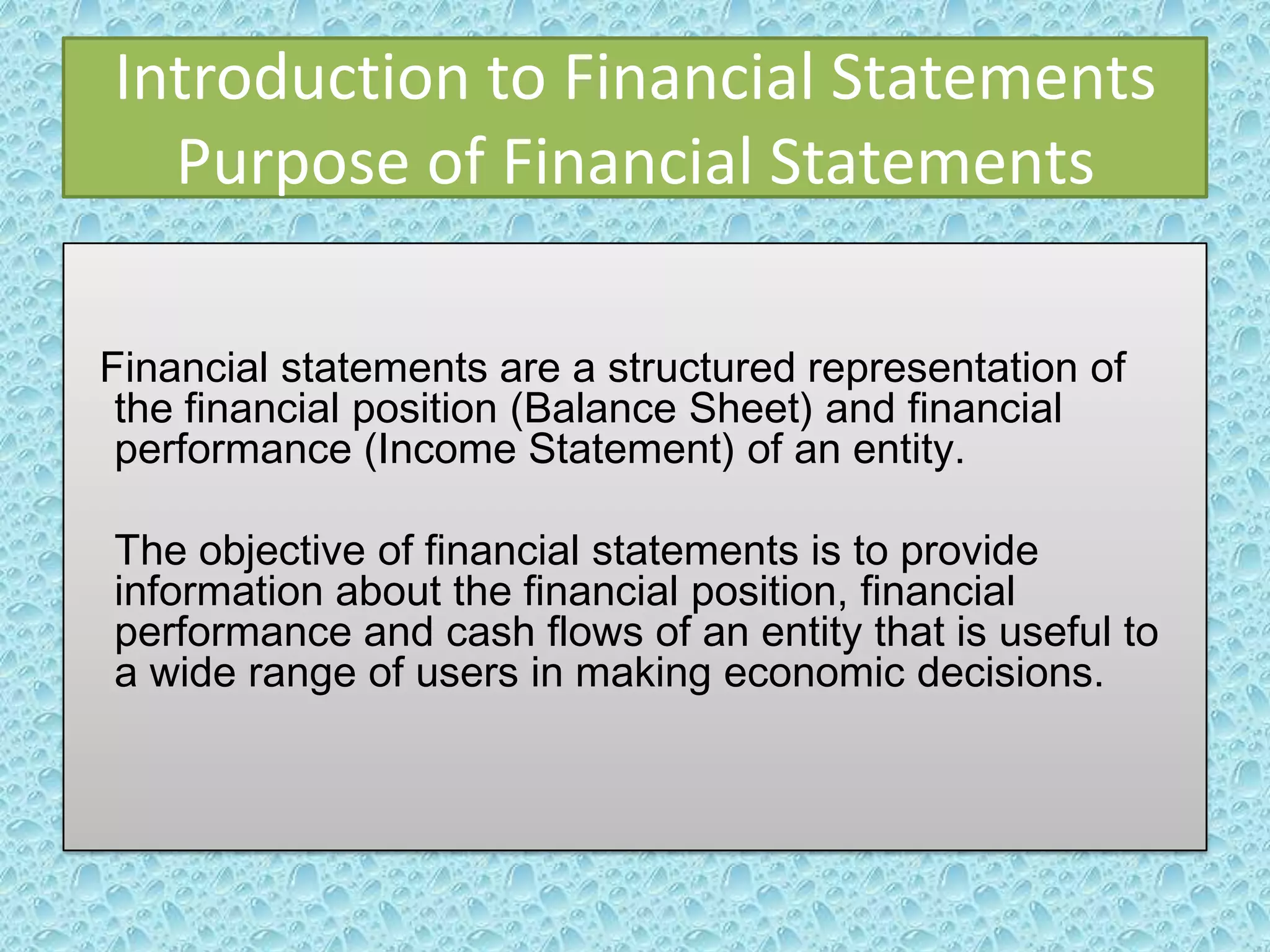
Financial statements are a structured representation of
the financial position (Balance Sheet) and financial
performance (Income Statement) of an entity.

The objective of financial statements is to provide
information about the financial position, financial
performance and cash flows of an entity that is useful to
a wide range of users in making economic decisions.
Introduction to Financial Statements – User of
Financial Statements
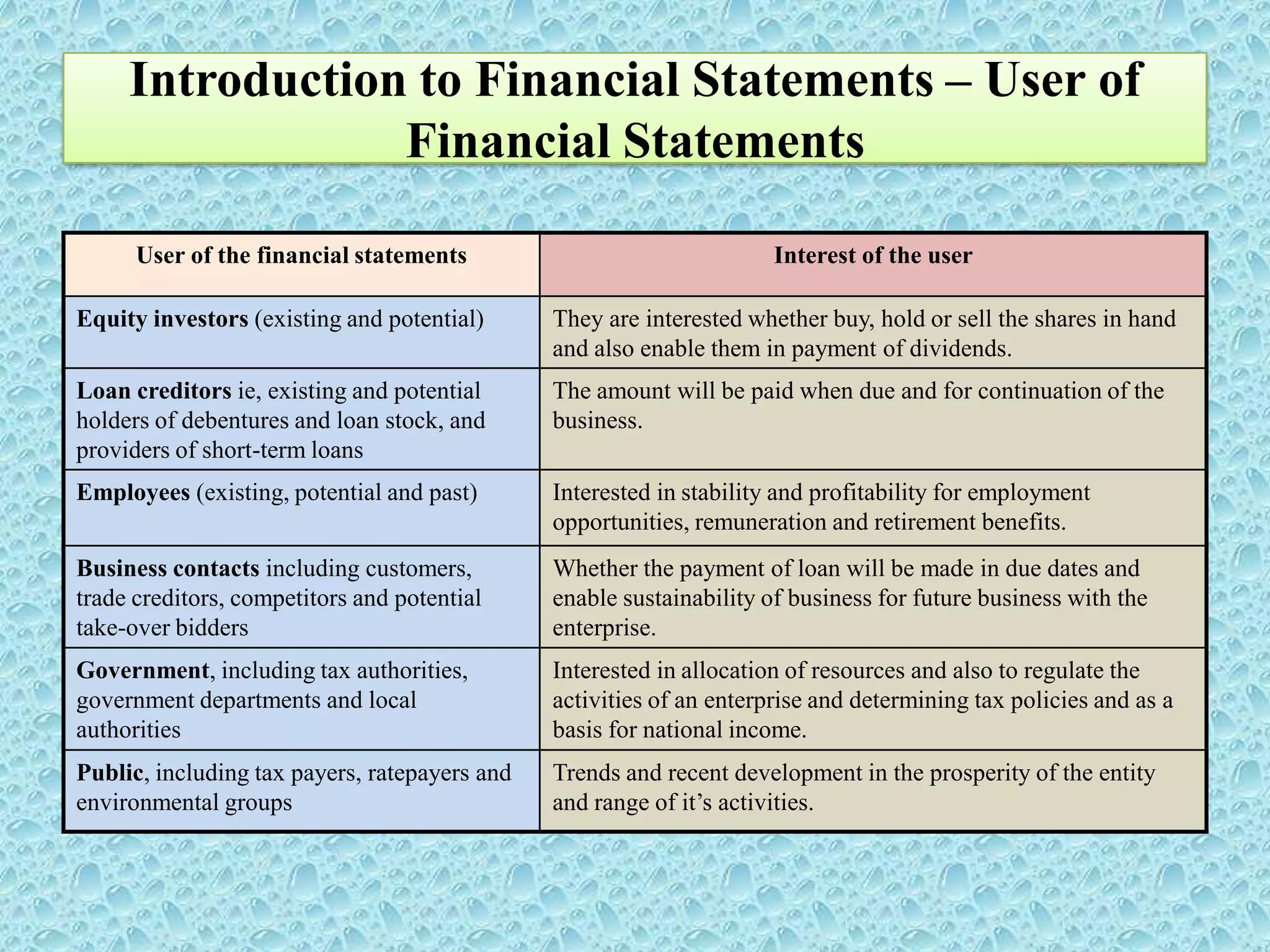
User of the financial statements

Interest of the user

Equity investors (existing and potential)

They are interested whether buy, hold or sell the shares in hand
and also enable them in payment of dividends.

Loan creditors ie, existing and potential
holders of debentures and loan stock, and
providers of short-term loans

The amount will be paid when due and for continuation of the
business.

Employees (existing, potential and past)

Interested in stability and profitability for employment
opportunities, remuneration and retirement benefits.

Business contacts including customers,
trade creditors, competitors and potential
take-over bidders

Whether the payment of loan will be made in due dates and
enable sustainability of business for future business with the
enterprise.

Government, including tax authorities,
government departments and local
authorities

Interested in allocation of resources and also to regulate the
activities of an enterprise and determining tax policies and as a
basis for national income.

Public, including tax payers, ratepayers and
environmental groups

Trends and recent development in the prosperity of the entity
and range of it’s activities.
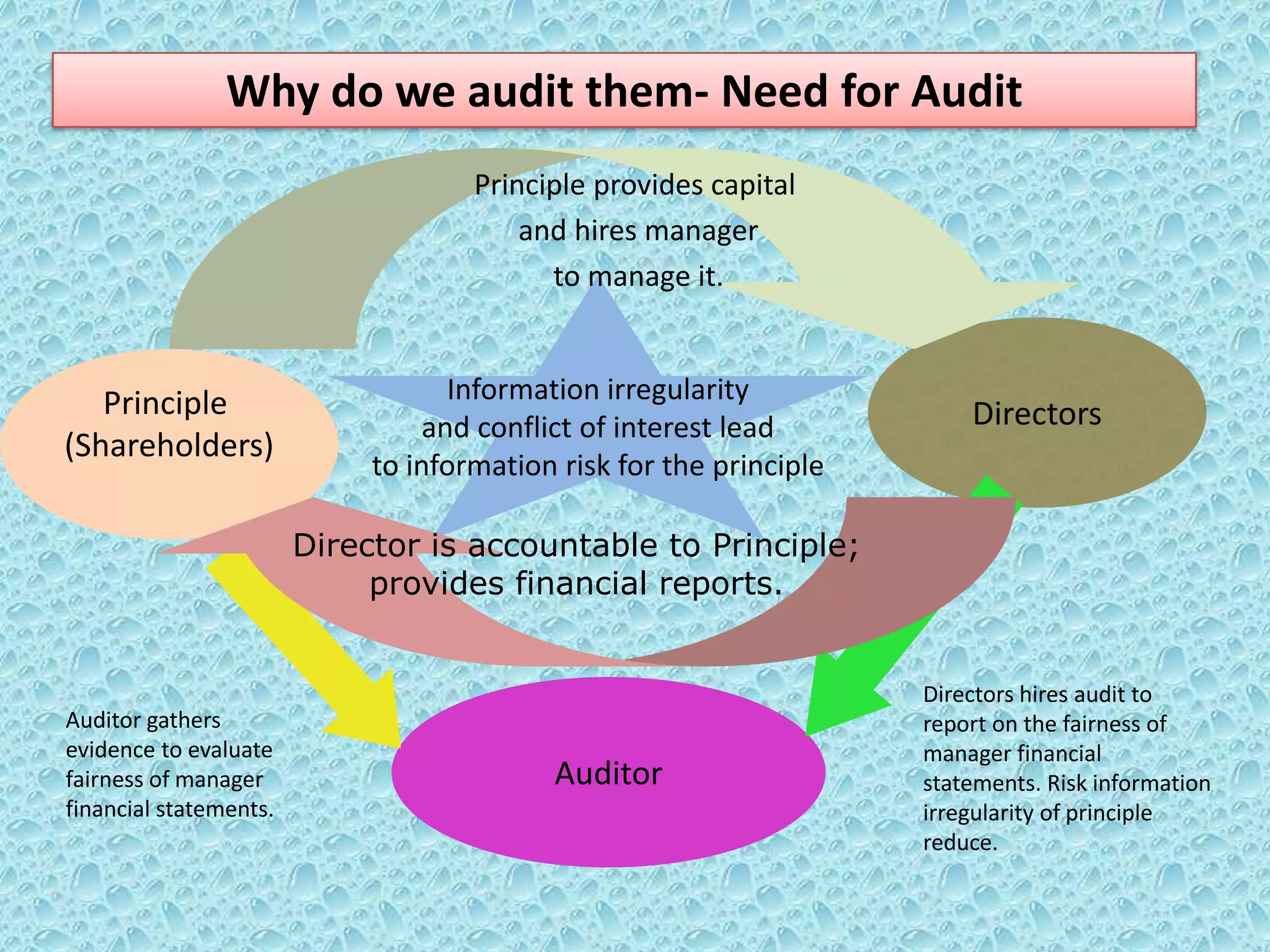
Why do we audit them- Need for Audit
Principle provides capital
and hires manager
to manage it.

Principle
(Shareholders)

Information irregularity
and conflict of interest lead
to information risk for the principle

Directors

Director is accountable to Principle;
provides financial reports.

Auditor gathers
evidence to evaluate
fairness of manager
financial statements.

Auditor

Directors hires audit to
report on the fairness of
manager financial
statements. Risk information
irregularity of principle
reduce.
M waseem jutt
UNIVERSITY OF CENTRAL PUNJAB
COURSE
MCOM
K1F12MCOM0047
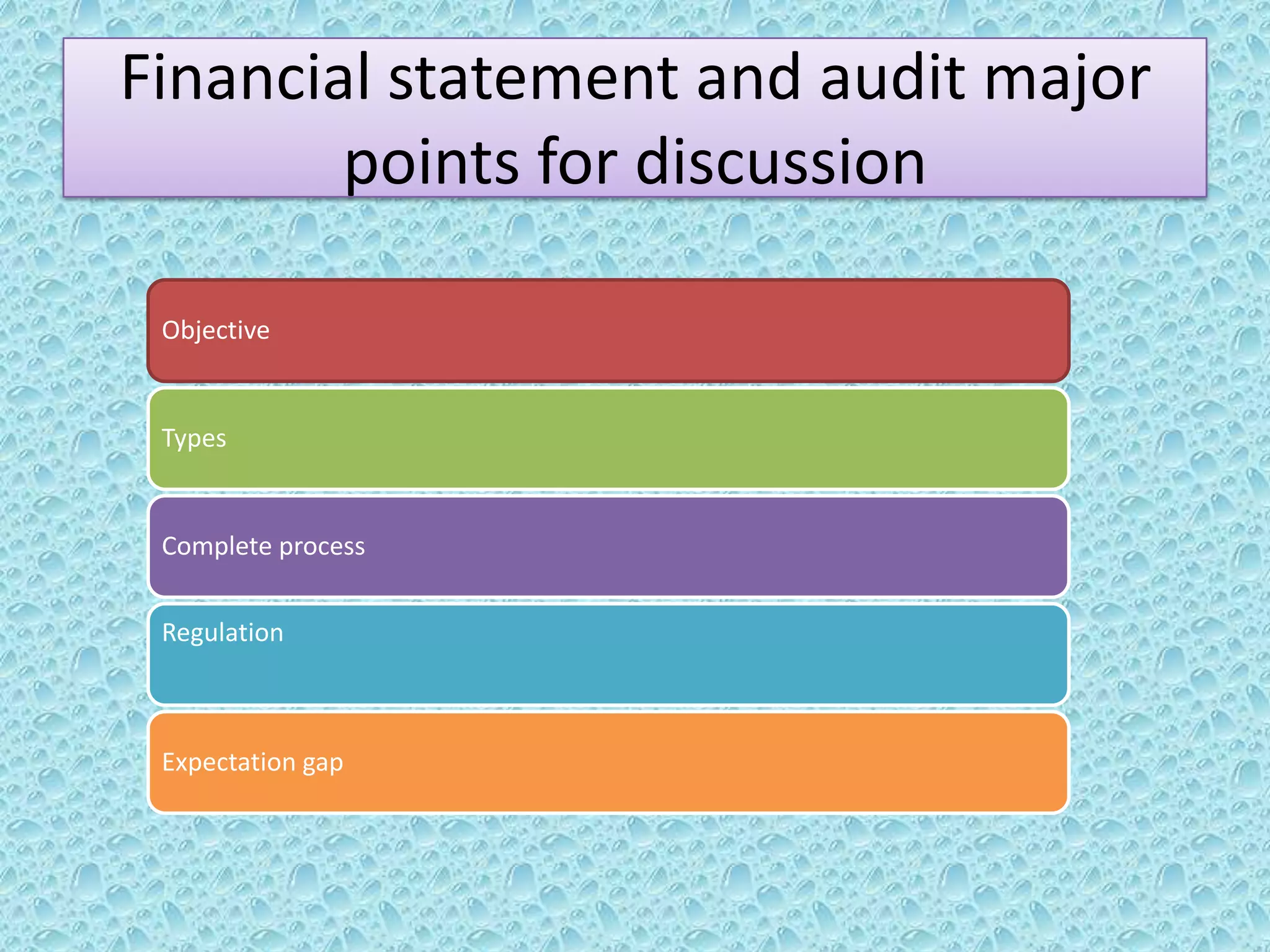
Financial statement and audit major
points for discussion
Objective

Types

Complete process
Regulation

Expectation gap
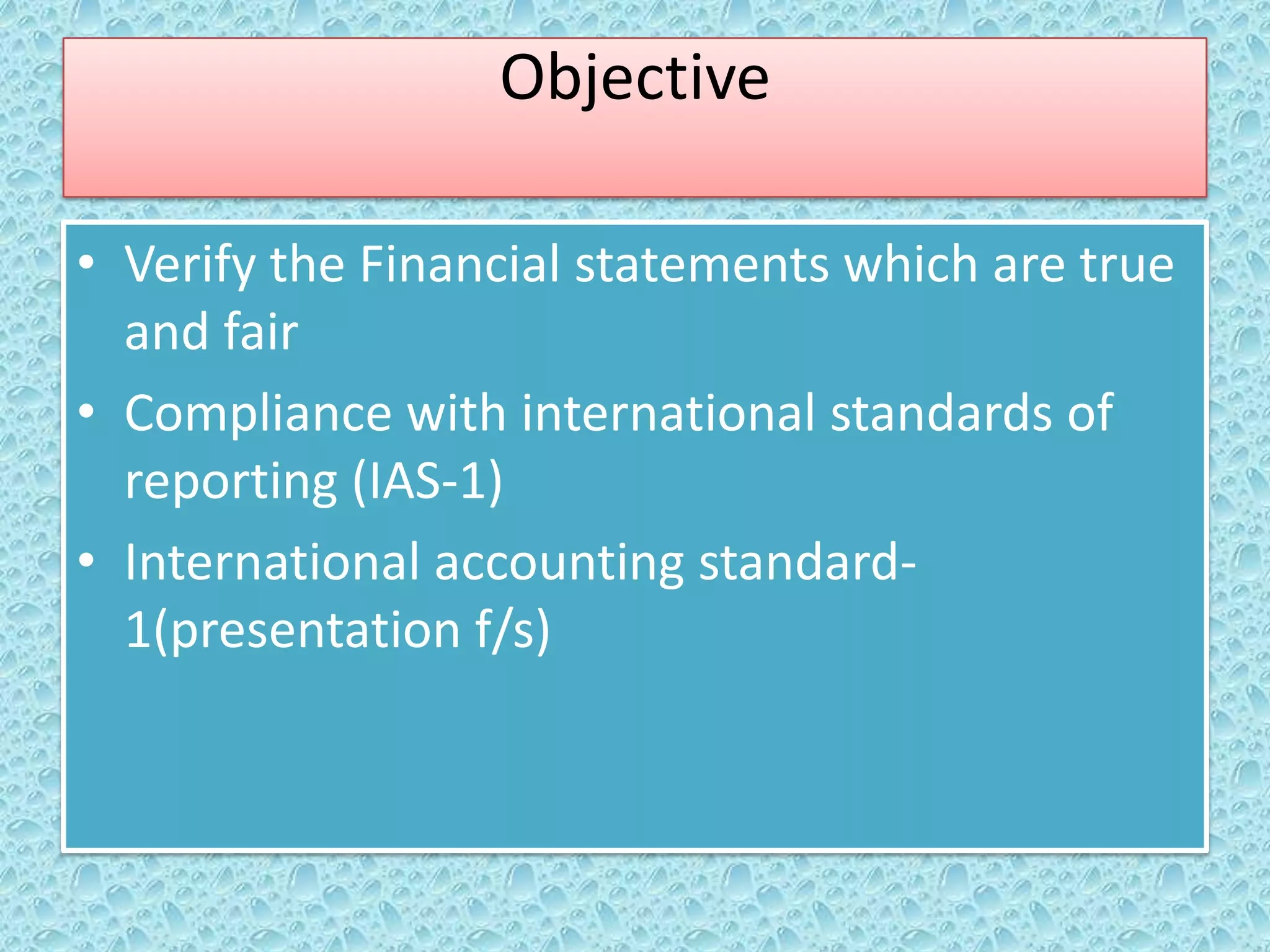
Objective
• Verify the Financial statements which are true
and fair
• Compliance with international standards of
reporting (IAS-1)
• International accounting standard1(presentation f/s)
Objectives of Auditing
• Primary Objective (main objective)
–To produce a report by the auditor
of his opinion of the truth and
fairness of financial statements so
that any person reading or using
them can have belief in them
@Sako Mayrick 2006
Objectives of Auditing
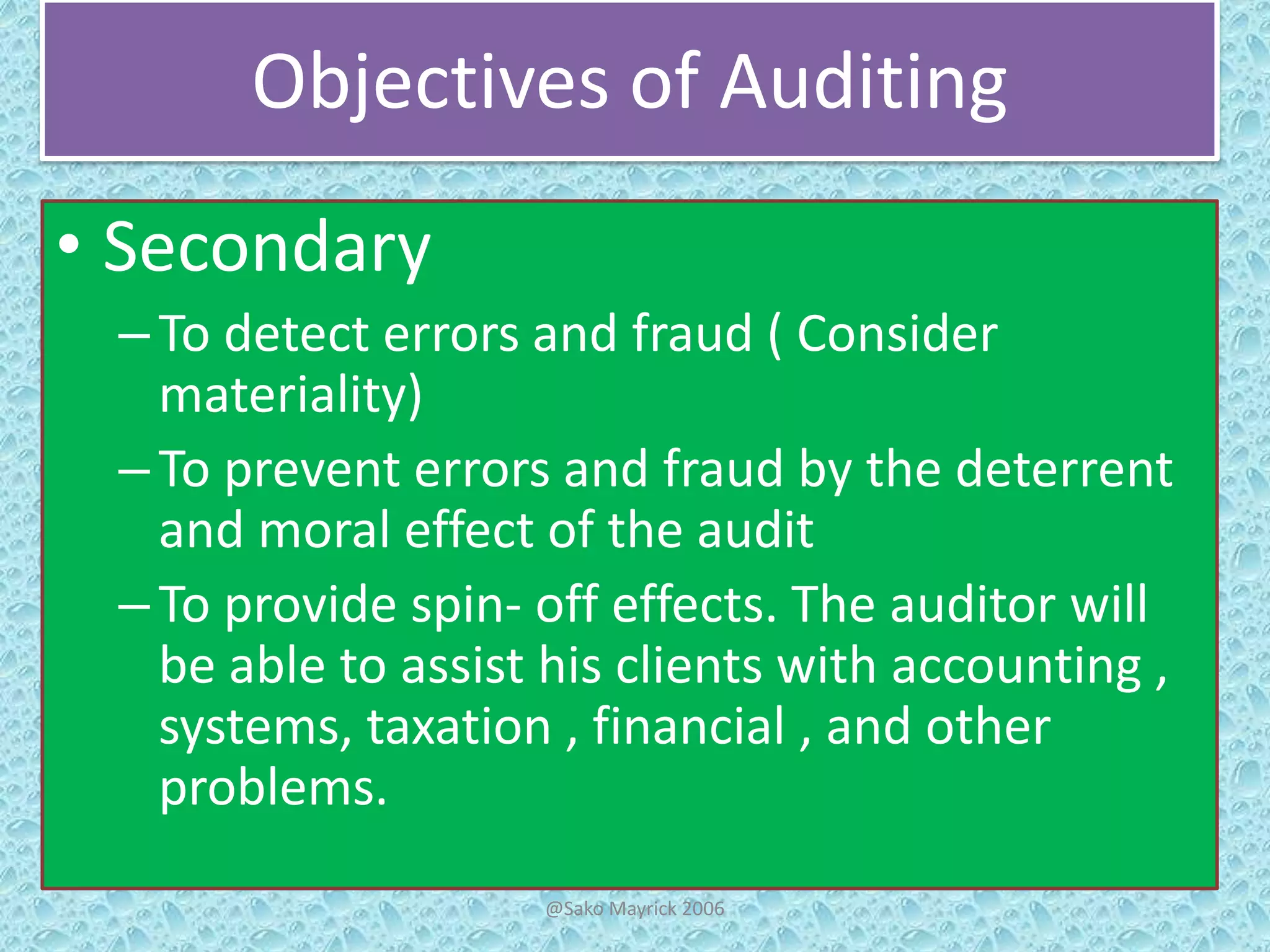
• Secondary
– To detect errors and fraud ( Consider
materiality)
– To prevent errors and fraud by the deterrent
and moral effect of the audit
– To provide spin- off effects. The auditor will
be able to assist his clients with accounting ,
systems, taxation , financial , and other
problems.
@Sako Mayrick 2006
Talha shahzadi
UNIVERSITY OF CENTRAL PUNJAB
COURSE
MCOM
K1F12MCOM0004
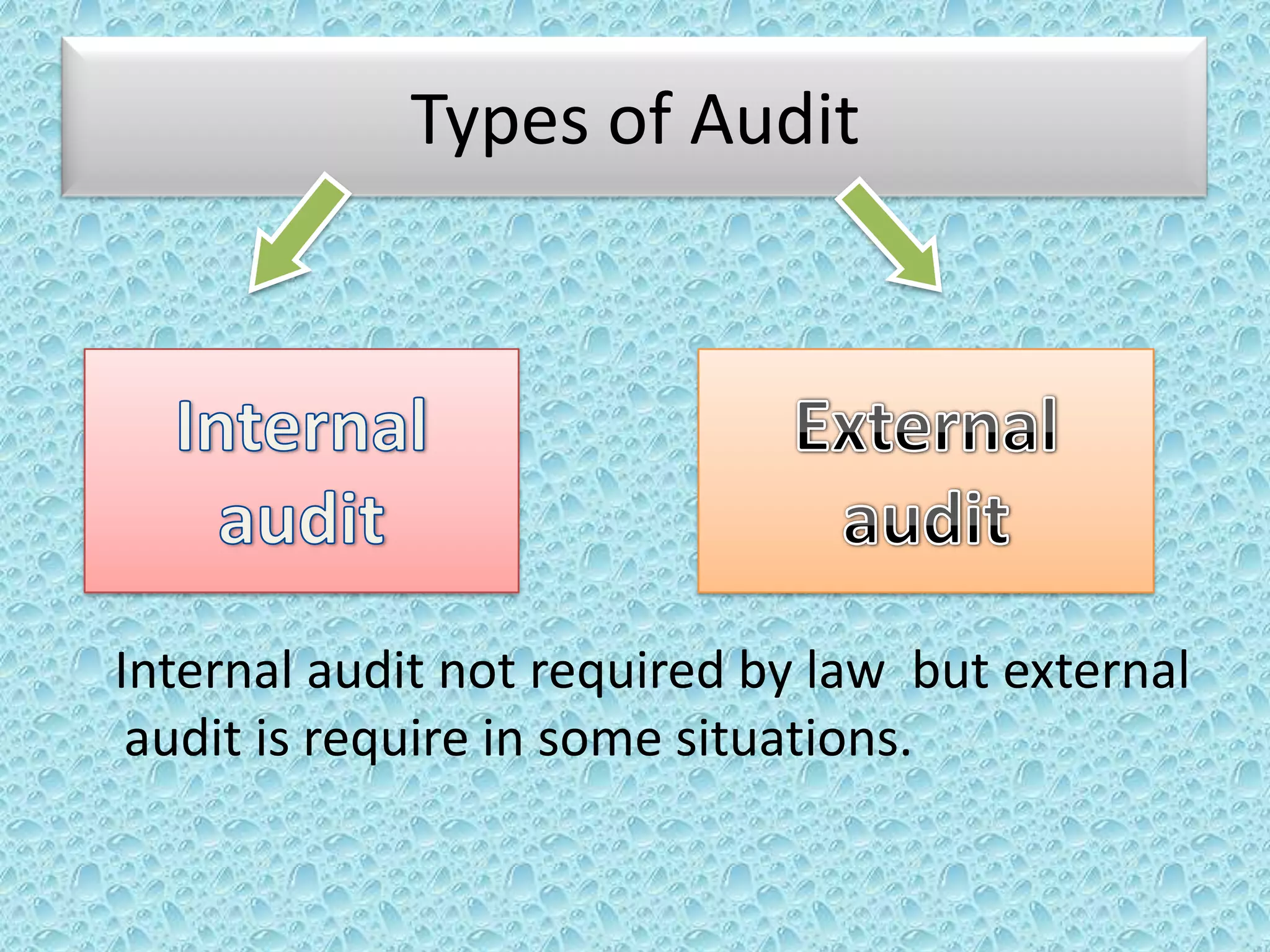
Types of Audit

Internal audit not required by law but external
audit is require in some situations.
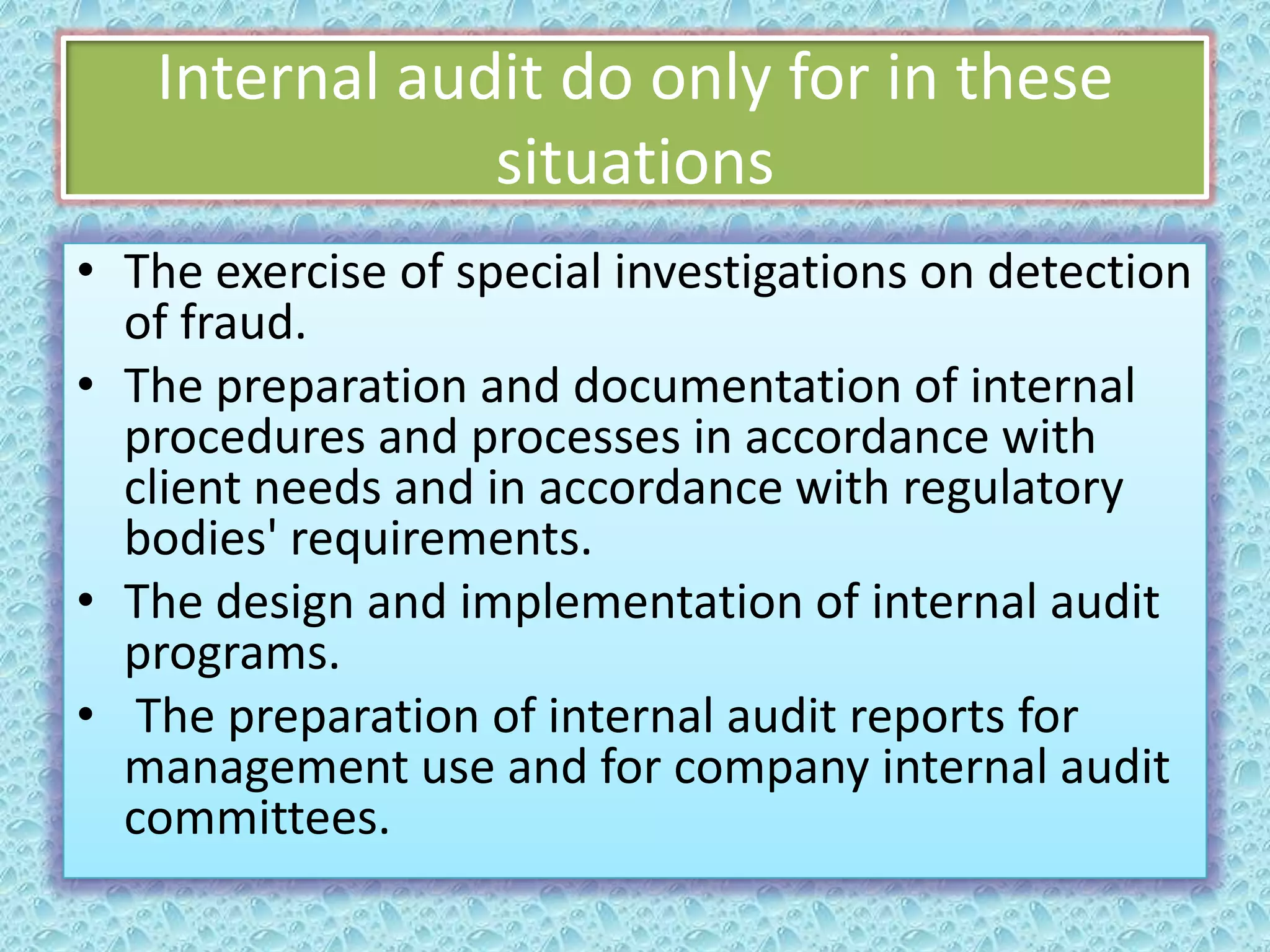
Internal audit do only for in these
situations
• The exercise of special investigations on detection
of fraud.
• The preparation and documentation of internal
procedures and processes in accordance with
client needs and in accordance with regulatory
bodies' requirements.
• The design and implementation of internal audit
programs.
• The preparation of internal audit reports for
management use and for company internal audit
committees.
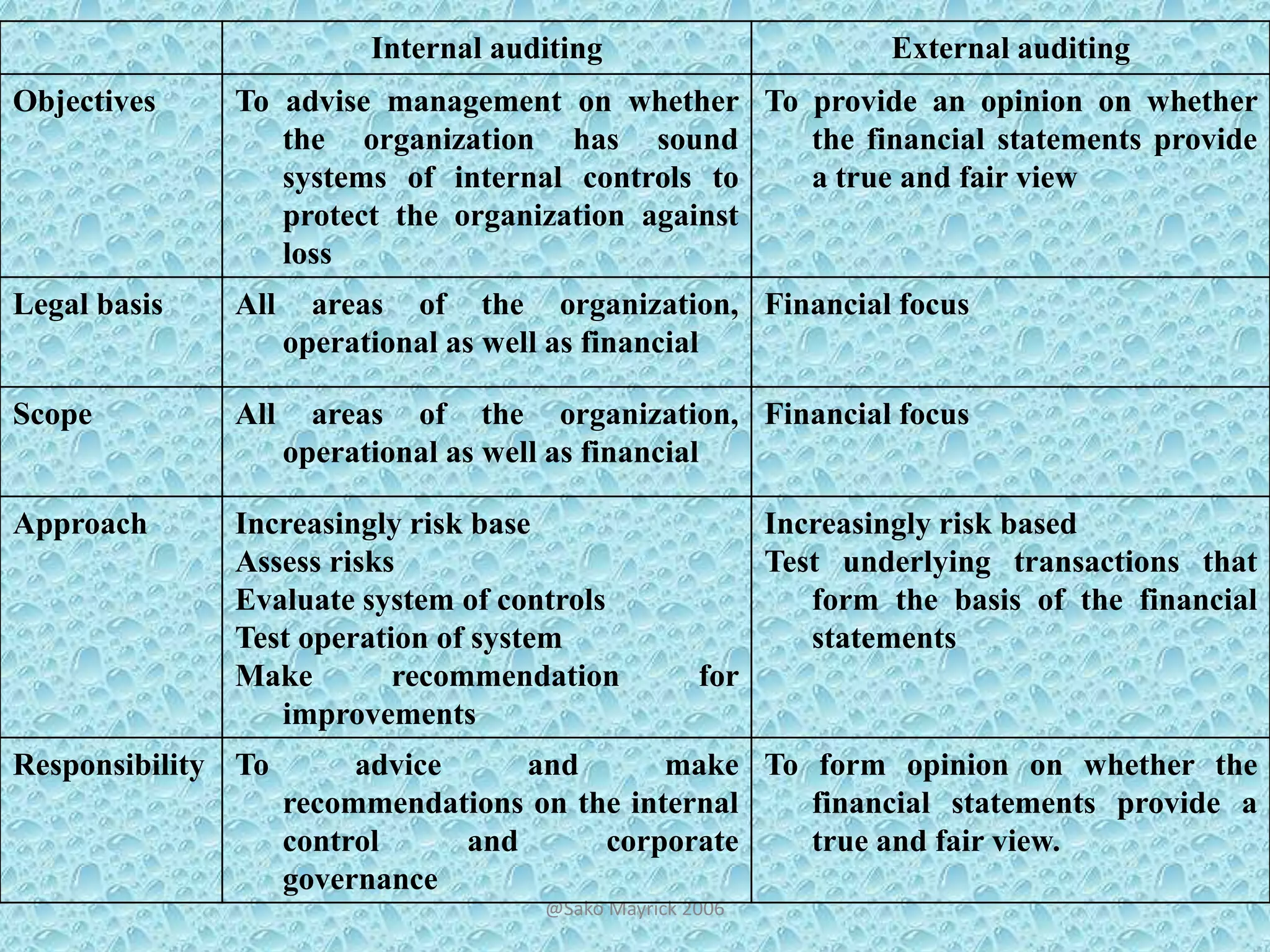
Internal auditing

External auditing

Objectives

To advise management on whether To provide an opinion on whether
the organization has sound
the financial statements provide
systems of internal controls to
a true and fair view
protect the organization against
loss

Legal basis

All

areas of the organization, Financial focus
operational as well as financial

Scope

All

areas of the organization, Financial focus
operational as well as financial

Approach

Increasingly risk base
Assess risks
Evaluate system of controls
Test operation of system
Make
recommendation
improvements

Responsibility To

Increasingly risk based
Test underlying transactions that
form the basis of the financial
statements
for

advice
and
make To form opinion on whether the
recommendations on the internal
financial statements provide a
control
and
corporate
true and fair view.
governance
@Sako Mayrick 2006
Statutory
audit

Nonstatutory
audit

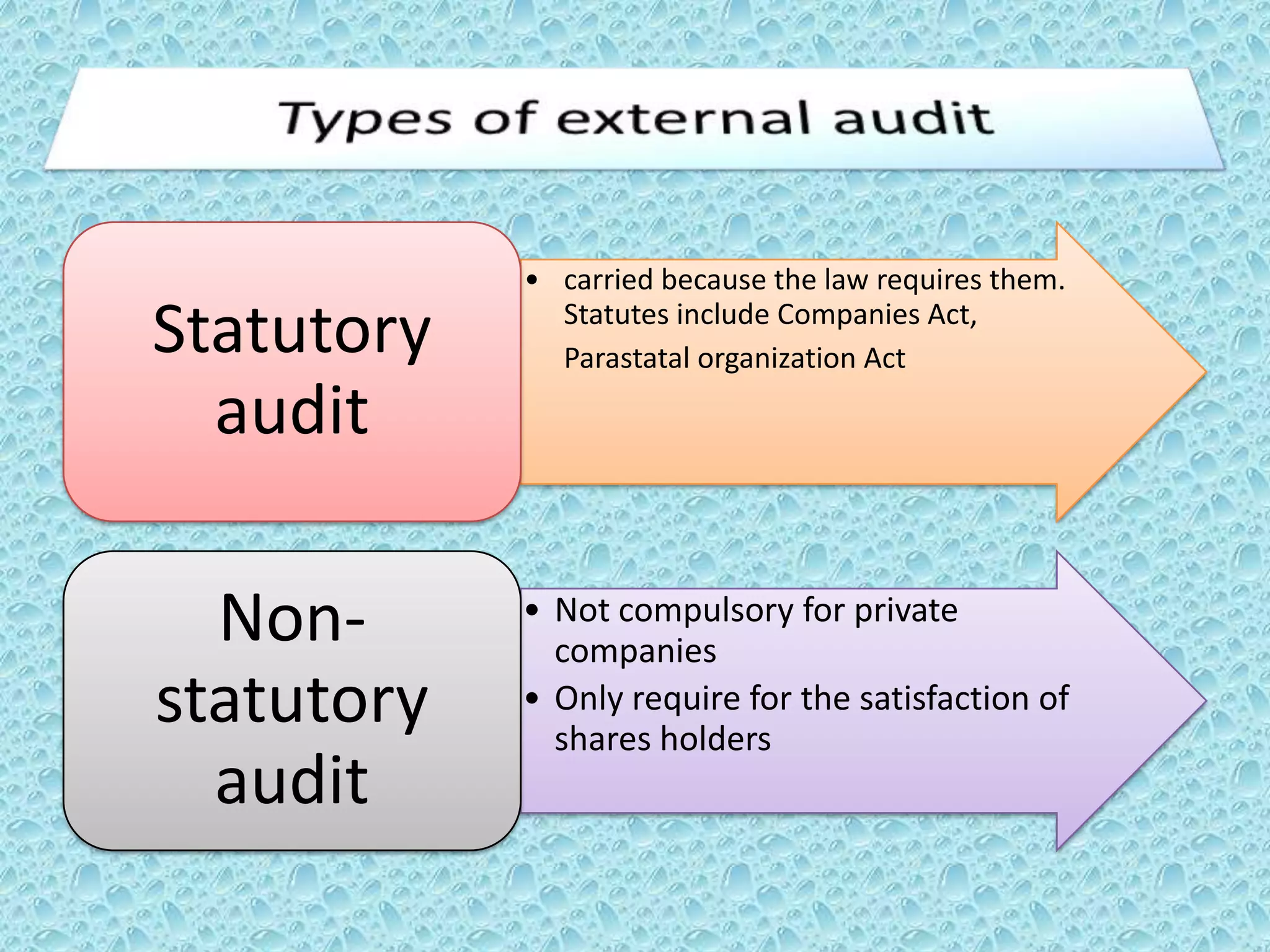
• carried because the law requires them.
Statutes include Companies Act,
Parastatal organization Act

• Not compulsory for private
companies
• Only require for the satisfaction of
shares holders
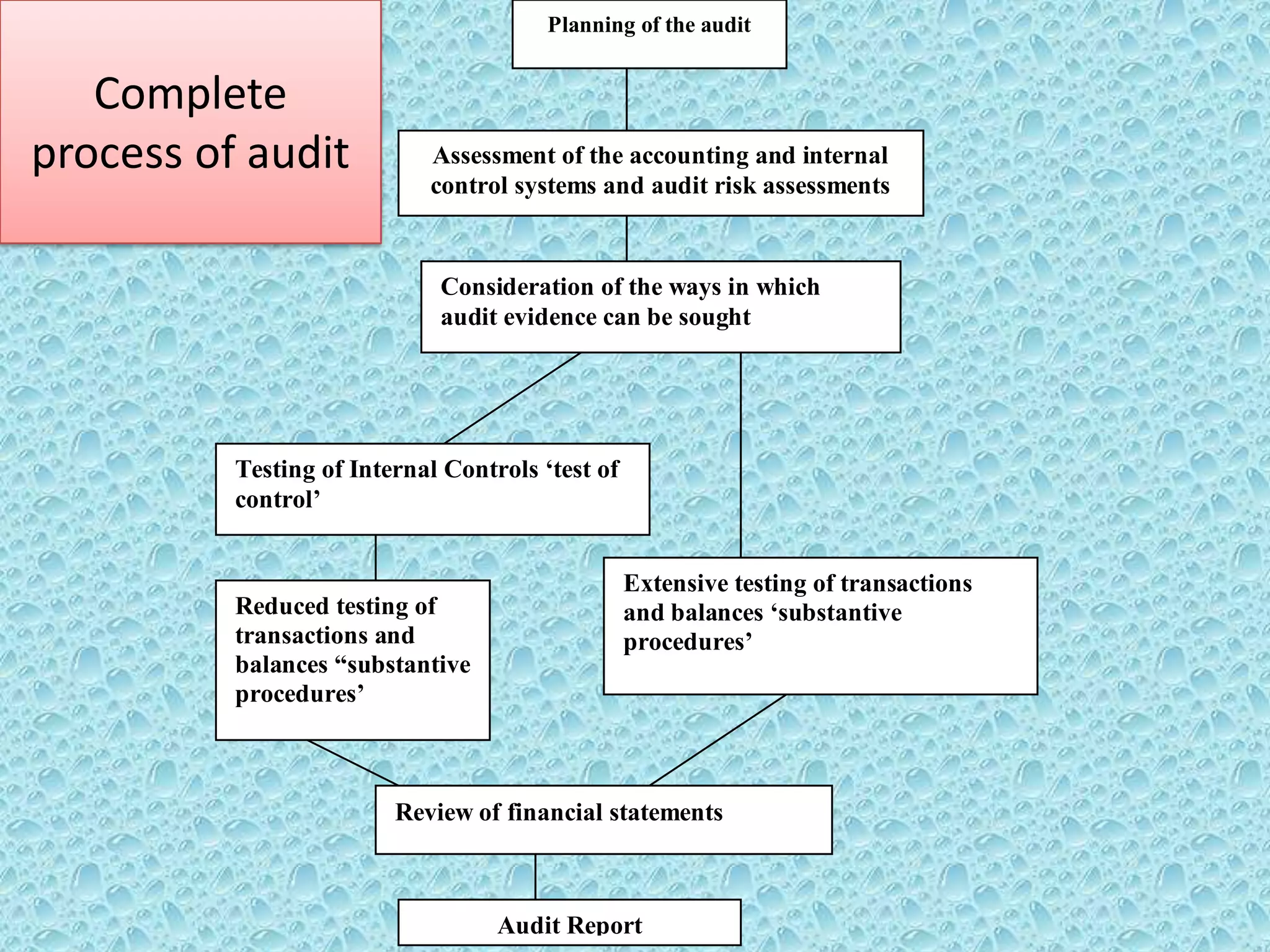
Planning of the audit

Complete
process of audit

Assessment of the accounting and internal
control systems and audit risk assessments

Consideration of the ways in which
audit evidence can be sought

Testing of Internal Controls ‘test of
control’

Reduced testing of
transactions and
balances “substantive
procedures’

Extensive testing of transactions
and balances ‘substantive
procedures’

Review of financial statements

@Sako Mayrick 2006

Audit Report
Rana sohail
UNIVERSITY OF CENTRAL PUNJAB
COURSE
MCOM
K1F12MCOM00o07
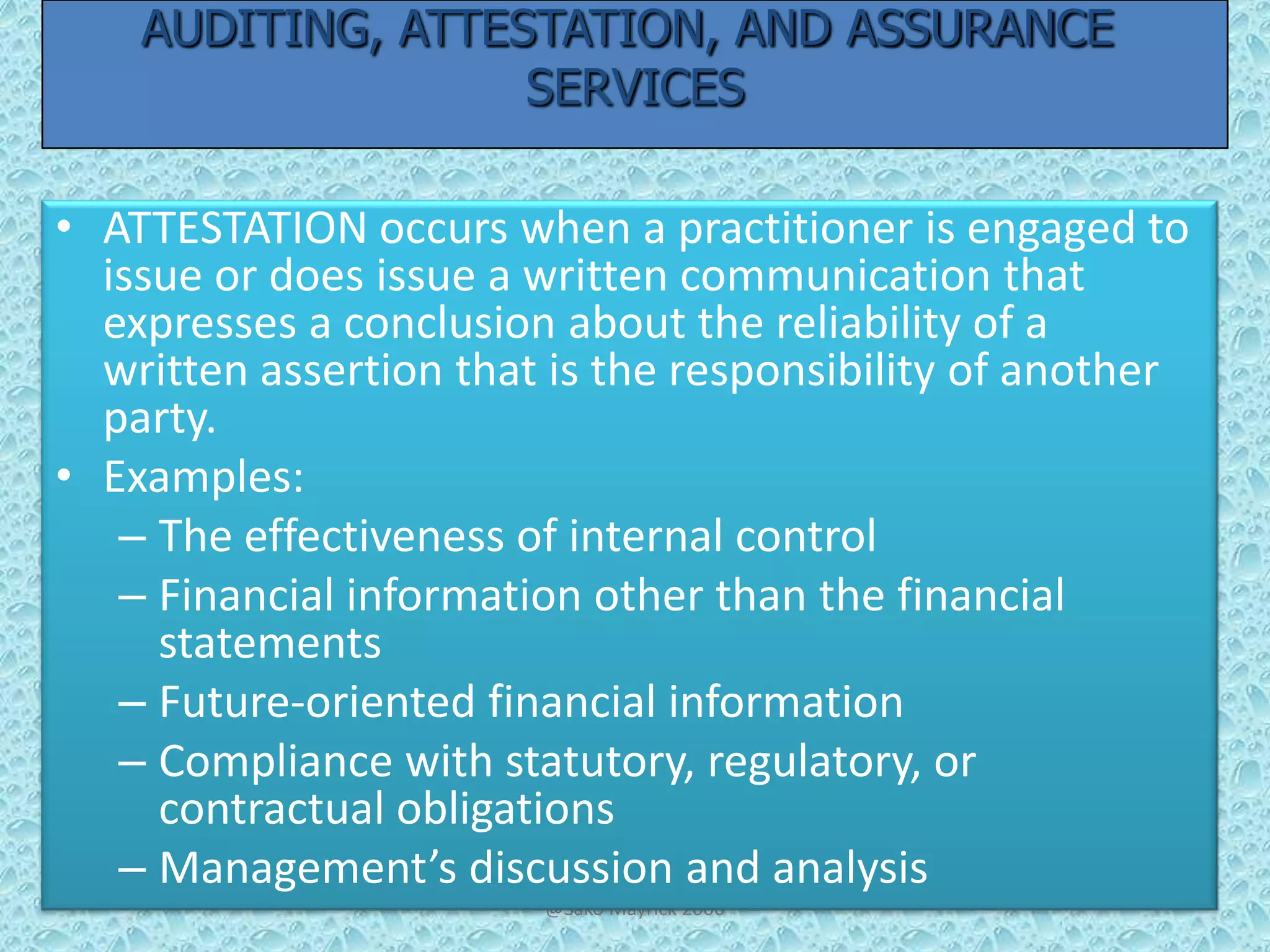
AUDITING, ATTESTATION, AND ASSURANCE
SERVICES
• ATTESTATION occurs when a practitioner is engaged to
issue or does issue a written communication that
expresses a conclusion about the reliability of a
written assertion that is the responsibility of another
party.
• Examples:
– The effectiveness of internal control
– Financial information other than the financial
statements
– Future-oriented financial information
– Compliance with statutory, regulatory, or
contractual obligations
– Management’s discussion and analysis
@Sako Mayrick 2006
AUDITING, ATTESTATION, AND ASSURANCE SERVICES

ASSURANCE services are independent
professional services that improve the quality
of information, or its context, for decision
makers.
Examples:
Risk assessment
Information system reliability
Electronic commerce
Health care performance measurement
@Sako Mayrick 2006
•

IFAC (international federation for accountancy)
IFAC is comprised of 179 members and associates in 130
countries, representing approximately 2.5 million
accountants in public practice, education, government
service, industry, and commerce. IFAC members are
professional accountancy organizations recognized by law
or general consensus within their countries as substantial
national organizations. National organizations may apply to
become an IFAC associate where the organization is
working toward membership.
Subsidiary boards
i) IAASB
The International Auditing and Assurance
Standards Board (IAASB) is an independent
standard-setting body that serves the public
interest by setting high-quality international
standards for auditing.
ii) IFRS ( international financial reporting standard)
iii) IAS (international accounting standard
Ejaz gadi
UNIVERSITY OF CENTRAL PUNJAB
COURSE
MCOM
K1F12MCOM0025
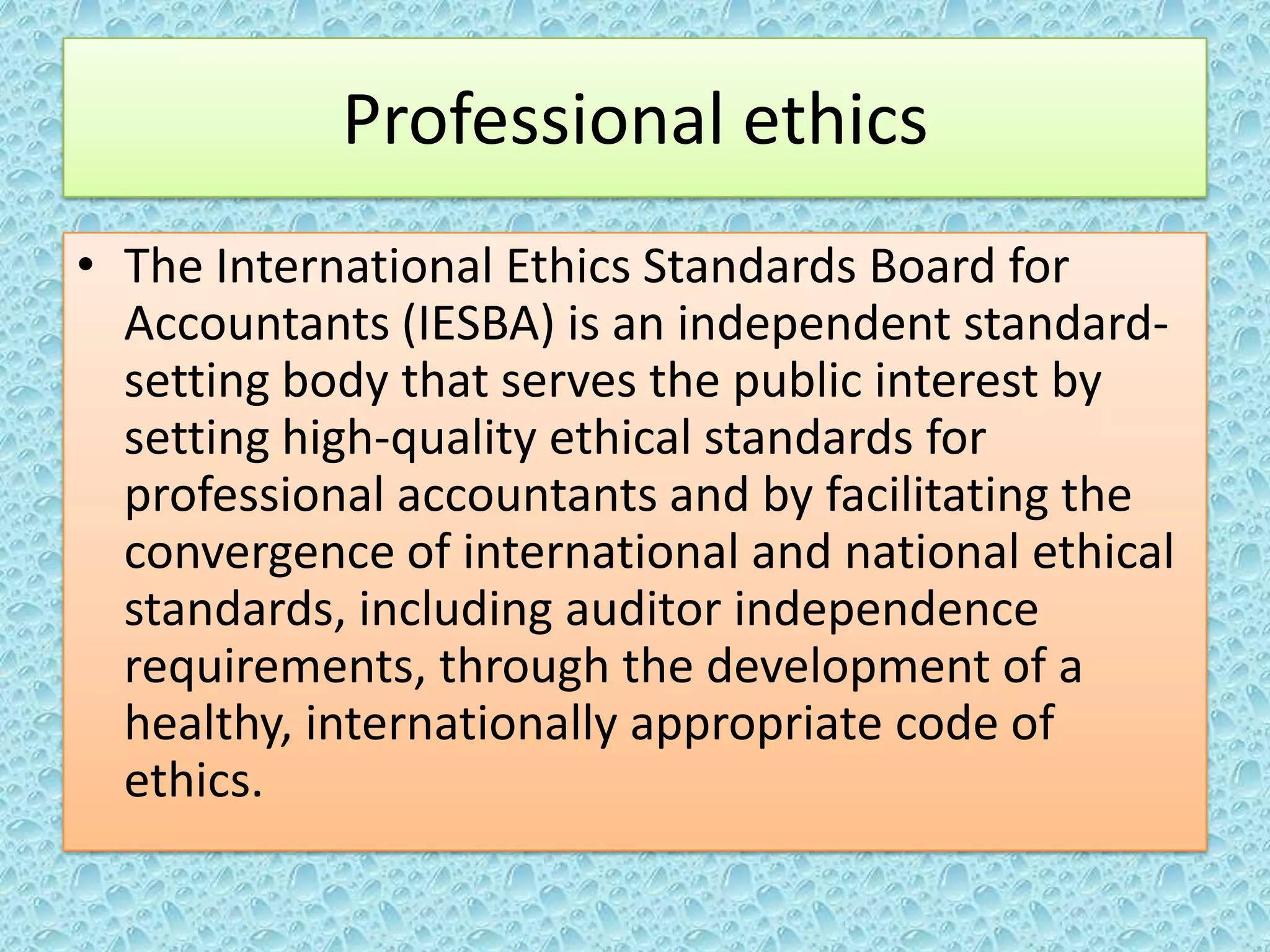
Professional ethics
• The International Ethics Standards Board for
Accountants (IESBA) is an independent standardsetting body that serves the public interest by
setting high-quality ethical standards for
professional accountants and by facilitating the
convergence of international and national ethical
standards, including auditor independence
requirements, through the development of a
healthy, internationally appropriate code of
ethics.
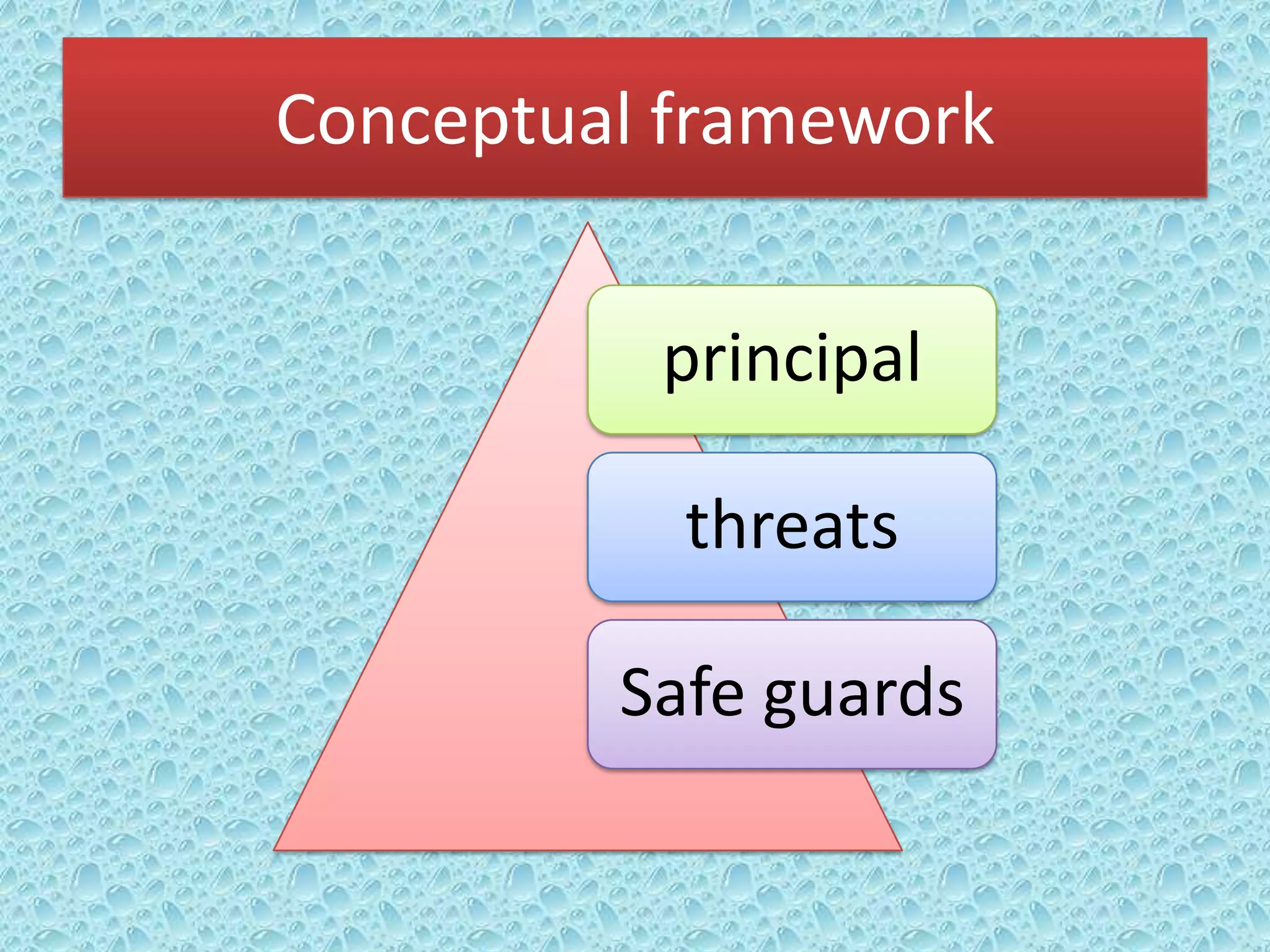
Conceptual framework
principal
threats
Safe guards
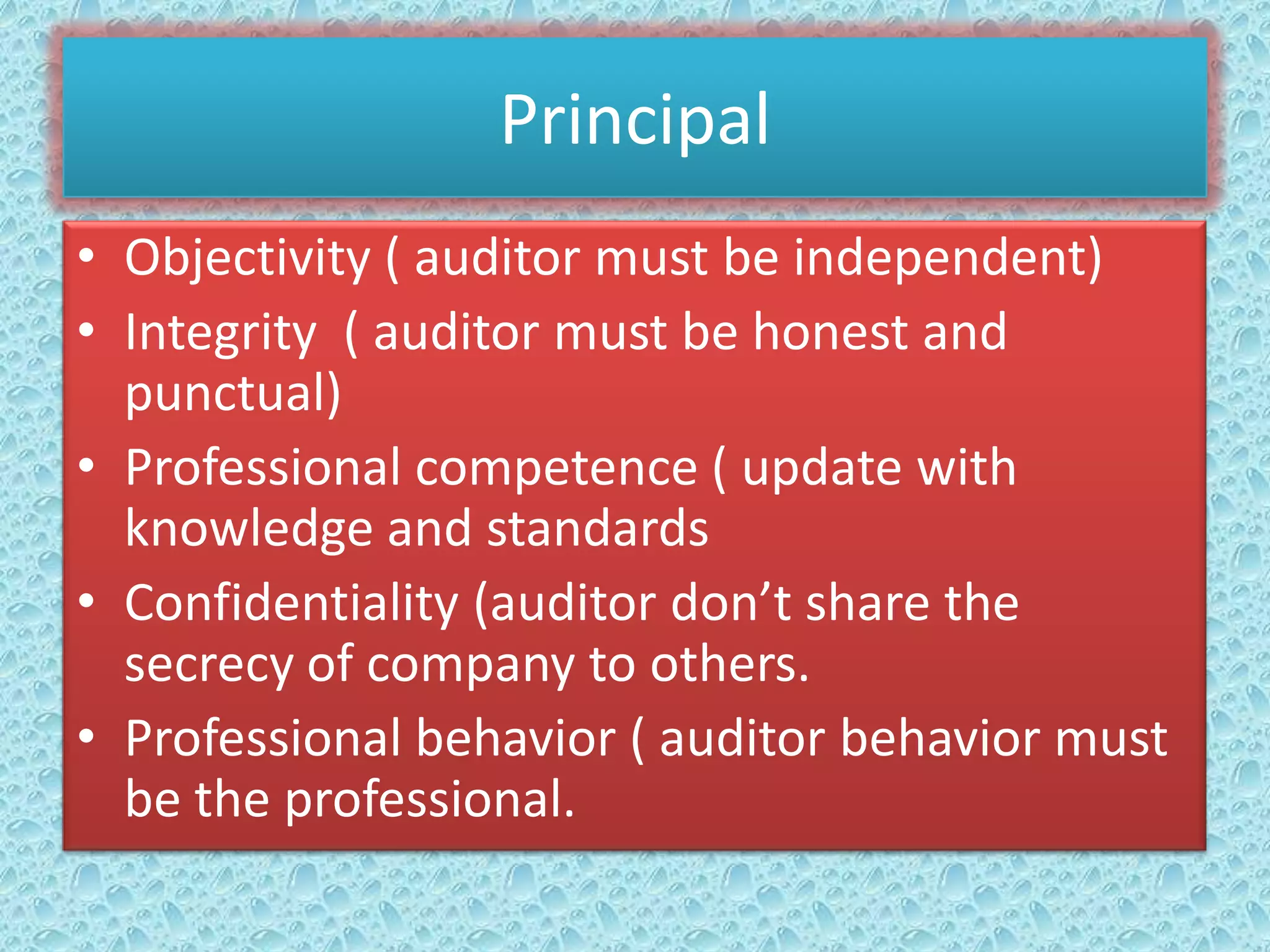
Principal
• Objectivity ( auditor must be independent)
• Integrity ( auditor must be honest and
punctual)
• Professional competence ( update with
knowledge and standards
• Confidentiality (auditor don’t share the
secrecy of company to others.
• Professional behavior ( auditor behavior must
be the professional.
Malik saqib
UNIVERSITY OF CENTRAL PUNJAB
COURSE
MCOM
K1F12MCOM0025
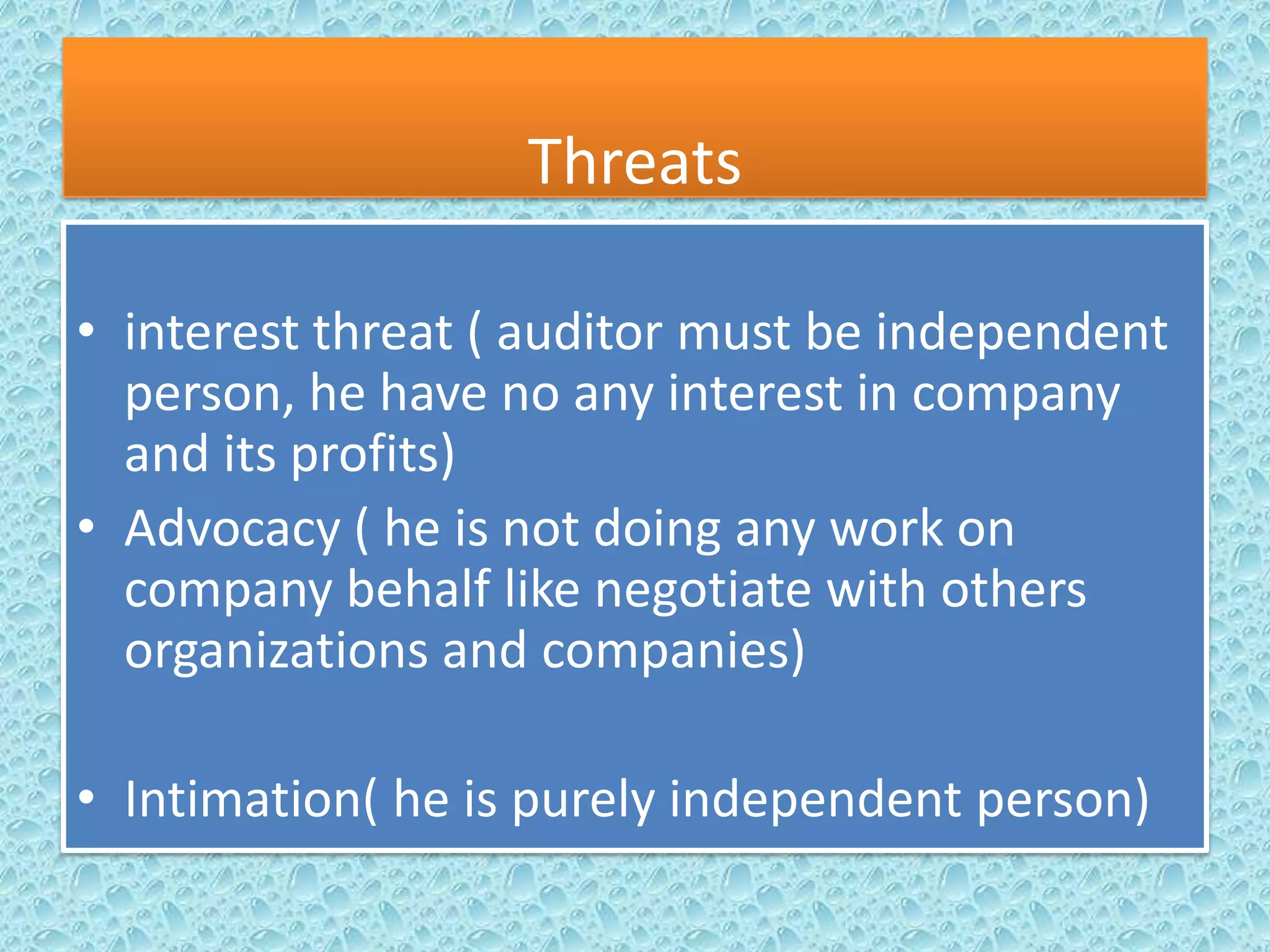
Threats
• interest threat ( auditor must be independent
person, he have no any interest in company
and its profits)
• Advocacy ( he is not doing any work on
company behalf like negotiate with others
organizations and companies)
• Intimation( he is purely independent person)
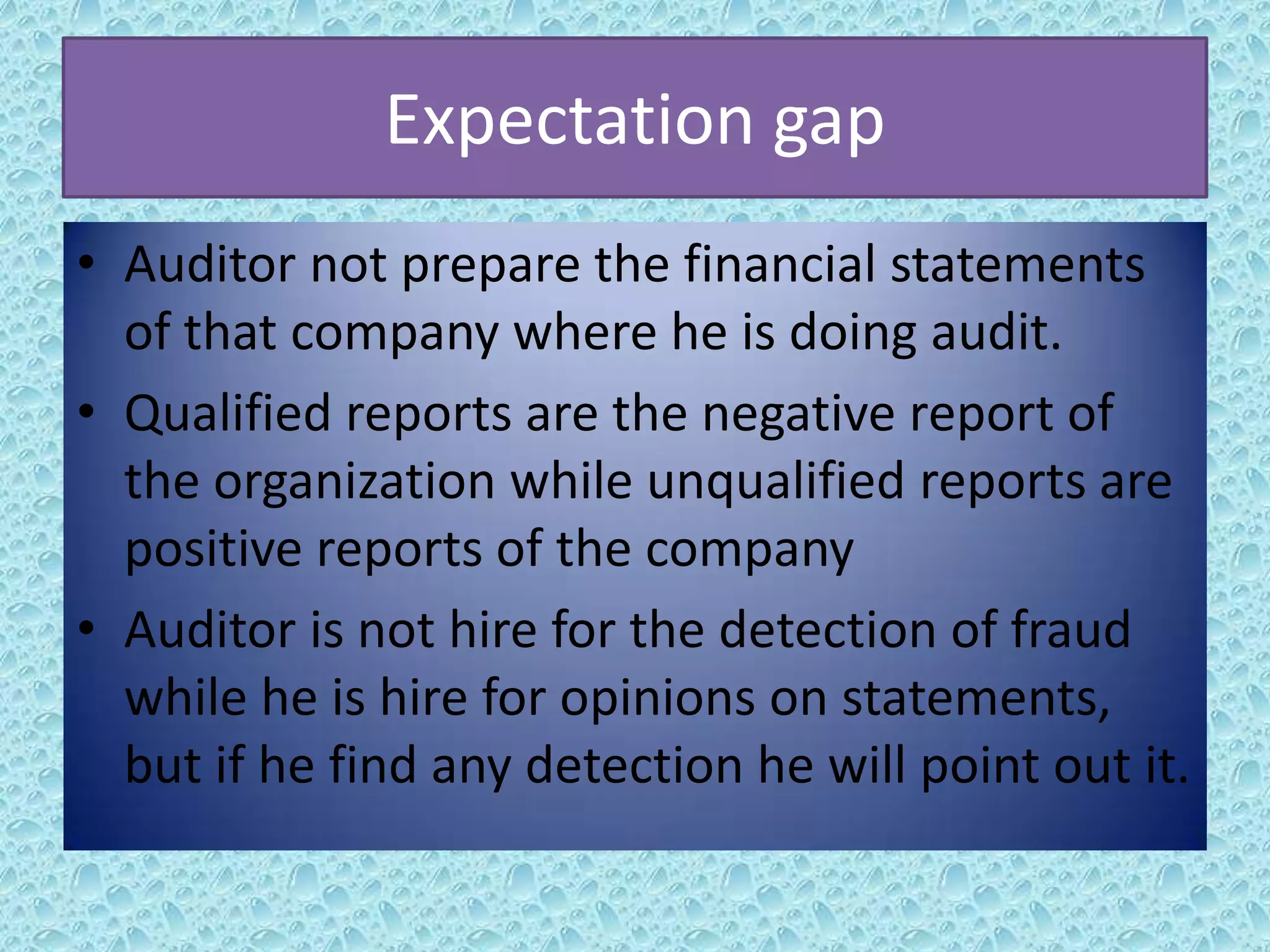
Expectation gap
• Auditor not prepare the financial statements
of that company where he is doing audit.
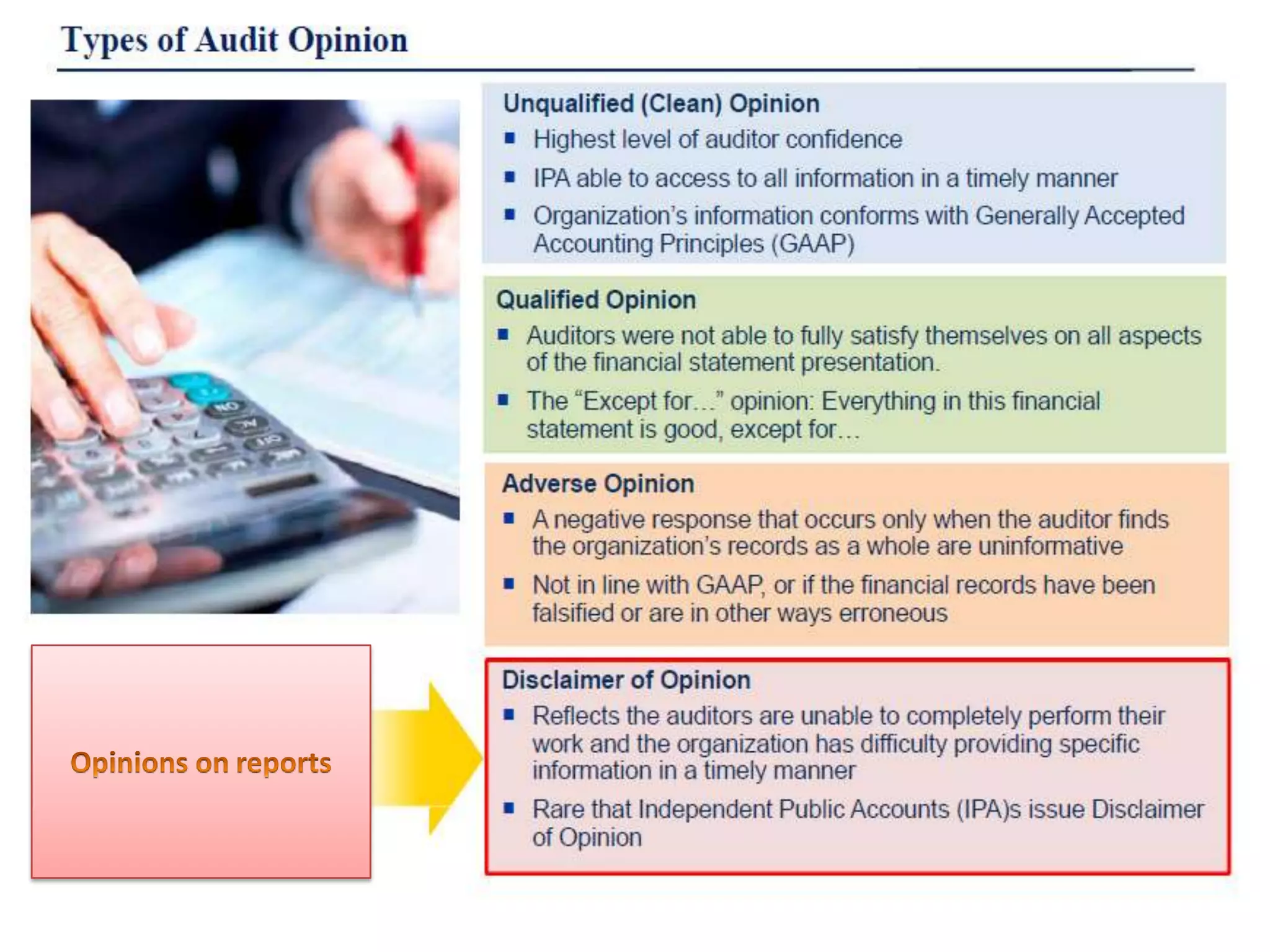
• Qualified reports are the negative report of
the organization while unqualified reports are
positive reports of the company
• Auditor is not hire for the detection of fraud
while he is hire for opinions on statements,
but if he find any detection he will point out it.
financial statements and audit

financial statements and audit

  • 2.
  • 4.
  • 5.
    Introduction to Financial Statementsand Audit We cover in this session the following: 1. Introduction to Financial Statements 2. User’s of financial statements 3. Why do we audit them
  • 6.
    Introduction to FinancialStatements Purpose of Financial Statements Financial statements are a structured representation of the financial position (Balance Sheet) and financial performance (Income Statement) of an entity. The objective of financial statements is to provide information about the financial position, financial performance and cash flows of an entity that is useful to a wide range of users in making economic decisions.
  • 7.
    Introduction to FinancialStatements – User of Financial Statements User of the financial statements Interest of the user Equity investors (existing and potential) They are interested whether buy, hold or sell the shares in hand and also enable them in payment of dividends. Loan creditors ie, existing and potential holders of debentures and loan stock, and providers of short-term loans The amount will be paid when due and for continuation of the business. Employees (existing, potential and past) Interested in stability and profitability for employment opportunities, remuneration and retirement benefits. Business contacts including customers, trade creditors, competitors and potential take-over bidders Whether the payment of loan will be made in due dates and enable sustainability of business for future business with the enterprise. Government, including tax authorities, government departments and local authorities Interested in allocation of resources and also to regulate the activities of an enterprise and determining tax policies and as a basis for national income. Public, including tax payers, ratepayers and environmental groups Trends and recent development in the prosperity of the entity and range of it’s activities.
  • 8.
    Why do weaudit them- Need for Audit Principle provides capital and hires manager to manage it. Principle (Shareholders) Information irregularity and conflict of interest lead to information risk for the principle Directors Director is accountable to Principle; provides financial reports. Auditor gathers evidence to evaluate fairness of manager financial statements. Auditor Directors hires audit to report on the fairness of manager financial statements. Risk information irregularity of principle reduce.
  • 9.
    M waseem jutt UNIVERSITYOF CENTRAL PUNJAB COURSE MCOM K1F12MCOM0047
  • 10.
    Financial statement andaudit major points for discussion Objective Types Complete process Regulation Expectation gap
  • 11.
    Objective • Verify theFinancial statements which are true and fair • Compliance with international standards of reporting (IAS-1) • International accounting standard1(presentation f/s)
  • 12.
    Objectives of Auditing •Primary Objective (main objective) –To produce a report by the auditor of his opinion of the truth and fairness of financial statements so that any person reading or using them can have belief in them @Sako Mayrick 2006
  • 13.
    Objectives of Auditing •Secondary – To detect errors and fraud ( Consider materiality) – To prevent errors and fraud by the deterrent and moral effect of the audit – To provide spin- off effects. The auditor will be able to assist his clients with accounting , systems, taxation , financial , and other problems. @Sako Mayrick 2006
  • 14.
    Talha shahzadi UNIVERSITY OFCENTRAL PUNJAB COURSE MCOM K1F12MCOM0004
  • 15.
    Types of Audit Internalaudit not required by law but external audit is require in some situations.
  • 16.
    Internal audit doonly for in these situations • The exercise of special investigations on detection of fraud. • The preparation and documentation of internal procedures and processes in accordance with client needs and in accordance with regulatory bodies' requirements. • The design and implementation of internal audit programs. • The preparation of internal audit reports for management use and for company internal audit committees.
  • 17.
    Internal auditing External auditing Objectives Toadvise management on whether To provide an opinion on whether the organization has sound the financial statements provide systems of internal controls to a true and fair view protect the organization against loss Legal basis All areas of the organization, Financial focus operational as well as financial Scope All areas of the organization, Financial focus operational as well as financial Approach Increasingly risk base Assess risks Evaluate system of controls Test operation of system Make recommendation improvements Responsibility To Increasingly risk based Test underlying transactions that form the basis of the financial statements for advice and make To form opinion on whether the recommendations on the internal financial statements provide a control and corporate true and fair view. governance @Sako Mayrick 2006
  • 18.
    Statutory audit Nonstatutory audit • carried becausethe law requires them. Statutes include Companies Act, Parastatal organization Act • Not compulsory for private companies • Only require for the satisfaction of shares holders
  • 19.
    Planning of theaudit Complete process of audit Assessment of the accounting and internal control systems and audit risk assessments Consideration of the ways in which audit evidence can be sought Testing of Internal Controls ‘test of control’ Reduced testing of transactions and balances “substantive procedures’ Extensive testing of transactions and balances ‘substantive procedures’ Review of financial statements @Sako Mayrick 2006 Audit Report
  • 20.
    Rana sohail UNIVERSITY OFCENTRAL PUNJAB COURSE MCOM K1F12MCOM00o07
  • 21.
    AUDITING, ATTESTATION, ANDASSURANCE SERVICES • ATTESTATION occurs when a practitioner is engaged to issue or does issue a written communication that expresses a conclusion about the reliability of a written assertion that is the responsibility of another party. • Examples: – The effectiveness of internal control – Financial information other than the financial statements – Future-oriented financial information – Compliance with statutory, regulatory, or contractual obligations – Management’s discussion and analysis @Sako Mayrick 2006
  • 22.
    AUDITING, ATTESTATION, ANDASSURANCE SERVICES ASSURANCE services are independent professional services that improve the quality of information, or its context, for decision makers. Examples: Risk assessment Information system reliability Electronic commerce Health care performance measurement @Sako Mayrick 2006
  • 23.
    • IFAC (international federationfor accountancy) IFAC is comprised of 179 members and associates in 130 countries, representing approximately 2.5 million accountants in public practice, education, government service, industry, and commerce. IFAC members are professional accountancy organizations recognized by law or general consensus within their countries as substantial national organizations. National organizations may apply to become an IFAC associate where the organization is working toward membership.
  • 24.
    Subsidiary boards i) IAASB TheInternational Auditing and Assurance Standards Board (IAASB) is an independent standard-setting body that serves the public interest by setting high-quality international standards for auditing. ii) IFRS ( international financial reporting standard) iii) IAS (international accounting standard
  • 25.
    Ejaz gadi UNIVERSITY OFCENTRAL PUNJAB COURSE MCOM K1F12MCOM0025
  • 26.
    Professional ethics • TheInternational Ethics Standards Board for Accountants (IESBA) is an independent standardsetting body that serves the public interest by setting high-quality ethical standards for professional accountants and by facilitating the convergence of international and national ethical standards, including auditor independence requirements, through the development of a healthy, internationally appropriate code of ethics.
  • 27.
  • 28.
    Principal • Objectivity (auditor must be independent) • Integrity ( auditor must be honest and punctual) • Professional competence ( update with knowledge and standards • Confidentiality (auditor don’t share the secrecy of company to others. • Professional behavior ( auditor behavior must be the professional.
  • 29.
    Malik saqib UNIVERSITY OFCENTRAL PUNJAB COURSE MCOM K1F12MCOM0025
  • 30.
    Threats • interest threat( auditor must be independent person, he have no any interest in company and its profits) • Advocacy ( he is not doing any work on company behalf like negotiate with others organizations and companies) • Intimation( he is purely independent person)
  • 31.
    Expectation gap • Auditornot prepare the financial statements of that company where he is doing audit. • Qualified reports are the negative report of the organization while unqualified reports are positive reports of the company • Auditor is not hire for the detection of fraud while he is hire for opinions on statements, but if he find any detection he will point out it.