1 
12Setting Product Strategy 
1 
7-2What is a Product? 
•A product is anything that can be offered to a market to satisfy a want or need 
−More than just tangible objects 
−A key element in the overall market offering 
−Examples include physical goods, services, experiences, events, persons, places, properties, organizations, information, ideas, etc. 
Copyright © 2013Pearson Education, Inc. Publishing as Prentice Hall12-2 
7-3 
What is a Service? 
•A service is an activity, benefit, or satisfaction offered for sale that is intangible and does not result in the ownership of anything 
−A form of product 
−Examples include banking, hotel, airline travel, etc. 
Copyright © 2013Pearson Education, Inc. Publishing as Prentice Hall12-3 
7-4 
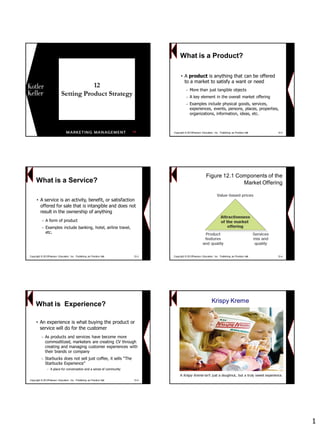
Figure 12.1 Components of the Market Offering 
Copyright © 2013Pearson Education, Inc. Publishing as Prentice Hall12-4 
7-5 
•An experience is what buying the product or service will do for the customer 
−As products and services have become more commoditized, marketers are creating CV through creating and managing customer experiences with their brands or company 
−Starbucks does not sell just coffee, it sells “The Starbucks Experience” 
−A place for conversation and a sense of community 
What is Experience? 
Copyright © 2013Pearson Education, Inc. Publishing as Prentice Hall12-5 
7-6KrispyKremeA Krispy Kreme isn’t just a doughnut, but a truly sweet experience.
2 
7-7 
•Products are tangible, services intangible and, experiences memorable 
•Products and services are external but experiences are personal that take place in the minds of individual consumers 
Product, Service and Experience 
Copyright © 2013Pearson Education, Inc. Publishing as Prentice Hall 12-7 
7-8 
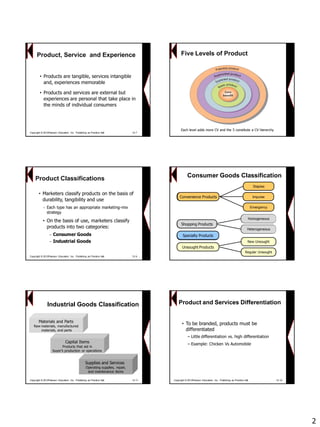
Five Levels of Product 
Each level adds more CV and the 5 constitute a CV hierarchy 
7-9Product Classifications 
Copyright © 2013Pearson Education, Inc. Publishing as Prentice Hall 12-9 
•Marketers classify products on the basis of durability, tangibility and use 
−Each type has an appropriate marketing-mix strategy 
•On the basis of use, marketers classify products into two categories: 
−Consumer Goods 
−Industrial Goods 
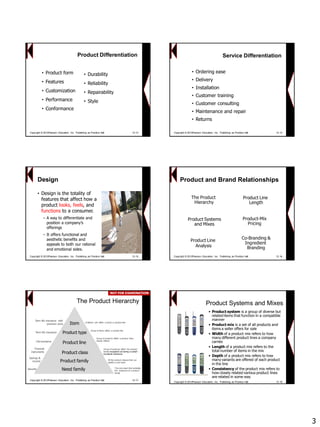
7-10Homogeneous Shopping ProductsHomogeneous ProductsHeterogeneous Shopping ProductsHeterogeneous ProductsShopping Products 
Homogeneous 
Heterogeneous 
Shopping ProductsSpecialty Convenience ProductsImpulseImpulse 
Emergency 
Staples 
StaplesConvenience ProductsConvenience ProductsSpecialty Products 
New UnsoughtRegular Unsought 
Unsought Products 
Consumer Goods Classification 
7-11 
Industrial Goods Classification 
Supplies and Services 
Operating supplies, repair, 
and maintenance items 
Materials and Parts 
Raw materials, manufactured 
materials, and parts 
partsCapital ItemsProducts that aid inbuyer’s production or operationsCapital operationsCopyright © 2013Pearson Education, Inc. Publishing as Prentice Hall 12-11 
7-12 
Product and Services Differentiation 
•To be branded, products must be differentiated 
−Little differentiation vs. high differentiation 
−Example: Chicken Vs Automobile 
Copyright © 2013Pearson Education, Inc. Publishing as Prentice Hall 12-12
3 
7-13 
Product Differentiation 
•Product form 
•Features 
•Customization 
•Performance 
•Conformance 
•Durability 
•Reliability 
•Repairability 
•Style 
Copyright © 2013Pearson Education, Inc. Publishing as Prentice Hall 12-13 
7-14 
Service Differentiation 
•Ordering ease 
•Delivery 
•Installation 
•Customer training 
•Customer consulting 
•Maintenance and repair 
•Returns 
Copyright © 2013Pearson Education, Inc. Publishing as Prentice Hall 12-14 
7-15 
Design 
•Design is the totality of features that affect how a product looks, feels, and functions to a consumer. 
−A way to differentiate and position a company’s offerings 
−It offers functional and aesthetic benefits and appeals to both our rational and emotional sides. 
Copyright © 2013Pearson Education, Inc. Publishing as Prentice Hall 12-15 
7-16 
Product Line 
Length 
Product Line 
Analysis 
Product and Brand RelationshipsProduct-MixPricingProduct-MixPricing 
Co-Branding & 
Ingredient 
Branding 
Product Systems 
and Mixes 
MixesThe Product HierarchyThe HierarchyCopyright © 2013Pearson Education, Inc. Publishing as Prentice Hall 12-16 
7-17 
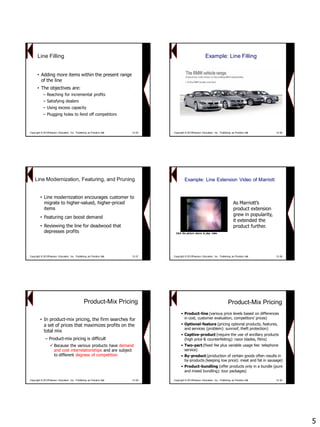
The Product Hierarchy 
Need family 
Product familyProduct classProduct line 
Product type 
Item 
The core need that underlies the existence of a product family 
All the product classes that can satisfy a core need 
Group of products within the product family recognized as having a certain functional coherence 
Group of products within a product class closely related 
Group of items within a product line A distinct unit within a brand or product line 
Security 
Savings & income 
Financial instrumentsLife insurance 
Term life insurance 
Term life insurance with premium price 
Copyright © 2013Pearson Education, Inc. Publishing as Prentice Hall 12-17NOT FOR EXAMINATIONNOT EXAMINATION 
7-18 
Product Systems and Mixes 
•Product systemis a group of diverse but related items that function in a compatible manner 
•Product mixis a set of all products and items a seller offers for sale 
•Widthof a product mix refers to how many different product lines a company carries 
•Lengthof a product mix refers to the total number of items in the mix 
•Depthof a product mix refers to how many variants are offered of each product in the line 
•Consistencyof the product mix refers to how closely related various product lines are related in some way 
Copyright © 2013Pearson Education, Inc. Publishing as Prentice Hall 12-18
4 
7-19 
•Product line is a group of products within a product class that are closely related because they 
−function in a similar way 
−are sold to the same customer groups through the same channels, or 
−fall within given price ranges 
Product Line Analysis 
•Product-line managers need to know the salesandprofits of each item in their line to determine which items to build, maintain, harvest, or divest 
•Also understand each product line’s market profile (how the line is positioned against competitors’ lines) 
Copyright © 2013Pearson Education, Inc. Publishing as Prentice Hall 12-19 
7-20Fig:12.3-Product-Item Contributions to a Product Line’s Total Sales and ProfitsCopyright © 2013Pearson Education, Inc. Publishing as Prentice Hall 12-20 
7-21 
Figure 12.4 Product Map for a Paperboard-Product LineCopyright © 2013Pearson Education, Inc. Publishing as Prentice Hall 12-21 
7-22 
•Product-line length is the number of items in the product line 
•Product line length is influenced by: 
−Company objectives (like up-selling, cross- selling or protecting against economic ups and downs) 
−Excess manufacturing capacity 
−Pressures from sales force/distributors for a complete product-line 
Product Line Length 
Copyright © 2013Pearson Education, Inc. Publishing as Prentice Hall 12-22 
7-23 
•It occurs when a company lengthens its product line beyond its current range 
Line Stretching 
DownMarket Stretch 
Down-Market StretchUp-Market StretchTwo-Way Stretch 
Copyright © 2013Pearson Education, Inc. Publishing as Prentice Hall 12-23 
7-24Example: Two-Way StretchMarriott added the Renaissance Hotels line to serve the upper end of the market and the TownePlace Suites line to serve the moderate and lower ends. Copyright © 2013Pearson Education, Inc. Publishing as Prentice Hall 12-24
5 
7-25 
•Adding more items within the present range of the line 
•The objectives are: 
−Reaching for incremental profits 
−Satisfying dealers 
−Using excess capacity 
−Plugging holes to fend off competitors 
Line Filling 
Copyright © 2013Pearson Education, Inc. Publishing as Prentice Hall 12-25 
7-26Example: Line Filling 
Copyright © 2013Pearson Education, Inc. Publishing as Prentice Hall 12-26 
7-27 
•Line modernization encourages customer to migrate to higher-valued, higher-priced items 
•Featuring can boost demand 
•Reviewing the line for deadwood that depresses profits 
Line Modernization, Featuring, and PruningCopyright © 2013Pearson Education, Inc. Publishing as Prentice Hall 12-27 
7-28 
Example: Line Extension Video of Marriott 
Click the picture above to play video 
As Marriott’s product extension grew in popularity, it extended the product further. Copyright © 2013Pearson Education, Inc. Publishing as Prentice Hall 12-28 
7-29 
Product-Mix Pricing 
•In product-mix pricing, the firm searches for a set of prices that maximizes profits on the total mix 
−Product-mix pricing is difficult 
Because the various products have demand and cost interrelationships and are subject to different degrees of competition 
Copyright © 2013Pearson Education, Inc. Publishing as Prentice Hall 12-29 
7-30 
Product-Mix Pricing 
•Product-line (various price levels based on differences in cost, customer evaluation, competitors’ prices) 
•Optional-feature (pricing optional products, features, and services (problem): sunroof, theft protection) 
•Captive-product (require the use of ancillary products (high price & counterfeiting): razor blades, films) 
•Two-part (fixed fee plus variable usage fee: telephone service) 
•By-product (production of certain goods often results in by-products (keeping low price): meat and fat in sausage) 
•Product-bundling (offer products only in a bundle (pure and mixed bundling): tour packages) 
Copyright © 2013Pearson Education, Inc. Publishing as Prentice Hall 12-30
6 
7-31 
Example: Product Line PricingCopyright © 2013Pearson Education, Inc. Publishing as Prentice Hall 12-31 
7-32 
Example: Two-Part PricingCopyright © 2013Pearson Education, Inc. Publishing as Prentice Hall 12-32 
7-33 
Co-branding 
•Co-brandingis combining a company’s products with the products from other companies in various ways 
•Known as dual branding or brand bundling 
−Same-company co-branding 
oGeneral Mills advertises Trixcereal and Yoplait yogurt 
−Joint-venture co-branding(Suzuki-Maruti) 
−Multiple-sponsor co-branding 
oTaligent-a technological alliance of Apple, IBM, and Motorola 
−Retail co-branding 
o2 retailers use the same location to optimize space/profits 
Copyright © 2013Pearson Education, Inc. Publishing as Prentice Hall 12-33 
7-34 
Ingredient Branding 
•Ingredient brandingis creating brand equity for materials, components, or parts that are necessarily contained within other branded products 
−A special case of co-branding Copyright © 2013Pearson Education, Inc. Publishing as Prentice Hall 12-34 
7-35 
What is the Fifth P? 
Packaging, sometimes called the 5thP, is all the activities of designing and producing the container for a product. 
•Developing a good package involves: 
−Packaging concept 
−Package elements 
−Product safety 
−Environmental concerns 
Copyright © 2013Pearson Education, Inc. Publishing as Prentice Hall 12-35 
7-36Innovative Packaging 
Dutch Boy recently came up with a long overdue innovation—paint in plastic containers with twist-off caps. 
Copyright © 2013Pearson Education, Inc. Publishing as Prentice Hall 12-36
7 
7-37 
Factors Contributing to the Emphasis on Packaging 
•Self-service 
•Consumer affluence 
•Company/brand image 
•Innovation opportunity 
Copyright © 2013Pearson Education, Inc. Publishing as Prentice Hall 12-37 
7-38 
Packaging Objectives 
•Identify the brand 
•Convey descriptive and persuasive information 
•Facilitate product transportation and protection 
•Assist at-home storage 
•Aid product consumption 
Copyright © 2013Pearson Education, Inc. Publishing as Prentice Hall 12-38 
7-39 
•After packaging is designed, it is tested 
−Engineering test-ensures that the package stands up under normal conditions 
−Visual test-ensures that the script is legible and the color is harmonious 
−Dealer test-ensures that dealers find package attractive and easy to handle 
−Consumer test-ensures favorable consumer response 
Packaging Tests 
Copyright © 2013Pearson Education, Inc. Publishing as Prentice Hall 12-39 
7-40Labels 
Identifies 
GradesDescribesPromotes 
Printed information appearing on or with the package. 
Copyright © 2013Pearson Education, Inc. Publishing as Prentice Hall 12-40 
7-41Innovative LabelingInnovative labeling can help promote a product. Copyright © 2013Pearson Education, Inc. Publishing as Prentice Hall 12-41 
NOT FOR EXAMINATIONNOT EXAMINATION 
7-42Warranties and Guarantees 
•Warranties are a formal statement of expected product performance by the manufacturer, while guarantees are informal statement 
−Warranties are Legally enforceable 
Copyright © 2013Pearson Education, Inc. Publishing as Prentice Hall 12-42

Ch 12 setting product strategy14e

  • 1.
    1 12Setting ProductStrategy 1 7-2What is a Product? •A product is anything that can be offered to a market to satisfy a want or need −More than just tangible objects −A key element in the overall market offering −Examples include physical goods, services, experiences, events, persons, places, properties, organizations, information, ideas, etc. Copyright © 2013Pearson Education, Inc. Publishing as Prentice Hall12-2 7-3 What is a Service? •A service is an activity, benefit, or satisfaction offered for sale that is intangible and does not result in the ownership of anything −A form of product −Examples include banking, hotel, airline travel, etc. Copyright © 2013Pearson Education, Inc. Publishing as Prentice Hall12-3 7-4 Figure 12.1 Components of the Market Offering Copyright © 2013Pearson Education, Inc. Publishing as Prentice Hall12-4 7-5 •An experience is what buying the product or service will do for the customer −As products and services have become more commoditized, marketers are creating CV through creating and managing customer experiences with their brands or company −Starbucks does not sell just coffee, it sells “The Starbucks Experience” −A place for conversation and a sense of community What is Experience? Copyright © 2013Pearson Education, Inc. Publishing as Prentice Hall12-5 7-6KrispyKremeA Krispy Kreme isn’t just a doughnut, but a truly sweet experience.
  • 2.
    2 7-7 •Productsare tangible, services intangible and, experiences memorable •Products and services are external but experiences are personal that take place in the minds of individual consumers Product, Service and Experience Copyright © 2013Pearson Education, Inc. Publishing as Prentice Hall 12-7 7-8 Five Levels of Product Each level adds more CV and the 5 constitute a CV hierarchy 7-9Product Classifications Copyright © 2013Pearson Education, Inc. Publishing as Prentice Hall 12-9 •Marketers classify products on the basis of durability, tangibility and use −Each type has an appropriate marketing-mix strategy •On the basis of use, marketers classify products into two categories: −Consumer Goods −Industrial Goods 7-10Homogeneous Shopping ProductsHomogeneous ProductsHeterogeneous Shopping ProductsHeterogeneous ProductsShopping Products Homogeneous Heterogeneous Shopping ProductsSpecialty Convenience ProductsImpulseImpulse Emergency Staples StaplesConvenience ProductsConvenience ProductsSpecialty Products New UnsoughtRegular Unsought Unsought Products Consumer Goods Classification 7-11 Industrial Goods Classification Supplies and Services Operating supplies, repair, and maintenance items Materials and Parts Raw materials, manufactured materials, and parts partsCapital ItemsProducts that aid inbuyer’s production or operationsCapital operationsCopyright © 2013Pearson Education, Inc. Publishing as Prentice Hall 12-11 7-12 Product and Services Differentiation •To be branded, products must be differentiated −Little differentiation vs. high differentiation −Example: Chicken Vs Automobile Copyright © 2013Pearson Education, Inc. Publishing as Prentice Hall 12-12
  • 3.
    3 7-13 ProductDifferentiation •Product form •Features •Customization •Performance •Conformance •Durability •Reliability •Repairability •Style Copyright © 2013Pearson Education, Inc. Publishing as Prentice Hall 12-13 7-14 Service Differentiation •Ordering ease •Delivery •Installation •Customer training •Customer consulting •Maintenance and repair •Returns Copyright © 2013Pearson Education, Inc. Publishing as Prentice Hall 12-14 7-15 Design •Design is the totality of features that affect how a product looks, feels, and functions to a consumer. −A way to differentiate and position a company’s offerings −It offers functional and aesthetic benefits and appeals to both our rational and emotional sides. Copyright © 2013Pearson Education, Inc. Publishing as Prentice Hall 12-15 7-16 Product Line Length Product Line Analysis Product and Brand RelationshipsProduct-MixPricingProduct-MixPricing Co-Branding & Ingredient Branding Product Systems and Mixes MixesThe Product HierarchyThe HierarchyCopyright © 2013Pearson Education, Inc. Publishing as Prentice Hall 12-16 7-17 The Product Hierarchy Need family Product familyProduct classProduct line Product type Item The core need that underlies the existence of a product family All the product classes that can satisfy a core need Group of products within the product family recognized as having a certain functional coherence Group of products within a product class closely related Group of items within a product line A distinct unit within a brand or product line Security Savings & income Financial instrumentsLife insurance Term life insurance Term life insurance with premium price Copyright © 2013Pearson Education, Inc. Publishing as Prentice Hall 12-17NOT FOR EXAMINATIONNOT EXAMINATION 7-18 Product Systems and Mixes •Product systemis a group of diverse but related items that function in a compatible manner •Product mixis a set of all products and items a seller offers for sale •Widthof a product mix refers to how many different product lines a company carries •Lengthof a product mix refers to the total number of items in the mix •Depthof a product mix refers to how many variants are offered of each product in the line •Consistencyof the product mix refers to how closely related various product lines are related in some way Copyright © 2013Pearson Education, Inc. Publishing as Prentice Hall 12-18
  • 4.
    4 7-19 •Productline is a group of products within a product class that are closely related because they −function in a similar way −are sold to the same customer groups through the same channels, or −fall within given price ranges Product Line Analysis •Product-line managers need to know the salesandprofits of each item in their line to determine which items to build, maintain, harvest, or divest •Also understand each product line’s market profile (how the line is positioned against competitors’ lines) Copyright © 2013Pearson Education, Inc. Publishing as Prentice Hall 12-19 7-20Fig:12.3-Product-Item Contributions to a Product Line’s Total Sales and ProfitsCopyright © 2013Pearson Education, Inc. Publishing as Prentice Hall 12-20 7-21 Figure 12.4 Product Map for a Paperboard-Product LineCopyright © 2013Pearson Education, Inc. Publishing as Prentice Hall 12-21 7-22 •Product-line length is the number of items in the product line •Product line length is influenced by: −Company objectives (like up-selling, cross- selling or protecting against economic ups and downs) −Excess manufacturing capacity −Pressures from sales force/distributors for a complete product-line Product Line Length Copyright © 2013Pearson Education, Inc. Publishing as Prentice Hall 12-22 7-23 •It occurs when a company lengthens its product line beyond its current range Line Stretching DownMarket Stretch Down-Market StretchUp-Market StretchTwo-Way Stretch Copyright © 2013Pearson Education, Inc. Publishing as Prentice Hall 12-23 7-24Example: Two-Way StretchMarriott added the Renaissance Hotels line to serve the upper end of the market and the TownePlace Suites line to serve the moderate and lower ends. Copyright © 2013Pearson Education, Inc. Publishing as Prentice Hall 12-24
  • 5.
    5 7-25 •Addingmore items within the present range of the line •The objectives are: −Reaching for incremental profits −Satisfying dealers −Using excess capacity −Plugging holes to fend off competitors Line Filling Copyright © 2013Pearson Education, Inc. Publishing as Prentice Hall 12-25 7-26Example: Line Filling Copyright © 2013Pearson Education, Inc. Publishing as Prentice Hall 12-26 7-27 •Line modernization encourages customer to migrate to higher-valued, higher-priced items •Featuring can boost demand •Reviewing the line for deadwood that depresses profits Line Modernization, Featuring, and PruningCopyright © 2013Pearson Education, Inc. Publishing as Prentice Hall 12-27 7-28 Example: Line Extension Video of Marriott Click the picture above to play video As Marriott’s product extension grew in popularity, it extended the product further. Copyright © 2013Pearson Education, Inc. Publishing as Prentice Hall 12-28 7-29 Product-Mix Pricing •In product-mix pricing, the firm searches for a set of prices that maximizes profits on the total mix −Product-mix pricing is difficult Because the various products have demand and cost interrelationships and are subject to different degrees of competition Copyright © 2013Pearson Education, Inc. Publishing as Prentice Hall 12-29 7-30 Product-Mix Pricing •Product-line (various price levels based on differences in cost, customer evaluation, competitors’ prices) •Optional-feature (pricing optional products, features, and services (problem): sunroof, theft protection) •Captive-product (require the use of ancillary products (high price & counterfeiting): razor blades, films) •Two-part (fixed fee plus variable usage fee: telephone service) •By-product (production of certain goods often results in by-products (keeping low price): meat and fat in sausage) •Product-bundling (offer products only in a bundle (pure and mixed bundling): tour packages) Copyright © 2013Pearson Education, Inc. Publishing as Prentice Hall 12-30
  • 6.
    6 7-31 Example:Product Line PricingCopyright © 2013Pearson Education, Inc. Publishing as Prentice Hall 12-31 7-32 Example: Two-Part PricingCopyright © 2013Pearson Education, Inc. Publishing as Prentice Hall 12-32 7-33 Co-branding •Co-brandingis combining a company’s products with the products from other companies in various ways •Known as dual branding or brand bundling −Same-company co-branding oGeneral Mills advertises Trixcereal and Yoplait yogurt −Joint-venture co-branding(Suzuki-Maruti) −Multiple-sponsor co-branding oTaligent-a technological alliance of Apple, IBM, and Motorola −Retail co-branding o2 retailers use the same location to optimize space/profits Copyright © 2013Pearson Education, Inc. Publishing as Prentice Hall 12-33 7-34 Ingredient Branding •Ingredient brandingis creating brand equity for materials, components, or parts that are necessarily contained within other branded products −A special case of co-branding Copyright © 2013Pearson Education, Inc. Publishing as Prentice Hall 12-34 7-35 What is the Fifth P? Packaging, sometimes called the 5thP, is all the activities of designing and producing the container for a product. •Developing a good package involves: −Packaging concept −Package elements −Product safety −Environmental concerns Copyright © 2013Pearson Education, Inc. Publishing as Prentice Hall 12-35 7-36Innovative Packaging Dutch Boy recently came up with a long overdue innovation—paint in plastic containers with twist-off caps. Copyright © 2013Pearson Education, Inc. Publishing as Prentice Hall 12-36
  • 7.
    7 7-37 FactorsContributing to the Emphasis on Packaging •Self-service •Consumer affluence •Company/brand image •Innovation opportunity Copyright © 2013Pearson Education, Inc. Publishing as Prentice Hall 12-37 7-38 Packaging Objectives •Identify the brand •Convey descriptive and persuasive information •Facilitate product transportation and protection •Assist at-home storage •Aid product consumption Copyright © 2013Pearson Education, Inc. Publishing as Prentice Hall 12-38 7-39 •After packaging is designed, it is tested −Engineering test-ensures that the package stands up under normal conditions −Visual test-ensures that the script is legible and the color is harmonious −Dealer test-ensures that dealers find package attractive and easy to handle −Consumer test-ensures favorable consumer response Packaging Tests Copyright © 2013Pearson Education, Inc. Publishing as Prentice Hall 12-39 7-40Labels Identifies GradesDescribesPromotes Printed information appearing on or with the package. Copyright © 2013Pearson Education, Inc. Publishing as Prentice Hall 12-40 7-41Innovative LabelingInnovative labeling can help promote a product. Copyright © 2013Pearson Education, Inc. Publishing as Prentice Hall 12-41 NOT FOR EXAMINATIONNOT EXAMINATION 7-42Warranties and Guarantees •Warranties are a formal statement of expected product performance by the manufacturer, while guarantees are informal statement −Warranties are Legally enforceable Copyright © 2013Pearson Education, Inc. Publishing as Prentice Hall 12-42