9/17/2014 
1 
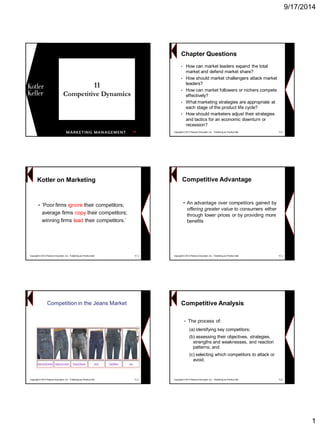
11Competitive Dynamics 
1Copyright © 2013 Pearson Education, Inc. Publishing as Prentice Hall 11-2Chapter Questions 
•How can market leaders expand the total market and defend market share? 
•How should market challengers attack market leaders? 
•How can market followers or nichers compete effectively? 
•What marketing strategies are appropriate at each stage of the product life cycle? 
•How should marketers adjust their strategies and tactics for an economic downturn or recession? Kotler on Marketing 
•‘Poor firms ignoretheir competitors; average firms copytheir competitors; winning firms leadtheir competitors.’ 
Copyright © 2013 Pearson Education, Inc. Publishing as Prentice Hall 11-3 
Competitive Advantage 
•An advantage over competitors gained by offering greater valueto consumers either through lower prices or by providing more benefits 
Copyright © 2013 Pearson Education, Inc. Publishing as Prentice Hall 11-4 
Competition in the Jeans Market 
Copyright © 2013 Pearson Education, Inc. Publishing as Prentice Hall 11-5 
Competitive Analysis 
•The process of: 
(a) identifying key competitors; 
(b) assessing their objectives, strategies, strengths and weaknesses, and reaction patterns; and 
(c) selecting which competitors to attack or avoid. 
Copyright © 2013 Pearson Education, Inc. Publishing as Prentice Hall 11-6
9/17/2014 
2Michel Porter: Five forces determining segment’s structural attractiveness and intrinsic long-run profitability 
Competitive Forces 
Copyright © 2013 Pearson Education, Inc. Publishing as Prentice Hall 11-7Threat of Intense Segment Rivalry 
•Unattractive when numerous, strong or aggressive competitors 
•More unattractive if: 
−It is stable or declining 
−Plant capacity additions are done in large increments 
−Fixed costs are high 
−Exit barriers are high 
−Competitors have stake in staying in the segment 
Copyright © 2013 Pearson Education, Inc. Publishing as Prentice Hall 11-8 
Threat of New Entrants 
•Attractive when high entry barriers and low exit barriers 
−When both barriers are high, profit potential is high but risky since nobody quits 
−When both barriers are low, returns are low but stable 
Copyright © 2013 Pearson Education, Inc. Publishing as Prentice Hall 11-9Barriers and Profitability 
Barriers 
Barriers 
Barriers 
Barriers 
Copyright © 2013 Pearson Education, Inc. Publishing as Prentice Hall 11-10Threat of Substitute Products 
•Unattractive when more substitutes 
−Substitutes place limit on price and profit 
−High prices induce buyers to switch to the substitutes 
Copyright © 2013 Pearson Education, Inc. Publishing as Prentice Hall 11-11 
Bargaining Power of Buyers 
•Unattractive if buyers have bargaining power 
•Buyers are more powerful when: 
−They are more organized and concentrated 
−They purchase in large quantities 
−Product is undifferentiated 
−Switching cost is low 
−They are price sensitive 
−Suppliers’ products are commodities 
−Product represents significant portion of buyer’s costs 
−Buyer is willing and able to achieve backward integration 
Copyright © 2013 Pearson Education, Inc. Publishing as Prentice Hall 11-12
9/17/2014 
3 
Bargaining Power of Suppliers 
•Unattractive, if suppliers are able to raise prices or reduce quantity supplied 
•Suppliers are powerful, when 
−They are concentrated or organized 
−There are few substitutes 
−Supplier’s products are critical inputs and highly differentiated 
−Costs of switching suppliers are high 
−Suppliers are willing and able to sell product themselves 
Copyright © 2013 Pearson Education, Inc. Publishing as Prentice Hall 11-13 
Identifying Competitors 
•Competitors include firms: 
−Making the same product or class of products 
−Making products that provide the same service 
−Competing for the same consumer dollars 
•Examine competition from both an industry and a market point of view 
Copyright © 2013 Pearson Education, Inc. Publishing as Prentice Hall 11-14 
•An industry is a group of firms that offer a product or class of products that are close substitutes for one another 
•Industries are classified according to: 
−The number of sellers 
−The degree of product differentiation 
−The presence or absence of entry, mobility, and exit barriers 
−Cost structure 
−The degree of vertical integration 
−The degree of globalization 
An Industry Point of View 
Copyright © 2013 Pearson Education, Inc. Publishing as Prentice Hall 11-15 
•Actual or potential companies that satisfy the same customer need (see map) 
−Competitor myopia occurs when a firm focuses on its direct competitor and ignores indirect or new competitors 
−Marketers must consider emerging competitors, new technologies, competitors on internet 
A Market Point of View 
Copyright © 2013 Pearson Education, Inc. Publishing as Prentice Hall 11-16 
Competitor’s Map 
•Once primary competitors are identified, company must ascertain their: 
−Strategies 
−Objectives 
−Strengths 
−Weaknesses 
Analyzing Competitors 
Copyright © 2013 Pearson Education, Inc. Publishing as Prentice Hall 11-18
9/17/2014 
4 
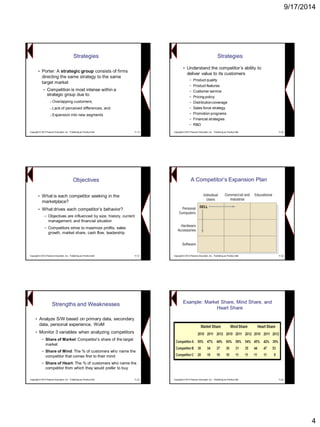
•Porter: A strategic group consists of firms directing the same strategy to the same target market 
−Competition is most intense within a strategic group due to: 
oOverlapping customers, 
oLack of perceived differences, and 
oExpansion into new segments 
Strategies 
Copyright © 2013 Pearson Education, Inc. Publishing as Prentice Hall 11-19 
•Understand the competitor’s ability to deliver value to its customers 
−Product quality 
−Product features 
−Customer service 
−Pricing policy 
−Distribution coverage 
−Sales force strategy 
−Promotion programs 
−Financial strategies 
−R&D 
Strategies 
Copyright © 2013 Pearson Education, Inc. Publishing as Prentice Hall 11-20 
•What is each competitor seeking in the marketplace? 
•What drives each competitor’s behavior? 
−Objectives are influenced by size, history, current management, and financial situation 
−Competitors strive to maximize profits, sales growth, market share, cash flow, leadership 
Objectives 
Copyright © 2013 Pearson Education, Inc. Publishing as Prentice Hall 11-21 
A Competitor’s Expansion Plan 
Copyright © 2013 Pearson Education, Inc. Publishing as Prentice Hall 11-22 
•Analyze S/W based on primary data, secondary data, personal experience, WoM 
•Monitor 3 variables when analyzing competitors 
−Share of Market: Competitor’s share of the target market 
−Share of Mind: The % of customers who name the competitor that comes first to their mind 
−Share of Heart: The % of customers who name the competitor from which they would prefer to buy 
Strengths and Weaknesses 
Copyright © 2013 Pearson Education, Inc. Publishing as Prentice Hall 11-23Example: Market Share, Mind Share, and Heart ShareCopyright © 2013 Pearson Education, Inc. Publishing as Prentice Hall 11-24
9/17/2014 
5 
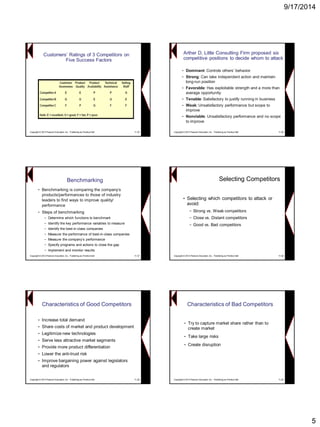
Customers’ Ratings of 3 Competitors on Five Success FactorsCopyright © 2013 Pearson Education, Inc. Publishing as Prentice Hall 11-25 
•Dominant: Controls others’ behavior 
•Strong: Can take independent action and maintain long-run position 
•Favorable: Has exploitable strength and a more than average opportunity 
•Tenable: Satisfactory to justify running in business 
•Weak: Unsatisfactory performance but scope to improve 
•Nonviable: Unsatisfactory performance and no scope to improve 
ArtherD. Little Consulting Firm proposed six competitive positions to decide whom to attack 
Copyright © 2013 Pearson Education, Inc. Publishing as Prentice Hall 11-26 
•Benchmarking is comparing the company’s products/performances to those of industry leaders to find ways to improve quality/ performance 
•Steps of benchmarking 
−Determine which functions to benchmark 
−Identify the key performance variables to measure 
−Identify the best-in-class companies 
−Measure the performance of best-in-class companies 
−Measure the company’s performance 
−Specify programs and actions to close the gap 
−Implement and monitor results 
Benchmarking 
Copyright © 2013 Pearson Education, Inc. Publishing as Prentice Hall 11-27 
•Selecting which competitors to attack or avoid: 
−Strong vs. Weak competitors 
−Close vs. Distant competitors 
−Good vs. Bad competitors 
Selecting Competitors 
Copyright © 2013 Pearson Education, Inc. Publishing as Prentice Hall 11-28 
•Increase total demand 
•Share costs of market and product development 
•Legitimize new technologies 
•Serve less attractive market segments 
•Provide more product differentiation 
•Lower the anti-trust risk 
•Improve bargaining power against legislators and regulators 
Characteristics of Good Competitors 
Copyright © 2013 Pearson Education, Inc. Publishing as Prentice Hall 11-29 
•Try to capture market share rather than to create market 
•Take large risks 
•Create disruption 
Characteristics of Bad Competitors 
Copyright © 2013 Pearson Education, Inc. Publishing as Prentice Hall 11-30
9/17/2014 
6 
Task of Competitive Intelligence System (CIS) 
•Identifies competitive information and its best sources 
•Continually collects information 
•Checks information for validity and reliability 
•Interprets and organizes information 
•Sends key information to decision makers 
•Responds to inquiries about competitors 
Copyright © 2013 Pearson Education, Inc. Publishing as Prentice Hall 11-31 
Porter’s 4 Basic Competitive Strategies 
•Overall cost leadership strategy: Achieving the lowest production and distribution costs 
•Differentiation strategy: Creating a highly differentiated product line and marketing program 
•Focus strategy: Serving few market segments 
•Middle-of-the-roaders: Without a clear strategy 
Copyright © 2013 Pearson Education, Inc. Publishing as Prentice Hall 11-32 
•Market leader: Firm with the largest market share leads the market price changes, innovations, distribution coverage, and promotion spending 
•Market challengers: Firms fighting to increase market share 
•Market followers: Firms trying to hold onto their market share 
•Market nichers: Firms that serve small market segments not being pursued by other firms 
Competitive Positions 
Copyright © 2013 Pearson Education, Inc. Publishing as Prentice Hall 11-33 
Figure 11.1: Hypothetical Market Structure 
Copyright © 2013 Pearson Education, Inc. Publishing as Prentice Hall 11-34 
•Expanding the total market 
•Protecting market share 
•Increasing market share 
Strategies for Market LeadersFig: Expanding the total market 
•New Customers− search for new users among three groups: 
−Who might use it but do not (market penetration) 
−Who have never used it (new-market segment) 
−Who live elsewhere (geographical-expansion) 
Expanding the Total Market 
Copyright © 2013 Pearson Education, Inc. Publishing as Prentice Hall 11-36
9/17/2014 
7 
•More usage−increase the amount, level, or frequency of consumption 
−Boost the amount through packaging or product redesign 
−Increase frequency of consumption by: 
a)identifying additional opportunities to use the brand in the same basic way 
b)identifying completely new and different ways to use the brand. 
Expanding the Total Market 
Copyright © 2013 Pearson Education, Inc. Publishing as Prentice Hall 11-37 
Fig: New Ways to Use a Brand 
Expanding the Total Market 
Fig: Frappuccino coffee drinks have been a new source of growth and revenues for Starbucks. 
•Continuous innovation the most constructive response 
−Develop new products and customer services, distribution effectiveness, and cost cutting 
−Be involved in: 
−PROACTIVE MARKETING 
−DEFENSIVE MARKETING 
Protecting Market Share 
Copyright © 2013 Pearson Education, Inc. Publishing as Prentice Hall 11-39 
•Proactive companies create new offers to serve unmet/unknown consumer needs. 
−A responsive marketerfinds a stated need and fills it 
−An anticipative marketer looks ahead to needs customers may have in the near future. 
−A creative marketer discovers solutions customers did not ask for but to which they enthusiastically respond. 
Proactive Marketing 
Copyright © 2013 Pearson Education, Inc. Publishing as Prentice Hall 11-40 
•Responsive anticipation to see the likely problem 
−IBM: a hardware producer to a service business 
−Responsive anticipation is performed before a given change 
−Reactive response happens after the change takes place 
•Creative anticipation to devise innovative solutions 
−PepsiCo: H2OH!, a bottled water hybrid soft drink 
Two Proactive kills of Proactive Firms 
Copyright © 2013 Pearson Education, Inc. Publishing as Prentice Hall 11-41 
•Are ready to take risks and make mistakes, 
•Have a vision of the future and of investing in it, 
•Have the capabilities to innovate, 
•Are flexible and non-bureaucratic, and 
•Have many managers who think proactively. 
What Proactive Firms Do? Copyright © 2013 Pearson Education, Inc. Publishing as Prentice Hall 11-42
9/17/2014 
8 
•Even when it does not launch offenses, the market leader must not leave any major flanks exposed. 
•The aim of defensive strategy is to: 
−Reduce the probability of attack 
−Divert attacks to less-threatened areas 
−Lessen their intensity 
Defensive Marketing 
Copyright © 2013 Pearson Education, Inc. Publishing as Prentice Hall 11-43Six Defense Strategies 
Copyright © 2013 Pearson Education, Inc. Publishing as Prentice Hall 11-44 
•Position--occupy the most desirable market space in consumers’ minds, making the brand almost impregnable. 
•Flank--erect outposts to protect a weak front or support a possible counterattack. 
•Preemptive--attack first, perhaps with guerrilla action across the market and keep everyone off balance. 
•Counteroffensive--meet the attacker frontally and hit its flank, or launch a pincer movement so it will have to pull back to defend itself. 
•Mobile--stretch its domain over new territories that can serve future centers for defense and offense—market broadening & diversification. 
•Contraction--give up weaker territories and reassign resources to stronger ones. 
Six Defense Strategies 
•Gaining increased share may not give higher profits 
•Because the cost of buying market share may exceed its revenue value, a company should consider four factors : 
−Possibility of provoking antitrust action 
−Economic cost (see figure) 
−The danger of pursuing the wrong marketing activities 
−The effect of increased market share on actual and perceived quality 
Increasing Market Share 
Copyright © 2013 Pearson Education, Inc. Publishing as Prentice Hall 11-46 
Fig:11.3 The Concept of Optimal Market Share 
Copyright © 2013 Pearson Education, Inc. Publishing as Prentice Hall 11-47Market Challenger Strategies 
•Define the strategic objective and opponents 
−First define its strategic objective to increase market share 
−Then decide whom to attack (leader or same size firms, small local or regional firms) 
•Choose a general attack strategy 
•Choose a specific attack strategy 
Copyright © 2013 Pearson Education, Inc. Publishing as Prentice Hall 11-48
9/17/2014 
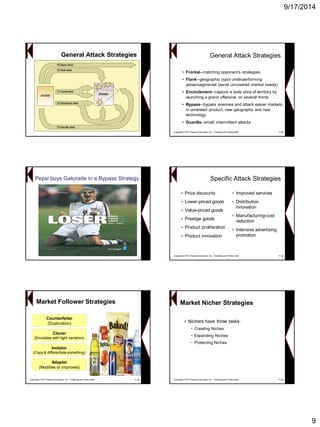
9General Attack StrategiesGeneral Attack Strategies 
•Frontal--matching opponent’s strategies 
•Flank--geographic (spot underperforming areas/segmental (serve uncovered market needs) 
•Encirclement--capture a wide slice of territory by launching a grand offensive on several fronts 
•Bypass--bypass enemies and attack easier markets in unrelated product, new geography and new technology 
•Guerilla--small, intermittent attacks 
Copyright © 2013 Pearson Education, Inc. Publishing as Prentice Hall 11-50Pepsi buys Gatorade in a Bypass Strategy 
Specific Attack Strategies 
•Price discounts 
•Lower-priced goods 
•Value-priced goods 
•Prestige goods 
•Product proliferation 
•Product innovation 
•Improved services 
•Distribution innovation 
•Manufacturing-cost reduction 
•Intensive advertising promotion 
Copyright © 2013 Pearson Education, Inc. Publishing as Prentice Hall 11-52 
Market Follower Strategies 
Counterfeiter 
(Duplication) 
Cloner 
(Emulates with light variation) Imitator(Copy & differentiate something) Adapter(Modifies or improves) Copyright © 2013 Pearson Education, Inc. Publishing as Prentice Hall 11-53 
•Nichers have three tasks: 
−Creating Niches 
−Expanding Niches 
−Protecting Niches 
Market NicherStrategies 
Copyright © 2013 Pearson Education, Inc. Publishing as Prentice Hall 11-54
9/17/2014 
10Market Nicher Strategies 
Copyright © 2013 Pearson Education, Inc. Publishing as Prentice Hall 11-55 
Niche Specialist Roles 
End-User Specialist 
Vertical-Level Specialist 
Customer-Size Specialist 
Specific-Customer Specialist 
Geographic Specialist 
Product-Line Specialist 
Job-Shop Specialist 
Quality-Price Specialist 
Service-Specialist 
Channel Specialist 
Copyright © 2013 Pearson Education, Inc. Publishing as Prentice Hall 11-56Product Life Cycle Marketing StrategiesTo say a product has a life cycle is to assert four things: 1. Products have a limited life. 2. Product sales pass through distinct stages, each posing different challenges, opportunities, and problems to the seller. 3. Profits rise and fall at different stages of the product life cycle. 4. Products require different marketing, financial, manufacturing, purchasing, and human resource strategies in each life-cycle stage. Copyright © 2013 Pearson Education, Inc. Publishing as Prentice Hall 11-57 
Figure 11.4 Sales and Profit Life Cycles 
Copyright © 2013 Pearson Education, Inc. Publishing as Prentice Hall 11-58 
Figure: Common PLC Patterns 
Growth-Slump-Maturity 
Cycle-Recycle 
ScallopedTimeTimeTime Sales VolumeSales Volume Copyright © 2013 Pearson Education, Inc. Publishing as Prentice Hall 11-59 
Figure 11.6 Style, Fashion, and Fad Life Cycles 
Fashion’s stages: distinctiveness, emulation, mass fashion, and decline 
Copyright © 2013 Pearson Education, Inc. Publishing as Prentice Hall 11-60
9/17/2014 
11 
Maintaining a Market Advantage: Trivial PursuitCopyright © 2013 Pearson Education, Inc. Publishing as Prentice Hall 11-61Characteristics, Objectives, and Marketing Strategies at Different Stages of PLCMarketing Strategies: Introduction Stage and the Pioneer AdvantageMarketing strategies: 
−Offer a basic product 
−Charge cost-plus 
−Build selective distribution 
−Build product awareness and trial among early adopters and dealers 
Characteristics: 
−Low sales 
−High cost per customer 
−Profit negative 
−Customers-Innovators 
−Competitors fewObjective: Create product awareness and trial 
Copyright © 2013 Pearson Education, Inc. Publishing as Prentice Hall 11-63 
Strategies for Developing a Pioneer Advantage 
Copyright © 2013 Pearson Education, Inc. Publishing as Prentice Hall 11-64 
Marketing Strategies: Growth Stage 
Marketing strategies: 
−Offer product extensions, service, warranty 
−Price to penetrate market 
−Build intensive distribution 
−Build awareness and interest in the mass market 
Objective: Maximize market share 
Characteristics: 
−Rapidly rising sales 
−Average cost per customer 
−Rising profits 
−Customers: early adopters 
−Competitors’ number growing 
Copyright © 2013 Pearson Education, Inc. Publishing as Prentice Hall 11-65Marketing Strategies: Maturity StageMarketing strategies: 
−Diversify brands and items models 
−Price to match or best competitors’ 
−Build more intensive distribution 
−Stress brand differences and benefits and encourage brand switchingObjective: Maximize profit while defending market shareCharacteristics: 
−Peak sales 
−Low cost per customer 
−High profits 
−Customers: Middle majority 
−Competitors: Stable number beginning to decline 
Copyright © 2013 Pearson Education, Inc. Publishing as Prentice Hall 11-66
9/17/2014 
12 
Changing Brand CourseMarket Modification 
Product ModificationMarketing Program ModificationCopyright © 2013 Pearson Education, Inc. Publishing as Prentice Hall 11-67Electrolux uses an elaborate segmentation plan and an expansive product line to make sure its brand is not stuck in the middle of a shrinking market. Marketing Strategies: Maturity StageMarketing Strategies: Decline StageMarketing strategies: 
−Phase out weak products 
−Cut price 
−Go selective: phase out unprofitable outlets 
−Reduce to minimal level needed to retain hard- core loyals 
Objective: Reduce expenditure and milk the brand 
Characteristics: 
−Declining sales 
−Low cost per customer 
−Declining profits 
−Customers: laggards 
−Competitors’ number declining 
Copyright © 2013 Pearson Education, Inc. Publishing as Prentice Hall 11-69 
Marketing in an Economic Downturn 
•Invest 
•Get close to customers 
•Review budgets 
•Use a compelling value proposition 
•Fine-tune offerings 
Copyright © 2013 Pearson Education, Inc. Publishing as Prentice Hall 11-70A Compelling Value PropositionCopyright © 2013 Pearson Education, Inc. Publishing as Prentice Hall 11-71One mistake in a recession is to be overly focused on price reductions and discounts, which can harm long-term brand equity and price integrity. Study Question 1 
A segment is unattractive when there are 
actual or potential ________ for the 
product. 
A.contenders 
B.Competitors 
C.Substitutes . 
D.unclear demand 
E.profit fluctuation 
Copyright © 2013 Pearson Education, Inc. Publishing as Prentice Hall 11-72
9/17/2014 
13 
A segment is unattractive if the company’s suppliers are able to 
raise prices or reduce quantity supplied. Which of the following is 
the best illustration of the threat of suppliers’ growing bargaining 
power? 
A.Wal-Mart has almost no competitors in its marketspace. 
B.Oil companies must purchase a significant amount of their product from OPEC. . 
C.McDonald’s is the largest fast-food franchise and is still growing. 
D.The U.S. Post Office has merged package operations with FedEx. 
E.Sears unsuccessfully attempted to compete with Wal-Mart and Kmart. 
Study Question 2 
Copyright © 2013 Pearson Education, Inc. Publishing as Prentice Hall 11-73 
In general, a company should monitor the 
following variables when analyzing competitors: 
________, share of heart, and share of market. 
A.share of demand 
B.share of profits 
C.share of promotion 
D.share of universe 
E.share of mind . 
Study Question 3Copyright © 2013 Pearson Education, Inc. Publishing as Prentice Hall 11-74 
The ________ in a given marketplace has the largest 
market share in the relevant product market and 
usually leads other firms in price changes, new-product 
introductions, distribution coverage, and promotional 
intensity. 
A.market challenger 
B.market leader . 
C.market follower 
D.market nicher 
E.market entrant 
Study Question 4Copyright © 2013 Pearson Education, Inc. Publishing as Prentice Hall 11-75 
A firm that is willing to maintain its market 
share and not rock the boat is known as a 
________. 
A.market challenger 
B.market leader 
C.market follower . 
D.market nicher 
E.market entrant 
Study Question 5 
Copyright © 2013 Pearson Education, Inc. Publishing as Prentice Hall 11-76Marketing Debate 
How do you attack a Category Leader? 
Take a position: 
1. The best way to challenge a leader is to 
attack its strengths. 
2. The best way to attack a leader is 
to avoid a head-on assault and to adopt 
a flanking strategy. 
Copyright © 2013 Pearson Education, Inc. Publishing as Prentice Hall 11-77Marketing DebatePick an industry. Classify firms according to the four different roles they might play. How would you characterize the nature of competition? Do the firms follow the principles described in this chapter? Copyright © 2013 Pearson Education, Inc. Publishing as Prentice Hall 11-78

Ch 11 competitive dynamics14e

  • 1.
    9/17/2014 1 11CompetitiveDynamics 1Copyright © 2013 Pearson Education, Inc. Publishing as Prentice Hall 11-2Chapter Questions •How can market leaders expand the total market and defend market share? •How should market challengers attack market leaders? •How can market followers or nichers compete effectively? •What marketing strategies are appropriate at each stage of the product life cycle? •How should marketers adjust their strategies and tactics for an economic downturn or recession? Kotler on Marketing •‘Poor firms ignoretheir competitors; average firms copytheir competitors; winning firms leadtheir competitors.’ Copyright © 2013 Pearson Education, Inc. Publishing as Prentice Hall 11-3 Competitive Advantage •An advantage over competitors gained by offering greater valueto consumers either through lower prices or by providing more benefits Copyright © 2013 Pearson Education, Inc. Publishing as Prentice Hall 11-4 Competition in the Jeans Market Copyright © 2013 Pearson Education, Inc. Publishing as Prentice Hall 11-5 Competitive Analysis •The process of: (a) identifying key competitors; (b) assessing their objectives, strategies, strengths and weaknesses, and reaction patterns; and (c) selecting which competitors to attack or avoid. Copyright © 2013 Pearson Education, Inc. Publishing as Prentice Hall 11-6
  • 2.
    9/17/2014 2Michel Porter:Five forces determining segment’s structural attractiveness and intrinsic long-run profitability Competitive Forces Copyright © 2013 Pearson Education, Inc. Publishing as Prentice Hall 11-7Threat of Intense Segment Rivalry •Unattractive when numerous, strong or aggressive competitors •More unattractive if: −It is stable or declining −Plant capacity additions are done in large increments −Fixed costs are high −Exit barriers are high −Competitors have stake in staying in the segment Copyright © 2013 Pearson Education, Inc. Publishing as Prentice Hall 11-8 Threat of New Entrants •Attractive when high entry barriers and low exit barriers −When both barriers are high, profit potential is high but risky since nobody quits −When both barriers are low, returns are low but stable Copyright © 2013 Pearson Education, Inc. Publishing as Prentice Hall 11-9Barriers and Profitability Barriers Barriers Barriers Barriers Copyright © 2013 Pearson Education, Inc. Publishing as Prentice Hall 11-10Threat of Substitute Products •Unattractive when more substitutes −Substitutes place limit on price and profit −High prices induce buyers to switch to the substitutes Copyright © 2013 Pearson Education, Inc. Publishing as Prentice Hall 11-11 Bargaining Power of Buyers •Unattractive if buyers have bargaining power •Buyers are more powerful when: −They are more organized and concentrated −They purchase in large quantities −Product is undifferentiated −Switching cost is low −They are price sensitive −Suppliers’ products are commodities −Product represents significant portion of buyer’s costs −Buyer is willing and able to achieve backward integration Copyright © 2013 Pearson Education, Inc. Publishing as Prentice Hall 11-12
  • 3.
    9/17/2014 3 BargainingPower of Suppliers •Unattractive, if suppliers are able to raise prices or reduce quantity supplied •Suppliers are powerful, when −They are concentrated or organized −There are few substitutes −Supplier’s products are critical inputs and highly differentiated −Costs of switching suppliers are high −Suppliers are willing and able to sell product themselves Copyright © 2013 Pearson Education, Inc. Publishing as Prentice Hall 11-13 Identifying Competitors •Competitors include firms: −Making the same product or class of products −Making products that provide the same service −Competing for the same consumer dollars •Examine competition from both an industry and a market point of view Copyright © 2013 Pearson Education, Inc. Publishing as Prentice Hall 11-14 •An industry is a group of firms that offer a product or class of products that are close substitutes for one another •Industries are classified according to: −The number of sellers −The degree of product differentiation −The presence or absence of entry, mobility, and exit barriers −Cost structure −The degree of vertical integration −The degree of globalization An Industry Point of View Copyright © 2013 Pearson Education, Inc. Publishing as Prentice Hall 11-15 •Actual or potential companies that satisfy the same customer need (see map) −Competitor myopia occurs when a firm focuses on its direct competitor and ignores indirect or new competitors −Marketers must consider emerging competitors, new technologies, competitors on internet A Market Point of View Copyright © 2013 Pearson Education, Inc. Publishing as Prentice Hall 11-16 Competitor’s Map •Once primary competitors are identified, company must ascertain their: −Strategies −Objectives −Strengths −Weaknesses Analyzing Competitors Copyright © 2013 Pearson Education, Inc. Publishing as Prentice Hall 11-18
  • 4.
    9/17/2014 4 •Porter:A strategic group consists of firms directing the same strategy to the same target market −Competition is most intense within a strategic group due to: oOverlapping customers, oLack of perceived differences, and oExpansion into new segments Strategies Copyright © 2013 Pearson Education, Inc. Publishing as Prentice Hall 11-19 •Understand the competitor’s ability to deliver value to its customers −Product quality −Product features −Customer service −Pricing policy −Distribution coverage −Sales force strategy −Promotion programs −Financial strategies −R&D Strategies Copyright © 2013 Pearson Education, Inc. Publishing as Prentice Hall 11-20 •What is each competitor seeking in the marketplace? •What drives each competitor’s behavior? −Objectives are influenced by size, history, current management, and financial situation −Competitors strive to maximize profits, sales growth, market share, cash flow, leadership Objectives Copyright © 2013 Pearson Education, Inc. Publishing as Prentice Hall 11-21 A Competitor’s Expansion Plan Copyright © 2013 Pearson Education, Inc. Publishing as Prentice Hall 11-22 •Analyze S/W based on primary data, secondary data, personal experience, WoM •Monitor 3 variables when analyzing competitors −Share of Market: Competitor’s share of the target market −Share of Mind: The % of customers who name the competitor that comes first to their mind −Share of Heart: The % of customers who name the competitor from which they would prefer to buy Strengths and Weaknesses Copyright © 2013 Pearson Education, Inc. Publishing as Prentice Hall 11-23Example: Market Share, Mind Share, and Heart ShareCopyright © 2013 Pearson Education, Inc. Publishing as Prentice Hall 11-24
  • 5.
    9/17/2014 5 Customers’Ratings of 3 Competitors on Five Success FactorsCopyright © 2013 Pearson Education, Inc. Publishing as Prentice Hall 11-25 •Dominant: Controls others’ behavior •Strong: Can take independent action and maintain long-run position •Favorable: Has exploitable strength and a more than average opportunity •Tenable: Satisfactory to justify running in business •Weak: Unsatisfactory performance but scope to improve •Nonviable: Unsatisfactory performance and no scope to improve ArtherD. Little Consulting Firm proposed six competitive positions to decide whom to attack Copyright © 2013 Pearson Education, Inc. Publishing as Prentice Hall 11-26 •Benchmarking is comparing the company’s products/performances to those of industry leaders to find ways to improve quality/ performance •Steps of benchmarking −Determine which functions to benchmark −Identify the key performance variables to measure −Identify the best-in-class companies −Measure the performance of best-in-class companies −Measure the company’s performance −Specify programs and actions to close the gap −Implement and monitor results Benchmarking Copyright © 2013 Pearson Education, Inc. Publishing as Prentice Hall 11-27 •Selecting which competitors to attack or avoid: −Strong vs. Weak competitors −Close vs. Distant competitors −Good vs. Bad competitors Selecting Competitors Copyright © 2013 Pearson Education, Inc. Publishing as Prentice Hall 11-28 •Increase total demand •Share costs of market and product development •Legitimize new technologies •Serve less attractive market segments •Provide more product differentiation •Lower the anti-trust risk •Improve bargaining power against legislators and regulators Characteristics of Good Competitors Copyright © 2013 Pearson Education, Inc. Publishing as Prentice Hall 11-29 •Try to capture market share rather than to create market •Take large risks •Create disruption Characteristics of Bad Competitors Copyright © 2013 Pearson Education, Inc. Publishing as Prentice Hall 11-30
  • 6.
    9/17/2014 6 Taskof Competitive Intelligence System (CIS) •Identifies competitive information and its best sources •Continually collects information •Checks information for validity and reliability •Interprets and organizes information •Sends key information to decision makers •Responds to inquiries about competitors Copyright © 2013 Pearson Education, Inc. Publishing as Prentice Hall 11-31 Porter’s 4 Basic Competitive Strategies •Overall cost leadership strategy: Achieving the lowest production and distribution costs •Differentiation strategy: Creating a highly differentiated product line and marketing program •Focus strategy: Serving few market segments •Middle-of-the-roaders: Without a clear strategy Copyright © 2013 Pearson Education, Inc. Publishing as Prentice Hall 11-32 •Market leader: Firm with the largest market share leads the market price changes, innovations, distribution coverage, and promotion spending •Market challengers: Firms fighting to increase market share •Market followers: Firms trying to hold onto their market share •Market nichers: Firms that serve small market segments not being pursued by other firms Competitive Positions Copyright © 2013 Pearson Education, Inc. Publishing as Prentice Hall 11-33 Figure 11.1: Hypothetical Market Structure Copyright © 2013 Pearson Education, Inc. Publishing as Prentice Hall 11-34 •Expanding the total market •Protecting market share •Increasing market share Strategies for Market LeadersFig: Expanding the total market •New Customers− search for new users among three groups: −Who might use it but do not (market penetration) −Who have never used it (new-market segment) −Who live elsewhere (geographical-expansion) Expanding the Total Market Copyright © 2013 Pearson Education, Inc. Publishing as Prentice Hall 11-36
  • 7.
    9/17/2014 7 •Moreusage−increase the amount, level, or frequency of consumption −Boost the amount through packaging or product redesign −Increase frequency of consumption by: a)identifying additional opportunities to use the brand in the same basic way b)identifying completely new and different ways to use the brand. Expanding the Total Market Copyright © 2013 Pearson Education, Inc. Publishing as Prentice Hall 11-37 Fig: New Ways to Use a Brand Expanding the Total Market Fig: Frappuccino coffee drinks have been a new source of growth and revenues for Starbucks. •Continuous innovation the most constructive response −Develop new products and customer services, distribution effectiveness, and cost cutting −Be involved in: −PROACTIVE MARKETING −DEFENSIVE MARKETING Protecting Market Share Copyright © 2013 Pearson Education, Inc. Publishing as Prentice Hall 11-39 •Proactive companies create new offers to serve unmet/unknown consumer needs. −A responsive marketerfinds a stated need and fills it −An anticipative marketer looks ahead to needs customers may have in the near future. −A creative marketer discovers solutions customers did not ask for but to which they enthusiastically respond. Proactive Marketing Copyright © 2013 Pearson Education, Inc. Publishing as Prentice Hall 11-40 •Responsive anticipation to see the likely problem −IBM: a hardware producer to a service business −Responsive anticipation is performed before a given change −Reactive response happens after the change takes place •Creative anticipation to devise innovative solutions −PepsiCo: H2OH!, a bottled water hybrid soft drink Two Proactive kills of Proactive Firms Copyright © 2013 Pearson Education, Inc. Publishing as Prentice Hall 11-41 •Are ready to take risks and make mistakes, •Have a vision of the future and of investing in it, •Have the capabilities to innovate, •Are flexible and non-bureaucratic, and •Have many managers who think proactively. What Proactive Firms Do? Copyright © 2013 Pearson Education, Inc. Publishing as Prentice Hall 11-42
  • 8.
    9/17/2014 8 •Evenwhen it does not launch offenses, the market leader must not leave any major flanks exposed. •The aim of defensive strategy is to: −Reduce the probability of attack −Divert attacks to less-threatened areas −Lessen their intensity Defensive Marketing Copyright © 2013 Pearson Education, Inc. Publishing as Prentice Hall 11-43Six Defense Strategies Copyright © 2013 Pearson Education, Inc. Publishing as Prentice Hall 11-44 •Position--occupy the most desirable market space in consumers’ minds, making the brand almost impregnable. •Flank--erect outposts to protect a weak front or support a possible counterattack. •Preemptive--attack first, perhaps with guerrilla action across the market and keep everyone off balance. •Counteroffensive--meet the attacker frontally and hit its flank, or launch a pincer movement so it will have to pull back to defend itself. •Mobile--stretch its domain over new territories that can serve future centers for defense and offense—market broadening & diversification. •Contraction--give up weaker territories and reassign resources to stronger ones. Six Defense Strategies •Gaining increased share may not give higher profits •Because the cost of buying market share may exceed its revenue value, a company should consider four factors : −Possibility of provoking antitrust action −Economic cost (see figure) −The danger of pursuing the wrong marketing activities −The effect of increased market share on actual and perceived quality Increasing Market Share Copyright © 2013 Pearson Education, Inc. Publishing as Prentice Hall 11-46 Fig:11.3 The Concept of Optimal Market Share Copyright © 2013 Pearson Education, Inc. Publishing as Prentice Hall 11-47Market Challenger Strategies •Define the strategic objective and opponents −First define its strategic objective to increase market share −Then decide whom to attack (leader or same size firms, small local or regional firms) •Choose a general attack strategy •Choose a specific attack strategy Copyright © 2013 Pearson Education, Inc. Publishing as Prentice Hall 11-48
  • 9.
    9/17/2014 9General AttackStrategiesGeneral Attack Strategies •Frontal--matching opponent’s strategies •Flank--geographic (spot underperforming areas/segmental (serve uncovered market needs) •Encirclement--capture a wide slice of territory by launching a grand offensive on several fronts •Bypass--bypass enemies and attack easier markets in unrelated product, new geography and new technology •Guerilla--small, intermittent attacks Copyright © 2013 Pearson Education, Inc. Publishing as Prentice Hall 11-50Pepsi buys Gatorade in a Bypass Strategy Specific Attack Strategies •Price discounts •Lower-priced goods •Value-priced goods •Prestige goods •Product proliferation •Product innovation •Improved services •Distribution innovation •Manufacturing-cost reduction •Intensive advertising promotion Copyright © 2013 Pearson Education, Inc. Publishing as Prentice Hall 11-52 Market Follower Strategies Counterfeiter (Duplication) Cloner (Emulates with light variation) Imitator(Copy & differentiate something) Adapter(Modifies or improves) Copyright © 2013 Pearson Education, Inc. Publishing as Prentice Hall 11-53 •Nichers have three tasks: −Creating Niches −Expanding Niches −Protecting Niches Market NicherStrategies Copyright © 2013 Pearson Education, Inc. Publishing as Prentice Hall 11-54
  • 10.
    9/17/2014 10Market NicherStrategies Copyright © 2013 Pearson Education, Inc. Publishing as Prentice Hall 11-55 Niche Specialist Roles End-User Specialist Vertical-Level Specialist Customer-Size Specialist Specific-Customer Specialist Geographic Specialist Product-Line Specialist Job-Shop Specialist Quality-Price Specialist Service-Specialist Channel Specialist Copyright © 2013 Pearson Education, Inc. Publishing as Prentice Hall 11-56Product Life Cycle Marketing StrategiesTo say a product has a life cycle is to assert four things: 1. Products have a limited life. 2. Product sales pass through distinct stages, each posing different challenges, opportunities, and problems to the seller. 3. Profits rise and fall at different stages of the product life cycle. 4. Products require different marketing, financial, manufacturing, purchasing, and human resource strategies in each life-cycle stage. Copyright © 2013 Pearson Education, Inc. Publishing as Prentice Hall 11-57 Figure 11.4 Sales and Profit Life Cycles Copyright © 2013 Pearson Education, Inc. Publishing as Prentice Hall 11-58 Figure: Common PLC Patterns Growth-Slump-Maturity Cycle-Recycle ScallopedTimeTimeTime Sales VolumeSales Volume Copyright © 2013 Pearson Education, Inc. Publishing as Prentice Hall 11-59 Figure 11.6 Style, Fashion, and Fad Life Cycles Fashion’s stages: distinctiveness, emulation, mass fashion, and decline Copyright © 2013 Pearson Education, Inc. Publishing as Prentice Hall 11-60
  • 11.
    9/17/2014 11 Maintaininga Market Advantage: Trivial PursuitCopyright © 2013 Pearson Education, Inc. Publishing as Prentice Hall 11-61Characteristics, Objectives, and Marketing Strategies at Different Stages of PLCMarketing Strategies: Introduction Stage and the Pioneer AdvantageMarketing strategies: −Offer a basic product −Charge cost-plus −Build selective distribution −Build product awareness and trial among early adopters and dealers Characteristics: −Low sales −High cost per customer −Profit negative −Customers-Innovators −Competitors fewObjective: Create product awareness and trial Copyright © 2013 Pearson Education, Inc. Publishing as Prentice Hall 11-63 Strategies for Developing a Pioneer Advantage Copyright © 2013 Pearson Education, Inc. Publishing as Prentice Hall 11-64 Marketing Strategies: Growth Stage Marketing strategies: −Offer product extensions, service, warranty −Price to penetrate market −Build intensive distribution −Build awareness and interest in the mass market Objective: Maximize market share Characteristics: −Rapidly rising sales −Average cost per customer −Rising profits −Customers: early adopters −Competitors’ number growing Copyright © 2013 Pearson Education, Inc. Publishing as Prentice Hall 11-65Marketing Strategies: Maturity StageMarketing strategies: −Diversify brands and items models −Price to match or best competitors’ −Build more intensive distribution −Stress brand differences and benefits and encourage brand switchingObjective: Maximize profit while defending market shareCharacteristics: −Peak sales −Low cost per customer −High profits −Customers: Middle majority −Competitors: Stable number beginning to decline Copyright © 2013 Pearson Education, Inc. Publishing as Prentice Hall 11-66
  • 12.
    9/17/2014 12 ChangingBrand CourseMarket Modification Product ModificationMarketing Program ModificationCopyright © 2013 Pearson Education, Inc. Publishing as Prentice Hall 11-67Electrolux uses an elaborate segmentation plan and an expansive product line to make sure its brand is not stuck in the middle of a shrinking market. Marketing Strategies: Maturity StageMarketing Strategies: Decline StageMarketing strategies: −Phase out weak products −Cut price −Go selective: phase out unprofitable outlets −Reduce to minimal level needed to retain hard- core loyals Objective: Reduce expenditure and milk the brand Characteristics: −Declining sales −Low cost per customer −Declining profits −Customers: laggards −Competitors’ number declining Copyright © 2013 Pearson Education, Inc. Publishing as Prentice Hall 11-69 Marketing in an Economic Downturn •Invest •Get close to customers •Review budgets •Use a compelling value proposition •Fine-tune offerings Copyright © 2013 Pearson Education, Inc. Publishing as Prentice Hall 11-70A Compelling Value PropositionCopyright © 2013 Pearson Education, Inc. Publishing as Prentice Hall 11-71One mistake in a recession is to be overly focused on price reductions and discounts, which can harm long-term brand equity and price integrity. Study Question 1 A segment is unattractive when there are actual or potential ________ for the product. A.contenders B.Competitors C.Substitutes . D.unclear demand E.profit fluctuation Copyright © 2013 Pearson Education, Inc. Publishing as Prentice Hall 11-72
  • 13.
    9/17/2014 13 Asegment is unattractive if the company’s suppliers are able to raise prices or reduce quantity supplied. Which of the following is the best illustration of the threat of suppliers’ growing bargaining power? A.Wal-Mart has almost no competitors in its marketspace. B.Oil companies must purchase a significant amount of their product from OPEC. . C.McDonald’s is the largest fast-food franchise and is still growing. D.The U.S. Post Office has merged package operations with FedEx. E.Sears unsuccessfully attempted to compete with Wal-Mart and Kmart. Study Question 2 Copyright © 2013 Pearson Education, Inc. Publishing as Prentice Hall 11-73 In general, a company should monitor the following variables when analyzing competitors: ________, share of heart, and share of market. A.share of demand B.share of profits C.share of promotion D.share of universe E.share of mind . Study Question 3Copyright © 2013 Pearson Education, Inc. Publishing as Prentice Hall 11-74 The ________ in a given marketplace has the largest market share in the relevant product market and usually leads other firms in price changes, new-product introductions, distribution coverage, and promotional intensity. A.market challenger B.market leader . C.market follower D.market nicher E.market entrant Study Question 4Copyright © 2013 Pearson Education, Inc. Publishing as Prentice Hall 11-75 A firm that is willing to maintain its market share and not rock the boat is known as a ________. A.market challenger B.market leader C.market follower . D.market nicher E.market entrant Study Question 5 Copyright © 2013 Pearson Education, Inc. Publishing as Prentice Hall 11-76Marketing Debate How do you attack a Category Leader? Take a position: 1. The best way to challenge a leader is to attack its strengths. 2. The best way to attack a leader is to avoid a head-on assault and to adopt a flanking strategy. Copyright © 2013 Pearson Education, Inc. Publishing as Prentice Hall 11-77Marketing DebatePick an industry. Classify firms according to the four different roles they might play. How would you characterize the nature of competition? Do the firms follow the principles described in this chapter? Copyright © 2013 Pearson Education, Inc. Publishing as Prentice Hall 11-78