Chapter
5-1
Chapter
5-2
CHAPTERCHAPTER 55
ACCOUNTING FORACCOUNTING FOR
MERCHANDISINGMERCHANDISING
OPERATIONSOPERATIONS
Accounting Principles, Eighth Edition
Chapter
5-3
Merchandising OperationsMerchandising OperationsMerchandising OperationsMerchandising Operations
LO 1 Identify the differences between service and merchandising companies.LO 1 Identify the differences between service and merchandising companies.
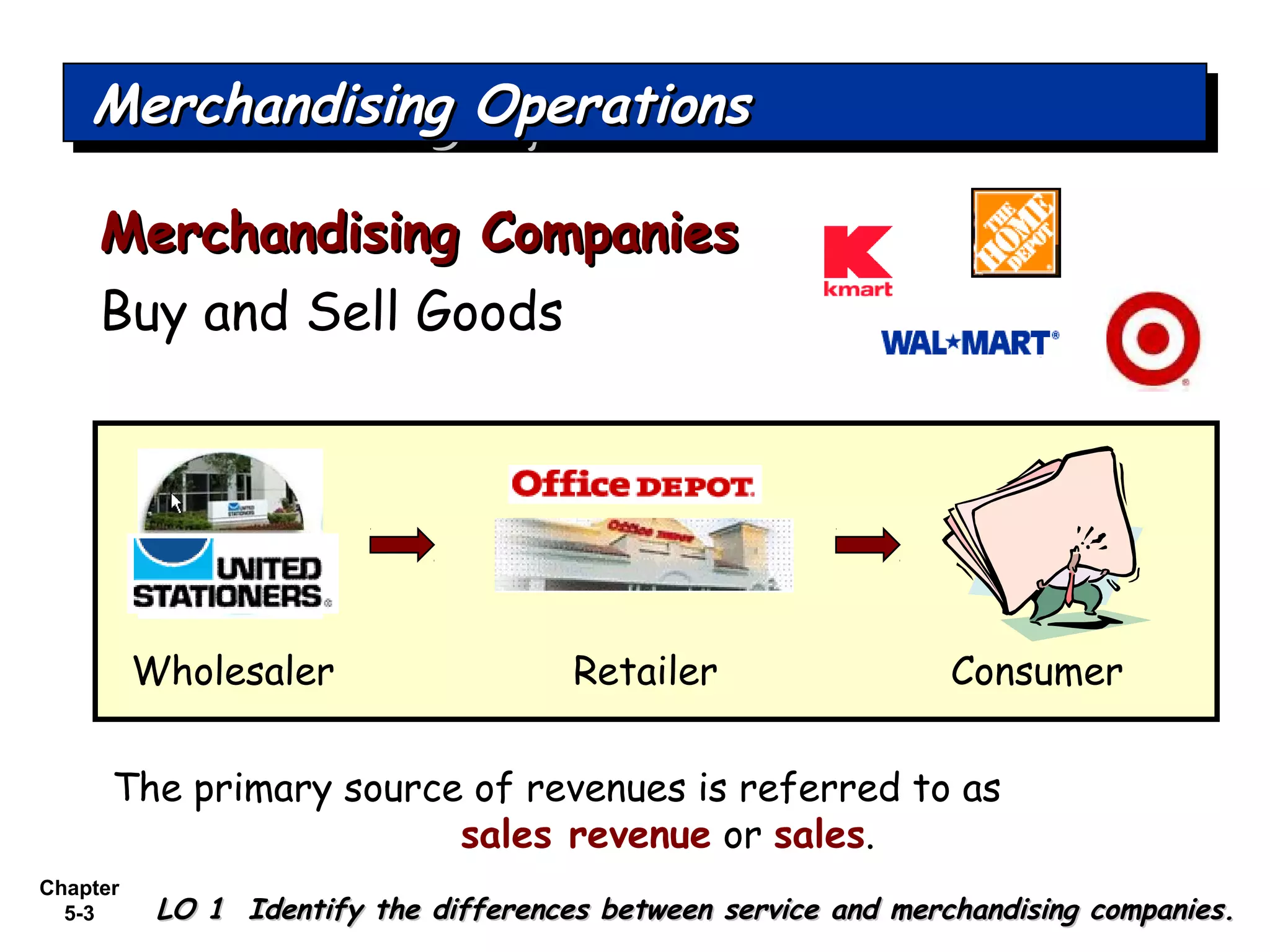
Merchandising CompaniesMerchandising Companies
Buy and Sell Goods
Wholesaler Retailer Consumer
The primary source of revenues is referred to as
sales revenue or sales.
Chapter
5-4
Merchandising OperationsMerchandising OperationsMerchandising OperationsMerchandising Operations
LO 1 Identify the differences between service and merchandising companies.LO 1 Identify the differences between service and merchandising companies.
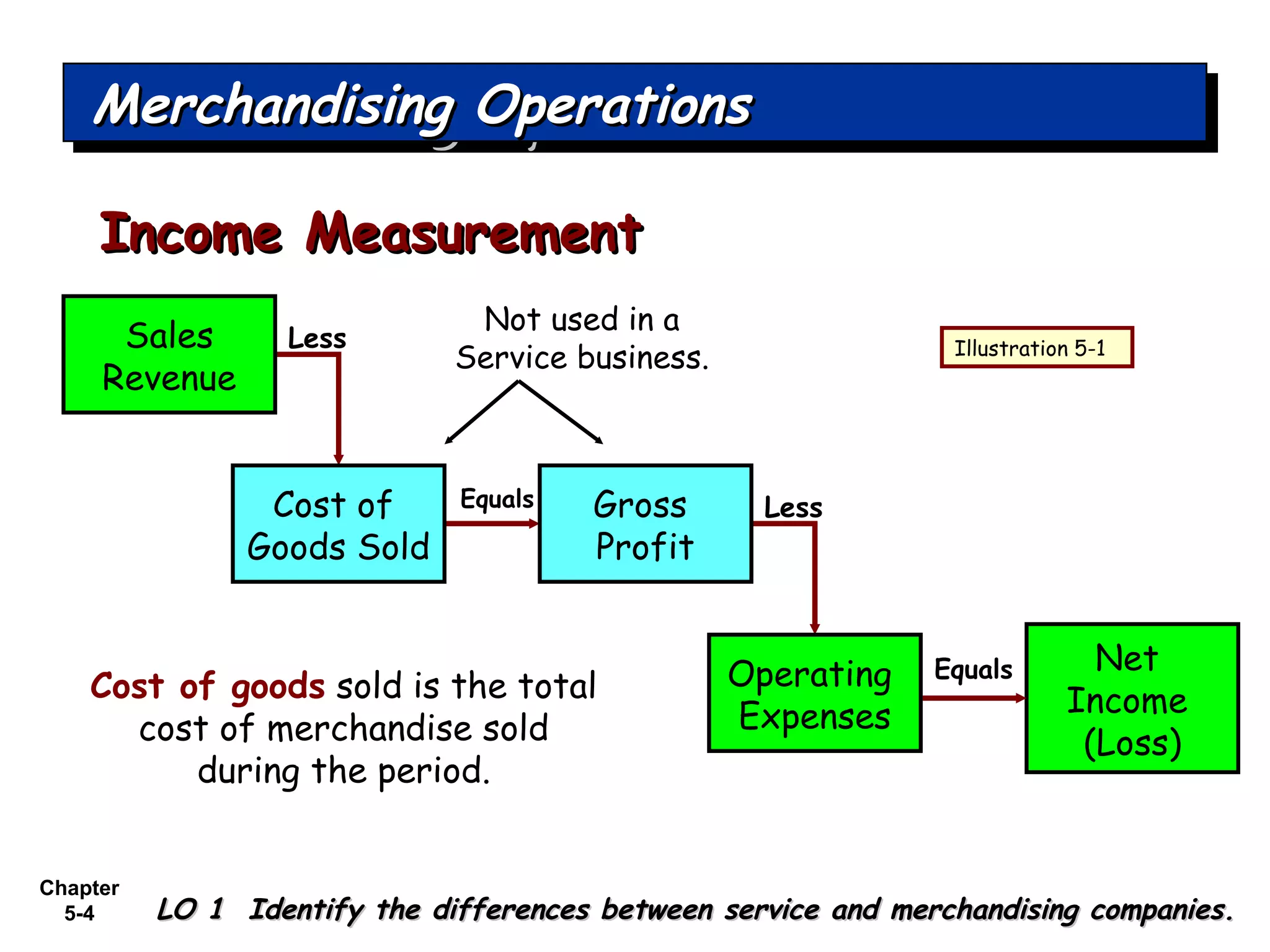
Income MeasurementIncome Measurement
Illustration 5-1
Cost of goods sold is the total
cost of merchandise sold
during the period.
Not used in a
Service business.
Net
Income
(Loss)
Less
LessEquals
Equals
Sales
Revenue
Cost of
Goods Sold
Gross
Profit
Operating
Expenses
Chapter
5-5
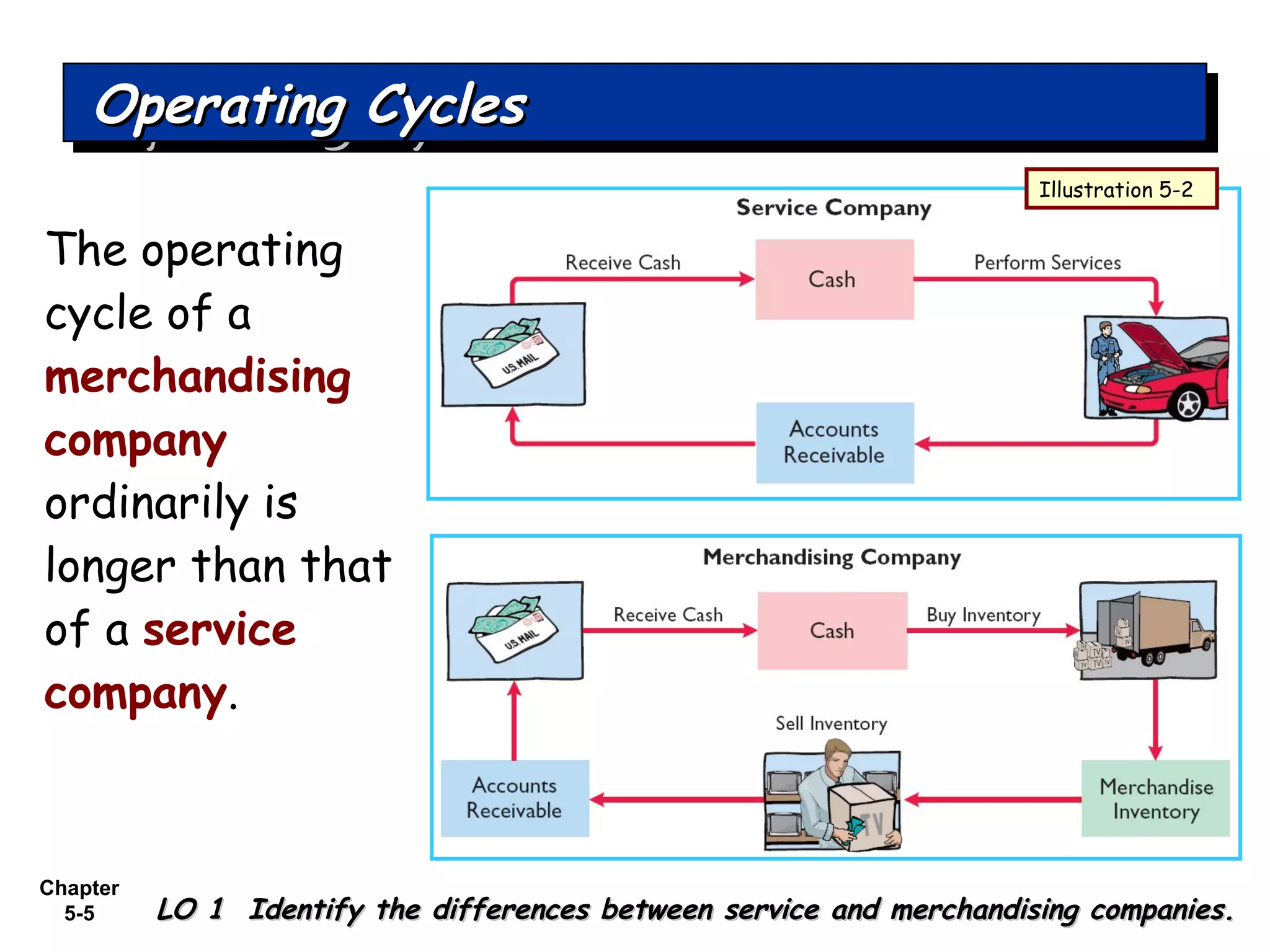
The operating
cycle of a
merchandising
company
ordinarily is
longer than that
of a service
company.
Operating CyclesOperating CyclesOperating CyclesOperating Cycles
LO 1 Identify the differences between service and merchandising companies.LO 1 Identify the differences between service and merchandising companies.
Illustration 5-2
Chapter
5-6
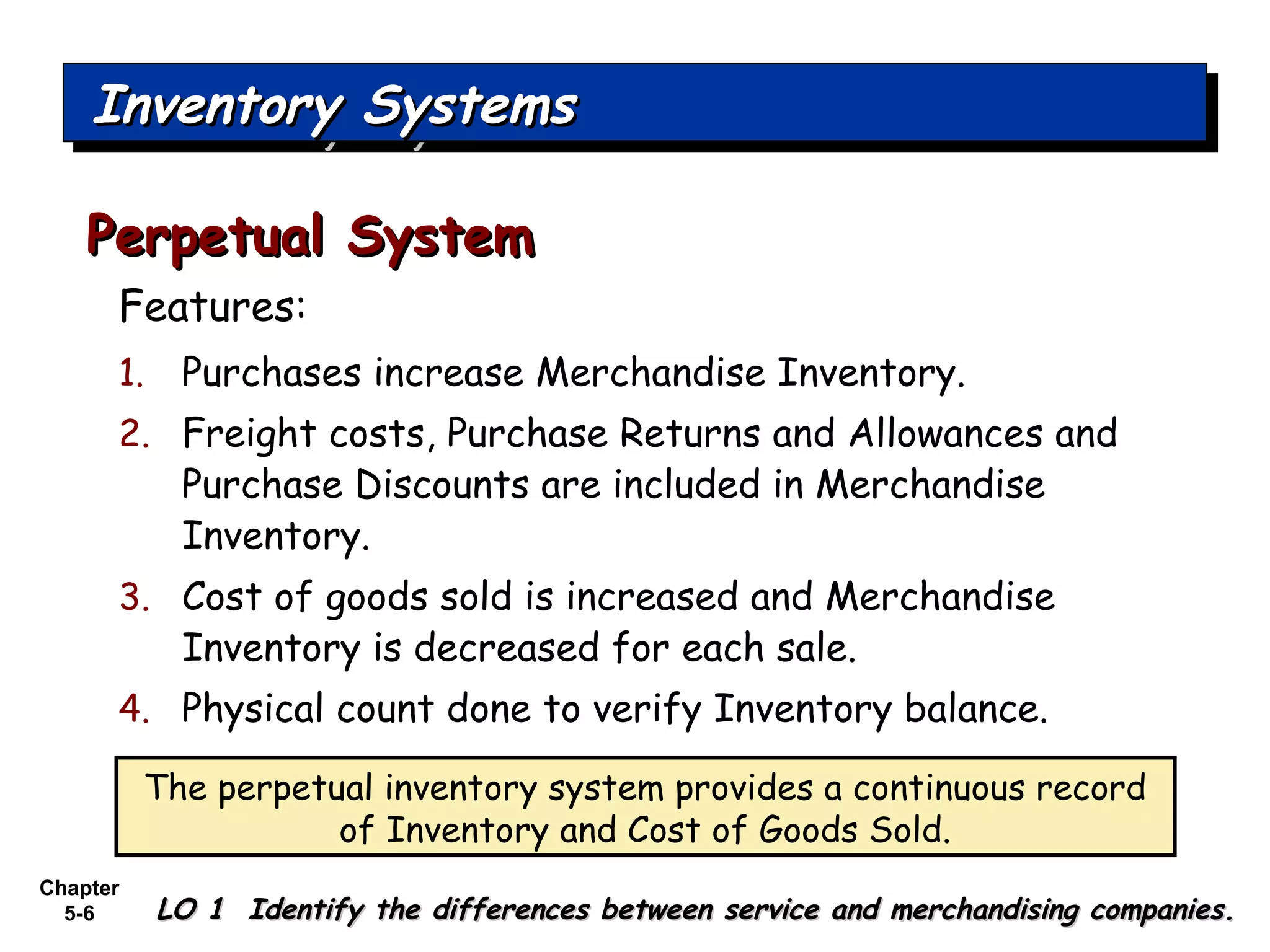
Features:
Perpetual SystemPerpetual System
1. Purchases increase Merchandise Inventory.
2. Freight costs, Purchase Returns and Allowances and
Purchase Discounts are included in Merchandise
Inventory.
3. Cost of goods sold is increased and Merchandise
Inventory is decreased for each sale.
4. Physical count done to verify Inventory balance.
The perpetual inventory system provides a continuous record
of Inventory and Cost of Goods Sold.
Inventory SystemsInventory SystemsInventory SystemsInventory Systems
LO 1 Identify the differences between service and merchandising companies.LO 1 Identify the differences between service and merchandising companies.
Chapter
5-7
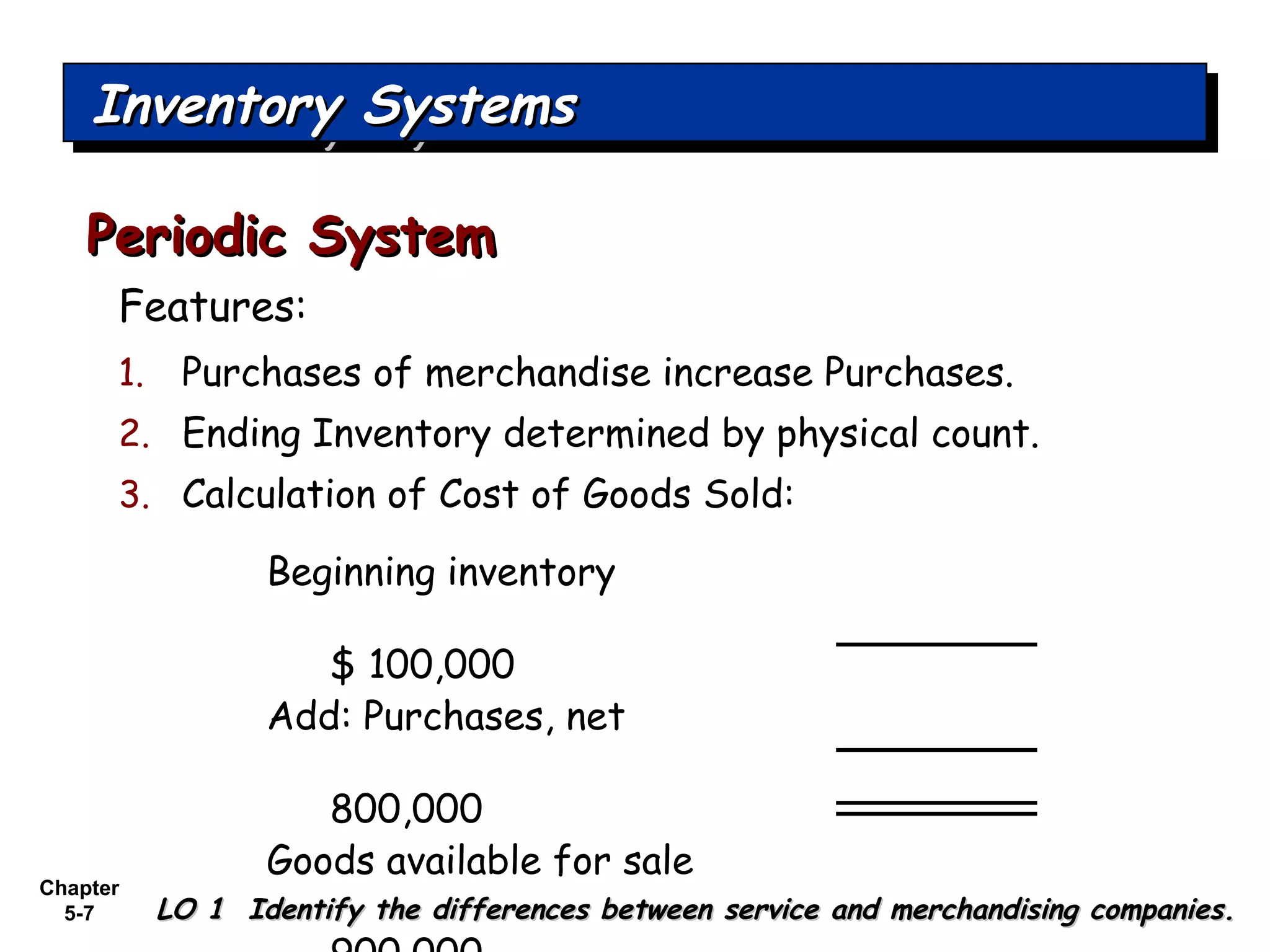
Features:
Periodic SystemPeriodic System
1. Purchases of merchandise increase Purchases.
2. Ending Inventory determined by physical count.
3. Calculation of Cost of Goods Sold:
Inventory SystemsInventory SystemsInventory SystemsInventory Systems
LO 1 Identify the differences between service and merchandising companies.LO 1 Identify the differences between service and merchandising companies.
Beginning inventory
$ 100,000
Add: Purchases, net
800,000
Goods available for sale
Chapter
5-8
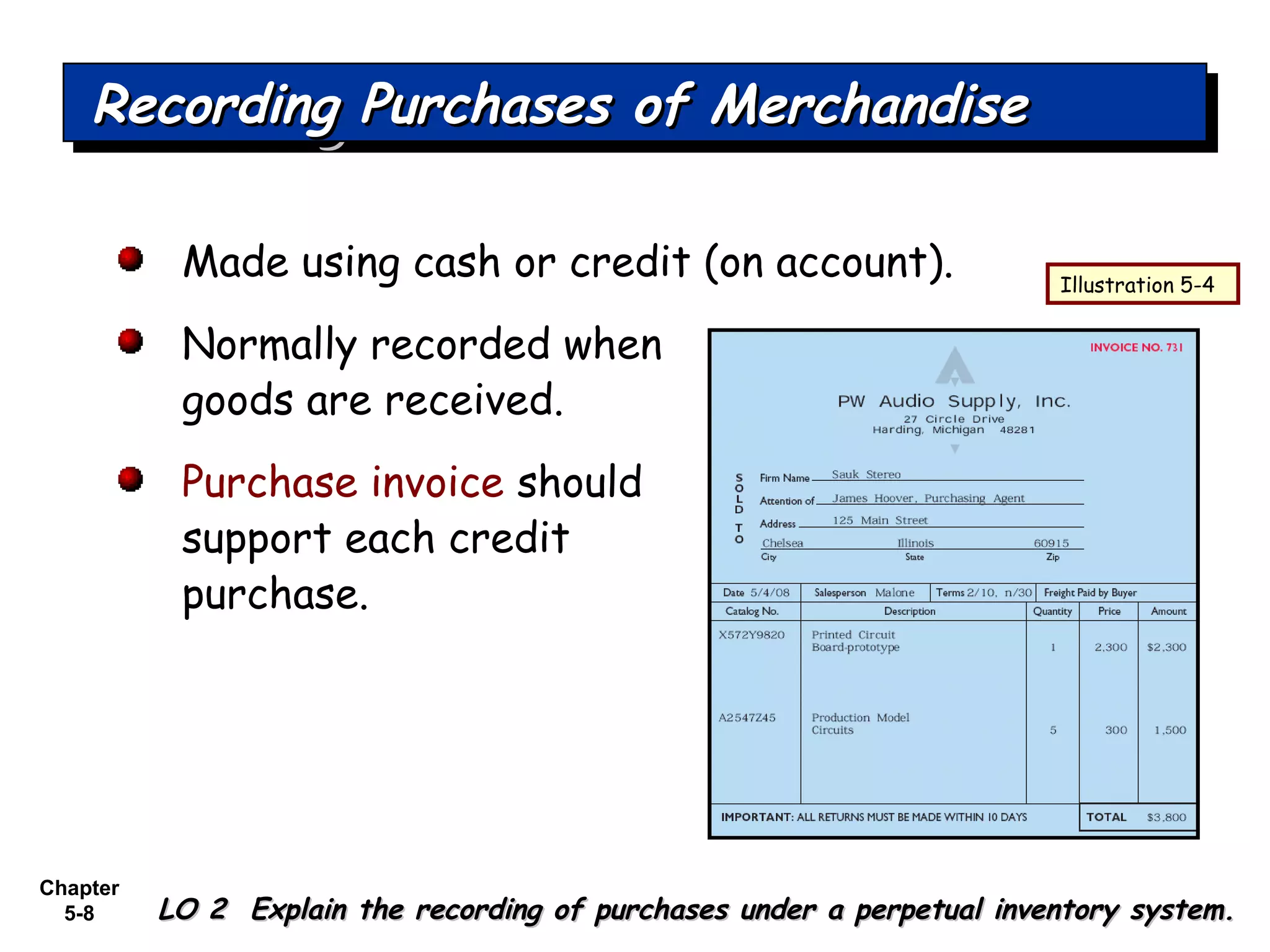
Made using cash or credit (on account).
Normally recorded when
goods are received.
Purchase invoice should
support each credit
purchase.
Recording Purchases of MerchandiseRecording Purchases of MerchandiseRecording Purchases of MerchandiseRecording Purchases of Merchandise
LO 2 Explain the recording of purchases under a perpetual inventory system.LO 2 Explain the recording of purchases under a perpetual inventory system.
Illustration 5-4
Chapter
5-9
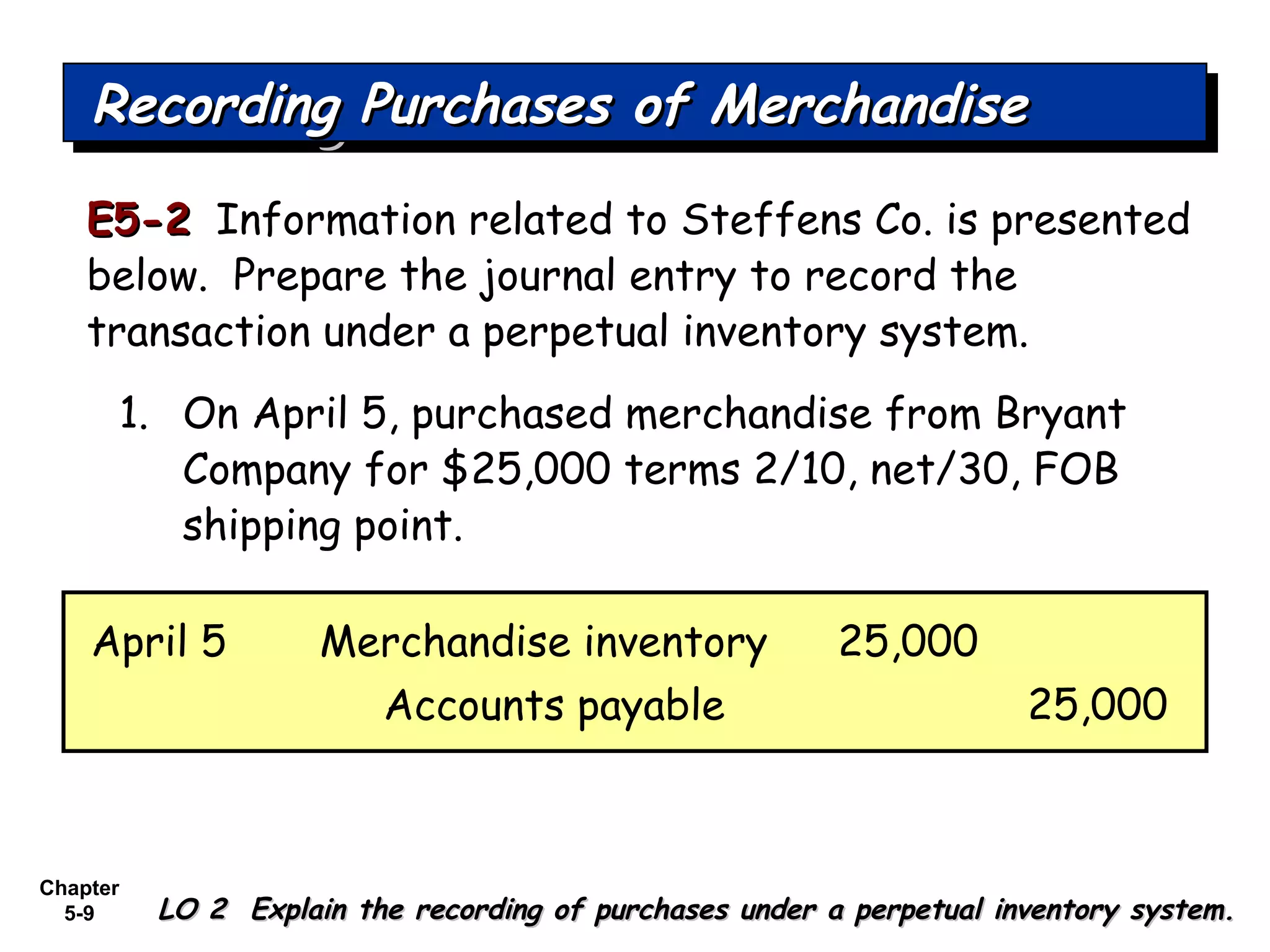
E5-2E5-2 Information related to Steffens Co. is presented
below. Prepare the journal entry to record the
transaction under a perpetual inventory system.
1. On April 5, purchased merchandise from Bryant
Company for $25,000 terms 2/10, net/30, FOB
shipping point.
Merchandise inventory 25,000April 5
Accounts payable 25,000
Recording Purchases of MerchandiseRecording Purchases of MerchandiseRecording Purchases of MerchandiseRecording Purchases of Merchandise
LO 2 Explain the recording of purchases under a perpetual inventory system.LO 2 Explain the recording of purchases under a perpetual inventory system.
Chapter
5-10
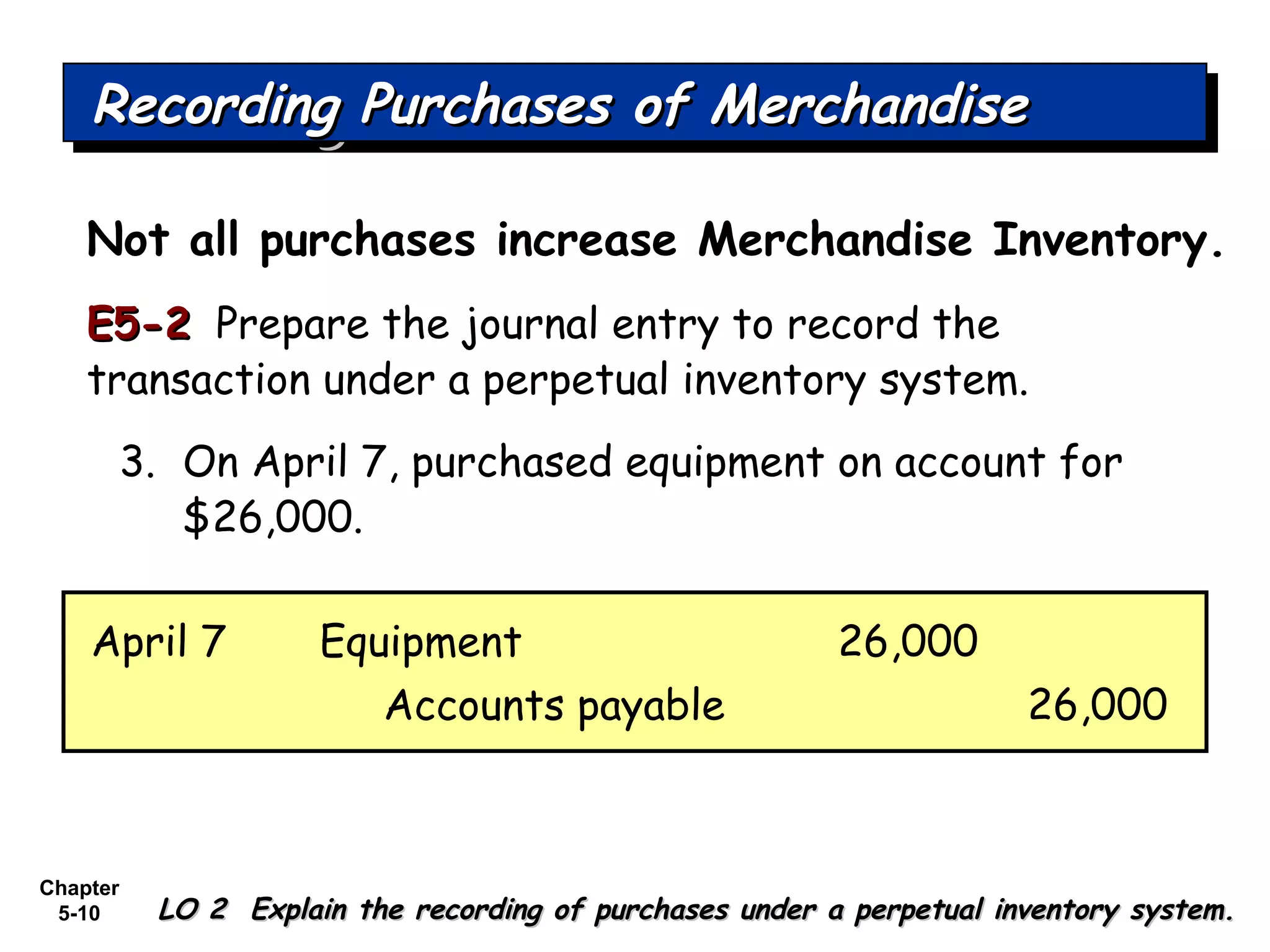
Not all purchases increase Merchandise Inventory.
E5-2E5-2 Prepare the journal entry to record the
transaction under a perpetual inventory system.
3. On April 7, purchased equipment on account for
$26,000.
Equipment 26,000April 7
Accounts payable 26,000
Recording Purchases of MerchandiseRecording Purchases of MerchandiseRecording Purchases of MerchandiseRecording Purchases of Merchandise
LO 2 Explain the recording of purchases under a perpetual inventory system.LO 2 Explain the recording of purchases under a perpetual inventory system.
Chapter
5-11
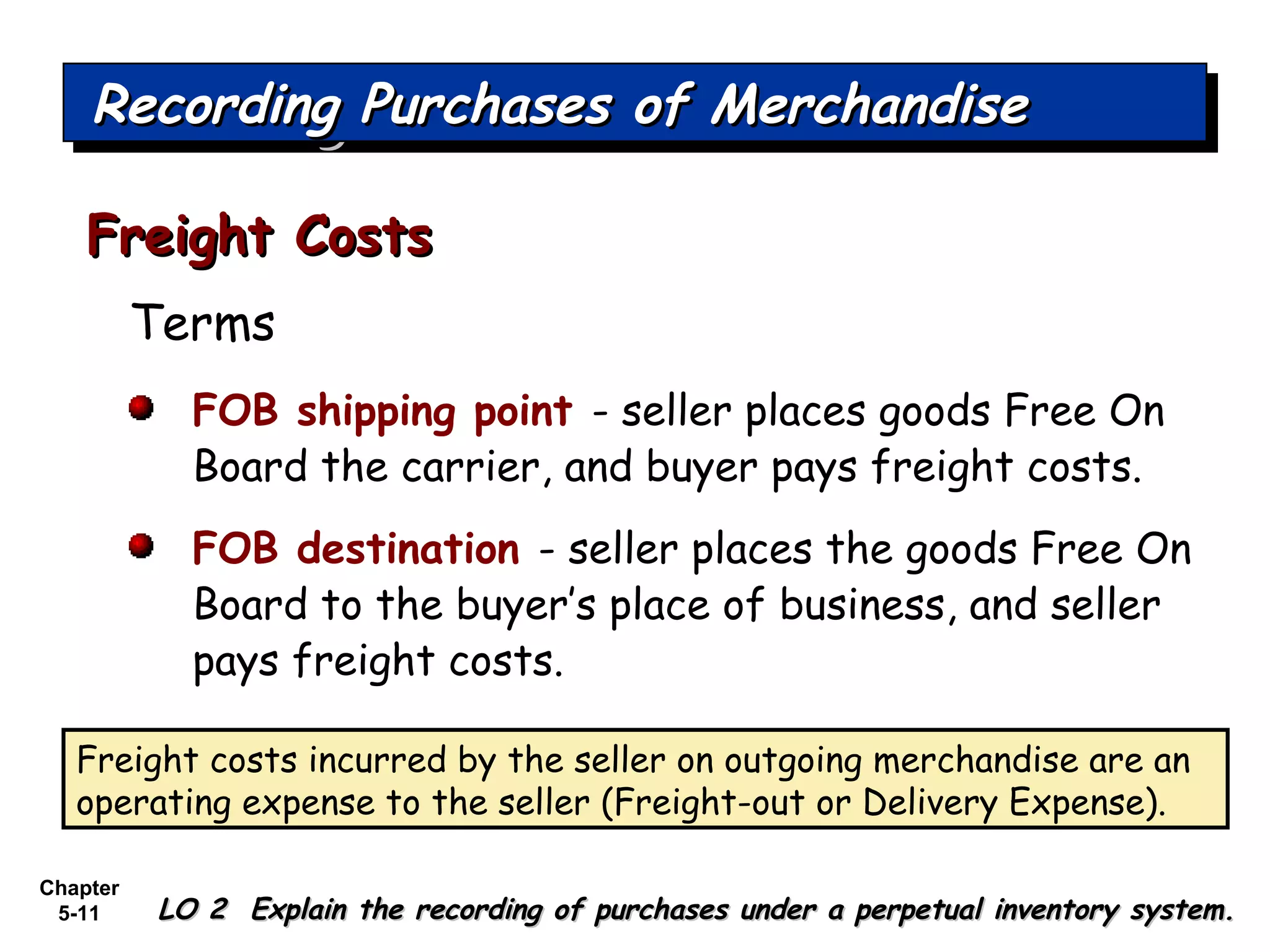
Terms
FOB shipping point - seller places goods Free On
Board the carrier, and buyer pays freight costs.
FOB destination - seller places the goods Free On
Board to the buyer’s place of business, and seller
pays freight costs.
Freight CostsFreight Costs
Recording Purchases of MerchandiseRecording Purchases of MerchandiseRecording Purchases of MerchandiseRecording Purchases of Merchandise
LO 2 Explain the recording of purchases under a perpetual inventory system.LO 2 Explain the recording of purchases under a perpetual inventory system.
Freight costs incurred by the seller on outgoing merchandise are an
operating expense to the seller (Freight-out or Delivery Expense).
Chapter
5-12
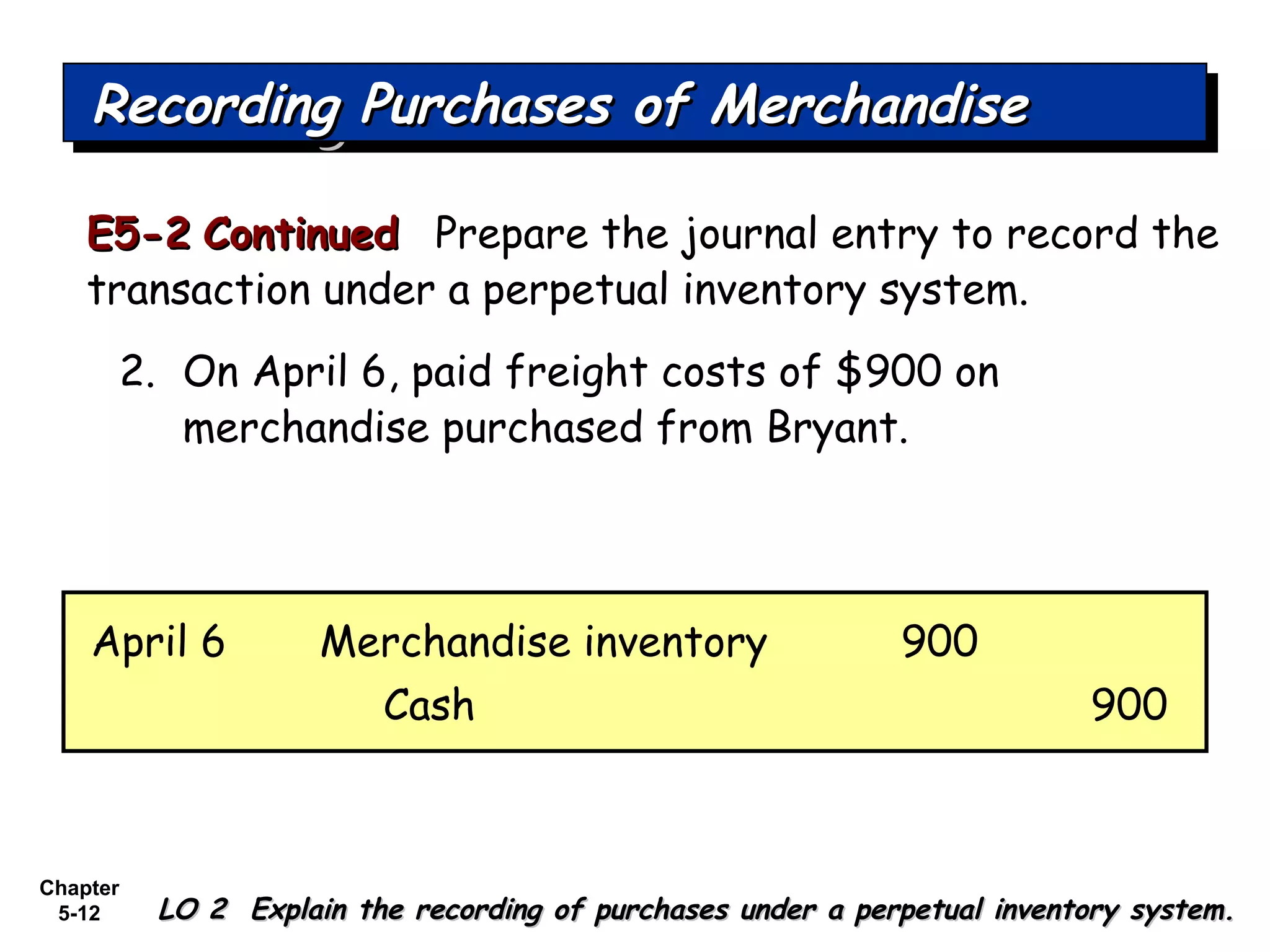
E5-2E5-2 ContinuedContinued Prepare the journal entry to record the
transaction under a perpetual inventory system.
2. On April 6, paid freight costs of $900 on
merchandise purchased from Bryant.
Merchandise inventory 900April 6
Cash 900
Recording Purchases of MerchandiseRecording Purchases of MerchandiseRecording Purchases of MerchandiseRecording Purchases of Merchandise
LO 2 Explain the recording of purchases under a perpetual inventory system.LO 2 Explain the recording of purchases under a perpetual inventory system.
Chapter
5-13
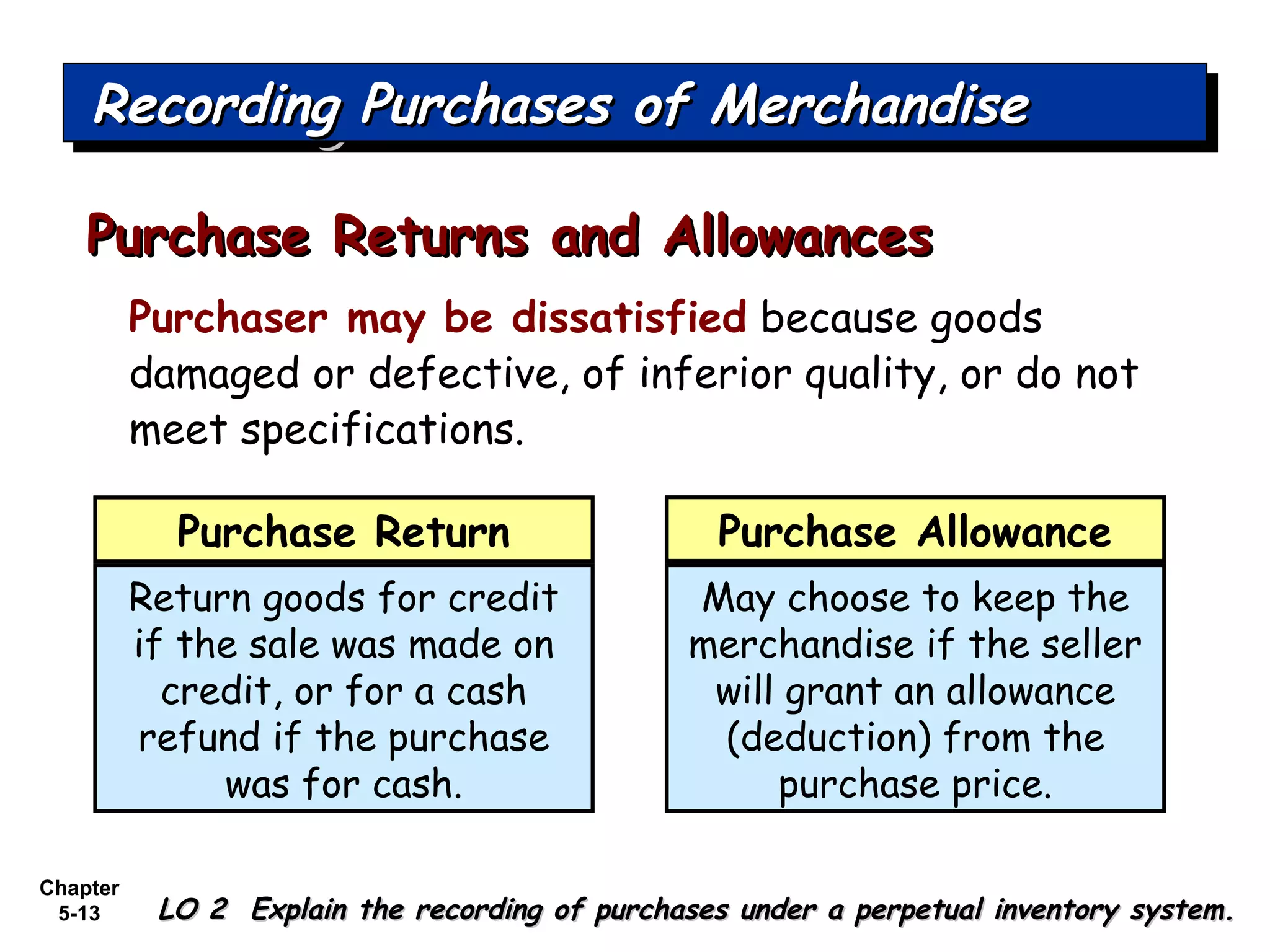
Purchaser may be dissatisfied because goods
damaged or defective, of inferior quality, or do not
meet specifications.
Purchase Returns and AllowancesPurchase Returns and Allowances
Recording Purchases of MerchandiseRecording Purchases of MerchandiseRecording Purchases of MerchandiseRecording Purchases of Merchandise
LO 2 Explain the recording of purchases under a perpetual inventory system.LO 2 Explain the recording of purchases under a perpetual inventory system.
Return goods for credit
if the sale was made on
credit, or for a cash
refund if the purchase
was for cash.
May choose to keep the
merchandise if the seller
will grant an allowance
(deduction) from the
purchase price.
Purchase Return Purchase Allowance
Chapter
5-14
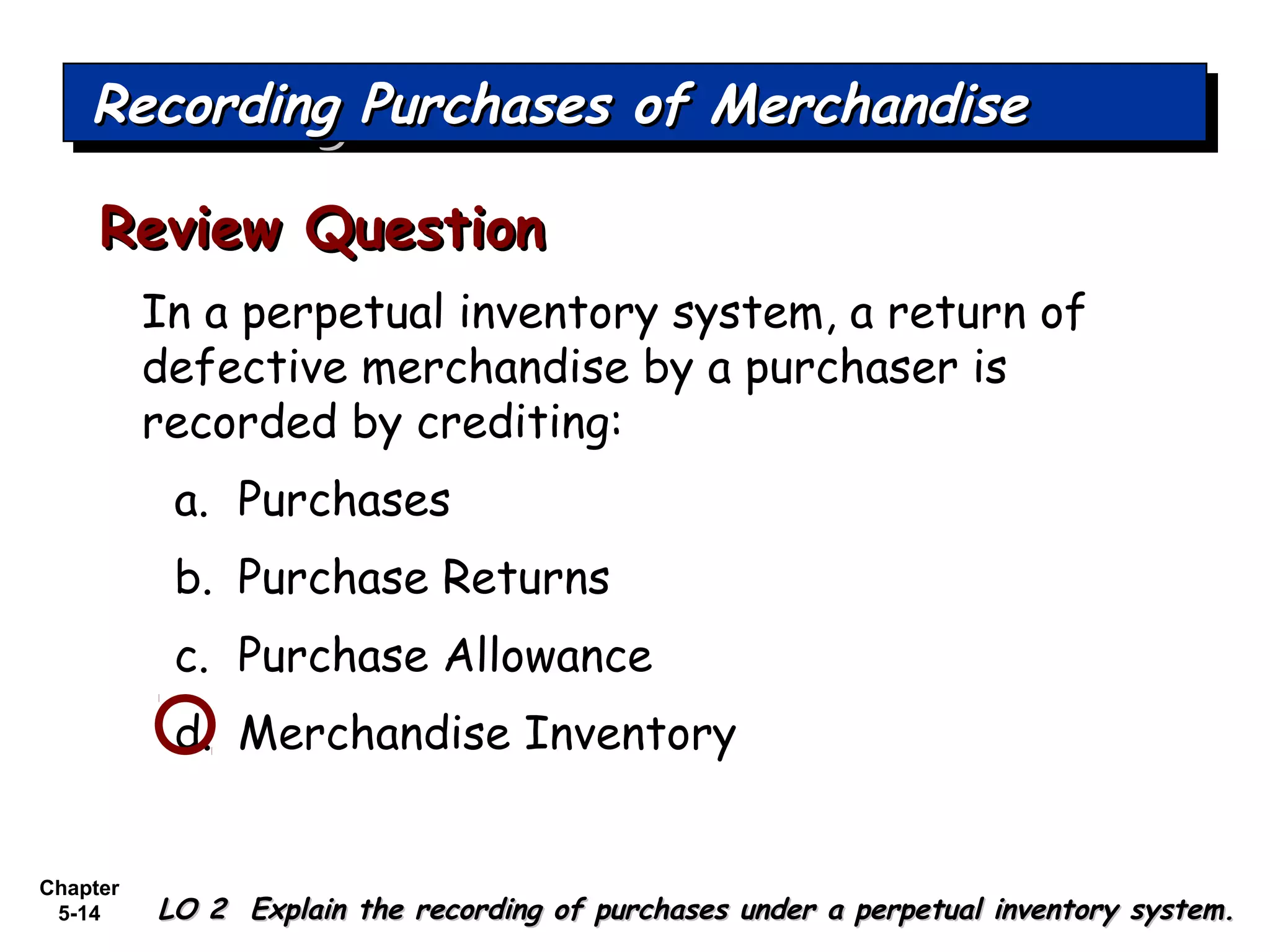
In a perpetual inventory system, a return of
defective merchandise by a purchaser is
recorded by crediting:
a. Purchases
b. Purchase Returns
c. Purchase Allowance
d. Merchandise Inventory
Review QuestionReview Question
Recording Purchases of MerchandiseRecording Purchases of MerchandiseRecording Purchases of MerchandiseRecording Purchases of Merchandise
LO 2 Explain the recording of purchases under a perpetual inventory system.LO 2 Explain the recording of purchases under a perpetual inventory system.
Chapter
5-15
E5-2E5-2 ContinuedContinued Prepare the journal entry to record
the transaction under a perpetual inventory system.
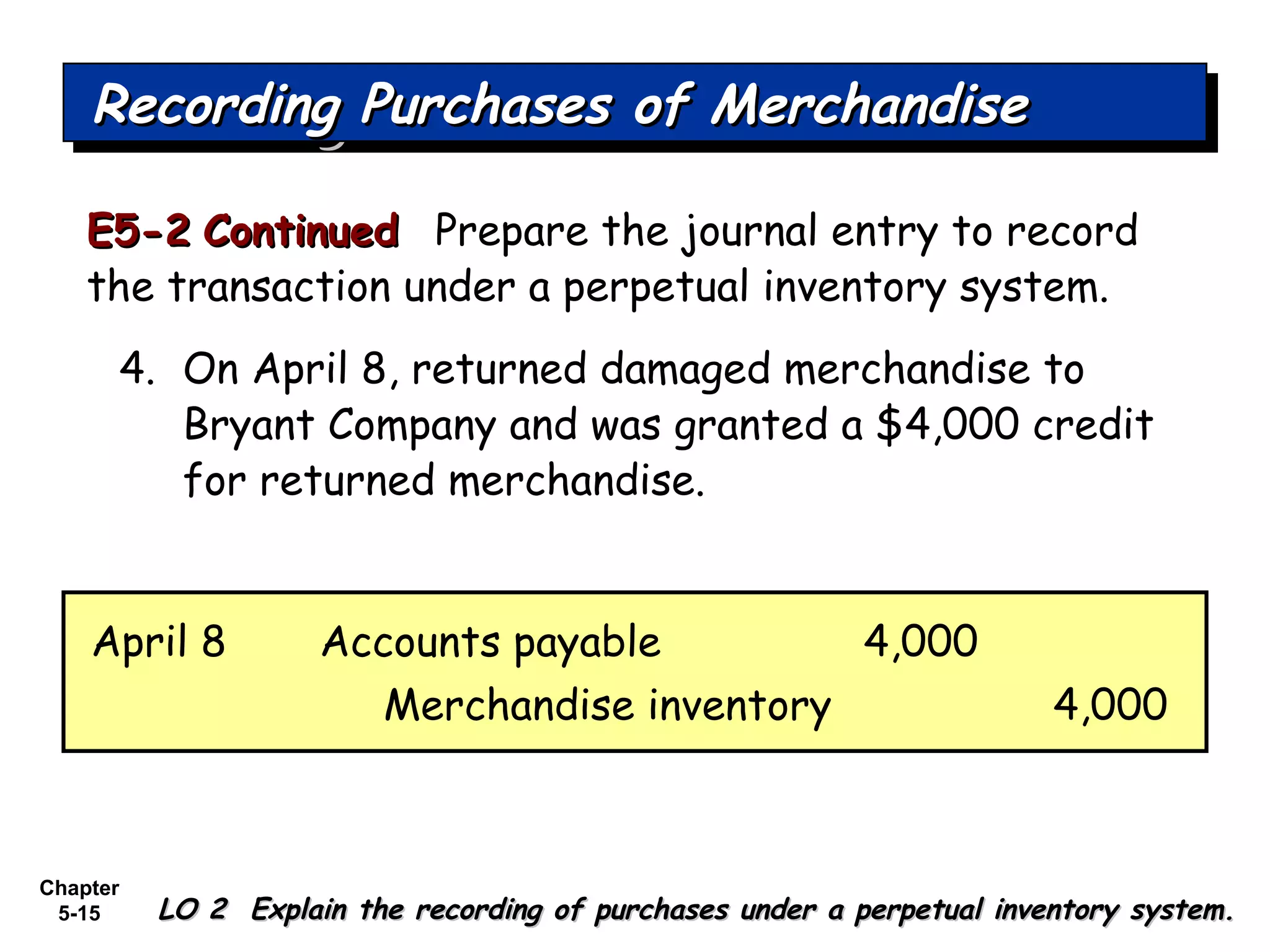
4. On April 8, returned damaged merchandise to
Bryant Company and was granted a $4,000 credit
for returned merchandise.
Accounts payable 4,000April 8
Merchandise inventory 4,000
Recording Purchases of MerchandiseRecording Purchases of MerchandiseRecording Purchases of MerchandiseRecording Purchases of Merchandise
LO 2 Explain the recording of purchases under a perpetual inventory system.LO 2 Explain the recording of purchases under a perpetual inventory system.
Chapter
5-16
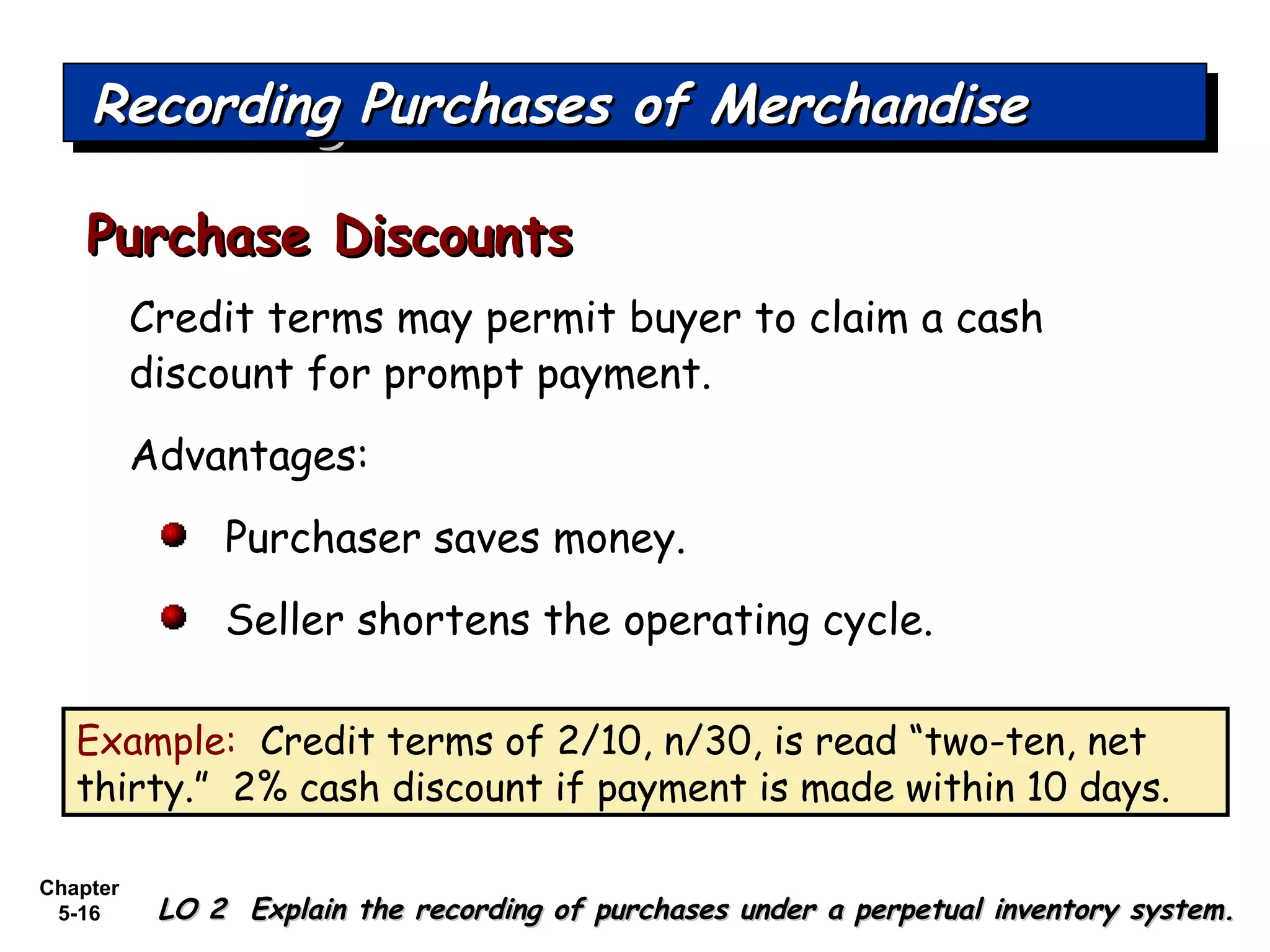
Credit terms may permit buyer to claim a cash
discount for prompt payment.
Advantages:
Purchaser saves money.
Seller shortens the operating cycle.
Purchase DiscountsPurchase Discounts
Recording Purchases of MerchandiseRecording Purchases of MerchandiseRecording Purchases of MerchandiseRecording Purchases of Merchandise
LO 2 Explain the recording of purchases under a perpetual inventory system.LO 2 Explain the recording of purchases under a perpetual inventory system.
Example: Credit terms of 2/10, n/30, is read “two-ten, net
thirty.” 2% cash discount if payment is made within 10 days.
Chapter
5-17
Purchase DiscountsPurchase Discounts TermsTerms
Recording Purchases of MerchandiseRecording Purchases of MerchandiseRecording Purchases of MerchandiseRecording Purchases of Merchandise
LO 2 Explain the recording of purchases under a perpetual inventory system.LO 2 Explain the recording of purchases under a perpetual inventory system.
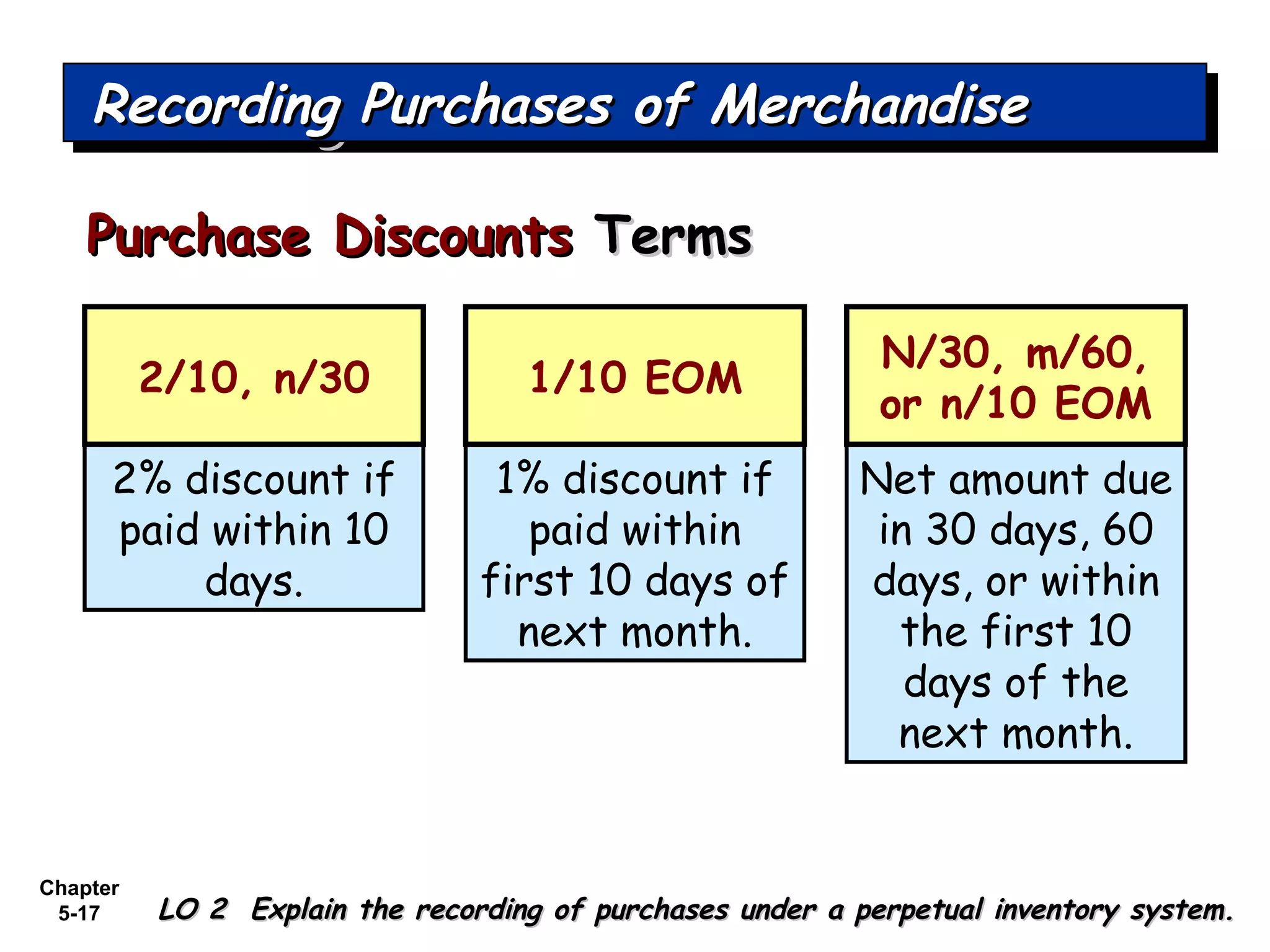
2% discount if
paid within 10
days.
1% discount if
paid within
first 10 days of
next month.
2/10, n/30 1/10 EOM
Net amount due
in 30 days, 60
days, or within
the first 10
days of the
next month.
N/30, m/60,
or n/10 EOM
Chapter
5-18
E5-2E5-2 ContinuedContinued Prepare the journal entry to record
the transaction under a perpetual inventory system.
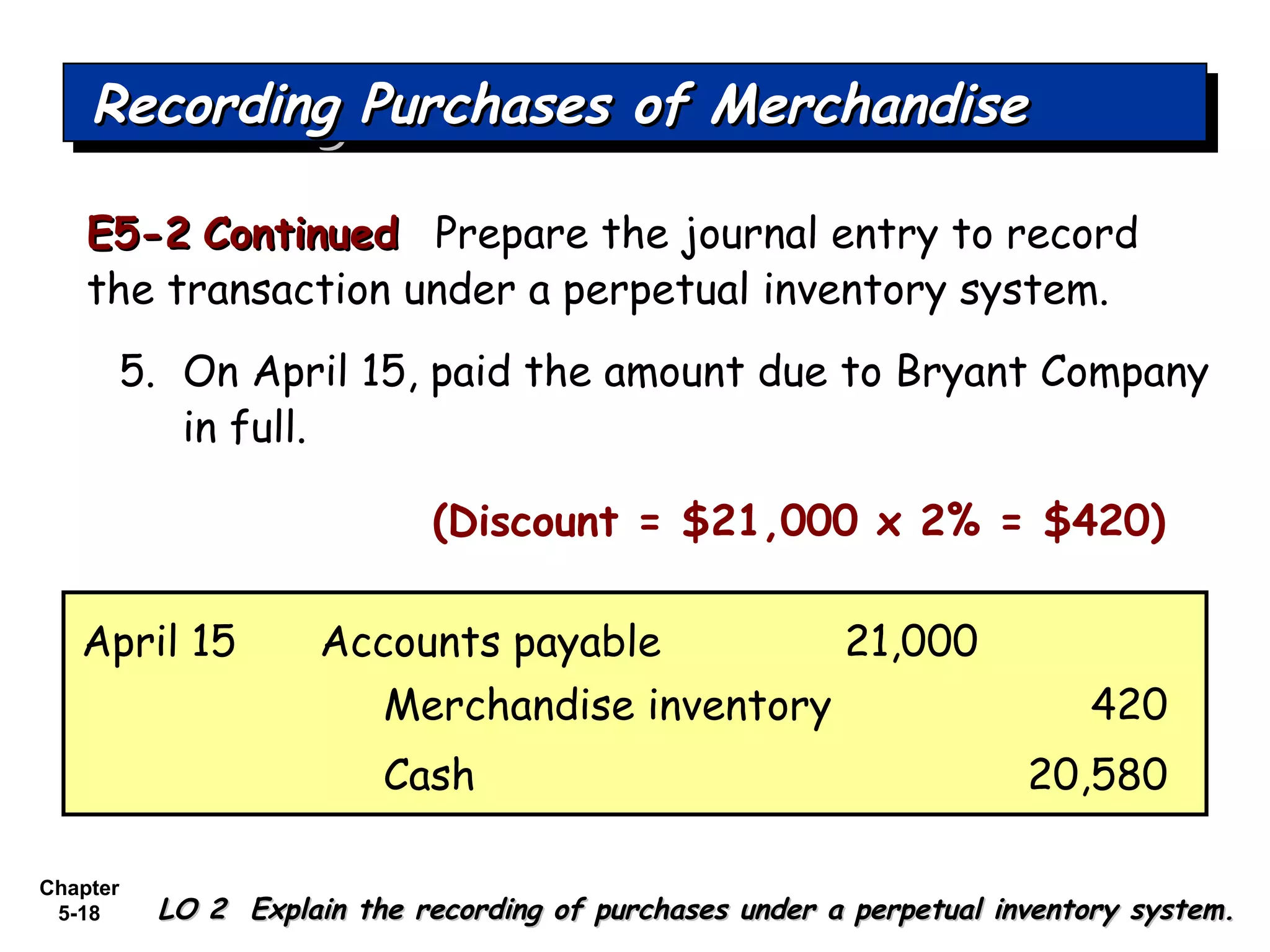
5. On April 15, paid the amount due to Bryant Company
in full.
Accounts payable 21,000April 15
Merchandise inventory 420
Recording Purchases of MerchandiseRecording Purchases of MerchandiseRecording Purchases of MerchandiseRecording Purchases of Merchandise
LO 2 Explain the recording of purchases under a perpetual inventory system.LO 2 Explain the recording of purchases under a perpetual inventory system.
Cash 20,580
(Discount = $21,000 x 2% = $420)
Chapter
5-19
E5-2E5-2 ContinuedContinued Prepare the journal entry to record
the transaction under a perpetual inventory system.
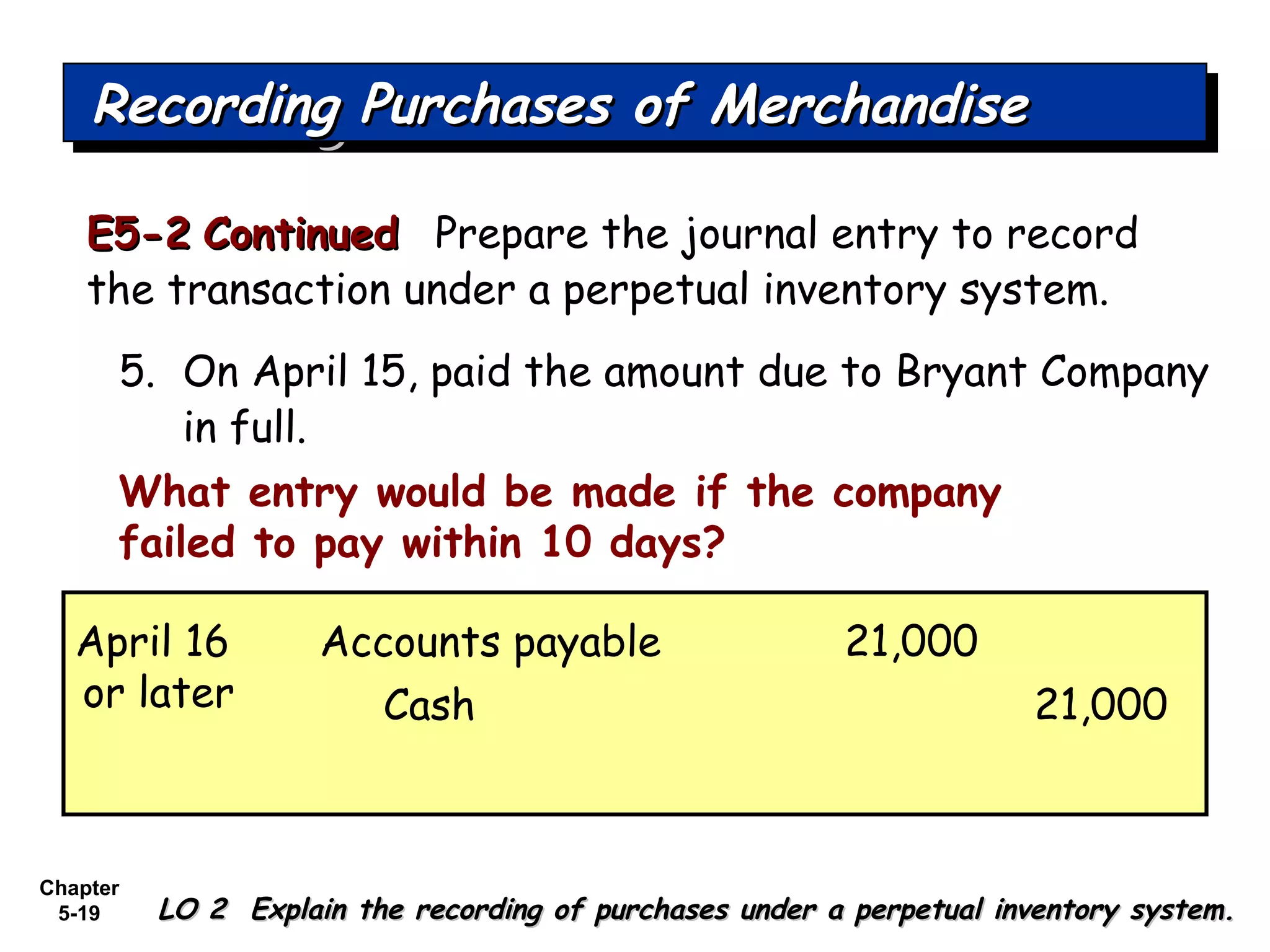
5. On April 15, paid the amount due to Bryant Company
in full.
Accounts payable 21,000April 16
or later Cash 21,000
Recording Purchases of MerchandiseRecording Purchases of MerchandiseRecording Purchases of MerchandiseRecording Purchases of Merchandise
LO 2 Explain the recording of purchases under a perpetual inventory system.LO 2 Explain the recording of purchases under a perpetual inventory system.
What entry would be made if the company
failed to pay within 10 days?
Chapter
5-20
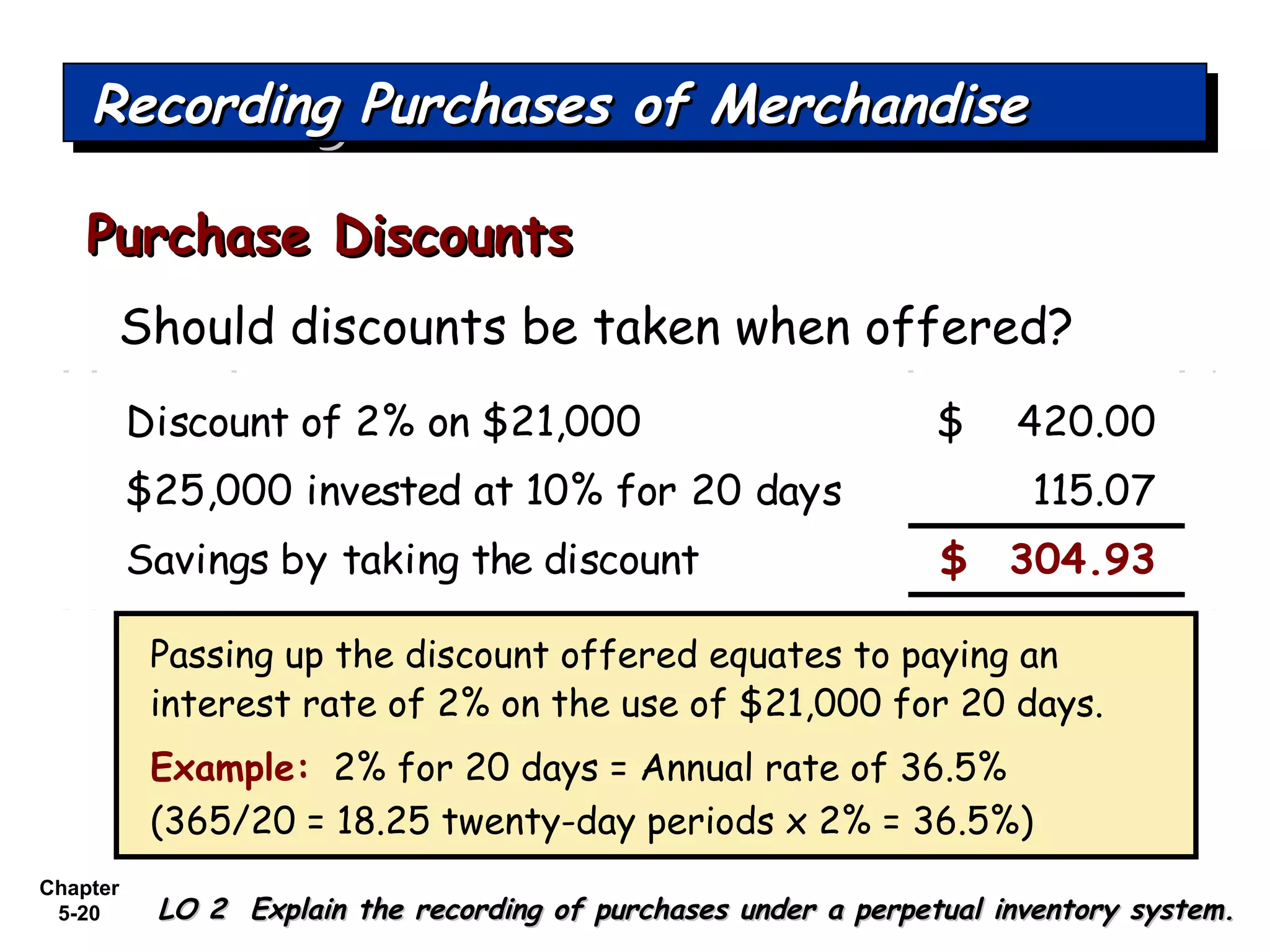
Should discounts be taken when offered?
Purchase DiscountsPurchase Discounts
Recording Purchases of MerchandiseRecording Purchases of MerchandiseRecording Purchases of MerchandiseRecording Purchases of Merchandise
LO 2 Explain the recording of purchases under a perpetual inventory system.LO 2 Explain the recording of purchases under a perpetual inventory system.
Discount of 2% on $21,000 420.00$
$25,000 invested at 10% for 20 days 115.07
Savings by taking the discount 304.93$
Example: 2% for 20 days = Annual rate of 36.5%
(365/20 = 18.25 twenty-day periods x 2% = 36.5%)
Passing up the discount offered equates to paying an
interest rate of 2% on the use of $21,000 for 20 days.
Chapter
5-21
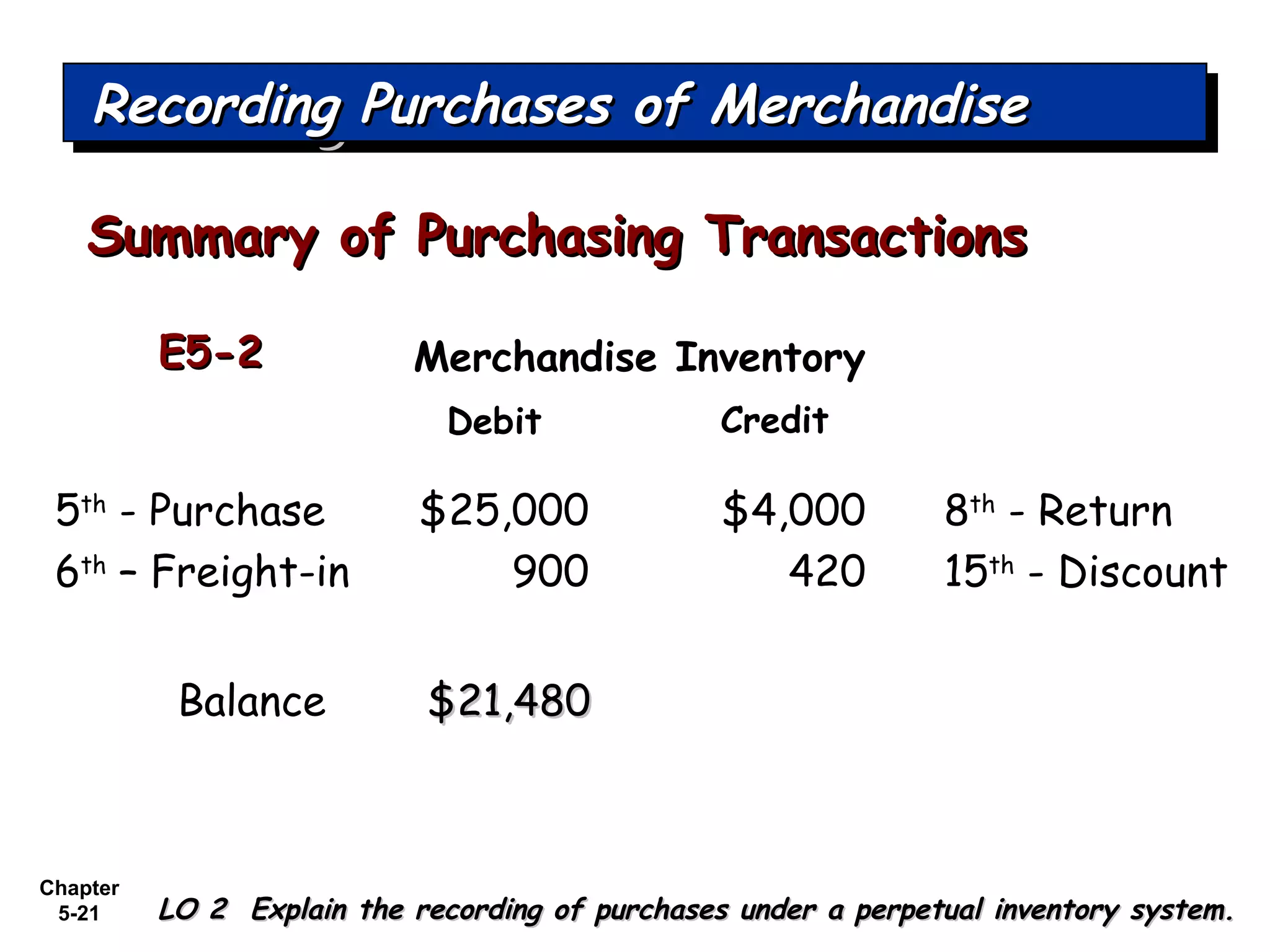
Merchandise Inventory
Debit Credit
$25,000 8th
- Return$4,000
Balance
5th
- Purchase
$21,480$21,480
420 15th
- Discount
Recording Purchases of MerchandiseRecording Purchases of MerchandiseRecording Purchases of MerchandiseRecording Purchases of Merchandise
LO 2 Explain the recording of purchases under a perpetual inventory system.LO 2 Explain the recording of purchases under a perpetual inventory system.
Summary of Purchasing TransactionsSummary of Purchasing Transactions
9006th
– Freight-in
E5-2E5-2
Chapter
5-22
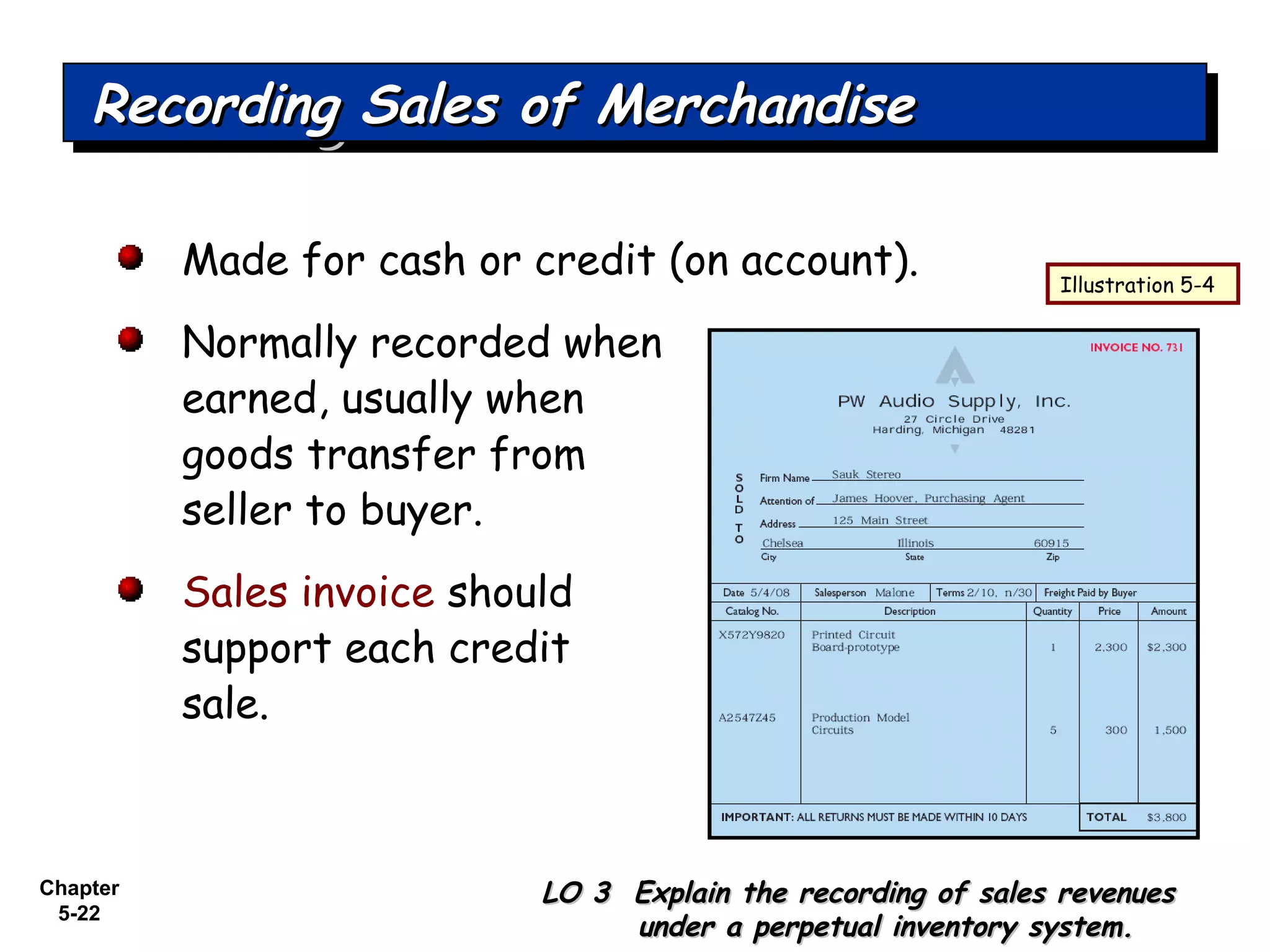
Made for cash or credit (on account).
Normally recorded when
earned, usually when
goods transfer from
seller to buyer.
Sales invoice should
support each credit
sale.
Recording Sales of MerchandiseRecording Sales of MerchandiseRecording Sales of MerchandiseRecording Sales of Merchandise
LO 3 Explain the recording of sales revenuesLO 3 Explain the recording of sales revenues
under a perpetual inventory system.under a perpetual inventory system.
Illustration 5-4
Chapter
5-23
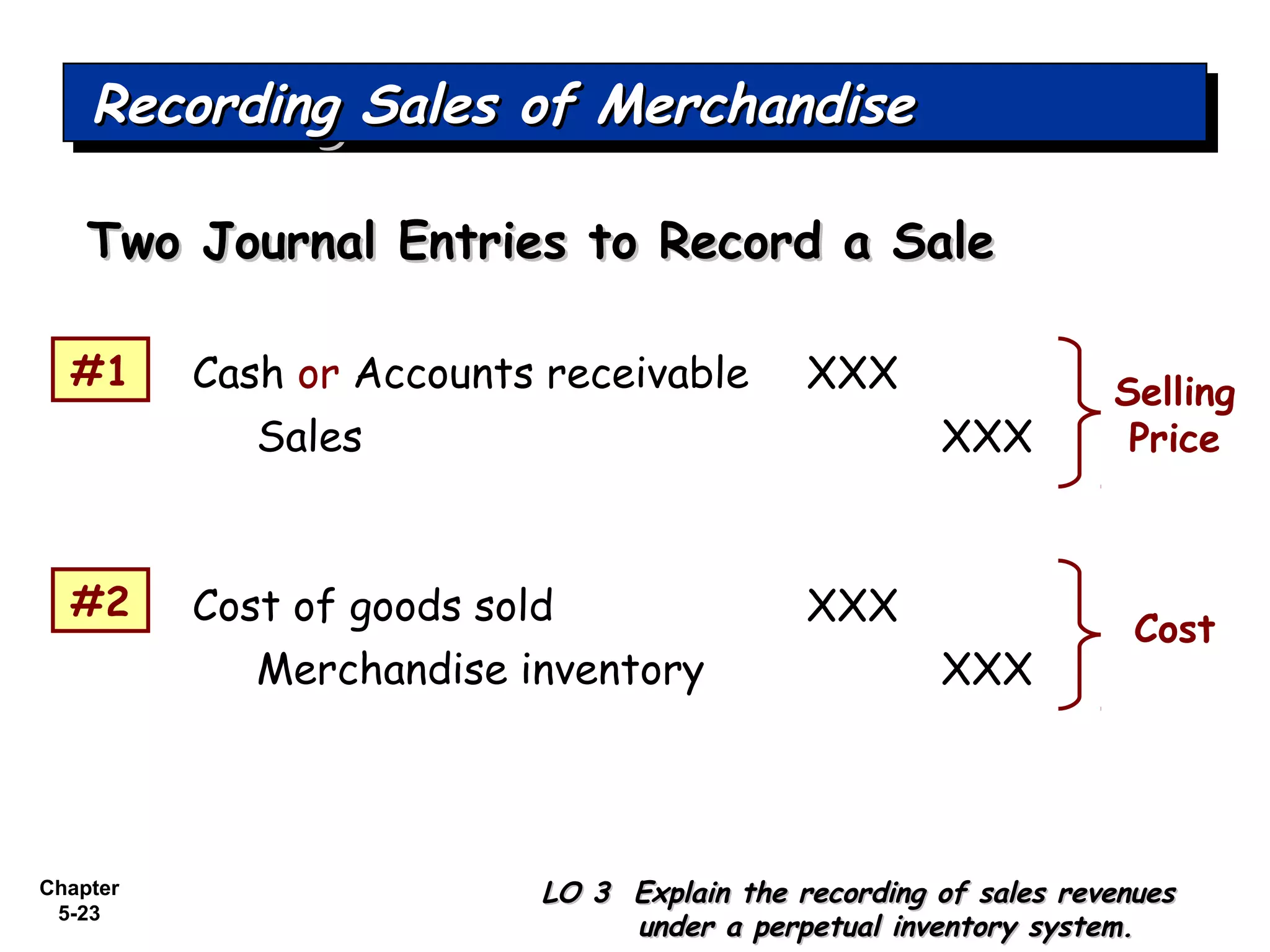
Two Journal Entries to Record a SaleTwo Journal Entries to Record a Sale
Cash or Accounts receivable XXX
Sales XXX
Recording Sales of MerchandiseRecording Sales of MerchandiseRecording Sales of MerchandiseRecording Sales of Merchandise
LO 3 Explain the recording of sales revenuesLO 3 Explain the recording of sales revenues
under a perpetual inventory system.under a perpetual inventory system.
#1
Cost of goods sold XXX
Merchandise inventory XXX
#2
Selling
Price
Cost
Chapter
5-24
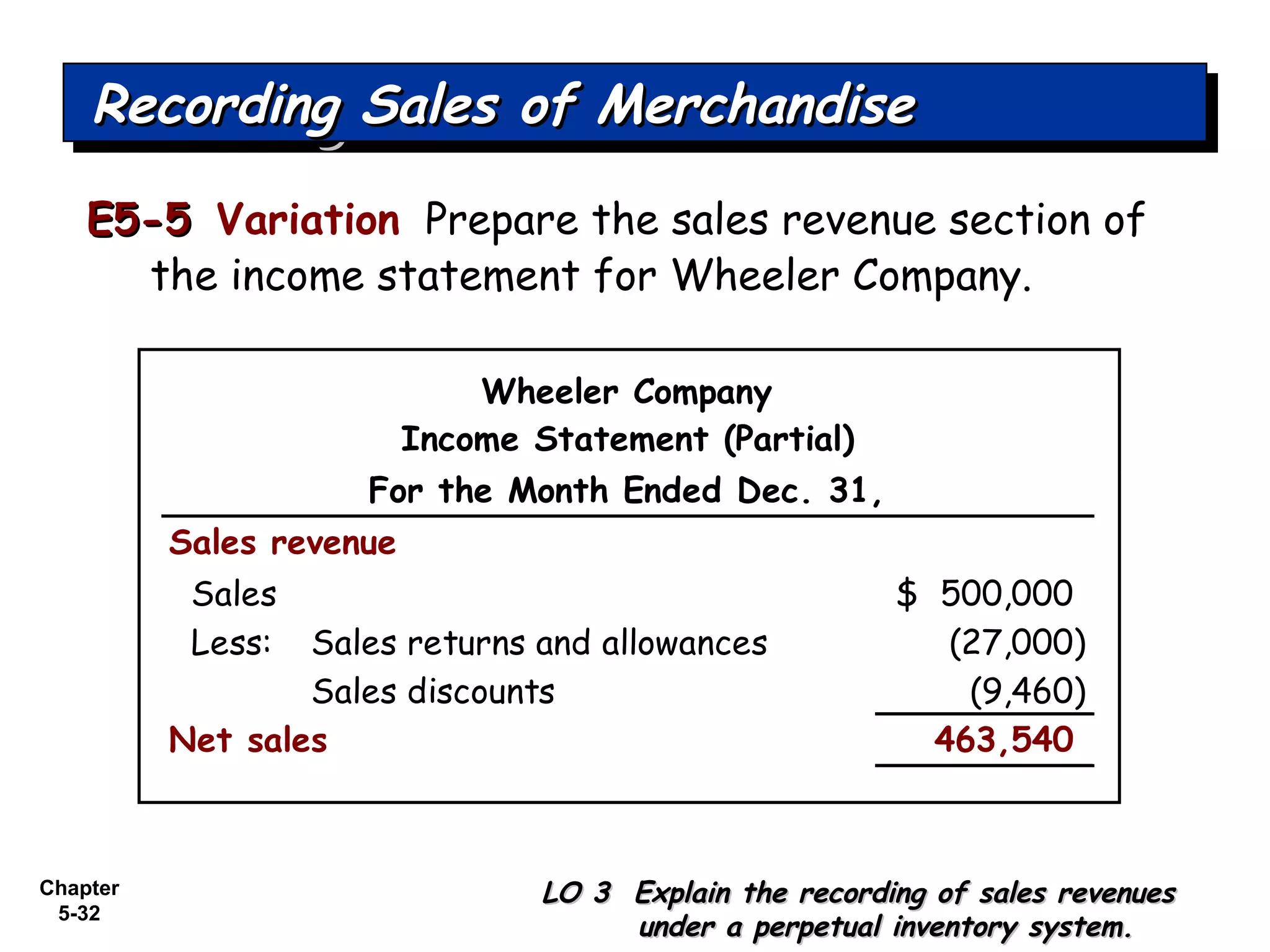
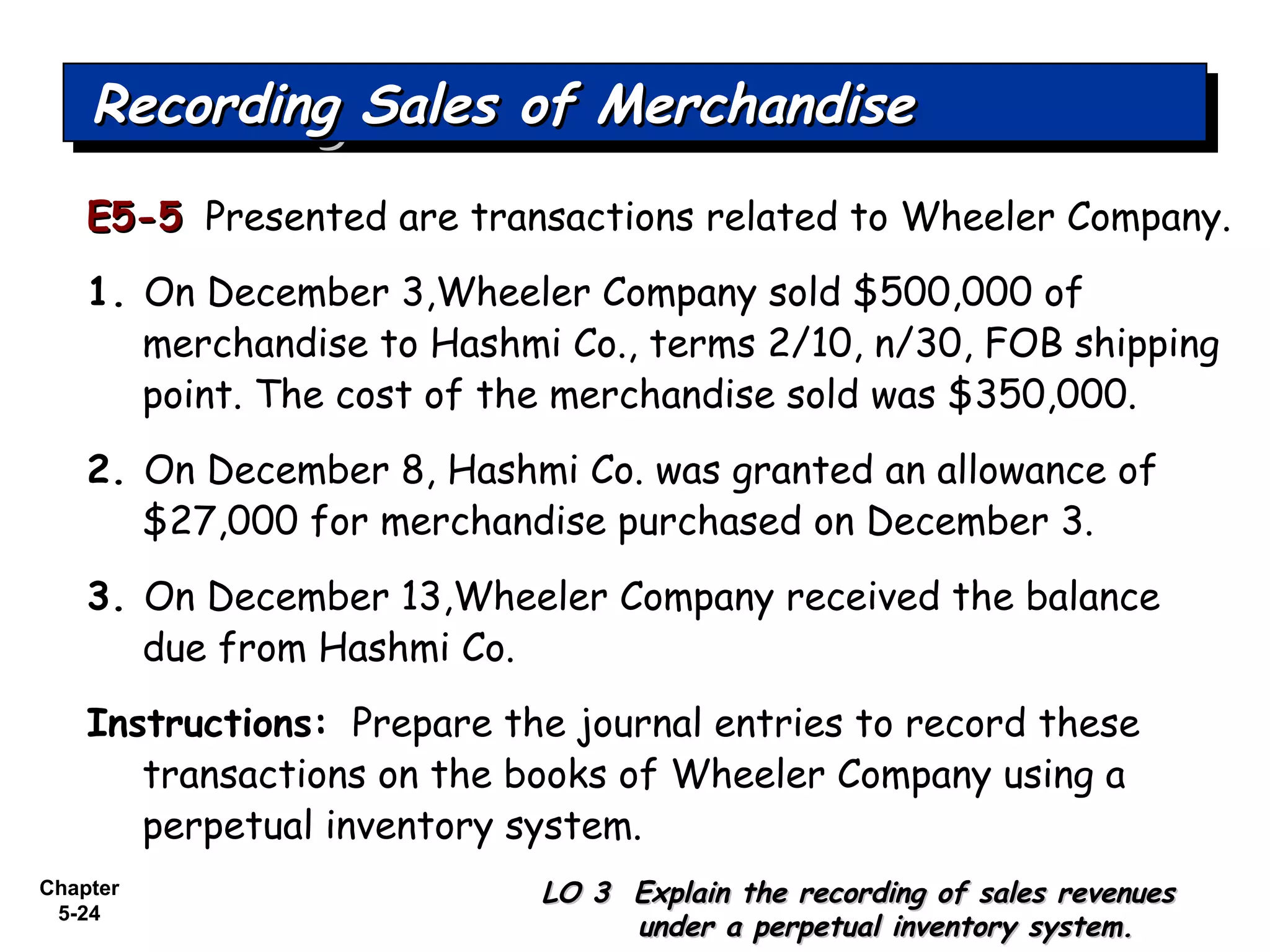
E5-5E5-5 Presented are transactions related to Wheeler Company.
1. On December 3,Wheeler Company sold $500,000 of
merchandise to Hashmi Co., terms 2/10, n/30, FOB shipping
point. The cost of the merchandise sold was $350,000.
2. On December 8, Hashmi Co. was granted an allowance of
$27,000 for merchandise purchased on December 3.
3. On December 13,Wheeler Company received the balance
due from Hashmi Co.
Instructions: Prepare the journal entries to record these
transactions on the books of Wheeler Company using a
perpetual inventory system.
Recording Sales of MerchandiseRecording Sales of MerchandiseRecording Sales of MerchandiseRecording Sales of Merchandise
LO 3 Explain the recording of sales revenuesLO 3 Explain the recording of sales revenues
under a perpetual inventory system.under a perpetual inventory system.
Chapter
5-25
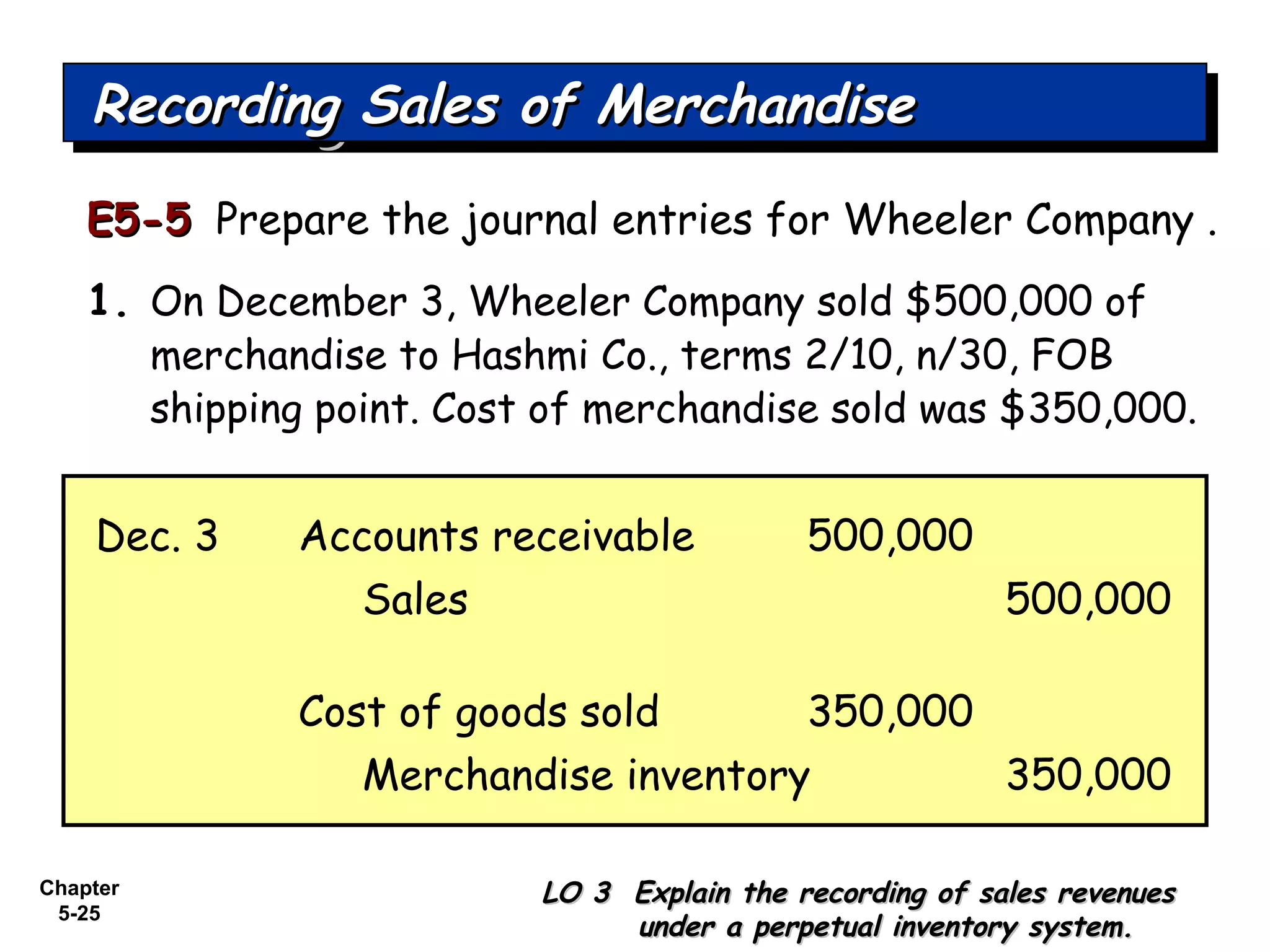
E5-5E5-5 Prepare the journal entries for Wheeler Company .
1. On December 3, Wheeler Company sold $500,000 of
merchandise to Hashmi Co., terms 2/10, n/30, FOB
shipping point. Cost of merchandise sold was $350,000.
Recording Sales of MerchandiseRecording Sales of MerchandiseRecording Sales of MerchandiseRecording Sales of Merchandise
LO 3 Explain the recording of sales revenuesLO 3 Explain the recording of sales revenues
under a perpetual inventory system.under a perpetual inventory system.
Accounts receivable 500,000Dec. 3
Sales 500,000
Cost of goods sold 350,000
Merchandise inventory 350,000
Chapter
5-26
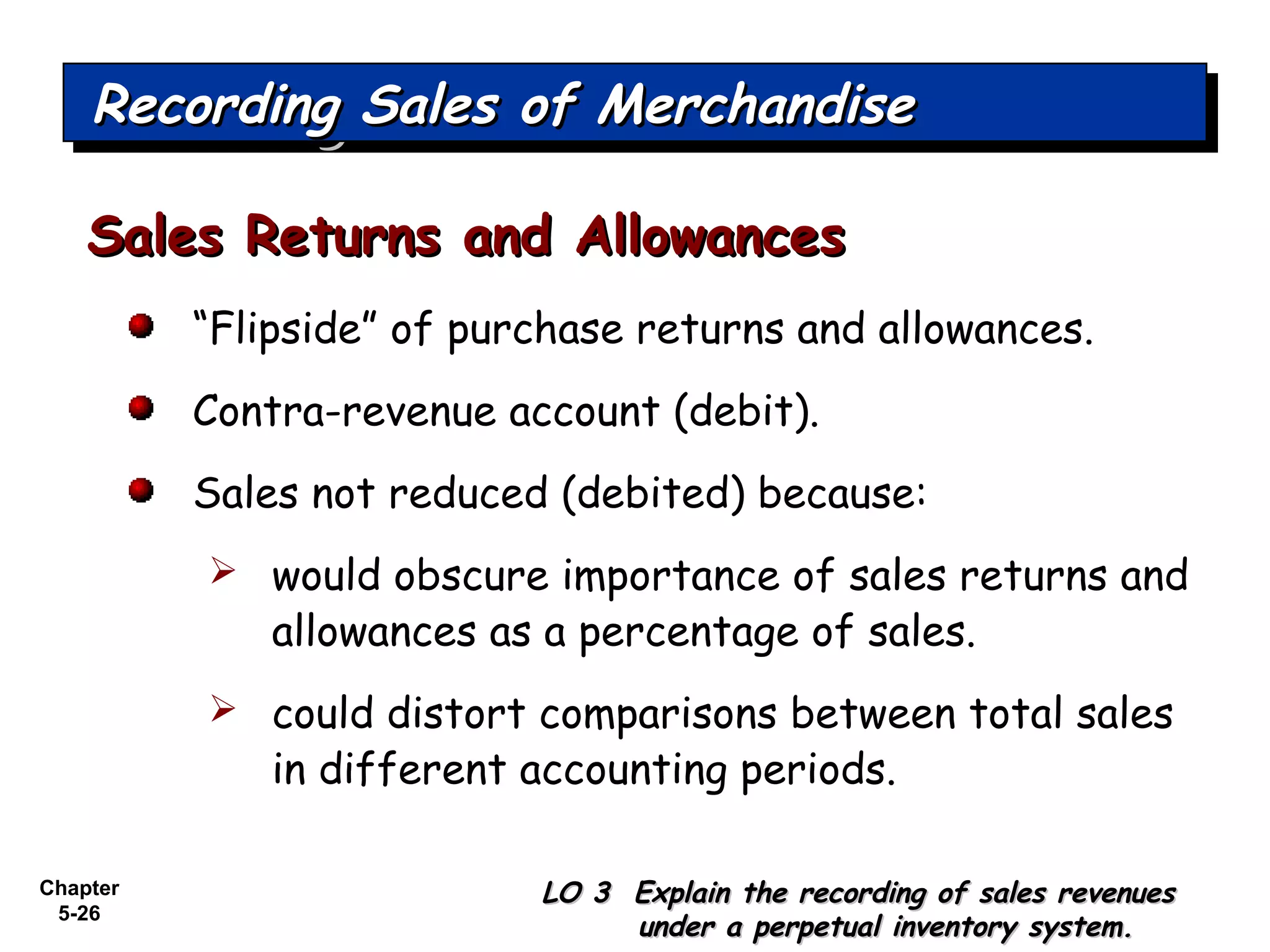
“Flipside” of purchase returns and allowances.
Contra-revenue account (debit).
Sales not reduced (debited) because:
 would obscure importance of sales returns and
allowances as a percentage of sales.
 could distort comparisons between total sales
in different accounting periods.
Sales Returns and AllowancesSales Returns and Allowances
Recording Sales of MerchandiseRecording Sales of MerchandiseRecording Sales of MerchandiseRecording Sales of Merchandise
LO 3 Explain the recording of sales revenuesLO 3 Explain the recording of sales revenues
under a perpetual inventory system.under a perpetual inventory system.
Chapter
5-27
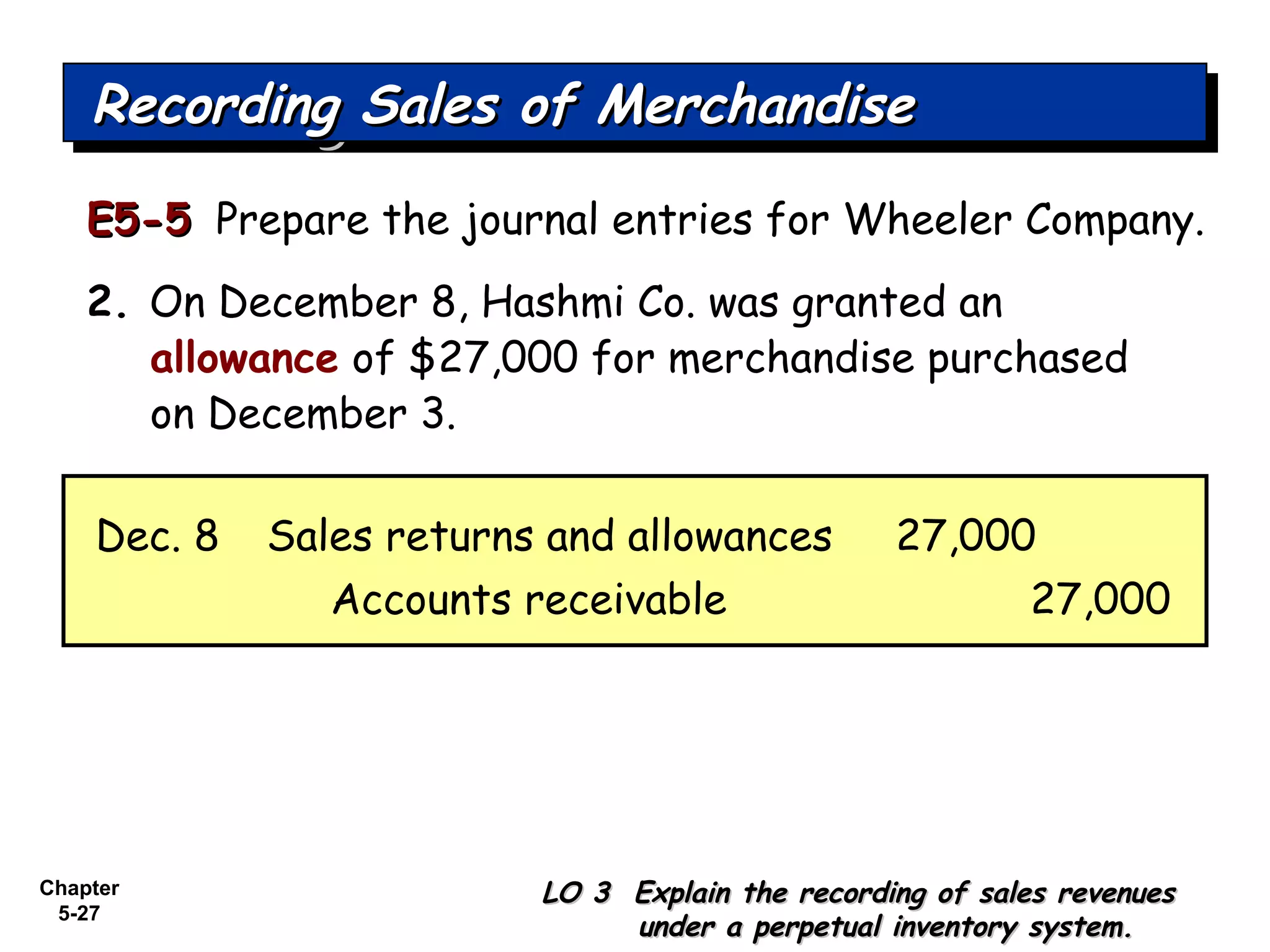
E5-5E5-5 Prepare the journal entries for Wheeler Company.
2. On December 8, Hashmi Co. was granted an
allowance of $27,000 for merchandise purchased
on December 3.
Recording Sales of MerchandiseRecording Sales of MerchandiseRecording Sales of MerchandiseRecording Sales of Merchandise
LO 3 Explain the recording of sales revenuesLO 3 Explain the recording of sales revenues
under a perpetual inventory system.under a perpetual inventory system.
Sales returns and allowances 27,000Dec. 8
Accounts receivable 27,000
Chapter
5-28
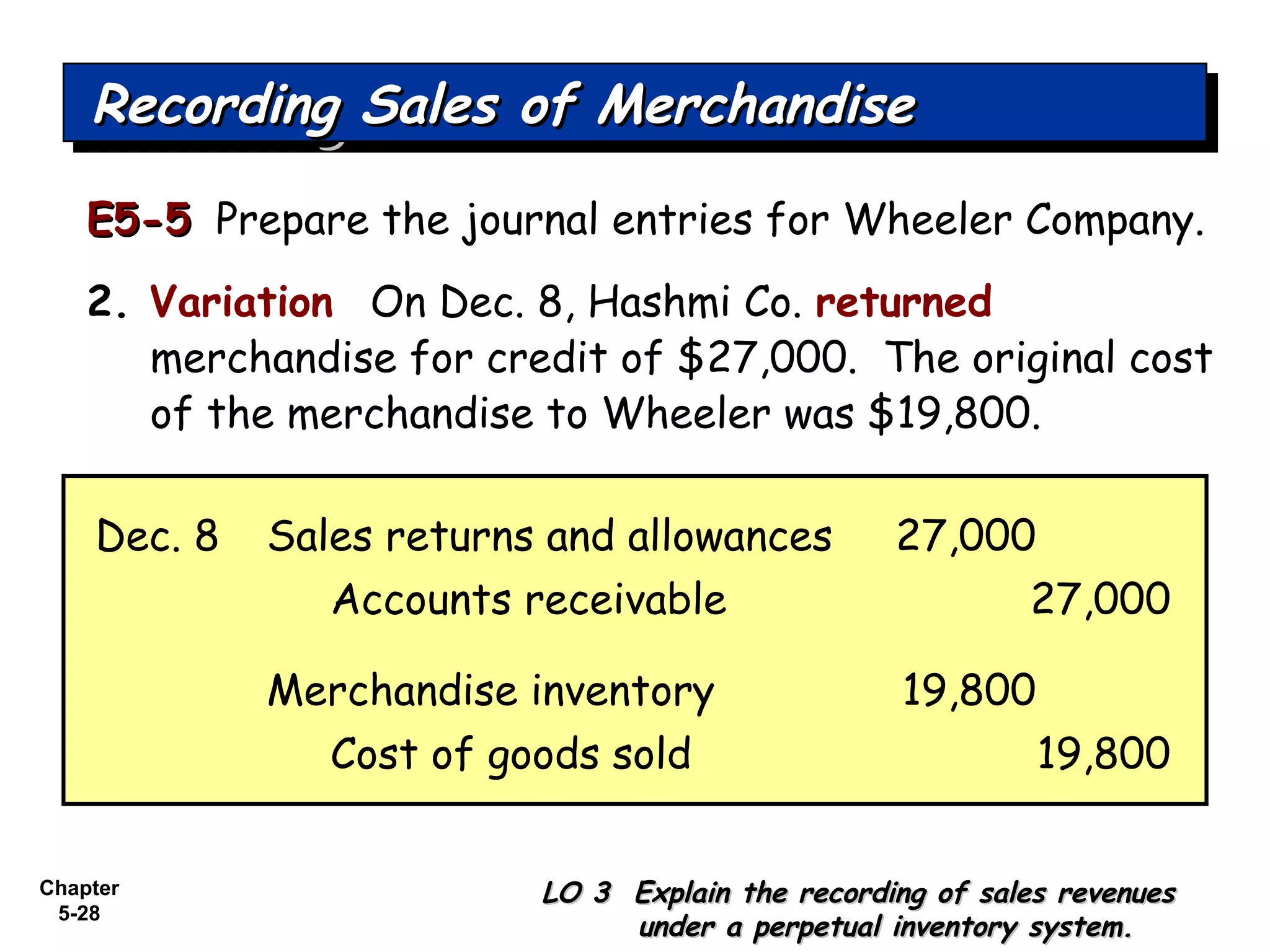
E5-5E5-5 Prepare the journal entries for Wheeler Company.
2. Variation On Dec. 8, Hashmi Co. returned
merchandise for credit of $27,000. The original cost
of the merchandise to Wheeler was $19,800.
Recording Sales of MerchandiseRecording Sales of MerchandiseRecording Sales of MerchandiseRecording Sales of Merchandise
LO 3 Explain the recording of sales revenuesLO 3 Explain the recording of sales revenues
under a perpetual inventory system.under a perpetual inventory system.
Sales returns and allowances 27,000Dec. 8
Accounts receivable 27,000
Merchandise inventory 19,800
Cost of goods sold 19,800
Chapter
5-29
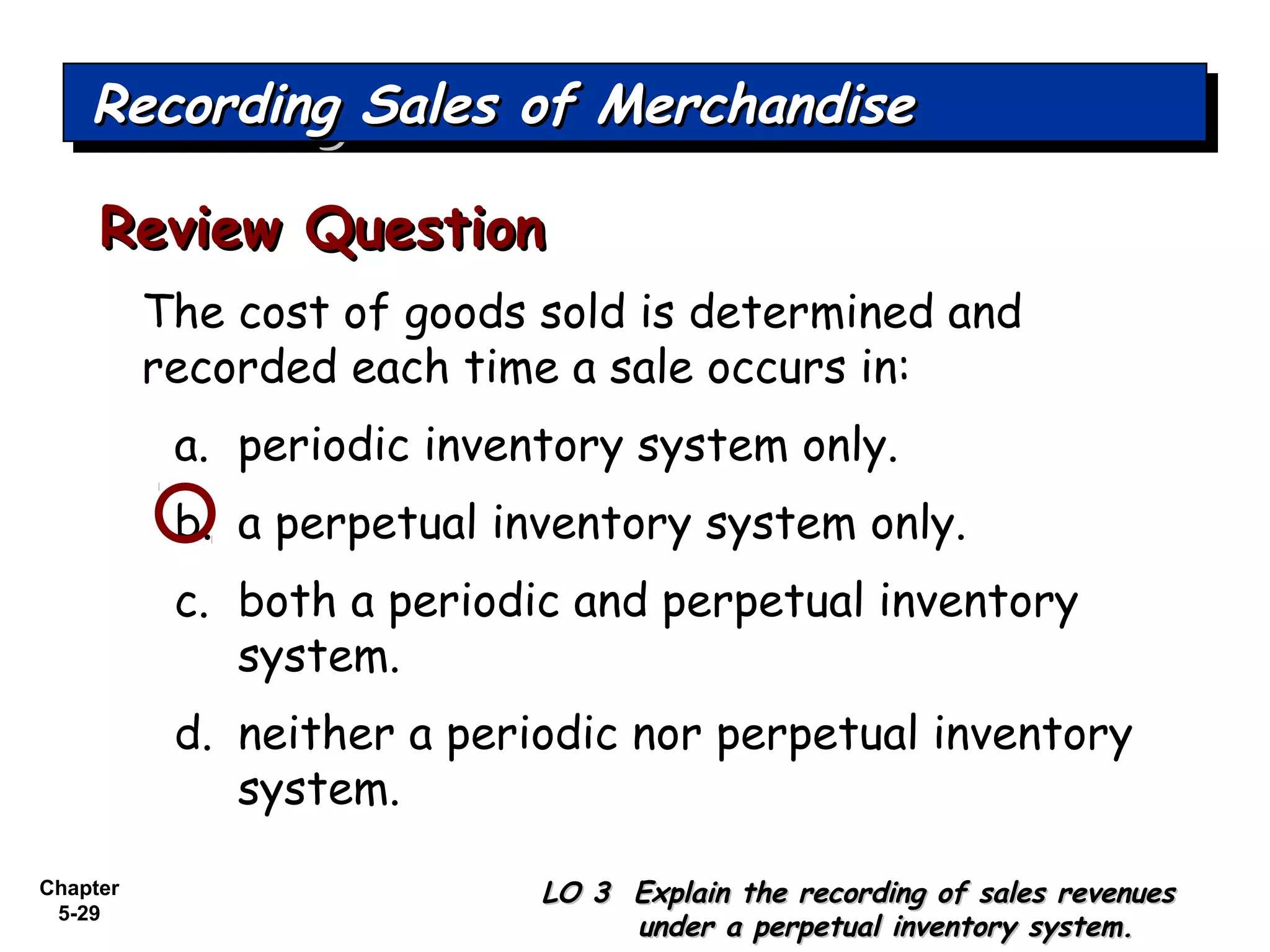
The cost of goods sold is determined and
recorded each time a sale occurs in:
a. periodic inventory system only.
b. a perpetual inventory system only.
c. both a periodic and perpetual inventory
system.
d. neither a periodic nor perpetual inventory
system.
Review QuestionReview Question
Recording Sales of MerchandiseRecording Sales of MerchandiseRecording Sales of MerchandiseRecording Sales of Merchandise
LO 3 Explain the recording of sales revenuesLO 3 Explain the recording of sales revenues
under a perpetual inventory system.under a perpetual inventory system.
Chapter
5-30
Offered to customers to promote prompt payment.
“Flipside” of purchase discount.
Contra-revenue account (debit).
Sales DiscountSales Discount
Recording Sales of MerchandiseRecording Sales of MerchandiseRecording Sales of MerchandiseRecording Sales of Merchandise
LO 3 Explain the recording of sales revenuesLO 3 Explain the recording of sales revenues
under a perpetual inventory system.under a perpetual inventory system.
Chapter
5-31
E5-5E5-5 Prepare the journal entries for Wheeler Company .
3. On December 13, Wheeler Company received the
balance due from Hashmi Co.
Recording Sales of MerchandiseRecording Sales of MerchandiseRecording Sales of MerchandiseRecording Sales of Merchandise
LO 3 Explain the recording of sales revenuesLO 3 Explain the recording of sales revenues
under a perpetual inventory system.under a perpetual inventory system.
Cash 463,540Dec. 13
Accounts receivable 473,000
Sales discounts 9,460
** [($500,000 – $27,000) X 2%]
**
*** ($500,000 – $27,000)
***
*
* ($473,000 – $9,460)
Chapter
5-32
E5-5E5-5 Variation Prepare the sales revenue section of
the income statement for Wheeler Company.
Recording Sales of MerchandiseRecording Sales of MerchandiseRecording Sales of MerchandiseRecording Sales of Merchandise
LO 3 Explain the recording of sales revenuesLO 3 Explain the recording of sales revenues
under a perpetual inventory system.under a perpetual inventory system.
Sales revenue
Sales 500,000$
Less: Sales returns and allowances (27,000)
Sales discounts (9,460)
Net sales 463,540
Income Statement (Partial)
For the Month Ended Dec. 31,
Wheeler Company
Chapter
5-33
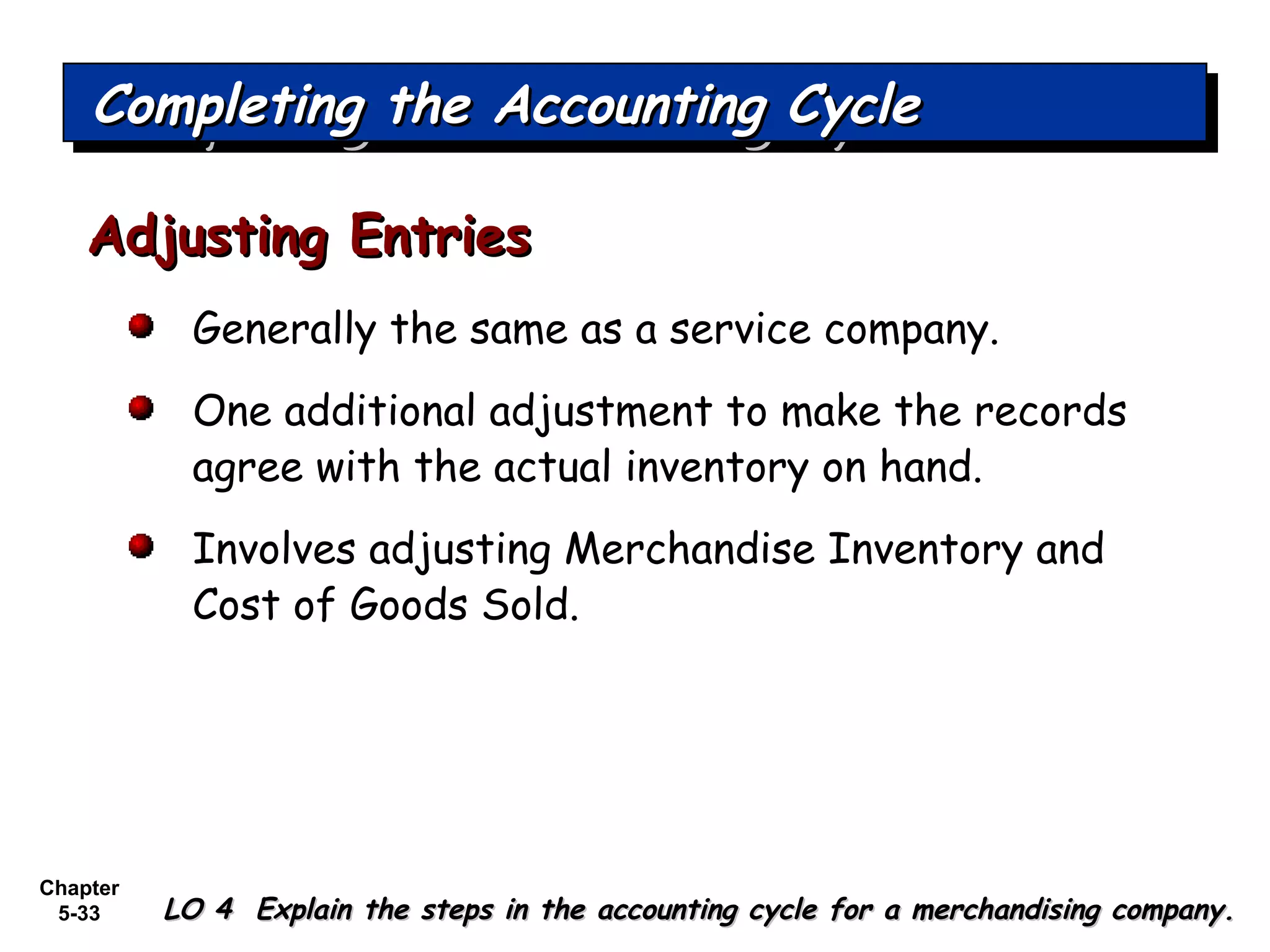
Generally the same as a service company.
One additional adjustment to make the records
agree with the actual inventory on hand.
Involves adjusting Merchandise Inventory and
Cost of Goods Sold.
Adjusting EntriesAdjusting Entries
Completing the Accounting CycleCompleting the Accounting CycleCompleting the Accounting CycleCompleting the Accounting Cycle
LO 4 Explain the steps in the accounting cycle for a merchandising company.LO 4 Explain the steps in the accounting cycle for a merchandising company.
Chapter
5-34
Close all accounts that affect net income.
Closing EntriesClosing Entries
Completing the Accounting CycleCompleting the Accounting CycleCompleting the Accounting CycleCompleting the Accounting Cycle
LO 4 Explain the steps in the accounting cycle for a merchandising company.LO 4 Explain the steps in the accounting cycle for a merchandising company.
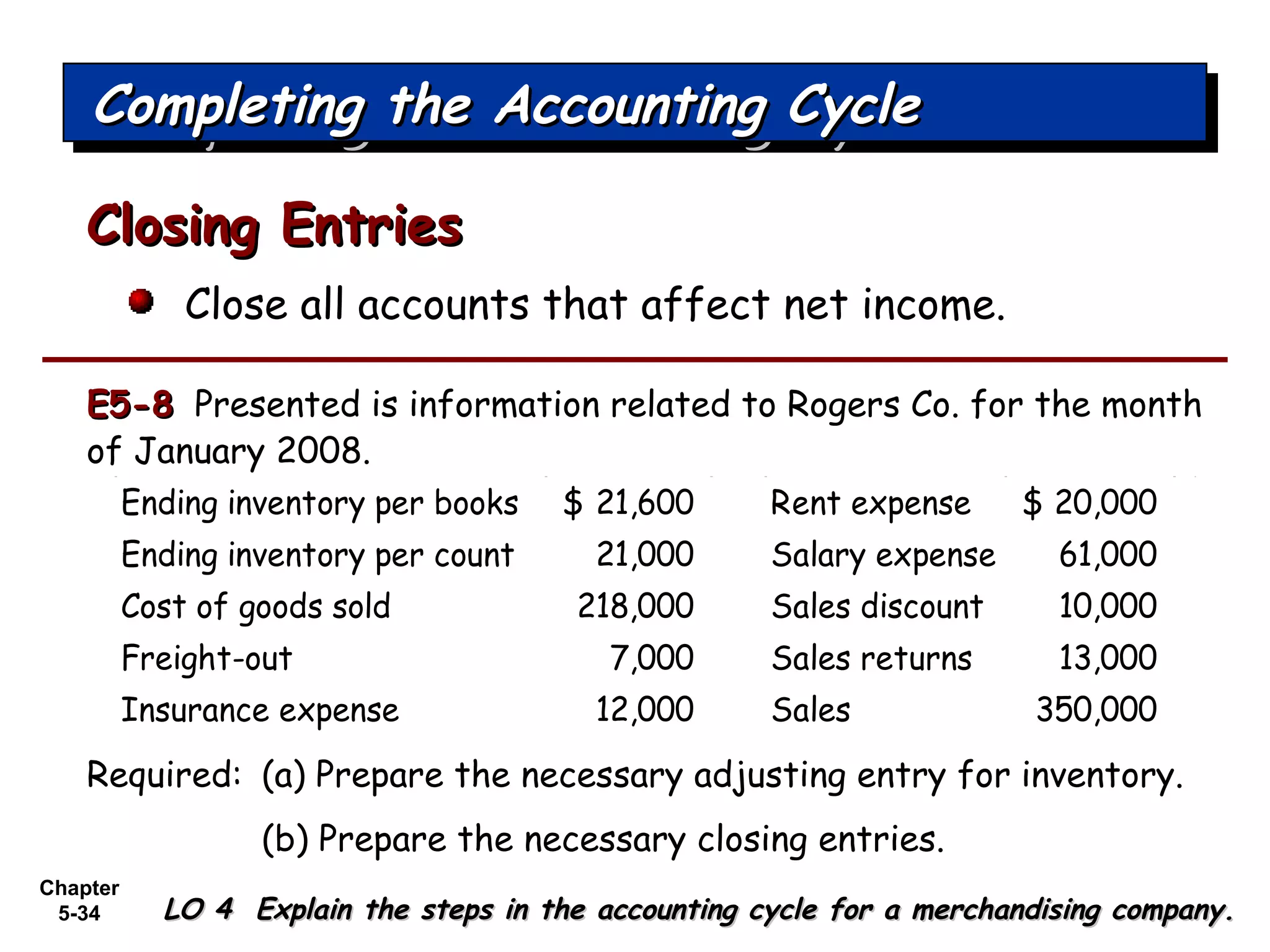
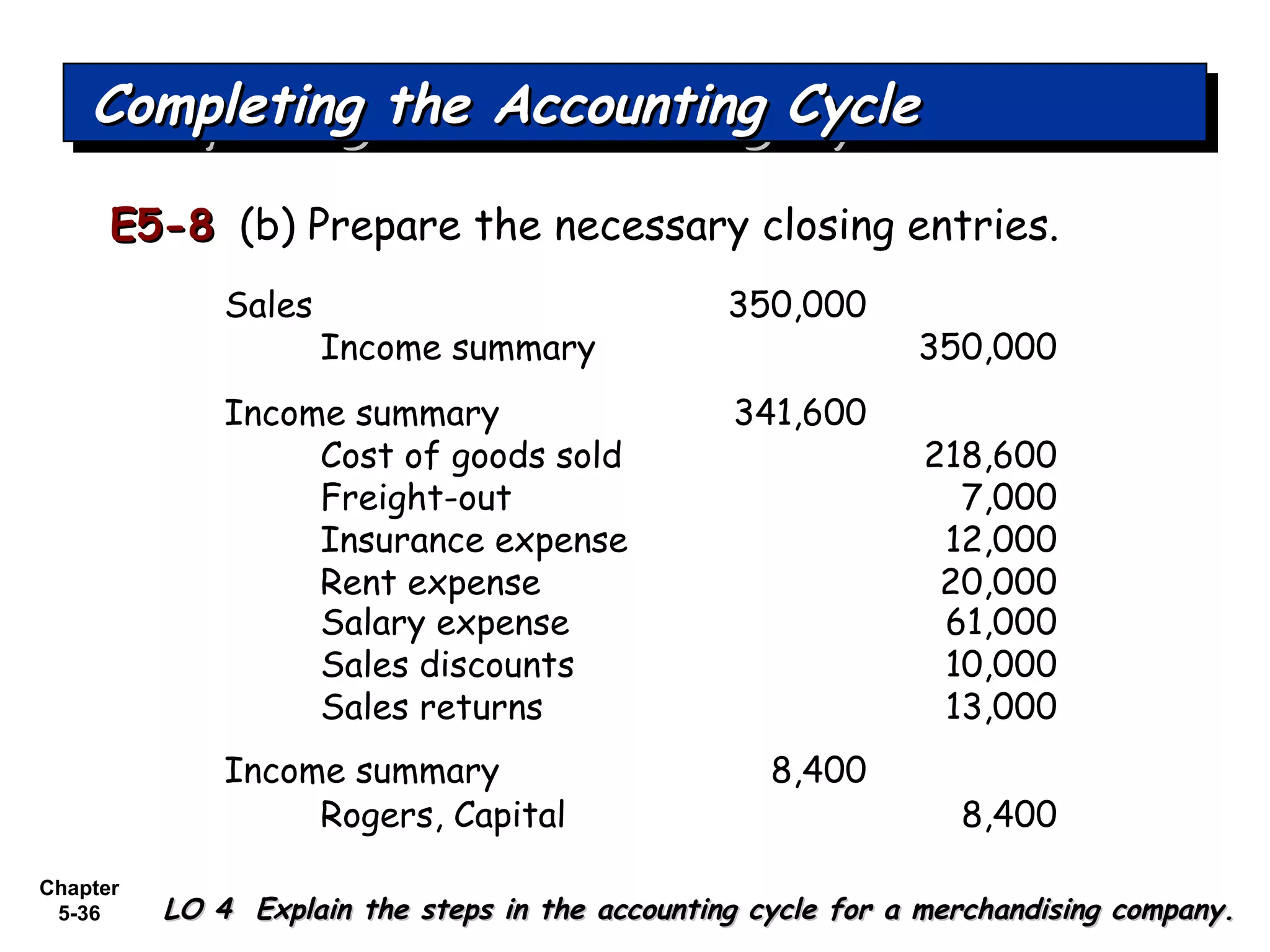
E5-8E5-8 Presented is information related to Rogers Co. for the month
of January 2008.
Ending inventory per books 21,600$ Rent expense 20,000$
Ending inventory per count 21,000 Salary expense 61,000
Cost of goods sold 218,000 Sales discount 10,000
Freight-out 7,000 Sales returns 13,000
Insurance expense 12,000 Sales 350,000
Required: (a) Prepare the necessary adjusting entry for inventory.
(b) Prepare the necessary closing entries.
Chapter
5-35
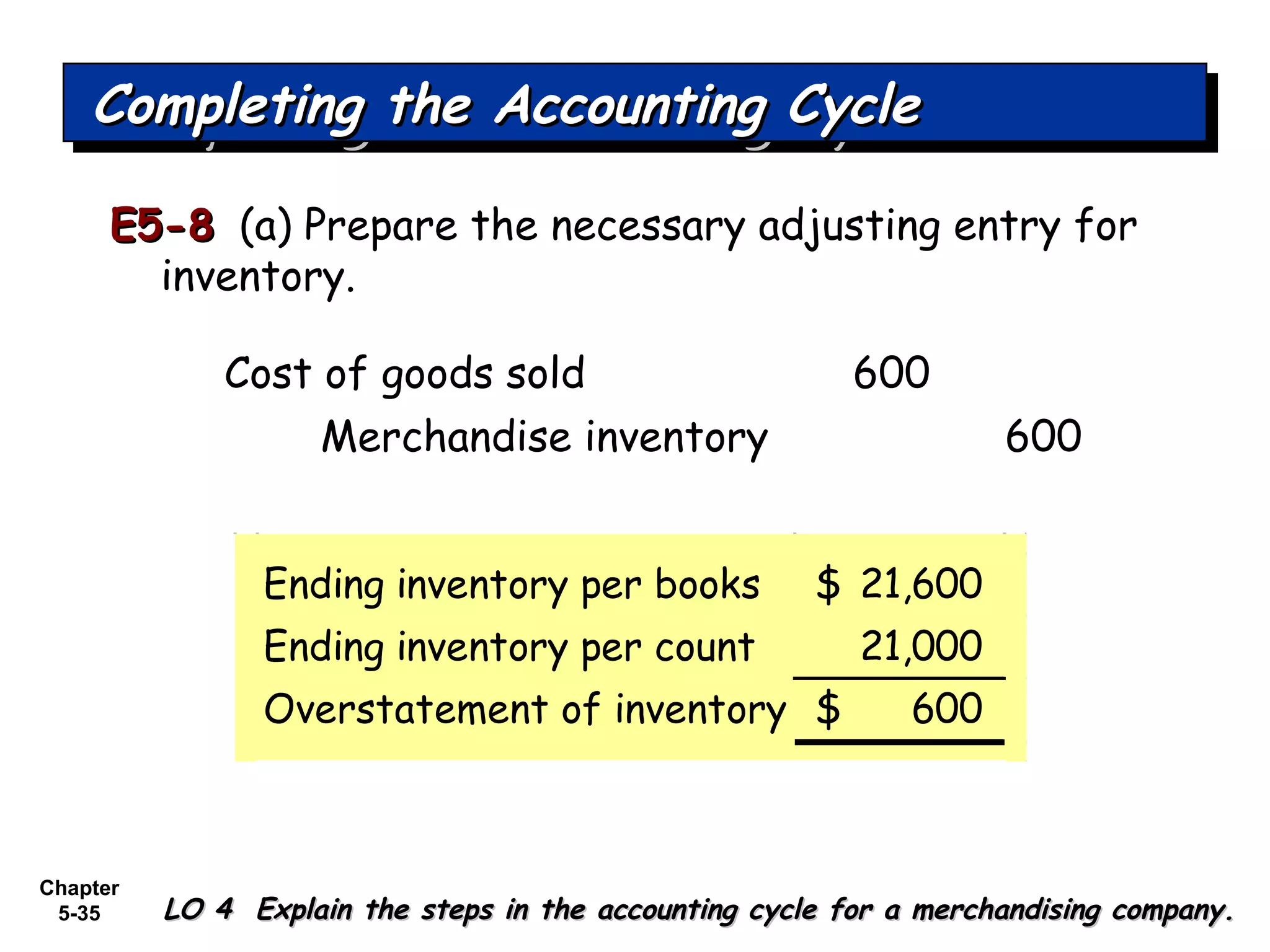
E5-8E5-8 (a) Prepare the necessary adjusting entry for
inventory.
Completing the Accounting CycleCompleting the Accounting CycleCompleting the Accounting CycleCompleting the Accounting Cycle
LO 4 Explain the steps in the accounting cycle for a merchandising company.LO 4 Explain the steps in the accounting cycle for a merchandising company.
Cost of goods sold 600
Merchandise inventory 600
Ending inventory per books 21,600$
Ending inventory per count 21,000
Overstatement of inventory 600$
Chapter
5-36
Sales 350,000
Income summary 350,000
Income summary 341,600
Cost of goods sold 218,600
Freight-out 7,000
Insurance expense 12,000
Income summary 8,400
Rogers, Capital 8,400
Rent expense 20,000
E5-8E5-8 (b) Prepare the necessary closing entries.
Completing the Accounting CycleCompleting the Accounting CycleCompleting the Accounting CycleCompleting the Accounting Cycle
LO 4 Explain the steps in the accounting cycle for a merchandising company.LO 4 Explain the steps in the accounting cycle for a merchandising company.
Salary expense 61,000
Sales discounts 10,000
Sales returns 13,000
Chapter
5-37
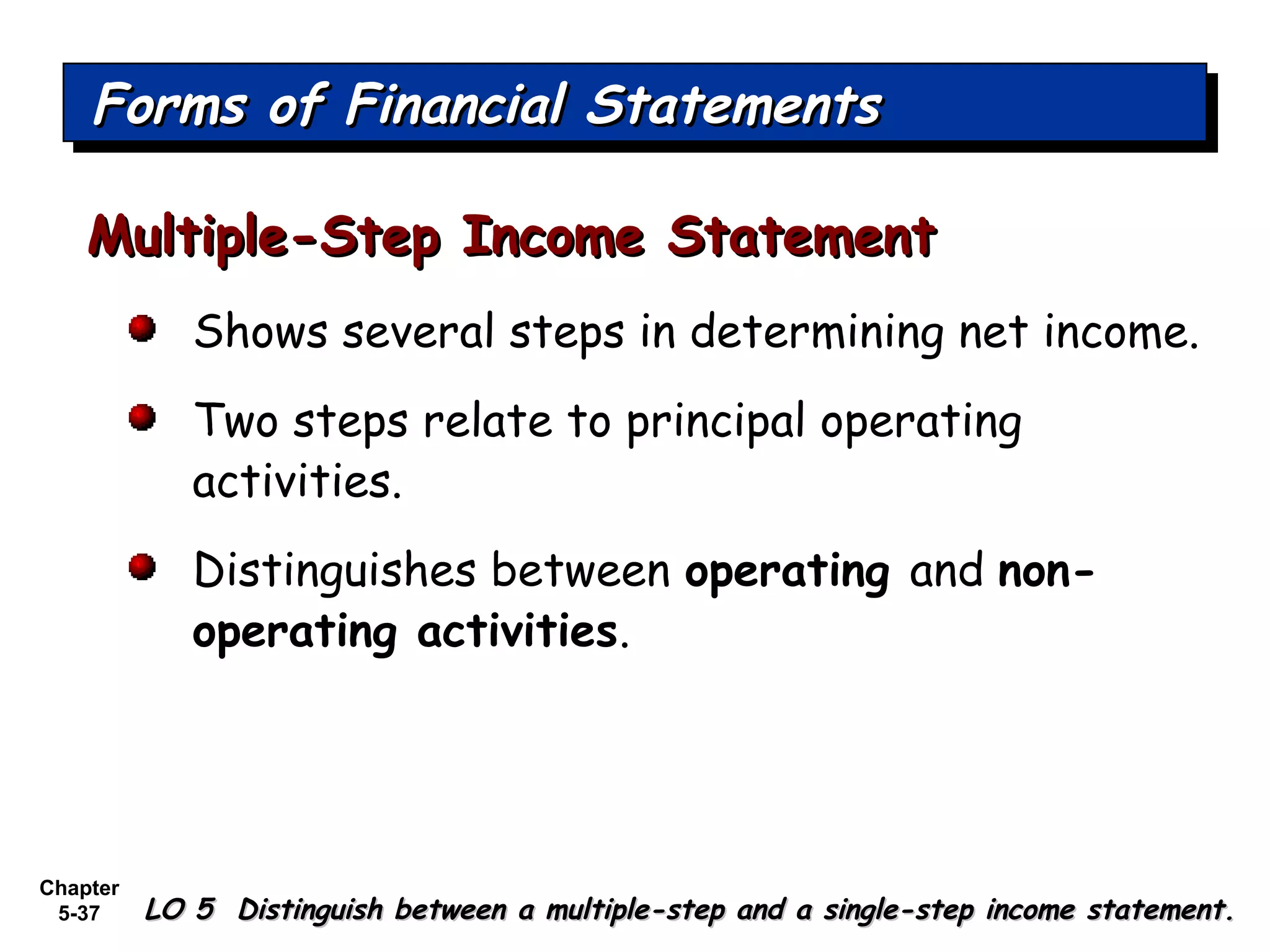
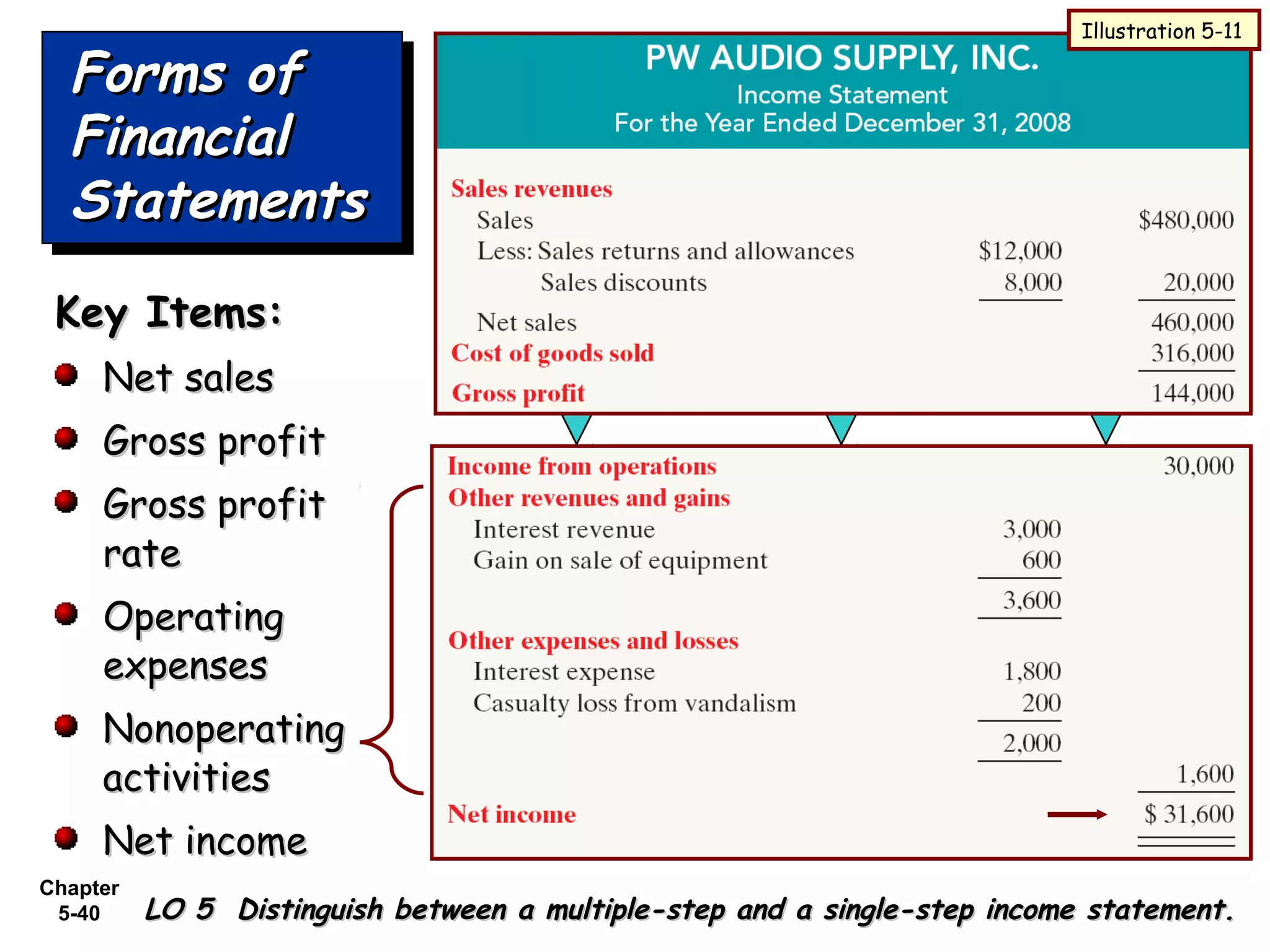
Shows several steps in determining net income.
Two steps relate to principal operating
activities.
Distinguishes between operating and non-
operating activities.
Multiple-Step Income StatementMultiple-Step Income Statement
Forms of Financial StatementsForms of Financial StatementsForms of Financial StatementsForms of Financial Statements
LO 5 Distinguish between a multiple-step and a single-step income statement.LO 5 Distinguish between a multiple-step and a single-step income statement.
Chapter
5-38
LO 5 Distinguish between a multiple-step and a single-step income statement.LO 5 Distinguish between a multiple-step and a single-step income statement.
LO 6 Explain the computation and importance of gross profit.LO 6 Explain the computation and importance of gross profit.
Forms ofForms of
FinancialFinancial
StatementsStatements
Forms ofForms of
FinancialFinancial
StatementsStatements
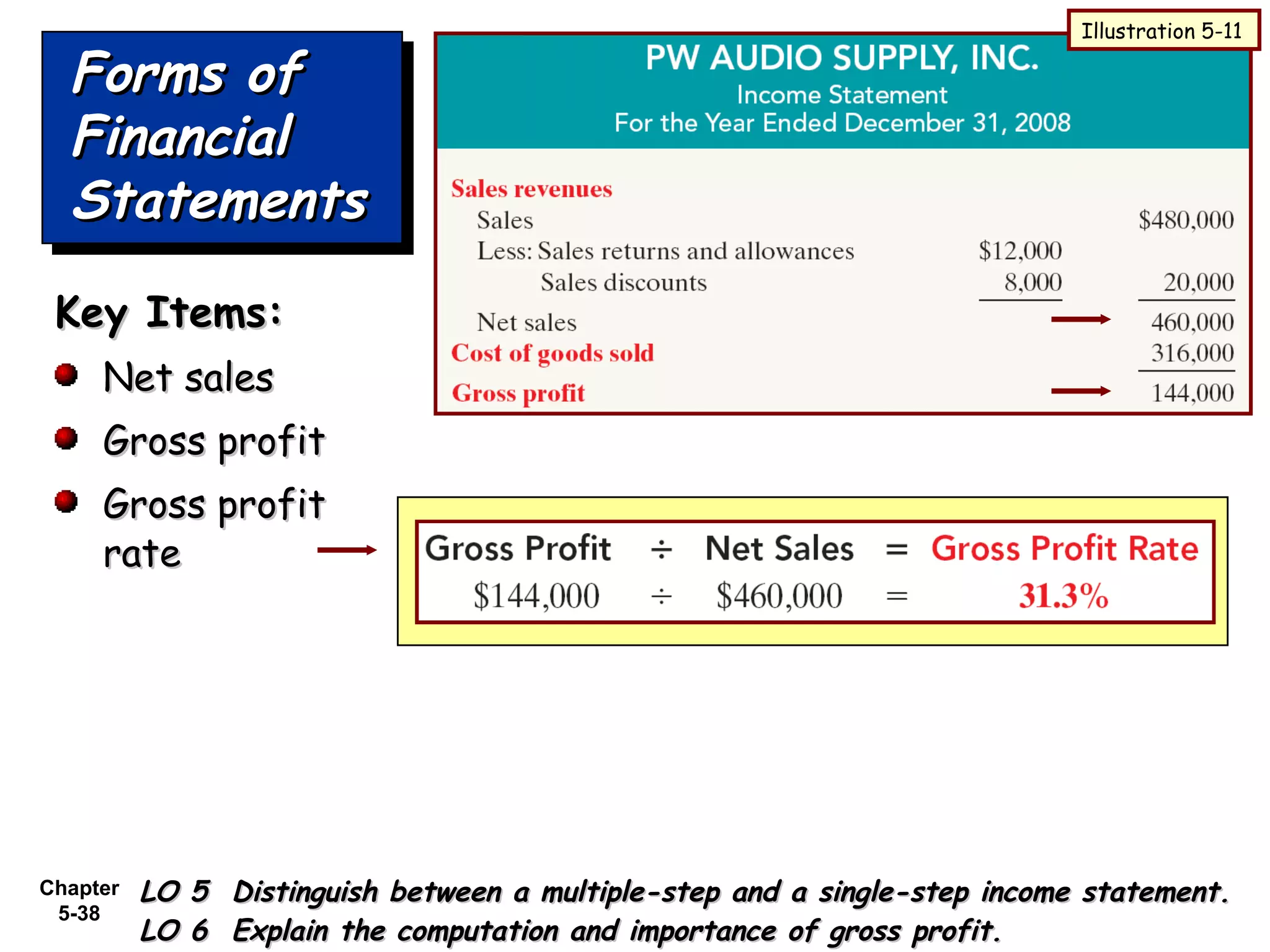
Illustration 5-11
Key Items:Key Items:
Net salesNet sales
Gross profitGross profit
raterate
Chapter
5-39 LO 5 Distinguish between a multiple-step and a single-step income statement.LO 5 Distinguish between a multiple-step and a single-step income statement.
Forms ofForms of
FinancialFinancial
StatementsStatements
Forms ofForms of
FinancialFinancial
StatementsStatements
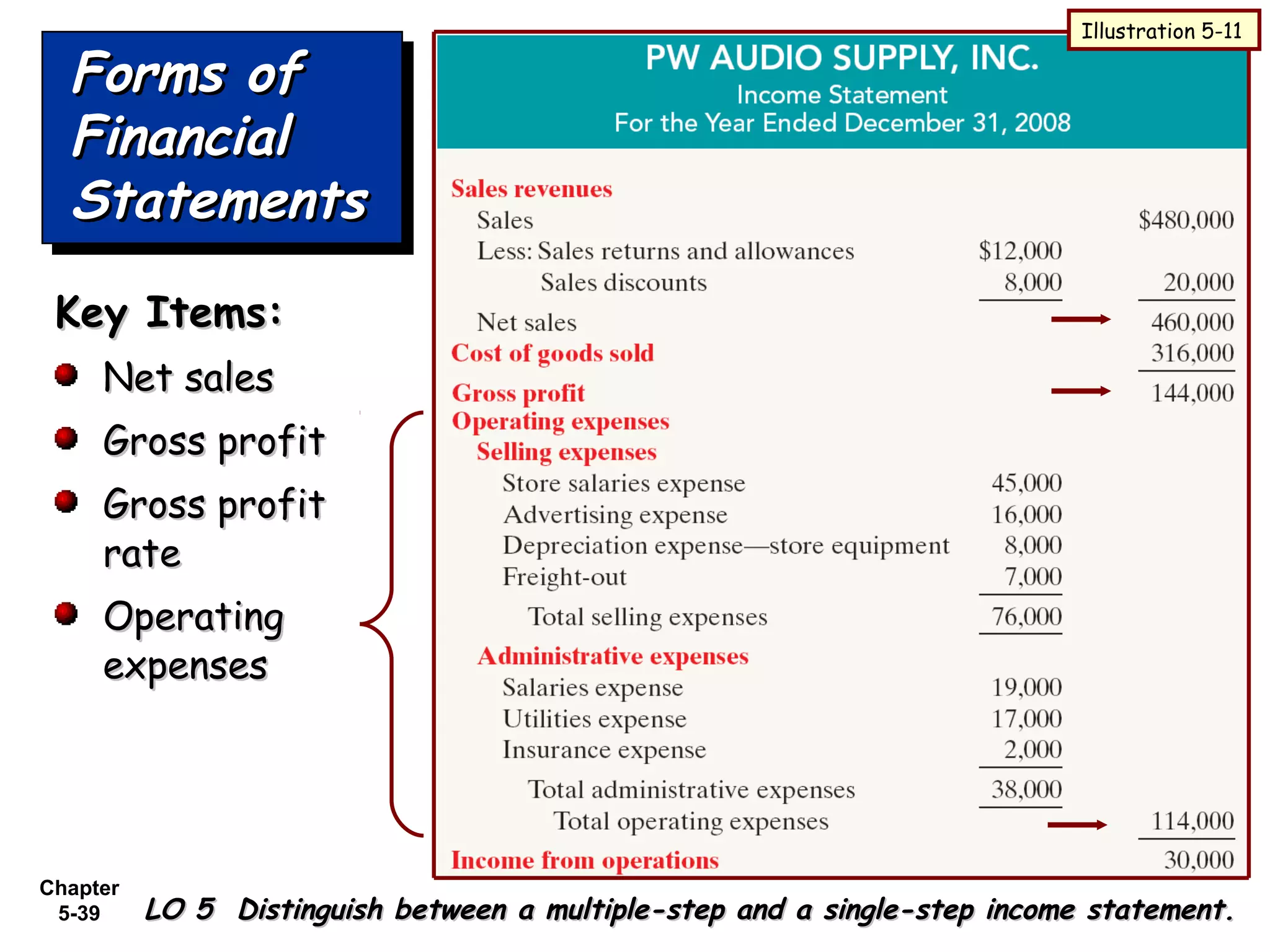
Illustration 5-11
Key Items:Key Items:
Net salesNet sales
Gross profitGross profit
raterate
OperatingOperating
expensesexpenses
Chapter
5-40
Forms ofForms of
FinancialFinancial
StatementsStatements
Forms ofForms of
FinancialFinancial
StatementsStatements
LO 5 Distinguish between a multiple-step and a single-step income statement.LO 5 Distinguish between a multiple-step and a single-step income statement.
Key Items:Key Items:
Net salesNet sales
Gross profitGross profit
raterate
OperatingOperating
expensesexpenses
NonoperatingNonoperating
activitiesactivities
Net incomeNet income
Illustration 5-11
Chapter
5-41
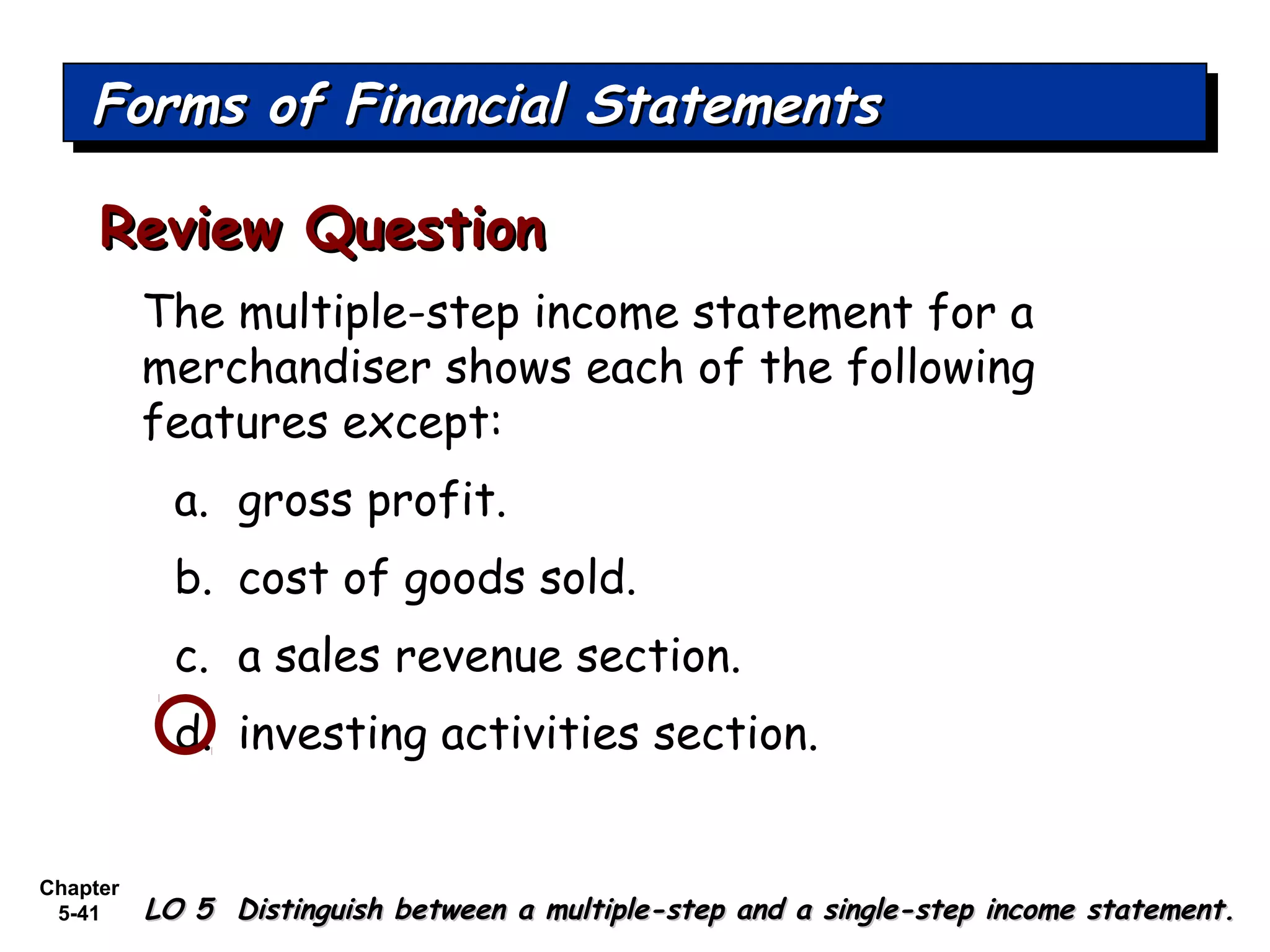
The multiple-step income statement for a
merchandiser shows each of the following
features except:
a. gross profit.
b. cost of goods sold.
c. a sales revenue section.
d. investing activities section.
Review QuestionReview Question
Forms of Financial StatementsForms of Financial StatementsForms of Financial StatementsForms of Financial Statements
LO 5 Distinguish between a multiple-step and a single-step income statement.LO 5 Distinguish between a multiple-step and a single-step income statement.
Chapter
5-42
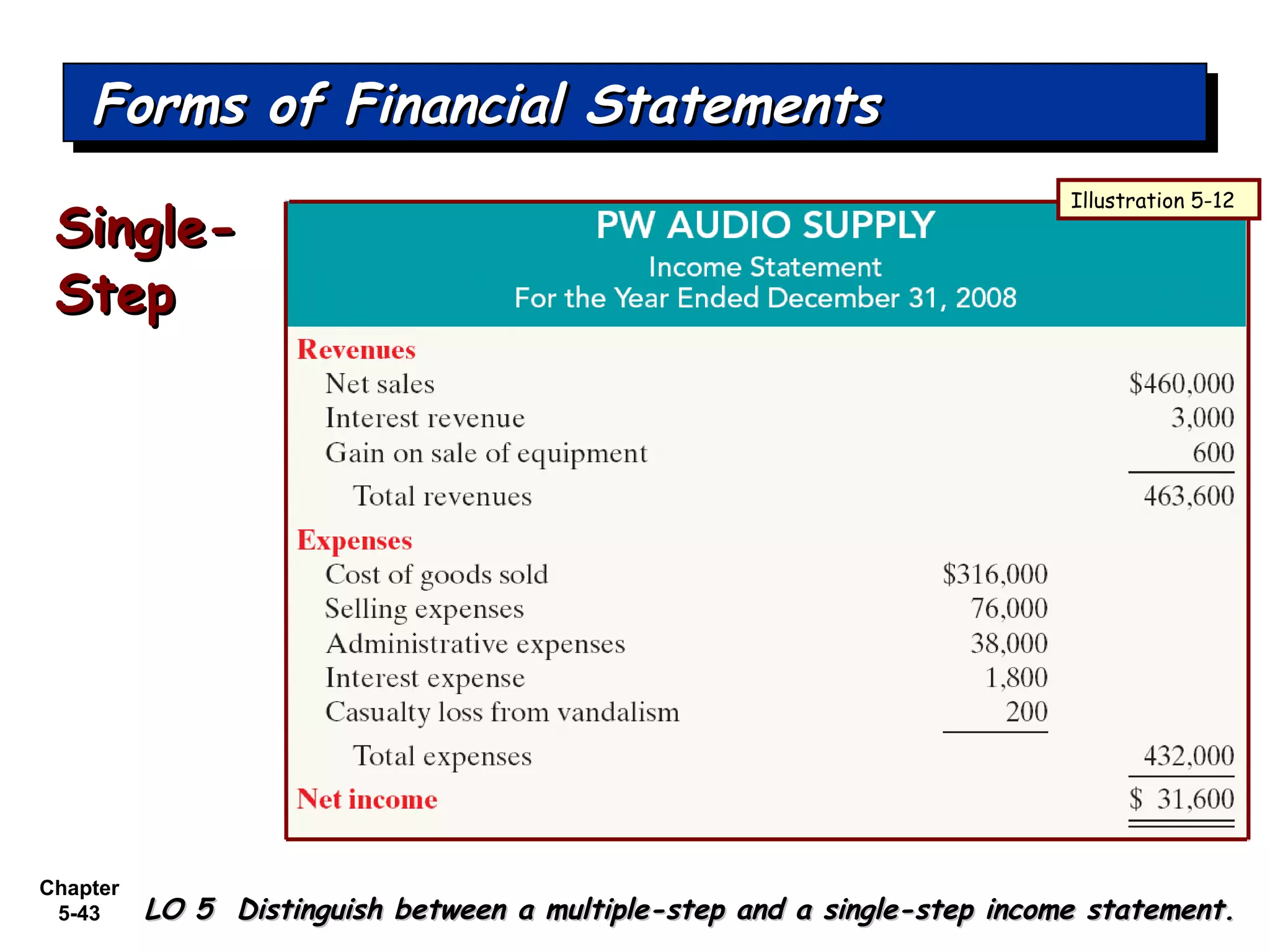
Subtract total expenses from total revenues
Two reasons for using the single-step format:
1) Company does not realize any type of profit
until total revenues exceed total expenses.
2) Format is simpler and easier to read.
Single-Step Income StatementSingle-Step Income Statement
Forms of Financial StatementsForms of Financial StatementsForms of Financial StatementsForms of Financial Statements
LO 5 Distinguish between a multiple-step and a single-step income statement.LO 5 Distinguish between a multiple-step and a single-step income statement.
Chapter
5-43
Single-Single-
StepStep
Forms of Financial StatementsForms of Financial StatementsForms of Financial StatementsForms of Financial Statements
LO 5 Distinguish between a multiple-step and a single-step income statement.LO 5 Distinguish between a multiple-step and a single-step income statement.
Illustration 5-12
Chapter
5-44
Forms of Financial StatementsForms of Financial StatementsForms of Financial StatementsForms of Financial Statements
LO 5 Distinguish between a multiple-step and a single-step income statement.LO 5 Distinguish between a multiple-step and a single-step income statement.
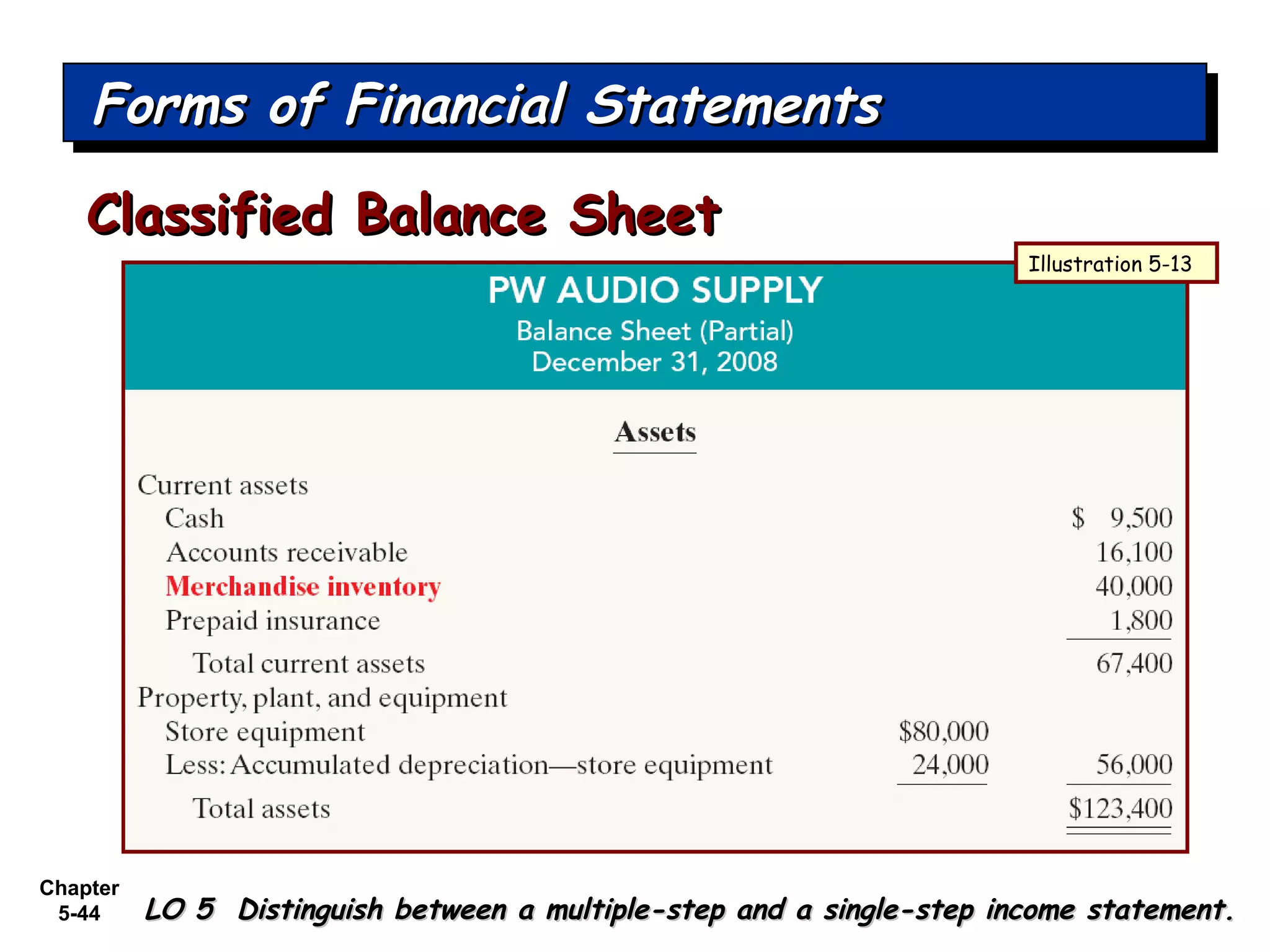
Illustration 5-13
Classified Balance SheetClassified Balance Sheet
Chapter
5-45
Periodic System
Separate accounts used to record purchases,
freight costs, returns, and discounts.
Company does not maintain a running account
of changes in inventory.
Ending inventory determined by physical count.
Determining Cost of Goods Sold Under aDetermining Cost of Goods Sold Under a
Periodic SystemPeriodic System
Determining Cost of Goods Sold Under aDetermining Cost of Goods Sold Under a
Periodic SystemPeriodic System
LO 7 Determine cost of goods sold under a periodic system.LO 7 Determine cost of goods sold under a periodic system.
Chapter
5-46
Determining Cost of Goods Sold Under aDetermining Cost of Goods Sold Under a
Periodic SystemPeriodic System
Determining Cost of Goods Sold Under aDetermining Cost of Goods Sold Under a
Periodic SystemPeriodic System
LO 7 Determine cost of goods sold under a periodic system.LO 7 Determine cost of goods sold under a periodic system.
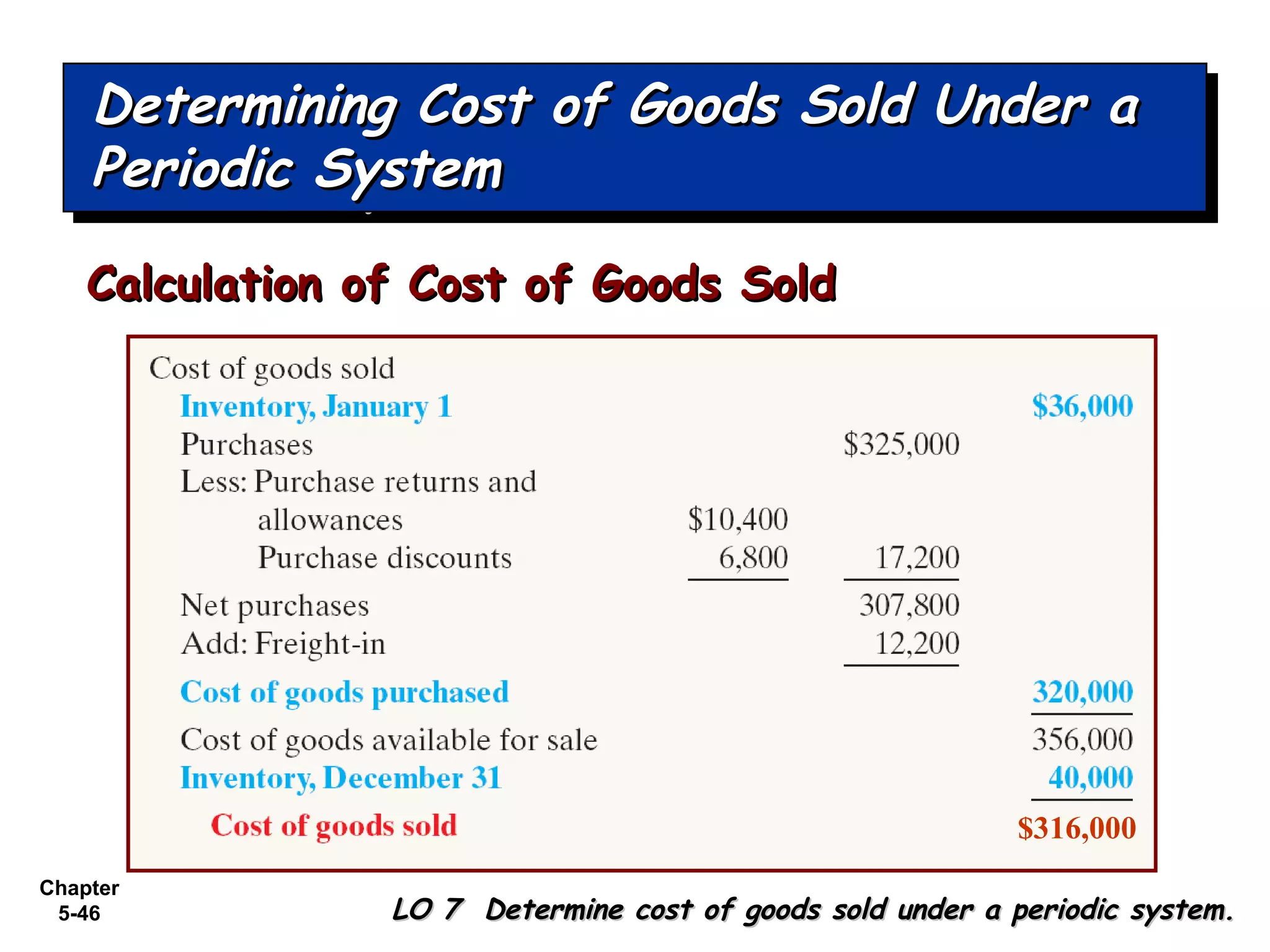
Calculation of Cost of Goods SoldCalculation of Cost of Goods Sold
$316,000

NSU EMB 501 Accounting Ch05

  • 1.
  • 2.
    Chapter 5-2 CHAPTERCHAPTER 55 ACCOUNTING FORACCOUNTINGFOR MERCHANDISINGMERCHANDISING OPERATIONSOPERATIONS Accounting Principles, Eighth Edition
  • 3.
    Chapter 5-3 Merchandising OperationsMerchandising OperationsMerchandisingOperationsMerchandising Operations LO 1 Identify the differences between service and merchandising companies.LO 1 Identify the differences between service and merchandising companies. Merchandising CompaniesMerchandising Companies Buy and Sell Goods Wholesaler Retailer Consumer The primary source of revenues is referred to as sales revenue or sales.
  • 4.
    Chapter 5-4 Merchandising OperationsMerchandising OperationsMerchandisingOperationsMerchandising Operations LO 1 Identify the differences between service and merchandising companies.LO 1 Identify the differences between service and merchandising companies. Income MeasurementIncome Measurement Illustration 5-1 Cost of goods sold is the total cost of merchandise sold during the period. Not used in a Service business. Net Income (Loss) Less LessEquals Equals Sales Revenue Cost of Goods Sold Gross Profit Operating Expenses
  • 5.
    Chapter 5-5 The operating cycle ofa merchandising company ordinarily is longer than that of a service company. Operating CyclesOperating CyclesOperating CyclesOperating Cycles LO 1 Identify the differences between service and merchandising companies.LO 1 Identify the differences between service and merchandising companies. Illustration 5-2
  • 6.
    Chapter 5-6 Features: Perpetual SystemPerpetual System 1.Purchases increase Merchandise Inventory. 2. Freight costs, Purchase Returns and Allowances and Purchase Discounts are included in Merchandise Inventory. 3. Cost of goods sold is increased and Merchandise Inventory is decreased for each sale. 4. Physical count done to verify Inventory balance. The perpetual inventory system provides a continuous record of Inventory and Cost of Goods Sold. Inventory SystemsInventory SystemsInventory SystemsInventory Systems LO 1 Identify the differences between service and merchandising companies.LO 1 Identify the differences between service and merchandising companies.
  • 7.
    Chapter 5-7 Features: Periodic SystemPeriodic System 1.Purchases of merchandise increase Purchases. 2. Ending Inventory determined by physical count. 3. Calculation of Cost of Goods Sold: Inventory SystemsInventory SystemsInventory SystemsInventory Systems LO 1 Identify the differences between service and merchandising companies.LO 1 Identify the differences between service and merchandising companies. Beginning inventory $ 100,000 Add: Purchases, net 800,000 Goods available for sale
  • 8.
    Chapter 5-8 Made using cashor credit (on account). Normally recorded when goods are received. Purchase invoice should support each credit purchase. Recording Purchases of MerchandiseRecording Purchases of MerchandiseRecording Purchases of MerchandiseRecording Purchases of Merchandise LO 2 Explain the recording of purchases under a perpetual inventory system.LO 2 Explain the recording of purchases under a perpetual inventory system. Illustration 5-4
  • 9.
    Chapter 5-9 E5-2E5-2 Information relatedto Steffens Co. is presented below. Prepare the journal entry to record the transaction under a perpetual inventory system. 1. On April 5, purchased merchandise from Bryant Company for $25,000 terms 2/10, net/30, FOB shipping point. Merchandise inventory 25,000April 5 Accounts payable 25,000 Recording Purchases of MerchandiseRecording Purchases of MerchandiseRecording Purchases of MerchandiseRecording Purchases of Merchandise LO 2 Explain the recording of purchases under a perpetual inventory system.LO 2 Explain the recording of purchases under a perpetual inventory system.
  • 10.
    Chapter 5-10 Not all purchasesincrease Merchandise Inventory. E5-2E5-2 Prepare the journal entry to record the transaction under a perpetual inventory system. 3. On April 7, purchased equipment on account for $26,000. Equipment 26,000April 7 Accounts payable 26,000 Recording Purchases of MerchandiseRecording Purchases of MerchandiseRecording Purchases of MerchandiseRecording Purchases of Merchandise LO 2 Explain the recording of purchases under a perpetual inventory system.LO 2 Explain the recording of purchases under a perpetual inventory system.
  • 11.
    Chapter 5-11 Terms FOB shipping point- seller places goods Free On Board the carrier, and buyer pays freight costs. FOB destination - seller places the goods Free On Board to the buyer’s place of business, and seller pays freight costs. Freight CostsFreight Costs Recording Purchases of MerchandiseRecording Purchases of MerchandiseRecording Purchases of MerchandiseRecording Purchases of Merchandise LO 2 Explain the recording of purchases under a perpetual inventory system.LO 2 Explain the recording of purchases under a perpetual inventory system. Freight costs incurred by the seller on outgoing merchandise are an operating expense to the seller (Freight-out or Delivery Expense).
  • 12.
    Chapter 5-12 E5-2E5-2 ContinuedContinued Preparethe journal entry to record the transaction under a perpetual inventory system. 2. On April 6, paid freight costs of $900 on merchandise purchased from Bryant. Merchandise inventory 900April 6 Cash 900 Recording Purchases of MerchandiseRecording Purchases of MerchandiseRecording Purchases of MerchandiseRecording Purchases of Merchandise LO 2 Explain the recording of purchases under a perpetual inventory system.LO 2 Explain the recording of purchases under a perpetual inventory system.
  • 13.
    Chapter 5-13 Purchaser may bedissatisfied because goods damaged or defective, of inferior quality, or do not meet specifications. Purchase Returns and AllowancesPurchase Returns and Allowances Recording Purchases of MerchandiseRecording Purchases of MerchandiseRecording Purchases of MerchandiseRecording Purchases of Merchandise LO 2 Explain the recording of purchases under a perpetual inventory system.LO 2 Explain the recording of purchases under a perpetual inventory system. Return goods for credit if the sale was made on credit, or for a cash refund if the purchase was for cash. May choose to keep the merchandise if the seller will grant an allowance (deduction) from the purchase price. Purchase Return Purchase Allowance
  • 14.
    Chapter 5-14 In a perpetualinventory system, a return of defective merchandise by a purchaser is recorded by crediting: a. Purchases b. Purchase Returns c. Purchase Allowance d. Merchandise Inventory Review QuestionReview Question Recording Purchases of MerchandiseRecording Purchases of MerchandiseRecording Purchases of MerchandiseRecording Purchases of Merchandise LO 2 Explain the recording of purchases under a perpetual inventory system.LO 2 Explain the recording of purchases under a perpetual inventory system.
  • 15.
    Chapter 5-15 E5-2E5-2 ContinuedContinued Preparethe journal entry to record the transaction under a perpetual inventory system. 4. On April 8, returned damaged merchandise to Bryant Company and was granted a $4,000 credit for returned merchandise. Accounts payable 4,000April 8 Merchandise inventory 4,000 Recording Purchases of MerchandiseRecording Purchases of MerchandiseRecording Purchases of MerchandiseRecording Purchases of Merchandise LO 2 Explain the recording of purchases under a perpetual inventory system.LO 2 Explain the recording of purchases under a perpetual inventory system.
  • 16.
    Chapter 5-16 Credit terms maypermit buyer to claim a cash discount for prompt payment. Advantages: Purchaser saves money. Seller shortens the operating cycle. Purchase DiscountsPurchase Discounts Recording Purchases of MerchandiseRecording Purchases of MerchandiseRecording Purchases of MerchandiseRecording Purchases of Merchandise LO 2 Explain the recording of purchases under a perpetual inventory system.LO 2 Explain the recording of purchases under a perpetual inventory system. Example: Credit terms of 2/10, n/30, is read “two-ten, net thirty.” 2% cash discount if payment is made within 10 days.
  • 17.
    Chapter 5-17 Purchase DiscountsPurchase DiscountsTermsTerms Recording Purchases of MerchandiseRecording Purchases of MerchandiseRecording Purchases of MerchandiseRecording Purchases of Merchandise LO 2 Explain the recording of purchases under a perpetual inventory system.LO 2 Explain the recording of purchases under a perpetual inventory system. 2% discount if paid within 10 days. 1% discount if paid within first 10 days of next month. 2/10, n/30 1/10 EOM Net amount due in 30 days, 60 days, or within the first 10 days of the next month. N/30, m/60, or n/10 EOM
  • 18.
    Chapter 5-18 E5-2E5-2 ContinuedContinued Preparethe journal entry to record the transaction under a perpetual inventory system. 5. On April 15, paid the amount due to Bryant Company in full. Accounts payable 21,000April 15 Merchandise inventory 420 Recording Purchases of MerchandiseRecording Purchases of MerchandiseRecording Purchases of MerchandiseRecording Purchases of Merchandise LO 2 Explain the recording of purchases under a perpetual inventory system.LO 2 Explain the recording of purchases under a perpetual inventory system. Cash 20,580 (Discount = $21,000 x 2% = $420)
  • 19.
    Chapter 5-19 E5-2E5-2 ContinuedContinued Preparethe journal entry to record the transaction under a perpetual inventory system. 5. On April 15, paid the amount due to Bryant Company in full. Accounts payable 21,000April 16 or later Cash 21,000 Recording Purchases of MerchandiseRecording Purchases of MerchandiseRecording Purchases of MerchandiseRecording Purchases of Merchandise LO 2 Explain the recording of purchases under a perpetual inventory system.LO 2 Explain the recording of purchases under a perpetual inventory system. What entry would be made if the company failed to pay within 10 days?
  • 20.
    Chapter 5-20 Should discounts betaken when offered? Purchase DiscountsPurchase Discounts Recording Purchases of MerchandiseRecording Purchases of MerchandiseRecording Purchases of MerchandiseRecording Purchases of Merchandise LO 2 Explain the recording of purchases under a perpetual inventory system.LO 2 Explain the recording of purchases under a perpetual inventory system. Discount of 2% on $21,000 420.00$ $25,000 invested at 10% for 20 days 115.07 Savings by taking the discount 304.93$ Example: 2% for 20 days = Annual rate of 36.5% (365/20 = 18.25 twenty-day periods x 2% = 36.5%) Passing up the discount offered equates to paying an interest rate of 2% on the use of $21,000 for 20 days.
  • 21.
    Chapter 5-21 Merchandise Inventory Debit Credit $25,0008th - Return$4,000 Balance 5th - Purchase $21,480$21,480 420 15th - Discount Recording Purchases of MerchandiseRecording Purchases of MerchandiseRecording Purchases of MerchandiseRecording Purchases of Merchandise LO 2 Explain the recording of purchases under a perpetual inventory system.LO 2 Explain the recording of purchases under a perpetual inventory system. Summary of Purchasing TransactionsSummary of Purchasing Transactions 9006th – Freight-in E5-2E5-2
  • 22.
    Chapter 5-22 Made for cashor credit (on account). Normally recorded when earned, usually when goods transfer from seller to buyer. Sales invoice should support each credit sale. Recording Sales of MerchandiseRecording Sales of MerchandiseRecording Sales of MerchandiseRecording Sales of Merchandise LO 3 Explain the recording of sales revenuesLO 3 Explain the recording of sales revenues under a perpetual inventory system.under a perpetual inventory system. Illustration 5-4
  • 23.
    Chapter 5-23 Two Journal Entriesto Record a SaleTwo Journal Entries to Record a Sale Cash or Accounts receivable XXX Sales XXX Recording Sales of MerchandiseRecording Sales of MerchandiseRecording Sales of MerchandiseRecording Sales of Merchandise LO 3 Explain the recording of sales revenuesLO 3 Explain the recording of sales revenues under a perpetual inventory system.under a perpetual inventory system. #1 Cost of goods sold XXX Merchandise inventory XXX #2 Selling Price Cost
  • 24.
    Chapter 5-24 E5-5E5-5 Presented aretransactions related to Wheeler Company. 1. On December 3,Wheeler Company sold $500,000 of merchandise to Hashmi Co., terms 2/10, n/30, FOB shipping point. The cost of the merchandise sold was $350,000. 2. On December 8, Hashmi Co. was granted an allowance of $27,000 for merchandise purchased on December 3. 3. On December 13,Wheeler Company received the balance due from Hashmi Co. Instructions: Prepare the journal entries to record these transactions on the books of Wheeler Company using a perpetual inventory system. Recording Sales of MerchandiseRecording Sales of MerchandiseRecording Sales of MerchandiseRecording Sales of Merchandise LO 3 Explain the recording of sales revenuesLO 3 Explain the recording of sales revenues under a perpetual inventory system.under a perpetual inventory system.
  • 25.
    Chapter 5-25 E5-5E5-5 Prepare thejournal entries for Wheeler Company . 1. On December 3, Wheeler Company sold $500,000 of merchandise to Hashmi Co., terms 2/10, n/30, FOB shipping point. Cost of merchandise sold was $350,000. Recording Sales of MerchandiseRecording Sales of MerchandiseRecording Sales of MerchandiseRecording Sales of Merchandise LO 3 Explain the recording of sales revenuesLO 3 Explain the recording of sales revenues under a perpetual inventory system.under a perpetual inventory system. Accounts receivable 500,000Dec. 3 Sales 500,000 Cost of goods sold 350,000 Merchandise inventory 350,000
  • 26.
    Chapter 5-26 “Flipside” of purchasereturns and allowances. Contra-revenue account (debit). Sales not reduced (debited) because:  would obscure importance of sales returns and allowances as a percentage of sales.  could distort comparisons between total sales in different accounting periods. Sales Returns and AllowancesSales Returns and Allowances Recording Sales of MerchandiseRecording Sales of MerchandiseRecording Sales of MerchandiseRecording Sales of Merchandise LO 3 Explain the recording of sales revenuesLO 3 Explain the recording of sales revenues under a perpetual inventory system.under a perpetual inventory system.
  • 27.
    Chapter 5-27 E5-5E5-5 Prepare thejournal entries for Wheeler Company. 2. On December 8, Hashmi Co. was granted an allowance of $27,000 for merchandise purchased on December 3. Recording Sales of MerchandiseRecording Sales of MerchandiseRecording Sales of MerchandiseRecording Sales of Merchandise LO 3 Explain the recording of sales revenuesLO 3 Explain the recording of sales revenues under a perpetual inventory system.under a perpetual inventory system. Sales returns and allowances 27,000Dec. 8 Accounts receivable 27,000
  • 28.
    Chapter 5-28 E5-5E5-5 Prepare thejournal entries for Wheeler Company. 2. Variation On Dec. 8, Hashmi Co. returned merchandise for credit of $27,000. The original cost of the merchandise to Wheeler was $19,800. Recording Sales of MerchandiseRecording Sales of MerchandiseRecording Sales of MerchandiseRecording Sales of Merchandise LO 3 Explain the recording of sales revenuesLO 3 Explain the recording of sales revenues under a perpetual inventory system.under a perpetual inventory system. Sales returns and allowances 27,000Dec. 8 Accounts receivable 27,000 Merchandise inventory 19,800 Cost of goods sold 19,800
  • 29.
    Chapter 5-29 The cost ofgoods sold is determined and recorded each time a sale occurs in: a. periodic inventory system only. b. a perpetual inventory system only. c. both a periodic and perpetual inventory system. d. neither a periodic nor perpetual inventory system. Review QuestionReview Question Recording Sales of MerchandiseRecording Sales of MerchandiseRecording Sales of MerchandiseRecording Sales of Merchandise LO 3 Explain the recording of sales revenuesLO 3 Explain the recording of sales revenues under a perpetual inventory system.under a perpetual inventory system.
  • 30.
    Chapter 5-30 Offered to customersto promote prompt payment. “Flipside” of purchase discount. Contra-revenue account (debit). Sales DiscountSales Discount Recording Sales of MerchandiseRecording Sales of MerchandiseRecording Sales of MerchandiseRecording Sales of Merchandise LO 3 Explain the recording of sales revenuesLO 3 Explain the recording of sales revenues under a perpetual inventory system.under a perpetual inventory system.
  • 31.
    Chapter 5-31 E5-5E5-5 Prepare thejournal entries for Wheeler Company . 3. On December 13, Wheeler Company received the balance due from Hashmi Co. Recording Sales of MerchandiseRecording Sales of MerchandiseRecording Sales of MerchandiseRecording Sales of Merchandise LO 3 Explain the recording of sales revenuesLO 3 Explain the recording of sales revenues under a perpetual inventory system.under a perpetual inventory system. Cash 463,540Dec. 13 Accounts receivable 473,000 Sales discounts 9,460 ** [($500,000 – $27,000) X 2%] ** *** ($500,000 – $27,000) *** * * ($473,000 – $9,460)
  • 32.
    Chapter 5-32 E5-5E5-5 Variation Preparethe sales revenue section of the income statement for Wheeler Company. Recording Sales of MerchandiseRecording Sales of MerchandiseRecording Sales of MerchandiseRecording Sales of Merchandise LO 3 Explain the recording of sales revenuesLO 3 Explain the recording of sales revenues under a perpetual inventory system.under a perpetual inventory system. Sales revenue Sales 500,000$ Less: Sales returns and allowances (27,000) Sales discounts (9,460) Net sales 463,540 Income Statement (Partial) For the Month Ended Dec. 31, Wheeler Company
  • 33.
    Chapter 5-33 Generally the sameas a service company. One additional adjustment to make the records agree with the actual inventory on hand. Involves adjusting Merchandise Inventory and Cost of Goods Sold. Adjusting EntriesAdjusting Entries Completing the Accounting CycleCompleting the Accounting CycleCompleting the Accounting CycleCompleting the Accounting Cycle LO 4 Explain the steps in the accounting cycle for a merchandising company.LO 4 Explain the steps in the accounting cycle for a merchandising company.
  • 34.
    Chapter 5-34 Close all accountsthat affect net income. Closing EntriesClosing Entries Completing the Accounting CycleCompleting the Accounting CycleCompleting the Accounting CycleCompleting the Accounting Cycle LO 4 Explain the steps in the accounting cycle for a merchandising company.LO 4 Explain the steps in the accounting cycle for a merchandising company. E5-8E5-8 Presented is information related to Rogers Co. for the month of January 2008. Ending inventory per books 21,600$ Rent expense 20,000$ Ending inventory per count 21,000 Salary expense 61,000 Cost of goods sold 218,000 Sales discount 10,000 Freight-out 7,000 Sales returns 13,000 Insurance expense 12,000 Sales 350,000 Required: (a) Prepare the necessary adjusting entry for inventory. (b) Prepare the necessary closing entries.
  • 35.
    Chapter 5-35 E5-8E5-8 (a) Preparethe necessary adjusting entry for inventory. Completing the Accounting CycleCompleting the Accounting CycleCompleting the Accounting CycleCompleting the Accounting Cycle LO 4 Explain the steps in the accounting cycle for a merchandising company.LO 4 Explain the steps in the accounting cycle for a merchandising company. Cost of goods sold 600 Merchandise inventory 600 Ending inventory per books 21,600$ Ending inventory per count 21,000 Overstatement of inventory 600$
  • 36.
    Chapter 5-36 Sales 350,000 Income summary350,000 Income summary 341,600 Cost of goods sold 218,600 Freight-out 7,000 Insurance expense 12,000 Income summary 8,400 Rogers, Capital 8,400 Rent expense 20,000 E5-8E5-8 (b) Prepare the necessary closing entries. Completing the Accounting CycleCompleting the Accounting CycleCompleting the Accounting CycleCompleting the Accounting Cycle LO 4 Explain the steps in the accounting cycle for a merchandising company.LO 4 Explain the steps in the accounting cycle for a merchandising company. Salary expense 61,000 Sales discounts 10,000 Sales returns 13,000
  • 37.
    Chapter 5-37 Shows several stepsin determining net income. Two steps relate to principal operating activities. Distinguishes between operating and non- operating activities. Multiple-Step Income StatementMultiple-Step Income Statement Forms of Financial StatementsForms of Financial StatementsForms of Financial StatementsForms of Financial Statements LO 5 Distinguish between a multiple-step and a single-step income statement.LO 5 Distinguish between a multiple-step and a single-step income statement.
  • 38.
    Chapter 5-38 LO 5 Distinguishbetween a multiple-step and a single-step income statement.LO 5 Distinguish between a multiple-step and a single-step income statement. LO 6 Explain the computation and importance of gross profit.LO 6 Explain the computation and importance of gross profit. Forms ofForms of FinancialFinancial StatementsStatements Forms ofForms of FinancialFinancial StatementsStatements Illustration 5-11 Key Items:Key Items: Net salesNet sales Gross profitGross profit Gross profitGross profit raterate
  • 39.
    Chapter 5-39 LO 5Distinguish between a multiple-step and a single-step income statement.LO 5 Distinguish between a multiple-step and a single-step income statement. Forms ofForms of FinancialFinancial StatementsStatements Forms ofForms of FinancialFinancial StatementsStatements Illustration 5-11 Key Items:Key Items: Net salesNet sales Gross profitGross profit Gross profitGross profit raterate OperatingOperating expensesexpenses
  • 40.
    Chapter 5-40 Forms ofForms of FinancialFinancial StatementsStatements FormsofForms of FinancialFinancial StatementsStatements LO 5 Distinguish between a multiple-step and a single-step income statement.LO 5 Distinguish between a multiple-step and a single-step income statement. Key Items:Key Items: Net salesNet sales Gross profitGross profit Gross profitGross profit raterate OperatingOperating expensesexpenses NonoperatingNonoperating activitiesactivities Net incomeNet income Illustration 5-11
  • 41.
    Chapter 5-41 The multiple-step incomestatement for a merchandiser shows each of the following features except: a. gross profit. b. cost of goods sold. c. a sales revenue section. d. investing activities section. Review QuestionReview Question Forms of Financial StatementsForms of Financial StatementsForms of Financial StatementsForms of Financial Statements LO 5 Distinguish between a multiple-step and a single-step income statement.LO 5 Distinguish between a multiple-step and a single-step income statement.
  • 42.
    Chapter 5-42 Subtract total expensesfrom total revenues Two reasons for using the single-step format: 1) Company does not realize any type of profit until total revenues exceed total expenses. 2) Format is simpler and easier to read. Single-Step Income StatementSingle-Step Income Statement Forms of Financial StatementsForms of Financial StatementsForms of Financial StatementsForms of Financial Statements LO 5 Distinguish between a multiple-step and a single-step income statement.LO 5 Distinguish between a multiple-step and a single-step income statement.
  • 43.
    Chapter 5-43 Single-Single- StepStep Forms of FinancialStatementsForms of Financial StatementsForms of Financial StatementsForms of Financial Statements LO 5 Distinguish between a multiple-step and a single-step income statement.LO 5 Distinguish between a multiple-step and a single-step income statement. Illustration 5-12
  • 44.
    Chapter 5-44 Forms of FinancialStatementsForms of Financial StatementsForms of Financial StatementsForms of Financial Statements LO 5 Distinguish between a multiple-step and a single-step income statement.LO 5 Distinguish between a multiple-step and a single-step income statement. Illustration 5-13 Classified Balance SheetClassified Balance Sheet
  • 45.
    Chapter 5-45 Periodic System Separate accountsused to record purchases, freight costs, returns, and discounts. Company does not maintain a running account of changes in inventory. Ending inventory determined by physical count. Determining Cost of Goods Sold Under aDetermining Cost of Goods Sold Under a Periodic SystemPeriodic System Determining Cost of Goods Sold Under aDetermining Cost of Goods Sold Under a Periodic SystemPeriodic System LO 7 Determine cost of goods sold under a periodic system.LO 7 Determine cost of goods sold under a periodic system.
  • 46.
    Chapter 5-46 Determining Cost ofGoods Sold Under aDetermining Cost of Goods Sold Under a Periodic SystemPeriodic System Determining Cost of Goods Sold Under aDetermining Cost of Goods Sold Under a Periodic SystemPeriodic System LO 7 Determine cost of goods sold under a periodic system.LO 7 Determine cost of goods sold under a periodic system. Calculation of Cost of Goods SoldCalculation of Cost of Goods Sold $316,000