Financial Accounting
Module 4: Completing the Accounting Cycle
Module Learning Outcomes
Describe the complete accounting cycle
4.1: Describe the process of making adjusting journal entries
4.2: Create adjusting journal entries
4.3: Creating the adjusted trial balance
4.4: Use an adjusted trial balance to prepare financial statements
4.5: Prepare and post closing entries
The Adjusting Process
Learning Outcomes: The Adjusting Process
4.1: Describe the process of making adjusting journal entries
4.1.1: Explain the need for adjusting journal entries
4.1.2: Describe the adjustment process
4.1.3: Differentiate between deferrals and accruals
The Need for Adjusting Journal Entries
• Adjusting entries are made during the accounting cycle after the
unadjusted trial balance and before the company prepares its financial
statements, bringing the amounts in the general ledger accounts to their
proper balances.
• Each adjusting entry has a dual purpose:
1. To make the income statement report the appropriate revenue or expense
2. To make the balance sheet report the appropriate asset or liability
Three Adjusting Entry Rules
• Rule 1: Adjusting entries will almost never include cash.
• The purpose of adjusting entries is to make the accounting records accurately reflect
the matching principle—match revenue and expense of the operating period. There
are some rare cases where cash needs to be adjusted, but ideally, that adjusting
should have all been done prior to running the unadjusted trial balance.
• Rule 2: Debits always equal credits (as usual).
• Rule 3: The adjusting entry will have one balance sheet account (asset,
liability, or equity) and one income statement account (revenue or
expense) in the journal entry.
• Remember, the goal of the adjusting entry is to match the revenue and expense of
the accounting period. Adjusting entries between balance sheet accounts only, or
between income statement accounts only, are usually called reclassifications.
How the Adjustment Process Works
• Accountants have followed these
steps for 500 years:
• Print out the unadjusted trial balance
• Analyze each account
• Look for anything that is missing
• Make adjusting journal entries
• Post the adjusting journal entries
Accruals versus Deferrals
• The word “accrue” means to add to. The word “defer” means to put off until
later.
• In accounting:
• If you earn revenue before you collect the cash, you have to accrue the revenue
(add it to the books).
• If you get the cash before you earn the revenue, you must defer recognition of the
revenue.
• The same holds true for expenses.
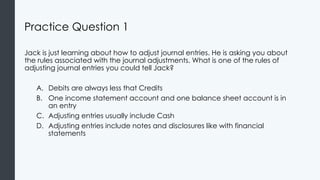
Practice Question 1
Jack is just learning about how to adjust journal entries. He is asking you about
the rules associated with the journal adjustments. What is one of the rules of
adjusting journal entries you could tell Jack?
A. Debits are always less that Credits
B. One income statement account and one balance sheet account is in
an entry
C. Adjusting entries usually include Cash
D. Adjusting entries include notes and disclosures like with financial
statements
Creating Adjusting Journal Entries
Learning Outcomes: Creating Adjusting Journal
Entries
4.2: Create adjusting journal entries
4.2.1: Analyzing revenue accounts and creating necessary adjustments
4.2.2: Analyzing expense accounts and creating necessary adjustments
4.2.3: Finding errors and creating adjustments
Analyzing Revenue Accounts and Creating
Necessary Adjustments
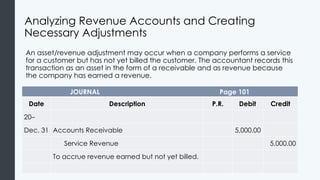
An asset/revenue adjustment may occur when a company performs a service
for a customer but has not yet billed the customer. The accountant records this
transaction as an asset in the form of a receivable and as revenue because
the company has earned a revenue.
JOURNAL Page 101
Date Description P.R. Debit Credit
20–
Dec. 31 Accounts Receivable 5,000.00
Service Revenue 5,000.00
To accrue revenue earned but not yet billed.
Analyzing Expense Accounts and Creating
Necessary Adjustments
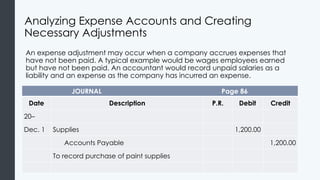
An expense adjustment may occur when a company accrues expenses that
have not been paid. A typical example would be wages employees earned
but have not been paid. An accountant would record unpaid salaries as a
liability and an expense as the company has incurred an expense.
JOURNAL Page 86
Date Description P.R. Debit Credit
20–
Dec. 1 Supplies 1,200.00
Accounts Payable 1,200.00
To record purchase of paint supplies
Finding Errors and Creating Adjustments
Start the process by asking yourself these three questions when dealing with
errors:
1. What type of error is it?
2. How should this error be fixed?
3. How did this error affect the financial statements?
Finding Errors and Creating Adjustments (cont.)
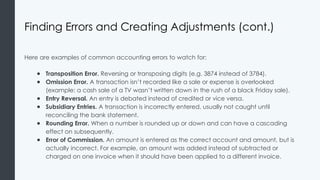
Here are examples of common accounting errors to watch for:
● Transposition Error. Reversing or transposing digits (e.g. 3874 instead of 3784).
● Omission Error. A transaction isn’t recorded like a sale or expense is overlooked
(example: a cash sale of a TV wasn’t written down in the rush of a black Friday sale).
● Entry Reversal. An entry is debated instead of credited or vice versa.
● Subsidiary Entries. A transaction is incorrectly entered, usually not caught until
reconciling the bank statement.
● Rounding Error. When a number is rounded up or down and can have a cascading
effect on subsequently.
● Error of Commission. An amount is entered as the correct account and amount, but is
actually incorrect. For example, an amount was added instead of subtracted or
charged on one invoice when it should have been applied to a different invoice.
Finding Errors and Creating Adjustments
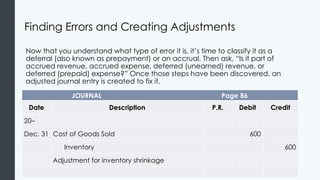
Now that you understand what type of error it is, it’s time to classify it as a
deferral (also known as prepayment) or an accrual. Then ask, “Is it part of
accrued revenue, accrued expense, deferred (unearned) revenue, or
deferred (prepaid) expense?” Once those steps have been discovered, an
adjusted journal entry is created to fix it.
JOURNAL Page 86
Date Description P.R. Debit Credit
20–
Dec. 31 Cost of Goods Sold 600
Inventory 600
Adjustment for inventory shrinkage
Finding Errors and Creating Adjustments
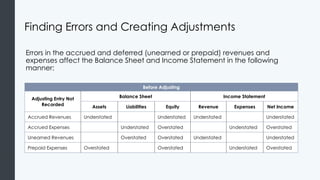
Errors in the accrued and deferred (unearned or prepaid) revenues and
expenses affect the Balance Sheet and Income Statement in the following
manner:
Before Adjusting
Adjusting Entry Not
Recorded
Balance Sheet Income Statement
Assets Liabilities Equity Revenue Expenses Net Income
Accrued Revenues Understated Understated Understated Understated
Accrued Expenses Understated Overstated Understated Overstated
Unearned Revenues Overstated Overstated Understated Understated
Prepaid Expenses Overstated Overstated Understated Overstated
Preparing an Adjusted Trial Balance
Learning Outcomes: Preparing an Adjusted Trial
Balance
4.3: Creating the adjusted trial balance
4.3.1: Posting adjusting entries to the ledgers and re-balancing the accounts
4.3.2: Creating an adjusted trial balance using a worksheet
Posting Adjusting Entries to the Ledgers and Re-
Balancing the Accounts
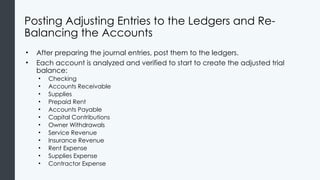
• After preparing the journal entries, post them to the ledgers.
• Each account is analyzed and verified to start to create the adjusted trial
balance:
• Checking
• Accounts Receivable
• Supplies
• Prepaid Rent
• Accounts Payable
• Capital Contributions
• Owner Withdrawals
• Service Revenue
• Insurance Revenue
• Rent Expense
• Supplies Expense
• Contractor Expense
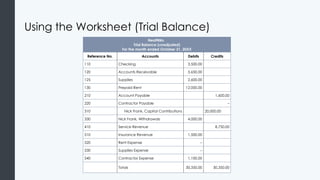
Using the Worksheet (Trial Balance)
NeatNiks
Trial Balance (unadjusted)
For the month ended October 31, 20XX
Reference No. Accounts Debits Credits
110 Checking 3,500.00
120 Accounts Receivable 5,650.00
125 Supplies 2,600.00
130 Prepaid Rent 12,000.00
210 Account Payable 1,600.00
220 Contractor Payable –
310 Nick Frank, Capital Contributions 20,000.00
330 Nick Frank, Withdrawals 4,000.00
410 Service Revenue 8,750.00
510 Insurance Revenue 1,500.00
520 Rent Expense –
530 Supplies Expense –
540 Contractor Expense 1,100.00
Totals 30,350.00 30,350.00
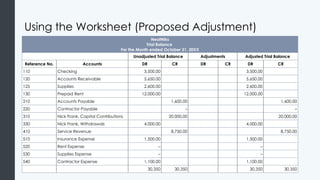
Using the Worksheet (Proposed Adjustment)
NeatNiks
Trial Balance
For the Month ended October 31, 20XX
Unadjusted Trial Balance Adjustments Adjusted Trial Balance
Reference No. Accounts DR CR DR CR DR CR
110 Checking 3,500.00 3,500.00
120 Accounts Receivable 5,650.00 5,650.00
125 Supplies 2,600.00 2,600.00
130 Prepaid Rent 12,000.00 12,000.00
210 Accounts Payable 1,600.00 1,600.00
220 Contractor Payable – –
310 Nick Frank, Capital Contributions 20,000.00 20,000.00
330 Nick Frank, Withdrawals 4,000.00 4,000.00
410 Service Revenue 8,750.00 8,750.00
510 Insurance Expense 1,500.00 1,500.00
520 Rent Expense – –
530 Supplies Expense – –
540 Contractor Expense 1,100.00 1,100.00
30,350 30,350 30,350 30,350
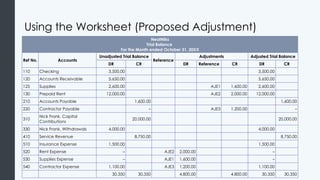
Using the Worksheet (Proposed Adjustment)
NeatNiks
Trial Balance
For the Month ended October 31, 20XX
Ref No. Accounts
Unadjusted Trial Balance
Reference
Adjustments Adjusted Trial Balance
DR CR DR Reference CR DR CR
110 Checking 3,500.00 3,500.00
120 Accounts Receivable 5,650.00 5,650.00
125 Supplies 2,600.00 AJE1 1,600.00 2,600.00
130 Prepaid Rent 12,000.00 AJE2 2,000.00 12,000.00
210 Accounts Payable 1,600.00 1,600.00
220 Contractor Payable – AJE3 1,200.00 –
310
Nick Frank, Capital
Contributions
20,000.00 20,000.00
330 Nick Frank, Withdrawals 4,000.00 4,000.00
410 Service Revenue 8,750.00 8,750.00
510 Insurance Expense 1,500.00 1,500.00
520 Rent Expense – AJE2 2,000.00 –
530 Supplies Expense – AJE1 1,600.00 –
540 Contractor Expense 1,100.00 AJE3 1,200.00 1,100.00
30,350 30,350 4,800.00 4,800.00 30,350 30,350
Creating An Adjusted Trial Balance Using a
Worksheet
Once we have made all the
adjustments to the ledger accounts
and we have run the adjusted trial
balance and feel confident all
assets, liabilities, capital accounts,
revenues, and expenses are
recorded and are being reported
according to GAAP (or, if we are a
small business, as close to GAAP as
we want to be), then we are ready
for the final step: to create the
financial statements.
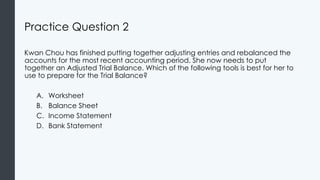
Practice Question 2
Kwan Chou has finished putting together adjusting entries and rebalanced the
accounts for the most recent accounting period. She now needs to put
together an Adjusted Trial Balance. Which of the following tools is best for her to
use to prepare for the Trial Balance?
A. Worksheet
B. Balance Sheet
C. Income Statement
D. Bank Statement
Preparing Financial Statements
Learning Outcomes: Preparing Financial
Statements
4.4: Use an adjusted trial balance to prepare financial statements
4.4.1: Prepare an income statement
4.4.2: Prepare a statement of owner's equity
4.4.3: Prepare a balance sheet
4.4.4: Identify the three main components of the statement of cash flows
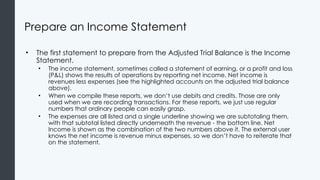
Prepare an Income Statement
• The first statement to prepare from the Adjusted Trial Balance is the Income
Statement.
• The income statement, sometimes called a statement of earning, or a profit and loss
(P&L) shows the results of operations by reporting net income. Net income is
revenues less expenses (see the highlighted accounts on the adjusted trial balance
above).
• When we compile these reports, we don’t use debits and credits. Those are only
used when we are recording transactions. For these reports, we just use regular
numbers that ordinary people can easily grasp.
• The expenses are all listed and a single underline showing we are subtotaling them,
with that subtotal listed directly underneath the revenue - the bottom line. Net
Income is shown as the combination of the two numbers above it. The external user
knows the net income is revenue minus expenses, so we don’t have to reiterate that
on the statement.
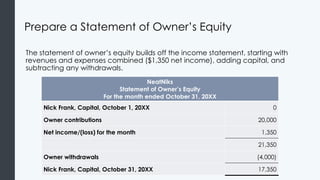
Prepare a Statement of Owner’s Equity
The statement of owner’s equity builds off the income statement, starting with
revenues and expenses combined ($1,350 net income), adding capital, and
subtracting any withdrawals.
NeatNiks
Statement of Owner’s Equity
For the month ended October 31, 20XX
Nick Frank, Capital, October 1, 20XX 0
Owner contributions 20,000
Net income/(loss) for the month 1,350
21,350
Owner withdrawals (4,000)
Nick Frank, Capital, October 31, 20XX 17,350
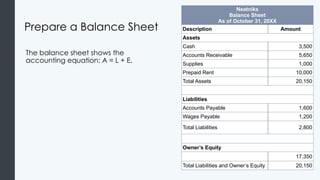
Prepare a Balance Sheet
The balance sheet shows the
accounting equation: A = L + E.
Neatniks
Balance Sheet
As of October 31, 20XX
Description Amount
Assets
Cash 3,500
Accounts Receivable 5,650
Supplies 1,000
Prepaid Rent 10,000
Total Assets 20,150
Liabilities
Accounts Payable 1,600
Wages Payable 1,200
Total Liabilities 2,800
Owner’s Equity
17,350
Total Liabilities and Owner’s Equity 20,150
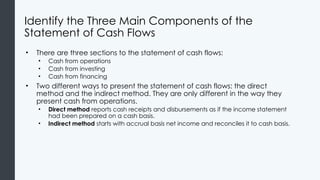
Identify the Three Main Components of the
Statement of Cash Flows
• There are three sections to the statement of cash flows:
• Cash from operations
• Cash from investing
• Cash from financing
• Two different ways to present the statement of cash flows: the direct
method and the indirect method. They are only different in the way they
present cash from operations.
• Direct method reports cash receipts and disbursements as if the income statement
had been prepared on a cash basis.
• Indirect method starts with accrual basis net income and reconciles it to cash basis.
Closing the Books
Learning Outcomes: Closing the Books
4.5: Prepare and post closing entries
4.5.1: Identify permanent and temporary accounts
4.5.2: Prepare closing entries
4.5.3: Post closing entries and prepare the post-closing trial balance
4.5.4: Demonstrate reversing entries
Identify Permanent and Temporary Accounts
• Permanent accounts: balance sheet accounts including assets, liabilities,
and equity accounts (except for withdrawals). These account balances roll
over into the next period. The ending balance of this period will be the
beginning balance for next period.
• Temporary accounts: revenues, expenses, and withdrawals accounts. These
account balances do not roll over into the next period after closing. The
closing process reduces revenue, expense, and withdrawals account
balances (temporary accounts) to zero so they are ready to accumulate
data for the next accounting period.
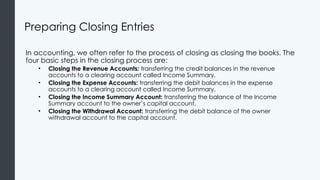
Preparing Closing Entries
In accounting, we often refer to the process of closing as closing the books. The
four basic steps in the closing process are:
• Closing the Revenue Accounts: transferring the credit balances in the revenue
accounts to a clearing account called Income Summary.
• Closing the Expense Accounts: transferring the debit balances in the expense
accounts to a clearing account called Income Summary.
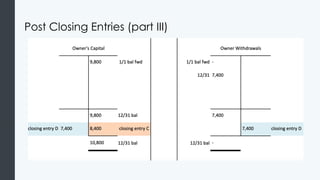
• Closing the Income Summary Account: transferring the balance of the Income
Summary account to the owner’s capital account.
• Closing the Withdrawal Account: transferring the debit balance of the owner
withdrawal account to the capital account.
Post Closing Entries and Prepare the Post-Closing
Trial Balance
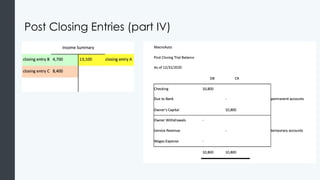
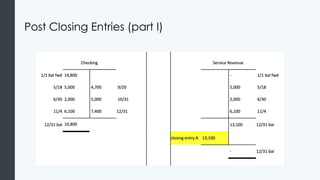
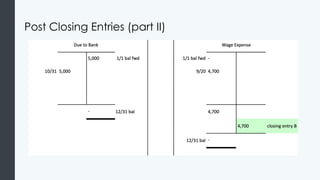
• After we complete journal entries, we post to the ledger and run a post-
closing trial balance.
• Once we are satisfied everything is balanced, carry the balances forward to
the new blank pages of the next (now current) year’s ledger and are now
ready to start posting transactions.
• Remember, closing entries are only used in systems using actual bound
books made of paper. They are an important concept and officially
represent the end of the process.
Post Closing Entries (part I)
Post Closing Entries (part II)
Post Closing Entries (part III)
Post Closing Entries (part IV)
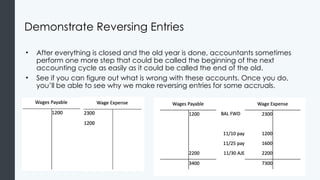
Demonstrate Reversing Entries
• After everything is closed and the old year is done, accountants sometimes
perform one more step that could be called the beginning of the next
accounting cycle as easily as it could be called the end of the old.
• See if you can figure out what is wrong with these accounts. Once you do,
you’ll be able to see why we make reversing entries for some accruals.
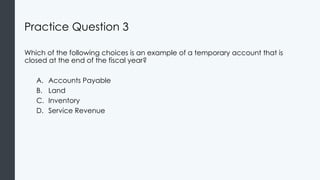
Practice Question 3
Which of the following choices is an example of a temporary account that is
closed at the end of the fiscal year?
A. Accounts Payable
B. Land
C. Inventory
D. Service Revenue
Class Activity: Financial Statement Discussion
• Refer to the four financial statements in the course for NeatNiks:
• Income Statement,
• Statement of Owner’s Equity,
• Balance Sheet,
• Statement of Cash Flows.
• Look through them carefully and find the connections and differences
between each other.
• Discussion these questions with a group of your classmates:
• Why is the Income Statements the first financial statement to prepare?
• What does each of the financial statements show or emphasize?
• How are each of the statements different from each other?
• Are some or all of the Statements necessary to have for a company? Why?
Quick Review
• Why is there a need for adjusting journal entries?
• What is the adjustment process?
• What is the difference between deferrals and accruals?
• How do you analyze revenue accounts and create the necessary
adjustments?
• How do you analyze expense accounts and create the necessary
adjustments?
• How do you find errors and create adjustments?
• How can you post adjusting entries to the ledgers and re-balance the
accounts?
• How can you create an adjusted trial balance using a worksheet?
More Quick Review
• How does an accountant prepare an income statement?
• How does an accountant prepare a statement of owner's equity?
• How does an accountant prepare a balance sheet?
• What are the three main components of the statement of cash
flows?
• Which accounts are permanent and which temporary?
• How do you prepare closing entries
• When do you post closing entries and prepare the post-closing trial
balance?
• What is the process for reversing entries?

Completing Accounting Cycle by Sir Niejay Llagas

  • 1.
    Financial Accounting Module 4:Completing the Accounting Cycle
  • 2.
    Module Learning Outcomes Describethe complete accounting cycle 4.1: Describe the process of making adjusting journal entries 4.2: Create adjusting journal entries 4.3: Creating the adjusted trial balance 4.4: Use an adjusted trial balance to prepare financial statements 4.5: Prepare and post closing entries
  • 3.
  • 4.
    Learning Outcomes: TheAdjusting Process 4.1: Describe the process of making adjusting journal entries 4.1.1: Explain the need for adjusting journal entries 4.1.2: Describe the adjustment process 4.1.3: Differentiate between deferrals and accruals
  • 5.
    The Need forAdjusting Journal Entries • Adjusting entries are made during the accounting cycle after the unadjusted trial balance and before the company prepares its financial statements, bringing the amounts in the general ledger accounts to their proper balances. • Each adjusting entry has a dual purpose: 1. To make the income statement report the appropriate revenue or expense 2. To make the balance sheet report the appropriate asset or liability
  • 6.
    Three Adjusting EntryRules • Rule 1: Adjusting entries will almost never include cash. • The purpose of adjusting entries is to make the accounting records accurately reflect the matching principle—match revenue and expense of the operating period. There are some rare cases where cash needs to be adjusted, but ideally, that adjusting should have all been done prior to running the unadjusted trial balance. • Rule 2: Debits always equal credits (as usual). • Rule 3: The adjusting entry will have one balance sheet account (asset, liability, or equity) and one income statement account (revenue or expense) in the journal entry. • Remember, the goal of the adjusting entry is to match the revenue and expense of the accounting period. Adjusting entries between balance sheet accounts only, or between income statement accounts only, are usually called reclassifications.
  • 7.
    How the AdjustmentProcess Works • Accountants have followed these steps for 500 years: • Print out the unadjusted trial balance • Analyze each account • Look for anything that is missing • Make adjusting journal entries • Post the adjusting journal entries
  • 8.
    Accruals versus Deferrals •The word “accrue” means to add to. The word “defer” means to put off until later. • In accounting: • If you earn revenue before you collect the cash, you have to accrue the revenue (add it to the books). • If you get the cash before you earn the revenue, you must defer recognition of the revenue. • The same holds true for expenses.
  • 9.
    Practice Question 1 Jackis just learning about how to adjust journal entries. He is asking you about the rules associated with the journal adjustments. What is one of the rules of adjusting journal entries you could tell Jack? A. Debits are always less that Credits B. One income statement account and one balance sheet account is in an entry C. Adjusting entries usually include Cash D. Adjusting entries include notes and disclosures like with financial statements
  • 10.
  • 11.
    Learning Outcomes: CreatingAdjusting Journal Entries 4.2: Create adjusting journal entries 4.2.1: Analyzing revenue accounts and creating necessary adjustments 4.2.2: Analyzing expense accounts and creating necessary adjustments 4.2.3: Finding errors and creating adjustments
  • 12.
    Analyzing Revenue Accountsand Creating Necessary Adjustments An asset/revenue adjustment may occur when a company performs a service for a customer but has not yet billed the customer. The accountant records this transaction as an asset in the form of a receivable and as revenue because the company has earned a revenue. JOURNAL Page 101 Date Description P.R. Debit Credit 20– Dec. 31 Accounts Receivable 5,000.00 Service Revenue 5,000.00 To accrue revenue earned but not yet billed.
  • 13.
    Analyzing Expense Accountsand Creating Necessary Adjustments An expense adjustment may occur when a company accrues expenses that have not been paid. A typical example would be wages employees earned but have not been paid. An accountant would record unpaid salaries as a liability and an expense as the company has incurred an expense. JOURNAL Page 86 Date Description P.R. Debit Credit 20– Dec. 1 Supplies 1,200.00 Accounts Payable 1,200.00 To record purchase of paint supplies
  • 14.
    Finding Errors andCreating Adjustments Start the process by asking yourself these three questions when dealing with errors: 1. What type of error is it? 2. How should this error be fixed? 3. How did this error affect the financial statements?
  • 15.
    Finding Errors andCreating Adjustments (cont.) Here are examples of common accounting errors to watch for: ● Transposition Error. Reversing or transposing digits (e.g. 3874 instead of 3784). ● Omission Error. A transaction isn’t recorded like a sale or expense is overlooked (example: a cash sale of a TV wasn’t written down in the rush of a black Friday sale). ● Entry Reversal. An entry is debated instead of credited or vice versa. ● Subsidiary Entries. A transaction is incorrectly entered, usually not caught until reconciling the bank statement. ● Rounding Error. When a number is rounded up or down and can have a cascading effect on subsequently. ● Error of Commission. An amount is entered as the correct account and amount, but is actually incorrect. For example, an amount was added instead of subtracted or charged on one invoice when it should have been applied to a different invoice.
  • 16.
    Finding Errors andCreating Adjustments Now that you understand what type of error it is, it’s time to classify it as a deferral (also known as prepayment) or an accrual. Then ask, “Is it part of accrued revenue, accrued expense, deferred (unearned) revenue, or deferred (prepaid) expense?” Once those steps have been discovered, an adjusted journal entry is created to fix it. JOURNAL Page 86 Date Description P.R. Debit Credit 20– Dec. 31 Cost of Goods Sold 600 Inventory 600 Adjustment for inventory shrinkage
  • 17.
    Finding Errors andCreating Adjustments Errors in the accrued and deferred (unearned or prepaid) revenues and expenses affect the Balance Sheet and Income Statement in the following manner: Before Adjusting Adjusting Entry Not Recorded Balance Sheet Income Statement Assets Liabilities Equity Revenue Expenses Net Income Accrued Revenues Understated Understated Understated Understated Accrued Expenses Understated Overstated Understated Overstated Unearned Revenues Overstated Overstated Understated Understated Prepaid Expenses Overstated Overstated Understated Overstated
  • 18.
    Preparing an AdjustedTrial Balance
  • 19.
    Learning Outcomes: Preparingan Adjusted Trial Balance 4.3: Creating the adjusted trial balance 4.3.1: Posting adjusting entries to the ledgers and re-balancing the accounts 4.3.2: Creating an adjusted trial balance using a worksheet
  • 20.
    Posting Adjusting Entriesto the Ledgers and Re- Balancing the Accounts • After preparing the journal entries, post them to the ledgers. • Each account is analyzed and verified to start to create the adjusted trial balance: • Checking • Accounts Receivable • Supplies • Prepaid Rent • Accounts Payable • Capital Contributions • Owner Withdrawals • Service Revenue • Insurance Revenue • Rent Expense • Supplies Expense • Contractor Expense
  • 21.
    Using the Worksheet(Trial Balance) NeatNiks Trial Balance (unadjusted) For the month ended October 31, 20XX Reference No. Accounts Debits Credits 110 Checking 3,500.00 120 Accounts Receivable 5,650.00 125 Supplies 2,600.00 130 Prepaid Rent 12,000.00 210 Account Payable 1,600.00 220 Contractor Payable – 310 Nick Frank, Capital Contributions 20,000.00 330 Nick Frank, Withdrawals 4,000.00 410 Service Revenue 8,750.00 510 Insurance Revenue 1,500.00 520 Rent Expense – 530 Supplies Expense – 540 Contractor Expense 1,100.00 Totals 30,350.00 30,350.00
  • 22.
    Using the Worksheet(Proposed Adjustment) NeatNiks Trial Balance For the Month ended October 31, 20XX Unadjusted Trial Balance Adjustments Adjusted Trial Balance Reference No. Accounts DR CR DR CR DR CR 110 Checking 3,500.00 3,500.00 120 Accounts Receivable 5,650.00 5,650.00 125 Supplies 2,600.00 2,600.00 130 Prepaid Rent 12,000.00 12,000.00 210 Accounts Payable 1,600.00 1,600.00 220 Contractor Payable – – 310 Nick Frank, Capital Contributions 20,000.00 20,000.00 330 Nick Frank, Withdrawals 4,000.00 4,000.00 410 Service Revenue 8,750.00 8,750.00 510 Insurance Expense 1,500.00 1,500.00 520 Rent Expense – – 530 Supplies Expense – – 540 Contractor Expense 1,100.00 1,100.00 30,350 30,350 30,350 30,350
  • 23.
    Using the Worksheet(Proposed Adjustment) NeatNiks Trial Balance For the Month ended October 31, 20XX Ref No. Accounts Unadjusted Trial Balance Reference Adjustments Adjusted Trial Balance DR CR DR Reference CR DR CR 110 Checking 3,500.00 3,500.00 120 Accounts Receivable 5,650.00 5,650.00 125 Supplies 2,600.00 AJE1 1,600.00 2,600.00 130 Prepaid Rent 12,000.00 AJE2 2,000.00 12,000.00 210 Accounts Payable 1,600.00 1,600.00 220 Contractor Payable – AJE3 1,200.00 – 310 Nick Frank, Capital Contributions 20,000.00 20,000.00 330 Nick Frank, Withdrawals 4,000.00 4,000.00 410 Service Revenue 8,750.00 8,750.00 510 Insurance Expense 1,500.00 1,500.00 520 Rent Expense – AJE2 2,000.00 – 530 Supplies Expense – AJE1 1,600.00 – 540 Contractor Expense 1,100.00 AJE3 1,200.00 1,100.00 30,350 30,350 4,800.00 4,800.00 30,350 30,350
  • 24.
    Creating An AdjustedTrial Balance Using a Worksheet Once we have made all the adjustments to the ledger accounts and we have run the adjusted trial balance and feel confident all assets, liabilities, capital accounts, revenues, and expenses are recorded and are being reported according to GAAP (or, if we are a small business, as close to GAAP as we want to be), then we are ready for the final step: to create the financial statements.
  • 25.
    Practice Question 2 KwanChou has finished putting together adjusting entries and rebalanced the accounts for the most recent accounting period. She now needs to put together an Adjusted Trial Balance. Which of the following tools is best for her to use to prepare for the Trial Balance? A. Worksheet B. Balance Sheet C. Income Statement D. Bank Statement
  • 26.
  • 27.
    Learning Outcomes: PreparingFinancial Statements 4.4: Use an adjusted trial balance to prepare financial statements 4.4.1: Prepare an income statement 4.4.2: Prepare a statement of owner's equity 4.4.3: Prepare a balance sheet 4.4.4: Identify the three main components of the statement of cash flows
  • 28.
    Prepare an IncomeStatement • The first statement to prepare from the Adjusted Trial Balance is the Income Statement. • The income statement, sometimes called a statement of earning, or a profit and loss (P&L) shows the results of operations by reporting net income. Net income is revenues less expenses (see the highlighted accounts on the adjusted trial balance above). • When we compile these reports, we don’t use debits and credits. Those are only used when we are recording transactions. For these reports, we just use regular numbers that ordinary people can easily grasp. • The expenses are all listed and a single underline showing we are subtotaling them, with that subtotal listed directly underneath the revenue - the bottom line. Net Income is shown as the combination of the two numbers above it. The external user knows the net income is revenue minus expenses, so we don’t have to reiterate that on the statement.
  • 29.
    Prepare a Statementof Owner’s Equity The statement of owner’s equity builds off the income statement, starting with revenues and expenses combined ($1,350 net income), adding capital, and subtracting any withdrawals. NeatNiks Statement of Owner’s Equity For the month ended October 31, 20XX Nick Frank, Capital, October 1, 20XX 0 Owner contributions 20,000 Net income/(loss) for the month 1,350 21,350 Owner withdrawals (4,000) Nick Frank, Capital, October 31, 20XX 17,350
  • 30.
    Prepare a BalanceSheet The balance sheet shows the accounting equation: A = L + E. Neatniks Balance Sheet As of October 31, 20XX Description Amount Assets Cash 3,500 Accounts Receivable 5,650 Supplies 1,000 Prepaid Rent 10,000 Total Assets 20,150 Liabilities Accounts Payable 1,600 Wages Payable 1,200 Total Liabilities 2,800 Owner’s Equity 17,350 Total Liabilities and Owner’s Equity 20,150
  • 31.
    Identify the ThreeMain Components of the Statement of Cash Flows • There are three sections to the statement of cash flows: • Cash from operations • Cash from investing • Cash from financing • Two different ways to present the statement of cash flows: the direct method and the indirect method. They are only different in the way they present cash from operations. • Direct method reports cash receipts and disbursements as if the income statement had been prepared on a cash basis. • Indirect method starts with accrual basis net income and reconciles it to cash basis.
  • 32.
  • 33.
    Learning Outcomes: Closingthe Books 4.5: Prepare and post closing entries 4.5.1: Identify permanent and temporary accounts 4.5.2: Prepare closing entries 4.5.3: Post closing entries and prepare the post-closing trial balance 4.5.4: Demonstrate reversing entries
  • 34.
    Identify Permanent andTemporary Accounts • Permanent accounts: balance sheet accounts including assets, liabilities, and equity accounts (except for withdrawals). These account balances roll over into the next period. The ending balance of this period will be the beginning balance for next period. • Temporary accounts: revenues, expenses, and withdrawals accounts. These account balances do not roll over into the next period after closing. The closing process reduces revenue, expense, and withdrawals account balances (temporary accounts) to zero so they are ready to accumulate data for the next accounting period.
  • 35.
    Preparing Closing Entries Inaccounting, we often refer to the process of closing as closing the books. The four basic steps in the closing process are: • Closing the Revenue Accounts: transferring the credit balances in the revenue accounts to a clearing account called Income Summary. • Closing the Expense Accounts: transferring the debit balances in the expense accounts to a clearing account called Income Summary. • Closing the Income Summary Account: transferring the balance of the Income Summary account to the owner’s capital account. • Closing the Withdrawal Account: transferring the debit balance of the owner withdrawal account to the capital account.
  • 36.
    Post Closing Entriesand Prepare the Post-Closing Trial Balance • After we complete journal entries, we post to the ledger and run a post- closing trial balance. • Once we are satisfied everything is balanced, carry the balances forward to the new blank pages of the next (now current) year’s ledger and are now ready to start posting transactions. • Remember, closing entries are only used in systems using actual bound books made of paper. They are an important concept and officially represent the end of the process.
  • 37.
  • 38.
  • 39.
  • 40.
  • 41.
    Demonstrate Reversing Entries •After everything is closed and the old year is done, accountants sometimes perform one more step that could be called the beginning of the next accounting cycle as easily as it could be called the end of the old. • See if you can figure out what is wrong with these accounts. Once you do, you’ll be able to see why we make reversing entries for some accruals.
  • 42.
    Practice Question 3 Whichof the following choices is an example of a temporary account that is closed at the end of the fiscal year? A. Accounts Payable B. Land C. Inventory D. Service Revenue
  • 43.
    Class Activity: FinancialStatement Discussion • Refer to the four financial statements in the course for NeatNiks: • Income Statement, • Statement of Owner’s Equity, • Balance Sheet, • Statement of Cash Flows. • Look through them carefully and find the connections and differences between each other. • Discussion these questions with a group of your classmates: • Why is the Income Statements the first financial statement to prepare? • What does each of the financial statements show or emphasize? • How are each of the statements different from each other? • Are some or all of the Statements necessary to have for a company? Why?
  • 44.
    Quick Review • Whyis there a need for adjusting journal entries? • What is the adjustment process? • What is the difference between deferrals and accruals? • How do you analyze revenue accounts and create the necessary adjustments? • How do you analyze expense accounts and create the necessary adjustments? • How do you find errors and create adjustments? • How can you post adjusting entries to the ledgers and re-balance the accounts? • How can you create an adjusted trial balance using a worksheet?
  • 45.
    More Quick Review •How does an accountant prepare an income statement? • How does an accountant prepare a statement of owner's equity? • How does an accountant prepare a balance sheet? • What are the three main components of the statement of cash flows? • Which accounts are permanent and which temporary? • How do you prepare closing entries • When do you post closing entries and prepare the post-closing trial balance? • What is the process for reversing entries?

Editor's Notes

  • #1 Cover Image: "White Canon Cash Register." Authored by: StellrWeb. Provided by: Unsplash. Located at: https://unsplash.com/photos/djb1whucfBY. Content Type: CC Licensed Content, Shared Previously. License: CC0: No Rights Reserved. License Terms: Unsplash License. All text in these slides is taken from https://courses.lumenlearning.com/wm-financialaccounting/ where it is published under one or more open licenses. All images in these slides are attributed in the notes of the slide on which they appear and licensed as indicated.
  • #7 Image. Authored by: stevepb. Located at: https://pixabay.com/photos/savings-budget-investment-money-2789112/. License: CC0: No Rights Reserved. License Terms: https://pixabay.com/service/terms/#license
  • #9 Correct answer: B —Adjusting entry will have one balance sheet account (asset, liability, or equity) and one income statement account (revenue or expense) in the journal entry.
  • #24 Authored by: pasja1000. Located at: https://pixabay.com/photos/the-dollar-america-currency-finance-3125419/. License: CC0: No Rights Reserved. License Terms: https://pixabay.com/service/terms/#license
  • #25 Correct answer: A — A worksheet starts with the unadjusted trial balance and provides places to work through adjustments resulting in the adjusted trial balance numbers.
  • #42 Correct answer: D — Service Revenue is closed to Income Summary, which at the end of the accounting period is closed to the capital account.