Audit Planning and Analytical
         Procedures
Presentation Outline


I.        Accept Client and Perform Initial Audit Planning
 II.      Understand the Client’s Business and Industry
             III. Assess Client Business Risk
       IV. Perform Preliminary Analytical Procedures
I. Accept Client and Perform Initial
                                   Planning

                                             B. Client Acceptance and
                                                     Continuance
                                           C. Identify Client’s Reasons
                                                       for Audit
                                           D. Obtain an Understanding
                                                    with the Client
                                               E. Select Staff for the
                                                     Engagement
                                           F. Evaluate Need for Outside
                                                       Specialist
Acceptable Audit Risk - how willing the auditor is to accept that the financial statements
          may be materially misstated when an unqualified opinion is issued.
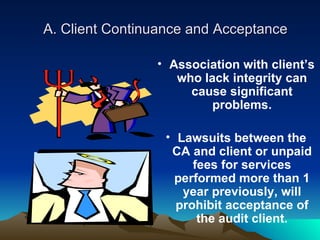
A. Client Continuance and Acceptance

                • Association with client’s
                   who lack integrity can
                     cause significant
                         problems.

                 • Lawsuits between the
                  CA and client or unpaid
                      fees for services
                   performed more than 1
                    year previously, will
                   prohibit acceptance of
                       the audit client.
B. Identify Client’s Reasons for
                      Audit


 Two major factors
 affecting acceptable
  audit risk are likely
 statement users and
                          The most likely uses can
their intended uses of
                              be determined from
the statements. More
                           previous experience with
   evidence may be
                           the client and discussion
 necessary when the
                               with management.
 statements are to be
   used extensively.
C. Obtaining an Understanding with the
                     Client


                              Contents of Engagement Letter
                                 Services to be provided
• Although not required, an  Any restrictions on the auditors’
     engagement letter is                    work
  normally used to establish  Deadlines for completing the
        the agreement.                       work
    • Auditors of public       Assistance to be provided by
                                       client personnel
 companies should establish
                              Inform client that fraud may not
  the understanding with the            be discovered
       audit committee.             May include fees
D. Select Staff for the Engagement


• Staff should be
  knowledgeable of
  the client’s industry.
• Continuity of staff
  helps the CA firm
  maintain familiarity
  with technical
  requirements.
E. Evaluate Need for Outside
                       Specialists
  If an audit client requires
  specialized knowledge, it may
    be necessary to consult a
             specialist.
 Auditor should evaluate the
  specialist’s qualifications and
    understand the objectives
     and scope of their work.
 Auditor should also consider
   specialist’s relationship to
      client that could impair
             objectivity.
II. Understand the Client’s Business and
                    Industry

The nature of the client’s business and industry
  affects client business risk and the risk of
    material misstatements in the financial
                  statements.
  A. Major Reasons for Understanding Client
       Industry and External Environment
   B. Business Operations and Processes
      C. Management and Governance
     D. Client Objectives and Strategies
     E. Measurement and Performance
A.   Major Reasons for
           Understanding
    Client Industry and External
            Environment
1. There may be risks associated
    with the client and the specific
    industry in which it operates.
 2. Many industries have unique
  accounting requirements that the
       auditor must understand.
B. Business Operations and
            Processes

  • Tour the plant and offices to better
understand client operations and meet key
                 personnel.
• Identify related parties for purposes of
  disclosure. Related parties include an
  affiliated company, a principal owner of
 client, and others who can influence the
 management or operating policies of the
                    other.
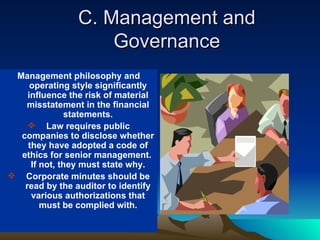
C. Management and
                    Governance
 Management philosophy and
     operating style significantly
    influence the risk of material
   misstatement in the financial
              statements.
     Law requires public
  companies to disclose whether
    they have adopted a code of
  ethics for senior management.
     If not, they must state why.
 Corporate minutes should be
   read by the auditor to identify
     various authorizations that
        must be complied with.
D. Client Objectives and Strategies

                 Strategies are approaches
                   followed by the entity to
                    achieve organizational
                      objectives. Auditor
                   should understand client
                     strategies regarding:
                  • Reliability of financial
                            reporting
                    • Effectiveness and
                    efficiency of operations
                  • Compliance with laws
                         and regulations
E. Measurement and
    Performance
         The risk of financial
          misstatements may
          be increased if the
             client has set
            unreasonable
          objectives or if the
             performance
         measurement system
              encourages
              aggressive
              accounting.
III. Assess Client Business Risk
 •  Client business risk is the risk that the client will fail to achieve its
   objectives. Sources include competitors, new technology, industry
    condition, and regulatory environment. Could influence client to
                    misstate the financial statements.
  • Law requires management to certify it has designed disclosure
     controls and procedures to ensure that they are made aware of
               material information about business risks.
 • Law also requires management to certify that it has informed the
      auditor and audit committee of any significant deficiencies in
                              internal control.
IV. Perform Preliminary
 Analytical Procedures

A. Defining Analytical Procedures
B. Short-term Debt-Paying Ability
   C. Liquidity Activity Ratios
D. Ability to Meet Long-term Debt
              Obligation
      E. Profitability Ratios
A. Defining Analytical Procedures


              • Evaluations of financial
                information made by a study
                of plausible relationships
                among financial and non-
                financial data.
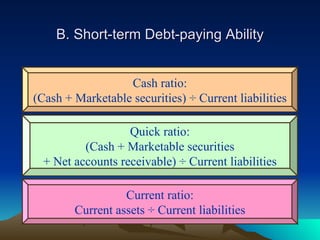
B. Short-term Debt-paying Ability


                  Cash ratio:
(Cash + Marketable securities) ÷ Current liabilities

                   Quick ratio:
          (Cash + Marketable securities
  + Net accounts receivable) ÷ Current liabilities

                  Current ratio:
        Current assets ÷ Current liabilities
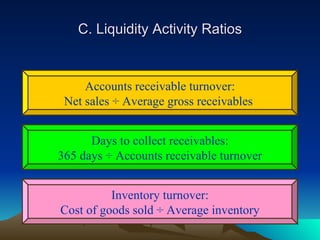
C. Liquidity Activity Ratios


     Accounts receivable turnover:
 Net sales ÷ Average gross receivables


      Days to collect receivables:
365 days ÷ Accounts receivable turnover


          Inventory turnover:
Cost of goods sold ÷ Average inventory
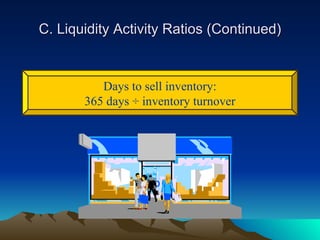
C. Liquidity Activity Ratios (Continued)


          Days to sell inventory:
       365 days ÷ inventory turnover
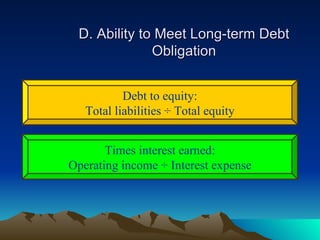
D. Ability to Meet Long-term Debt
              Obligation


           Debt to equity:
   Total liabilities ÷ Total equity


       Times interest earned:
Operating income ÷ Interest expense
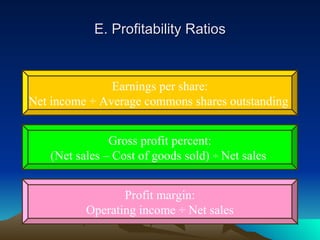
E. Profitability Ratios


               Earnings per share:
Net income ÷ Average commons shares outstanding


               Gross profit percent:
   (Net sales – Cost of goods sold) ÷ Net sales


                 Profit margin:
          Operating income ÷ Net sales
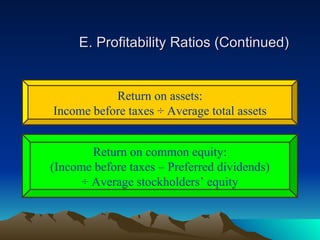
E. Profitability Ratios (Continued)


           Return on assets:
Income before taxes ÷ Average total assets


        Return on common equity:
(Income before taxes – Preferred dividends)
      ÷ Average stockholders’ equity
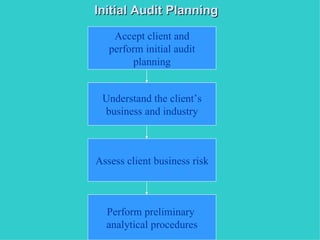
Initial Audit Planning

    Accept client and
   perform initial audit
         planning


 Understand the client’s
 business and industry


Assess client business risk


  Perform preliminary
  analytical procedures
BY
KHALID AZIZ
EX AUDIT SUPERVISOR
DAUDALLY LALANI & CO
CHARTERED ACCOUNTANTS

Audit.planning

  • 1.
    Audit Planning andAnalytical Procedures
  • 2.
    Presentation Outline I. Accept Client and Perform Initial Audit Planning II. Understand the Client’s Business and Industry III. Assess Client Business Risk IV. Perform Preliminary Analytical Procedures
  • 3.
    I. Accept Clientand Perform Initial Planning B. Client Acceptance and Continuance C. Identify Client’s Reasons for Audit D. Obtain an Understanding with the Client E. Select Staff for the Engagement F. Evaluate Need for Outside Specialist Acceptable Audit Risk - how willing the auditor is to accept that the financial statements may be materially misstated when an unqualified opinion is issued.
  • 4.
    A. Client Continuanceand Acceptance • Association with client’s who lack integrity can cause significant problems. • Lawsuits between the CA and client or unpaid fees for services performed more than 1 year previously, will prohibit acceptance of the audit client.
  • 5.
    B. Identify Client’sReasons for Audit Two major factors affecting acceptable audit risk are likely statement users and The most likely uses can their intended uses of be determined from the statements. More previous experience with evidence may be the client and discussion necessary when the with management. statements are to be used extensively.
  • 6.
    C. Obtaining anUnderstanding with the Client Contents of Engagement Letter  Services to be provided • Although not required, an  Any restrictions on the auditors’ engagement letter is work normally used to establish  Deadlines for completing the the agreement. work • Auditors of public  Assistance to be provided by client personnel companies should establish  Inform client that fraud may not the understanding with the be discovered audit committee.  May include fees
  • 7.
    D. Select Stafffor the Engagement • Staff should be knowledgeable of the client’s industry. • Continuity of staff helps the CA firm maintain familiarity with technical requirements.
  • 8.
    E. Evaluate Needfor Outside Specialists  If an audit client requires specialized knowledge, it may be necessary to consult a specialist.  Auditor should evaluate the specialist’s qualifications and understand the objectives and scope of their work.  Auditor should also consider specialist’s relationship to client that could impair objectivity.
  • 9.
    II. Understand theClient’s Business and Industry The nature of the client’s business and industry affects client business risk and the risk of material misstatements in the financial statements. A. Major Reasons for Understanding Client Industry and External Environment B. Business Operations and Processes C. Management and Governance D. Client Objectives and Strategies E. Measurement and Performance
  • 10.
    A. Major Reasons for Understanding Client Industry and External Environment 1. There may be risks associated with the client and the specific industry in which it operates. 2. Many industries have unique accounting requirements that the auditor must understand.
  • 11.
    B. Business Operationsand Processes • Tour the plant and offices to better understand client operations and meet key personnel. • Identify related parties for purposes of disclosure. Related parties include an affiliated company, a principal owner of client, and others who can influence the management or operating policies of the other.
  • 12.
    C. Management and Governance Management philosophy and operating style significantly influence the risk of material misstatement in the financial statements.  Law requires public companies to disclose whether they have adopted a code of ethics for senior management. If not, they must state why.  Corporate minutes should be read by the auditor to identify various authorizations that must be complied with.
  • 13.
    D. Client Objectivesand Strategies Strategies are approaches followed by the entity to achieve organizational objectives. Auditor should understand client strategies regarding: • Reliability of financial reporting • Effectiveness and efficiency of operations • Compliance with laws and regulations
  • 14.
    E. Measurement and Performance The risk of financial misstatements may be increased if the client has set unreasonable objectives or if the performance measurement system encourages aggressive accounting.
  • 15.
    III. Assess ClientBusiness Risk • Client business risk is the risk that the client will fail to achieve its objectives. Sources include competitors, new technology, industry condition, and regulatory environment. Could influence client to misstate the financial statements. • Law requires management to certify it has designed disclosure controls and procedures to ensure that they are made aware of material information about business risks. • Law also requires management to certify that it has informed the auditor and audit committee of any significant deficiencies in internal control.
  • 16.
    IV. Perform Preliminary Analytical Procedures A. Defining Analytical Procedures B. Short-term Debt-Paying Ability C. Liquidity Activity Ratios D. Ability to Meet Long-term Debt Obligation E. Profitability Ratios
  • 17.
    A. Defining AnalyticalProcedures • Evaluations of financial information made by a study of plausible relationships among financial and non- financial data.
  • 18.
    B. Short-term Debt-payingAbility Cash ratio: (Cash + Marketable securities) ÷ Current liabilities Quick ratio: (Cash + Marketable securities + Net accounts receivable) ÷ Current liabilities Current ratio: Current assets ÷ Current liabilities
  • 19.
    C. Liquidity ActivityRatios Accounts receivable turnover: Net sales ÷ Average gross receivables Days to collect receivables: 365 days ÷ Accounts receivable turnover Inventory turnover: Cost of goods sold ÷ Average inventory
  • 20.
    C. Liquidity ActivityRatios (Continued) Days to sell inventory: 365 days ÷ inventory turnover
  • 21.
    D. Ability toMeet Long-term Debt Obligation Debt to equity: Total liabilities ÷ Total equity Times interest earned: Operating income ÷ Interest expense
  • 22.
    E. Profitability Ratios Earnings per share: Net income ÷ Average commons shares outstanding Gross profit percent: (Net sales – Cost of goods sold) ÷ Net sales Profit margin: Operating income ÷ Net sales
  • 23.
    E. Profitability Ratios(Continued) Return on assets: Income before taxes ÷ Average total assets Return on common equity: (Income before taxes – Preferred dividends) ÷ Average stockholders’ equity
  • 24.
    Initial Audit Planning Accept client and perform initial audit planning Understand the client’s business and industry Assess client business risk Perform preliminary analytical procedures
  • 25.
    BY KHALID AZIZ EX AUDITSUPERVISOR DAUDALLY LALANI & CO CHARTERED ACCOUNTANTS