9/17/2014 
1 
9Creating Brand Equity 
1 
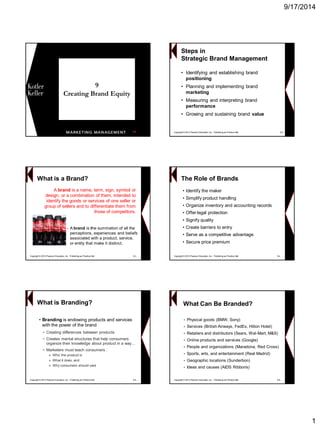
Steps in Strategic Brand Management 
•Identifying and establishing brand positioning 
•Planning and implementing brand marketing 
•Measuring and interpreting brand performance 
•Growing and sustaining brand value 
Copyright © 2013 Pearson Education, Inc. Publishing as Prentice Hall 9-2 
What is a Brand? 
A brandis a name, term, sign, symbol or design, or a combination of them, intended to identify the goods or services of one seller or group of sellers and to differentiate them from those of competitors. 
A brandis the summation of all the perceptions, experiences and beliefs associated with a product, service, or entity that make it distinct. 
Copyright © 2013 Pearson Education, Inc. Publishing as Prentice Hall 9-3 
The Role of Brands 
•Identify the maker 
•Simplify product handling 
•Organize inventory and accounting records 
•Offer legal protection 
•Signify quality 
•Create barriers to entry 
•Serve as a competitive advantage 
•Secure price premium 
Copyright © 2013 Pearson Education, Inc. Publishing as Prentice Hall 9-4 
What is Branding? 
•Brandingis endowing products and services with the power of the brand 
−Creating differences between products 
−Creates mental structures that help consumers organize their knowledge about product in a way… 
−Marketers must teach consumers : 
»Who’ the product is 
»What it does, and 
»Why consumers should care 
Copyright © 2013 Pearson Education, Inc. Publishing as Prentice Hall 9-5What Can Be Branded? 
•Physical goods (BMW, Sony) 
•Services (British Airways, FedEx, Hilton Hotel) 
•Retailers and distributors (Sears, Wal-Mart, M&S) 
•Online products and services (Google) 
•People and organizations (Maradona, Red Cross) 
•Sports, arts, and entertainment (Real Madrid) 
•Geographic locations (Sunderbon) 
•Ideas and causes (AIDS Ribbons) 
Copyright © 2013 Pearson Education, Inc. Publishing as Prentice Hall 9-6
9/17/2014 
2 
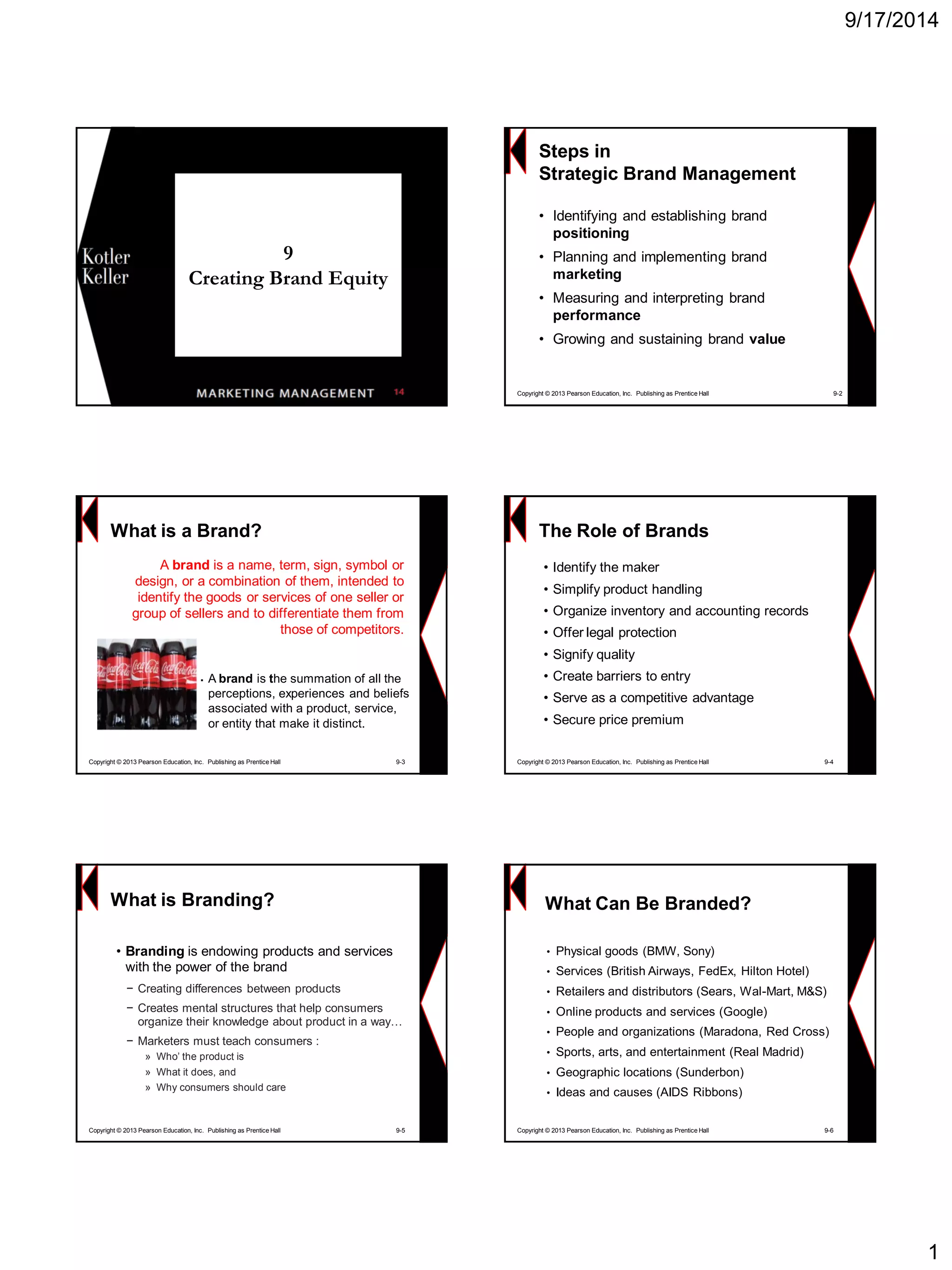
What is Brand Equity? 
•Brand equity is the added value endowed on products and services 
•Brand equity is the difference between perceived value and intrinsic value of a brand 
−Brand equity is reflected: 
»in the way consumers, think, feel, and act with respect to the brand and 
»in the prices, market share, and profitability the brand commands 
Copyright © 2013 Pearson Education, Inc. Publishing as Prentice Hall 9-7 
What is Customer-Based Brand Equity (CBBE? 
•CBBEis the differential effect that brand knowledge has on consumer response to the marketing of that brand 
•Three ingredients of CBBE: 
−BE arises from differential consumer response 
−Differential response is a result of brand knowledge 
−Differential response is reflected in perceptions, preferences, and behavior related to all aspects of marketing of a brand 
Copyright © 2013 Pearson Education, Inc. Publishing as Prentice Hall 9-8 
Brand Knowledge 
•BKconsists of all thoughts, feelings, images, experiences, beliefs, and so on that become associated with the brand 
•Brands must create strong, favorable, and unique brand association 
−Volvo (safety) 
−Hallmark (caring) Brand Knowledge 
Brand 
Knowledge 
Thoughts 
Experiences 
BeliefsImagesFeelings 
Copyright © 2013 Pearson Education, Inc. Publishing as Prentice Hall 9-10Advantages of Strong Brands 
•Improved perceptions of product performance 
•Greater loyalty 
•Less vulnerability to competitive marketing actions 
•Less vulnerability to crises 
•Larger margins 
•More inelastic consumer response 
•Greater trade cooperation 
•Increased marketing communications effectiveness 
•Possible licensing opportunities 
Copyright © 2013 Pearson Education, Inc. Publishing as Prentice Hall 9-11Brand Equity as a ―Bridge” 
•BE provides marketers with a vital strategic bridge from their past to their future 
−Think brand as a reflection of past investments in creating consumer BK 
−BK created by marketing investment dictates the direction/prospect for future marketing actions 
Copyright © 2013 Pearson Education, Inc. Publishing as Prentice Hall 9-12
9/17/2014 
3Brand Promise 
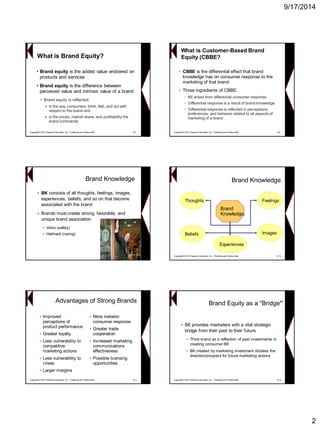
•Brand promise is the marketer’s vision of what the brand must beand dofor consumers 
−Consumers will decide, based on what they think and feel about the brand 
−The true value a brand rest with consumers 
Virgin Atlantic’s Brand PromiseBy satisfying unmet consumer needs with a little bit of flair, Virgin America has quickly built a strong brand. Brand Equity ModelsBrand Asset Valuator (BAV) BrandzBrand ResonanceCopyright © 2013 Pearson Education, Inc. Publishing as Prentice Hall 9-15 
Energized 
Differentiation 
Relevance 
Esteem 
Knowledge Brand Equity 
BAV Model: Key Components 
BRAND STRENGTHLeading IndicatorFuture Growth ValueBRAND STATURECurrent IndicatorCurrent Operating ValueFigure 9.1: BAV ModelBAV Model: Key ComponentsCopyright © 2013 Pearson Education, Inc. Publishing as Prentice Hall 9-17Figure 9.2 Universe of Brand Performance 
BAV Model 
Copyright © 2013 Pearson Education, Inc. Publishing as Prentice Hall 9-18
9/17/2014 
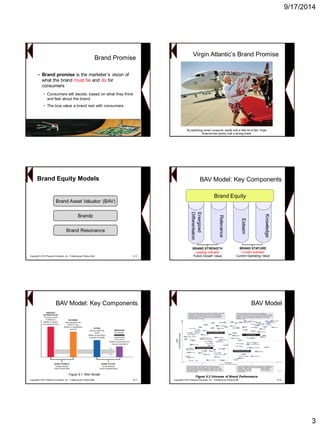
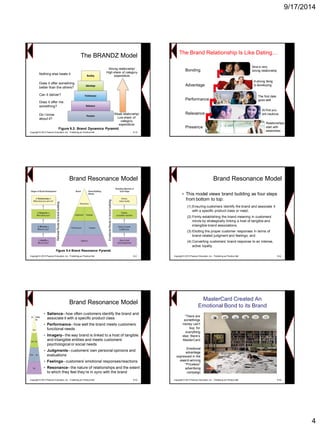
4Figure 9.3: Brand Dynamics Pyramid 
The BRANDZ ModelWeak relationship/ Low share of category expenditureStrong relationship/ High share of category expenditureDo I know about it? Nothing else beats itDoes it offer somethingbetter than the others? Can it deliver? 
Does it offer me something? 
Copyright © 2013 Pearson Education, Inc. Publishing as Prentice Hall 9-19 
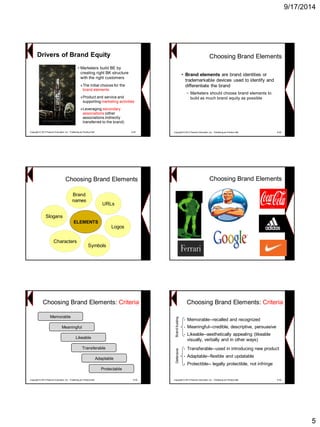
The Brand Relationship Is Like Dating… 
Relationships start with awareness 
At first you are cautious 
The first date goes well 
A strong liking is developingNow a very strong relationshipPresenceRelevancePerformanceAdvantage 
Bonding 
Brand Resonance Model 
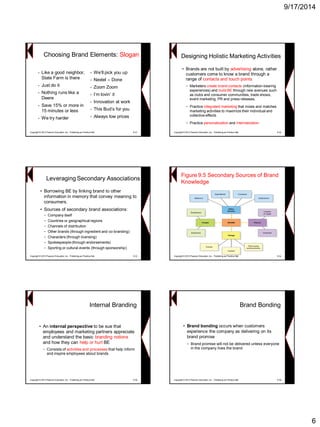
Figure 9.4 Brand Resonance Pyramid 
Emotional Route to brand building 
Rational Route to brand building 
Copyright © 2013 Pearson Education, Inc. Publishing as Prentice Hall 9-21Brand Resonance Model 
•This model views brand building as four steps from bottom to top: 
(1)Ensuring customers identify the brand and associate it with a specific product class or need; 
(2)Firmly establishing the brand meaning in customers’ minds by strategically linking a host of tangible and intangible brand associations; 
(3)Eliciting the proper customer responses in terms of brand-related judgment and feelings; and 
(4)Converting customers’ brand response to an intense, active loyalty. 
Copyright © 2013 Pearson Education, Inc. Publishing as Prentice Hall 9-22 
•Salience–how often customers identify the brand and associate it with a specific product class 
•Performance–how well the brand meets customers’ functional needs 
•Imagery–the way brand is linked to a host of tangible and intangible entities and meets customers’ psychological or social needs 
•Judgments–customers’ own personal opinions and evaluations 
•Feelings–customers’ emotional responses/reactions 
•Resonance–the nature of relationships and the extent to which they feel they’re in sync with the brand 
Brand Resonance ModelCopyright © 2013 Pearson Education, Inc. Publishing as Prentice Hall 9-23 
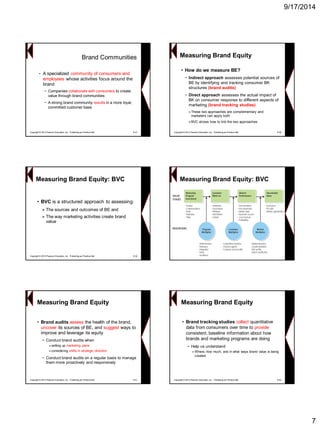
MasterCard Created An Emotional Bond to its Brand 
Copyright © 2013 Pearson Education, Inc. Publishing as Prentice Hall 9-24 
―There are somethings money can’t buy; for everything else, there’s MasterCard 
Emotional advantage expressed in the award-winning ―Priceless‖ advertising campaign
9/17/2014 
5Drivers of Brand EquityCopyright © 2013 Pearson Education, Inc. Publishing as Prentice Hall 9-25 
•Marketers build BE by creating right BK structure with the right customers 
»The initial choices for the brand elements 
»Product and service and supporting marketing activities 
»Leveraging secondary associations (other associations indirectly transferred to the brand) Choosing Brand Elements 
•Brand elements are brand identities or trademarkabledevices used to identify and differentiate the brand 
−Marketers should choose brand elements to build as much brand equity as possible 
Copyright © 2013 Pearson Education, Inc. Publishing as Prentice Hall 9-26 
ELEMENTS 
Slogans 
Brand 
names 
URLs 
Logos 
SymbolsCharactersChoosing Brand ElementsChoosing Brand ElementsChoosing Brand Elements: CriteriaMemorable 
Meaningful 
Likeable 
Transferable 
Adaptable 
Protectable 
Copyright © 2013 Pearson Education, Inc. Publishing as Prentice Hall 9-29 
•Memorable--recalled and recognized 
•Meaningful--credible, descriptive, persuasive 
•Likeable--aesthetically appealing (likeable visually, verbally and in other ways) 
•Transferable--used in introducing new product 
•Adaptable--flexible and updatable 
•Protectible--legally protectible, not infringe BrandBuildingDefensive Copyright © 2013 Pearson Education, Inc. Publishing as Prentice Hall 9-30 
Choosing Brand Elements: Criteria
9/17/2014 
6 
•Like a good neighbor, State Farm is there 
•Just do it 
•Nothing runs like a Deere 
•Save 15% or more in 15 minutes or less 
•We try harder 
•We’ll pick you up 
•Nextel –Done 
•Zoom Zoom 
•I’m lovin’ it 
•Innovation at work 
•This Bud’s for you 
•Always low prices 
Copyright © 2013 Pearson Education, Inc. Publishing as Prentice Hall 9-31 
Choosing Brand Elements: SloganDesigning Holistic Marketing Activities 
•Brands are not built by advertisingalone, rather customers come to know a brand through a range of contacts and touch points 
−Marketers create brand contacts (information-bearing experiences) and build BE through new avenues such as clubs and consumer communities, trade shows, event marketing, PR and press releases, 
−Practice integrated marketing that mixes and matches marketing activities to maximize their individual and collective effects 
−Practicepersonalization andinternalization 
Copyright © 2013 Pearson Education, Inc. Publishing as Prentice Hall 9-32Leveraging Secondary Associations 
•Borrowing BE by linking brand to other information in memory that convey meaning to consumers. 
•Sources of secondary brand associations: 
−Company itself 
−Countries or geographical regions 
−Channels of distribution 
−Other brands (through ingredient and co-branding) 
−Characters (through licensing) 
−Spokespeople (through endorsements) 
−Sporting or cultural events (through sponsorship) 
Copyright © 2013 Pearson Education, Inc. Publishing as Prentice Hall 9-33 
Figure 9.5 Secondary Sources of Brand Knowledge 
Copyright © 2013 Pearson Education, Inc. Publishing as Prentice Hall 9-34Internal Branding 
•An internal perspective to be sue that employees and marketing partners appreciate and understand the basic branding notionsand how they can help or hurt BE 
−Consists of activities and processesthat help inform and inspire employees about brands 
Copyright © 2013 Pearson Education, Inc. Publishing as Prentice Hall 9-35Brand Bonding 
•Brand bonding occurs when customers experience the company as delivering on its brand promise 
−Brand promise will not be delivered unless everyone in the company lives the brand 
Copyright © 2013 Pearson Education, Inc. Publishing as Prentice Hall 9-36
9/17/2014 
7Brand Communities 
•A specialized community of consumers and employees whose activities focus around the brand 
−Companies collaborate with consumers to create value through brand communities 
−A strong brand community resultsin a more loyal, committed customer base 
Copyright © 2013 Pearson Education, Inc. Publishing as Prentice Hall 9-37 
Measuring Brand Equity 
•How do we measure BE? 
−Indirect approach assesses potential sources of BE by identifying and tracking consumer BK structures (brand audits) 
−Direct approach assesses the actual impact of BK on consumer response to different aspects of marketing (brand tracking studies) 
»These two approaches are complementary and marketers can apply both 
»BVC shows how to link the two approaches 
Copyright © 2013 Pearson Education, Inc. Publishing as Prentice Hall 9-38 
•BVCis a structured approach to assessing: 
»The sources and outcomes of BE and 
»The way marketing activities create brand value 
Copyright © 2013 Pearson Education, Inc. Publishing as Prentice Hall 9-39Measuring Brand Equity: BVCMeasuring Brand Equity: BVC 
Measuring Brand Equity 
•Brand audits assessthe health of the brand, uncoverits sources of BE, and suggestways to improve and leverage its equity 
−Conduct brand audits when 
»setting up marketing plans 
»considering shifts in strategic direction 
−Conduct brand audits on a regular basis to manage them more proactively and responsively 
Copyright © 2013 Pearson Education, Inc. Publishing as Prentice Hall 9-41Measuring Brand Equity 
•Brand tracking studies collectquantitative data from consumers over time to provideconsistent, baseline information about how brands and marketing programs are doing 
−Help us understand 
»Where, how much, and in what ways brand value is being created 
Copyright © 2013 Pearson Education, Inc. Publishing as Prentice Hall 9-42
9/17/2014 
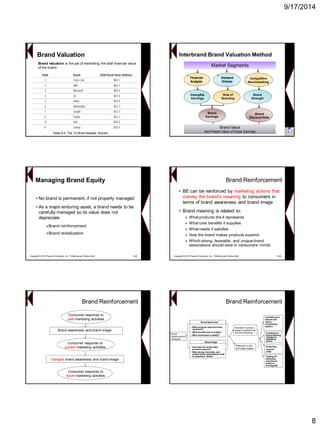
8Table 9.4: The 10 Most Valuable BrandsBrand valuation is the job of estimating the total financial value of the brand. Brand ValuationInterbrandBrand Valuation MethodFinancial AnalysisMarket SegmentsDemand Drivers 
Competitive BenchmarkingIntangible EarningsRole of Branding 
Brand Strength 
Brand Earnings 
Brand Discount RateBrand ValueNet Present Value of Future Earnings 
Managing Brand Equity 
•No brand is permanent, if not properly managed 
•As a major enduring asset, a brand needs to be carefully managed so its value does not depreciate 
»Brand reinforcement 
»Brand revitalization 
Copyright © 2013 Pearson Education, Inc. Publishing as Prentice Hall 9-45Brand Reinforcement 
•BE can be reinforced by marketing actions that convey the brand’s meaning to consumers in terms of brand awareness and brand image 
•Brand meaning is related to: 
»What products the it represents 
»What core benefits it supplies 
»What needs it satisfies 
»How the brand makes products superior 
»Which strong, favorable, and unique brand associations should exist in consumers’ minds 
Copyright © 2013 Pearson Education, Inc. Publishing as Prentice Hall 9-46 
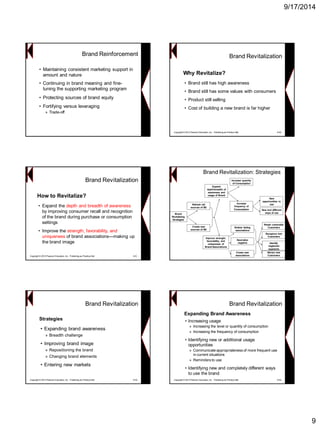
Consumer response to 
pastmarketing activities 
Consumer response to 
futuremarketing activities 
Consumer response to currentmarketing activitiesBrand awareness and brand imageChangedbrand awareness and brand image 
Brand ReinforcementBrand Reinforcement 
Innovation in product 
design, manufacturing 
and merchandisingRelevance in userand usage imagery 
Consistency in amount and nature 
of marketing supportContinuity in brand meaning; changes in marketing tacticsTrading off marketingactivities to fortify vs. leverage BE 
Protecting sources 
of BEBrand Awareness 
•What products does the brand represent? 
•What benefits does it supply? 
•What needs does it satisfy? 
Brand 
Reinforcement 
StrategiesBrand Image 
•How does the brand make products superior? 
•What strong, favorable, and unique brand associations exist in customers’ minds?
9/17/20149 
Brand Reinforcement 
•Maintaining consistent marketing support in amount and nature 
•Continuing in brand meaning and fine- tuning the supporting marketing program 
•Protecting sources of brand equity 
•Fortifying versus leveraging 
»Trade-off 
Brand Revitalization 
Why Revitalize? 
•Brand still has high awareness 
•Brand still has some values with consumers 
•Product still selling 
•Cost of building a new brand is far higher 
Copyright © 2013 Pearson Education, Inc. Publishing as Prentice Hall 9-50 
Brand Revitalization 
How to Revitalize? 
•Expand the depth and breadth of awareness by improving consumer recall and recognition of the brand during purchase or consumption settings 
•Improve the strength, favorability, and uniqueness of brand associations—making up the brand image 
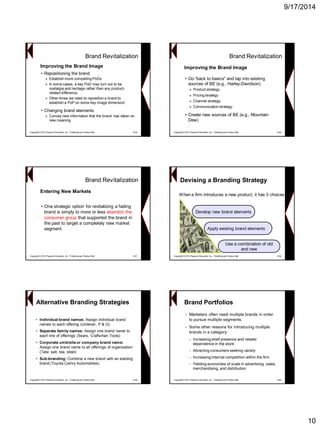
Copyright © 2013 Pearson Education, Inc. Publishing as Prentice Hall 9-51Brand Revitalization: StrategiesNew and different ways of useNew opportunities to useAttract new Customers 
Identify neglected segmentsRecapture lost Customers 
Retain vulnerable CustomersBrand Revitalizing Strategies 
Create new sources of BERefresh old sources of BE 
Improve strength, favorability, and uniqueness of Brand Associations 
Expand depth/breadth of awareness and usage of BrandIncrease frequency of ConsumptionIncrease quantity of Consumption 
Bolster fading associationsCreate new associations 
Neutralize negative 
Brand Revitalization 
Strategies 
•Expanding brand awareness 
»Breadth challenge 
•Improving brand image 
»Repositioning the brand 
»Changing brand elements 
•Entering new markets 
Copyright © 2013 Pearson Education, Inc. Publishing as Prentice Hall 9-53 
Brand Revitalization 
•Increasing usage 
»Increasing the level or quantity of consumption 
»Increasing the frequency of consumption 
•Identifying new or additional usage opportunities 
»Communicate appropriateness of more frequent use in current situations 
»Reminders to use 
•Identifying new and completely different ways to use the brand 
Copyright © 2013 Pearson Education, Inc. Publishing as Prentice Hall 9-54 
Expanding Brand Awareness
9/17/2014 
10 
Brand Revitalization 
•Repositioning the brand 
»Establish more compelling PoDs 
»In some cases, a key PoDmay turn out to be nostalgia and heritage rather than any product- related difference. 
»Other times we need to reposition a brand to establish a PoPon some key image dimension. 
•Changing brand elements 
»Convey new information that the brand has taken on new meaning 
Copyright © 2013 Pearson Education, Inc. Publishing as Prentice Hall 9-55 
Improving the Brand ImageBrand Revitalization 
•Go ―back to basics‖ and tap into existing sources of BE (e.g., Harley-Davidson) 
»Product strategy 
»Pricing strategy 
»Channel strategy 
»Communication strategy 
•Create new sources of BE (e.g., Mountain Dew) 
Copyright © 2013 Pearson Education, Inc. Publishing as Prentice Hall 9-56 
Improving the Brand Image 
Brand Revitalization 
•One strategic option for revitalizing a fading brand is simply to more orless abandon the consumer groupthat supported the brand in the past to target a completely new market segment. 
Copyright © 2013 Pearson Education, Inc. Publishing as Prentice Hall 9-57 
Entering New Markets 
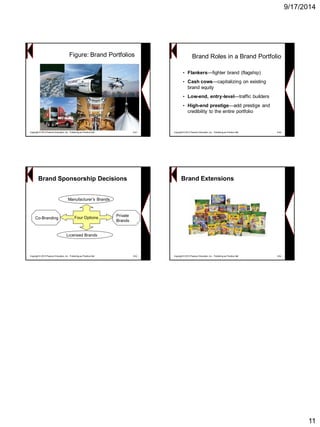
Devising a Branding StrategyDevelop new brand elementsDevelop elements 
Apply existing brand elements 
elementsUse a combination of old Use and newWhen a firm introduces a new product, it has 3 choices 
Copyright © 2013 Pearson Education, Inc. Publishing as Prentice Hall 9-58Alternative Branding Strategies 
•Individual brand names: Assign individual brand names to each offering (Unilever, P & G) 
•Separate family names: Assign one brand name to each line of offerings (Sears, Craftsman Tools) 
•Corporate umbrella or company brand name: Assign one brand name to all offerings of organization (Tata: salt, tea, steel) 
•Sub-branding: Combine a new brandwith an existing brand (Toyota Camry Automobiles) 
Copyright © 2013 Pearson Education, Inc. Publishing as Prentice Hall 9-59 
Brand Portfolios 
•Marketers often need multiple brands in order to pursue multiple segments. 
•Some other reasons for introducing multiple brands in a category: 
–Increasing shelf presence and retailer dependence in the store 
–Attracting consumers seeking variety 
–Increasing internal competition within the firm 
–Yielding economies of scale in advertising, sales, merchandising, and distribution 
Copyright © 2013 Pearson Education, Inc. Publishing as Prentice Hall 9-60
9/17/2014 
11 
Figure: Brand PortfoliosCopyright © 2013 Pearson Education, Inc. Publishing as Prentice Hall 9-61 
•Flankers—fighter brand (flagship) 
•Cash cows—capitalizing on existing brand equity 
•Low-end, entry-level—traffic builders 
•High-end prestige—add prestige and credibility to the entire portfolio 
Brand Roles in a Brand Portfolio 
Copyright © 2013 Pearson Education, Inc. Publishing as Prentice Hall 9-62Brand Sponsorship DecisionsFour Options 
Co-BrandingPrivateBrands 
Manufacturer’s Brands 
Licensed Brands 
Copyright © 2013 Pearson Education, Inc. Publishing as Prentice Hall 9-63 
Brand ExtensionsCopyright © 2013 Pearson Education, Inc. Publishing as Prentice Hall 9-64

Ch 9 creating brand equity14e

  • 1.
    9/17/2014 1 9CreatingBrand Equity 1 Steps in Strategic Brand Management •Identifying and establishing brand positioning •Planning and implementing brand marketing •Measuring and interpreting brand performance •Growing and sustaining brand value Copyright © 2013 Pearson Education, Inc. Publishing as Prentice Hall 9-2 What is a Brand? A brandis a name, term, sign, symbol or design, or a combination of them, intended to identify the goods or services of one seller or group of sellers and to differentiate them from those of competitors. A brandis the summation of all the perceptions, experiences and beliefs associated with a product, service, or entity that make it distinct. Copyright © 2013 Pearson Education, Inc. Publishing as Prentice Hall 9-3 The Role of Brands •Identify the maker •Simplify product handling •Organize inventory and accounting records •Offer legal protection •Signify quality •Create barriers to entry •Serve as a competitive advantage •Secure price premium Copyright © 2013 Pearson Education, Inc. Publishing as Prentice Hall 9-4 What is Branding? •Brandingis endowing products and services with the power of the brand −Creating differences between products −Creates mental structures that help consumers organize their knowledge about product in a way… −Marketers must teach consumers : »Who’ the product is »What it does, and »Why consumers should care Copyright © 2013 Pearson Education, Inc. Publishing as Prentice Hall 9-5What Can Be Branded? •Physical goods (BMW, Sony) •Services (British Airways, FedEx, Hilton Hotel) •Retailers and distributors (Sears, Wal-Mart, M&S) •Online products and services (Google) •People and organizations (Maradona, Red Cross) •Sports, arts, and entertainment (Real Madrid) •Geographic locations (Sunderbon) •Ideas and causes (AIDS Ribbons) Copyright © 2013 Pearson Education, Inc. Publishing as Prentice Hall 9-6
  • 2.
    9/17/2014 2 Whatis Brand Equity? •Brand equity is the added value endowed on products and services •Brand equity is the difference between perceived value and intrinsic value of a brand −Brand equity is reflected: »in the way consumers, think, feel, and act with respect to the brand and »in the prices, market share, and profitability the brand commands Copyright © 2013 Pearson Education, Inc. Publishing as Prentice Hall 9-7 What is Customer-Based Brand Equity (CBBE? •CBBEis the differential effect that brand knowledge has on consumer response to the marketing of that brand •Three ingredients of CBBE: −BE arises from differential consumer response −Differential response is a result of brand knowledge −Differential response is reflected in perceptions, preferences, and behavior related to all aspects of marketing of a brand Copyright © 2013 Pearson Education, Inc. Publishing as Prentice Hall 9-8 Brand Knowledge •BKconsists of all thoughts, feelings, images, experiences, beliefs, and so on that become associated with the brand •Brands must create strong, favorable, and unique brand association −Volvo (safety) −Hallmark (caring) Brand Knowledge Brand Knowledge Thoughts Experiences BeliefsImagesFeelings Copyright © 2013 Pearson Education, Inc. Publishing as Prentice Hall 9-10Advantages of Strong Brands •Improved perceptions of product performance •Greater loyalty •Less vulnerability to competitive marketing actions •Less vulnerability to crises •Larger margins •More inelastic consumer response •Greater trade cooperation •Increased marketing communications effectiveness •Possible licensing opportunities Copyright © 2013 Pearson Education, Inc. Publishing as Prentice Hall 9-11Brand Equity as a ―Bridge” •BE provides marketers with a vital strategic bridge from their past to their future −Think brand as a reflection of past investments in creating consumer BK −BK created by marketing investment dictates the direction/prospect for future marketing actions Copyright © 2013 Pearson Education, Inc. Publishing as Prentice Hall 9-12
  • 3.
    9/17/2014 3Brand Promise •Brand promise is the marketer’s vision of what the brand must beand dofor consumers −Consumers will decide, based on what they think and feel about the brand −The true value a brand rest with consumers Virgin Atlantic’s Brand PromiseBy satisfying unmet consumer needs with a little bit of flair, Virgin America has quickly built a strong brand. Brand Equity ModelsBrand Asset Valuator (BAV) BrandzBrand ResonanceCopyright © 2013 Pearson Education, Inc. Publishing as Prentice Hall 9-15 Energized Differentiation Relevance Esteem Knowledge Brand Equity BAV Model: Key Components BRAND STRENGTHLeading IndicatorFuture Growth ValueBRAND STATURECurrent IndicatorCurrent Operating ValueFigure 9.1: BAV ModelBAV Model: Key ComponentsCopyright © 2013 Pearson Education, Inc. Publishing as Prentice Hall 9-17Figure 9.2 Universe of Brand Performance BAV Model Copyright © 2013 Pearson Education, Inc. Publishing as Prentice Hall 9-18
  • 4.
    9/17/2014 4Figure 9.3:Brand Dynamics Pyramid The BRANDZ ModelWeak relationship/ Low share of category expenditureStrong relationship/ High share of category expenditureDo I know about it? Nothing else beats itDoes it offer somethingbetter than the others? Can it deliver? Does it offer me something? Copyright © 2013 Pearson Education, Inc. Publishing as Prentice Hall 9-19 The Brand Relationship Is Like Dating… Relationships start with awareness At first you are cautious The first date goes well A strong liking is developingNow a very strong relationshipPresenceRelevancePerformanceAdvantage Bonding Brand Resonance Model Figure 9.4 Brand Resonance Pyramid Emotional Route to brand building Rational Route to brand building Copyright © 2013 Pearson Education, Inc. Publishing as Prentice Hall 9-21Brand Resonance Model •This model views brand building as four steps from bottom to top: (1)Ensuring customers identify the brand and associate it with a specific product class or need; (2)Firmly establishing the brand meaning in customers’ minds by strategically linking a host of tangible and intangible brand associations; (3)Eliciting the proper customer responses in terms of brand-related judgment and feelings; and (4)Converting customers’ brand response to an intense, active loyalty. Copyright © 2013 Pearson Education, Inc. Publishing as Prentice Hall 9-22 •Salience–how often customers identify the brand and associate it with a specific product class •Performance–how well the brand meets customers’ functional needs •Imagery–the way brand is linked to a host of tangible and intangible entities and meets customers’ psychological or social needs •Judgments–customers’ own personal opinions and evaluations •Feelings–customers’ emotional responses/reactions •Resonance–the nature of relationships and the extent to which they feel they’re in sync with the brand Brand Resonance ModelCopyright © 2013 Pearson Education, Inc. Publishing as Prentice Hall 9-23 MasterCard Created An Emotional Bond to its Brand Copyright © 2013 Pearson Education, Inc. Publishing as Prentice Hall 9-24 ―There are somethings money can’t buy; for everything else, there’s MasterCard Emotional advantage expressed in the award-winning ―Priceless‖ advertising campaign
  • 5.
    9/17/2014 5Drivers ofBrand EquityCopyright © 2013 Pearson Education, Inc. Publishing as Prentice Hall 9-25 •Marketers build BE by creating right BK structure with the right customers »The initial choices for the brand elements »Product and service and supporting marketing activities »Leveraging secondary associations (other associations indirectly transferred to the brand) Choosing Brand Elements •Brand elements are brand identities or trademarkabledevices used to identify and differentiate the brand −Marketers should choose brand elements to build as much brand equity as possible Copyright © 2013 Pearson Education, Inc. Publishing as Prentice Hall 9-26 ELEMENTS Slogans Brand names URLs Logos SymbolsCharactersChoosing Brand ElementsChoosing Brand ElementsChoosing Brand Elements: CriteriaMemorable Meaningful Likeable Transferable Adaptable Protectable Copyright © 2013 Pearson Education, Inc. Publishing as Prentice Hall 9-29 •Memorable--recalled and recognized •Meaningful--credible, descriptive, persuasive •Likeable--aesthetically appealing (likeable visually, verbally and in other ways) •Transferable--used in introducing new product •Adaptable--flexible and updatable •Protectible--legally protectible, not infringe BrandBuildingDefensive Copyright © 2013 Pearson Education, Inc. Publishing as Prentice Hall 9-30 Choosing Brand Elements: Criteria
  • 6.
    9/17/2014 6 •Likea good neighbor, State Farm is there •Just do it •Nothing runs like a Deere •Save 15% or more in 15 minutes or less •We try harder •We’ll pick you up •Nextel –Done •Zoom Zoom •I’m lovin’ it •Innovation at work •This Bud’s for you •Always low prices Copyright © 2013 Pearson Education, Inc. Publishing as Prentice Hall 9-31 Choosing Brand Elements: SloganDesigning Holistic Marketing Activities •Brands are not built by advertisingalone, rather customers come to know a brand through a range of contacts and touch points −Marketers create brand contacts (information-bearing experiences) and build BE through new avenues such as clubs and consumer communities, trade shows, event marketing, PR and press releases, −Practice integrated marketing that mixes and matches marketing activities to maximize their individual and collective effects −Practicepersonalization andinternalization Copyright © 2013 Pearson Education, Inc. Publishing as Prentice Hall 9-32Leveraging Secondary Associations •Borrowing BE by linking brand to other information in memory that convey meaning to consumers. •Sources of secondary brand associations: −Company itself −Countries or geographical regions −Channels of distribution −Other brands (through ingredient and co-branding) −Characters (through licensing) −Spokespeople (through endorsements) −Sporting or cultural events (through sponsorship) Copyright © 2013 Pearson Education, Inc. Publishing as Prentice Hall 9-33 Figure 9.5 Secondary Sources of Brand Knowledge Copyright © 2013 Pearson Education, Inc. Publishing as Prentice Hall 9-34Internal Branding •An internal perspective to be sue that employees and marketing partners appreciate and understand the basic branding notionsand how they can help or hurt BE −Consists of activities and processesthat help inform and inspire employees about brands Copyright © 2013 Pearson Education, Inc. Publishing as Prentice Hall 9-35Brand Bonding •Brand bonding occurs when customers experience the company as delivering on its brand promise −Brand promise will not be delivered unless everyone in the company lives the brand Copyright © 2013 Pearson Education, Inc. Publishing as Prentice Hall 9-36
  • 7.
    9/17/2014 7Brand Communities •A specialized community of consumers and employees whose activities focus around the brand −Companies collaborate with consumers to create value through brand communities −A strong brand community resultsin a more loyal, committed customer base Copyright © 2013 Pearson Education, Inc. Publishing as Prentice Hall 9-37 Measuring Brand Equity •How do we measure BE? −Indirect approach assesses potential sources of BE by identifying and tracking consumer BK structures (brand audits) −Direct approach assesses the actual impact of BK on consumer response to different aspects of marketing (brand tracking studies) »These two approaches are complementary and marketers can apply both »BVC shows how to link the two approaches Copyright © 2013 Pearson Education, Inc. Publishing as Prentice Hall 9-38 •BVCis a structured approach to assessing: »The sources and outcomes of BE and »The way marketing activities create brand value Copyright © 2013 Pearson Education, Inc. Publishing as Prentice Hall 9-39Measuring Brand Equity: BVCMeasuring Brand Equity: BVC Measuring Brand Equity •Brand audits assessthe health of the brand, uncoverits sources of BE, and suggestways to improve and leverage its equity −Conduct brand audits when »setting up marketing plans »considering shifts in strategic direction −Conduct brand audits on a regular basis to manage them more proactively and responsively Copyright © 2013 Pearson Education, Inc. Publishing as Prentice Hall 9-41Measuring Brand Equity •Brand tracking studies collectquantitative data from consumers over time to provideconsistent, baseline information about how brands and marketing programs are doing −Help us understand »Where, how much, and in what ways brand value is being created Copyright © 2013 Pearson Education, Inc. Publishing as Prentice Hall 9-42
  • 8.
    9/17/2014 8Table 9.4:The 10 Most Valuable BrandsBrand valuation is the job of estimating the total financial value of the brand. Brand ValuationInterbrandBrand Valuation MethodFinancial AnalysisMarket SegmentsDemand Drivers Competitive BenchmarkingIntangible EarningsRole of Branding Brand Strength Brand Earnings Brand Discount RateBrand ValueNet Present Value of Future Earnings Managing Brand Equity •No brand is permanent, if not properly managed •As a major enduring asset, a brand needs to be carefully managed so its value does not depreciate »Brand reinforcement »Brand revitalization Copyright © 2013 Pearson Education, Inc. Publishing as Prentice Hall 9-45Brand Reinforcement •BE can be reinforced by marketing actions that convey the brand’s meaning to consumers in terms of brand awareness and brand image •Brand meaning is related to: »What products the it represents »What core benefits it supplies »What needs it satisfies »How the brand makes products superior »Which strong, favorable, and unique brand associations should exist in consumers’ minds Copyright © 2013 Pearson Education, Inc. Publishing as Prentice Hall 9-46 Consumer response to pastmarketing activities Consumer response to futuremarketing activities Consumer response to currentmarketing activitiesBrand awareness and brand imageChangedbrand awareness and brand image Brand ReinforcementBrand Reinforcement Innovation in product design, manufacturing and merchandisingRelevance in userand usage imagery Consistency in amount and nature of marketing supportContinuity in brand meaning; changes in marketing tacticsTrading off marketingactivities to fortify vs. leverage BE Protecting sources of BEBrand Awareness •What products does the brand represent? •What benefits does it supply? •What needs does it satisfy? Brand Reinforcement StrategiesBrand Image •How does the brand make products superior? •What strong, favorable, and unique brand associations exist in customers’ minds?
  • 9.
    9/17/20149 Brand Reinforcement •Maintaining consistent marketing support in amount and nature •Continuing in brand meaning and fine- tuning the supporting marketing program •Protecting sources of brand equity •Fortifying versus leveraging »Trade-off Brand Revitalization Why Revitalize? •Brand still has high awareness •Brand still has some values with consumers •Product still selling •Cost of building a new brand is far higher Copyright © 2013 Pearson Education, Inc. Publishing as Prentice Hall 9-50 Brand Revitalization How to Revitalize? •Expand the depth and breadth of awareness by improving consumer recall and recognition of the brand during purchase or consumption settings •Improve the strength, favorability, and uniqueness of brand associations—making up the brand image Copyright © 2013 Pearson Education, Inc. Publishing as Prentice Hall 9-51Brand Revitalization: StrategiesNew and different ways of useNew opportunities to useAttract new Customers Identify neglected segmentsRecapture lost Customers Retain vulnerable CustomersBrand Revitalizing Strategies Create new sources of BERefresh old sources of BE Improve strength, favorability, and uniqueness of Brand Associations Expand depth/breadth of awareness and usage of BrandIncrease frequency of ConsumptionIncrease quantity of Consumption Bolster fading associationsCreate new associations Neutralize negative Brand Revitalization Strategies •Expanding brand awareness »Breadth challenge •Improving brand image »Repositioning the brand »Changing brand elements •Entering new markets Copyright © 2013 Pearson Education, Inc. Publishing as Prentice Hall 9-53 Brand Revitalization •Increasing usage »Increasing the level or quantity of consumption »Increasing the frequency of consumption •Identifying new or additional usage opportunities »Communicate appropriateness of more frequent use in current situations »Reminders to use •Identifying new and completely different ways to use the brand Copyright © 2013 Pearson Education, Inc. Publishing as Prentice Hall 9-54 Expanding Brand Awareness
  • 10.
    9/17/2014 10 BrandRevitalization •Repositioning the brand »Establish more compelling PoDs »In some cases, a key PoDmay turn out to be nostalgia and heritage rather than any product- related difference. »Other times we need to reposition a brand to establish a PoPon some key image dimension. •Changing brand elements »Convey new information that the brand has taken on new meaning Copyright © 2013 Pearson Education, Inc. Publishing as Prentice Hall 9-55 Improving the Brand ImageBrand Revitalization •Go ―back to basics‖ and tap into existing sources of BE (e.g., Harley-Davidson) »Product strategy »Pricing strategy »Channel strategy »Communication strategy •Create new sources of BE (e.g., Mountain Dew) Copyright © 2013 Pearson Education, Inc. Publishing as Prentice Hall 9-56 Improving the Brand Image Brand Revitalization •One strategic option for revitalizing a fading brand is simply to more orless abandon the consumer groupthat supported the brand in the past to target a completely new market segment. Copyright © 2013 Pearson Education, Inc. Publishing as Prentice Hall 9-57 Entering New Markets Devising a Branding StrategyDevelop new brand elementsDevelop elements Apply existing brand elements elementsUse a combination of old Use and newWhen a firm introduces a new product, it has 3 choices Copyright © 2013 Pearson Education, Inc. Publishing as Prentice Hall 9-58Alternative Branding Strategies •Individual brand names: Assign individual brand names to each offering (Unilever, P & G) •Separate family names: Assign one brand name to each line of offerings (Sears, Craftsman Tools) •Corporate umbrella or company brand name: Assign one brand name to all offerings of organization (Tata: salt, tea, steel) •Sub-branding: Combine a new brandwith an existing brand (Toyota Camry Automobiles) Copyright © 2013 Pearson Education, Inc. Publishing as Prentice Hall 9-59 Brand Portfolios •Marketers often need multiple brands in order to pursue multiple segments. •Some other reasons for introducing multiple brands in a category: –Increasing shelf presence and retailer dependence in the store –Attracting consumers seeking variety –Increasing internal competition within the firm –Yielding economies of scale in advertising, sales, merchandising, and distribution Copyright © 2013 Pearson Education, Inc. Publishing as Prentice Hall 9-60
  • 11.
    9/17/2014 11 Figure:Brand PortfoliosCopyright © 2013 Pearson Education, Inc. Publishing as Prentice Hall 9-61 •Flankers—fighter brand (flagship) •Cash cows—capitalizing on existing brand equity •Low-end, entry-level—traffic builders •High-end prestige—add prestige and credibility to the entire portfolio Brand Roles in a Brand Portfolio Copyright © 2013 Pearson Education, Inc. Publishing as Prentice Hall 9-62Brand Sponsorship DecisionsFour Options Co-BrandingPrivateBrands Manufacturer’s Brands Licensed Brands Copyright © 2013 Pearson Education, Inc. Publishing as Prentice Hall 9-63 Brand ExtensionsCopyright © 2013 Pearson Education, Inc. Publishing as Prentice Hall 9-64