9/17/2014 
1 
8Identifying Market Segments and Targets 
1 
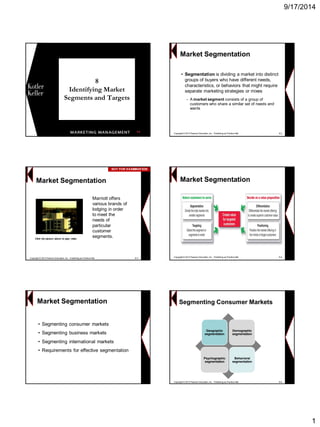
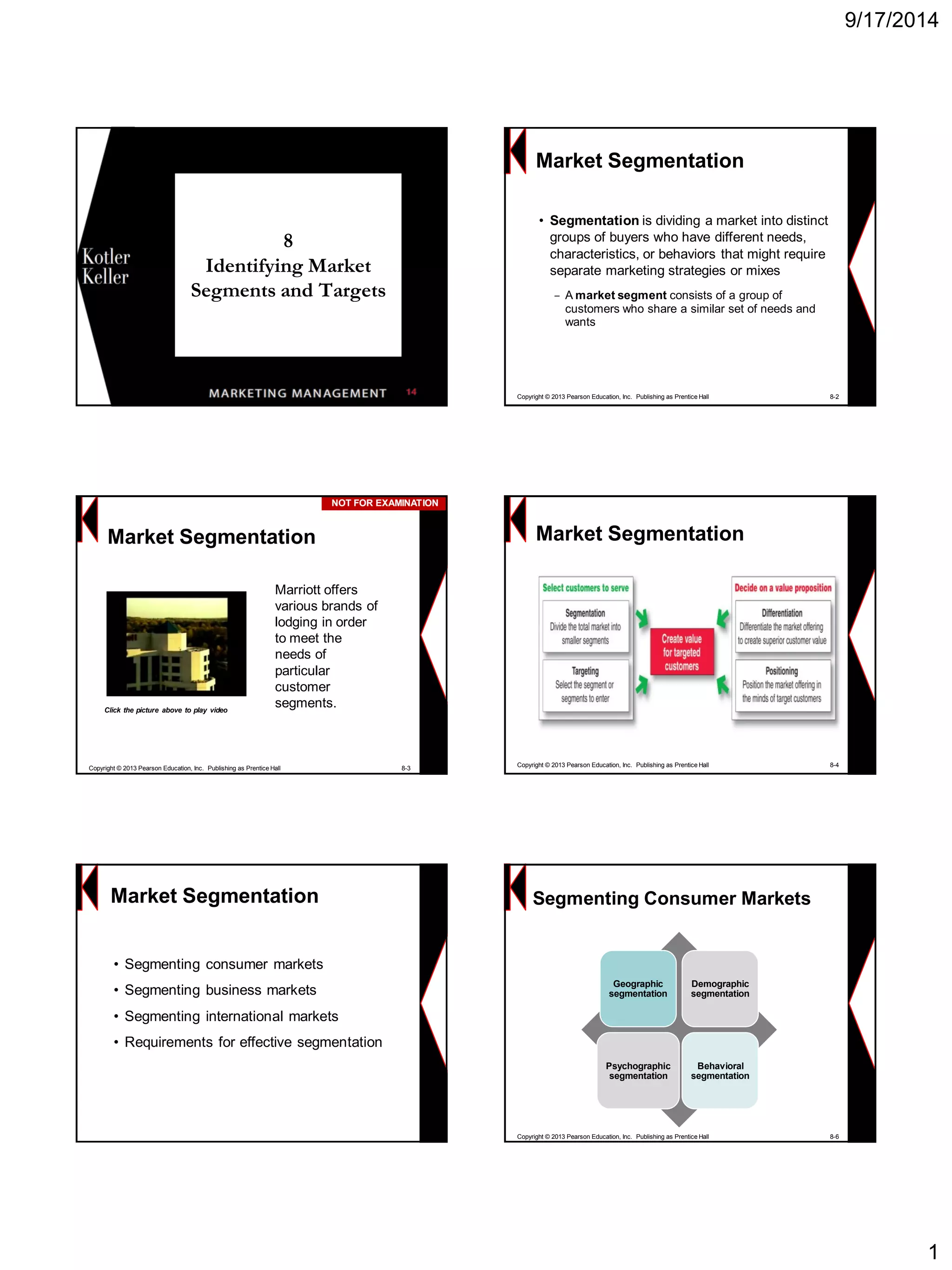
•Segmentation is dividing a market into distinct groups of buyers who have different needs, characteristics, or behaviors that might require separate marketing strategies or mixes 
−A market segment consists of a group of customers who share a similar set of needs and wants 
Market Segmentation 
Copyright © 2013 Pearson Education, Inc. Publishing as Prentice Hall8-2 
Click the picture above to play videoMarriott offers various brands of lodging in order to meet the needs of particular customer segments. Market Segmentation 
Copyright © 2013 Pearson Education, Inc. Publishing as Prentice Hall8-3 
NOT FOR EXAMINATIONNOT EXAMINATIONMarket SegmentationCopyright © 2013 Pearson Education, Inc. Publishing as Prentice Hall8-4 
•Segmenting consumer markets 
•Segmenting business markets 
•Segmenting international markets 
•Requirements for effective segmentation 
Market SegmentationGeographic segmentationDemographic segmentation 
Psychographic segmentation 
Behavioral segmentation 
Copyright © 2013 Pearson Education, Inc. Publishing as Prentice Hall8-6Segmenting Consumer Markets
9/17/2014 
2Segmenting Consumer Markets 
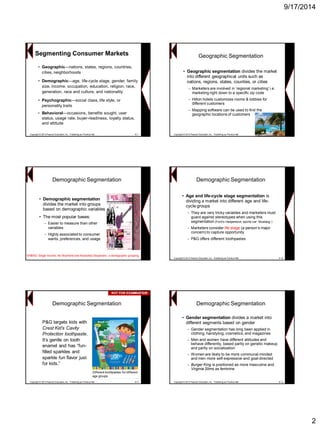
•Geographic—nations, states, regions, countries, cities, neighborhoods 
•Demographic—age, life-cycle stage, gender, family size, income, occupation, education, religion, race, generation, race and culture, and nationality 
•Psychographic—social class, life style, or personality traits 
•Behavioral—occasions, benefits sought, user status, usage rate, buyer-readiness, loyalty status, and attitude 
Copyright © 2013 Pearson Education, Inc. Publishing as Prentice Hall8-7 
Geographic Segmentation 
•Geographic segmentation divides the market into different geographical units such as nations, regions, states, counties, or cities 
−Marketers are involved in „regional marketing‟ i.e. marketing right down to a specific zip code 
−Hilton hotels customizes rooms & lobbies for different customers 
−Mapping software can be used to find the geographic locations of customersCopyright © 2013 Pearson Education, Inc. Publishing as Prentice Hall8-8 
•Demographic segmentation divides the market into groups based on demographic variables 
•The most popular bases: 
−Easier to measure than other variables 
−Highly associated to consumer wants, preferences, and usage 
Demographic Segmentation 
SINBAD: Single Income, No Boyfriend and Absolutely Desperate -a demographic grouping. 
•Age and life-cycle stage segmentation is dividing a market into different age and life- cycle groups 
−They are very tricky variables and marketers must guard against stereotypes when using this segmentation (Ford‟s inexpensive sports car: Mustang ) 
−Marketers consider life stage (a person‟s major concern) to capture opportunity 
−P&G offers different toothpastes 
Demographic Segmentation 
Copyright © 2013 Pearson Education, Inc. Publishing as Prentice Hall8-10P&G targets kids with Crest Kid’s Cavity Protection toothpaste. It‟s gentle on tooth enamel and has “fun- filled sparkles and sparkle fun flavor just for kids.” Demographic SegmentationDifferent toothpastes for different age groups 
Copyright © 2013 Pearson Education, Inc. Publishing as Prentice Hall8-11NOT FOR EXAMINATIONNOT EXAMINATION 
•Gender segmentation divides a market into different segments based on gender 
−Gender segmentation has long been applied in clothing, hairstyling, cosmetics, and magazines 
−Men and women have different attitudes and behave differently, based partly on genetic makeup and partly on socialization 
−Women are likely to be more communal-minded and men more self-expressive and goal-directed 
−Burger King is positioned as more masculine and Virginia Slims as feminine 
Demographic Segmentation 
Copyright © 2013 Pearson Education, Inc. Publishing as Prentice Hall8-12
9/17/2014 
3 
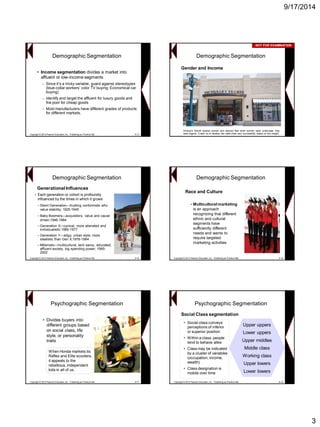
•Income segmentation divides amarket into affluent or low-income segments 
−Since it‟s a tricky variable, guard against stereotypes (blue-collar workers‟ color TV buying; Economical car buying) 
−Identify and target the affluent for luxury goods and the poor for cheap goods 
−Most manufacturers have different grades of products for different markets. 
Demographic Segmentation 
Copyright © 2013 Pearson Education, Inc. Publishing as Prentice Hall8-13Gender and IncomeDemographic Segmentation 
Victoria‟sSecretstudiedwomenandlearnedthatwhilewomenneedunderwear,theywantlingerie.Itwentontodeveloptheretailchainverysuccessfullybasedonthisinsight. NOT FOR EXAMINATIONNOT EXAMINATIONGenerational Influences 
•Each generation or cohort is profoundly influenced by the times in which it grows 
–Silent Generation—trusting conformists who value stability; 1925-1945 
–Baby Boomers—acquisitors, value and cause driven;1946-1964 
–Generation X—cynical, more alienated and individualistic;1965-1977 
–Generation Y—edgy, urban style, more idealistic than Gen X;1978-1994 
–Millenials—multicultural, tech savvy, educated, affluent society, big spending power; 1995- 2002 
Demographic Segmentation 
Copyright © 2013 Pearson Education, Inc. Publishing as Prentice Hall8-15 
Race and CultureDemographic Segmentation 
Copyright © 2013 Pearson Education, Inc. Publishing as Prentice Hall8-16 
•Multicultural marketing is an approach recognizing that different ethnic and cultural segments have sufficiently different needs and wants to require targeted marketing activities 
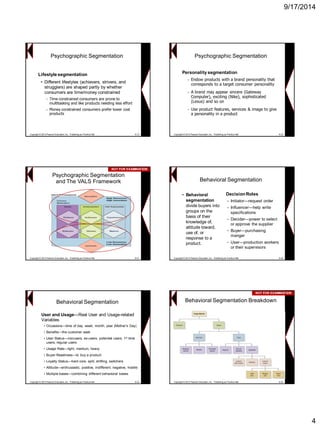
•Divides buyers into different groups based on social class, life style, or personality traits 
Psychographic Segmentation 
When Honda markets its Reflex and Elite scooters, it appeals to the rebellious, independent kids in all of us. Copyright © 2013 Pearson Education, Inc. Publishing as Prentice Hall8-17Upper uppersLower uppersUpper middlesMiddle classWorking classUpper lowersLower lowersPsychographic Segmentation 
Social Class segmentation 
•Social class conveys perceptions of inferior or superior position 
•Within a class, people tend to behave alike 
•Class may be indicated by a cluster of variables (occupation, income, wealth) 
•Class designation is mobile over time 
Copyright © 2013 Pearson Education, Inc. Publishing as Prentice Hall8-18
9/17/2014 
4 
Lifestyle segmentation 
•Different lifestyles (achievers, strivers, and strugglers) are shaped partly by whether consumers are time/money constrained 
−Time constrained consumers are prone to multitasking and like products needing less effort 
−Money constrained consumers prefer lower cost products 
Psychographic SegmentationCopyright © 2013 Pearson Education, Inc. Publishing as Prentice Hall8-19 
Personality segmentation 
−Endow products with a brand personality that corresponds to a target consumer personality 
−A brand may appear sincere (Gateway Computer), exciting (Nike), sophisticated (Lexus) and so on 
−Use product features, services & image to give a personality in a product 
Psychographic SegmentationCopyright © 2013 Pearson Education, Inc. Publishing as Prentice Hall8-20Psychographic Segmentation and The VALS Framework 
Copyright © 2013 Pearson Education, Inc. Publishing as Prentice Hall8-21NOT FOR EXAMINATIONNOT EXAMINATION 
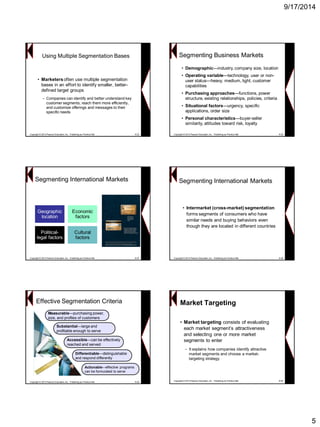
•Behavioral segmentation divide buyers into groups on the basis of their knowledge of, attitude toward, use of, or response to a product. 
Behavioral Segmentation 
Copyright © 2013 Pearson Education, Inc. Publishing as Prentice Hall8-22 
Decision Roles 
–Initiator—request order 
–Influencer—help write specifications 
–Decider—power to select or approve the supplier 
–Buyer—purchasing manger 
–User—production workers or their supervisorsBehavioral Segmentation 
User and Usage—Real User and Usage-related Variables 
•Occasions—time of day, week, month, year (Mother‟s Day) 
•Benefits—the customer seek 
•User Status—nonusers, ex-users, potential users, 1sttime users, regular users 
•Usage Rate—light, medium, heavy 
•Buyer-Readiness—to buy a product 
•Loyalty Status—hard core, split, shifting, switchers 
•Attitude—enthusiastic, positive, indifferent, negative, hostile 
•Multiple bases—combining different behavioral bases 
Copyright © 2013 Pearson Education, Inc. Publishing as Prentice Hall8-23Behavioral Segmentation BreakdownCopyright © 2013 Pearson Education, Inc. Publishing as Prentice Hall8-24NOT FOR EXAMINATIONNOT EXAMINATION
9/17/2014 
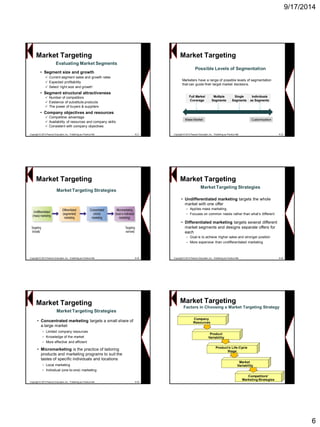
5Using Multiple Segmentation Bases 
•Marketers often use multiple segmentation bases in an effort to identify smaller, better- defined target groups 
–Companies can identify and better understand key customer segments, reach them more efficiently, and customize offerings and messages to their specific needs 
Copyright © 2013 Pearson Education, Inc. Publishing as Prentice Hall8-25Segmenting Business Markets 
•Demographic—industry, company size, location 
•Operating variable—technology, user or non- user status—heavy, medium, light, customer capabilities 
•Purchasing approaches—functions, power structure, existing relationships, policies, criteria 
•Situational factors—urgency, specific applications, order size 
•Personal characteristics—buyer-seller similarity, attitudes toward risk, loyalty 
Copyright © 2013 Pearson Education, Inc. Publishing as Prentice Hall8-26Segmenting International MarketsGeographic locationEconomic factorsPolitical- legal factors 
Cultural factors 
Copyright © 2013 Pearson Education, Inc. Publishing as Prentice Hall8-27 
•Intermarket(cross-market) segmentation forms segments of consumers who have similar needs and buying behaviors even though they are located in different countries 
Copyright © 2013 Pearson Education, Inc. Publishing as Prentice Hall8-28 
Segmenting International MarketsEffective Segmentation CriteriaMeasurable—purchasing power, size, and profiles of customersMeasurable—customersSubstantialprofitable enough to serveSubstantial—large and profitable serveAccessiblecan be effectively reached and servedAccessible—can servedDifferentiabledistinguishable and respond differently Differentiable—distinguishable Actionableeffective programs can be formulated to serveActionable—effective serve 
Copyright © 2013 Pearson Education, Inc. Publishing as Prentice Hall8-29 
•Market targeting consists of evaluating each market segment‟s attractiveness and selecting one or more market segments to enter 
–It explains how companies identify attractive market segments and choose a market- targeting strategy 
Market Targeting 
Copyright © 2013 Pearson Education, Inc. Publishing as Prentice Hall8-30
9/17/2014 
6Evaluating Market Segments 
•Segment size and growth 
Current segment sales and growth rates 
Expected profitability 
Select „right size and growth‟ 
•Segment structural attractiveness 
Number of competitors 
Existence of substitute products 
The power of buyers & suppliers 
•Company objectives and resources 
Competitive advantage 
Availability of resources and company skills 
Consistent with company objectives 
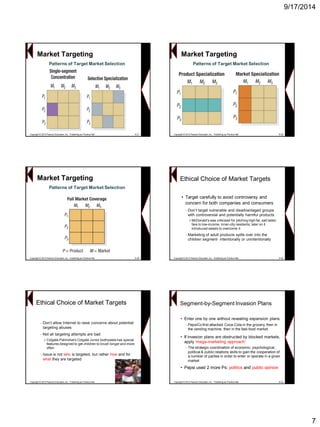
Copyright © 2013 Pearson Education, Inc. Publishing as Prentice Hall8-31Market TargetingCopyright © 2013 Pearson Education, Inc. Publishing as Prentice Hall8-32Possible Levels of Segmentation 
Market Targeting 
Full Market Coverage 
Multiple Segments 
Single Segments 
Individuals as SegmentsMass MarketCustomizationMarketers have a range of possible levels of segmentation that can guide their target market decisions. Copyright © 2013 Pearson Education, Inc. Publishing as Prentice Hall8-33Market Targeting StrategiesMarket Targeting 
Copyright © 2013 Pearson Education, Inc. Publishing as Prentice Hall8-34 
Market Targeting Strategies 
Market Targeting 
•Undifferentiated marketing targets the whole market with one offer 
–Applies mass marketing 
–Focuses on common needs rather than what‟s different 
•Differentiated marketing targets several different market segments and designs separate offers for each 
–Goal is to achieve higher sales and stronger position 
–More expensive than undifferentiated marketing 
Copyright © 2013 Pearson Education, Inc. Publishing as Prentice Hall8-35 
Market Targeting Strategies 
Market Targeting 
•Concentrated marketing targets a small share of a large market 
–Limited company resources 
–Knowledge of the market 
–More effective and efficient 
•Micromarketing is the practice of tailoring products and marketing programs to suit the tastes of specific individuals and locations 
–Local marketing 
–Individual (one-to-one) marketingFactors in Choosing a Market Targeting StrategyMarket TargetingCompany ResourcesProductVariability 
Product’s Life-Cycle 
Stage 
Market 
VariabilityCompetitors’Marketing Strategies
9/17/2014 
7Patterns of Target Market SelectionCopyright © 2013 Pearson Education, Inc. Publishing as Prentice Hall8-37Market Targeting 
Copyright © 2013 Pearson Education, Inc. Publishing as Prentice Hall8-38 
Patterns of Target Market Selection 
Market TargetingCopyright © 2013 Pearson Education, Inc. Publishing as Prentice Hall8-39 
Patterns of Target Market Selection 
Market TargetingEthical Choice of Market Targets 
•Target carefully to avoid controversy and concern for both companies and consumers 
–Don‟t target vulnerable and disadvantaged groups with controversial and potentially harmful products 
»McDonald's was criticized for pitching high fat, salt laden fare to low-income, inner-city residents; later on it introduced salads to overcome it 
–Marketing of adult products spills over into the children segment-intentionally or unintentionally 
Copyright © 2013 Pearson Education, Inc. Publishing as Prentice Hall8-40 
–Don‟t allow Internet to raise concerns about potential targeting abuses 
–Not all targeting attempts are bad 
»Colgate-Palmolive's Colgate Junior toothpaste has special features designed to get children to brush longer and more often 
–Issue is not whois targeted, but rather howand for whatthey are targeted 
Ethical Choice of Market TargetsCopyright © 2013 Pearson Education, Inc. Publishing as Prentice Hall8-41 
•Enter one by one without revealing expansion plans 
–PepsiCo first attacked Coca-Cola in the grocery, then in the vending machine, then in the fast-food market 
•If invasion plans are obstructed by blocked markets, apply „mega-marketing approach‟ 
–The strategic coordination of economic, psychological, political & public relations skills to gain the cooperation of a number of parties in order to enter or operate in a given market 
•Pepsi used 2 more Ps: politicsand public opinion 
Segment-by-Segment Invasion Plans 
Copyright © 2013 Pearson Education, Inc. Publishing as Prentice Hall8-42
9/17/2014 
8 
Pepsi used Megamarketing in IndiaCopyright © 2013 Pearson Education, Inc. Publishing as Prentice Hall8-43NOT FOR EXAMINATIONNOT EXAMINATION 
Marketing Debate 
Is mass marketing dead? 
Take a position: 
1.Mass marketing is dead. 
2. Mass marketing is still a viable way 
to build a profitable brand.

Ch 08 identifying market segments and targets

  • 1.
    9/17/2014 1 8IdentifyingMarket Segments and Targets 1 •Segmentation is dividing a market into distinct groups of buyers who have different needs, characteristics, or behaviors that might require separate marketing strategies or mixes −A market segment consists of a group of customers who share a similar set of needs and wants Market Segmentation Copyright © 2013 Pearson Education, Inc. Publishing as Prentice Hall8-2 Click the picture above to play videoMarriott offers various brands of lodging in order to meet the needs of particular customer segments. Market Segmentation Copyright © 2013 Pearson Education, Inc. Publishing as Prentice Hall8-3 NOT FOR EXAMINATIONNOT EXAMINATIONMarket SegmentationCopyright © 2013 Pearson Education, Inc. Publishing as Prentice Hall8-4 •Segmenting consumer markets •Segmenting business markets •Segmenting international markets •Requirements for effective segmentation Market SegmentationGeographic segmentationDemographic segmentation Psychographic segmentation Behavioral segmentation Copyright © 2013 Pearson Education, Inc. Publishing as Prentice Hall8-6Segmenting Consumer Markets
  • 2.
    9/17/2014 2Segmenting ConsumerMarkets •Geographic—nations, states, regions, countries, cities, neighborhoods •Demographic—age, life-cycle stage, gender, family size, income, occupation, education, religion, race, generation, race and culture, and nationality •Psychographic—social class, life style, or personality traits •Behavioral—occasions, benefits sought, user status, usage rate, buyer-readiness, loyalty status, and attitude Copyright © 2013 Pearson Education, Inc. Publishing as Prentice Hall8-7 Geographic Segmentation •Geographic segmentation divides the market into different geographical units such as nations, regions, states, counties, or cities −Marketers are involved in „regional marketing‟ i.e. marketing right down to a specific zip code −Hilton hotels customizes rooms & lobbies for different customers −Mapping software can be used to find the geographic locations of customersCopyright © 2013 Pearson Education, Inc. Publishing as Prentice Hall8-8 •Demographic segmentation divides the market into groups based on demographic variables •The most popular bases: −Easier to measure than other variables −Highly associated to consumer wants, preferences, and usage Demographic Segmentation SINBAD: Single Income, No Boyfriend and Absolutely Desperate -a demographic grouping. •Age and life-cycle stage segmentation is dividing a market into different age and life- cycle groups −They are very tricky variables and marketers must guard against stereotypes when using this segmentation (Ford‟s inexpensive sports car: Mustang ) −Marketers consider life stage (a person‟s major concern) to capture opportunity −P&G offers different toothpastes Demographic Segmentation Copyright © 2013 Pearson Education, Inc. Publishing as Prentice Hall8-10P&G targets kids with Crest Kid’s Cavity Protection toothpaste. It‟s gentle on tooth enamel and has “fun- filled sparkles and sparkle fun flavor just for kids.” Demographic SegmentationDifferent toothpastes for different age groups Copyright © 2013 Pearson Education, Inc. Publishing as Prentice Hall8-11NOT FOR EXAMINATIONNOT EXAMINATION •Gender segmentation divides a market into different segments based on gender −Gender segmentation has long been applied in clothing, hairstyling, cosmetics, and magazines −Men and women have different attitudes and behave differently, based partly on genetic makeup and partly on socialization −Women are likely to be more communal-minded and men more self-expressive and goal-directed −Burger King is positioned as more masculine and Virginia Slims as feminine Demographic Segmentation Copyright © 2013 Pearson Education, Inc. Publishing as Prentice Hall8-12
  • 3.
    9/17/2014 3 •Incomesegmentation divides amarket into affluent or low-income segments −Since it‟s a tricky variable, guard against stereotypes (blue-collar workers‟ color TV buying; Economical car buying) −Identify and target the affluent for luxury goods and the poor for cheap goods −Most manufacturers have different grades of products for different markets. Demographic Segmentation Copyright © 2013 Pearson Education, Inc. Publishing as Prentice Hall8-13Gender and IncomeDemographic Segmentation Victoria‟sSecretstudiedwomenandlearnedthatwhilewomenneedunderwear,theywantlingerie.Itwentontodeveloptheretailchainverysuccessfullybasedonthisinsight. NOT FOR EXAMINATIONNOT EXAMINATIONGenerational Influences •Each generation or cohort is profoundly influenced by the times in which it grows –Silent Generation—trusting conformists who value stability; 1925-1945 –Baby Boomers—acquisitors, value and cause driven;1946-1964 –Generation X—cynical, more alienated and individualistic;1965-1977 –Generation Y—edgy, urban style, more idealistic than Gen X;1978-1994 –Millenials—multicultural, tech savvy, educated, affluent society, big spending power; 1995- 2002 Demographic Segmentation Copyright © 2013 Pearson Education, Inc. Publishing as Prentice Hall8-15 Race and CultureDemographic Segmentation Copyright © 2013 Pearson Education, Inc. Publishing as Prentice Hall8-16 •Multicultural marketing is an approach recognizing that different ethnic and cultural segments have sufficiently different needs and wants to require targeted marketing activities •Divides buyers into different groups based on social class, life style, or personality traits Psychographic Segmentation When Honda markets its Reflex and Elite scooters, it appeals to the rebellious, independent kids in all of us. Copyright © 2013 Pearson Education, Inc. Publishing as Prentice Hall8-17Upper uppersLower uppersUpper middlesMiddle classWorking classUpper lowersLower lowersPsychographic Segmentation Social Class segmentation •Social class conveys perceptions of inferior or superior position •Within a class, people tend to behave alike •Class may be indicated by a cluster of variables (occupation, income, wealth) •Class designation is mobile over time Copyright © 2013 Pearson Education, Inc. Publishing as Prentice Hall8-18
  • 4.
    9/17/2014 4 Lifestylesegmentation •Different lifestyles (achievers, strivers, and strugglers) are shaped partly by whether consumers are time/money constrained −Time constrained consumers are prone to multitasking and like products needing less effort −Money constrained consumers prefer lower cost products Psychographic SegmentationCopyright © 2013 Pearson Education, Inc. Publishing as Prentice Hall8-19 Personality segmentation −Endow products with a brand personality that corresponds to a target consumer personality −A brand may appear sincere (Gateway Computer), exciting (Nike), sophisticated (Lexus) and so on −Use product features, services & image to give a personality in a product Psychographic SegmentationCopyright © 2013 Pearson Education, Inc. Publishing as Prentice Hall8-20Psychographic Segmentation and The VALS Framework Copyright © 2013 Pearson Education, Inc. Publishing as Prentice Hall8-21NOT FOR EXAMINATIONNOT EXAMINATION •Behavioral segmentation divide buyers into groups on the basis of their knowledge of, attitude toward, use of, or response to a product. Behavioral Segmentation Copyright © 2013 Pearson Education, Inc. Publishing as Prentice Hall8-22 Decision Roles –Initiator—request order –Influencer—help write specifications –Decider—power to select or approve the supplier –Buyer—purchasing manger –User—production workers or their supervisorsBehavioral Segmentation User and Usage—Real User and Usage-related Variables •Occasions—time of day, week, month, year (Mother‟s Day) •Benefits—the customer seek •User Status—nonusers, ex-users, potential users, 1sttime users, regular users •Usage Rate—light, medium, heavy •Buyer-Readiness—to buy a product •Loyalty Status—hard core, split, shifting, switchers •Attitude—enthusiastic, positive, indifferent, negative, hostile •Multiple bases—combining different behavioral bases Copyright © 2013 Pearson Education, Inc. Publishing as Prentice Hall8-23Behavioral Segmentation BreakdownCopyright © 2013 Pearson Education, Inc. Publishing as Prentice Hall8-24NOT FOR EXAMINATIONNOT EXAMINATION
  • 5.
    9/17/2014 5Using MultipleSegmentation Bases •Marketers often use multiple segmentation bases in an effort to identify smaller, better- defined target groups –Companies can identify and better understand key customer segments, reach them more efficiently, and customize offerings and messages to their specific needs Copyright © 2013 Pearson Education, Inc. Publishing as Prentice Hall8-25Segmenting Business Markets •Demographic—industry, company size, location •Operating variable—technology, user or non- user status—heavy, medium, light, customer capabilities •Purchasing approaches—functions, power structure, existing relationships, policies, criteria •Situational factors—urgency, specific applications, order size •Personal characteristics—buyer-seller similarity, attitudes toward risk, loyalty Copyright © 2013 Pearson Education, Inc. Publishing as Prentice Hall8-26Segmenting International MarketsGeographic locationEconomic factorsPolitical- legal factors Cultural factors Copyright © 2013 Pearson Education, Inc. Publishing as Prentice Hall8-27 •Intermarket(cross-market) segmentation forms segments of consumers who have similar needs and buying behaviors even though they are located in different countries Copyright © 2013 Pearson Education, Inc. Publishing as Prentice Hall8-28 Segmenting International MarketsEffective Segmentation CriteriaMeasurable—purchasing power, size, and profiles of customersMeasurable—customersSubstantialprofitable enough to serveSubstantial—large and profitable serveAccessiblecan be effectively reached and servedAccessible—can servedDifferentiabledistinguishable and respond differently Differentiable—distinguishable Actionableeffective programs can be formulated to serveActionable—effective serve Copyright © 2013 Pearson Education, Inc. Publishing as Prentice Hall8-29 •Market targeting consists of evaluating each market segment‟s attractiveness and selecting one or more market segments to enter –It explains how companies identify attractive market segments and choose a market- targeting strategy Market Targeting Copyright © 2013 Pearson Education, Inc. Publishing as Prentice Hall8-30
  • 6.
    9/17/2014 6Evaluating MarketSegments •Segment size and growth Current segment sales and growth rates Expected profitability Select „right size and growth‟ •Segment structural attractiveness Number of competitors Existence of substitute products The power of buyers & suppliers •Company objectives and resources Competitive advantage Availability of resources and company skills Consistent with company objectives Copyright © 2013 Pearson Education, Inc. Publishing as Prentice Hall8-31Market TargetingCopyright © 2013 Pearson Education, Inc. Publishing as Prentice Hall8-32Possible Levels of Segmentation Market Targeting Full Market Coverage Multiple Segments Single Segments Individuals as SegmentsMass MarketCustomizationMarketers have a range of possible levels of segmentation that can guide their target market decisions. Copyright © 2013 Pearson Education, Inc. Publishing as Prentice Hall8-33Market Targeting StrategiesMarket Targeting Copyright © 2013 Pearson Education, Inc. Publishing as Prentice Hall8-34 Market Targeting Strategies Market Targeting •Undifferentiated marketing targets the whole market with one offer –Applies mass marketing –Focuses on common needs rather than what‟s different •Differentiated marketing targets several different market segments and designs separate offers for each –Goal is to achieve higher sales and stronger position –More expensive than undifferentiated marketing Copyright © 2013 Pearson Education, Inc. Publishing as Prentice Hall8-35 Market Targeting Strategies Market Targeting •Concentrated marketing targets a small share of a large market –Limited company resources –Knowledge of the market –More effective and efficient •Micromarketing is the practice of tailoring products and marketing programs to suit the tastes of specific individuals and locations –Local marketing –Individual (one-to-one) marketingFactors in Choosing a Market Targeting StrategyMarket TargetingCompany ResourcesProductVariability Product’s Life-Cycle Stage Market VariabilityCompetitors’Marketing Strategies
  • 7.
    9/17/2014 7Patterns ofTarget Market SelectionCopyright © 2013 Pearson Education, Inc. Publishing as Prentice Hall8-37Market Targeting Copyright © 2013 Pearson Education, Inc. Publishing as Prentice Hall8-38 Patterns of Target Market Selection Market TargetingCopyright © 2013 Pearson Education, Inc. Publishing as Prentice Hall8-39 Patterns of Target Market Selection Market TargetingEthical Choice of Market Targets •Target carefully to avoid controversy and concern for both companies and consumers –Don‟t target vulnerable and disadvantaged groups with controversial and potentially harmful products »McDonald's was criticized for pitching high fat, salt laden fare to low-income, inner-city residents; later on it introduced salads to overcome it –Marketing of adult products spills over into the children segment-intentionally or unintentionally Copyright © 2013 Pearson Education, Inc. Publishing as Prentice Hall8-40 –Don‟t allow Internet to raise concerns about potential targeting abuses –Not all targeting attempts are bad »Colgate-Palmolive's Colgate Junior toothpaste has special features designed to get children to brush longer and more often –Issue is not whois targeted, but rather howand for whatthey are targeted Ethical Choice of Market TargetsCopyright © 2013 Pearson Education, Inc. Publishing as Prentice Hall8-41 •Enter one by one without revealing expansion plans –PepsiCo first attacked Coca-Cola in the grocery, then in the vending machine, then in the fast-food market •If invasion plans are obstructed by blocked markets, apply „mega-marketing approach‟ –The strategic coordination of economic, psychological, political & public relations skills to gain the cooperation of a number of parties in order to enter or operate in a given market •Pepsi used 2 more Ps: politicsand public opinion Segment-by-Segment Invasion Plans Copyright © 2013 Pearson Education, Inc. Publishing as Prentice Hall8-42
  • 8.
    9/17/2014 8 Pepsiused Megamarketing in IndiaCopyright © 2013 Pearson Education, Inc. Publishing as Prentice Hall8-43NOT FOR EXAMINATIONNOT EXAMINATION Marketing Debate Is mass marketing dead? Take a position: 1.Mass marketing is dead. 2. Mass marketing is still a viable way to build a profitable brand.