Computer Networks

Prof. Hema A Murthy

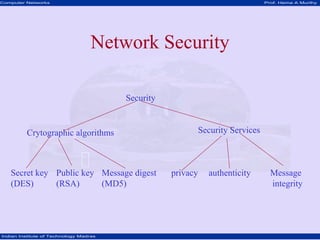
Network Security
Security
Security Services

Crytographic algorithms

Secret key Public key Message digest
(DES)
(RSA)
(MD5)

Indian Institute of Technology Madras

privacy

authenticity

Message
integrity
Computer Networks

Prof. Hema A Murthy

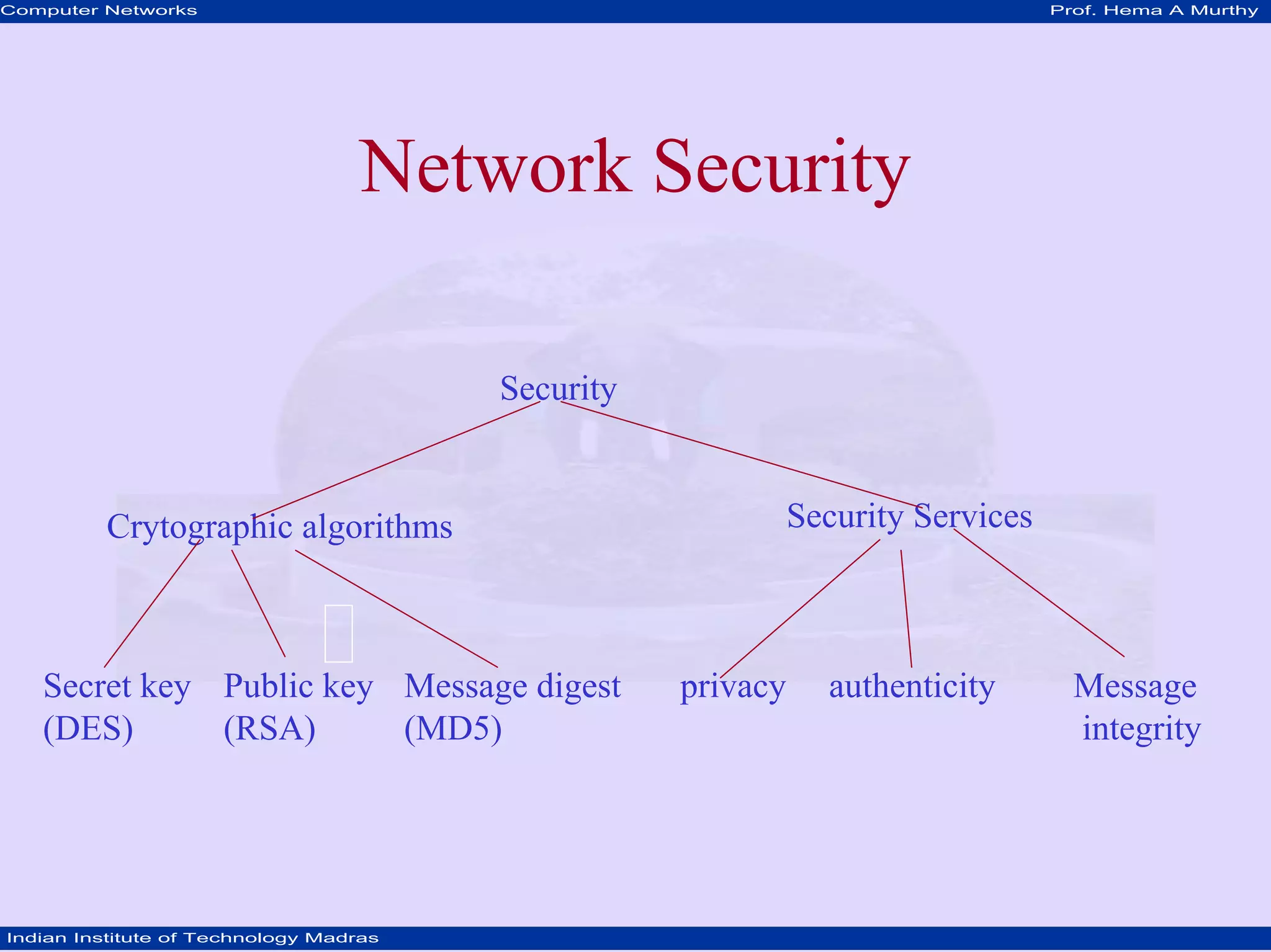
Secret Key Encryption
Plain text

Encrypt using
secret key

Indian Institute of Technology Madras

Plain text

Decrypt using
secret key
Computer Networks

Prof. Hema A Murthy

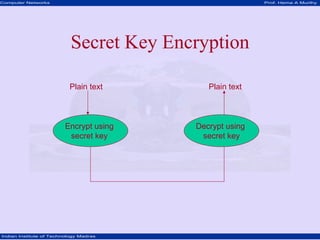
Public Key Encryption
• Each participant has a secret key (private
key)
• The key is not stored
– Publish on the web (for instance)

• To send a message
– Encrypt with public key
– To decrypt, decrypt using a private key

Indian Institute of Technology Madras
Computer Networks

Prof. Hema A Murthy

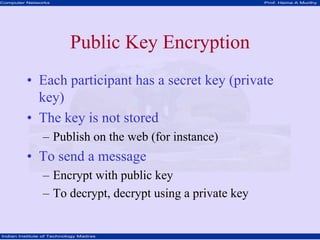
Message Digest Encryption
• Map a potentially large message into a
small fixed length number
• Compute checksum for message
• Given cryptographic checksum
– Difficult to figure out the message

Indian Institute of Technology Madras
Computer Networks

Prof. Hema A Murthy

DES (secret key encryption)
• Block cipher (operates on a fixed block of
bits)
• Encrypts a 64-bit of plain text using a 64-bit
key
– Only 56 bits used
– Last bit of every byte is a parity bit

• Three phases in DES
– 64-bits in each block are permuted
Indian Institute of Technology Madras
Computer Networks

Prof. Hema A Murthy

DES (secret key encryption)
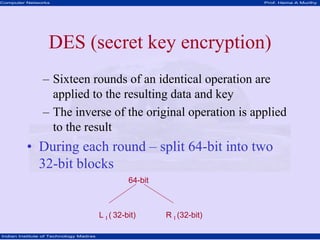
– Sixteen rounds of an identical operation are
applied to the resulting data and key
– The inverse of the original operation is applied
to the result

• During each round – split 64-bit into two
32-bit blocks
64-bit

L I ( 32-bit)
Indian Institute of Technology Madras

R I (32-bit)
Computer Networks

Prof. Hema A Murthy

DES (secret key encryption)
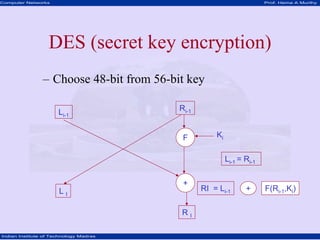
– Choose 48-bit from 56-bit key
Li-1

Ri-1

F

Ki
Li-1 = Ri-1

+
LI
RI
Indian Institute of Technology Madras

RI = Li-1

+

F(Ri-1,Ki)
Computer Networks

Prof. Hema A Murthy

DES (secret key encryption)
• Define F, generate Ki
• Initially the permuted 56-bit key is divided
into two blocks of 28-bit
– Ignore every 8th bit in original key
– Each half is rotated 1/2 bits depending upon the
round
– A table is used to define the rotation of the 28bit
Indian Institute of Technology Madras
Computer Networks

Prof. Hema A Murthy

DES (secret key encryption)
• DES compression permutation
– 48-bit key is permuted and then used in the
current round as key

• Function F combines 48-bit key (Ki) with
the right half of data after round i-1 (Ri-1)
• Expand R from 32-bit to 48-bit
– Divide R into 4-bit chunks
– Expand each chunk into 6-bit

Indian Institute of Technology Madras
Computer Networks

Prof. Hema A Murthy

DES (secret key encryption)
• 1-bit from left, 1-bit from right
• 1st and last bit –use circular shift – they get from
each other

– Divide 48-bit into 6-bit chunks
– XOR expanded R
– Finally pass 6-bit through substitution box to
get 4-bit from 6-bit

Indian Institute of Technology Madras
Computer Networks

Prof. Hema A Murthy

DES (Decryption)
• Algorithm works exactly the same as that of
encryption
• Apply keys in reverse
– K16, K15, K14, …, K1

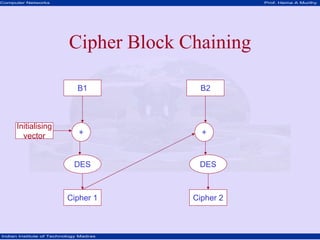
• Encryption of large messages
– Cipher block chaining

Indian Institute of Technology Madras
Computer Networks

Prof. Hema A Murthy

Cipher Block Chaining
B1

Initialising
vector

B2

+

+

DES

DES

Cipher 1

Cipher 2

Indian Institute of Technology Madras
Computer Networks

Prof. Hema A Murthy

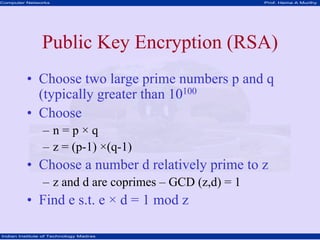
Public Key Encryption (RSA)
• Choose two large prime numbers p and q
(typically greater than 10100
• Choose
–n=p×q
– z = (p-1) ×(q-1)

• Choose a number d relatively prime to z
– z and d are coprimes – GCD (z,d) = 1

• Find e s.t. e × d = 1 mod z
Indian Institute of Technology Madras
Computer Networks

Prof. Hema A Murthy

Public Key Encryption (RSA)
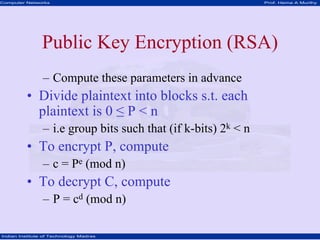
– Compute these parameters in advance

• Divide plaintext into blocks s.t. each
plaintext is 0 ≤ P < n
– i.e group bits such that (if k-bits) 2k < n

• To encrypt P, compute
– c = Pe (mod n)

• To decrypt C, compute
– P = cd (mod n)
Indian Institute of Technology Madras
Computer Networks

Prof. Hema A Murthy

Public Key Encryption (RSA)
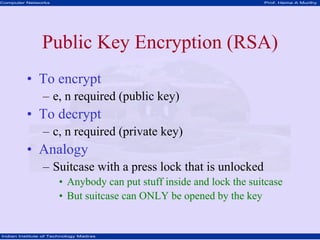
• To encrypt
– e, n required (public key)

• To decrypt
– c, n required (private key)

• Analogy
– Suitcase with a press lock that is unlocked
• Anybody can put stuff inside and lock the suitcase
• But suitcase can ONLY be opened by the key

Indian Institute of Technology Madras
Computer Networks

Prof. Hema A Murthy

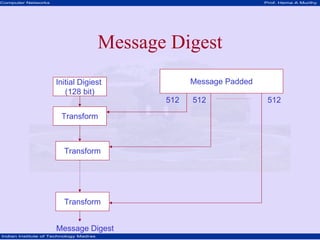
Message Digest
Message Padded

Initial Digiest
(128 bit)
512
Transform

Transform

Transform
Message Digest
Indian Institute of Technology Madras

512

512
Computer Networks

Prof. Hema A Murthy

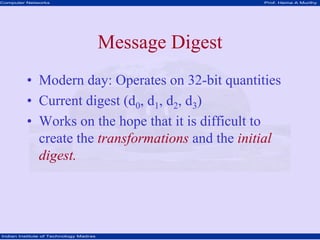
Message Digest
• Modern day: Operates on 32-bit quantities
• Current digest (d0, d1, d2, d3)
• Works on the hope that it is difficult to
create the transformations and the initial
digest.

Indian Institute of Technology Madras

Lecture43 network security

  • 1.
    Computer Networks Prof. HemaA Murthy Network Security Security Security Services Crytographic algorithms Secret key Public key Message digest (DES) (RSA) (MD5) Indian Institute of Technology Madras privacy authenticity Message integrity
  • 2.
    Computer Networks Prof. HemaA Murthy Secret Key Encryption Plain text Encrypt using secret key Indian Institute of Technology Madras Plain text Decrypt using secret key
  • 3.
    Computer Networks Prof. HemaA Murthy Public Key Encryption • Each participant has a secret key (private key) • The key is not stored – Publish on the web (for instance) • To send a message – Encrypt with public key – To decrypt, decrypt using a private key Indian Institute of Technology Madras
  • 4.
    Computer Networks Prof. HemaA Murthy Message Digest Encryption • Map a potentially large message into a small fixed length number • Compute checksum for message • Given cryptographic checksum – Difficult to figure out the message Indian Institute of Technology Madras
  • 5.
    Computer Networks Prof. HemaA Murthy DES (secret key encryption) • Block cipher (operates on a fixed block of bits) • Encrypts a 64-bit of plain text using a 64-bit key – Only 56 bits used – Last bit of every byte is a parity bit • Three phases in DES – 64-bits in each block are permuted Indian Institute of Technology Madras
  • 6.
    Computer Networks Prof. HemaA Murthy DES (secret key encryption) – Sixteen rounds of an identical operation are applied to the resulting data and key – The inverse of the original operation is applied to the result • During each round – split 64-bit into two 32-bit blocks 64-bit L I ( 32-bit) Indian Institute of Technology Madras R I (32-bit)
  • 7.
    Computer Networks Prof. HemaA Murthy DES (secret key encryption) – Choose 48-bit from 56-bit key Li-1 Ri-1 F Ki Li-1 = Ri-1 + LI RI Indian Institute of Technology Madras RI = Li-1 + F(Ri-1,Ki)
  • 8.
    Computer Networks Prof. HemaA Murthy DES (secret key encryption) • Define F, generate Ki • Initially the permuted 56-bit key is divided into two blocks of 28-bit – Ignore every 8th bit in original key – Each half is rotated 1/2 bits depending upon the round – A table is used to define the rotation of the 28bit Indian Institute of Technology Madras
  • 9.
    Computer Networks Prof. HemaA Murthy DES (secret key encryption) • DES compression permutation – 48-bit key is permuted and then used in the current round as key • Function F combines 48-bit key (Ki) with the right half of data after round i-1 (Ri-1) • Expand R from 32-bit to 48-bit – Divide R into 4-bit chunks – Expand each chunk into 6-bit Indian Institute of Technology Madras
  • 10.
    Computer Networks Prof. HemaA Murthy DES (secret key encryption) • 1-bit from left, 1-bit from right • 1st and last bit –use circular shift – they get from each other – Divide 48-bit into 6-bit chunks – XOR expanded R – Finally pass 6-bit through substitution box to get 4-bit from 6-bit Indian Institute of Technology Madras
  • 11.
    Computer Networks Prof. HemaA Murthy DES (Decryption) • Algorithm works exactly the same as that of encryption • Apply keys in reverse – K16, K15, K14, …, K1 • Encryption of large messages – Cipher block chaining Indian Institute of Technology Madras
  • 12.
    Computer Networks Prof. HemaA Murthy Cipher Block Chaining B1 Initialising vector B2 + + DES DES Cipher 1 Cipher 2 Indian Institute of Technology Madras
  • 13.
    Computer Networks Prof. HemaA Murthy Public Key Encryption (RSA) • Choose two large prime numbers p and q (typically greater than 10100 • Choose –n=p×q – z = (p-1) ×(q-1) • Choose a number d relatively prime to z – z and d are coprimes – GCD (z,d) = 1 • Find e s.t. e × d = 1 mod z Indian Institute of Technology Madras
  • 14.
    Computer Networks Prof. HemaA Murthy Public Key Encryption (RSA) – Compute these parameters in advance • Divide plaintext into blocks s.t. each plaintext is 0 ≤ P < n – i.e group bits such that (if k-bits) 2k < n • To encrypt P, compute – c = Pe (mod n) • To decrypt C, compute – P = cd (mod n) Indian Institute of Technology Madras
  • 15.
    Computer Networks Prof. HemaA Murthy Public Key Encryption (RSA) • To encrypt – e, n required (public key) • To decrypt – c, n required (private key) • Analogy – Suitcase with a press lock that is unlocked • Anybody can put stuff inside and lock the suitcase • But suitcase can ONLY be opened by the key Indian Institute of Technology Madras
  • 16.
    Computer Networks Prof. HemaA Murthy Message Digest Message Padded Initial Digiest (128 bit) 512 Transform Transform Transform Message Digest Indian Institute of Technology Madras 512 512
  • 17.
    Computer Networks Prof. HemaA Murthy Message Digest • Modern day: Operates on 32-bit quantities • Current digest (d0, d1, d2, d3) • Works on the hope that it is difficult to create the transformations and the initial digest. Indian Institute of Technology Madras