Transactions and SQL
The Setting
• Database systems are normally being
accessed by many users or processes at
the same time.
– Both queries and modifications.

• Unlike operating systems, which support
interaction of processes, a DMBS needs
to keep processes from troublesome
interactions.
Example: Bad Interaction
• You and your domestic partner each take
$100 from different ATM’s at about the
same time.
– The DBMS better make sure one account
deduction doesn’t get lost.

• Compare: An OS allows two people to edit
a document at the same time. If both
write, one’s changes get lost.
ACID Transactions
• A DBMS is expected to support “ACID
transactions,” processes that are:
– Atomic : Either the whole process is done or
none is.
– Consistent : Database constraints are
preserved.
– Isolated : It appears to the user as if only one
process executes at a time.
– Durable : Effects of a process do not get lost if
the system crashes.
Transactions in SQL
• SQL supports transactions, often
behind the scenes.
– Each statement issued at the generic
query interface is a transaction by itself.
– In programming interfaces like Embedded
SQL or PSM, a transaction begins the first
time a SQL statement is executed and
ends with the program or an explicit
transaction-end.
COMMIT
• The SQL statement COMMIT causes a
transaction to complete.
– It’s database modifications are now
permanent in the database.
ROLLBACK
• The SQL statement ROLLBACK also
causes the transaction to end, but by
aborting.
– No effects on the database.

• Failures like division by 0 or a
constraint violation can also cause
rollback, even if the programmer does
not request it.
An Example: Interacting Processes
• Assume the usual Sells(bar,beer,price)
relation, and suppose that Joe’s Bar sells
only Bud for $2.50 and Miller for $3.00.
• Sally is querying Sells for the highest and
lowest price Joe charges.
• Joe decides to stop selling Bud and
Miller, but to sell only Heineken at $3.50.
Sally’s Program
• Sally executes the following two SQL
statements, which we call (min) and
(max), to help remember what they do.
(max)
SELECT MAX(price) FROM Sells
WHERE bar = ’Joe’’s Bar’;
(min)
SELECT MIN(price) FROM Sells
WHERE bar = ’Joe’’s Bar’;
Joe’s Program
• At about the same time, Joe executes the
following steps, which have the mnemonic
names (del) and (ins).
(del) DELETE FROM Sells
WHERE bar = ’Joe’’s Bar’;
(ins) INSERT INTO Sells
VALUES(’Joe’’s Bar’, ’Heineken’, 3.50);
Interleaving of Statements
• Although (max) must come before (min),
and (del) must come before (ins), there
are no other constraints on the order of
these statements, unless we group Sally’s
and/or Joe’s statements into transactions.
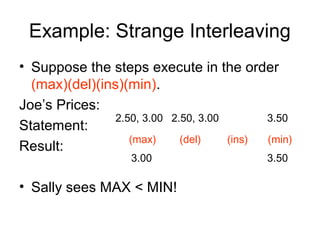
Example: Strange Interleaving
• Suppose the steps execute in the order
(max)(del)(ins)(min).
Joe’s Prices:
2.50, 3.00 2.50, 3.00
3.50
Statement:
(max)
(del)
(ins)
(min)
Result:
3.00

• Sally sees MAX < MIN!

3.50
Fixing the Problem by Using
Transactions

• If we group Sally’s statements (max)(min)
into one transaction, then she cannot see
this inconsistency.
• She sees Joe’s prices at some fixed time.
– Either before or after he changes prices, or in
the middle, but the MAX and MIN are
computed from the same prices.
Another Problem: Rollback
• Suppose Joe executes (del)(ins), not as
a transaction, but after executing these
statements, thinks better of it and
issues a ROLLBACK statement.
• If Sally executes her statements after
(ins) but before the rollback, she sees a
value, 3.50, that never existed in the
database.
Solution
• If Joe executes (del)(ins) as a transaction,
its effect cannot be seen by others until
the transaction executes COMMIT.
– If the transaction executes ROLLBACK
instead, then its effects can never be seen.
Isolation Levels
• SQL defines four isolation levels =
choices about what interactions are
allowed by transactions that execute at
about the same time.
• How a DBMS implements these isolation
levels is highly complex, and a typical
DBMS provides its own options.
Choosing the Isolation Level
•

Within a transaction, we can say:
SET TRANSACTION ISOLATION LEVEL X
where X =
1.
2.
3.
4.

SERIALIZABLE
REPEATABLE READ
READ COMMITTED
READ UNCOMMITTED
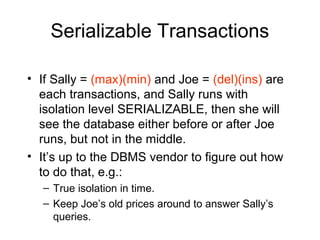
Serializable Transactions
• If Sally = (max)(min) and Joe = (del)(ins) are
each transactions, and Sally runs with
isolation level SERIALIZABLE, then she will
see the database either before or after Joe
runs, but not in the middle.
• It’s up to the DBMS vendor to figure out how
to do that, e.g.:
– True isolation in time.
– Keep Joe’s old prices around to answer Sally’s
queries.
Isolation Level Is Personal Choice
• Your choice, e.g., run serializable,
affects only how you see the database,
not how others see it.
• Example: If Joe Runs serializable, but
Sally doesn’t, then Sally might see no
prices for Joe’s Bar.
– i.e., it looks to Sally as if she ran in the
middle of Joe’s transaction.
Read-Commited Transactions
• If Sally runs with isolation level READ
COMMITTED, then she can see only
committed data, but not necessarily the
same data each time.
• Example: Under READ COMMITTED, the
interleaving (max)(del)(ins)(min) is
allowed, as long as Joe commits.
– Sally sees MAX < MIN.
Repeatable-Read Transactions
• Requirement is like read-committed, plus:
if data is read again, then everything seen
the first time will be seen the second time.
– But the second and subsequent reads may
see more tuples as well.
Example: Repeatable Read
• Suppose Sally runs under REPEATABLE
READ, and the order of execution is (max)
(del)(ins)(min).
– (max) sees prices 2.50 and 3.00.
– (min) can see 3.50, but must also see 2.50
and 3.00, because they were seen on the
earlier read by (max).
Read Uncommitted
• A transaction running under READ
UNCOMMITTED can see data in the
database, even if it was written by a
transaction that has not committed (and
may never).
• Example: If Sally runs under READ
UNCOMMITTED, she could see a price
3.50 even if Joe later aborts.

11. transaction sql

  • 1.
  • 2.
    The Setting • Databasesystems are normally being accessed by many users or processes at the same time. – Both queries and modifications. • Unlike operating systems, which support interaction of processes, a DMBS needs to keep processes from troublesome interactions.
  • 3.
    Example: Bad Interaction •You and your domestic partner each take $100 from different ATM’s at about the same time. – The DBMS better make sure one account deduction doesn’t get lost. • Compare: An OS allows two people to edit a document at the same time. If both write, one’s changes get lost.
  • 4.
    ACID Transactions • ADBMS is expected to support “ACID transactions,” processes that are: – Atomic : Either the whole process is done or none is. – Consistent : Database constraints are preserved. – Isolated : It appears to the user as if only one process executes at a time. – Durable : Effects of a process do not get lost if the system crashes.
  • 5.
    Transactions in SQL •SQL supports transactions, often behind the scenes. – Each statement issued at the generic query interface is a transaction by itself. – In programming interfaces like Embedded SQL or PSM, a transaction begins the first time a SQL statement is executed and ends with the program or an explicit transaction-end.
  • 6.
    COMMIT • The SQLstatement COMMIT causes a transaction to complete. – It’s database modifications are now permanent in the database.
  • 7.
    ROLLBACK • The SQLstatement ROLLBACK also causes the transaction to end, but by aborting. – No effects on the database. • Failures like division by 0 or a constraint violation can also cause rollback, even if the programmer does not request it.
  • 8.
    An Example: InteractingProcesses • Assume the usual Sells(bar,beer,price) relation, and suppose that Joe’s Bar sells only Bud for $2.50 and Miller for $3.00. • Sally is querying Sells for the highest and lowest price Joe charges. • Joe decides to stop selling Bud and Miller, but to sell only Heineken at $3.50.
  • 9.
    Sally’s Program • Sallyexecutes the following two SQL statements, which we call (min) and (max), to help remember what they do. (max) SELECT MAX(price) FROM Sells WHERE bar = ’Joe’’s Bar’; (min) SELECT MIN(price) FROM Sells WHERE bar = ’Joe’’s Bar’;
  • 10.
    Joe’s Program • Atabout the same time, Joe executes the following steps, which have the mnemonic names (del) and (ins). (del) DELETE FROM Sells WHERE bar = ’Joe’’s Bar’; (ins) INSERT INTO Sells VALUES(’Joe’’s Bar’, ’Heineken’, 3.50);
  • 11.
    Interleaving of Statements •Although (max) must come before (min), and (del) must come before (ins), there are no other constraints on the order of these statements, unless we group Sally’s and/or Joe’s statements into transactions.
  • 12.
    Example: Strange Interleaving •Suppose the steps execute in the order (max)(del)(ins)(min). Joe’s Prices: 2.50, 3.00 2.50, 3.00 3.50 Statement: (max) (del) (ins) (min) Result: 3.00 • Sally sees MAX < MIN! 3.50
  • 13.
    Fixing the Problemby Using Transactions • If we group Sally’s statements (max)(min) into one transaction, then she cannot see this inconsistency. • She sees Joe’s prices at some fixed time. – Either before or after he changes prices, or in the middle, but the MAX and MIN are computed from the same prices.
  • 14.
    Another Problem: Rollback •Suppose Joe executes (del)(ins), not as a transaction, but after executing these statements, thinks better of it and issues a ROLLBACK statement. • If Sally executes her statements after (ins) but before the rollback, she sees a value, 3.50, that never existed in the database.
  • 15.
    Solution • If Joeexecutes (del)(ins) as a transaction, its effect cannot be seen by others until the transaction executes COMMIT. – If the transaction executes ROLLBACK instead, then its effects can never be seen.
  • 16.
    Isolation Levels • SQLdefines four isolation levels = choices about what interactions are allowed by transactions that execute at about the same time. • How a DBMS implements these isolation levels is highly complex, and a typical DBMS provides its own options.
  • 17.
    Choosing the IsolationLevel • Within a transaction, we can say: SET TRANSACTION ISOLATION LEVEL X where X = 1. 2. 3. 4. SERIALIZABLE REPEATABLE READ READ COMMITTED READ UNCOMMITTED
  • 18.
    Serializable Transactions • IfSally = (max)(min) and Joe = (del)(ins) are each transactions, and Sally runs with isolation level SERIALIZABLE, then she will see the database either before or after Joe runs, but not in the middle. • It’s up to the DBMS vendor to figure out how to do that, e.g.: – True isolation in time. – Keep Joe’s old prices around to answer Sally’s queries.
  • 19.
    Isolation Level IsPersonal Choice • Your choice, e.g., run serializable, affects only how you see the database, not how others see it. • Example: If Joe Runs serializable, but Sally doesn’t, then Sally might see no prices for Joe’s Bar. – i.e., it looks to Sally as if she ran in the middle of Joe’s transaction.
  • 20.
    Read-Commited Transactions • IfSally runs with isolation level READ COMMITTED, then she can see only committed data, but not necessarily the same data each time. • Example: Under READ COMMITTED, the interleaving (max)(del)(ins)(min) is allowed, as long as Joe commits. – Sally sees MAX < MIN.
  • 21.
    Repeatable-Read Transactions • Requirementis like read-committed, plus: if data is read again, then everything seen the first time will be seen the second time. – But the second and subsequent reads may see more tuples as well.
  • 22.
    Example: Repeatable Read •Suppose Sally runs under REPEATABLE READ, and the order of execution is (max) (del)(ins)(min). – (max) sees prices 2.50 and 3.00. – (min) can see 3.50, but must also see 2.50 and 3.00, because they were seen on the earlier read by (max).
  • 23.
    Read Uncommitted • Atransaction running under READ UNCOMMITTED can see data in the database, even if it was written by a transaction that has not committed (and may never). • Example: If Sally runs under READ UNCOMMITTED, she could see a price 3.50 even if Joe later aborts.