INTERCELLUAR
CONNECTIONS BETWEEN
EPITHELIAL CELLS
Ladi Anudeep
ISM-IUK
• Five types of cellular junctions are present in between
the epithelial cells
• 1) Tight junctions or Zona occludens
• 2) Adhering junctions or Zona adherens
• 3) Desmosomes or Macula adherens
• 4) Gap junctions or Connexons
• 5) Hemidesmosomes
ZONA OCCLUDENS
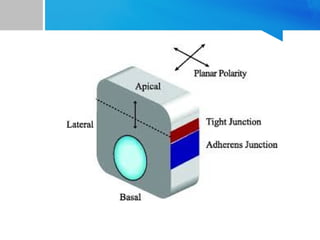
>This is the example of tight junction
>It is present in the lateral surfaces of epithelial cells
>They help in stiching the cells together
>These are the special structures around the cell as to
attatch with surrounding cells
>Zona occludens prevents floating of protein channels from
apical surface to basal surface
>It controls fluid movement through paracellular route
• Zona occludens is a membrane protein complex that
made up of special type proteins called occludens and
claudins
• Occludens and claudins come out of cell membrane and
interact with each other and seal the surface of two
adjacent cells
• These two proteins are attatched to three proteins called
ZO1, ZO2, ZO3.
• These three proteins helps in holding occludens and
claudins properly in their positions.
• This type of junction is present at apical region.
ZONA ADHERENS
• This is the example for adhering junctions present just
below to tight junctions.
• They help in tightly adhering the adjacent cells together.
• This is like a sticky belt present around the cell.
• E.cadherins are the proteins helping in sticking the cells
together in the presence of calcium.
• Vinculin is the protein present in the inner side of cell
which is further attatched to the alpha actinin and
catenin.
• the cytoskeleton filaments which are attatched to alpha
actinin are actin filaments.
MACULA ADHERENS
• This is an example for desmosomes.
• Macula means a spot like.
• This is also helpful for sticking the cells together but in
only some places.
• These are not as strong as zona adherens.
• The proteins which are helpful for adhering here are
Desmocollins and Desmogleins.
• This is also calcium based attatchment.
• Inside the cell, there is a special disc present which is
made up of desmoplachins and plakoglobins.
• The cytoskeletal filaments attatched to this disc are
intermediate fillaments and tonofillaments( keratin)
GAP JUNCTIONS
• These are the window like structures present on the
lateral surface of each epithelial cells for the sake of
communication between the cells.
• It is made up of 6 types of proteins made up of
connexins, so these 6 connexins combine to form a
protein channel called connexon.
• These can be opened or closed when neccesary.
HEMIDESMOSOMES
• These are the only celluar junctions present on the basal
surface of the epithelium.
• Integrins are the proteins which are present on basal cell
membrane.
• Hemidesmosomes through integrin attacthes to extra
cellular material.
• Inside hemidesmosomes have special type of fillaments
of cytoskeleton called as intermediate fillaments .
HEMIDESMOSOMES
• These are the only celluar junctions present on the basal
surface of the epithelium.
• Integrins are the proteins which are present on basal cell
membrane.
• Hemidesmosomes through integrin attacthes to extra
cellular material.
• Inside hemidesmosomes have special type of fillaments
of cytoskeleton called as intermediate fillaments .

Cellular Junctions

  • 1.
  • 3.
    • Five typesof cellular junctions are present in between the epithelial cells • 1) Tight junctions or Zona occludens • 2) Adhering junctions or Zona adherens • 3) Desmosomes or Macula adherens • 4) Gap junctions or Connexons • 5) Hemidesmosomes
  • 4.
    ZONA OCCLUDENS >This isthe example of tight junction >It is present in the lateral surfaces of epithelial cells >They help in stiching the cells together >These are the special structures around the cell as to attatch with surrounding cells >Zona occludens prevents floating of protein channels from apical surface to basal surface >It controls fluid movement through paracellular route
  • 5.
    • Zona occludensis a membrane protein complex that made up of special type proteins called occludens and claudins • Occludens and claudins come out of cell membrane and interact with each other and seal the surface of two adjacent cells • These two proteins are attatched to three proteins called ZO1, ZO2, ZO3. • These three proteins helps in holding occludens and claudins properly in their positions. • This type of junction is present at apical region.
  • 6.
    ZONA ADHERENS • Thisis the example for adhering junctions present just below to tight junctions. • They help in tightly adhering the adjacent cells together. • This is like a sticky belt present around the cell. • E.cadherins are the proteins helping in sticking the cells together in the presence of calcium. • Vinculin is the protein present in the inner side of cell which is further attatched to the alpha actinin and catenin. • the cytoskeleton filaments which are attatched to alpha actinin are actin filaments.
  • 7.
    MACULA ADHERENS • Thisis an example for desmosomes. • Macula means a spot like. • This is also helpful for sticking the cells together but in only some places. • These are not as strong as zona adherens. • The proteins which are helpful for adhering here are Desmocollins and Desmogleins. • This is also calcium based attatchment. • Inside the cell, there is a special disc present which is made up of desmoplachins and plakoglobins. • The cytoskeletal filaments attatched to this disc are intermediate fillaments and tonofillaments( keratin)
  • 8.
    GAP JUNCTIONS • Theseare the window like structures present on the lateral surface of each epithelial cells for the sake of communication between the cells. • It is made up of 6 types of proteins made up of connexins, so these 6 connexins combine to form a protein channel called connexon. • These can be opened or closed when neccesary.
  • 9.
    HEMIDESMOSOMES • These arethe only celluar junctions present on the basal surface of the epithelium. • Integrins are the proteins which are present on basal cell membrane. • Hemidesmosomes through integrin attacthes to extra cellular material. • Inside hemidesmosomes have special type of fillaments of cytoskeleton called as intermediate fillaments .
  • 10.
    HEMIDESMOSOMES • These arethe only celluar junctions present on the basal surface of the epithelium. • Integrins are the proteins which are present on basal cell membrane. • Hemidesmosomes through integrin attacthes to extra cellular material. • Inside hemidesmosomes have special type of fillaments of cytoskeleton called as intermediate fillaments .