Intercellular Junctions
13 January 2017
Resource Faculty: Dr. Ashish Shrestha
Dr. Vinay Marla
Prepared By:
Raman Dhungel
BDS 2014 , BPKIHS
1 ©RAMAN 2016
Objectives:
We shall be discussing:
about different types of intercellular junctions
about the location of these junctions
about the proteins and structural molecules
involved
about clinical abnormalities
13 January 2017 2 ©RAMAN 2016
Contents:
 Introduction to intercellular junctions
Classification
Functions
Proteins involved
Clinical significance
Summary & MCQs
13 January 2017 3 ©RAMAN 2016
What are intercellular junctions?
points of contact between the plasma membranes of
adjacent cells.
consist of multi-protein complexes that provide
contact between neighboring cells or between a cell
and the extracellular matrix.
13 January 2017 4 ©RAMAN 2016
Composition:
Typically consist of three components:
a transmembrane adhesive protein,
a cytoplasmic adapter protein,&
a cytoskeletal filament.
13 January 2017 ©RAMAN 20165
Functions of intercellular junctions:
Cell junctions may :
- Form fluid-tight seal between cells.
- Anchor cells together or to extracellular materials.
- Allow ions/molecules to pass from cell to another cell
within a tissue.
13 January 2017 ©RAMAN 20166
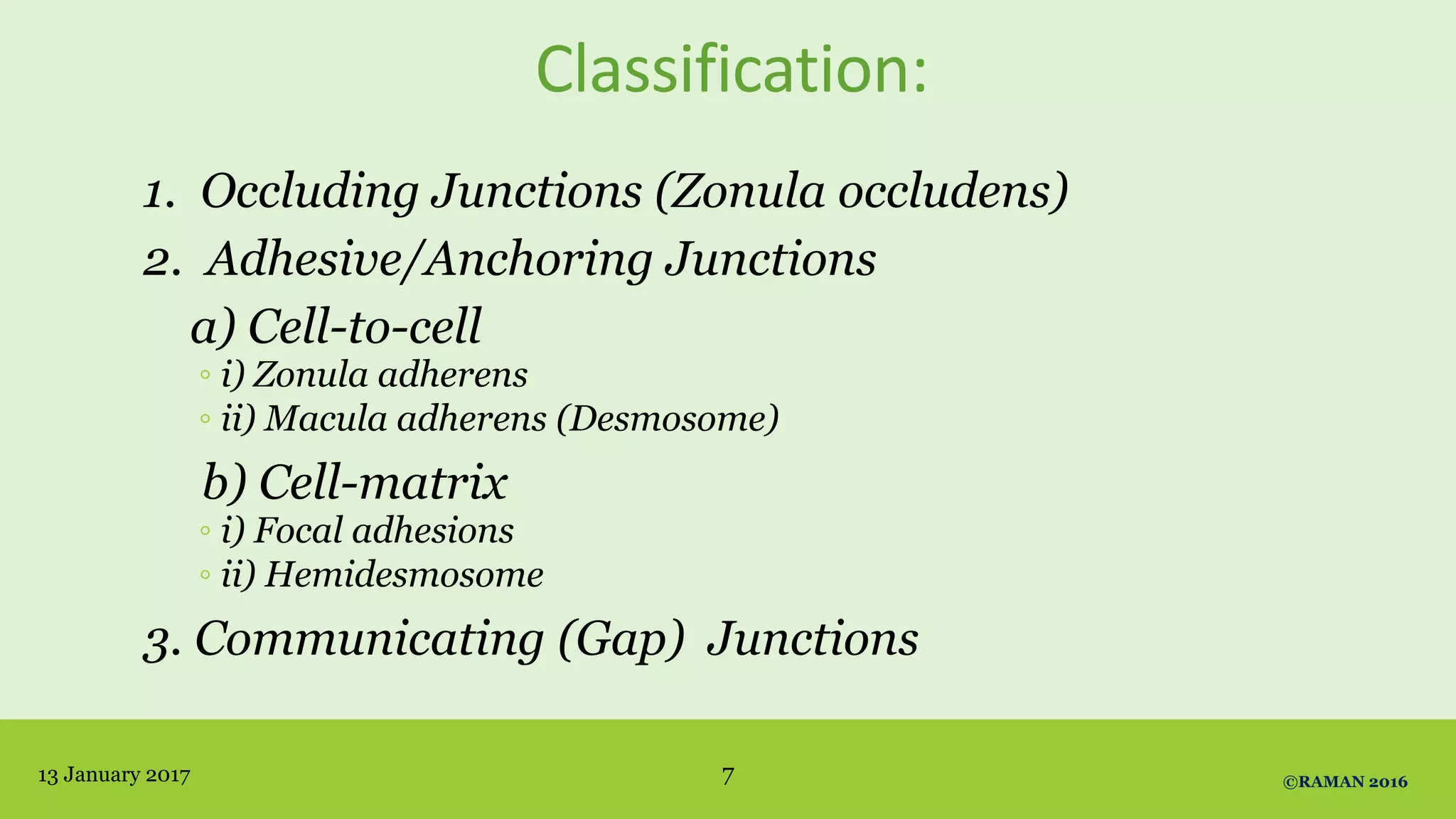
Classification:
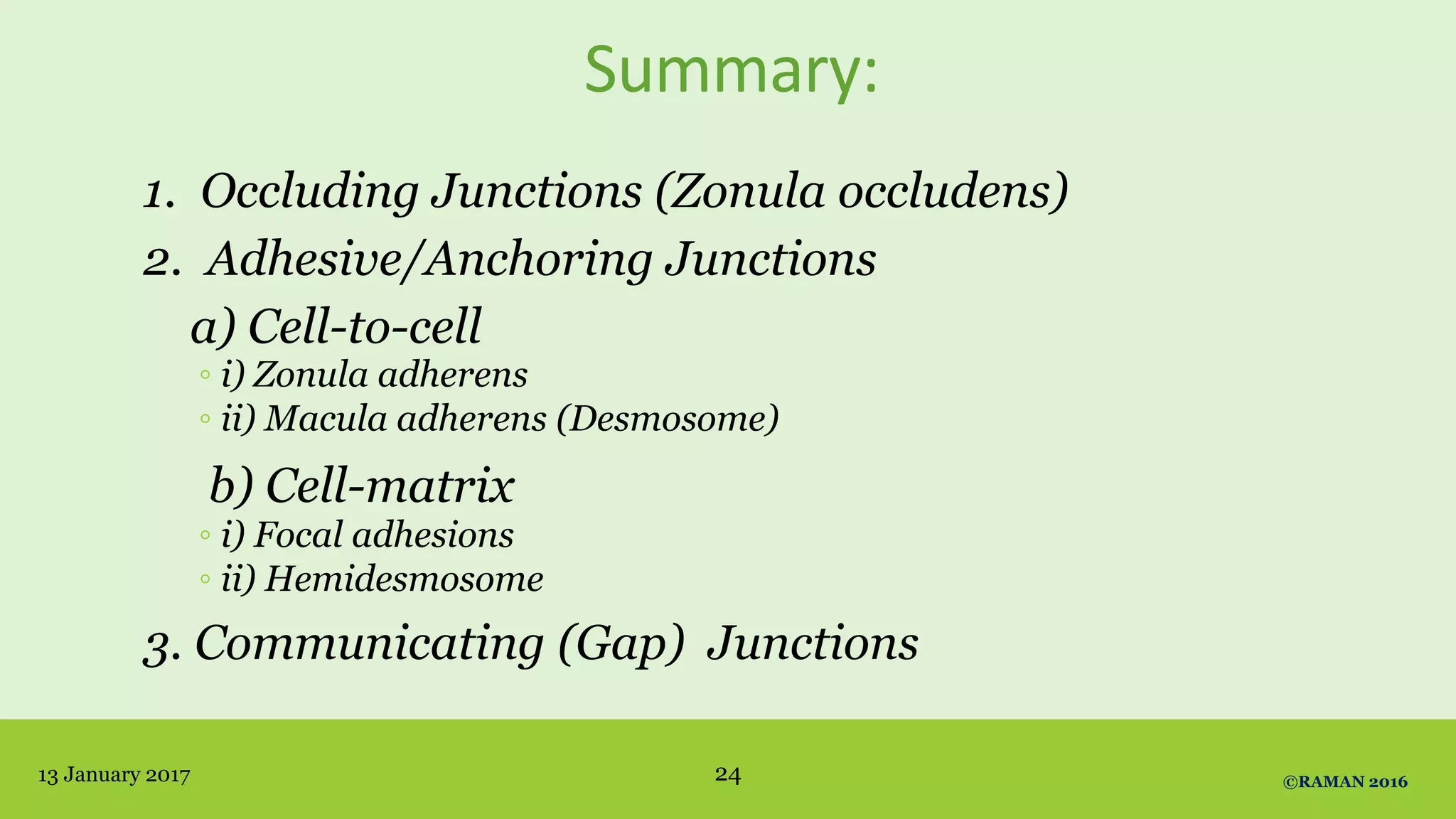
1. Occluding Junctions (Zonula occludens)
2. Adhesive/Anchoring Junctions
a) Cell-to-cell
◦ i) Zonula adherens
◦ ii) Macula adherens (Desmosome)
b) Cell-matrix
◦ i) Focal adhesions
◦ ii) Hemidesmosome
3. Communicating (Gap) Junctions
13 January 2017 7 ©RAMAN 2016
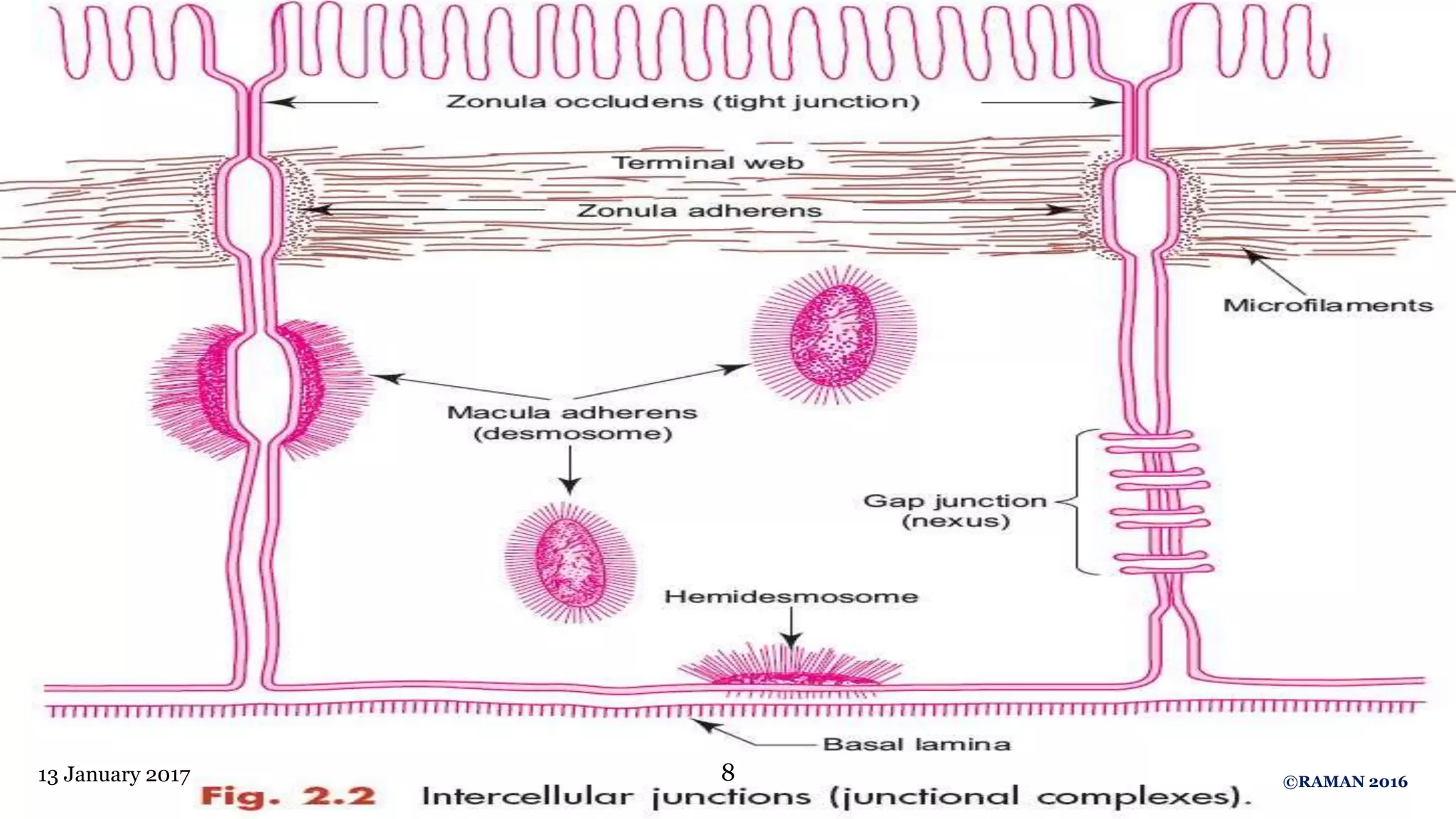
13 January 2017 ©RAMAN 20168
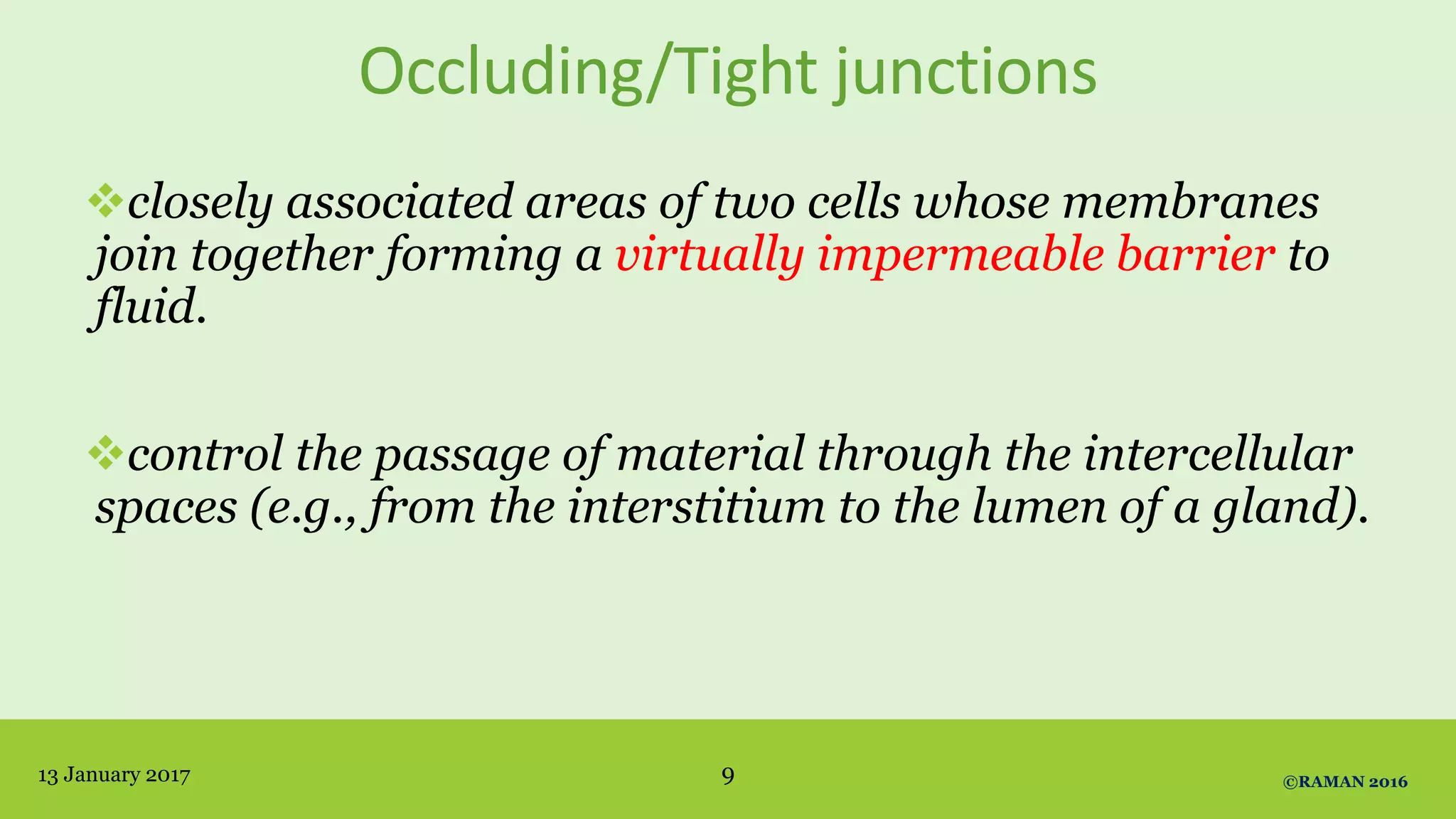
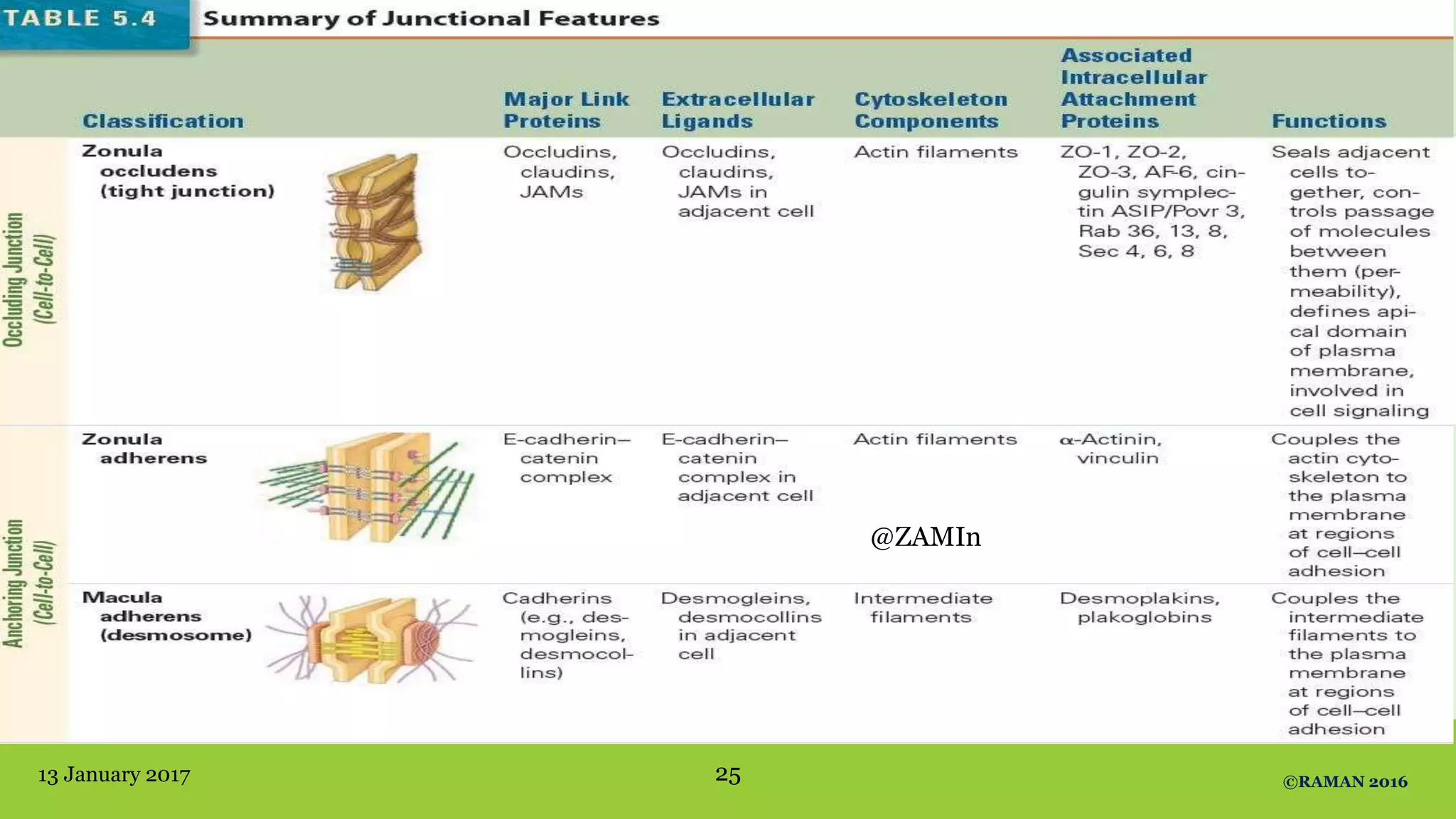
Occluding/Tight junctions
closely associated areas of two cells whose membranes
join together forming a virtually impermeable barrier to
fluid.
control the passage of material through the intercellular
spaces (e.g., from the interstitium to the lumen of a gland).
13 January 2017 ©RAMAN 20169
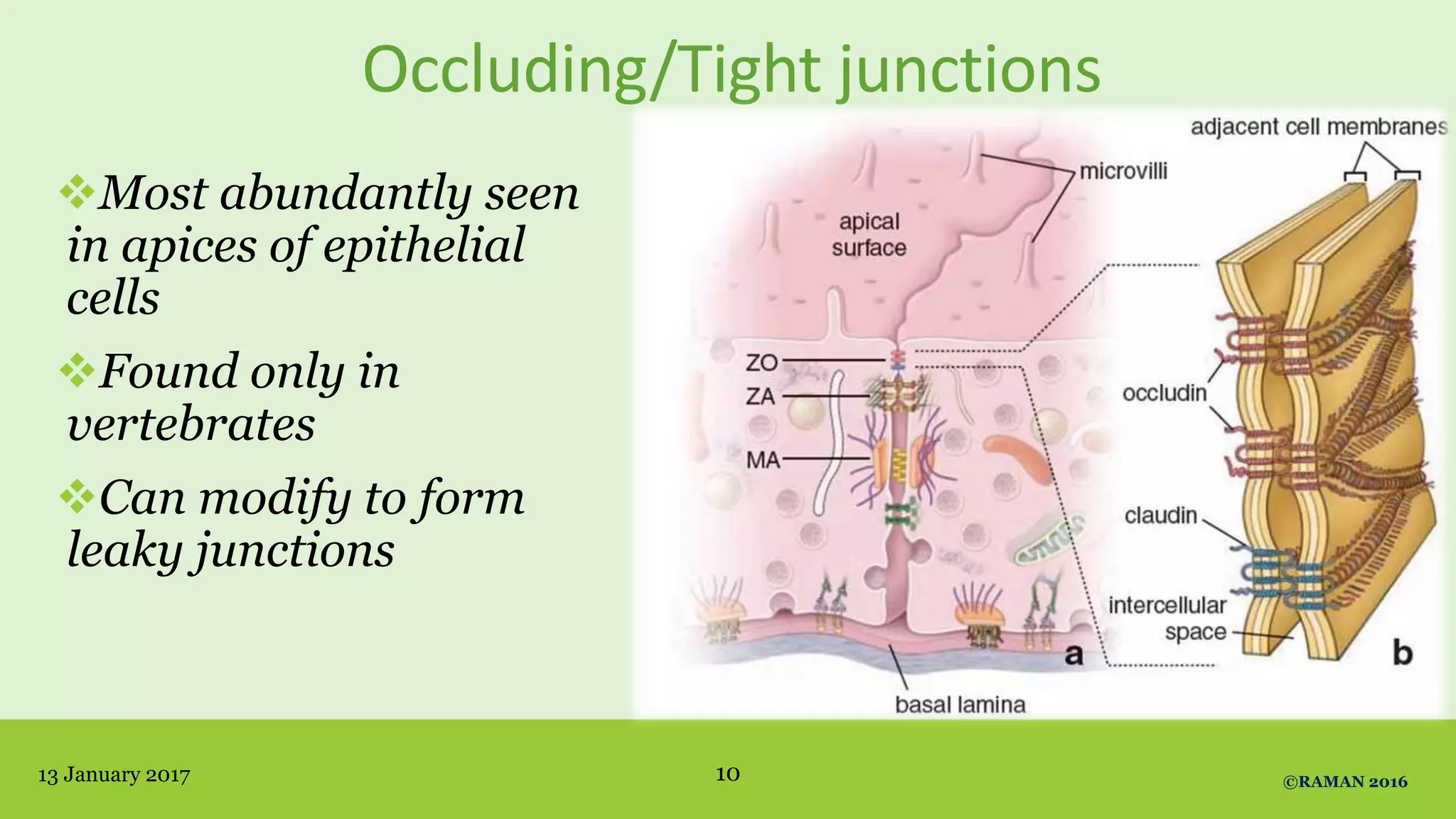
Occluding/Tight junctions
Most abundantly seen
in apices of epithelial
cells
Found only in
vertebrates
Can modify to form
leaky junctions
13 January 2017 ©RAMAN 201610
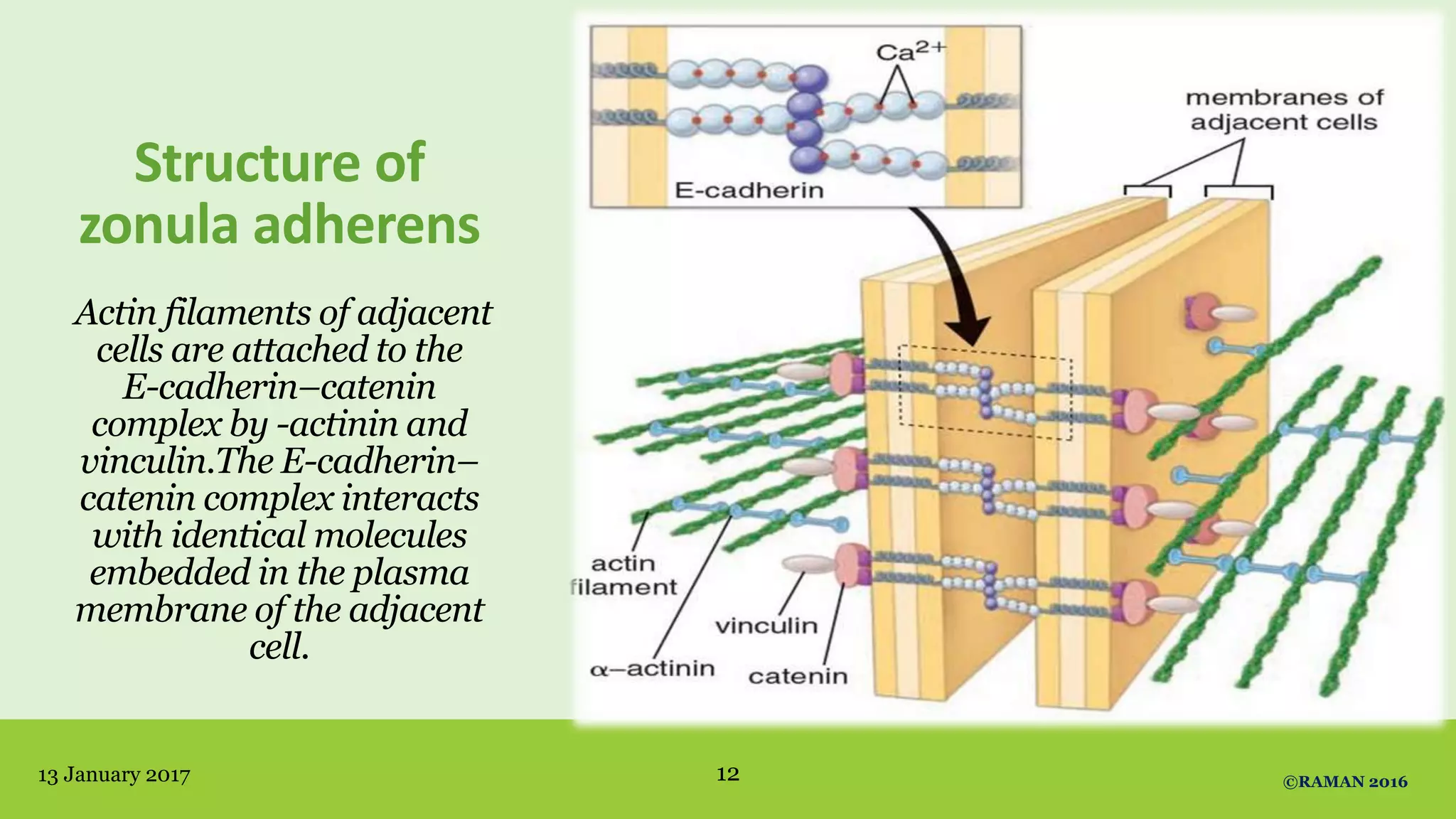
Anchoring junctions(cell to cell)
-provide strength to the cell by mechanical attachment.
Two types on the lateral cell surface:
 zonula adherens ,which interacts with the network of actin
filaments inside the cell; and
 macula adherens or desmosome, which interacts with
intermediate filaments.
13 January 2017 ©RAMAN 201611
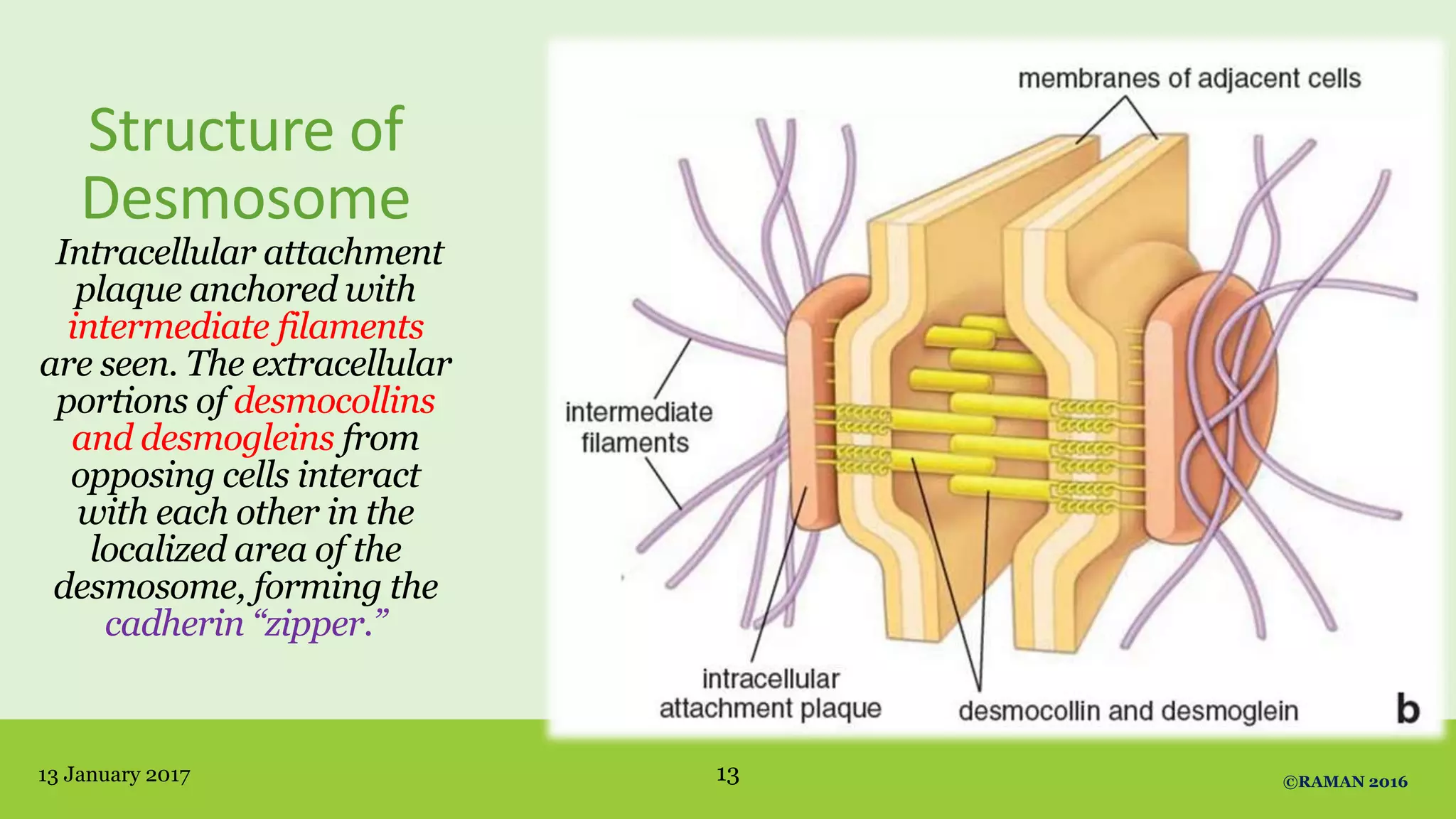
Structure of
zonula adherens
Actin filaments of adjacent
cells are attached to the
E-cadherin–catenin
complex by -actinin and
vinculin.The E-cadherin–
catenin complex interacts
with identical molecules
embedded in the plasma
membrane of the adjacent
cell.
13 January 2017 ©RAMAN 201612
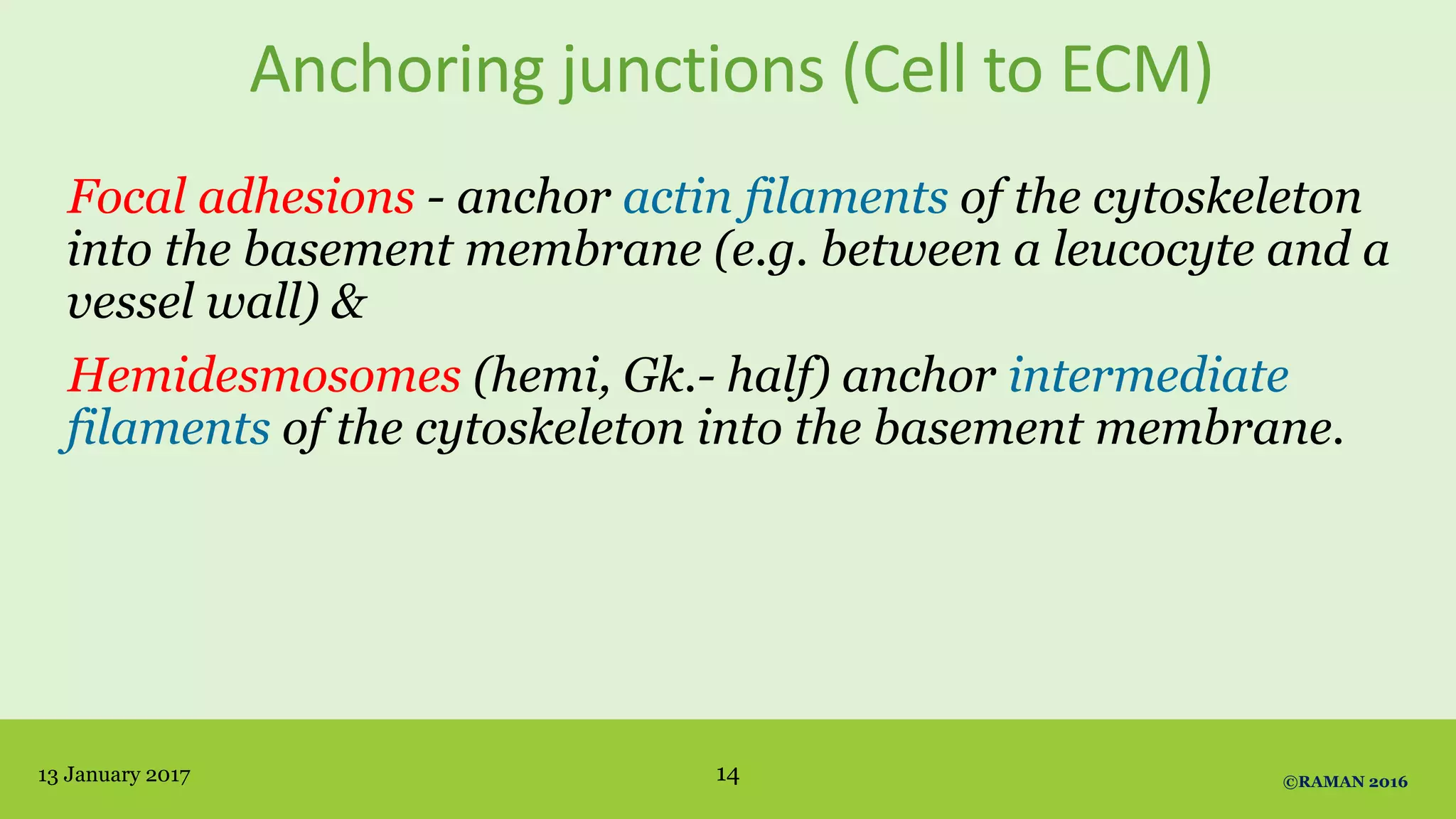
Structure of
Desmosome
Intracellular attachment
plaque anchored with
intermediate filaments
are seen. The extracellular
portions of desmocollins
and desmogleins from
opposing cells interact
with each other in the
localized area of the
desmosome, forming the
cadherin “zipper.”
13 January 2017 13 ©RAMAN 2016
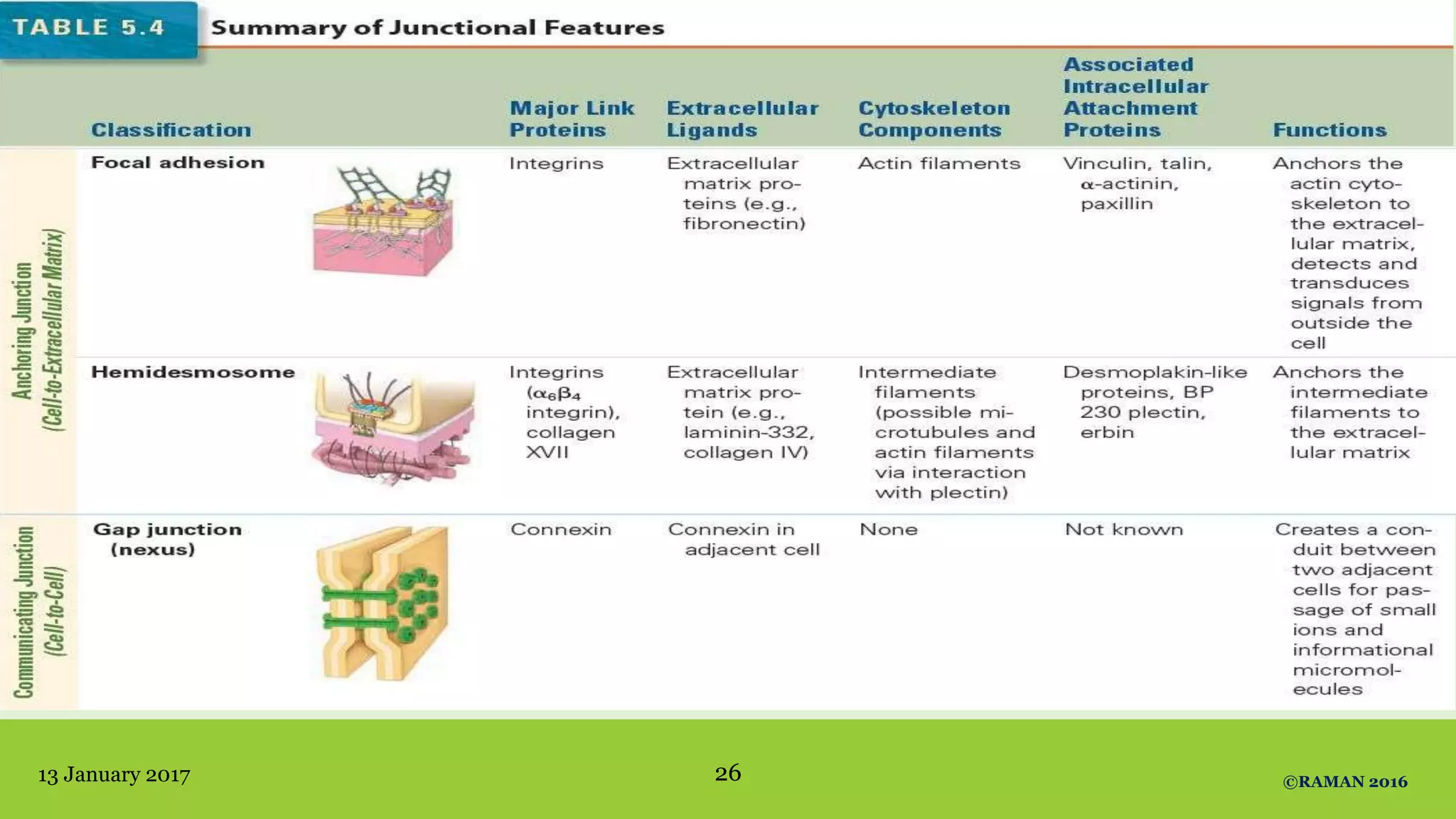
Anchoring junctions (Cell to ECM)
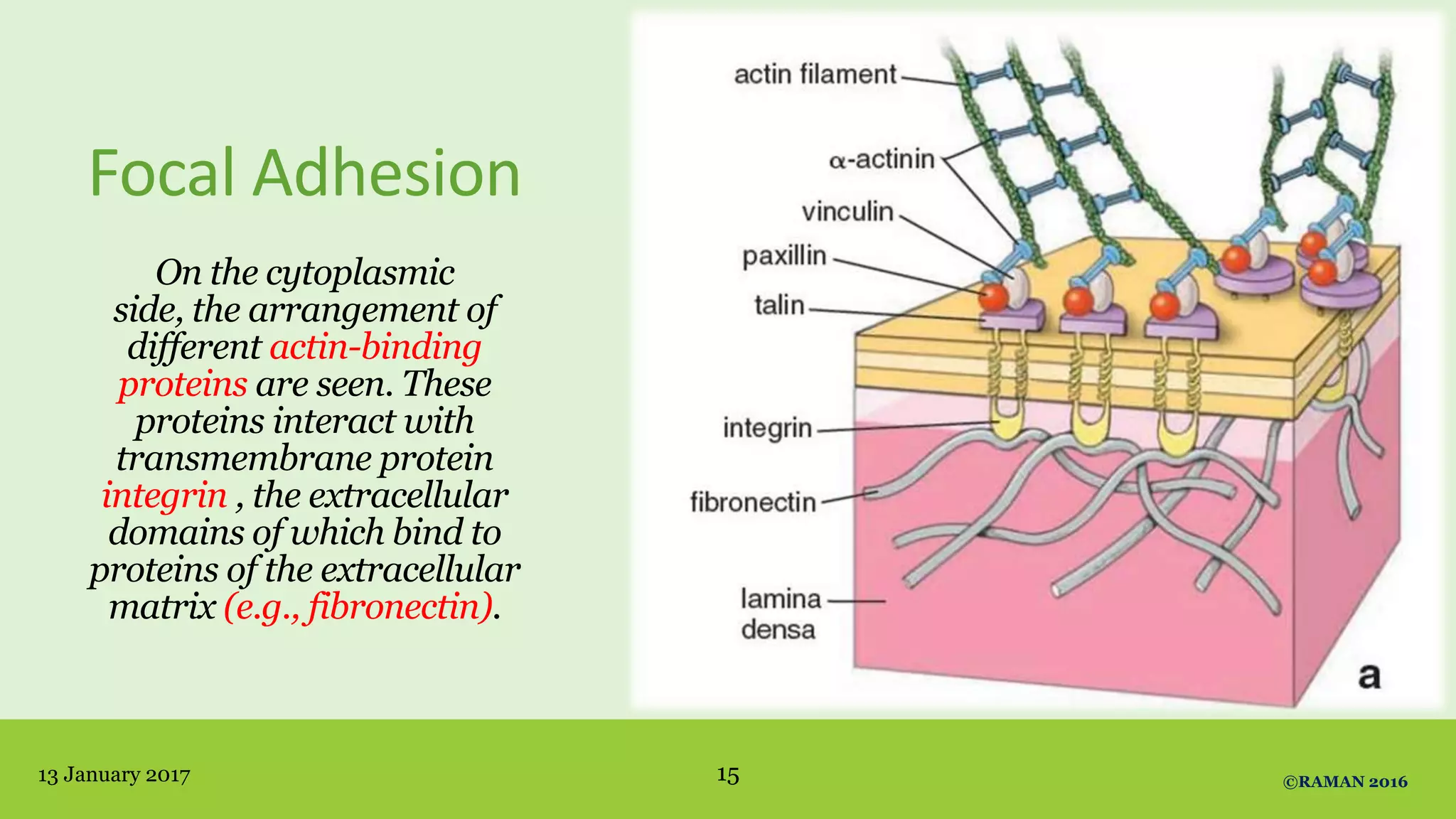
Focal adhesions - anchor actin filaments of the cytoskeleton
into the basement membrane (e.g. between a leucocyte and a
vessel wall) &
Hemidesmosomes (hemi, Gk.- half) anchor intermediate
filaments of the cytoskeleton into the basement membrane.
13 January 2017 ©RAMAN 201614
Focal Adhesion
On the cytoplasmic
side, the arrangement of
different actin-binding
proteins are seen. These
proteins interact with
transmembrane protein
integrin , the extracellular
domains of which bind to
proteins of the extracellular
matrix (e.g., fibronectin).
13 January 2017 ©RAMAN 201615
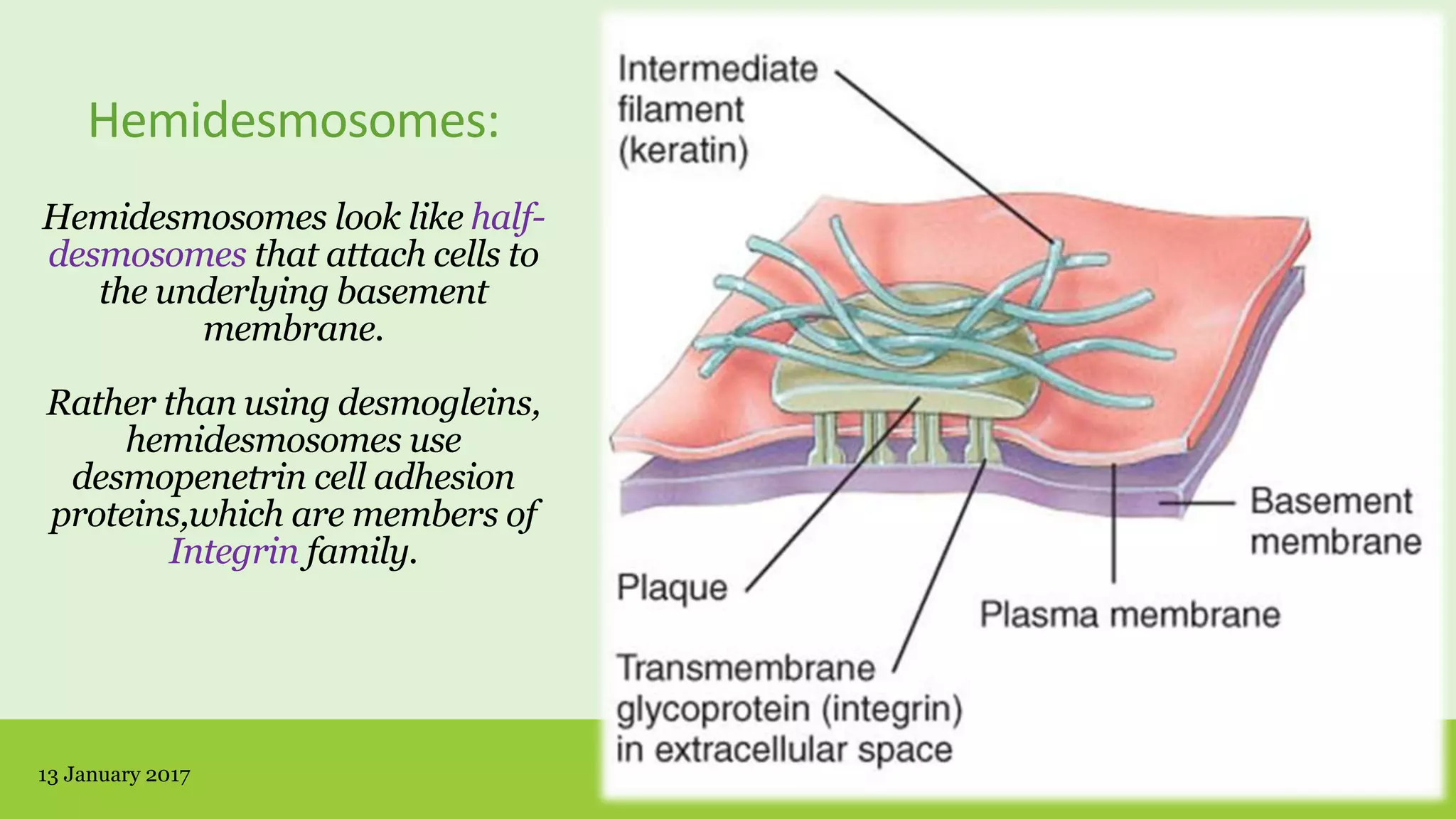
Hemidesmosomes:
Hemidesmosomes look like half-
desmosomes that attach cells to
the underlying basement
membrane.
Rather than using desmogleins,
hemidesmosomes use
desmopenetrin cell adhesion
proteins,which are members of
Integrin family.
13 January 2017 ©RAMAN 201616
Gap junctions:
clusters of intercellular channels that allow direct diffusion
of ions and small molecules between adjacent cells.
intercellular space narrows from 25 nm to 3 nm.
first discovered in myocardium and nerves between
adjacent cells because of their properties of electrical
transmission
13 January 2017 ©RAMAN 201617
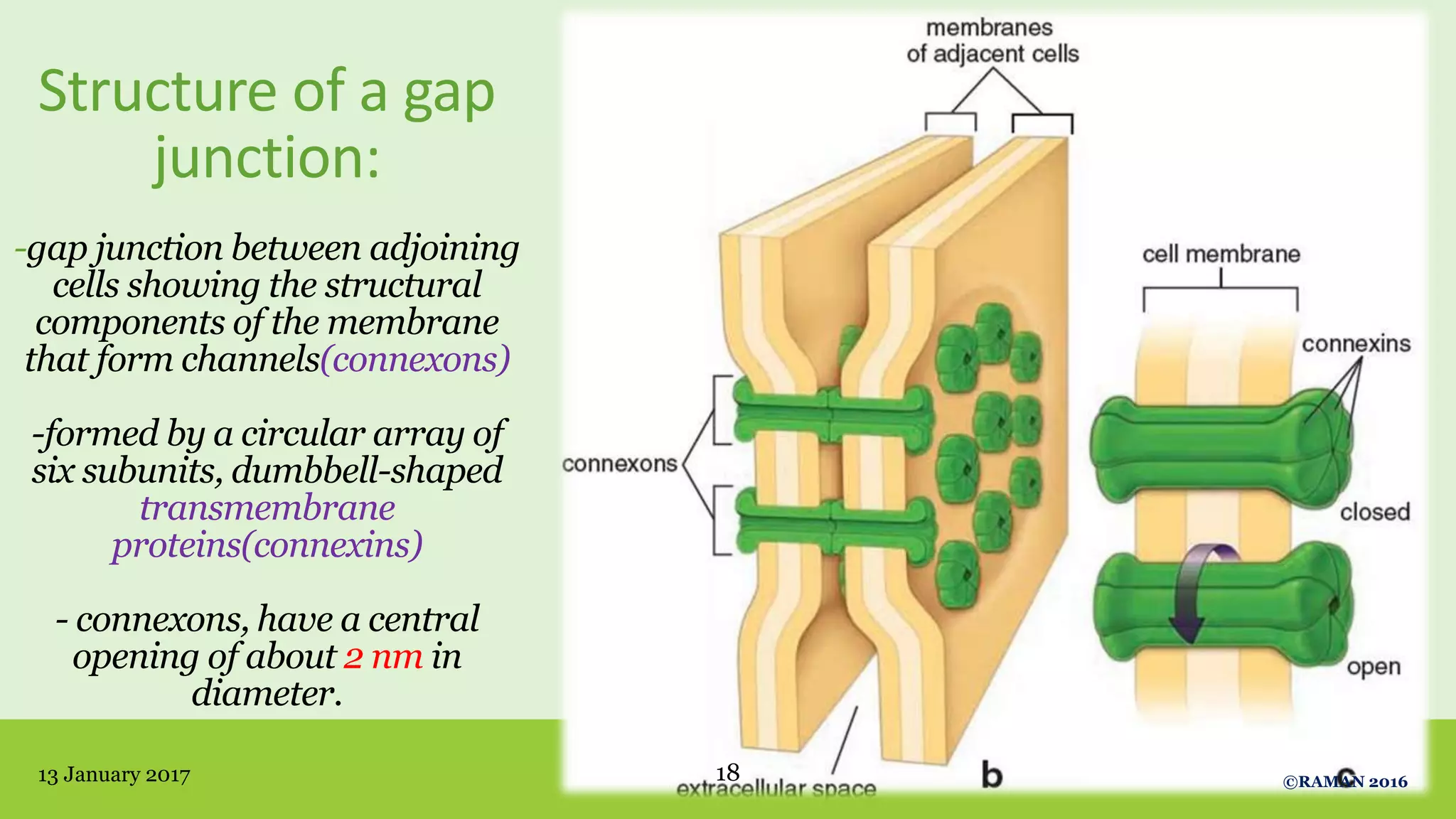
Structure of a gap
junction:
-gap junction between adjoining
cells showing the structural
components of the membrane
that form channels(connexons)
-formed by a circular array of
six subunits, dumbbell-shaped
transmembrane
proteins(connexins)
- connexons, have a central
opening of about 2 nm in
diameter.
13 January 2017 18 ©RAMAN 2016
Clinical Significance:
Cell – cell and cell – matrix junctions have important
role in differentiation, development & function of
normal cells, tissues and organs.
However, function may be altered by genetic
abnormalities of junctional or cytoskeletal proteins, or
by autoimmune disease.
13 January 2017 ©RAMAN 201619
Clinical Significance:
Mutation of gene of desmosome, hemidesmosome and
intermediate filament protein :
i. Epidermolysis bullosa
ii.Blistering skin disorder
Mutation of gene of extracellular matrix proteins:
i. Pemphigus vulgaris
ii.Pemphigus foliaceous
13 January 2017 ©RAMAN 201620
Pemphigus Vulgaris
- an autoimmune
disease
-antibodies against
proteins
Blistering disease of
oral mucosa:
antibodies against
desmoglein-3 &
Skin: antibodies
against desmoglein-1
13 January 2017 ©RAMAN 201621
Clinical significance:
13 January 2017 ©RAMAN 201622
Mutation in the gene encoding connexin-26 (Cx26)
-congenital deafness.
Cx46 and Cx50 gene mutations- congenital
cataracts
bullous pemphigoid- presence of autoantibodies to
collagen XVII (BP180) and BP230.
Clinical Significance:
Mutation of connexins may also cause:
Demyelinating disease (Charcot-Marie Tooth)
 Oculodentodigital dysplasia –ODD syndrome
13 January 2017 ©RAMAN 201623
Summary:
1. Occluding Junctions (Zonula occludens)
2. Adhesive/Anchoring Junctions
a) Cell-to-cell
◦ i) Zonula adherens
◦ ii) Macula adherens (Desmosome)
b) Cell-matrix
◦ i) Focal adhesions
◦ ii) Hemidesmosome
3. Communicating (Gap) Junctions
13 January 2017 24 ©RAMAN 2016
13 January 2017 ©RAMAN 201625
@ZAMIn
13 January 2017 ©RAMAN 201626
MCQ
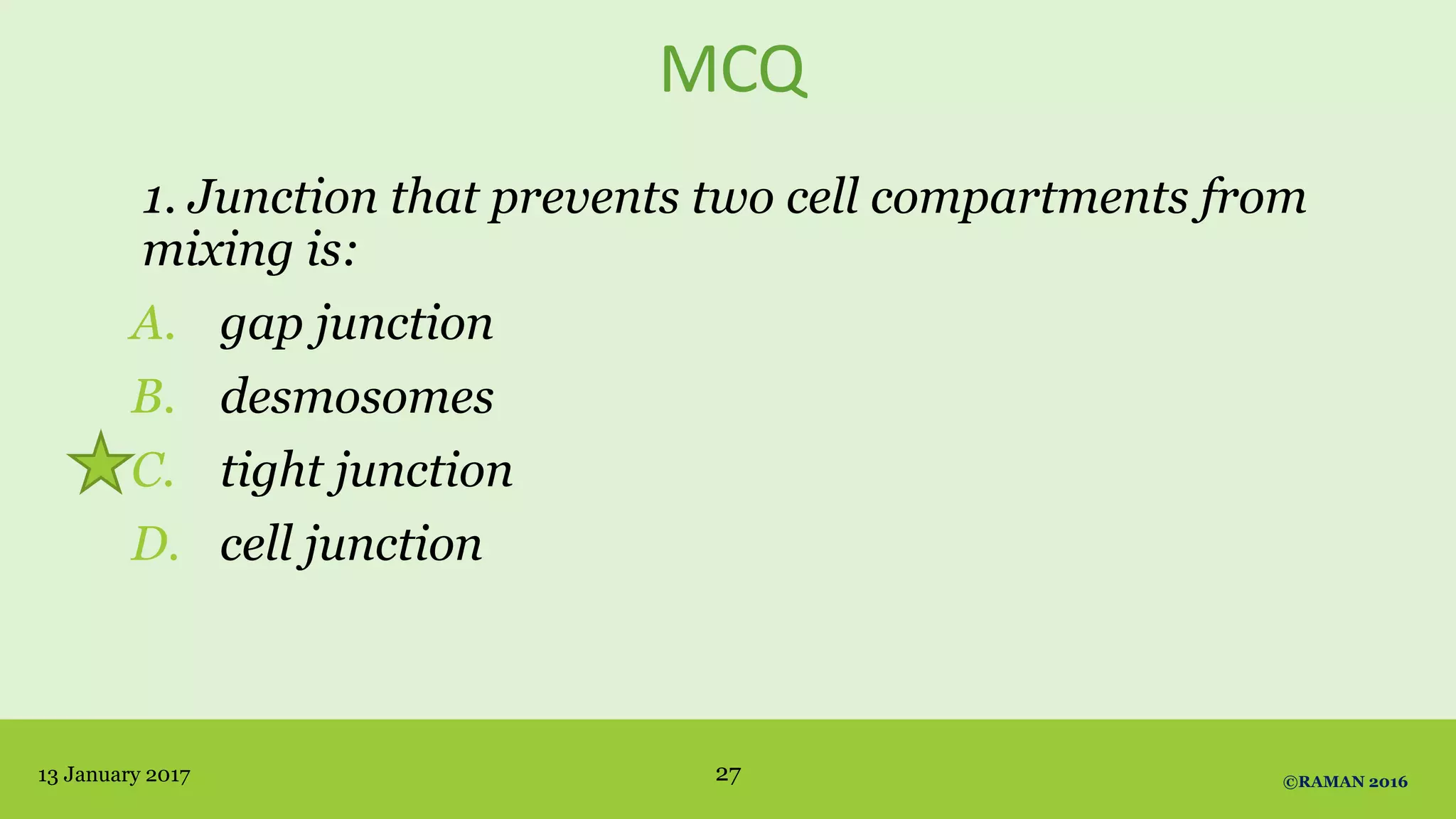
1. Junction that prevents two cell compartments from
mixing is:
A. gap junction
B. desmosomes
C. tight junction
D. cell junction
13 January 2017 ©RAMAN 201627
MCQ
2. Pore- like connections between adjacent cells is an
example of
A. cell junction
B. desmosomes
C. tight junction
D. gap junction
13 January 2017 ©RAMAN 201628
MCQ
3. Which of the following is a cell adhesion molecule
A. Lysin
B. Myosin
C. Integrin
D. Keratin
13 January 2017 ©RAMAN 201629
MCQ
4. Tight junctions:
A. are essential for metabolic coupling
B. don’t occur in vertebrates
C. have the closest approach of two plasma
membranes of any junction
D. surround connexons
13 January 2017 ©RAMAN 201630
MCQ
5. Hemi desmosome differs from spot desmosome in
that hemi desmosome:
A. connects cell to cell
B. connects extracellular matrix to extracellular
matrix
C. connects cell to extracellular matrix
D. has tonofilament , made up of intermediate
filament
13 January 2017 ©RAMAN 201631
13 January 2017
References:
32 ©RAMAN 2016
13 January 2017 ©RAMAN 201633

Intercellular Junctions - Types and Location with MCQs

  • 1.
    Intercellular Junctions 13 January2017 Resource Faculty: Dr. Ashish Shrestha Dr. Vinay Marla Prepared By: Raman Dhungel BDS 2014 , BPKIHS 1 ©RAMAN 2016
  • 2.
    Objectives: We shall bediscussing: about different types of intercellular junctions about the location of these junctions about the proteins and structural molecules involved about clinical abnormalities 13 January 2017 2 ©RAMAN 2016
  • 3.
    Contents:  Introduction tointercellular junctions Classification Functions Proteins involved Clinical significance Summary & MCQs 13 January 2017 3 ©RAMAN 2016
  • 4.
    What are intercellularjunctions? points of contact between the plasma membranes of adjacent cells. consist of multi-protein complexes that provide contact between neighboring cells or between a cell and the extracellular matrix. 13 January 2017 4 ©RAMAN 2016
  • 5.
    Composition: Typically consist ofthree components: a transmembrane adhesive protein, a cytoplasmic adapter protein,& a cytoskeletal filament. 13 January 2017 ©RAMAN 20165
  • 6.
    Functions of intercellularjunctions: Cell junctions may : - Form fluid-tight seal between cells. - Anchor cells together or to extracellular materials. - Allow ions/molecules to pass from cell to another cell within a tissue. 13 January 2017 ©RAMAN 20166
  • 7.
    Classification: 1. Occluding Junctions(Zonula occludens) 2. Adhesive/Anchoring Junctions a) Cell-to-cell ◦ i) Zonula adherens ◦ ii) Macula adherens (Desmosome) b) Cell-matrix ◦ i) Focal adhesions ◦ ii) Hemidesmosome 3. Communicating (Gap) Junctions 13 January 2017 7 ©RAMAN 2016
  • 8.
    13 January 2017©RAMAN 20168
  • 9.
    Occluding/Tight junctions closely associatedareas of two cells whose membranes join together forming a virtually impermeable barrier to fluid. control the passage of material through the intercellular spaces (e.g., from the interstitium to the lumen of a gland). 13 January 2017 ©RAMAN 20169
  • 10.
    Occluding/Tight junctions Most abundantlyseen in apices of epithelial cells Found only in vertebrates Can modify to form leaky junctions 13 January 2017 ©RAMAN 201610
  • 11.
    Anchoring junctions(cell tocell) -provide strength to the cell by mechanical attachment. Two types on the lateral cell surface:  zonula adherens ,which interacts with the network of actin filaments inside the cell; and  macula adherens or desmosome, which interacts with intermediate filaments. 13 January 2017 ©RAMAN 201611
  • 12.
    Structure of zonula adherens Actinfilaments of adjacent cells are attached to the E-cadherin–catenin complex by -actinin and vinculin.The E-cadherin– catenin complex interacts with identical molecules embedded in the plasma membrane of the adjacent cell. 13 January 2017 ©RAMAN 201612
  • 13.
    Structure of Desmosome Intracellular attachment plaqueanchored with intermediate filaments are seen. The extracellular portions of desmocollins and desmogleins from opposing cells interact with each other in the localized area of the desmosome, forming the cadherin “zipper.” 13 January 2017 13 ©RAMAN 2016
  • 14.
    Anchoring junctions (Cellto ECM) Focal adhesions - anchor actin filaments of the cytoskeleton into the basement membrane (e.g. between a leucocyte and a vessel wall) & Hemidesmosomes (hemi, Gk.- half) anchor intermediate filaments of the cytoskeleton into the basement membrane. 13 January 2017 ©RAMAN 201614
  • 15.
    Focal Adhesion On thecytoplasmic side, the arrangement of different actin-binding proteins are seen. These proteins interact with transmembrane protein integrin , the extracellular domains of which bind to proteins of the extracellular matrix (e.g., fibronectin). 13 January 2017 ©RAMAN 201615
  • 16.
    Hemidesmosomes: Hemidesmosomes look likehalf- desmosomes that attach cells to the underlying basement membrane. Rather than using desmogleins, hemidesmosomes use desmopenetrin cell adhesion proteins,which are members of Integrin family. 13 January 2017 ©RAMAN 201616
  • 17.
    Gap junctions: clusters ofintercellular channels that allow direct diffusion of ions and small molecules between adjacent cells. intercellular space narrows from 25 nm to 3 nm. first discovered in myocardium and nerves between adjacent cells because of their properties of electrical transmission 13 January 2017 ©RAMAN 201617
  • 18.
    Structure of agap junction: -gap junction between adjoining cells showing the structural components of the membrane that form channels(connexons) -formed by a circular array of six subunits, dumbbell-shaped transmembrane proteins(connexins) - connexons, have a central opening of about 2 nm in diameter. 13 January 2017 18 ©RAMAN 2016
  • 19.
    Clinical Significance: Cell –cell and cell – matrix junctions have important role in differentiation, development & function of normal cells, tissues and organs. However, function may be altered by genetic abnormalities of junctional or cytoskeletal proteins, or by autoimmune disease. 13 January 2017 ©RAMAN 201619
  • 20.
    Clinical Significance: Mutation ofgene of desmosome, hemidesmosome and intermediate filament protein : i. Epidermolysis bullosa ii.Blistering skin disorder Mutation of gene of extracellular matrix proteins: i. Pemphigus vulgaris ii.Pemphigus foliaceous 13 January 2017 ©RAMAN 201620
  • 21.
    Pemphigus Vulgaris - anautoimmune disease -antibodies against proteins Blistering disease of oral mucosa: antibodies against desmoglein-3 & Skin: antibodies against desmoglein-1 13 January 2017 ©RAMAN 201621
  • 22.
    Clinical significance: 13 January2017 ©RAMAN 201622 Mutation in the gene encoding connexin-26 (Cx26) -congenital deafness. Cx46 and Cx50 gene mutations- congenital cataracts bullous pemphigoid- presence of autoantibodies to collagen XVII (BP180) and BP230.
  • 23.
    Clinical Significance: Mutation ofconnexins may also cause: Demyelinating disease (Charcot-Marie Tooth)  Oculodentodigital dysplasia –ODD syndrome 13 January 2017 ©RAMAN 201623
  • 24.
    Summary: 1. Occluding Junctions(Zonula occludens) 2. Adhesive/Anchoring Junctions a) Cell-to-cell ◦ i) Zonula adherens ◦ ii) Macula adherens (Desmosome) b) Cell-matrix ◦ i) Focal adhesions ◦ ii) Hemidesmosome 3. Communicating (Gap) Junctions 13 January 2017 24 ©RAMAN 2016
  • 25.
    13 January 2017©RAMAN 201625 @ZAMIn
  • 26.
    13 January 2017©RAMAN 201626
  • 27.
    MCQ 1. Junction thatprevents two cell compartments from mixing is: A. gap junction B. desmosomes C. tight junction D. cell junction 13 January 2017 ©RAMAN 201627
  • 28.
    MCQ 2. Pore- likeconnections between adjacent cells is an example of A. cell junction B. desmosomes C. tight junction D. gap junction 13 January 2017 ©RAMAN 201628
  • 29.
    MCQ 3. Which ofthe following is a cell adhesion molecule A. Lysin B. Myosin C. Integrin D. Keratin 13 January 2017 ©RAMAN 201629
  • 30.
    MCQ 4. Tight junctions: A.are essential for metabolic coupling B. don’t occur in vertebrates C. have the closest approach of two plasma membranes of any junction D. surround connexons 13 January 2017 ©RAMAN 201630
  • 31.
    MCQ 5. Hemi desmosomediffers from spot desmosome in that hemi desmosome: A. connects cell to cell B. connects extracellular matrix to extracellular matrix C. connects cell to extracellular matrix D. has tonofilament , made up of intermediate filament 13 January 2017 ©RAMAN 201631
  • 32.
  • 33.
    13 January 2017©RAMAN 201633

Editor's Notes

  • #10 Functions of tight junctions: Strength and stability Selective permeability for ions (leaky tight junctions) Fencing function Maintenance of cell polarity Blood-brain barrier
  • #13 In the zonula adherens the cadherin family member is E-cadherin, α- and β-catenin are the cytoplasmic adapters, and actin filaments are the cytoskeletal component. The catenins and actin filaments are concentrated on the cytoplasmic side of the cell membrane at the zonula adherens to form a dense web that is continuous with the terminal web of actin at the apical (and sometimes the basal) end of the cells.
  • #14 In the desmosome ,the cadherins are desmoglein and desmocollin. The interaction of these transmembrane proteins with those from the adjacent cell results in a dense line in the middle of the intercellular space at the desmosome. The catenins are desmoplakin, plakoglobin, and plakophilin, which form an electron-dense plaque on the cytoplasmic side of the desmosome. Eg. Between odontoblasts
  • #18 Plasmodesmata in plants Function of gap junction- channel passage the substance have molecular weight less than 1000. Exchange of chemical messenger between cells Rapid propagation of action potential from one cell to another cell.
  • #19 present in heart, basal part of epithelial cell of intestinal mucosa Eg:lateral surface of odontoblasts, between osteoblast process and osteocyte process
  • #24 Oculodentodigital syndrome (ODD syndrome) is an extremely rare genetic condition that typically results in small eyes, underdeveloped teeth, and syndactyly and malformation of the fourth and fifth fingers