AIR POLLUTION
-Ladi Anudeep
ISM IUK
INTRODUCTION
• air pollution is the introduction of particulates, biological
molecules or harmful materials into earth's atmosphere
causing diseases, death to humans, damage to other
living organisms such as animals and food crops or
naturall or built environment
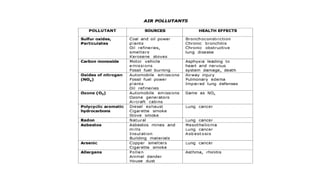
• the agents which cause polllution is called as pollutants
• there are two types of pollutants
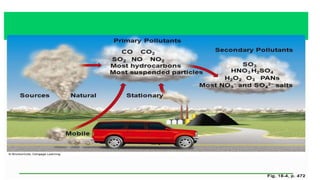
• PRIMARY POLLUTANT:
• It is air pollutant emitted directly from a source
• SECONDARY POLLUTANT:
• It is not directy emitted from source but forms when other
pollutants react in atmosphere
sources
• Sources refer to location or factors which are responsible for releasing pollutants in
atmosphere
• 2 categories :
• 1) ANTHROPOGENIC SOURCES ( Human Activity):
• stationary sources like smoke, stacks of power plants
• mobile sources, motor vehicles, air crafts, chemicals, dust, controled burn practices
in agriculture and forestry management, fumes, aerial sprays,and other solvents
• 2) NATURAL SOURCES:
• Radon gas from radio active decay with in earth's crust
• methane emitted by digestion of food by animals
• dust from natural sources
• land with no vegetationsmoke and CO2 from wild fires
EFFECTS OF AIR POLLUTION
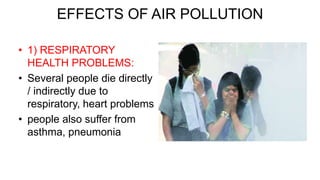
• 1) RESPIRATORY
HEALTH PROBLEMS:
• Several people die directly
/ indirectly due to
respiratory, heart problems
• people also suffer from
asthma, pneumonia
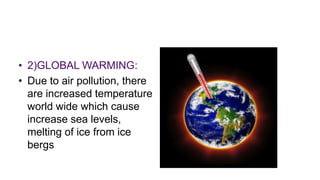
• 2)GLOBAL WARMING:
• Due to air pollution, there
are increased temperature
world wide which cause
increase sea levels,
melting of ice from ice
bergs
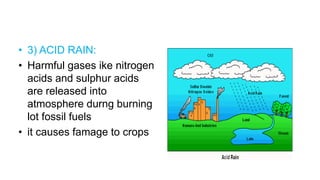
• 3) ACID RAIN:
• Harmful gases ike nitrogen
acids and sulphur acids
are released into
atmosphere durng burning
lot fossil fuels
• it causes famage to crops
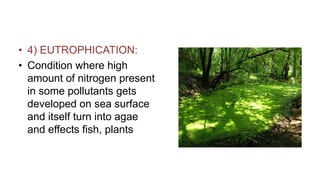
• 4) EUTROPHICATION:
• Condition where high
amount of nitrogen present
in some pollutants gets
developed on sea surface
and itself turn into agae
and effects fish, plants
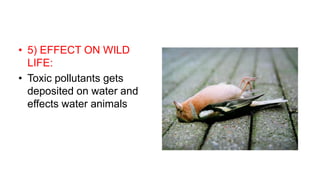
• 5) EFFECT ON WILD
LIFE:
• Toxic pollutants gets
deposited on water and
effects water animals
CONTROL MEASURES
• The atmosphere has several built in self ceaning processes such as dispersion, gravitational
settling, floccuation, absorption, rain washout etc to cleanse the atmosphere
• SOURCE CONTROL: some measures that can be adopted in this direction are
• 1) using unleaded petrol
• 2) using fuels with low sulphur and ash content
• 3) encouraging people to use pubic transport, walk or use a cycle as opposed to private
vehicles
• 4) ensure that houses, schools, restaurants and play grounds are not located on busy streets
• 5) plant trees along busy streets as they remove paticulates ike CO2 and absorb noise
• 6) industries and waste disposal sites should be situated outside the city
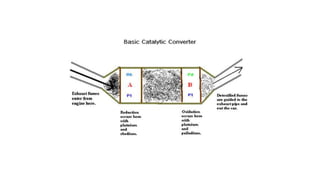
• 7) catalytic converts should be used to hep control emissions of carbonmonoxide and
hydrocarbons
Air pollution
Air pollution
Air pollution
Air pollution

Air pollution

  • 1.
  • 2.
    INTRODUCTION • air pollutionis the introduction of particulates, biological molecules or harmful materials into earth's atmosphere causing diseases, death to humans, damage to other living organisms such as animals and food crops or naturall or built environment • the agents which cause polllution is called as pollutants • there are two types of pollutants
  • 4.
    • PRIMARY POLLUTANT: •It is air pollutant emitted directly from a source • SECONDARY POLLUTANT: • It is not directy emitted from source but forms when other pollutants react in atmosphere
  • 6.
    sources • Sources referto location or factors which are responsible for releasing pollutants in atmosphere • 2 categories : • 1) ANTHROPOGENIC SOURCES ( Human Activity): • stationary sources like smoke, stacks of power plants • mobile sources, motor vehicles, air crafts, chemicals, dust, controled burn practices in agriculture and forestry management, fumes, aerial sprays,and other solvents • 2) NATURAL SOURCES: • Radon gas from radio active decay with in earth's crust • methane emitted by digestion of food by animals • dust from natural sources • land with no vegetationsmoke and CO2 from wild fires
  • 7.
    EFFECTS OF AIRPOLLUTION • 1) RESPIRATORY HEALTH PROBLEMS: • Several people die directly / indirectly due to respiratory, heart problems • people also suffer from asthma, pneumonia
  • 8.
    • 2)GLOBAL WARMING: •Due to air pollution, there are increased temperature world wide which cause increase sea levels, melting of ice from ice bergs
  • 9.
    • 3) ACIDRAIN: • Harmful gases ike nitrogen acids and sulphur acids are released into atmosphere durng burning lot fossil fuels • it causes famage to crops
  • 10.
    • 4) EUTROPHICATION: •Condition where high amount of nitrogen present in some pollutants gets developed on sea surface and itself turn into agae and effects fish, plants
  • 11.
    • 5) EFFECTON WILD LIFE: • Toxic pollutants gets deposited on water and effects water animals
  • 12.
    CONTROL MEASURES • Theatmosphere has several built in self ceaning processes such as dispersion, gravitational settling, floccuation, absorption, rain washout etc to cleanse the atmosphere • SOURCE CONTROL: some measures that can be adopted in this direction are • 1) using unleaded petrol • 2) using fuels with low sulphur and ash content • 3) encouraging people to use pubic transport, walk or use a cycle as opposed to private vehicles • 4) ensure that houses, schools, restaurants and play grounds are not located on busy streets • 5) plant trees along busy streets as they remove paticulates ike CO2 and absorb noise • 6) industries and waste disposal sites should be situated outside the city • 7) catalytic converts should be used to hep control emissions of carbonmonoxide and hydrocarbons