Characteristics of Living Things
 Reproduction
 Growth
Characteristics of Living Things
 Development
 Energy Capture
Characteristics of Living Things
 Energy Utilization
 Response to Stimuli
Characteristics of Living Things
 Composed of Cells
 Adaptation
Basic Chemistry
Textbook Chapter 2 (Sections 1 and 3)
Biochemistry
 Atom: single unit,
found on periodic table
 Molecule: combination
of multiple atoms via
bonds
 Element (atoms) vs.
Compound (molecules)
Bonding
 Ionic Bond – atoms
gain/lose electrons
and take on pos./neg.
charge
 Covalent Bond –
atoms share electrons
(stronger; larger
molecules)
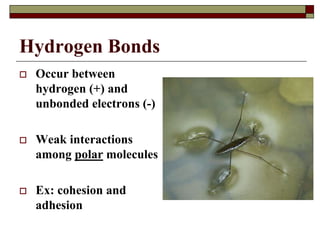
Hydrogen Bonds
 Occur between
hydrogen (+) and
unbonded electrons (-)
 Weak interactions
among polar molecules
 Ex: cohesion and
adhesion
Biochemistry
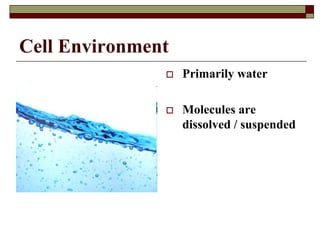
Cell Environment
 Primarily water
 Molecules are
dissolved / suspended
Types of Solute
 (Solute = dissolved
particles)
 HYDROPHILIC
(usually have pos. or
neg. charge)
 HYDROPHOBIC
(usually uncharged)
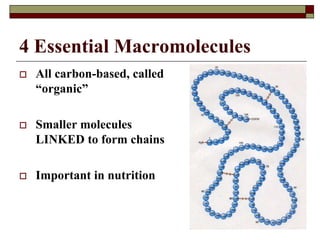
4 Essential Macromolecules
 All carbon-based, called
“organic”
 Smaller molecules
LINKED to form chains
 Important in nutrition
Formation of Macromolecules
 Small compounds
(monomers) combine to
make larger
“polymers”
 Combination is called a
“condensation
reaction”
 Opposite is called
“hydrolysis”
1.) CARBOHYDRATES
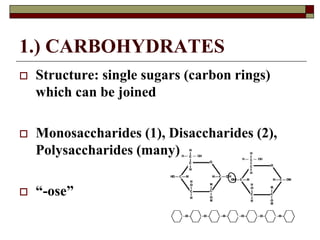
 Structure: single sugars (carbon rings)
which can be joined
 Monosaccharides (1), Disaccharides (2),
Polysaccharides (many)
 “-ose”
1.) CARBOHYDRATES
 Primary energy source
(utilized first)
 Examples in foods:
starches, sugars, bread,
and fruit
 Other examples?
Cellulose and chitin
2.) PROTEINS
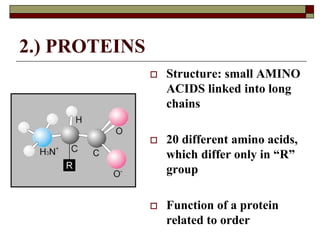
 Structure: small AMINO
ACIDS linked into long
chains
 20 different amino acids,
which differ only in “R”
group
 Function of a protein
related to order
2.) PROTEINS
 Peptide bond
 Proteins are also
called “polypeptides”
 Enzymes: important
proteins that carry
out chemical
reactions in cells
2.) PROTEINS
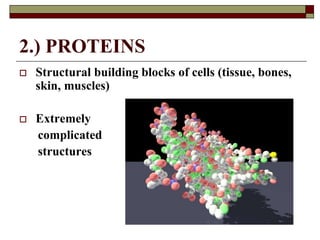
 Structural building blocks of cells (tissue, bones,
skin, muscles)
 Extremely
complicated
structures
3.) LIPIDS
 Structure: long carbon/hydrogen chains
 C-H bonds store most energy
 Fats, waxes, oils
 Use: long-term energy storage
3.) LIPIDS
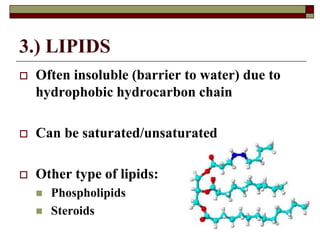
 Often insoluble (barrier to water) due to
hydrophobic hydrocarbon chain
 Can be saturated/unsaturated
 Other type of lipids:
 Phospholipids
 Steroids
4.) NUCLEIC ACIDS
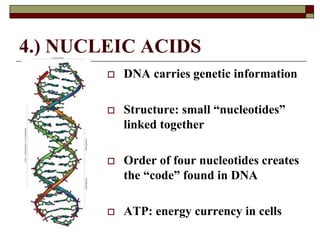
 DNA carries genetic information
 Structure: small “nucleotides”
linked together
 Order of four nucleotides creates
the “code” found in DNA
 ATP: energy currency in cells
Cells
Levels of Organization
 “SMALLER” LEVELS
 Cells
 Tissues
 Organs
 Organ Systems
 Organisms
 “LARGER” LEVELS
 Organisms
 Populations
 Communities
 Ecosystems
 Biosphere
“Cell” Theory
1. All living things are made of cells.
2. Cells are the basic units of structure and
function within organisms.
3. All cells are derived from other cells.
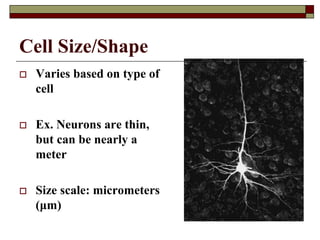
Cell Size/Shape
 Varies based on type of
cell
 Ex. Neurons are thin,
but can be nearly a
meter
 Size scale: micrometers
(μm)
Why are cells so small?
 A small volume (size)
requires fewer
nutrients
 A larger surface area
allows a cell to
transport more across
the cell membrane
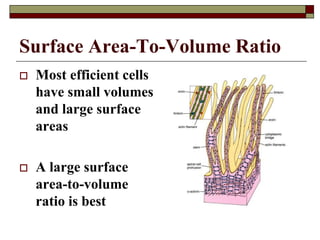
Surface Area-To-Volume Ratio
 Most efficient cells
have small volumes
and large surface
areas
 A large surface
area-to-volume
ratio is best
PROKARYOTIC CELLS
 Bacteria
 First organisms on
Earth
 No nucleus. Few cell
structures.
EUKARYOTIC CELLS
 Part of multi-celled
organisms
 More specialized
 Nucleus and
membrane-bound
organelles
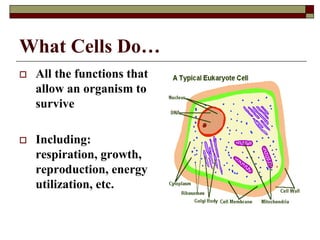
What Cells Do…
 All the functions that
allow an organism to
survive
 Including:
respiration, growth,
reproduction, energy
utilization, etc.
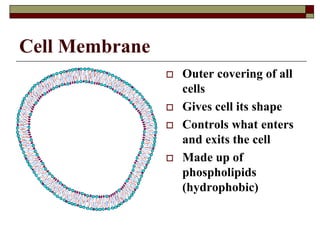
Cell Membrane
 Outer covering of all
cells
 Gives cell its shape
 Controls what enters
and exits the cell
 Made up of
phospholipids
(hydrophobic)
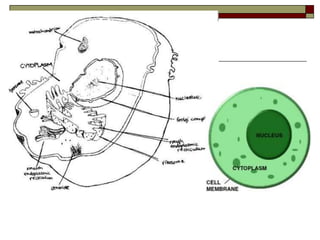
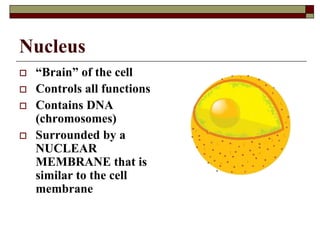
Nucleus
 “Brain” of the cell
 Controls all functions
 Contains DNA
(chromosomes)
 Surrounded by a
NUCLEAR
MEMBRANE that is
similar to the cell
membrane
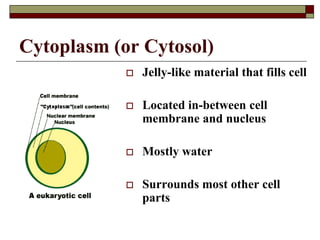
Cytoplasm (or Cytosol)
 Jelly-like material that fills cell
 Located in-between cell
membrane and nucleus
 Mostly water
 Surrounds most other cell
parts
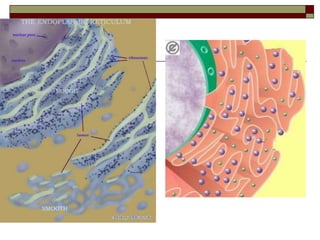
Ribosomes
 Made of protein and RNA
 Structures in which
proteins are made
 Some proteins kept, others
exported
 *Endoplasmic Reticulum
 *Golgi Apparatus
Mitochondria
 Small, rod-like
structures
 “Powerhouse” of the
cell
 Extract energy from
food / makes ATP
 What kind of cells
have the most?
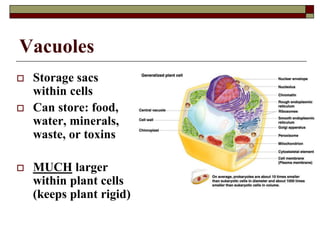
Vacuoles
 Storage sacs
within cells
 Can store: food,
water, minerals,
waste, or toxins
 MUCH larger
within plant cells
(keeps plant rigid)
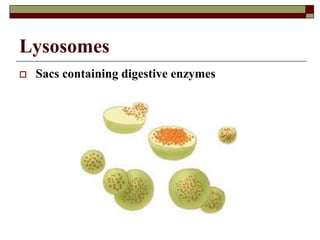
Lysosomes
 Sacs containing digestive enzymes
Specialized Organelles
Only In Plant Cells:
 Chloroplasts (and chlorophyll)
 Cell Wall
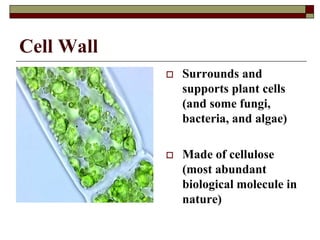
Cell Wall
 Surrounds and
supports plant cells
(and some fungi,
bacteria, and algae)
 Made of cellulose
(most abundant
biological molecule in
nature)
Chloroplast
 Structure in which plant
cells create sugars
 Contain chlorophyll (green)
which captures sunlight
 Sugars made in chloroplasts
are used in mitochondria as
energy
Cells

Cells

  • 2.
    Characteristics of LivingThings  Reproduction  Growth
  • 3.
    Characteristics of LivingThings  Development  Energy Capture
  • 4.
    Characteristics of LivingThings  Energy Utilization  Response to Stimuli
  • 5.
    Characteristics of LivingThings  Composed of Cells  Adaptation
  • 6.
  • 7.
    Biochemistry  Atom: singleunit, found on periodic table  Molecule: combination of multiple atoms via bonds  Element (atoms) vs. Compound (molecules)
  • 8.
    Bonding  Ionic Bond– atoms gain/lose electrons and take on pos./neg. charge  Covalent Bond – atoms share electrons (stronger; larger molecules)
  • 9.
    Hydrogen Bonds  Occurbetween hydrogen (+) and unbonded electrons (-)  Weak interactions among polar molecules  Ex: cohesion and adhesion
  • 10.
  • 11.
    Cell Environment  Primarilywater  Molecules are dissolved / suspended
  • 12.
    Types of Solute (Solute = dissolved particles)  HYDROPHILIC (usually have pos. or neg. charge)  HYDROPHOBIC (usually uncharged)
  • 13.
    4 Essential Macromolecules All carbon-based, called “organic”  Smaller molecules LINKED to form chains  Important in nutrition
  • 15.
    Formation of Macromolecules Small compounds (monomers) combine to make larger “polymers”  Combination is called a “condensation reaction”  Opposite is called “hydrolysis”
  • 16.
    1.) CARBOHYDRATES  Structure:single sugars (carbon rings) which can be joined  Monosaccharides (1), Disaccharides (2), Polysaccharides (many)  “-ose”
  • 17.
    1.) CARBOHYDRATES  Primaryenergy source (utilized first)  Examples in foods: starches, sugars, bread, and fruit  Other examples? Cellulose and chitin
  • 18.
    2.) PROTEINS  Structure:small AMINO ACIDS linked into long chains  20 different amino acids, which differ only in “R” group  Function of a protein related to order
  • 19.
    2.) PROTEINS  Peptidebond  Proteins are also called “polypeptides”  Enzymes: important proteins that carry out chemical reactions in cells
  • 20.
    2.) PROTEINS  Structuralbuilding blocks of cells (tissue, bones, skin, muscles)  Extremely complicated structures
  • 21.
    3.) LIPIDS  Structure:long carbon/hydrogen chains  C-H bonds store most energy  Fats, waxes, oils  Use: long-term energy storage
  • 22.
    3.) LIPIDS  Ofteninsoluble (barrier to water) due to hydrophobic hydrocarbon chain  Can be saturated/unsaturated  Other type of lipids:  Phospholipids  Steroids
  • 23.
    4.) NUCLEIC ACIDS DNA carries genetic information  Structure: small “nucleotides” linked together  Order of four nucleotides creates the “code” found in DNA  ATP: energy currency in cells
  • 24.
  • 25.
    Levels of Organization “SMALLER” LEVELS  Cells  Tissues  Organs  Organ Systems  Organisms  “LARGER” LEVELS  Organisms  Populations  Communities  Ecosystems  Biosphere
  • 26.
    “Cell” Theory 1. Allliving things are made of cells. 2. Cells are the basic units of structure and function within organisms. 3. All cells are derived from other cells.
  • 28.
    Cell Size/Shape  Variesbased on type of cell  Ex. Neurons are thin, but can be nearly a meter  Size scale: micrometers (μm)
  • 29.
    Why are cellsso small?  A small volume (size) requires fewer nutrients  A larger surface area allows a cell to transport more across the cell membrane
  • 30.
    Surface Area-To-Volume Ratio Most efficient cells have small volumes and large surface areas  A large surface area-to-volume ratio is best
  • 31.
    PROKARYOTIC CELLS  Bacteria First organisms on Earth  No nucleus. Few cell structures.
  • 32.
    EUKARYOTIC CELLS  Partof multi-celled organisms  More specialized  Nucleus and membrane-bound organelles
  • 34.
    What Cells Do… All the functions that allow an organism to survive  Including: respiration, growth, reproduction, energy utilization, etc.
  • 35.
    Cell Membrane  Outercovering of all cells  Gives cell its shape  Controls what enters and exits the cell  Made up of phospholipids (hydrophobic)
  • 37.
    Nucleus  “Brain” ofthe cell  Controls all functions  Contains DNA (chromosomes)  Surrounded by a NUCLEAR MEMBRANE that is similar to the cell membrane
  • 39.
    Cytoplasm (or Cytosol) Jelly-like material that fills cell  Located in-between cell membrane and nucleus  Mostly water  Surrounds most other cell parts
  • 41.
    Ribosomes  Made ofprotein and RNA  Structures in which proteins are made  Some proteins kept, others exported  *Endoplasmic Reticulum  *Golgi Apparatus
  • 43.
    Mitochondria  Small, rod-like structures “Powerhouse” of the cell  Extract energy from food / makes ATP  What kind of cells have the most?
  • 44.
    Vacuoles  Storage sacs withincells  Can store: food, water, minerals, waste, or toxins  MUCH larger within plant cells (keeps plant rigid)
  • 46.
  • 47.
  • 48.
    Only In PlantCells:  Chloroplasts (and chlorophyll)  Cell Wall
  • 49.
    Cell Wall  Surroundsand supports plant cells (and some fungi, bacteria, and algae)  Made of cellulose (most abundant biological molecule in nature)
  • 51.
    Chloroplast  Structure inwhich plant cells create sugars  Contain chlorophyll (green) which captures sunlight  Sugars made in chloroplasts are used in mitochondria as energy