CELLS
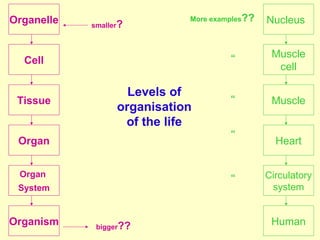
Organelle

smaller?

More examples??

“

Cell

Tissue

Levels of
organisation
of the life

Organ
Organ

Muscle
cell

“

Muscle

“

“

System

Organism

Nucleus

bigger??

Heart
Circulatory
system

Human
Cell is the smallest unit of life,
the smallest structure that is classified as a
living thing,
and is often called the building block of life
- but I dont think this description is clear enough-
The cell is the basic structural and functional unit
of an organism
What does it mean?

All living things are
made up of one or more
cells.
All living cells come from
pre-existing cells by
division.

The activity of an organism
depends on
the total activity of individual cells.

All cells are basically the same in chemical composition
in organisms of similar species.
Anton van Leuwenhoek
1673 - Anton van Leuwenhoek used a
handmade microscope to observe
pond water & discovered
single-celled organisms
He called them “animalcules”
He also observed blood cells from fish, birds, frogs, dogs,
and humans
Therefore, it was known that cells are
found in animals as well as plants
MICROSCOPIO
DE
LEEUWENHOEK

Tornillo
s
para
enfoque

Lente
Muestra
en
la punta
del
alfiler

Microbios que
Leeuwenhoek
observó (con un
aumento que
superaba el de los
primeros
microscopios con
lentes múltiples).
Discovery of Cells – Robert Hooke
1665 – English scientist, Robert Hooke,
discovered cells when he was looking
through one of the first microscopes
Looked at a thin slice of cork and
described what he saw as “tiny boxes or
honeycombs”
Named the boxes “cells” as they reminded
him of the cells in monasteries
Thought cells only existed in plants
Development of Cell Theory – 1800’s
1833 – Robert Brown


Observed the nucleus in the epidermis of an orchid
Schleiden and Schwann
1838 - Matthias Schleiden, a German
professor of botany, identified the first
plant cells and concluded that all parts
of a plant is made of cells

1839 – Theodor Schwann, a German
zoologist and a close friend of
Schleiden, stated that all animal
tissues are composed of cells.
Rudolf
Virchow
1855 – Rudolf Virchow, German
doctor

Proved that cells come from other
cells, not from non-living matter

“Omnis cellula e cellula”
The Complete Cell Theory
Putting it all together:

The 3 Basic Components of the Cell Theory were now
complete:
1. All living things are composed of one or more cells. (Schleiden &
Schwann, 1838-39)
2. The cell is the basic unit of structure and function in all living
things (Schleiden & Schwann, 1838-39)
3. All cells come from preexisting cells (Virchow, 1858)
¿Por qué las células suelen ser pequeñas?




El cubo de 4 cm de arista,
los ocho cubos de 2 cm de
arista y los 64 cubos de 1
cm de arista tienen todos
el mismo volumen. Pero al
dividir el volumen en
porciones, la superficie
total aumenta.
Al ser las células pequeñas
tienen mayor superficie
(aumentando la eficacia de
entrada y salida de
materiales).
Cells have lots of
different functions but
they are often
specialised to do a
particular job.
For this reason each
type of cell has
special characteristics
that make it well
adapted at carrying
out its functions.
We are going to study in detail just
a few of the organelles in animal cells:
* mitochondria
* nucleus and DNA
* ribosomes
* ER + Golgi apparatus
mitochondria role:
cellular respiration
GLÚCIDOS:
estructura

°#Lèô‚#†_LÙ#¨éxŸÚ³.7G®#*jÝW±#5

C6H12O6
1.- MONOSACÁRIDOS
glucosa, fructosa y galactosa
No requieren digestión pues son pequeñas moléculas.
De fórmula C6H12O6

PO
S
LI
A
CÁ
S
O
D
RI

as simbolizaremos como

3.

Se disuelven en agua y tienen sabor dulce

GLÚCIDOS:
estructura

2.- DISACÁRIDOS
sacarosa y lactosa, uniones de dos monosacáridos
Requieren digestión hasta monosacáridos para poder entrar en las célul
Se disuelven en agua y tienen sabor dulce.

Las simbolizaremos como
Respiración
celular

+

+ Energía

La ecuación anterior
solo tiene sentido...
considerando el resultado aprovechable
por los seres vivos cuando realizan el proceso:
LA ENERGÍA
Nucleus role: containing DNA
DNA carries the information for making
all of the cell's proteins.

Ribosome role: producing proteins.
These proteins perform all of the functions
of a living organism
Deoxyribonucleic acid
(DNA) is the master
molecule of every cell.
It control the making
of other molecules
(proteins)
Although it may look
complicated, the DNA in a
cell is just a sequence
made up of four different
parts called nucleotides.
Imagine a set of blocks
that has only four shapes,
or an alphabet that has
only four letters. DNA is a
long string of these blocks
or letters.
DNA carries the information for making all of the
cell's proteins.
These proteins carry out all of the functions of a living
organism
When the cell reproduces, it has to pass all of this information
-copy of DNA- to the daughter cells.
In DNA, each protein is encoded by a gene (a specific
sequence of DNA) that determines the order of amino acids
that must be put together to make a protein.
A protein is made of a long chain of chemicals called
amino acids

Depending on the sequence of amino acids,
trillions different proteins
20 types of amino acids in organisms

protein
Proteins have many functions:
Enzymes that speed up chemical reactions (such as digestive enzymes)
Structural proteins that are building materials (such as collagen and nail keratin)
Transporting proteins that carry substances (such as oxygen-carrying haemoglobin in blood)
Contraction proteins that cause muscles to compress (such as actin and myosin)
Hormones - chemical messengers between cells (including insulin, growth hormone etcetera)
Protective proteins - antibodies of the immune system, clotting -coagulantes- proteins in blood

The particular sequence of amino acids in the protein chain is
what makes one protein different from another. This sequence
is encoded in the DNA where one gene encodes -CODIFICAfor one protein.
The particular sequence of amino acids in the chain is what
makes one protein different from another. This sequence is
encoded in the DNA where one gene encodes for one protein.
(2)
Growing protein:
two amin oacids so far -hasta ahora: M-R

(1)
Ribosome
making a new protein.
A ribosome is made up of two round parts,
the smaller subunit and the bigger subunit

Instructions in DNA

(3)

The third amino acid is about to
join the two previous amino acids
Instructions in DNA
Endoplasmic reticullum
and
Golgi apparatus
roles:
packaging proteins inside lysosomes
OR
to be secreted outside the cell
Cells
Cells
Cells

Cells

  • 1.
  • 2.
    Organelle smaller? More examples?? “ Cell Tissue Levels of organisation ofthe life Organ Organ Muscle cell “ Muscle “ “ System Organism Nucleus bigger?? Heart Circulatory system Human
  • 3.
    Cell is thesmallest unit of life, the smallest structure that is classified as a living thing, and is often called the building block of life - but I dont think this description is clear enough-
  • 4.
    The cell isthe basic structural and functional unit of an organism What does it mean? All living things are made up of one or more cells. All living cells come from pre-existing cells by division. The activity of an organism depends on the total activity of individual cells. All cells are basically the same in chemical composition in organisms of similar species.
  • 5.
    Anton van Leuwenhoek 1673- Anton van Leuwenhoek used a handmade microscope to observe pond water & discovered single-celled organisms He called them “animalcules” He also observed blood cells from fish, birds, frogs, dogs, and humans Therefore, it was known that cells are found in animals as well as plants
  • 6.
    MICROSCOPIO DE LEEUWENHOEK Tornillo s para enfoque Lente Muestra en la punta del alfiler Microbios que Leeuwenhoek observó(con un aumento que superaba el de los primeros microscopios con lentes múltiples).
  • 7.
    Discovery of Cells– Robert Hooke 1665 – English scientist, Robert Hooke, discovered cells when he was looking through one of the first microscopes Looked at a thin slice of cork and described what he saw as “tiny boxes or honeycombs” Named the boxes “cells” as they reminded him of the cells in monasteries Thought cells only existed in plants
  • 8.
    Development of CellTheory – 1800’s 1833 – Robert Brown  Observed the nucleus in the epidermis of an orchid
  • 9.
    Schleiden and Schwann 1838- Matthias Schleiden, a German professor of botany, identified the first plant cells and concluded that all parts of a plant is made of cells 1839 – Theodor Schwann, a German zoologist and a close friend of Schleiden, stated that all animal tissues are composed of cells.
  • 10.
    Rudolf Virchow 1855 – RudolfVirchow, German doctor Proved that cells come from other cells, not from non-living matter “Omnis cellula e cellula”
  • 11.
    The Complete CellTheory Putting it all together: The 3 Basic Components of the Cell Theory were now complete: 1. All living things are composed of one or more cells. (Schleiden & Schwann, 1838-39) 2. The cell is the basic unit of structure and function in all living things (Schleiden & Schwann, 1838-39) 3. All cells come from preexisting cells (Virchow, 1858)
  • 12.
    ¿Por qué lascélulas suelen ser pequeñas?   El cubo de 4 cm de arista, los ocho cubos de 2 cm de arista y los 64 cubos de 1 cm de arista tienen todos el mismo volumen. Pero al dividir el volumen en porciones, la superficie total aumenta. Al ser las células pequeñas tienen mayor superficie (aumentando la eficacia de entrada y salida de materiales).
  • 15.
    Cells have lotsof different functions but they are often specialised to do a particular job. For this reason each type of cell has special characteristics that make it well adapted at carrying out its functions.
  • 18.
    We are goingto study in detail just a few of the organelles in animal cells: * mitochondria * nucleus and DNA * ribosomes * ER + Golgi apparatus
  • 19.
  • 20.
  • 21.
    1.- MONOSACÁRIDOS glucosa, fructosay galactosa No requieren digestión pues son pequeñas moléculas. De fórmula C6H12O6 PO S LI A CÁ S O D RI as simbolizaremos como 3. Se disuelven en agua y tienen sabor dulce GLÚCIDOS: estructura 2.- DISACÁRIDOS sacarosa y lactosa, uniones de dos monosacáridos Requieren digestión hasta monosacáridos para poder entrar en las célul Se disuelven en agua y tienen sabor dulce. Las simbolizaremos como
  • 22.
    Respiración celular + + Energía La ecuaciónanterior solo tiene sentido... considerando el resultado aprovechable por los seres vivos cuando realizan el proceso: LA ENERGÍA
  • 23.
    Nucleus role: containingDNA DNA carries the information for making all of the cell's proteins. Ribosome role: producing proteins. These proteins perform all of the functions of a living organism
  • 24.
    Deoxyribonucleic acid (DNA) isthe master molecule of every cell. It control the making of other molecules (proteins) Although it may look complicated, the DNA in a cell is just a sequence made up of four different parts called nucleotides. Imagine a set of blocks that has only four shapes, or an alphabet that has only four letters. DNA is a long string of these blocks or letters.
  • 25.
    DNA carries theinformation for making all of the cell's proteins. These proteins carry out all of the functions of a living organism When the cell reproduces, it has to pass all of this information -copy of DNA- to the daughter cells. In DNA, each protein is encoded by a gene (a specific sequence of DNA) that determines the order of amino acids that must be put together to make a protein.
  • 26.
    A protein ismade of a long chain of chemicals called amino acids Depending on the sequence of amino acids, trillions different proteins 20 types of amino acids in organisms protein
  • 27.
    Proteins have manyfunctions: Enzymes that speed up chemical reactions (such as digestive enzymes) Structural proteins that are building materials (such as collagen and nail keratin) Transporting proteins that carry substances (such as oxygen-carrying haemoglobin in blood) Contraction proteins that cause muscles to compress (such as actin and myosin) Hormones - chemical messengers between cells (including insulin, growth hormone etcetera) Protective proteins - antibodies of the immune system, clotting -coagulantes- proteins in blood The particular sequence of amino acids in the protein chain is what makes one protein different from another. This sequence is encoded in the DNA where one gene encodes -CODIFICAfor one protein.
  • 28.
    The particular sequenceof amino acids in the chain is what makes one protein different from another. This sequence is encoded in the DNA where one gene encodes for one protein.
  • 29.
    (2) Growing protein: two aminoacids so far -hasta ahora: M-R (1) Ribosome making a new protein. A ribosome is made up of two round parts, the smaller subunit and the bigger subunit Instructions in DNA (3) The third amino acid is about to join the two previous amino acids
  • 30.
  • 31.
    Endoplasmic reticullum and Golgi apparatus roles: packagingproteins inside lysosomes OR to be secreted outside the cell