Sri Ramya Vaddiparthy
V/VI Pharm.D
Structure of CELL- Components
& Functions
Introduction
 The cell (from Latin cella, meaning "small
room") is the basic structural, functional, and
biological unit of all known organisms. A cell is
the smallest unit of life. Cells are often called
the "building blocks of life". The study of cells
is called cell biology, cellular biology, or
cytology.
 The number of cells in plants and animals varies
from species to species; it has been estimated
that humans contain somewhere around 40
trillion (4×10¹³) cells. The human brain accounts
for around 80 billion of these cells.
History
 1595 – Jansen credited with 1st compound microscope
1655 – Hooke described ‘cells’ in cork.
1674 – Leeuwenhoek discovered protozoa. He saw
bacteria some 9 years later.
1833 – Brown descibed the cell nucleus in cells of the
orchid.
1838 – Schleiden and Schwann proposed cell theory.
1840 – Albrecht von Roelliker realized that sperm cells
and egg cells are also cells.
1856 – N. Pringsheim observed how a sperm cell
penetrated an egg cell.
1858 – Rudolf Virchow (physician, pathologist and
anthropologist) expounds his famous conclusion: omnis
cellula e cellula, that is cells develop only from existing
cells [cells come from preexisting cells]
 1857 – Kolliker described mitochondria.
1879 – Flemming described chromosome behavior during
mitosis.
1883 – Germ cells are haploid, chromosome theory of
heredity.
1898 – Golgi described the golgi apparatus.
1938 – Behrens used differential centrifugation to separate
nuclei from cytoplasm.
1939 – Siemens produced the first commercial transmission
electron microscope.
1952 – Gey and coworkers established a continuous human
cell line.
1955 – Eagle systematically defined the nutritional needs of
animal cells in culture.
1957 – Meselson, Stahl and Vinograd developed density
gradient centrifugation in cesium chloride solutions for
separating nucleic acids.
.
 1965 – Ham introduced a defined serum-free
medium. Cambridge Instruments produced the
first commercial scanning electron microscope.
1976 – Sato and colleagues publish papers showing
that different cell lines require different mixtures
of hormones and growth factors in serum-free
media.
1981 – Transgenic mice and fruit flies are
produced. Mouse embryonic stem cell line
established 1995 – Tsien identifies mutant of GFP
with enhanced spectral properties
1998 – Mice are cloned from somatic cells.
1999 – Hamilton and Baulcombe discover siRNA as
part of post-transcriptional gene silencing (PTGS)
in plants
 Cells were discovered by Robert Hooke in 1665,
who named them for their resemblance to cells
inhabited by Christian monks in a
monastery. Cell theory, first developed in 1839
by Matthias Jakob Schleiden & Theodor
Schwann, states that all organisms are
composed of one or more cells, that cells are the
fundamental unit of structure and function in all
living organisms, and that all cells come from
pre-existing cells. Cells emerged on Earth at least
3.5 billion years ago.
Cell Theory
The cell theory developed in 1839 by microbiologists Schleiden and Schwann
describes the properties of cells. It is an explanation of the relationship
between cells and living things. The theory states that:
 all living things are made of cells and their products.
 new cells are created by old cells dividing into two.
 cells are the basic building blocks of life.
The cell theory applies to all living things, however big or small. The
modern understanding of cell theory extends the concepts of the original cell
theory to include the following:
 The activity of an organism depends on the total activity of independent cells.
 Energy flow occurs in cells through the breakdown of carbohydrates by
respiration.
 Cells contain the information necessary for the creation of new cells. This
information is known as 'hereditary information' and is contained within DNA.
 The contents of cells from similar species are basically the same.
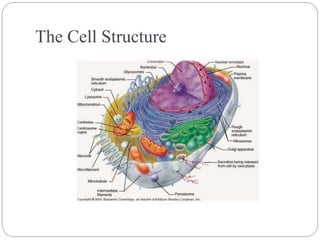
The Cell Structure
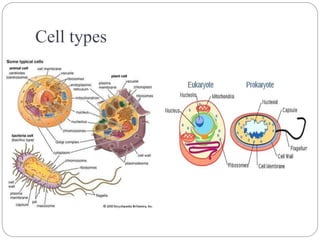
Cell types
CELL
 Animals are a large group of diverse living
organisms that make up to three-quarters of
all species on earth. With their ability to move,
to respond to stimuli, respond to environmental
changes and adapt to different modes of
feeding defense mechanisms and reproduction,
all these mechanisms are enhanced by their
constituent elements in the body. Some of
these living things are single-celled
(unicellular) and other organisms are made up
of more than one cell (Multicellular).
 Most cells are covered by a protective
membrane known as the cell wall which gives
the cells their shape and rigidity.
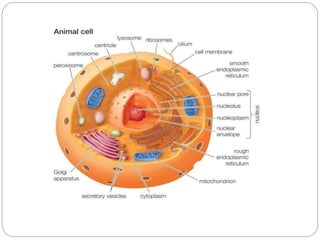
 An animal cell is a eukaryotic cell that lacks a
cell wall, and it is enclosed by the plasma
membrane. The cell organelles are enclosed by
the plasma membrane including the cell nucleus.
Size & Shape
 Animal cells come in all kinds of shapes and
sizes, with their size ranging from a few
millimeters to micrometers. The largest animal
cell is the ostrich egg which has a 5-inch
diameter, weighing about 1.2-1.4 kg and the
smallest animal cells are the neurons of about
100 microns in diameter.
 Animal cells are eukaryotic cells with a
membrane-bound nucleus. therefore they have
their genetic material in the form of DNA
enclosed in the nucleus. They also have several
structural organelles within the plasma
membrane which perform various specific
functions for proper cell function and generally
to maintain the body normal mechanisms.
Plasma membrane(Definition,
structure, functions)
It is a thin semi-permeable protein membrane
layer that surrounds animal cell.
Structure of Plasma membrane (Cell
membrane)
 Thin semi-permeable membrane
 It contains a percentage of lipids making a
semi-permeable barrier between the cell and
its physical environment.
 It has some protein components a
 It is very consistent around the cell
 All living cells have a plasma membrane.
 Functions of Plasma membrane (Cell membrane)
 To enclose and protect the cell content
 To also regulate the molecules that pass into and
out of the cell, through the plasma membrane.
Therefore it controls homeostasis.
 The proteins are actively involved in transporting
materials across the membrane
 The proteins and lipids allow cell communication,
and carbohydrates (sugars and sugar chains), which
decorate both the proteins and lipids and help cells
recognize each other.
Nucleus(Definition,structure, Functions)
 This is a spherical structured organelle found
majorly at the center of a cell surrounded by a
double-layered nuclear membrane separating it
from the cytoplasm.
 It is held together to the cytoplasm with the help
of the filaments and microtubules.
 It holds other cells organelles including the
nucleolus, nucleosomes, and chromatins.
 A cell has one nucleus which divides producing
multinucleated cells e.g. the skeletal muscle cell
fibers.
 Some cells lose their nuclei after maturations e.g.
the red blood cells.
 Structure of Nucleus
 The double-layered membrane is a continuous
channel of membranous from the endoplasmic
reticulum network.
 The membrane has pores which allow entry of
large molecule
 Nucleoli (Singular; nucleolus) are tiny/small
bodies found in the nucleus
 The nucleus and its component organelles are
suspended in the nucleoplasm (House of the
chromosomal DNA and genetic materials)
 Functions of Nucleus
 The primary role of the nucleus is to control and
regulate cell activities of growth and maintain cell
metabolisms.
 It also carries the genes that have hereditary
information of the cell.
 The chromosomal DNA and genetic materials,
which are made up of genetic coded ultimately
make up their proteins’ amino acid sequences for
use by the cell.
 Therefore, the nucleus is the information center.
 It is the site for Transcription (formation of
mRNA from DNA) and the mRNA is transported to
the nuclear envelope.
Cytoplasm
 A jelly-like material which contains all the cell
organelles, enclosed within the cell membrane.
The substance found within the cell nucleus,
contained by the nuclear membrane is called
the nucleoplasm.
Mitochondria(Definition, Structure,
Function)
 These are membrane-bound organelles located
in the cytoplasm of all eukaryotic cells
 The number of mitochondria found in each cell
varies widely depending on the function of the
cell it performs.
 For example, erythrocytes do not have
mitochondria while the liver and muscle cells
have thousands of mitochondria.
Structure
 A mitochondrion contains outer and inner membranes
composed of phospholipid bilayers and proteins.The two
membranes have different properties. Because of this
double-membraned organization, there are five distinct
parts to a mitochondrion. They are:
 the outer mitochondrial membrane,
 the intermembrane space (the space between the outer
and inner membranes),
 the inner mitochondrial membrane,
 the cristae space (formed by infoldings of the inner
membrane), and
 the matrix (space within the inner membrane).
 Mitochondria stripped of their outer membrane are
called mitoplasts.
Functions
Energy conversion
 A dominant role for the mitochondria is the production
of ATP, as reflected by the large number of proteins in
the inner membrane for this task. This is done by
oxidizing the major products of glucose: pyruvate,
and NADH, which are produced in the cytosol. This type
of cellular respiration known as aerobic respiration, is
dependent on the presence of oxygen, which provides
most of the energy released. When oxygen is limited,
the glycolytic products will be metabolized by anaerobic
fermentation, a process that is independent of the
mitochondria. The production of ATP from glucose and
oxygen has an approximately 13-times higher yield
during aerobic respiration compared to fermentation.
Heat production
 Under certain conditions, protons can re-enter the
mitochondrial matrix without contributing to ATP
synthesis. This process is known as proton
leak or mitochondrial uncoupling and is due to
the facilitated diffusion of protons into the
matrix. The process results in the unharnessed
potential energy of the
proton electrochemical gradient being released as
heat. The process is mediated by a proton channel
called thermogenin, or UCP1. Thermogenin is a 33
kDa protein first discovered in 1973. Thermogenin
is primarily found in brown adipose tissue, or brown
fat, and is responsible for non-shivering
thermogenesis.
Storage of calcium ions
 Transmission electron micrograph of a chondrocyte,
stained for calcium, showing its nucleus (N) and
mitochondria (M).
 The concentrations of free calcium in the cell can
regulate an array of reactions and is important
for signal transduction in the cell. Mitochondria can
transiently store calcium, a contributing process for
the cell's homeostasis of calcium. In fact, their ability
to rapidly take in calcium for later release makes them
very good "cytosolic buffers" for calcium. The
endoplasmic reticulum (ER) is the most significant
storage site of calcium,and there is a significant
interplay between the mitochondrion and ER with
regard to calcium.
Mitochondria play a central role in many other metabolic
tasks, such as:
 Signaling through mitochondrial reactive oxygen species
 Regulation of the membrane potential
 Apoptosis-programmed cell death
 Calcium signaling (including calcium-evoked apoptosis)
 Regulation of cellular metabolism
 Certain heme synthesis reactions
 Steroid synthesis.
 Hormonal signaling Mitochondria are sensitive and responsive
to hormones, in part by the action of mitochondrial estrogen
receptors (mtERs). These receptors have been found in
various tissues and cell types, including brain and heart
 Immune signaling
Ribosomes
 They are small organelles majorly made up of
60% RNA cytoplasmic- granules and 40%
proteins.
 All living cells contain ribosomes, which may be
freely circulating in the cytoplasm and some
are bound to the endoplasmic reticulum.
 It is the site for protein synthesis.
Structure of Ribosomes
 Ribosomes are made up of ribosomal proteins
and ribosomal RNA (rRNA). In a eukaryotic
cell, ribosomes constitute half ribosomal RNA
and half ribosomal proteins.
 Each ribosome is made up of two subunits i. e
large subunit and small subunit with their own
distinct shapes. These subunits are designated
as the 40s and 60s in the animal cell.
Functions of Ribosomes
 Ribosomes that occur as free particles are attached to
the endoplasmic reticulum membrane occurring in large
numbers accounting for about a quarter of the cell
organelles. A single replicated cell has about 10 million
ribosomes.
 The ribosomal subunits are the site for genetic coding
into proteins. On the ribosomes, the mRNA helps
determine the coding for Transfer RNA (tRNA) which
also determines the protein amino acid sequences. This
leads to the formation of the rRNA which are involved
in the catalyzation of peptidyl transferase creating the
peptide bond found between the amino acid sequences
that develop the proteins. The formed proteins then
detach from the ribosomes, migrating to other cell
parts for utilization by the cell.
Endoplasmic Reticulum(ER)
(Structure, Function)
Structure of Endoplasmic Reticulum (ER)
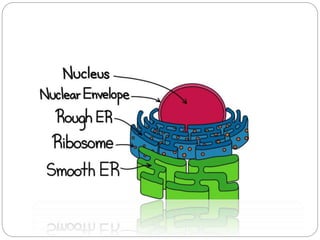
 This is a continuous folded membranous organelle
found in the cytoplasm made up of a thin network
of flattened interconnected compartments (sacs)
that connects from the cytoplasm to the cell
nucleus.
 Within its membranes, there are membranous
spaces called the cristae spaces and the
membrane folding are called cristae.
 There are two types of ER based on their
structure and the function they perform
including Rough Endoplasmic reticulum and
the Smooth endoplasmic reticulum.
Functions of Endoplasmic Reticulum (ER)
 Manufacturing, processing and transporting
proteins for cell utilization both in and out of the
cell. This is because it is directly connected to the
nuclear membrane providing a passage between the
nucleus and the cytoplasm.
 The ER has more than half the membranous cell
content, hence it has a large surface area where
chemical reactions take place. They also contain
the enzymes for almost all the cell lipid synthesis
hence they are the site for lipid synthesis.
Types of Endoplasmic Reticulum
 Rough Endoplasmic Reticulum (Rough ER) – Rough ER is called “rough”
because there surface is covered with ribosomes, giving it a rough
appearance. The function of the ribosomes on rough ER is to synthesis
proteins and they have a signaling sequence, directing them to the
endoplasmic reticulum for processing. Rough ER transports the proteins and
lipids through the cell into the cristae. They are then sent into the Golgi
bodies or inserted into the cell membrane.
 Smooth Endoplasmic Reticulum (Smooth ER) – Smooth ER is not associated
with ribosomes and their unction is different from that of the rough
endoplasmic reticulum, despite lying adjacent to the rough endoplasmic
reticulum. Its function is to synthesis lipids (cholesterol and phospholipids)
that are utilized for producing new cellular membranes. They are also
involved in the synthesis of steroid hormones from cholesterol for certain
cell types. It also contributes to the detoxification of the liver after the
intake of drugs and toxic chemicals.
 There is also a specialized type of smooth ER known as the sarcoplasmic
reticulum. Its function is to regulate the concentration of Calcium ions in
the muscle cell cytoplasm.
Golgi Apparatus
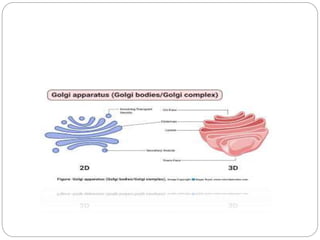
Structure of Golgi apparatus (Golgi bodies)
 These are membrane-bound cell organelles found in the cytoplasm
of a eukaryotic cell, next to the endoplasmic reticulum and near the
nucleus.
 Golgi bodies are supported together by cytoplasmic microtubules
and held by a protein matrix
 It is made up of flattened stacked pouches known as cisternae.
 These cisternae maybe 4- 10 in number for animal cell Golgi bodies
though some organisms like single-celled organisms have about 60
cisternae.
 They have three primary compartments known as cis (Cisternae
Nearest the Endoplasmic Reticulum), medial (central layers of
cisternae) and the trans (cisternae farthest from the endoplasmic
reticulum).
 Animal cells have very few (1-2) Golgi bodies while plants have a few
hundred.
Functions of Golgi apparatus (Golgi bodies)
 Their primary function is to transport, modify and pack
proteins and lipids into the Golgi vesicles to deliver them to
their target sites. Animal cells contain one or more Golgi
bodies while plants have a few hundred.
 Cis and trans Golgi network make up the outer layer of
cisternae at the cis and trans face and they are responsible
for sorting proteins and lipids received at the cis face and
released by the trans face, by the Golgi bodies.
 The cis face collects the proteins and lipids, of fused
vesicles in clusters. The fused vesicles move along the
microtubules through a specialized compartment known as
the vesicular-tubular cluster. This compartment is found
between the endoplasmic reticulum and the Golgi apparatus.
 The vesicle clusters fuse with the cis Golgi
network, delivering the proteins and lipids into
the cis face cisternae and as they move from
the cis face to the trans face, they
get modified to functional units. These
functional units get delivered to intracellular
and extracellular components of the
cell.Modification mechanisms include:
 Cleaving of oligosaccharides chains
 Attachment of sugar moieties of different
side chains
Lysosomes
 It is also known as cell vesicles; Lysosomes were discovered
by Christian Rene de Duve, a Belgian cytologist in the 1950s.
Structure of Lysosomes
 They are round subcellular organelle found in almost all
eukaryotic cells
 Lysosomes are very acidic organelles containing the digestive
enzymes and therefore each of the lysosomes is surrounded
by a membrane to protect it from the outer environment.
Functions of Lysosomes
 This is the site for digestion of cell nutrients, excretion, and
cell renewal.
 Lysosomes break down macromolecules components from the
outside of the cell into simpler elements that are
transported into the cytoplasm via a proton pump to build
new cell materials.
 These macromolecule components include old
cells and parts, cell waste products,
microorganisms, and cell debris.
 The digestive enzymes found in the lysosomes
are called hydrolytic enzymes or acid
hydrolases, breaking down large molecules into
smaller molecules that can be utilized by the
cell.
Cytoskeleton, Microtubules
 This is a fibrous network that’s formed from and by
different proteins of long chains of amino acids.
 It plays a major role in the movement of the cell and some
cell organelles in the cytoplasm.
 The tiny filaments include:
 Actin filaments; also known as microfilaments; it’s a
meshwork of fibers running parallel to each other and they
play a primary role in giving the cell its shape; they change
consistently, helping the cell to move and to also mediate
certain cell activities such as adherence ability to substrates
and cleavage mechanisms during mitotic cell division
 Microtubules- these are long filaments that assist in mitosis
moving daughter chromosomes to new forming daughter cells.
 Intermediate filaments– they are more stable filaments in
comparison to the actin and microtubules. They form the true
skeleton of the cell, and the hold the nucleus in its rightful
position within the cell.
 Microtubules are long, straight, hollow
cylinders filaments that are constructed from
13-15 sub-filaments (protofilament) strand of
a special globular protein called tubulin, found
only in eukaryotic cells.
 They are found throughout the cytoplasm of
the animal cell.
 Transportation of some organelles like the
mitochondria and the vesicles i.e. transporting
vesicles from the neuron cell body to the axon
tips, and back to the cell body
 Structural support, they give characteristic
support to the Golgi bodies, holding them
within the gel-matrix of the cytoplasm.
 They provide the rigid and organized
component of the cytoskeleton of the cell,
enabling a cell to take up a particular shape.
Centrioles
 This is distinctly found in the animal cell, which has
the ability to replicate or make copies by itself. It
is made up of 9 microtubule bundles and their
primary function is to assist in organizing the cell
division process.
 The triplet microtubules are held together by
proteins, giving the centriole its shape.
 They are found in the centrosome, creating and
holding microtubules within the cell.
 The triplet microtubules are surrounded by a
pericentriolar matrix containing molecules that
build up the microtubules.
Functions
 The centriole microtubules allow the
transportation of substances that are linked
together with a glycoprotein to any cell location.
the glycoprotein linkage acts as a signaling unit to
move specific proteins.
 The centrioles anchor the microtubules that
extend from it and contain the factors needed to
create more tubules.
 Mitosis is achieved by replication of each centriole
which makes duplicates of each centriole (4
centrioles). The newly formed centrioles divide
into two centrosomes, each centriole at an angle to
the second centriole.
References
 https://microbenotes.com/animal-cell-
definition-structure-parts-functions-and-
diagram/
 https://en.wikipedia.org/wiki/Mitochondrion#F
unction
 https://intl.siyavula.com/read/science/grade-10-
lifesciences/cells-the-basic-units-of-life/02-cells-
the-basic-units-of-life-03
 https://bitesizebio.com/166/history-of-cell-
biology/
Thank
you

Structure of cell components and functions

  • 1.
    Sri Ramya Vaddiparthy V/VIPharm.D Structure of CELL- Components & Functions
  • 2.
    Introduction  The cell(from Latin cella, meaning "small room") is the basic structural, functional, and biological unit of all known organisms. A cell is the smallest unit of life. Cells are often called the "building blocks of life". The study of cells is called cell biology, cellular biology, or cytology.  The number of cells in plants and animals varies from species to species; it has been estimated that humans contain somewhere around 40 trillion (4×10¹³) cells. The human brain accounts for around 80 billion of these cells.
  • 3.
    History  1595 –Jansen credited with 1st compound microscope 1655 – Hooke described ‘cells’ in cork. 1674 – Leeuwenhoek discovered protozoa. He saw bacteria some 9 years later. 1833 – Brown descibed the cell nucleus in cells of the orchid. 1838 – Schleiden and Schwann proposed cell theory. 1840 – Albrecht von Roelliker realized that sperm cells and egg cells are also cells. 1856 – N. Pringsheim observed how a sperm cell penetrated an egg cell. 1858 – Rudolf Virchow (physician, pathologist and anthropologist) expounds his famous conclusion: omnis cellula e cellula, that is cells develop only from existing cells [cells come from preexisting cells]
  • 4.
     1857 –Kolliker described mitochondria. 1879 – Flemming described chromosome behavior during mitosis. 1883 – Germ cells are haploid, chromosome theory of heredity. 1898 – Golgi described the golgi apparatus. 1938 – Behrens used differential centrifugation to separate nuclei from cytoplasm. 1939 – Siemens produced the first commercial transmission electron microscope. 1952 – Gey and coworkers established a continuous human cell line. 1955 – Eagle systematically defined the nutritional needs of animal cells in culture. 1957 – Meselson, Stahl and Vinograd developed density gradient centrifugation in cesium chloride solutions for separating nucleic acids. .
  • 5.
     1965 –Ham introduced a defined serum-free medium. Cambridge Instruments produced the first commercial scanning electron microscope. 1976 – Sato and colleagues publish papers showing that different cell lines require different mixtures of hormones and growth factors in serum-free media. 1981 – Transgenic mice and fruit flies are produced. Mouse embryonic stem cell line established 1995 – Tsien identifies mutant of GFP with enhanced spectral properties 1998 – Mice are cloned from somatic cells. 1999 – Hamilton and Baulcombe discover siRNA as part of post-transcriptional gene silencing (PTGS) in plants
  • 6.
     Cells werediscovered by Robert Hooke in 1665, who named them for their resemblance to cells inhabited by Christian monks in a monastery. Cell theory, first developed in 1839 by Matthias Jakob Schleiden & Theodor Schwann, states that all organisms are composed of one or more cells, that cells are the fundamental unit of structure and function in all living organisms, and that all cells come from pre-existing cells. Cells emerged on Earth at least 3.5 billion years ago.
  • 7.
    Cell Theory The celltheory developed in 1839 by microbiologists Schleiden and Schwann describes the properties of cells. It is an explanation of the relationship between cells and living things. The theory states that:  all living things are made of cells and their products.  new cells are created by old cells dividing into two.  cells are the basic building blocks of life. The cell theory applies to all living things, however big or small. The modern understanding of cell theory extends the concepts of the original cell theory to include the following:  The activity of an organism depends on the total activity of independent cells.  Energy flow occurs in cells through the breakdown of carbohydrates by respiration.  Cells contain the information necessary for the creation of new cells. This information is known as 'hereditary information' and is contained within DNA.  The contents of cells from similar species are basically the same.
  • 8.
  • 9.
  • 10.
    CELL  Animals area large group of diverse living organisms that make up to three-quarters of all species on earth. With their ability to move, to respond to stimuli, respond to environmental changes and adapt to different modes of feeding defense mechanisms and reproduction, all these mechanisms are enhanced by their constituent elements in the body. Some of these living things are single-celled (unicellular) and other organisms are made up of more than one cell (Multicellular).
  • 11.
     Most cellsare covered by a protective membrane known as the cell wall which gives the cells their shape and rigidity.  An animal cell is a eukaryotic cell that lacks a cell wall, and it is enclosed by the plasma membrane. The cell organelles are enclosed by the plasma membrane including the cell nucleus.
  • 12.
    Size & Shape Animal cells come in all kinds of shapes and sizes, with their size ranging from a few millimeters to micrometers. The largest animal cell is the ostrich egg which has a 5-inch diameter, weighing about 1.2-1.4 kg and the smallest animal cells are the neurons of about 100 microns in diameter.
  • 13.
     Animal cellsare eukaryotic cells with a membrane-bound nucleus. therefore they have their genetic material in the form of DNA enclosed in the nucleus. They also have several structural organelles within the plasma membrane which perform various specific functions for proper cell function and generally to maintain the body normal mechanisms.
  • 15.
    Plasma membrane(Definition, structure, functions) Itis a thin semi-permeable protein membrane layer that surrounds animal cell. Structure of Plasma membrane (Cell membrane)  Thin semi-permeable membrane  It contains a percentage of lipids making a semi-permeable barrier between the cell and its physical environment.  It has some protein components a  It is very consistent around the cell  All living cells have a plasma membrane.
  • 16.
     Functions ofPlasma membrane (Cell membrane)  To enclose and protect the cell content  To also regulate the molecules that pass into and out of the cell, through the plasma membrane. Therefore it controls homeostasis.  The proteins are actively involved in transporting materials across the membrane  The proteins and lipids allow cell communication, and carbohydrates (sugars and sugar chains), which decorate both the proteins and lipids and help cells recognize each other.
  • 17.
    Nucleus(Definition,structure, Functions)  Thisis a spherical structured organelle found majorly at the center of a cell surrounded by a double-layered nuclear membrane separating it from the cytoplasm.  It is held together to the cytoplasm with the help of the filaments and microtubules.  It holds other cells organelles including the nucleolus, nucleosomes, and chromatins.  A cell has one nucleus which divides producing multinucleated cells e.g. the skeletal muscle cell fibers.  Some cells lose their nuclei after maturations e.g. the red blood cells.
  • 18.
     Structure ofNucleus  The double-layered membrane is a continuous channel of membranous from the endoplasmic reticulum network.  The membrane has pores which allow entry of large molecule  Nucleoli (Singular; nucleolus) are tiny/small bodies found in the nucleus  The nucleus and its component organelles are suspended in the nucleoplasm (House of the chromosomal DNA and genetic materials)
  • 19.
     Functions ofNucleus  The primary role of the nucleus is to control and regulate cell activities of growth and maintain cell metabolisms.  It also carries the genes that have hereditary information of the cell.  The chromosomal DNA and genetic materials, which are made up of genetic coded ultimately make up their proteins’ amino acid sequences for use by the cell.  Therefore, the nucleus is the information center.  It is the site for Transcription (formation of mRNA from DNA) and the mRNA is transported to the nuclear envelope.
  • 20.
    Cytoplasm  A jelly-likematerial which contains all the cell organelles, enclosed within the cell membrane. The substance found within the cell nucleus, contained by the nuclear membrane is called the nucleoplasm.
  • 21.
    Mitochondria(Definition, Structure, Function)  Theseare membrane-bound organelles located in the cytoplasm of all eukaryotic cells  The number of mitochondria found in each cell varies widely depending on the function of the cell it performs.  For example, erythrocytes do not have mitochondria while the liver and muscle cells have thousands of mitochondria.
  • 22.
    Structure  A mitochondrioncontains outer and inner membranes composed of phospholipid bilayers and proteins.The two membranes have different properties. Because of this double-membraned organization, there are five distinct parts to a mitochondrion. They are:  the outer mitochondrial membrane,  the intermembrane space (the space between the outer and inner membranes),  the inner mitochondrial membrane,  the cristae space (formed by infoldings of the inner membrane), and  the matrix (space within the inner membrane).  Mitochondria stripped of their outer membrane are called mitoplasts.
  • 23.
    Functions Energy conversion  Adominant role for the mitochondria is the production of ATP, as reflected by the large number of proteins in the inner membrane for this task. This is done by oxidizing the major products of glucose: pyruvate, and NADH, which are produced in the cytosol. This type of cellular respiration known as aerobic respiration, is dependent on the presence of oxygen, which provides most of the energy released. When oxygen is limited, the glycolytic products will be metabolized by anaerobic fermentation, a process that is independent of the mitochondria. The production of ATP from glucose and oxygen has an approximately 13-times higher yield during aerobic respiration compared to fermentation.
  • 24.
    Heat production  Undercertain conditions, protons can re-enter the mitochondrial matrix without contributing to ATP synthesis. This process is known as proton leak or mitochondrial uncoupling and is due to the facilitated diffusion of protons into the matrix. The process results in the unharnessed potential energy of the proton electrochemical gradient being released as heat. The process is mediated by a proton channel called thermogenin, or UCP1. Thermogenin is a 33 kDa protein first discovered in 1973. Thermogenin is primarily found in brown adipose tissue, or brown fat, and is responsible for non-shivering thermogenesis.
  • 25.
    Storage of calciumions  Transmission electron micrograph of a chondrocyte, stained for calcium, showing its nucleus (N) and mitochondria (M).  The concentrations of free calcium in the cell can regulate an array of reactions and is important for signal transduction in the cell. Mitochondria can transiently store calcium, a contributing process for the cell's homeostasis of calcium. In fact, their ability to rapidly take in calcium for later release makes them very good "cytosolic buffers" for calcium. The endoplasmic reticulum (ER) is the most significant storage site of calcium,and there is a significant interplay between the mitochondrion and ER with regard to calcium.
  • 26.
    Mitochondria play acentral role in many other metabolic tasks, such as:  Signaling through mitochondrial reactive oxygen species  Regulation of the membrane potential  Apoptosis-programmed cell death  Calcium signaling (including calcium-evoked apoptosis)  Regulation of cellular metabolism  Certain heme synthesis reactions  Steroid synthesis.  Hormonal signaling Mitochondria are sensitive and responsive to hormones, in part by the action of mitochondrial estrogen receptors (mtERs). These receptors have been found in various tissues and cell types, including brain and heart  Immune signaling
  • 27.
    Ribosomes  They aresmall organelles majorly made up of 60% RNA cytoplasmic- granules and 40% proteins.  All living cells contain ribosomes, which may be freely circulating in the cytoplasm and some are bound to the endoplasmic reticulum.  It is the site for protein synthesis.
  • 28.
    Structure of Ribosomes Ribosomes are made up of ribosomal proteins and ribosomal RNA (rRNA). In a eukaryotic cell, ribosomes constitute half ribosomal RNA and half ribosomal proteins.  Each ribosome is made up of two subunits i. e large subunit and small subunit with their own distinct shapes. These subunits are designated as the 40s and 60s in the animal cell.
  • 29.
    Functions of Ribosomes Ribosomes that occur as free particles are attached to the endoplasmic reticulum membrane occurring in large numbers accounting for about a quarter of the cell organelles. A single replicated cell has about 10 million ribosomes.  The ribosomal subunits are the site for genetic coding into proteins. On the ribosomes, the mRNA helps determine the coding for Transfer RNA (tRNA) which also determines the protein amino acid sequences. This leads to the formation of the rRNA which are involved in the catalyzation of peptidyl transferase creating the peptide bond found between the amino acid sequences that develop the proteins. The formed proteins then detach from the ribosomes, migrating to other cell parts for utilization by the cell.
  • 30.
    Endoplasmic Reticulum(ER) (Structure, Function) Structureof Endoplasmic Reticulum (ER)  This is a continuous folded membranous organelle found in the cytoplasm made up of a thin network of flattened interconnected compartments (sacs) that connects from the cytoplasm to the cell nucleus.  Within its membranes, there are membranous spaces called the cristae spaces and the membrane folding are called cristae.  There are two types of ER based on their structure and the function they perform including Rough Endoplasmic reticulum and the Smooth endoplasmic reticulum.
  • 31.
    Functions of EndoplasmicReticulum (ER)  Manufacturing, processing and transporting proteins for cell utilization both in and out of the cell. This is because it is directly connected to the nuclear membrane providing a passage between the nucleus and the cytoplasm.  The ER has more than half the membranous cell content, hence it has a large surface area where chemical reactions take place. They also contain the enzymes for almost all the cell lipid synthesis hence they are the site for lipid synthesis.
  • 33.
    Types of EndoplasmicReticulum  Rough Endoplasmic Reticulum (Rough ER) – Rough ER is called “rough” because there surface is covered with ribosomes, giving it a rough appearance. The function of the ribosomes on rough ER is to synthesis proteins and they have a signaling sequence, directing them to the endoplasmic reticulum for processing. Rough ER transports the proteins and lipids through the cell into the cristae. They are then sent into the Golgi bodies or inserted into the cell membrane.  Smooth Endoplasmic Reticulum (Smooth ER) – Smooth ER is not associated with ribosomes and their unction is different from that of the rough endoplasmic reticulum, despite lying adjacent to the rough endoplasmic reticulum. Its function is to synthesis lipids (cholesterol and phospholipids) that are utilized for producing new cellular membranes. They are also involved in the synthesis of steroid hormones from cholesterol for certain cell types. It also contributes to the detoxification of the liver after the intake of drugs and toxic chemicals.  There is also a specialized type of smooth ER known as the sarcoplasmic reticulum. Its function is to regulate the concentration of Calcium ions in the muscle cell cytoplasm.
  • 34.
    Golgi Apparatus Structure ofGolgi apparatus (Golgi bodies)  These are membrane-bound cell organelles found in the cytoplasm of a eukaryotic cell, next to the endoplasmic reticulum and near the nucleus.  Golgi bodies are supported together by cytoplasmic microtubules and held by a protein matrix  It is made up of flattened stacked pouches known as cisternae.  These cisternae maybe 4- 10 in number for animal cell Golgi bodies though some organisms like single-celled organisms have about 60 cisternae.  They have three primary compartments known as cis (Cisternae Nearest the Endoplasmic Reticulum), medial (central layers of cisternae) and the trans (cisternae farthest from the endoplasmic reticulum).  Animal cells have very few (1-2) Golgi bodies while plants have a few hundred.
  • 36.
    Functions of Golgiapparatus (Golgi bodies)  Their primary function is to transport, modify and pack proteins and lipids into the Golgi vesicles to deliver them to their target sites. Animal cells contain one or more Golgi bodies while plants have a few hundred.  Cis and trans Golgi network make up the outer layer of cisternae at the cis and trans face and they are responsible for sorting proteins and lipids received at the cis face and released by the trans face, by the Golgi bodies.  The cis face collects the proteins and lipids, of fused vesicles in clusters. The fused vesicles move along the microtubules through a specialized compartment known as the vesicular-tubular cluster. This compartment is found between the endoplasmic reticulum and the Golgi apparatus.
  • 37.
     The vesicleclusters fuse with the cis Golgi network, delivering the proteins and lipids into the cis face cisternae and as they move from the cis face to the trans face, they get modified to functional units. These functional units get delivered to intracellular and extracellular components of the cell.Modification mechanisms include:  Cleaving of oligosaccharides chains  Attachment of sugar moieties of different side chains
  • 38.
    Lysosomes  It isalso known as cell vesicles; Lysosomes were discovered by Christian Rene de Duve, a Belgian cytologist in the 1950s. Structure of Lysosomes  They are round subcellular organelle found in almost all eukaryotic cells  Lysosomes are very acidic organelles containing the digestive enzymes and therefore each of the lysosomes is surrounded by a membrane to protect it from the outer environment. Functions of Lysosomes  This is the site for digestion of cell nutrients, excretion, and cell renewal.  Lysosomes break down macromolecules components from the outside of the cell into simpler elements that are transported into the cytoplasm via a proton pump to build new cell materials.
  • 39.
     These macromoleculecomponents include old cells and parts, cell waste products, microorganisms, and cell debris.  The digestive enzymes found in the lysosomes are called hydrolytic enzymes or acid hydrolases, breaking down large molecules into smaller molecules that can be utilized by the cell.
  • 40.
    Cytoskeleton, Microtubules  Thisis a fibrous network that’s formed from and by different proteins of long chains of amino acids.  It plays a major role in the movement of the cell and some cell organelles in the cytoplasm.  The tiny filaments include:  Actin filaments; also known as microfilaments; it’s a meshwork of fibers running parallel to each other and they play a primary role in giving the cell its shape; they change consistently, helping the cell to move and to also mediate certain cell activities such as adherence ability to substrates and cleavage mechanisms during mitotic cell division  Microtubules- these are long filaments that assist in mitosis moving daughter chromosomes to new forming daughter cells.  Intermediate filaments– they are more stable filaments in comparison to the actin and microtubules. They form the true skeleton of the cell, and the hold the nucleus in its rightful position within the cell.
  • 41.
     Microtubules arelong, straight, hollow cylinders filaments that are constructed from 13-15 sub-filaments (protofilament) strand of a special globular protein called tubulin, found only in eukaryotic cells.  They are found throughout the cytoplasm of the animal cell.
  • 42.
     Transportation ofsome organelles like the mitochondria and the vesicles i.e. transporting vesicles from the neuron cell body to the axon tips, and back to the cell body  Structural support, they give characteristic support to the Golgi bodies, holding them within the gel-matrix of the cytoplasm.  They provide the rigid and organized component of the cytoskeleton of the cell, enabling a cell to take up a particular shape.
  • 43.
    Centrioles  This isdistinctly found in the animal cell, which has the ability to replicate or make copies by itself. It is made up of 9 microtubule bundles and their primary function is to assist in organizing the cell division process.  The triplet microtubules are held together by proteins, giving the centriole its shape.  They are found in the centrosome, creating and holding microtubules within the cell.  The triplet microtubules are surrounded by a pericentriolar matrix containing molecules that build up the microtubules.
  • 44.
    Functions  The centriolemicrotubules allow the transportation of substances that are linked together with a glycoprotein to any cell location. the glycoprotein linkage acts as a signaling unit to move specific proteins.  The centrioles anchor the microtubules that extend from it and contain the factors needed to create more tubules.  Mitosis is achieved by replication of each centriole which makes duplicates of each centriole (4 centrioles). The newly formed centrioles divide into two centrosomes, each centriole at an angle to the second centriole.
  • 45.
    References  https://microbenotes.com/animal-cell- definition-structure-parts-functions-and- diagram/  https://en.wikipedia.org/wiki/Mitochondrion#F unction https://intl.siyavula.com/read/science/grade-10- lifesciences/cells-the-basic-units-of-life/02-cells- the-basic-units-of-life-03  https://bitesizebio.com/166/history-of-cell- biology/
  • 46.