Copyright © 2010 Pearson Education, Inc.
BIOCHEMISTRY
 CHAPTER TWO: BIOMOLECULES
SECTION 2.1
What Does Life Require
A Definition of Life
There is no simple definition of life.
But, all Earth organisms…
 Require liquid water
 Have a common set of biological molecules
 Can maintain homeostasis
 Can evolve
Copyright © 2010 Pearson Education, Inc.
2.1 What Does Life Require?
Additional Characteristics of Life
 Cellular organization
 Growth and metabolism
 Reproduction
 Heredity
Copyright © 2010 Pearson Education, Inc.
2.1 What Does Life Require?
Physical Properties of Chemicals
 Elements: fundamental forms of matter
 EXP: carbon, hydrogen, oxygen, etc
 Atoms: the smallest units of an element
Copyright © 2010 Pearson Education, Inc.
2.1 What Does Life Require?
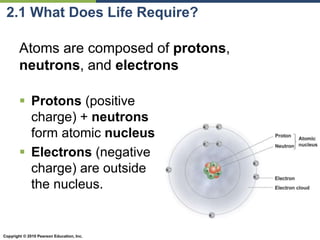
 Protons (positive
charge) + neutrons
form atomic nucleus
 Electrons (negative
charge) are outside
the nucleus.
Atoms are composed of protons,
neutrons, and electrons
Copyright © 2010 Pearson Education, Inc.
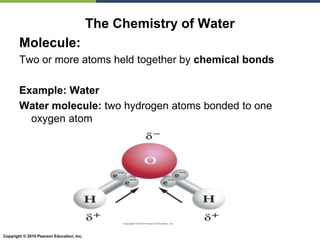
The Chemistry of Water
Molecule:
Two or more atoms held together by chemical bonds
Example: Water
Water molecule: two hydrogen atoms bonded to one
oxygen atom
Copyright © 2010 Pearson Education, Inc.
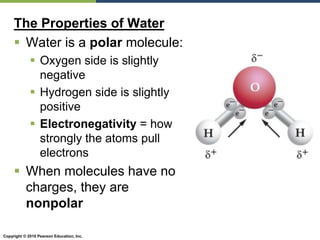
The Properties of Water
 Water is a polar molecule:
 Oxygen side is slightly
negative
 Hydrogen side is slightly
positive
 Electronegativity = how
strongly the atoms pull
electrons
 When molecules have no
charges, they are
nonpolar
Copyright © 2010 Pearson Education, Inc.
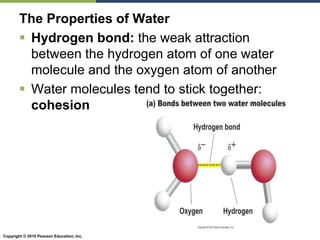
The Properties of Water
 Hydrogen bond: the weak attraction
between the hydrogen atom of one water
molecule and the oxygen atom of another
 Water molecules tend to stick together:
cohesion
Copyright © 2010 Pearson Education, Inc.
The Properties of Water
 Due to its polarity, water is a good solvent
 Solute: what is being dissolved
 Solution: the solute in the solvent
Copyright © 2010 Pearson Education, Inc.
The Properties of
Water
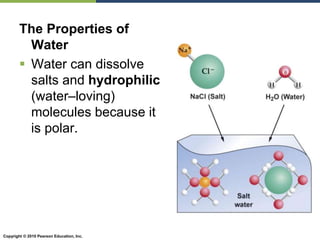
 Water can dissolve
salts and hydrophilic
(water–loving)
molecules because it
is polar.
Copyright © 2010 Pearson Education, Inc.
The Properties of Water CONTINUE.
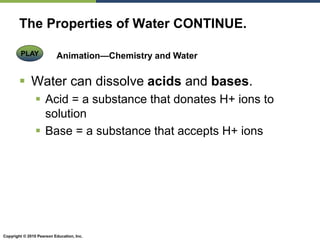
 Water can dissolve acids and bases.
 Acid = a substance that donates H+ ions to
solution
 Base = a substance that accepts H+ ions
Animation—Chemistry and Water
PLAY
Copyright © 2010 Pearson Education, Inc.
2.1 What Does Life Require?
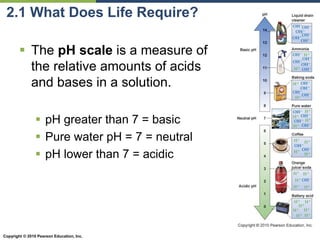
 The pH scale is a measure of
the relative amounts of acids
and bases in a solution.
 pH greater than 7 = basic
 Pure water pH = 7 = neutral
 pH lower than 7 = acidic
Copyright © 2010 Pearson Education, Inc.
Organic Chemistry =
The Chemistry of Carbon
Organic Chemistry
 All life on Earth is based on organic
chemistry: the chemistry of the element
carbon.
 Carbon makes up most of the mass of living
organisms.
 Why?
Copyright © 2010 Pearson Education, Inc.
Carbon as a building block
 Carbon forms Covalent bonds: strong bonds
from sharing electrons
 Carbon is like a molecular TinkerToy
 Can bond to 4 different atoms at once
 Carbon can make macromolecules
Copyright © 2010 Pearson Education, Inc.
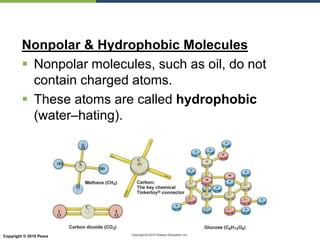
Nonpolar & Hydrophobic Molecules
 Nonpolar molecules, such as oil, do not
contain charged atoms.
 These atoms are called hydrophobic
(water–hating).
Copyright © 2010 Pearson Education, Inc.
Types of Macromolecules
1. Carbohydrates
2. Proteins
3. Lipids
4. Nucleic Acis
Figure 2.12
Structure and Function of Macromolecules
Copyright © 2010 Pearson Education, Inc.
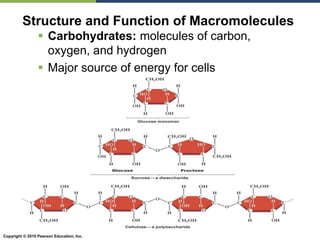
 Carbohydrates: molecules of carbon,
oxygen, and hydrogen
 Major source of energy for cells
Structure and Function of Macromolecules
Copyright © 2010 Pearson Education, Inc.
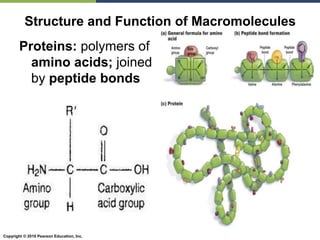
Proteins: polymers of
amino acids; joined
by peptide bonds
Structure and Function of Macromolecules
Copyright © 2010 Pearson Education, Inc.
Structure and Function of Macromolecules
Proteins
 There are 20 different common amino acids,
with different chemical properties.
 Amino Acids are made up of carbon, oxygen,
hydrogen, and nitrogen.
 Different combinations of amino acids give
proteins different properties.
Copyright © 2010 Pearson Education, Inc.
Structure and Function of Macromolecules
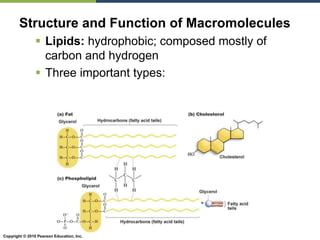
 Lipids: hydrophobic; composed mostly of
carbon and hydrogen
 Three important types:
Copyright © 2010 Pearson Education, Inc.
Structure and Function of Macromolecules
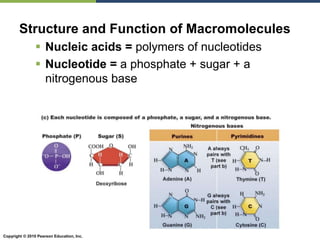
 Nucleic acids = polymers of nucleotides
 Nucleotide = a phosphate + sugar + a
nitrogenous base
Copyright © 2010 Pearson Education, Inc.
Structure and Function of Macromolecules
 Nucleotides are of two types, depending on the
sugar
 RNA = ribonucleic acid
 DNA = deoxyribonucleic acid
 DNA is the hereditary material in nearly all
organisms.
Copyright © 2010 Pearson Education, Inc.
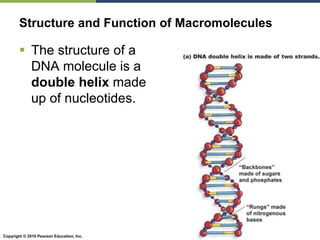
 The structure of a
DNA molecule is a
double helix made
up of nucleotides.
Figure 2.15a
Structure and Function of Macromolecules
Copyright © 2010 Pearson Education, Inc.
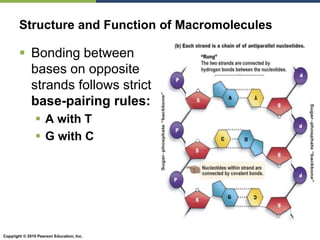
 Bonding between
bases on opposite
strands follows strict
base-pairing rules:
 A with T
 G with C
Structure and Function of Macromolecules
Copyright © 2010 Pearson Education, Inc.
Section 2.2
Life on Earth: Part 1 Cells
Cells – the smallest living unit
 All cells on Earth are either:
 Prokaryotic or Eukaryotic.
 Prokaryotic cells are smaller and simpler in
structure.
 EXP: bacteria
 They probably resemble the earliest cells to arise
on Earth.
 Some structures in the Martian meteorite resemble
them.
Copyright © 2010 Pearson Education, Inc.
Cells – the smallest living unit
 All cells on Earth are either:
 Prokaryotic or Eukaryotic.
 Prokaryotic cells are smaller and simpler in
structure.
 EXP: bacteria
 They probably resemble the earliest cells to
arise on Earth.
 Some structures in the Martian meteorite
resemble them.
Copyright © 2010 Pearson Education, Inc.
Characteristics of Cells
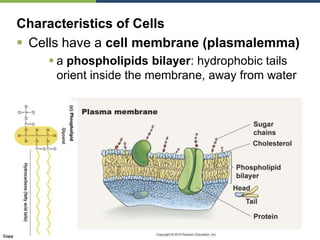
 Cells have a cell membrane (plasmalemma)
 a phospholipids bilayer: hydrophobic tails
orient inside the membrane, away from water
Copyright © 2010 Pearson Education, Inc.
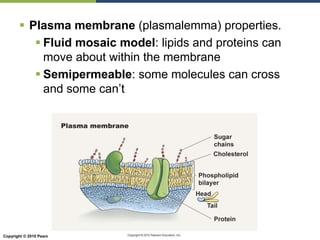
 Plasma membrane (plasmalemma) properties.
 Fluid mosaic model: lipids and proteins can
move about within the membrane
 Semipermeable: some molecules can cross
and some can’t
Copyright © 2010 Pearson Education, Inc.
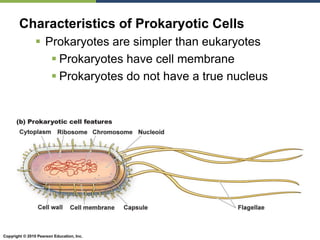
Characteristics of Prokaryotic Cells
 Prokaryotes are simpler than eukaryotes
 Prokaryotes have cell membrane
 Prokaryotes do not have a true nucleus
Copyright © 2010 Pearson Education, Inc.
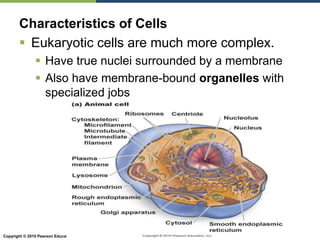
Characteristics of Cells
 Eukaryotic cells are much more complex.
 Have true nuclei surrounded by a membrane
 Also have membrane-bound organelles with
specialized jobs
Copyright © 2010 Pearson Education, Inc.
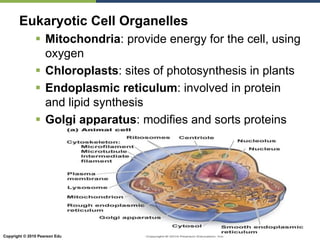
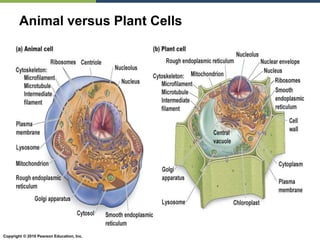
Eukaryotic Cell Organelles
 Mitochondria: provide energy for the cell, using
oxygen
 Chloroplasts: sites of photosynthesis in plants
 Endoplasmic reticulum: involved in protein
and lipid synthesis
 Golgi apparatus: modifies and sorts proteins
Copyright © 2010 Pearson Education, Inc.
Prokaryotic and Eukaryotic Cells
Animation—A Comparison of Prokaryotic
and Eukaryotic Cells
PLAY
Copyright © 2010 Pearson Education, Inc.
Animal versus Plant Cells
Copyright © 2010 Pearson Education, Inc.
Section 2.2 Life on Earth
Part 2 Tree of Life
The Tree of Life and Evolutionary Theory
 All Earth organisms share many similarities:
 Same basic biochemistry, with same types of
macromolecules
 All organisms consist of cells
 Cells always have phospholipid bilayer plasma
membrane
 Eukaryotes share most of the same organelles
Copyright © 2010 Pearson Education, Inc.
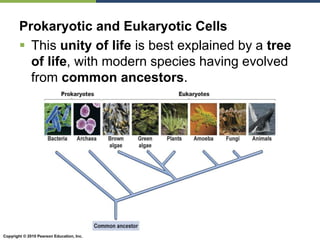
Prokaryotic and Eukaryotic Cells
 This unity of life is best explained by a tree
of life, with modern species having evolved
from common ancestors.
Copyright © 2010 Pearson Education, Inc.
Section 2.2 Life on Earth
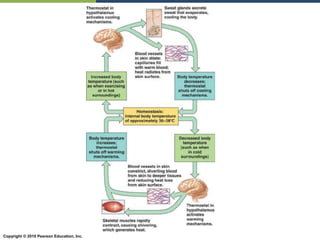
Part 3: Homeostasis
 Homeostasis – a dynamic state of equilibrium in which
internal conditions remain relative stable (Steady State)
 homeostasis maintains constant conditions in the
internal environment
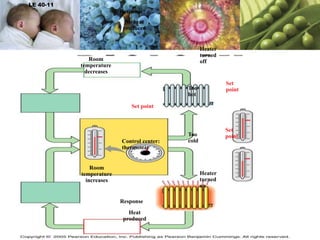
 A homeostatic control system has
 a receptor – can sense internal conditions
 a set point – what conditions should be maintained
at.
 a control center – processes information & sends
instructions to effectors
 an effector – can make changes to internal
conditions
Steve McCommas
Southern Illinois State University
PowerPoint lecture prepared by
Copyright © 2010 Pearson Education, Inc.
LE 40-11
Response
No heat
produced
Room
temperature
decreases
Room
temperature
increases
Set point
Too
hot
Set
point
Heater
turned
off
Too
cold
Set
point
Control center:
thermostat
Heater
turned
on
Response
Heat
produced
Copyright © 2010 Pearson Education, Inc.
Two Types of Regulatory Systems
 Negative Feedback – Homeostatic mechanism
that stops or reduces a change in internal
conditions
 Causes a change in the variable in the opposite
direction as the initial stimulus
 Positive feedback – a physiological mechanism
that disrupts homeostasis and causes dramatic
swings in physiological parameters
 Causes a change in the variable in the same direction
as the initial stimulus

Chapter two Biomolecule.ppt

  • 1.
    Copyright © 2010Pearson Education, Inc. BIOCHEMISTRY  CHAPTER TWO: BIOMOLECULES SECTION 2.1 What Does Life Require A Definition of Life There is no simple definition of life. But, all Earth organisms…  Require liquid water  Have a common set of biological molecules  Can maintain homeostasis  Can evolve
  • 2.
    Copyright © 2010Pearson Education, Inc. 2.1 What Does Life Require? Additional Characteristics of Life  Cellular organization  Growth and metabolism  Reproduction  Heredity
  • 3.
    Copyright © 2010Pearson Education, Inc. 2.1 What Does Life Require? Physical Properties of Chemicals  Elements: fundamental forms of matter  EXP: carbon, hydrogen, oxygen, etc  Atoms: the smallest units of an element
  • 4.
    Copyright © 2010Pearson Education, Inc. 2.1 What Does Life Require?  Protons (positive charge) + neutrons form atomic nucleus  Electrons (negative charge) are outside the nucleus. Atoms are composed of protons, neutrons, and electrons
  • 5.
    Copyright © 2010Pearson Education, Inc. The Chemistry of Water Molecule: Two or more atoms held together by chemical bonds Example: Water Water molecule: two hydrogen atoms bonded to one oxygen atom
  • 6.
    Copyright © 2010Pearson Education, Inc. The Properties of Water  Water is a polar molecule:  Oxygen side is slightly negative  Hydrogen side is slightly positive  Electronegativity = how strongly the atoms pull electrons  When molecules have no charges, they are nonpolar
  • 7.
    Copyright © 2010Pearson Education, Inc. The Properties of Water  Hydrogen bond: the weak attraction between the hydrogen atom of one water molecule and the oxygen atom of another  Water molecules tend to stick together: cohesion
  • 8.
    Copyright © 2010Pearson Education, Inc. The Properties of Water  Due to its polarity, water is a good solvent  Solute: what is being dissolved  Solution: the solute in the solvent
  • 9.
    Copyright © 2010Pearson Education, Inc. The Properties of Water  Water can dissolve salts and hydrophilic (water–loving) molecules because it is polar.
  • 10.
    Copyright © 2010Pearson Education, Inc. The Properties of Water CONTINUE.  Water can dissolve acids and bases.  Acid = a substance that donates H+ ions to solution  Base = a substance that accepts H+ ions Animation—Chemistry and Water PLAY
  • 11.
    Copyright © 2010Pearson Education, Inc. 2.1 What Does Life Require?  The pH scale is a measure of the relative amounts of acids and bases in a solution.  pH greater than 7 = basic  Pure water pH = 7 = neutral  pH lower than 7 = acidic
  • 12.
    Copyright © 2010Pearson Education, Inc. Organic Chemistry = The Chemistry of Carbon Organic Chemistry  All life on Earth is based on organic chemistry: the chemistry of the element carbon.  Carbon makes up most of the mass of living organisms.  Why?
  • 13.
    Copyright © 2010Pearson Education, Inc. Carbon as a building block  Carbon forms Covalent bonds: strong bonds from sharing electrons  Carbon is like a molecular TinkerToy  Can bond to 4 different atoms at once  Carbon can make macromolecules
  • 14.
    Copyright © 2010Pearson Education, Inc. Nonpolar & Hydrophobic Molecules  Nonpolar molecules, such as oil, do not contain charged atoms.  These atoms are called hydrophobic (water–hating).
  • 15.
    Copyright © 2010Pearson Education, Inc. Types of Macromolecules 1. Carbohydrates 2. Proteins 3. Lipids 4. Nucleic Acis Figure 2.12 Structure and Function of Macromolecules
  • 16.
    Copyright © 2010Pearson Education, Inc.  Carbohydrates: molecules of carbon, oxygen, and hydrogen  Major source of energy for cells Structure and Function of Macromolecules
  • 17.
    Copyright © 2010Pearson Education, Inc. Proteins: polymers of amino acids; joined by peptide bonds Structure and Function of Macromolecules
  • 18.
    Copyright © 2010Pearson Education, Inc. Structure and Function of Macromolecules Proteins  There are 20 different common amino acids, with different chemical properties.  Amino Acids are made up of carbon, oxygen, hydrogen, and nitrogen.  Different combinations of amino acids give proteins different properties.
  • 19.
    Copyright © 2010Pearson Education, Inc. Structure and Function of Macromolecules  Lipids: hydrophobic; composed mostly of carbon and hydrogen  Three important types:
  • 20.
    Copyright © 2010Pearson Education, Inc. Structure and Function of Macromolecules  Nucleic acids = polymers of nucleotides  Nucleotide = a phosphate + sugar + a nitrogenous base
  • 21.
    Copyright © 2010Pearson Education, Inc. Structure and Function of Macromolecules  Nucleotides are of two types, depending on the sugar  RNA = ribonucleic acid  DNA = deoxyribonucleic acid  DNA is the hereditary material in nearly all organisms.
  • 22.
    Copyright © 2010Pearson Education, Inc.  The structure of a DNA molecule is a double helix made up of nucleotides. Figure 2.15a Structure and Function of Macromolecules
  • 23.
    Copyright © 2010Pearson Education, Inc.  Bonding between bases on opposite strands follows strict base-pairing rules:  A with T  G with C Structure and Function of Macromolecules
  • 24.
    Copyright © 2010Pearson Education, Inc. Section 2.2 Life on Earth: Part 1 Cells Cells – the smallest living unit  All cells on Earth are either:  Prokaryotic or Eukaryotic.  Prokaryotic cells are smaller and simpler in structure.  EXP: bacteria  They probably resemble the earliest cells to arise on Earth.  Some structures in the Martian meteorite resemble them.
  • 25.
    Copyright © 2010Pearson Education, Inc. Cells – the smallest living unit  All cells on Earth are either:  Prokaryotic or Eukaryotic.  Prokaryotic cells are smaller and simpler in structure.  EXP: bacteria  They probably resemble the earliest cells to arise on Earth.  Some structures in the Martian meteorite resemble them.
  • 26.
    Copyright © 2010Pearson Education, Inc. Characteristics of Cells  Cells have a cell membrane (plasmalemma)  a phospholipids bilayer: hydrophobic tails orient inside the membrane, away from water
  • 27.
    Copyright © 2010Pearson Education, Inc.  Plasma membrane (plasmalemma) properties.  Fluid mosaic model: lipids and proteins can move about within the membrane  Semipermeable: some molecules can cross and some can’t
  • 28.
    Copyright © 2010Pearson Education, Inc. Characteristics of Prokaryotic Cells  Prokaryotes are simpler than eukaryotes  Prokaryotes have cell membrane  Prokaryotes do not have a true nucleus
  • 29.
    Copyright © 2010Pearson Education, Inc. Characteristics of Cells  Eukaryotic cells are much more complex.  Have true nuclei surrounded by a membrane  Also have membrane-bound organelles with specialized jobs
  • 30.
    Copyright © 2010Pearson Education, Inc. Eukaryotic Cell Organelles  Mitochondria: provide energy for the cell, using oxygen  Chloroplasts: sites of photosynthesis in plants  Endoplasmic reticulum: involved in protein and lipid synthesis  Golgi apparatus: modifies and sorts proteins
  • 31.
    Copyright © 2010Pearson Education, Inc. Prokaryotic and Eukaryotic Cells Animation—A Comparison of Prokaryotic and Eukaryotic Cells PLAY
  • 32.
    Copyright © 2010Pearson Education, Inc. Animal versus Plant Cells
  • 33.
    Copyright © 2010Pearson Education, Inc. Section 2.2 Life on Earth Part 2 Tree of Life The Tree of Life and Evolutionary Theory  All Earth organisms share many similarities:  Same basic biochemistry, with same types of macromolecules  All organisms consist of cells  Cells always have phospholipid bilayer plasma membrane  Eukaryotes share most of the same organelles
  • 34.
    Copyright © 2010Pearson Education, Inc. Prokaryotic and Eukaryotic Cells  This unity of life is best explained by a tree of life, with modern species having evolved from common ancestors.
  • 35.
    Copyright © 2010Pearson Education, Inc. Section 2.2 Life on Earth Part 3: Homeostasis  Homeostasis – a dynamic state of equilibrium in which internal conditions remain relative stable (Steady State)  homeostasis maintains constant conditions in the internal environment  A homeostatic control system has  a receptor – can sense internal conditions  a set point – what conditions should be maintained at.  a control center – processes information & sends instructions to effectors  an effector – can make changes to internal conditions
  • 36.
    Steve McCommas Southern IllinoisState University PowerPoint lecture prepared by Copyright © 2010 Pearson Education, Inc. LE 40-11 Response No heat produced Room temperature decreases Room temperature increases Set point Too hot Set point Heater turned off Too cold Set point Control center: thermostat Heater turned on Response Heat produced
  • 37.
    Copyright © 2010Pearson Education, Inc.
  • 38.
    Copyright © 2010Pearson Education, Inc. Two Types of Regulatory Systems  Negative Feedback – Homeostatic mechanism that stops or reduces a change in internal conditions  Causes a change in the variable in the opposite direction as the initial stimulus  Positive feedback – a physiological mechanism that disrupts homeostasis and causes dramatic swings in physiological parameters  Causes a change in the variable in the same direction as the initial stimulus