Chapter 4
Cell Structure and Function
Section 1: The History
    of Cell Biology
The Discovery of Cells
• All living things are made up of one or
  more cells.
• A cell is the smallest unit that can
  carry on all of the processes of life.
Robert Hooke
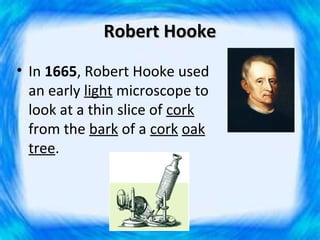
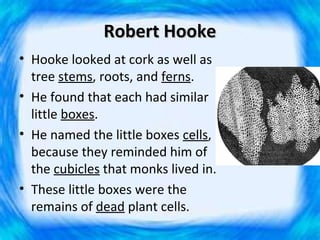
• In 1665, Robert Hooke used
  an early light microscope to
  look at a thin slice of cork
  from the bark of a cork oak
  tree.
Robert Hooke
• Hooke looked at cork as well as
  tree stems, roots, and ferns.
• He found that each had similar
  little boxes.
• He named the little boxes cells,
  because they reminded him of
  the cubicles that monks lived in.
• These little boxes were the
  remains of dead plant cells.
Anton van Leeuwenhoek
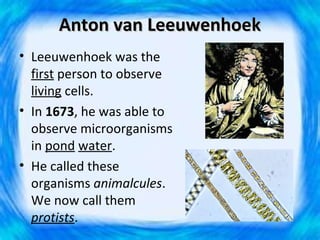
• Leeuwenhoek was the
  first person to observe
  living cells.
• In 1673, he was able to
  observe microorganisms
  in pond water.
• He called these
  organisms animalcules.
  We now call them
  protists.
The Cell Theory

• Although Hooke and Leeuwenhoek were
  the first to report observing cells, the
  importance of this observation was not
  realized until about 150 years later.
• At this time, biologists began to organize
  information about cells into a unified
  understanding.
The Cell Theory
• In 1838, the German botanist Matthias
  Schleiden concluded that all plants were
  composed of cells.
• In 1839, the German zoologist Theodor
  Schwann concluded that all animals were
  composed of cells.
• Finally, in 1855, the German physician
  Rudolph Virchow noted that all cells come
  from other cells.
• These three observations were combined to
  form the cell theory.
The Cell Theory
  • The cell theory has three essential parts:
     All living organisms are composed of
      one or more cells.
     Cells are the basic units of structure
      and function in an organism.
     Cells come only from the reproduction
      of existing cells.
http://www.youtube.com/watch?
v=dscY_2QQbKU&feature=related
       http://www.youtube.com/watch?v=Q2ezDdKyRUc
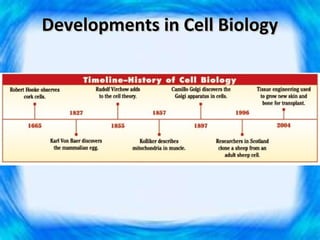
Developments in Cell Biology
The Cellular Basis of Life
• All living things share several basic
  characteristics:
   – Consist of organized parts
   – Obtain energy from their surroundings
   – Perform chemical reactions
   – Change with time
   – Respond to their environments
   – Reproduce
   – Maintain homeostasis
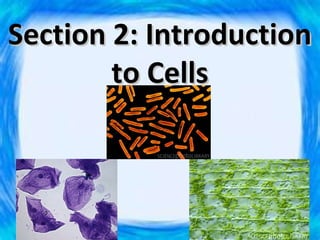
Section 2: Introduction
        to Cells
Cell Diversity

• Cells are very diverse in terms of shape,
  size, and internal organization.
• A cell’s function influences its physical
  features.
Cell Shape

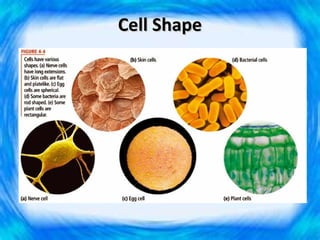
• The diversity in cell shapes reflects the
  different functions of cells.
• A cell’s shape can be simple or complex
  depending on the function of the cell.
• Each cell has a shape that has evolved to
  allow the cell to perform its function
  effectively.
Cell Shape
Cell Size
• Cells differ greatly in their sizes:
   – Nerve cells in a giraffe’s spinal cord can be 2
     m (about 6.5 ft) long.
   – A human egg cell is about the size of a period
     at the end of a sentence.
   – Most cells are only about 1/500 the size of a
     period at the end of a sentence.

  – http://learn.genetics.utah.edu/content/begin
    /cells/scale/
Cell Size
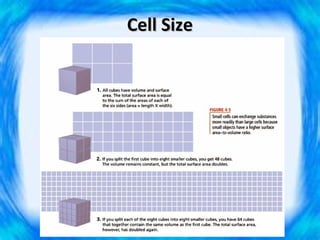
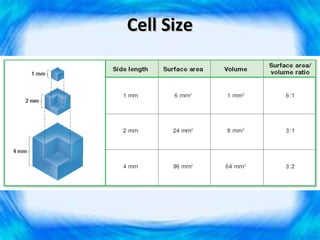
• The size of a cell is limited by the cell’s
  surface area-to-volume ratio.
• As a cell grows, its volume increases
  much faster than its surface area.
• This is important because materials
  needed by a cell (such as nutrients and
  oxygen) and wastes produced by a cell
  (such as carbon dioxide) must pass into
  and out of the cell through its surface.
Cell Size

• If a cell became very large, there would
  not be enough surface area to allow
  materials to enter or leave the cell
  quickly enough to meet the cell’s needs.
• Therefore, most cells are microscopic in
  size.
Cell Size
Cell Size
Basic Parts of a Cell

• Despite the diversity among cells, three
  basic features are common to all cell
  types – an outer boundary, an interior
  substance, and a control region.
Plasma Membrane (or Cell Membrane)

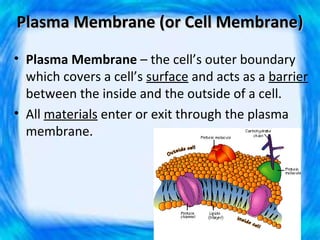
• Plasma Membrane – the cell’s outer boundary
  which covers a cell’s surface and acts as a barrier
  between the inside and the outside of a cell.
• All materials enter or exit through the plasma
  membrane.
Cytoplasm
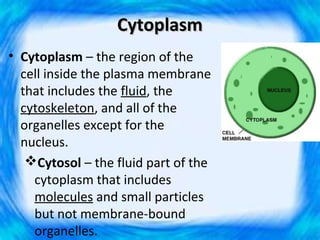
• Cytoplasm – the region of the
  cell inside the plasma membrane
  that includes the fluid, the
  cytoskeleton, and all of the
  organelles except for the
  nucleus.
   Cytosol – the fluid part of the
    cytoplasm that includes
    molecules and small particles
    but not membrane-bound
    organelles.
Control Center
• Cells carry DNA for regulating their
  functions and reproducing themselves.
   – The DNA in some types of cells floats
     freely inside the cell.
   – Other cells keep the DNA in a
     membrane-bound organelle called the
     nucleus.
• Most of the functions of a eukaryotic cell
  are controlled by the nucleus.
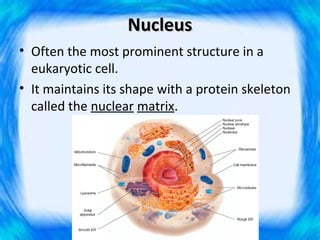
Nucleus
• Often the most prominent structure in a
  eukaryotic cell.
• It maintains its shape with a protein skeleton
  called the nuclear matrix.
Two Basic Types of Cells
• Fossil evidence suggests that the earliest
  cells on Earth were simple cells similar to
  some present-day bacteria.
• As cells evolved, they differentiated into
  two major types – prokaryotes and
  eukaryotes.
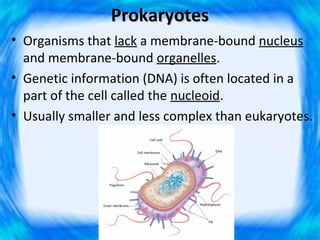
Prokaryotes
• Organisms that lack a membrane-bound nucleus
  and membrane-bound organelles.
• Genetic information (DNA) is often located in a
  part of the cell called the nucleoid.
• Usually smaller and less complex than eukaryotes.
Eukaryotes
• Organisms made up of one or more cells that
  have a nucleus and membrane-bound
  organelles.
• Eukaryotic cells have a variety of organelles,
  which are well-defined, intracellular bodies
  that perform specific functions for the cell.
• Eukaryotic cells are generally much larger and
  more complex than prokaryotic cells.
Comparing Prokaryotes and Eukaryotes

 C:ProjectsHolt-Rinehart-
 WinstonHRWScienceHRWScienceMo
 dern_BiologyCh0460052.html
Cellular Organization
• Over time, cells began to form groups
  that functioned together.
• Some cells retained the ability to live
  outside a group.
• Others became dependent on each other
  for survival.
Colonies

• A colonial organism is a collection of
  genetically identical cells that live
  together in a connected group.
• Not truly multicellular because few cell
  activities are coordinated.
True Multicellularity
• As organisms evolved, their cells became more
  specialized and eventually were unable to
  survive independently.
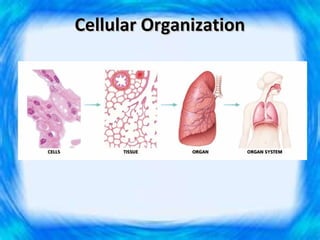
   Tissue – a group of similar cells and their
     products that carry out a specific function
   Organs – groups of tissues that perform a
     particular job in an organism
   Organ System – group of organs that
     accomplish related tasks
   Organism – several organ systems combined
Cellular Organization

Chapter 4 - Cells

  • 1.
  • 2.
    Section 1: TheHistory of Cell Biology
  • 3.
    The Discovery ofCells • All living things are made up of one or more cells. • A cell is the smallest unit that can carry on all of the processes of life.
  • 4.
    Robert Hooke • In1665, Robert Hooke used an early light microscope to look at a thin slice of cork from the bark of a cork oak tree.
  • 5.
    Robert Hooke • Hookelooked at cork as well as tree stems, roots, and ferns. • He found that each had similar little boxes. • He named the little boxes cells, because they reminded him of the cubicles that monks lived in. • These little boxes were the remains of dead plant cells.
  • 6.
    Anton van Leeuwenhoek •Leeuwenhoek was the first person to observe living cells. • In 1673, he was able to observe microorganisms in pond water. • He called these organisms animalcules. We now call them protists.
  • 7.
    The Cell Theory •Although Hooke and Leeuwenhoek were the first to report observing cells, the importance of this observation was not realized until about 150 years later. • At this time, biologists began to organize information about cells into a unified understanding.
  • 8.
    The Cell Theory •In 1838, the German botanist Matthias Schleiden concluded that all plants were composed of cells. • In 1839, the German zoologist Theodor Schwann concluded that all animals were composed of cells. • Finally, in 1855, the German physician Rudolph Virchow noted that all cells come from other cells. • These three observations were combined to form the cell theory.
  • 9.
    The Cell Theory • The cell theory has three essential parts: All living organisms are composed of one or more cells. Cells are the basic units of structure and function in an organism. Cells come only from the reproduction of existing cells. http://www.youtube.com/watch? v=dscY_2QQbKU&feature=related http://www.youtube.com/watch?v=Q2ezDdKyRUc
  • 10.
  • 11.
    The Cellular Basisof Life • All living things share several basic characteristics: – Consist of organized parts – Obtain energy from their surroundings – Perform chemical reactions – Change with time – Respond to their environments – Reproduce – Maintain homeostasis
  • 12.
  • 13.
    Cell Diversity • Cellsare very diverse in terms of shape, size, and internal organization. • A cell’s function influences its physical features.
  • 14.
    Cell Shape • Thediversity in cell shapes reflects the different functions of cells. • A cell’s shape can be simple or complex depending on the function of the cell. • Each cell has a shape that has evolved to allow the cell to perform its function effectively.
  • 15.
  • 16.
    Cell Size • Cellsdiffer greatly in their sizes: – Nerve cells in a giraffe’s spinal cord can be 2 m (about 6.5 ft) long. – A human egg cell is about the size of a period at the end of a sentence. – Most cells are only about 1/500 the size of a period at the end of a sentence. – http://learn.genetics.utah.edu/content/begin /cells/scale/
  • 17.
    Cell Size • Thesize of a cell is limited by the cell’s surface area-to-volume ratio. • As a cell grows, its volume increases much faster than its surface area. • This is important because materials needed by a cell (such as nutrients and oxygen) and wastes produced by a cell (such as carbon dioxide) must pass into and out of the cell through its surface.
  • 18.
    Cell Size • Ifa cell became very large, there would not be enough surface area to allow materials to enter or leave the cell quickly enough to meet the cell’s needs. • Therefore, most cells are microscopic in size.
  • 19.
  • 20.
  • 21.
    Basic Parts ofa Cell • Despite the diversity among cells, three basic features are common to all cell types – an outer boundary, an interior substance, and a control region.
  • 22.
    Plasma Membrane (orCell Membrane) • Plasma Membrane – the cell’s outer boundary which covers a cell’s surface and acts as a barrier between the inside and the outside of a cell. • All materials enter or exit through the plasma membrane.
  • 23.
    Cytoplasm • Cytoplasm –the region of the cell inside the plasma membrane that includes the fluid, the cytoskeleton, and all of the organelles except for the nucleus. Cytosol – the fluid part of the cytoplasm that includes molecules and small particles but not membrane-bound organelles.
  • 24.
    Control Center • Cellscarry DNA for regulating their functions and reproducing themselves. – The DNA in some types of cells floats freely inside the cell. – Other cells keep the DNA in a membrane-bound organelle called the nucleus. • Most of the functions of a eukaryotic cell are controlled by the nucleus.
  • 25.
    Nucleus • Often themost prominent structure in a eukaryotic cell. • It maintains its shape with a protein skeleton called the nuclear matrix.
  • 26.
    Two Basic Typesof Cells • Fossil evidence suggests that the earliest cells on Earth were simple cells similar to some present-day bacteria. • As cells evolved, they differentiated into two major types – prokaryotes and eukaryotes.
  • 27.
    Prokaryotes • Organisms thatlack a membrane-bound nucleus and membrane-bound organelles. • Genetic information (DNA) is often located in a part of the cell called the nucleoid. • Usually smaller and less complex than eukaryotes.
  • 28.
    Eukaryotes • Organisms madeup of one or more cells that have a nucleus and membrane-bound organelles. • Eukaryotic cells have a variety of organelles, which are well-defined, intracellular bodies that perform specific functions for the cell. • Eukaryotic cells are generally much larger and more complex than prokaryotic cells.
  • 29.
    Comparing Prokaryotes andEukaryotes C:ProjectsHolt-Rinehart- WinstonHRWScienceHRWScienceMo dern_BiologyCh0460052.html
  • 30.
    Cellular Organization • Overtime, cells began to form groups that functioned together. • Some cells retained the ability to live outside a group. • Others became dependent on each other for survival.
  • 31.
    Colonies • A colonialorganism is a collection of genetically identical cells that live together in a connected group. • Not truly multicellular because few cell activities are coordinated.
  • 32.
    True Multicellularity • Asorganisms evolved, their cells became more specialized and eventually were unable to survive independently. Tissue – a group of similar cells and their products that carry out a specific function Organs – groups of tissues that perform a particular job in an organism Organ System – group of organs that accomplish related tasks Organism – several organ systems combined
  • 33.