STD 11 BIOLOGY
CHAPTER 05
MORPHOLOGY OF
FLOWERING PLANTS
SANJAY SIDDHAPURA
M.Sc., B.Ed., GSET, GPSC
Ph.D. (Continue)
INTRODUCTION
• Morphology is the branch of biology which deals with the study
of form, structure and relative position of different organs.
• Flowering plants (or angiosperms) are seed bearing plants in
which seeds are always enclosed in a ovary inside the fruits and
the sporophylls are organized into flowers.
• These plants have been classified into monocots and dicots.
• Plant morphology refers to the study of external form and
structure of plants.
• The flowering plants consists of an axis, root system and shoot
system.
• Shoot system lies above the ground and the root system lies below
the ground.
• Shoot system bears branches, leaves, flowers and fruits.
• The root, leaves and branches constitute the vegetative parts of
the plants.
• The flowers, fruits and seeds form the reproductive parts of the
plants.
THE ROOT
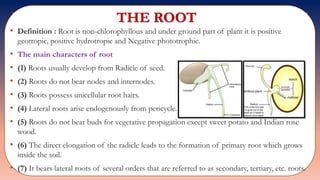
• Definition : Root is non-chlorophyllous and under ground part of plant it is positive
geotropic, positive hydrotropic and Negative phototrophic.
• The main characters of root
• (1) Roots usually develop from Radicle of seed.
• (2) Roots do not bear nodes and internodes.
• (3) Roots possess unicellular root hairs.
• (4) Lateral roots arise endogenously from pericycle.
• (5) Roots do not bear buds for vegetative propagation except sweet potato and Indian rose
wood.
• (6) The direct elongation of the radicle leads to the formation of primary root which grows
inside the soil.
• (7) It bears lateral roots of several orders that are referred to as secondary, tertiary, etc. roots.
TYPES OF ROOT SYSTEM
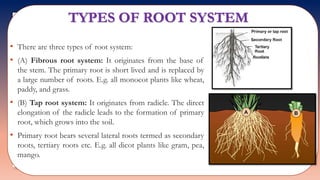
• There are three types of root system:
• (A) Fibrous root system: It originates from the base of
the stem. The primary root is short lived and is replaced by
a large number of roots. E.g. all monocot plants like wheat,
paddy, and grass.
• (B) Tap root system: It originates from radicle. The direct
elongation of the radicle leads to the formation of primary
root, which grows into the soil.
• Primary root bears several lateral roots termed as secondary
roots, tertiary roots etc. E.g. all dicot plants like gram, pea,
mango.
• (C) Adventitious root system: The root develops from any part of the plant other than
radicle. E.g. Grass, banyan tree, Monstera etc.
• Functions of Root
• (i) Roots help in absorption of water and minerals from the soil.
• (ii) It provides a proper anchorage to the plant parts.
• (iii) It helps in storage of reserve food materials.
• (iv) It helps in synthesis of plant growth regulators.
C
REGIONS OF THE ROOT
• A root has the following regions:
• (i) Root cap: It is a thimble like structure that covers the root at apex.
• Its main function is to protect the tender apical part.
• (ii) Region of meristematic activity: It lies above the root cap.
• The cells of this region are very small, thin-walled and with dense
protoplasm.
• They divide repeatedly.
• (iii) Region of elongation: It lies above the region of meristematic
activity.
• Cells in this region undergo rapid elongation and enlargement and are
responsible for the growth of the root in length.
• (iv) Region of maturation: It lies above the region of elongation.
• The cells of the elongation zone gradually differentiate and mature.
• Epidermal cells of this region form delicate thread like root hair, which
helps in the absorption of water and minerals from the soil.
Modifications of Root
• Roots in some plants change their shape and structure and become modified to perform certain
functions like support, storage of food and respiration.
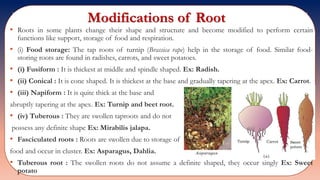
• (i) Food storage: The tap roots of turnip (Brassica rape) help in the storage of food. Similar food-
storing roots are found in radishes, carrots, and sweet potatoes.
• (i) Fusiform : It is thickest at middle and spindle shaped. Ex: Radish.
• (ii) Conical : It is cone shaped. It is thickest at the base and gradually tapering at the apex. Ex: Carrot.
• (iii) Napiform : It is quite thick at the base and
abruptly tapering at the apex. Ex: Turnip and beet root.
• (iv) Tuberous : They are swollen taproots and do not
possess any definite shape Ex: Mirabilis jalapa.
• Fasciculated roots : Roots are swollen due to storage of
food and occur in cluster. Ex: Asparagus, Dahlia.
• Tuberous root : The swollen roots do not assume a definite shaped, they occur singly Ex: Sweet
potato
Modifications of Root
• (ii) Support: The banyan tree (Ficus benghalensis) has massive pillar-like adventitious roots arising
from the aerial part of the stem. These roots grow towards the ground and provide support to
the tree. Such roots are called prop roots.
• Stilt roots : They appear from the basal nodes near the soil. They grow downwards and fix the
erect stem with soil to provide extra support. Ex: Zea mays, Saccharum officinarum
Modifications of Root
• (iii) Respiration: The roots of mangrove (Rhizophora ) plants grow vertically upwards from the
soil for the absorption of oxygen from the atmosphere as the soil is poorly aerated (swampy
areas). These types of roots are called pneumatophores.
THE STEM
• Stem is the ascending part of the axis growing above the soil-bearing
leaves, fruits, and flowers.
• It develops from the plumule of the embryo of a germinating seed.
• The stem bears nodes and internodes.
• The regions of the stem where leaves are born are called nodes while
internodes are the portions between two nodes.
• The stem bears buds, which may be terminal or axillary.
• Functions of Stem
• (i) It conducts water and minerals from the roots and food from the leaves.
• (ii) It helps in spreading out branches bearing leaves, flowers and fruits.
• (iii) Some stems perform the function of storage of food, support, protection and of
vegetative propagation.
• They are modified to perform different functions.
• Underground stems of potato, ginger, turmeric, zaminkand, Colocasia are modified to store food
in them.
• They also act as organs of perennation to tide over conditions unfavourable for growth.
• Stem tendrils which develop from axillary buds, are slender and spirally coiled and help plants
to climb such as in gourds (cucumber, pumpkins, watermelon) and grapevines.
• Axillary buds of stems may also get modified into woody, straight and pointed thorns. Thorns
are found in many plants such as Citrus, Bougainvillea. They protect plants from browsing
animals.
• Some plants of arid regions modify their stems into flattened (Opuntia), or fleshy cylindrical
(Euphorbia) structures. They contain chlorophyll and carry out photosynthesis.
Modifications of Stem
• Underground stems of some plants such as grass and strawberry, etc., spread to new niches
and when older parts die new plants are formed.
• In plants like mint and jasmine a slender lateral branch arises from the base of the main axis
and after growing aerially for some time arch downwards to touch the ground.
• A lateral branch with short internodes and each node bearing a rosette of leaves and a tuft of
roots is found in aquatic plants like Pistia and Eichhornia.
• In banana, pineapple and Chrysanthemum, the lateral branches originate from the basal and
underground portion of the main stem, grow horizontally beneath the soil and then come out
obliquely upward giving rise to leafy shoots.
Modifications of Stem
• (i) For food storage: Rhizomes and corms are underground stems, modified for the storage
of food. Example : Ginger (Zingiber officinale), turmeric., Colocasia
• Rhizomes :- Horizontal underground stem bears nodes and internodes.
Modifications of Stem
• (ii) For support: The stem in some weak plants bear thin, slender, and spirally-coiled
structures called tendrils that help the plant get attached to nearby structures for support.
• Tendrils are found in cucumbers, melons, and other members of the family Cucurbitaceae.
Modifications of Stem
• (iii) For protection: The stem in Bougainvillea and citrus plants (like lemon and orange) bear
sharp, pointed structures called thorns, which provide protection to the plant from herbivores.
Modifications of Stem
• (iv) For vegetative propagation: Underground
stems of grass, strawberry, lateral branches of
mint and jasmine are propagated vegetatively.
• Runner : It is elongated prostrate aerial branch
with long internodes and roots at nodes, Ex:
Oxalis, Centella asiatica (Brahmi), grass.
• Stolon : It is elongated horizontal branch, which
arise from base of the stem. It produces a new
plant at its tip. Ex: Dracaena mint jasmine.
• Offset : It is short horizontal branch producing a
cluster of leaves above and cluster of roots
below. Ex : Pistia, Eichhornia.
• (v) For assimilation of food: The stem in the Opuntia is green. It carries out the process of
photosynthesis in the absence of leaves.
THE LEAF
• The leaf is a lateral, generally flattened structure borne on the stem.
• It develops at the node and bears a bud in its axil.
• The axillary bud later develops into a branch.
• Leaves originate from shoot apical meristems and are arranged in an acropetal order.
• They are the most important vegetative organs for photosynthesis.
Structure of leaf
• A typical leaf consists of three main parts: leaf base, petiole and lamina.
• The leaf is attached to the stem by the leaf base and may bear two lateral
small leaf like structures called stipules.
• In monocotyledons, the leaf base expands into a sheath covering the stem
partially or wholly.
• In some leguminous plants the leafbase may become swollen, which is called the pulvinus.
• The petiole help hold the blade to light.
• Long thin flexible petioles allow leaf blades to flutter in wind, thereby cooling the leaf and bringing
fresh air to leaf surface.
• The lamina or the leaf blade is the green expanded part of the leaf with veins and veinlets.
• There is, usually, a middle prominent vein, which is known as the midrib.
• Veins provide rigidity to the leaf blade and act as channels of transport for water, minerals and food
materials.
• The shape, margin, apex, surface and extent of incision of lamina varies in different leaves.
Venation
• The arrangement of veins and the veinlets in the lamina of leaf is termed as venation.
• When the veinlets form a network, the venation is termed as reticulate (Figure 5.7 b).
• When the veins run parallel to each other within a lamina, the venation is termed as parallel (Figure
5.7 c).
• Leaves of dicotyledonous plants generally possess reticulate venation, while parallel venation is the
characteristic of most monocotyledons.
Types of Leaves
• A leaf may be simple or compound depending upon the incision of lamina.
• Simple leaf : In simple leaf lamina is not divided completely into distinct leaflets.
• Compound leaf : In compound leaf, incision of leaf blade goes down to the rachis so the
leaf is broken up into number of segments called leaflets. The compound leaves are of two
types-pinnate and palmate.
• Pinnate: These are feather like leaves. The segmentation of the leaf-blade is towards the midrib, so that the
leaflets are borne laterally by midrib or rachis. Example neem.
• Palmate: They are fan-like having leaflets which are borne at the tip of the petiole. In palmate compound
leaves the segmentation of the leaf extends from the apical margin to the petiole so that the leaflets are
articulated to the tip of the petiole like fingers on a palm. Example :silk cotton.
Phyllotaxy
• It is the arrangement of leaves on stem and its branches. It is of following types
• (a) alternate, (b) opposite and (c) whorled.
• (a) Alternate: In alternate type of phyllotaxy, a single leaf arises at each node in alternate
manner, as in china rose, mustard and sun flower plants.
• (b) Opposite : In opposite type, a pair of leaves arise at each node and lie opposite to each
other as in Calotropis and guava plants.
• (c) Whorled : If more than two leaves arise at a node and form a whorl, it is called whorled, as
in Alstonia.
Modifications of Leaves
• Leaves are often modified to perform functions other than photosynthesis.
• They are converted into tendrils for climbing as in peas.
• They are converted into spines for defence as in cacti.
• Bulb: The fleshy leaves of onion and garlic store food.
• Phyllode : In some plants such as Australian acacia, the leaves are
small and short-lived. The petioles in these plants expand, become green and synthesise food.
• Pitcher : Leaves of certain insectivorous plants such as pitcher plant, venus-fly trap are also
modified leaves.
THE INFLORESCENCE
• The arrangement of flowers on floral axis is known as inflorescence.
• Flower is a modified shoot.
• Several modifications take place in the shoot to give rise to inflorescence.
• These are follows:
• Shoot apical meristem changes to floral meristem.
• Internodes do not elongate and axis gets condensed.
• The apex produces different kinds of floral appendages at nodes in place of leaves.
• When shoot tip is modified into flowers, the flower is always solitary.
TYPES OF INFLORESCENCE
• Based on arrangement on the floral axis, inflorescence is of two types:Racemose and Cymose.
• (i) Racemose inflorescence:
• In racemose inflorescence, the main axis continues to grow.
• The flowers are borne laterally in an acropetal succession,
which means the older flowers are at the base and younger
flowers are near the apex.
• E.g. radish, mustard, Amaranthus.
• (ii) Cymose inflorescence: In cymose inflorescence,
the axis terminates in a flower, hence, is limited in growth.
• The flowers are borne in a basipetal order, which means
older flowers are at the apex and younger flowers are near
the base. E.g. cotton, jasmine, Calotropis.
Types of Racemose inflorescence
• (a) Raceme : Peduncle is unbranched and bears Pedicellate flowers in an acropetal fashion.
Ex: Delphinium, Radish.
• (b) Corymb : An unbranched peduncle have pedicellate flowers in an acropetal fashion but
the lower flowers have long pedicels than upper ones. So that all the flowers are brought to the
same level. Ex: Candytuft or Iberis amara.
• (c) Corymbose raceme : The young flowers show corymb inflorescence but in mature state
the longer pedicels of the lower flowers do not bring them to the leave of upper ones. Ex:
Mustard.
Types of Racemose inflorescence
• (d) Umbel : The main axis is short and all flowers appear to be arising from the same point at
the base of flowers, cluster of bracts form involucre. Ex: Centella asiatica. The name of
family Umbeliferae is based on umbel inflorescence.
• (e) Spike : It is unbranched, elongated, simple and indefinite inflorescence in which flowers
are sessile. Ex: Adhatoda vasica, Achyranthus aspara.
• (f) Catkin : It is pendulous spike, which bears unisexual and sessile flowers. Ex: Salix,
Mulberry.
Types of Racemose inflorescence
• (h) Spikelet : It is compact spike of few flowers borne on axis called rachilla and surrounded
by two scales called glumes. Each flower has at its base a bract called lemma (lower palea) and a
bracteole called palea (upper palea) Ex: Wheat, Grasses.
• (i) Spadix : It is spike inflorescence with fleshy axis which bears both Staminate and Pistillate
flower. It is covered by a large coloured bract called spathe. Ex: Colocasia, Arum.
• (j) Head or Capitulum : The peduncle is flattened to form a recepticle which bears small
sessile flowers called florets. The florets are arranged in centripetal fashion. Peripheral florets
are called ray florets while central florets are known as disc florets. Ex: Sunflower.
THE FLOWER
• A flower is a modified shoot. It is the main reproductive unit in angiosperms.
• Flowers carry out sexual reproduction in angiosperms.
• A typical flower has four different kinds of whorls arranged successively on the swollen end of
the stalk (or pedicel), called thalamus (receptacle).
• The different kinds of whorls are: Androecium, Gynoecium, Calyx and Corolla.
pedicel
thalamus (receptacle).
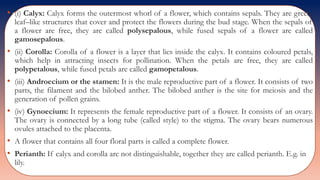
• (i) Calyx: Calyx forms the outermost whorl of a flower, which contains sepals. They are green,
leaf–like structures that cover and protect the flowers during the bud stage. When the sepals of
a flower are free, they are called polysepalous, while fused sepals of a flower are called
gamosepalous.
• (ii) Corolla: Corolla of a flower is a layer that lies inside the calyx. It contains coloured petals,
which help in attracting insects for pollination. When the petals are free, they are called
polypetalous, while fused petals are called gamopetalous.
• (iii) Androecium or the stamen: It is the male reproductive part of a flower. It consists of two
parts, the filament and the bilobed anther. The bilobed anther is the site for meiosis and the
generation of pollen grains.
• (iv) Gynoecium: It represents the female reproductive part of a flower. It consists of an ovary.
The ovary is connected by a long tube (called style) to the stigma. The ovary bears numerous
ovules attached to the placenta.
• A flower that contains all four floral parts is called a complete flower.
• Perianth: If calyx and corolla are not distinguishable, together they are called perianth. E.g. in
lily.
• Based on sexuality, flowers are divided into two types:
• Unisexual and Bisexual.
• Unisexual flowers:Unisexual flowers are those which contain either gynoecium (carpels) or
androecium (stamen) .
• Bisexual flowers: Bisexual flowers are those which contain both gynoecium (carpels) or
androecium (stamen).
• Based on symmetry, flowers are divided into three types:
• Actinomorphic, Zygomorphic and Asymmetrical.
• (i) Actinomorphic flowers: Actinomorphic flowers can be divided into two radial halves by
any radial plane passing through its centre. E.g. Chilly, mustard, Datura Etc.
• (ii) Zygomorphic flowers: Zygomorphic flowers are those flowers which can be divided into
two similar halves by a single vertical plane. E.g. Pea, beans, Gulmohar etc.
• (iii) Asymmetrical flowers: Asymmetrical flowers are those flowers which cannot be divided
by any plane equally. E.g. Canna.
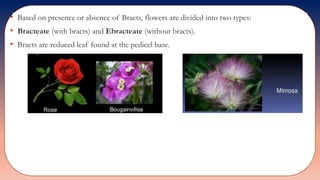
• Based on presence or absence of Bracts, flowers are divided into two types:
• Bracteate (with bracts) and Ebracteate (without bracts).
• Bracts are reduced leaf found at the pedicel base.
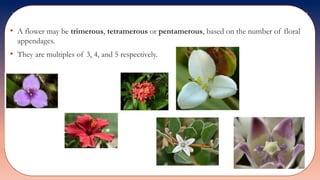
• A flower may be trimerous, tetramerous or pentamerous, based on the number of floral
appendages.
• They are multiples of 3, 4, and 5 respectively.
• Based on the position of the calyx, corolla, and androecium (with respect to the ovary on the
thalamus), the flowers are divided into three types:
• Hypognous, perigynous, and epigynous.
• (i) Hypogynous flowers (Superior ovary): In this, the ovary occupies the highest position on
the thalamus while other floral parts are situated below it. In such flowers, the ovary is
superior. E.g., China rose, mustard etc.
• (ii) Perigynous flowers (Half inferior ovary): In
this, the ovary is situated at the centre and other
floral parts are arranged on the rim of the thalamus.
The ovary here is said to be half inferior. E.g., plum,
rose, peach.
• (iii) Epigynous flowers (Inferior ovary): In this,
the thalamus grows around the ovary fusing with its
wall. The other floral parts are present above the
ovary. Hence, the ovary is said to be inferior. E.g.,
flowers of guava and cucumber.
Aestivation
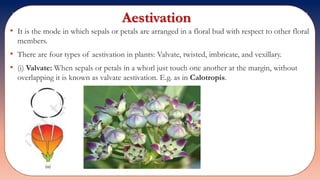
• It is the mode in which sepals or petals are arranged in a floral bud with respect to other floral
members.
• There are four types of aestivation in plants: Valvate, twisted, imbricate, and vexillary.
• (i) Valvate: When sepals or petals in a whorl just touch one another at the margin, without
overlapping it is known as valvate aestivation. E.g. as in Calotropis.
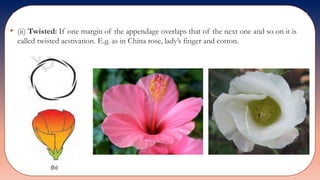
• (ii) Twisted: If one margin of the appendage overlaps that of the next one and so on it is
called twisted aestivation. E.g. as in China rose, lady’s finger and cotton.
• (iii) Imbricate: If the margins of sepals or petals overlap one another but not in anyparticular
direction, the aestivation is called imbricate. E.g. as in Cassia and gulmohur.
• (iv) Vexillary: In vexillary aestivation, the largest (standard) overlaps the two lateral petals
(wings) which in turn overlap the two smallest anterior petals (keel). E.g. In pea and bean
flowers, which have five petals.
Androecium
• Androecium is the male reproductive part composed of stamens.
• Each stamen consists of a filament and an anther.
• Anther is bilobed. Each lobe has 2 chambers called pollensacs where pollen grains are
produced.
• Sterile stamen is called a staminode.
• There may be a variation in the length of filaments within a flower, as in Salvia and mustard.
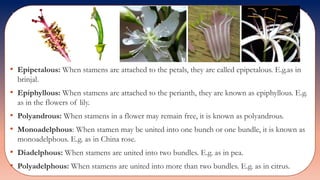
• Epipetalous: When stamens are attached to the petals, they are called epipetalous. E.g.as in
brinjal.
• Epiphyllous: When stamens are attached to the perianth, they are known as epiphyllous. E.g.
as in the flowers of lily.
• Polyandrous: When stamens in a flower may remain free, it is known as polyandrous.
• Monoadelphous: When stamen may be united into one bunch or one bundle, it is known as
monoadelphous. E.g. as in China rose.
• Diadelphous: When stamens are united into two bundles. E.g. as in pea.
• Polyadelphous: When stamens are united into more than two bundles. E.g. as in citrus.
Gynoecium
• Gynoecium is a female reproductive part
made up of carpels.
• Carpel is made up of three parts: Stigma,
style and ovary.
• The stigma is usually at the tip of the
style and is the receptive surface for pollen
grains.
• The style connects the ovary to the stigma.
• Ovary is the enlarged basal part, on which
lies the elongated tube, the style.
• Each ovary bears one or more ovules
attached to a flattened, cushion-like
placenta.
• After fertilisation, the ovules develop into
seeds and the ovary matures into a fruit.
Classification of carpel
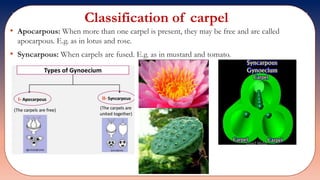
• Apocarpous: When more than one carpel is present, they may be free and are called
apocarpous. E.g. as in lotus and rose.
• Syncarpous: When carpels are fused. E.g. as in mustard and tomato.
Placentation
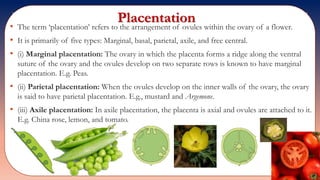
• The term ‘placentation’ refers to the arrangement of ovules within the ovary of a flower.
• It is primarily of five types: Marginal, basal, parietal, axile, and free central.
• (i) Marginal placentation: The ovary in which the placenta forms a ridge along the ventral
suture of the ovary and the ovules develop on two separate rows is known to have marginal
placentation. E.g. Peas.
• (ii) Parietal placentation: When the ovules develop on the inner walls of the ovary, the ovary
is said to have parietal placentation. E.g., mustard and Argemone.
• (iii) Axile placentation: In axile placentation, the placenta is axial and ovules are attached to it.
E.g. China rose, lemon, and tomato.
• (iv) Basal placentation: The ovary in which the placenta develops from its base and a single
ovule is found attached to the base is said to have basal placentation. E.g. marigold and
sunflower.
• (v) Free central placentation: In free central placentation, the ovules develop on the central
axis while the septa are absent. E.g. Dianthus and primrose.
THE FRUIT
• It is the matured or ripened ovary developed after fertilization.
• Fruits formed without fertilization of ovary are called
parthenocarpic fruits.
• Generally a fruit consists of two parts: Pericarp (walls) and
seeds.
• The pericarp may be dry and fleshy.
• Fleshy pericarp is further divided into three parts: Outer
epicarp, middle mesocarp and inner endocarp.
• In mango and coconut, the fruit is known as drupe. Drupe
develops from monocarpellary superior ovaries.
• In mango, the pericarp is differentiated into an outer thin
epicarp, middle fleshy edible mesocarp and an inner stony hard
endocarp.
• In coconut, the mesocarp is represented by the fibrous part.
THE SEED
• Seeds develops from ovule after fertilization.
• Seed is made up of seed coat and an embryo.
• An embryo is made up of an embryonic axis having
Plumule and radicle with one or two cotyledons.
• Based on number of cotyledons, seeds can be divided into:
• Monocotyledon and Dicotyledons.
Structure of a Dicotyledonous Seed
• The outermost covering of a seed is the bilayered seed coat. The
seed coat has two layers, the testa (outer) and the tegmen (inner).
• The hilum is a scar on the seed coat where the developing seed
was attached to the fruit.
• Above the hilum is a small pore called the micropyle.
• Embryo lies within the seed coat and consists of embryonal axis
and two cotyledons. The cotyledons are often fleshy and full of
reserve food materials.
• At the two ends of the embryonal axis are present the radicle and
the plumule.
• In some seeds, cotyledons are replaced byendosperm formed as a
result of double fertilisation. E.g. Castor.
• Mature seeds without endosperm are known as nonendospermous.
E.g. Bean, gram and pea.
Structure of Monocot Seed
• Generally, monocot seeds are endospermic.
• Endosperm is bulky and stores food. But in some as in orchids
are nonendospermic.
• In the seeds of cereals(such as maize) the seed coat is
membranous and fused with the fruit wall.
• The outer covering of endosperm separates the embryo by a
proteinous layer called aleurone layer.
• The embryo is small and situated in a groove at one end of the
endosperm.
• Embryo consists of
• One large and shield shaped cotyledon known as scutellum
• Embryonal axis with a plumule and a radicle.
• The plumule is enclosed in a sheath called coleoptile while radicle in
coleorhiza.
SEMI-TECHNICAL DESCRIPTION OF
A TYPICAL FLOWERING PLANT
• The Plant Is Described Beginning With Its Habit
• Vegetative Characters – Roots, Stem And Leaves
• Floral Characters
• Inflorescence And Flower Parts.
• After Describing Various Parts Of Plant, A Floral Diagram And A Floral Formula Are
Presented.
• The Floral Formula Is Represented By Some Symbols.
Floral Diagram
• A floral diagram provides information about the
number of parts of a flower, their arrangement and
the relation they have with one another.
• The position of the mother axis with respect to the
flower is represented by a dot on the top of the
floral diagram.
• Calyx, corolla, androecium and gynoecium are
drawn in successive whorls, calyx being the
outermost and the gynoecium being in the centre.
• Fusion is indicated by enclosing the figure within
bracket and adhesion by a line drawn above the
symbols of the floral parts.
• A floral diagram provides information about the
number of parts of a flower, their arrangement and
the relation they have with one another.
FABACEAE
• This family was earlier called Papilionoideae, a subfamily of family Leguminosae. It is
distributed all over the world.
• Vegetative Characters:
• Trees, shrubs, herbs;
• Root : with root nodules
• Stem: erect or climber
• Leaves: alternate, pinnately compound or simple;
leaf base, pulvinate; stipulate; venation reticulate.
Floral characters• Inflorescence: racemose
• Flower: bisexual, zygomorphic
• Calyx: sepals five, gamosepalous; valvate/imbricate aestivation
• Corolla: petals five, polypetalous, papilionaceous, consisting of a posterior standard, two
lateral wings, two anterior ones forming a keel (enclosing stamens and pistil), vexillary
aestivation
• Androecium: ten, diadelphous, anther dithecous
• Gynoecium: ovary superior, mono carpellary, unilocular with many ovules, style single
• Fruit: legume; seed: one to many, non-endospermic
• ..
• Many plants belonging to the family are sources of pulses (gram, arhar, sem, moong, soyabean;
edible oil (soyabean, groundnut); dye (Indigofera); fibres (sunhemp); fodder (Sesbania,
Trifolium), ornamentals (lupin, sweet pea); medicine (muliathi).
SOLANACEAE• Vegetative features
• Habit: Erect, herbaceous plant.
• Leaves: Simple, exstipulate leaves with reticulate venation.
• Stem: Erect stem with numerous branches.
• Floral features
• Inflorescence: Solitary and axillary
• Flowers: Actinomorphic, bisexual flowers
• Calyx: Calyx is composed of five sepals that are united and persistent. Aestivation is valvate.
• Corolla: Corolla consists of five united petals with valvate aestivation.
• Androecium: It consists of five epipetalous stamens.
• Gynoecium: It consists of bicarpellary, syncarpous superior ovary with axile placentation.
• Fruits: Berry
• Seeds: Numerous, endospermous
• Economic importance:
• Many plants belonging to this family are source of food (tomato,
brinjal, potato), spice (chilli); medicine (belladonna, ashwagandha);
fumigatory (tobacco); ornamentals (petunia).
LILIACEAE
• Commonly called the ‘Lily family’ is a characteristic representative of monocotyledonous
plants. It is distributed world wide.
• Vegetative characters: Perennial herbs with underground bulbs/corms/ rhizomes
• Leaves mostly basal, alternate, linear, exstipulate with parallel venation
• Floral characters
• Inflorescence: solitary / cymose; often umbellate clusters
• Flower: bisexual; actinomorphic
• Perianth tepal six (3+3), often united into tube; valvate aestivation
• Androecium: stamen six, 3+3, epitepalous
• Gynoecium: tricarpellary, syncarpous, ovary superior, trilocular with many ovules; axile
placentation
• Fruit: capsule, rarely berry
• Seed: endospermous
• Economic Importance
• Many plants belonging to this family are good ornamentals (tulip, Gloriosa), source of
medicine (Aloe), vegetables (Asparagus), and colchicine (Colchicum autumnale).
THANK
YOU

Std 11 biology chapter 05

  • 1.
    STD 11 BIOLOGY CHAPTER05 MORPHOLOGY OF FLOWERING PLANTS SANJAY SIDDHAPURA M.Sc., B.Ed., GSET, GPSC Ph.D. (Continue)
  • 2.
    INTRODUCTION • Morphology isthe branch of biology which deals with the study of form, structure and relative position of different organs. • Flowering plants (or angiosperms) are seed bearing plants in which seeds are always enclosed in a ovary inside the fruits and the sporophylls are organized into flowers. • These plants have been classified into monocots and dicots. • Plant morphology refers to the study of external form and structure of plants. • The flowering plants consists of an axis, root system and shoot system. • Shoot system lies above the ground and the root system lies below the ground. • Shoot system bears branches, leaves, flowers and fruits. • The root, leaves and branches constitute the vegetative parts of the plants. • The flowers, fruits and seeds form the reproductive parts of the plants.
  • 3.
    THE ROOT • Definition: Root is non-chlorophyllous and under ground part of plant it is positive geotropic, positive hydrotropic and Negative phototrophic. • The main characters of root • (1) Roots usually develop from Radicle of seed. • (2) Roots do not bear nodes and internodes. • (3) Roots possess unicellular root hairs. • (4) Lateral roots arise endogenously from pericycle. • (5) Roots do not bear buds for vegetative propagation except sweet potato and Indian rose wood. • (6) The direct elongation of the radicle leads to the formation of primary root which grows inside the soil. • (7) It bears lateral roots of several orders that are referred to as secondary, tertiary, etc. roots.
  • 4.
    TYPES OF ROOTSYSTEM • There are three types of root system: • (A) Fibrous root system: It originates from the base of the stem. The primary root is short lived and is replaced by a large number of roots. E.g. all monocot plants like wheat, paddy, and grass. • (B) Tap root system: It originates from radicle. The direct elongation of the radicle leads to the formation of primary root, which grows into the soil. • Primary root bears several lateral roots termed as secondary roots, tertiary roots etc. E.g. all dicot plants like gram, pea, mango.
  • 5.
    • (C) Adventitiousroot system: The root develops from any part of the plant other than radicle. E.g. Grass, banyan tree, Monstera etc. • Functions of Root • (i) Roots help in absorption of water and minerals from the soil. • (ii) It provides a proper anchorage to the plant parts. • (iii) It helps in storage of reserve food materials. • (iv) It helps in synthesis of plant growth regulators. C
  • 6.
    REGIONS OF THEROOT • A root has the following regions: • (i) Root cap: It is a thimble like structure that covers the root at apex. • Its main function is to protect the tender apical part. • (ii) Region of meristematic activity: It lies above the root cap. • The cells of this region are very small, thin-walled and with dense protoplasm. • They divide repeatedly. • (iii) Region of elongation: It lies above the region of meristematic activity. • Cells in this region undergo rapid elongation and enlargement and are responsible for the growth of the root in length. • (iv) Region of maturation: It lies above the region of elongation. • The cells of the elongation zone gradually differentiate and mature. • Epidermal cells of this region form delicate thread like root hair, which helps in the absorption of water and minerals from the soil.
  • 7.
    Modifications of Root •Roots in some plants change their shape and structure and become modified to perform certain functions like support, storage of food and respiration. • (i) Food storage: The tap roots of turnip (Brassica rape) help in the storage of food. Similar food- storing roots are found in radishes, carrots, and sweet potatoes. • (i) Fusiform : It is thickest at middle and spindle shaped. Ex: Radish. • (ii) Conical : It is cone shaped. It is thickest at the base and gradually tapering at the apex. Ex: Carrot. • (iii) Napiform : It is quite thick at the base and abruptly tapering at the apex. Ex: Turnip and beet root. • (iv) Tuberous : They are swollen taproots and do not possess any definite shape Ex: Mirabilis jalapa. • Fasciculated roots : Roots are swollen due to storage of food and occur in cluster. Ex: Asparagus, Dahlia. • Tuberous root : The swollen roots do not assume a definite shaped, they occur singly Ex: Sweet potato
  • 8.
    Modifications of Root •(ii) Support: The banyan tree (Ficus benghalensis) has massive pillar-like adventitious roots arising from the aerial part of the stem. These roots grow towards the ground and provide support to the tree. Such roots are called prop roots. • Stilt roots : They appear from the basal nodes near the soil. They grow downwards and fix the erect stem with soil to provide extra support. Ex: Zea mays, Saccharum officinarum
  • 9.
    Modifications of Root •(iii) Respiration: The roots of mangrove (Rhizophora ) plants grow vertically upwards from the soil for the absorption of oxygen from the atmosphere as the soil is poorly aerated (swampy areas). These types of roots are called pneumatophores.
  • 11.
    THE STEM • Stemis the ascending part of the axis growing above the soil-bearing leaves, fruits, and flowers. • It develops from the plumule of the embryo of a germinating seed. • The stem bears nodes and internodes. • The regions of the stem where leaves are born are called nodes while internodes are the portions between two nodes. • The stem bears buds, which may be terminal or axillary. • Functions of Stem • (i) It conducts water and minerals from the roots and food from the leaves. • (ii) It helps in spreading out branches bearing leaves, flowers and fruits. • (iii) Some stems perform the function of storage of food, support, protection and of vegetative propagation.
  • 12.
    • They aremodified to perform different functions. • Underground stems of potato, ginger, turmeric, zaminkand, Colocasia are modified to store food in them. • They also act as organs of perennation to tide over conditions unfavourable for growth. • Stem tendrils which develop from axillary buds, are slender and spirally coiled and help plants to climb such as in gourds (cucumber, pumpkins, watermelon) and grapevines. • Axillary buds of stems may also get modified into woody, straight and pointed thorns. Thorns are found in many plants such as Citrus, Bougainvillea. They protect plants from browsing animals. • Some plants of arid regions modify their stems into flattened (Opuntia), or fleshy cylindrical (Euphorbia) structures. They contain chlorophyll and carry out photosynthesis. Modifications of Stem
  • 13.
    • Underground stemsof some plants such as grass and strawberry, etc., spread to new niches and when older parts die new plants are formed. • In plants like mint and jasmine a slender lateral branch arises from the base of the main axis and after growing aerially for some time arch downwards to touch the ground. • A lateral branch with short internodes and each node bearing a rosette of leaves and a tuft of roots is found in aquatic plants like Pistia and Eichhornia. • In banana, pineapple and Chrysanthemum, the lateral branches originate from the basal and underground portion of the main stem, grow horizontally beneath the soil and then come out obliquely upward giving rise to leafy shoots. Modifications of Stem
  • 14.
    Modifications of Stem •(i) For food storage: Rhizomes and corms are underground stems, modified for the storage of food. Example : Ginger (Zingiber officinale), turmeric., Colocasia • Rhizomes :- Horizontal underground stem bears nodes and internodes.
  • 15.
    Modifications of Stem •(ii) For support: The stem in some weak plants bear thin, slender, and spirally-coiled structures called tendrils that help the plant get attached to nearby structures for support. • Tendrils are found in cucumbers, melons, and other members of the family Cucurbitaceae.
  • 16.
    Modifications of Stem •(iii) For protection: The stem in Bougainvillea and citrus plants (like lemon and orange) bear sharp, pointed structures called thorns, which provide protection to the plant from herbivores.
  • 17.
    Modifications of Stem •(iv) For vegetative propagation: Underground stems of grass, strawberry, lateral branches of mint and jasmine are propagated vegetatively. • Runner : It is elongated prostrate aerial branch with long internodes and roots at nodes, Ex: Oxalis, Centella asiatica (Brahmi), grass. • Stolon : It is elongated horizontal branch, which arise from base of the stem. It produces a new plant at its tip. Ex: Dracaena mint jasmine. • Offset : It is short horizontal branch producing a cluster of leaves above and cluster of roots below. Ex : Pistia, Eichhornia.
  • 18.
    • (v) Forassimilation of food: The stem in the Opuntia is green. It carries out the process of photosynthesis in the absence of leaves.
  • 22.
    THE LEAF • Theleaf is a lateral, generally flattened structure borne on the stem. • It develops at the node and bears a bud in its axil. • The axillary bud later develops into a branch. • Leaves originate from shoot apical meristems and are arranged in an acropetal order. • They are the most important vegetative organs for photosynthesis.
  • 23.
    Structure of leaf •A typical leaf consists of three main parts: leaf base, petiole and lamina. • The leaf is attached to the stem by the leaf base and may bear two lateral small leaf like structures called stipules. • In monocotyledons, the leaf base expands into a sheath covering the stem partially or wholly. • In some leguminous plants the leafbase may become swollen, which is called the pulvinus. • The petiole help hold the blade to light. • Long thin flexible petioles allow leaf blades to flutter in wind, thereby cooling the leaf and bringing fresh air to leaf surface. • The lamina or the leaf blade is the green expanded part of the leaf with veins and veinlets. • There is, usually, a middle prominent vein, which is known as the midrib. • Veins provide rigidity to the leaf blade and act as channels of transport for water, minerals and food materials. • The shape, margin, apex, surface and extent of incision of lamina varies in different leaves.
  • 24.
    Venation • The arrangementof veins and the veinlets in the lamina of leaf is termed as venation. • When the veinlets form a network, the venation is termed as reticulate (Figure 5.7 b). • When the veins run parallel to each other within a lamina, the venation is termed as parallel (Figure 5.7 c). • Leaves of dicotyledonous plants generally possess reticulate venation, while parallel venation is the characteristic of most monocotyledons.
  • 25.
    Types of Leaves •A leaf may be simple or compound depending upon the incision of lamina. • Simple leaf : In simple leaf lamina is not divided completely into distinct leaflets. • Compound leaf : In compound leaf, incision of leaf blade goes down to the rachis so the leaf is broken up into number of segments called leaflets. The compound leaves are of two types-pinnate and palmate. • Pinnate: These are feather like leaves. The segmentation of the leaf-blade is towards the midrib, so that the leaflets are borne laterally by midrib or rachis. Example neem. • Palmate: They are fan-like having leaflets which are borne at the tip of the petiole. In palmate compound leaves the segmentation of the leaf extends from the apical margin to the petiole so that the leaflets are articulated to the tip of the petiole like fingers on a palm. Example :silk cotton.
  • 26.
    Phyllotaxy • It isthe arrangement of leaves on stem and its branches. It is of following types • (a) alternate, (b) opposite and (c) whorled. • (a) Alternate: In alternate type of phyllotaxy, a single leaf arises at each node in alternate manner, as in china rose, mustard and sun flower plants. • (b) Opposite : In opposite type, a pair of leaves arise at each node and lie opposite to each other as in Calotropis and guava plants. • (c) Whorled : If more than two leaves arise at a node and form a whorl, it is called whorled, as in Alstonia.
  • 27.
    Modifications of Leaves •Leaves are often modified to perform functions other than photosynthesis. • They are converted into tendrils for climbing as in peas. • They are converted into spines for defence as in cacti. • Bulb: The fleshy leaves of onion and garlic store food. • Phyllode : In some plants such as Australian acacia, the leaves are small and short-lived. The petioles in these plants expand, become green and synthesise food. • Pitcher : Leaves of certain insectivorous plants such as pitcher plant, venus-fly trap are also modified leaves.
  • 28.
    THE INFLORESCENCE • Thearrangement of flowers on floral axis is known as inflorescence. • Flower is a modified shoot. • Several modifications take place in the shoot to give rise to inflorescence. • These are follows: • Shoot apical meristem changes to floral meristem. • Internodes do not elongate and axis gets condensed. • The apex produces different kinds of floral appendages at nodes in place of leaves. • When shoot tip is modified into flowers, the flower is always solitary.
  • 29.
    TYPES OF INFLORESCENCE •Based on arrangement on the floral axis, inflorescence is of two types:Racemose and Cymose. • (i) Racemose inflorescence: • In racemose inflorescence, the main axis continues to grow. • The flowers are borne laterally in an acropetal succession, which means the older flowers are at the base and younger flowers are near the apex. • E.g. radish, mustard, Amaranthus. • (ii) Cymose inflorescence: In cymose inflorescence, the axis terminates in a flower, hence, is limited in growth. • The flowers are borne in a basipetal order, which means older flowers are at the apex and younger flowers are near the base. E.g. cotton, jasmine, Calotropis.
  • 30.
    Types of Racemoseinflorescence • (a) Raceme : Peduncle is unbranched and bears Pedicellate flowers in an acropetal fashion. Ex: Delphinium, Radish. • (b) Corymb : An unbranched peduncle have pedicellate flowers in an acropetal fashion but the lower flowers have long pedicels than upper ones. So that all the flowers are brought to the same level. Ex: Candytuft or Iberis amara. • (c) Corymbose raceme : The young flowers show corymb inflorescence but in mature state the longer pedicels of the lower flowers do not bring them to the leave of upper ones. Ex: Mustard.
  • 31.
    Types of Racemoseinflorescence • (d) Umbel : The main axis is short and all flowers appear to be arising from the same point at the base of flowers, cluster of bracts form involucre. Ex: Centella asiatica. The name of family Umbeliferae is based on umbel inflorescence. • (e) Spike : It is unbranched, elongated, simple and indefinite inflorescence in which flowers are sessile. Ex: Adhatoda vasica, Achyranthus aspara. • (f) Catkin : It is pendulous spike, which bears unisexual and sessile flowers. Ex: Salix, Mulberry.
  • 32.
    Types of Racemoseinflorescence • (h) Spikelet : It is compact spike of few flowers borne on axis called rachilla and surrounded by two scales called glumes. Each flower has at its base a bract called lemma (lower palea) and a bracteole called palea (upper palea) Ex: Wheat, Grasses. • (i) Spadix : It is spike inflorescence with fleshy axis which bears both Staminate and Pistillate flower. It is covered by a large coloured bract called spathe. Ex: Colocasia, Arum. • (j) Head or Capitulum : The peduncle is flattened to form a recepticle which bears small sessile flowers called florets. The florets are arranged in centripetal fashion. Peripheral florets are called ray florets while central florets are known as disc florets. Ex: Sunflower.
  • 33.
    THE FLOWER • Aflower is a modified shoot. It is the main reproductive unit in angiosperms. • Flowers carry out sexual reproduction in angiosperms. • A typical flower has four different kinds of whorls arranged successively on the swollen end of the stalk (or pedicel), called thalamus (receptacle). • The different kinds of whorls are: Androecium, Gynoecium, Calyx and Corolla. pedicel thalamus (receptacle).
  • 34.
    • (i) Calyx:Calyx forms the outermost whorl of a flower, which contains sepals. They are green, leaf–like structures that cover and protect the flowers during the bud stage. When the sepals of a flower are free, they are called polysepalous, while fused sepals of a flower are called gamosepalous. • (ii) Corolla: Corolla of a flower is a layer that lies inside the calyx. It contains coloured petals, which help in attracting insects for pollination. When the petals are free, they are called polypetalous, while fused petals are called gamopetalous. • (iii) Androecium or the stamen: It is the male reproductive part of a flower. It consists of two parts, the filament and the bilobed anther. The bilobed anther is the site for meiosis and the generation of pollen grains. • (iv) Gynoecium: It represents the female reproductive part of a flower. It consists of an ovary. The ovary is connected by a long tube (called style) to the stigma. The ovary bears numerous ovules attached to the placenta. • A flower that contains all four floral parts is called a complete flower. • Perianth: If calyx and corolla are not distinguishable, together they are called perianth. E.g. in lily.
  • 36.
    • Based onsexuality, flowers are divided into two types: • Unisexual and Bisexual. • Unisexual flowers:Unisexual flowers are those which contain either gynoecium (carpels) or androecium (stamen) . • Bisexual flowers: Bisexual flowers are those which contain both gynoecium (carpels) or androecium (stamen).
  • 37.
    • Based onsymmetry, flowers are divided into three types: • Actinomorphic, Zygomorphic and Asymmetrical. • (i) Actinomorphic flowers: Actinomorphic flowers can be divided into two radial halves by any radial plane passing through its centre. E.g. Chilly, mustard, Datura Etc. • (ii) Zygomorphic flowers: Zygomorphic flowers are those flowers which can be divided into two similar halves by a single vertical plane. E.g. Pea, beans, Gulmohar etc. • (iii) Asymmetrical flowers: Asymmetrical flowers are those flowers which cannot be divided by any plane equally. E.g. Canna.
  • 39.
    • Based onpresence or absence of Bracts, flowers are divided into two types: • Bracteate (with bracts) and Ebracteate (without bracts). • Bracts are reduced leaf found at the pedicel base.
  • 40.
    • A flowermay be trimerous, tetramerous or pentamerous, based on the number of floral appendages. • They are multiples of 3, 4, and 5 respectively.
  • 41.
    • Based onthe position of the calyx, corolla, and androecium (with respect to the ovary on the thalamus), the flowers are divided into three types: • Hypognous, perigynous, and epigynous. • (i) Hypogynous flowers (Superior ovary): In this, the ovary occupies the highest position on the thalamus while other floral parts are situated below it. In such flowers, the ovary is superior. E.g., China rose, mustard etc.
  • 42.
    • (ii) Perigynousflowers (Half inferior ovary): In this, the ovary is situated at the centre and other floral parts are arranged on the rim of the thalamus. The ovary here is said to be half inferior. E.g., plum, rose, peach. • (iii) Epigynous flowers (Inferior ovary): In this, the thalamus grows around the ovary fusing with its wall. The other floral parts are present above the ovary. Hence, the ovary is said to be inferior. E.g., flowers of guava and cucumber.
  • 43.
    Aestivation • It isthe mode in which sepals or petals are arranged in a floral bud with respect to other floral members. • There are four types of aestivation in plants: Valvate, twisted, imbricate, and vexillary. • (i) Valvate: When sepals or petals in a whorl just touch one another at the margin, without overlapping it is known as valvate aestivation. E.g. as in Calotropis.
  • 44.
    • (ii) Twisted:If one margin of the appendage overlaps that of the next one and so on it is called twisted aestivation. E.g. as in China rose, lady’s finger and cotton.
  • 45.
    • (iii) Imbricate:If the margins of sepals or petals overlap one another but not in anyparticular direction, the aestivation is called imbricate. E.g. as in Cassia and gulmohur.
  • 46.
    • (iv) Vexillary:In vexillary aestivation, the largest (standard) overlaps the two lateral petals (wings) which in turn overlap the two smallest anterior petals (keel). E.g. In pea and bean flowers, which have five petals.
  • 47.
    Androecium • Androecium isthe male reproductive part composed of stamens. • Each stamen consists of a filament and an anther. • Anther is bilobed. Each lobe has 2 chambers called pollensacs where pollen grains are produced. • Sterile stamen is called a staminode. • There may be a variation in the length of filaments within a flower, as in Salvia and mustard.
  • 48.
    • Epipetalous: Whenstamens are attached to the petals, they are called epipetalous. E.g.as in brinjal. • Epiphyllous: When stamens are attached to the perianth, they are known as epiphyllous. E.g. as in the flowers of lily. • Polyandrous: When stamens in a flower may remain free, it is known as polyandrous. • Monoadelphous: When stamen may be united into one bunch or one bundle, it is known as monoadelphous. E.g. as in China rose. • Diadelphous: When stamens are united into two bundles. E.g. as in pea. • Polyadelphous: When stamens are united into more than two bundles. E.g. as in citrus.
  • 49.
    Gynoecium • Gynoecium isa female reproductive part made up of carpels. • Carpel is made up of three parts: Stigma, style and ovary. • The stigma is usually at the tip of the style and is the receptive surface for pollen grains. • The style connects the ovary to the stigma. • Ovary is the enlarged basal part, on which lies the elongated tube, the style. • Each ovary bears one or more ovules attached to a flattened, cushion-like placenta. • After fertilisation, the ovules develop into seeds and the ovary matures into a fruit.
  • 50.
    Classification of carpel •Apocarpous: When more than one carpel is present, they may be free and are called apocarpous. E.g. as in lotus and rose. • Syncarpous: When carpels are fused. E.g. as in mustard and tomato.
  • 51.
    Placentation • The term‘placentation’ refers to the arrangement of ovules within the ovary of a flower. • It is primarily of five types: Marginal, basal, parietal, axile, and free central. • (i) Marginal placentation: The ovary in which the placenta forms a ridge along the ventral suture of the ovary and the ovules develop on two separate rows is known to have marginal placentation. E.g. Peas. • (ii) Parietal placentation: When the ovules develop on the inner walls of the ovary, the ovary is said to have parietal placentation. E.g., mustard and Argemone. • (iii) Axile placentation: In axile placentation, the placenta is axial and ovules are attached to it. E.g. China rose, lemon, and tomato.
  • 52.
    • (iv) Basalplacentation: The ovary in which the placenta develops from its base and a single ovule is found attached to the base is said to have basal placentation. E.g. marigold and sunflower. • (v) Free central placentation: In free central placentation, the ovules develop on the central axis while the septa are absent. E.g. Dianthus and primrose.
  • 53.
    THE FRUIT • Itis the matured or ripened ovary developed after fertilization. • Fruits formed without fertilization of ovary are called parthenocarpic fruits. • Generally a fruit consists of two parts: Pericarp (walls) and seeds. • The pericarp may be dry and fleshy. • Fleshy pericarp is further divided into three parts: Outer epicarp, middle mesocarp and inner endocarp. • In mango and coconut, the fruit is known as drupe. Drupe develops from monocarpellary superior ovaries. • In mango, the pericarp is differentiated into an outer thin epicarp, middle fleshy edible mesocarp and an inner stony hard endocarp. • In coconut, the mesocarp is represented by the fibrous part.
  • 54.
    THE SEED • Seedsdevelops from ovule after fertilization. • Seed is made up of seed coat and an embryo. • An embryo is made up of an embryonic axis having Plumule and radicle with one or two cotyledons. • Based on number of cotyledons, seeds can be divided into: • Monocotyledon and Dicotyledons.
  • 55.
    Structure of aDicotyledonous Seed • The outermost covering of a seed is the bilayered seed coat. The seed coat has two layers, the testa (outer) and the tegmen (inner). • The hilum is a scar on the seed coat where the developing seed was attached to the fruit. • Above the hilum is a small pore called the micropyle. • Embryo lies within the seed coat and consists of embryonal axis and two cotyledons. The cotyledons are often fleshy and full of reserve food materials. • At the two ends of the embryonal axis are present the radicle and the plumule. • In some seeds, cotyledons are replaced byendosperm formed as a result of double fertilisation. E.g. Castor. • Mature seeds without endosperm are known as nonendospermous. E.g. Bean, gram and pea.
  • 56.
    Structure of MonocotSeed • Generally, monocot seeds are endospermic. • Endosperm is bulky and stores food. But in some as in orchids are nonendospermic. • In the seeds of cereals(such as maize) the seed coat is membranous and fused with the fruit wall. • The outer covering of endosperm separates the embryo by a proteinous layer called aleurone layer. • The embryo is small and situated in a groove at one end of the endosperm. • Embryo consists of • One large and shield shaped cotyledon known as scutellum • Embryonal axis with a plumule and a radicle. • The plumule is enclosed in a sheath called coleoptile while radicle in coleorhiza.
  • 57.
    SEMI-TECHNICAL DESCRIPTION OF ATYPICAL FLOWERING PLANT • The Plant Is Described Beginning With Its Habit • Vegetative Characters – Roots, Stem And Leaves • Floral Characters • Inflorescence And Flower Parts. • After Describing Various Parts Of Plant, A Floral Diagram And A Floral Formula Are Presented. • The Floral Formula Is Represented By Some Symbols.
  • 59.
    Floral Diagram • Afloral diagram provides information about the number of parts of a flower, their arrangement and the relation they have with one another. • The position of the mother axis with respect to the flower is represented by a dot on the top of the floral diagram. • Calyx, corolla, androecium and gynoecium are drawn in successive whorls, calyx being the outermost and the gynoecium being in the centre. • Fusion is indicated by enclosing the figure within bracket and adhesion by a line drawn above the symbols of the floral parts. • A floral diagram provides information about the number of parts of a flower, their arrangement and the relation they have with one another.
  • 60.
    FABACEAE • This familywas earlier called Papilionoideae, a subfamily of family Leguminosae. It is distributed all over the world. • Vegetative Characters: • Trees, shrubs, herbs; • Root : with root nodules • Stem: erect or climber • Leaves: alternate, pinnately compound or simple; leaf base, pulvinate; stipulate; venation reticulate.
  • 61.
    Floral characters• Inflorescence:racemose • Flower: bisexual, zygomorphic • Calyx: sepals five, gamosepalous; valvate/imbricate aestivation • Corolla: petals five, polypetalous, papilionaceous, consisting of a posterior standard, two lateral wings, two anterior ones forming a keel (enclosing stamens and pistil), vexillary aestivation • Androecium: ten, diadelphous, anther dithecous • Gynoecium: ovary superior, mono carpellary, unilocular with many ovules, style single • Fruit: legume; seed: one to many, non-endospermic • .. • Many plants belonging to the family are sources of pulses (gram, arhar, sem, moong, soyabean; edible oil (soyabean, groundnut); dye (Indigofera); fibres (sunhemp); fodder (Sesbania, Trifolium), ornamentals (lupin, sweet pea); medicine (muliathi).
  • 63.
    SOLANACEAE• Vegetative features •Habit: Erect, herbaceous plant. • Leaves: Simple, exstipulate leaves with reticulate venation. • Stem: Erect stem with numerous branches. • Floral features • Inflorescence: Solitary and axillary • Flowers: Actinomorphic, bisexual flowers • Calyx: Calyx is composed of five sepals that are united and persistent. Aestivation is valvate. • Corolla: Corolla consists of five united petals with valvate aestivation. • Androecium: It consists of five epipetalous stamens. • Gynoecium: It consists of bicarpellary, syncarpous superior ovary with axile placentation. • Fruits: Berry • Seeds: Numerous, endospermous
  • 64.
    • Economic importance: •Many plants belonging to this family are source of food (tomato, brinjal, potato), spice (chilli); medicine (belladonna, ashwagandha); fumigatory (tobacco); ornamentals (petunia).
  • 65.
    LILIACEAE • Commonly calledthe ‘Lily family’ is a characteristic representative of monocotyledonous plants. It is distributed world wide. • Vegetative characters: Perennial herbs with underground bulbs/corms/ rhizomes • Leaves mostly basal, alternate, linear, exstipulate with parallel venation • Floral characters • Inflorescence: solitary / cymose; often umbellate clusters • Flower: bisexual; actinomorphic • Perianth tepal six (3+3), often united into tube; valvate aestivation • Androecium: stamen six, 3+3, epitepalous • Gynoecium: tricarpellary, syncarpous, ovary superior, trilocular with many ovules; axile placentation • Fruit: capsule, rarely berry • Seed: endospermous
  • 66.
    • Economic Importance •Many plants belonging to this family are good ornamentals (tulip, Gloriosa), source of medicine (Aloe), vegetables (Asparagus), and colchicine (Colchicum autumnale).
  • 68.