PHASE CHANGES
KINETIC THEORY OF MATTER
Matter is made up of particles
which are in continual random
motion.
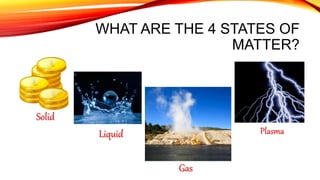
WHAT ARE THE 4 STATES OF
MATTER?
Solid
Plasma
Gas
Liquid
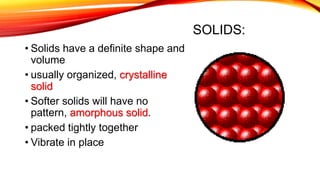
SOLIDS:
• Solids have a definite shape and
volume
• usually organized, crystalline
solid
• Softer solids will have no
pattern, amorphous solid.
• packed tightly together
• Vibrate in place
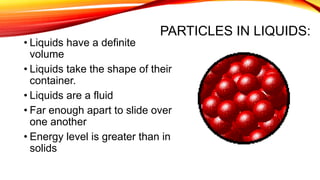
PARTICLES IN LIQUIDS:
• Liquids have a definite
volume
• Liquids take the shape of their
container.
• Liquids are a fluid
• Far enough apart to slide over
one another
• Energy level is greater than in
solids
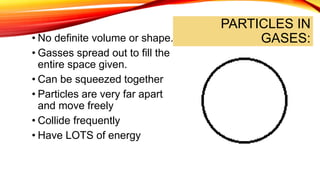
PARTICLES IN
GASES:• No definite volume or shape.
• Gasses spread out to fill the
entire space given.
• Can be squeezed together
• Particles are very far apart
and move freely
• Collide frequently
• Have LOTS of energy
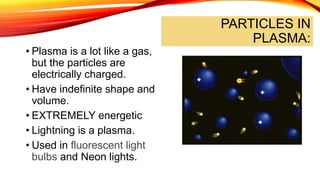
PARTICLES IN
PLASMA:
• Plasma is a lot like a gas,
but the particles are
electrically charged.
• Have indefinite shape and
volume.
• EXTREMELY energetic
• Lightning is a plasma.
• Used in fluorescent light
bulbs and Neon lights.
STATES OF
MATTER
SOLID LIQUID GAS PLASMA
Tightly packed, in
a regular pattern
Vibrate, but do not
move from place
to place
Close together
with no regular
arrangement.
Vibrate, move
about, and slide
past each other
Well separated
with no regular
arrangement.
Vibrate and move
freely at high
speeds
Has no definite volume
or shape and is
composed of electrical
charged particles
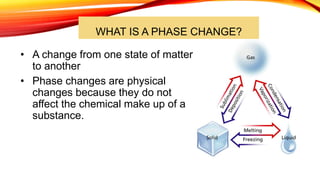
WHAT IS A PHASE CHANGE?
• A change from one state of matter
to another
• Phase changes are physical
changes because they do not
affect the chemical make up of a
substance.
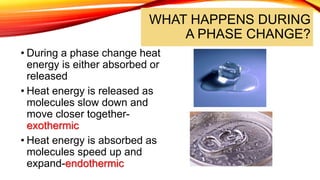
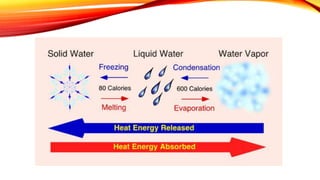
WHAT HAPPENS DURING
A PHASE CHANGE?
• During a phase change heat
energy is either absorbed or
released
• Heat energy is released as
molecules slow down and
move closer together-
exothermic
• Heat energy is absorbed as
molecules speed up and
expand-endothermic
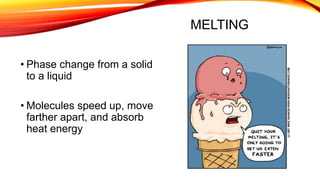
MELTING
• Phase change from a solid
to a liquid
• Molecules speed up, move
farther apart, and absorb
heat energy
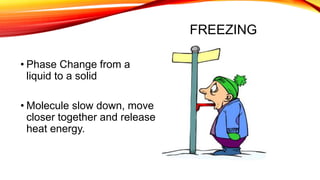
FREEZING
• Phase Change from a
liquid to a solid
• Molecule slow down, move
closer together and release
heat energy.
VAPORIZATION (BOILING)
• Phase change from a liquid
to gas. It occurs at the
boiling point of matter.
• Molecules speed up, move
farther apart, and absorb
heat energy.
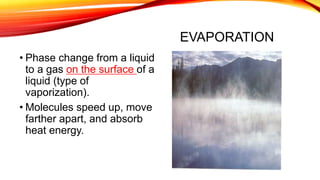
EVAPORATION
• Phase change from a liquid
to a gas on the surface of a
liquid (type of
vaporization).
• Molecules speed up, move
farther apart, and absorb
heat energy.
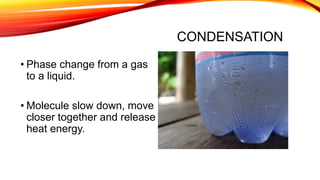
CONDENSATION
• Phase change from a gas
to a liquid.
• Molecule slow down, move
closer together and release
heat energy.
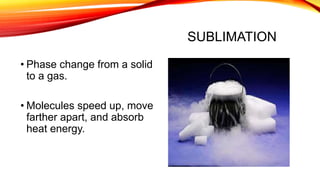
SUBLIMATION
• Phase change from a solid
to a gas.
• Molecules speed up, move
farther apart, and absorb
heat energy.
DEPOSITION
• Phase change from a gas
to a solid.
• Molecules slow down,
move closer together and
release heat energy.
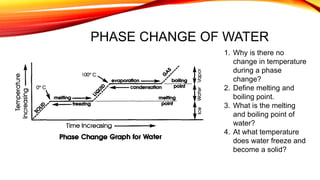
PHASE CHANGE OF WATER
1. Why is there no
change in temperature
during a phase
change?
2. Define melting and
boiling point.
3. What is the melting
and boiling point of
water?
4. At what temperature
does water freeze and
become a solid?

Matter and phase changes

  • 1.
  • 2.
    KINETIC THEORY OFMATTER Matter is made up of particles which are in continual random motion.
  • 3.
    WHAT ARE THE4 STATES OF MATTER? Solid Plasma Gas Liquid
  • 4.
    SOLIDS: • Solids havea definite shape and volume • usually organized, crystalline solid • Softer solids will have no pattern, amorphous solid. • packed tightly together • Vibrate in place
  • 5.
    PARTICLES IN LIQUIDS: •Liquids have a definite volume • Liquids take the shape of their container. • Liquids are a fluid • Far enough apart to slide over one another • Energy level is greater than in solids
  • 6.
    PARTICLES IN GASES:• Nodefinite volume or shape. • Gasses spread out to fill the entire space given. • Can be squeezed together • Particles are very far apart and move freely • Collide frequently • Have LOTS of energy
  • 7.
    PARTICLES IN PLASMA: • Plasmais a lot like a gas, but the particles are electrically charged. • Have indefinite shape and volume. • EXTREMELY energetic • Lightning is a plasma. • Used in fluorescent light bulbs and Neon lights.
  • 8.
    STATES OF MATTER SOLID LIQUIDGAS PLASMA Tightly packed, in a regular pattern Vibrate, but do not move from place to place Close together with no regular arrangement. Vibrate, move about, and slide past each other Well separated with no regular arrangement. Vibrate and move freely at high speeds Has no definite volume or shape and is composed of electrical charged particles
  • 9.
    WHAT IS APHASE CHANGE? • A change from one state of matter to another • Phase changes are physical changes because they do not affect the chemical make up of a substance.
  • 10.
    WHAT HAPPENS DURING APHASE CHANGE? • During a phase change heat energy is either absorbed or released • Heat energy is released as molecules slow down and move closer together- exothermic • Heat energy is absorbed as molecules speed up and expand-endothermic
  • 11.
    MELTING • Phase changefrom a solid to a liquid • Molecules speed up, move farther apart, and absorb heat energy
  • 12.
    FREEZING • Phase Changefrom a liquid to a solid • Molecule slow down, move closer together and release heat energy.
  • 13.
    VAPORIZATION (BOILING) • Phasechange from a liquid to gas. It occurs at the boiling point of matter. • Molecules speed up, move farther apart, and absorb heat energy.
  • 14.
    EVAPORATION • Phase changefrom a liquid to a gas on the surface of a liquid (type of vaporization). • Molecules speed up, move farther apart, and absorb heat energy.
  • 15.
    CONDENSATION • Phase changefrom a gas to a liquid. • Molecule slow down, move closer together and release heat energy.
  • 16.
    SUBLIMATION • Phase changefrom a solid to a gas. • Molecules speed up, move farther apart, and absorb heat energy.
  • 17.
    DEPOSITION • Phase changefrom a gas to a solid. • Molecules slow down, move closer together and release heat energy.
  • 19.
    PHASE CHANGE OFWATER 1. Why is there no change in temperature during a phase change? 2. Define melting and boiling point. 3. What is the melting and boiling point of water? 4. At what temperature does water freeze and become a solid?