Cell Division
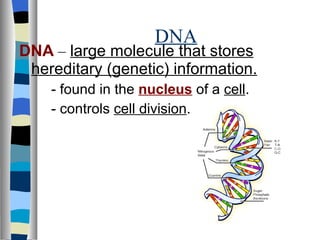
DNA DNA  –   large molecule that stores hereditary (genetic) information. - found in the  nucleus  of a  cell . - controls  cell division .
Chromosomes Chromosomes   –   MANY strands of DNA wound together into threadlike structures.
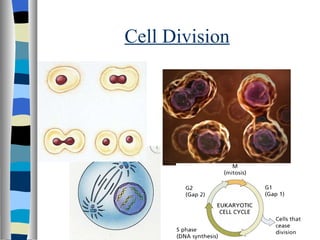
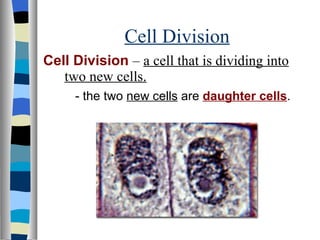
Cell Division Cell Division   –  a cell that is dividing into two new cells. - the two  new cells  are  daughter cells .
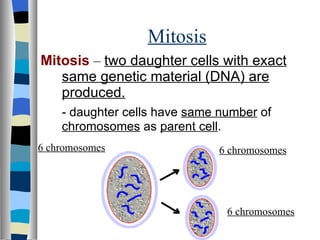
Mitosis Mitosis  –  two daughter cells with exact same genetic material (DNA) are produced. - daughter cells have  same number  of  chromosomes  as  parent cell . 6 chromosomes 6 chromosomes 6 chromosomes
Interphase Interphase   –   preparation stage BEFORE Mitosis where the cell grows and duplicates materials. -  Longest stage  of Cell Cycle  - Copies  chromosomes ! -  Organelles  double.                             
Prophase Prophase   –   first phase of Mitosis where DNA winds into chromosomes .
Prophase Chromosomes
Metaphase Metaphase   –   chromosomes line up along the middle of the cell.
Metaphase Chromosomes Middle (equator) of cell
Anaphase Anaphase   –   chromosomes are  “ pulled ”  apart!   - move to  opposite sides  of cell.
Anaphase Single Chromosome
Telophase Telophase  –   “ ending ”  phase of Mitosis. - two new  cells  form.
Telophase New nuclei Chromosomes unwinding
End Results of Mitosis 4 chromosomes at start Chromosomes double into 2 strands (8) 4 chromosomes in each new cell at end
What kinds of cells do Mitosis? Single-celled organisms  -  mitosis as a form of asexual reproduction. Multicellular organisms  -  mitosis in repair and replacement of body cells (hair, skin, etc.)
Cancer: Uncontrolled Division Normal cells  will  stop  dividing when they come in  contact  with other  cells . Cancer   –   disease where cells do not stop dividing and ignore signals from other cells.
What is the Purpose of Reproduction? To form new  individuals ( offspring )  of a  species . 2 Types: Asexual Reproduction  –  reproduction involving only one parent. Sexual Reproduction  –  reproduction involving two parents.
Asexual Reproduction Offspring are  identical  and contain  same amount  of genetic material as  parents . - Results from  mitosis . Ex:  a.  Budding   b. Binary Fission c. Vegetative Propogation   d. Sporulation   e. Regeneration
Sexual Cell Division:  Meiosis
Chromosome Number Human body cell –  46 chromosomes Arranged in  23 pairs (23 X 2=46). Homologous Chromosomes  –  a   pair of chromosomes with same   size, shape, etc.
Diploid Diploid  –   body cells that contain two sets of chromosomes. - Ex:  skin, hair, heart,   liver, muscle cells, etc.   - Written as  2n .
Haploid Haploid   –   gamete (sex) cells which contain only one set of chromosomes. - Ex:  sperm/egg cells.   - Written as  n .
Meiosis Meiosis  –  type of cell division used to produce gametes (sex cells). Two functions: Forms cells with half the number of chromosomes. (23 chromosomes in both egg and sperm) Rearrange chromosomes   for genetic differences from parents ( variability ). Two sets of phases whereas Mitosis only has one set.
Meiosis Overview 4 Chromosomes 2 Chromosomes in each cell
Meiosis in Males Meiosis in  males  produces  four   sperm (n) cells  which are  all   functional. 2n n n n n
Meiosis in Females Meiosis in  females  produces  four   egg (n) cells .  Only  one  is functional! 2n n n n n
Meiosis = Genetic Variation Meiosis is responsible for  genetic differences  in new cells: Chromosomes  lineup  in  different  ways. Crossing over  –  swapping pieces of chromosomes.
Mitosis Vs. Meiosis   Mitosis  Meiosis # of parent cells   1 2 # of cells produced   2 4 Appearance of    Identical     Different offspring Types of cells   Body     Gametes   (egg/sperm)
 
Meiosis I Interphase I  – DNA is unwound as chromatin. - DNA duplicates.
Prophase I  –chromosomes become visible and double-stranded. - Homologous chromosomes pair up. -  Crossing over  – pieces of  chromosomes are swapped. Homologous chromosomes Homologous chromosomes Meiosis I
Metaphase I  – pairs  of homologous chromosomes lineup in the middle of the cell.
Anaphase I  –  homologous chromosomes separate ( not  into single-stranded chromosomes or  chromatids ).
Telophase I  – two haploid daughter cells are formed.  - nuclear membrane  returns!
Meiosis II (like Mitosis) Prophase II  – two haploid daughter cells now enter meiosis II.  - cell has completely divided and chromosomes are separated.
Metaphase II  – chromosomes (non-homologous) line up in the middle of each cell.
Anaphase II  – double-stranded chromosomes split into single-stranded chromosomes ( chromatids ).
Telophase II  – four haploid cells are formed each with single-stranded chromosomes ( chromatids ).

Cell Division

  • 1.
  • 2.
    DNA DNA – large molecule that stores hereditary (genetic) information. - found in the nucleus of a cell . - controls cell division .
  • 3.
    Chromosomes Chromosomes – MANY strands of DNA wound together into threadlike structures.
  • 4.
    Cell Division CellDivision – a cell that is dividing into two new cells. - the two new cells are daughter cells .
  • 5.
    Mitosis Mitosis – two daughter cells with exact same genetic material (DNA) are produced. - daughter cells have same number of chromosomes as parent cell . 6 chromosomes 6 chromosomes 6 chromosomes
  • 6.
    Interphase Interphase – preparation stage BEFORE Mitosis where the cell grows and duplicates materials. - Longest stage of Cell Cycle - Copies chromosomes ! - Organelles double.                             
  • 7.
    Prophase Prophase – first phase of Mitosis where DNA winds into chromosomes .
  • 8.
  • 9.
    Metaphase Metaphase – chromosomes line up along the middle of the cell.
  • 10.
  • 11.
    Anaphase Anaphase – chromosomes are “ pulled ” apart! - move to opposite sides of cell.
  • 12.
  • 13.
    Telophase Telophase – “ ending ” phase of Mitosis. - two new cells form.
  • 14.
    Telophase New nucleiChromosomes unwinding
  • 15.
    End Results ofMitosis 4 chromosomes at start Chromosomes double into 2 strands (8) 4 chromosomes in each new cell at end
  • 16.
    What kinds ofcells do Mitosis? Single-celled organisms - mitosis as a form of asexual reproduction. Multicellular organisms - mitosis in repair and replacement of body cells (hair, skin, etc.)
  • 17.
    Cancer: Uncontrolled DivisionNormal cells will stop dividing when they come in contact with other cells . Cancer – disease where cells do not stop dividing and ignore signals from other cells.
  • 18.
    What is thePurpose of Reproduction? To form new individuals ( offspring ) of a species . 2 Types: Asexual Reproduction – reproduction involving only one parent. Sexual Reproduction – reproduction involving two parents.
  • 19.
    Asexual Reproduction Offspringare identical and contain same amount of genetic material as parents . - Results from mitosis . Ex: a. Budding b. Binary Fission c. Vegetative Propogation d. Sporulation e. Regeneration
  • 20.
  • 21.
    Chromosome Number Humanbody cell – 46 chromosomes Arranged in 23 pairs (23 X 2=46). Homologous Chromosomes – a pair of chromosomes with same size, shape, etc.
  • 22.
    Diploid Diploid – body cells that contain two sets of chromosomes. - Ex: skin, hair, heart, liver, muscle cells, etc. - Written as 2n .
  • 23.
    Haploid Haploid – gamete (sex) cells which contain only one set of chromosomes. - Ex: sperm/egg cells. - Written as n .
  • 24.
    Meiosis Meiosis – type of cell division used to produce gametes (sex cells). Two functions: Forms cells with half the number of chromosomes. (23 chromosomes in both egg and sperm) Rearrange chromosomes for genetic differences from parents ( variability ). Two sets of phases whereas Mitosis only has one set.
  • 25.
    Meiosis Overview 4Chromosomes 2 Chromosomes in each cell
  • 26.
    Meiosis in MalesMeiosis in males produces four sperm (n) cells which are all functional. 2n n n n n
  • 27.
    Meiosis in FemalesMeiosis in females produces four egg (n) cells . Only one is functional! 2n n n n n
  • 28.
    Meiosis = GeneticVariation Meiosis is responsible for genetic differences in new cells: Chromosomes lineup in different ways. Crossing over – swapping pieces of chromosomes.
  • 29.
    Mitosis Vs. Meiosis Mitosis Meiosis # of parent cells 1 2 # of cells produced 2 4 Appearance of Identical Different offspring Types of cells Body Gametes (egg/sperm)
  • 30.
  • 31.
    Meiosis I InterphaseI – DNA is unwound as chromatin. - DNA duplicates.
  • 32.
    Prophase I –chromosomes become visible and double-stranded. - Homologous chromosomes pair up. - Crossing over – pieces of chromosomes are swapped. Homologous chromosomes Homologous chromosomes Meiosis I
  • 33.
    Metaphase I – pairs of homologous chromosomes lineup in the middle of the cell.
  • 34.
    Anaphase I – homologous chromosomes separate ( not into single-stranded chromosomes or chromatids ).
  • 35.
    Telophase I – two haploid daughter cells are formed. - nuclear membrane returns!
  • 36.
    Meiosis II (likeMitosis) Prophase II – two haploid daughter cells now enter meiosis II. - cell has completely divided and chromosomes are separated.
  • 37.
    Metaphase II – chromosomes (non-homologous) line up in the middle of each cell.
  • 38.
    Anaphase II – double-stranded chromosomes split into single-stranded chromosomes ( chromatids ).
  • 39.
    Telophase II – four haploid cells are formed each with single-stranded chromosomes ( chromatids ).