By
Abeer Ansari
Our universe
operates under certain
principles. For understanding
of these principles, the
experiments are done and
observations are made; on the
basis of which logical
conclusions are drawn.
Such a study is called
“Science”.
In brief science is the
knowledge based on
experiments and
observations
What is Science?
Scientia (Latin) –to know.
Definition-
A branch of knowledge or study
Dealing with a body of facts
systematically arranged.
Lecture no1
What is Biology?
• Origins of word “biology”
• Biology (Two Greek words)
• Bios = life Logos = study of
• The study of life
• The science of living things
Biology
is the natural science
that studies life and living organisms,
including their physical structure,
chemical composition, function,
development
and evolution
Lecture no1
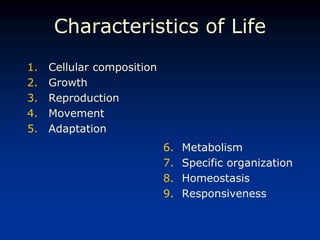
Characteristics of Life
1. Cellular composition
2. Growth
3. Reproduction
4. Movement
5. Adaptation
6. Metabolism
7. Specific organization
8. Homeostasis
9. Responsiveness
Why is it important for you
to study biology?
Importance of Biology: How the Study of Life
Affects Ours.
Biology is all about studying life and living
organisms. We're living organisms and we eat living
organisms, so you could probably guess that it has
something to tell use about what's going on all
around – and inside – us
IMPORTANCE OF BIOLOGY
• Various kind of living organisms existing in
earth
• Relations of organisms with organisms
• Structure and function of organisms
• Inheritance of characters from one generation
to next generation.
• Relationship of organisms to their environment
• Harmful and beneficial effects produce by
different living organisms etc.
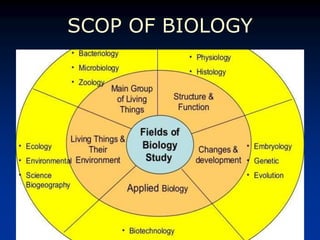
SCOP OF BIOLOGY
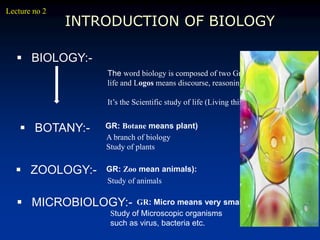
 BIOLOGY:-
The word biology is composed of two Greek words bios mean
life and Logos means discourse, reasoning, or study
It’s the Scientific study of life (Living things)
 ZOOLOGY:-
 BOTANY:-
 MICROBIOLOGY:-
GR: Botane means plant)
A branch of biology
Study of plants
GR: Zoo mean animals):
Study of animals
GR: Micro means very small):
Study of Microscopic organisms
such as virus, bacteria etc.
INTRODUCTION OF BIOLOGY
Lecture no 2
INTRODUCTION OF BIOLOGY
GENETIC: GR: Genesis = origin )
Study of gene & biological inheritance of
Characters from parent to their offspring.
HISTOLOGY: GR: Histos= Tissues)
Microscopic study of tissues is called histology
or it deal with the study of tissues of plants
and animals under microscope
ANATOMY:
Study of internal structural characteristics of plants and animals.
In plant deal with the arrangement of
different types of tissues in root , stem, and
leaf etc.
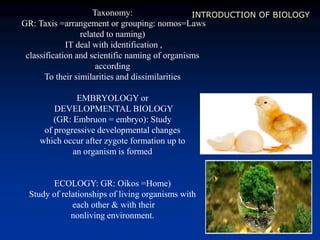
INTRODUCTION OF BIOLOGYTaxonomy:
GR: Taxis =arrangement or grouping: nomos=Laws
related to naming)
IT deal with identification ,
classification and scientific naming of organisms
according
To their similarities and dissimilarities
EMBRYOLOGY or
DEVELOPMENTAL BIOLOGY
(GR: Embruon = embryo): Study
of progressive developmental changes
which occur after zygote formation up to
an organism is formed
ECOLOGY: GR: Oikos =Home)
Study of relationships of living organisms with
each other & with their
nonliving environment.
INTRODUCTION OF BIOLOGY
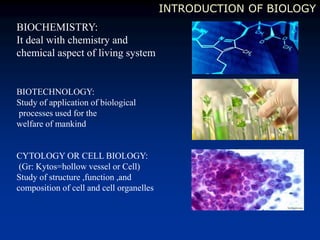
BIOTECHNOLOGY:
Study of application of biological
processes used for the
welfare of mankind
CYTOLOGY OR CELL BIOLOGY:
(Gr: Kytos=hollow vessel or Cell)
Study of structure ,function ,and
composition of cell and cell organelles
BIOCHEMISTRY:
It deal with chemistry and
chemical aspect of living system
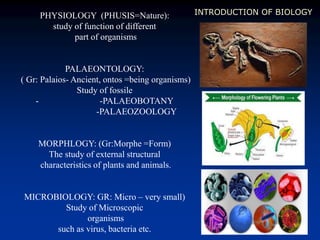
INTRODUCTION OF BIOLOGYPHYSIOLOGY (PHUSIS=Nature):
study of function of different
part of organisms
PALAEONTOLOGY:
( Gr: Palaios- Ancient, ontos =being organisms)
Study of fossile
- -PALAEOBOTANY
-PALAEOZOOLOGY
MORPHLOGY: (Gr:Morphe =Form)
The study of external structural
characteristics of plants and animals.
MICROBIOLOGY: GR: Micro – very small)
Study of Microscopic
organisms
such as virus, bacteria etc.
Class
work
Class
work
© 2007 Thomson - Wadsworth
Introduction of biology

Introduction of biology

  • 1.
  • 2.
    Our universe operates undercertain principles. For understanding of these principles, the experiments are done and observations are made; on the basis of which logical conclusions are drawn. Such a study is called “Science”. In brief science is the knowledge based on experiments and observations What is Science? Scientia (Latin) –to know. Definition- A branch of knowledge or study Dealing with a body of facts systematically arranged. Lecture no1
  • 3.
    What is Biology? •Origins of word “biology” • Biology (Two Greek words) • Bios = life Logos = study of • The study of life • The science of living things Biology is the natural science that studies life and living organisms, including their physical structure, chemical composition, function, development and evolution Lecture no1
  • 4.
    Characteristics of Life 1.Cellular composition 2. Growth 3. Reproduction 4. Movement 5. Adaptation 6. Metabolism 7. Specific organization 8. Homeostasis 9. Responsiveness
  • 5.
    Why is itimportant for you to study biology? Importance of Biology: How the Study of Life Affects Ours. Biology is all about studying life and living organisms. We're living organisms and we eat living organisms, so you could probably guess that it has something to tell use about what's going on all around – and inside – us
  • 6.
    IMPORTANCE OF BIOLOGY •Various kind of living organisms existing in earth • Relations of organisms with organisms • Structure and function of organisms • Inheritance of characters from one generation to next generation. • Relationship of organisms to their environment • Harmful and beneficial effects produce by different living organisms etc.
  • 7.
  • 8.
     BIOLOGY:- The wordbiology is composed of two Greek words bios mean life and Logos means discourse, reasoning, or study It’s the Scientific study of life (Living things)  ZOOLOGY:-  BOTANY:-  MICROBIOLOGY:- GR: Botane means plant) A branch of biology Study of plants GR: Zoo mean animals): Study of animals GR: Micro means very small): Study of Microscopic organisms such as virus, bacteria etc. INTRODUCTION OF BIOLOGY Lecture no 2
  • 9.
    INTRODUCTION OF BIOLOGY GENETIC:GR: Genesis = origin ) Study of gene & biological inheritance of Characters from parent to their offspring. HISTOLOGY: GR: Histos= Tissues) Microscopic study of tissues is called histology or it deal with the study of tissues of plants and animals under microscope ANATOMY: Study of internal structural characteristics of plants and animals. In plant deal with the arrangement of different types of tissues in root , stem, and leaf etc.
  • 10.
    INTRODUCTION OF BIOLOGYTaxonomy: GR:Taxis =arrangement or grouping: nomos=Laws related to naming) IT deal with identification , classification and scientific naming of organisms according To their similarities and dissimilarities EMBRYOLOGY or DEVELOPMENTAL BIOLOGY (GR: Embruon = embryo): Study of progressive developmental changes which occur after zygote formation up to an organism is formed ECOLOGY: GR: Oikos =Home) Study of relationships of living organisms with each other & with their nonliving environment.
  • 11.
    INTRODUCTION OF BIOLOGY BIOTECHNOLOGY: Studyof application of biological processes used for the welfare of mankind CYTOLOGY OR CELL BIOLOGY: (Gr: Kytos=hollow vessel or Cell) Study of structure ,function ,and composition of cell and cell organelles BIOCHEMISTRY: It deal with chemistry and chemical aspect of living system
  • 12.
    INTRODUCTION OF BIOLOGYPHYSIOLOGY(PHUSIS=Nature): study of function of different part of organisms PALAEONTOLOGY: ( Gr: Palaios- Ancient, ontos =being organisms) Study of fossile - -PALAEOBOTANY -PALAEOZOOLOGY MORPHLOGY: (Gr:Morphe =Form) The study of external structural characteristics of plants and animals. MICROBIOLOGY: GR: Micro – very small) Study of Microscopic organisms such as virus, bacteria etc.
  • 13.
  • 14.

Editor's Notes

  • #3 Science Our universe operates under certain principles. For understanding of these principles, the experiments are done and observations are made; on the basis of which logical conclusions are drawn. Such a study is called “Science”. In brief science is the knowledge based on experiments and observations.