CYTOPLASM AND ITS
ORGANELLES
PREPARED BY FATIMA SUNDUS
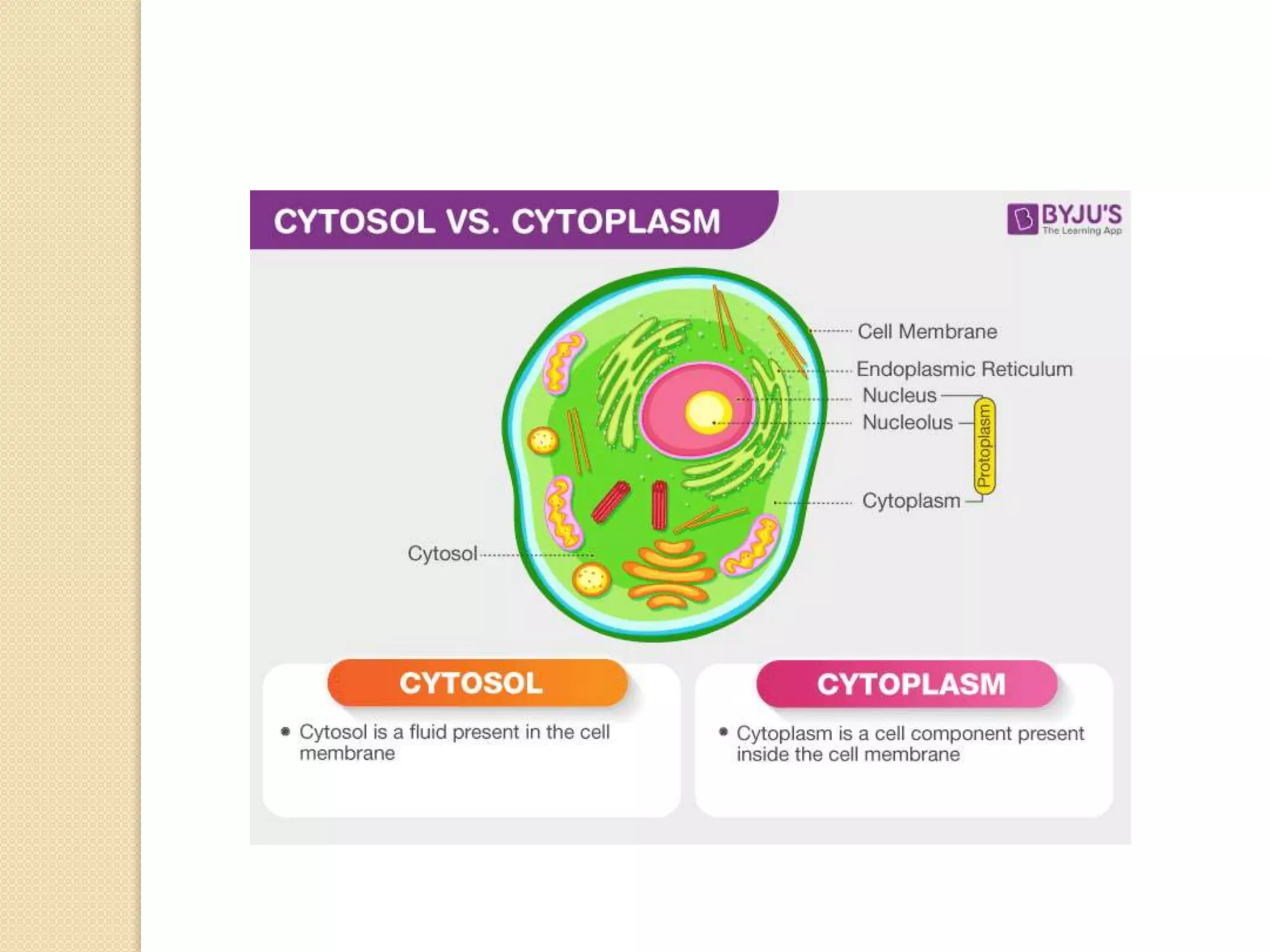
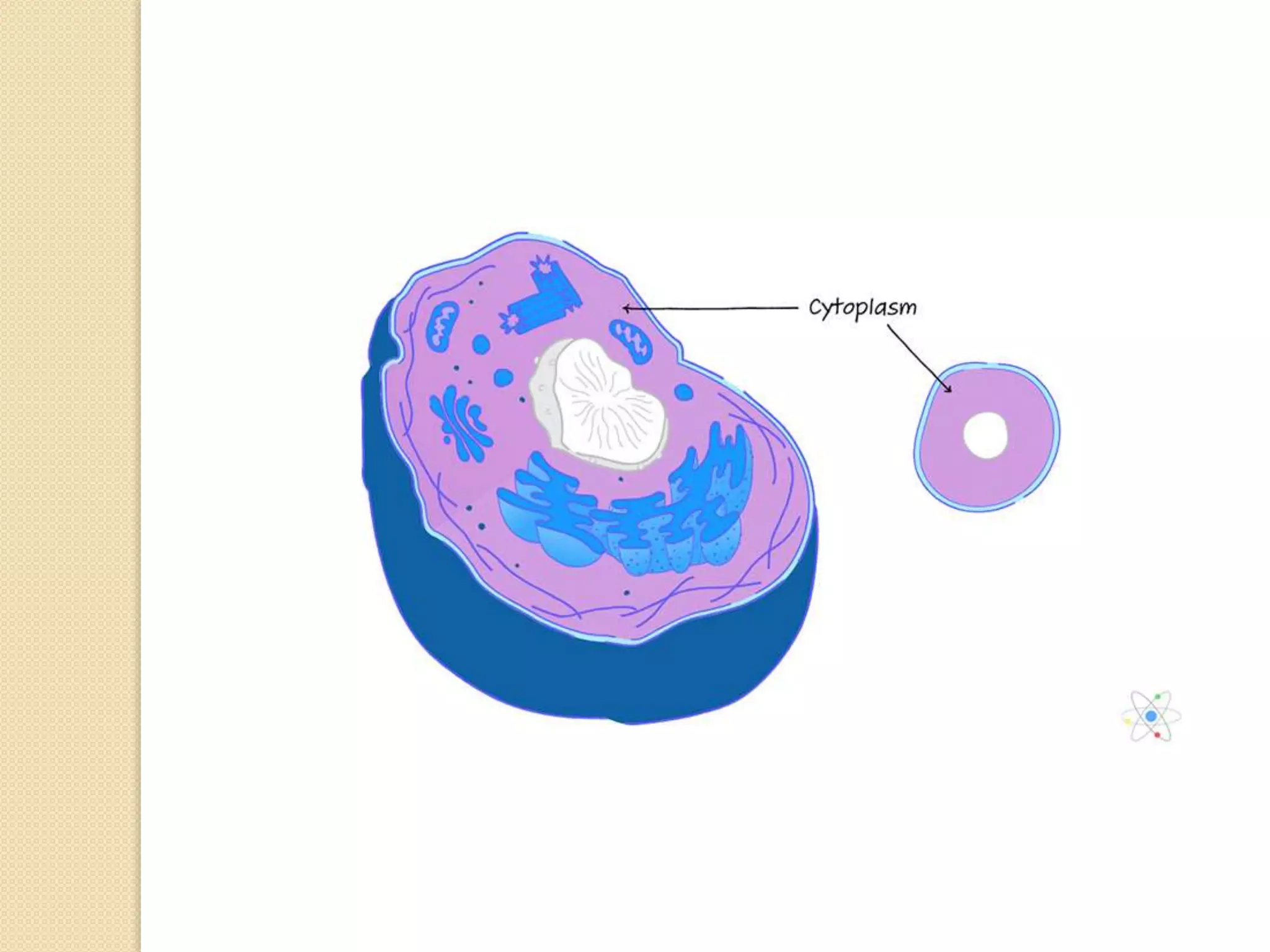
• The cytoplasm is filled with both minute and large dispersed
particles and organelles.
• The clear fluid portion of the cytoplasm in which the particles are
dispersed is called cytosol: this contains mainly dissolved
proteins, electrolytes, and glucose.
• Dispersed in the cytoplasm are neutral fat globules, glycogen
granules, ribosomes, secretory vesicles, and five especially
important organelles (membrane bound organelles):
• Most organelles of the cell are covered by membranes
composed primarily of lipids and proteins.
• These membranes include
1. cell membrane
2. nuclear membrane
3. membrane of the endoplasmic reticulum
4. membranes of the mitochondria
5. membranes of the lysosomes
6. Membranes of the Golgi apparatus.
• Non membrane bound organelles
1. Ribosome
2. Centrosome
3. Cytoskeleton (Microtubules, Microfilament, Intermediate
Filaments)
ENDOPLASMIC RETICULUM
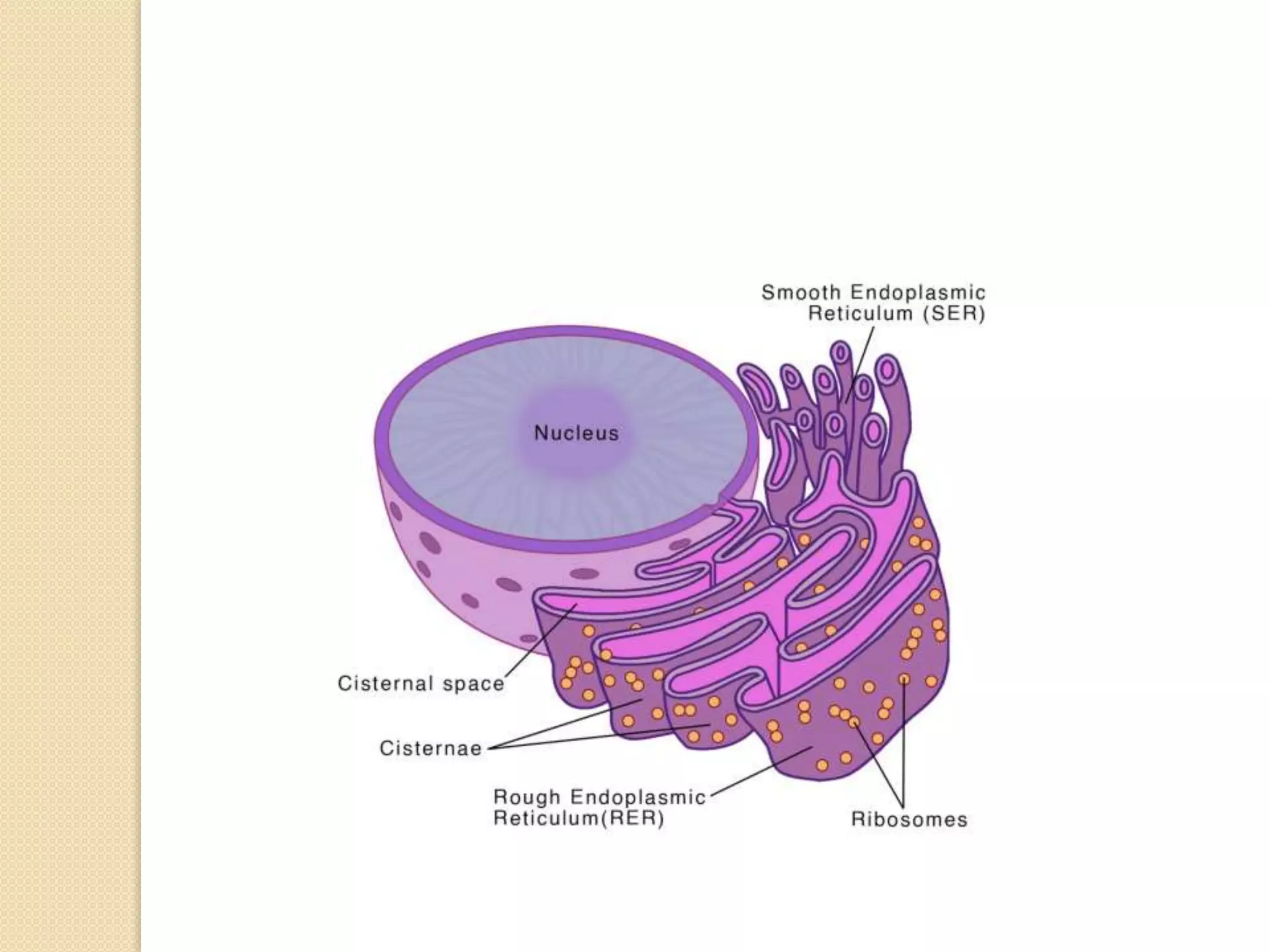
It is a network of tubular and flat vesicular structures, the tubules and
vesicles interconnect with one another.
Types and functions
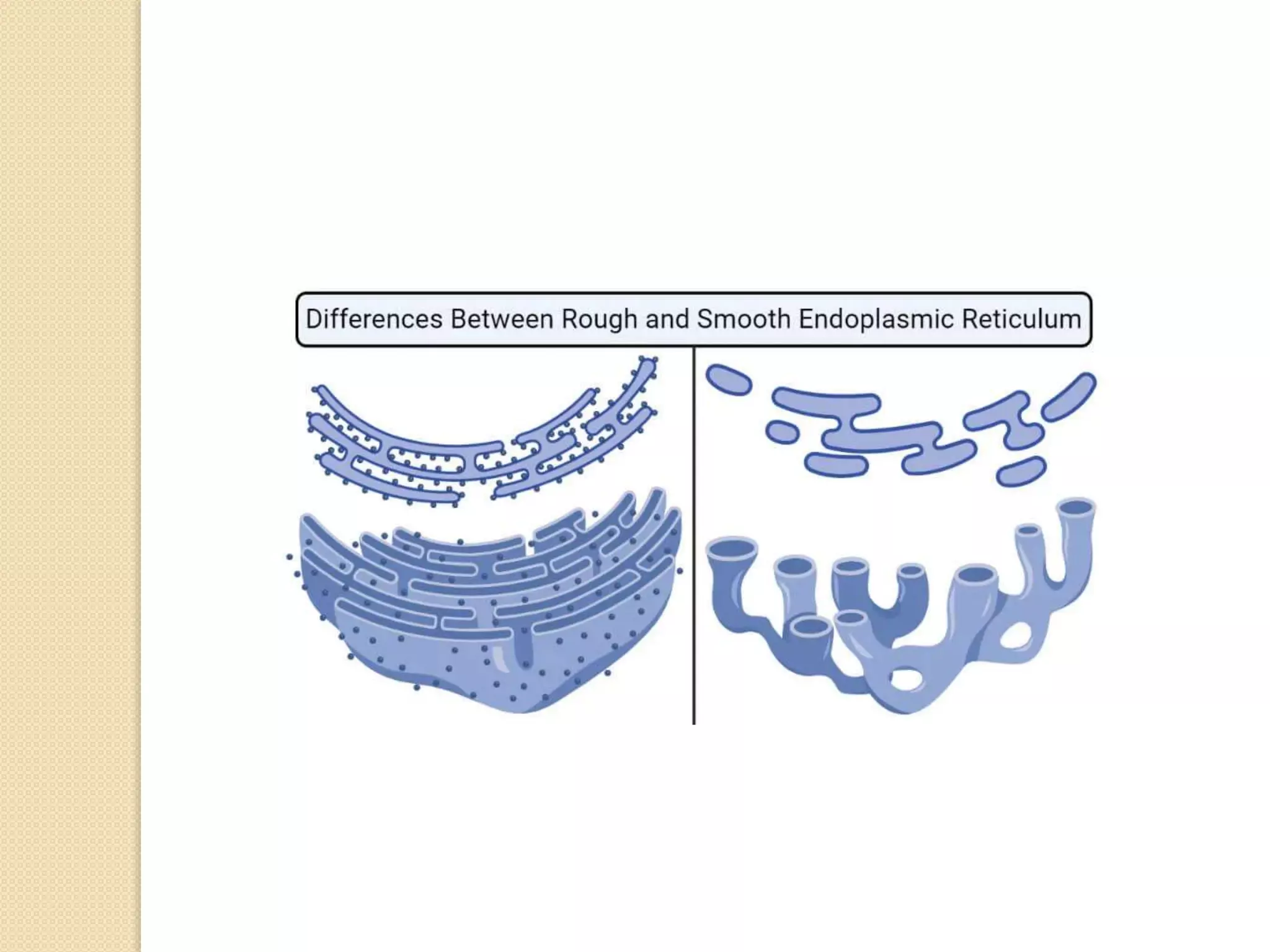
1. Granular endoplasmic reticulum:
Outer surface is covered with ribosomes.
Function:
Synthesis of protein in the cell.
2. Agranular endoplasmic reticulum.
Outer surface is devoid of ribosome.
Function:
Synthesis of lipid substances and in many other enzymatic processes
of the cell
Ribosomes and the Granular Endoplasmic Reticulum.
Attached to the outer surfaces of many parts of the endoplasmic
reticulum are large numbers of minute granular particles called
ribosomes.
Where these particles are present, the reticulum is called the
granular endoplasmic reticulum.
The ribosomes are composed of a mixture of RNA and proteins,
and they function to synthesize new protein molecules in the
cell.
Golgi Apparatus
The Golgi apparatus, is closely related to the endoplasmic
reticulum.
It has membranes similar to those of the agranular endoplasmic
reticulum.
Structure
The Golgi apparatus is usually composed of four or more stacked
layers of thin, flat, enclosed vesicles lying near one side of the
nucleus.
Location
This apparatus is prominent in secretory cells, where it is
located on the side of the cell from which the secretory
substances are extruded
The Golgi apparatus functions in association with the endoplasmic
reticulum.
small “transport vesicles” (also called endoplasmic reticulum vesicles,
or ER vesicles) continually pinch off from the endoplasmic reticulum
and shortly thereafter fuse with the Golgi apparatus.
In this way, substances entrapped in the ER vesicles are transported
from the
endoplasmic reticulum to the Golgi apparatus.
The transported substances are then processed in the Golgi apparatus
to form lysosomes, secretory vesicles, and other cytoplasmic
components.
LYSOSOMES
Formation
They are vesicular organelles formed by breaking off from the Golgi
apparatus
and then dispersing throughout the cytoplasm
Function
The lysosomes provide an intracellular digestive system that allows
the cell to digest
(1) damaged cellular structures,
(2) food particle that have been ingested by the cell
(3) unwanted matter such as bacteria
Structure
It is surrounded by a typical lipid bilayer membrane and is filled with
large numbers of small granules, which are protein aggregates of as
many as 40 different hydrolase (digestive) enzymes
Peroxisomes are similar physically to lysosomes, but they are
different in two important ways.
1. formed by self-replication (or perhaps by budding off from the
smooth endoplasmic reticulum) rather than from the Golgi
apparatus.
2. they contain oxidases rather than hydrolases
Peroxisomes
Functions of the Peroxisomes
Hydrogen peroxide is a highly oxidizing substance and is used in
association with catalase, another oxidase enzyme present in large
quantities in peroxisomes, to oxidize many substances that might
otherwise be
poisonous. For instance, about half the alcohol a person drinks is
detoxified into acetaldehyde by the peroxisomes of the liver cells
in this manner.
A major function of peroxisomes is to catabolize long chain fatty
acids.
SECRETORY VESICLES
One of the important functions of many cells is secretion of special
substances.
Almost all such secretory substances are formed by the endoplasmic
reticulum-Gogi apparatus system and are then released from the Golgi
apparatus into the cytoplasm in the form of storage vesicles called
secretory
vesicles or secretory granules
Example:
In pancreatic acinar cells, secretory vesicles store protein pro-enzymes
(enzyme not activated).
The proenzymes are secreted latter through the outer cell membrane into
the pancreatic duct and thence into the duodenum, where they become
activated and perform digestive functions on the food in the intestinal
tract.
Mitochondria
The mitochondria, are called the “powerhouses” of the cell.
Without them, cells would be unable to extract enough energy from
the nutrients, and essentially all cellular functions would cease.
Mitochondria are self-replicative, which means that one mitochondrion
can form a second one, a third one, and SO on
the mitochondria contain deoxyribonucleic acid (DNA) similar to that
found in the nucleus
• Mitochondria are present in all areas of each cell’s cytoplasm
• Total number per cell varies from less than a hundred up to several
thousand, depending on the amount of energy require by the cell.
• The cardiac muscle cells (cardiomyocytes), for example, use
large amounts of energy and have far more mitochondria than do
fat cells (adipocytes), which are much less active and use less
energy.
• They are variable in size and shape
Structure
The mitochondrion is composed mainly of two lipid bilayer–protein
membranes: an outer membrane and an inner membrane.
cristae
Many infoldings of the inner membrane form shelves or tubules
called cristae onto which oxidative enzymes are attached.
The cristae provide a large surface area for chemical reactions to
occur.
Mitochontrial matrix
the inner cavity of the mitochondrion is filled with a matrix that contains
large quantities of dissolved enzymes that are necessary for extracting
energy from nutrients
These enzymes operate in association with the oxidative enzymes on
the shelves to cause oxidation of the nutrients, thereby forming carbon
dioxide and water and at the same time releasing energy.
The liberated energy is used to synthesize a “high-energy” substance
called adenosine triphosphate (ATP).
The chemical details of ATP formation by the mitochondrion are given in
Chapter 67, but some of the basic functions of ATP in the cell are
introduced later in this chapter.
Cell Cytoskeleton—Filament and Tubular Structures
The fibrillar proteins of the cell are usually organized into filaments or
tubules.
These originate as precursor protein molecules synthesized by
ribosomes in the cytoplasm.
The precursor molecules then polymerize to form filaments.
As an example, large numbers of actin filaments frequently occur in the
outer zone of the cytoplasm, called the ectoplasm, to form an elastic
support for the cell membrane.
A special type of stiff filament composed of polymerized
tubulin molecules is used in all cells to construct strong tubular
structures, the microtubules.
microtubules that were teased from the flagellum of a sperm
Function of cell cytoskeleton
 rigid physical structures
 Support
 Muscle contraction
 Cell division
 Locomotion
Nucleus
The nucleus is the control center of the cell, sends messages to the
cell to grow and mature, to replicate or to die.
the nucleus contains large quantities of DNA, which are the genes.
The genes determine the characteristics of the cell’s proteins
The genes also control and promote reproduction of the cell itself.
The genes first reproduce to give two identical sets of genes; then
the cell splits by a special process called mitosis to form two
daughter cells, each of which receives one of the two sets of DNA
genes.
Nuclear Membrane
The nuclear membrane, also called the nuclear envelope, is actually two
separate bilayer membranes, one inside the other.
The outer membrane is continuous with the endoplasmic reticulum of the
cell cytoplasm,
Structure of Nucleus
The nucleus is covered by a membrane called nuclear membrane.
The structures of nucleus enclosed by the nuclear membrane are the
nucleoplasm and nucleolus.
The nuclear membrane is penetrated by several thousand nuclear
pores.
Large complexes of protein molecules are attached at the edges of the
pores so that the central area of each pore is only about 9 nanometers
in
diameter. Even this size is large enough to allow molecules up to
44,000
molecular weight to pass through with reasonable ease
2. Nucleoplasm
This is a gel like ground substance of the nucleus. The nucleoplasm
contains
large quantities of the genetic material in the form of deoxyribonucleic
acid
(DNA).
3. Nucleoli
One or more nucleoli are present in each nucleus. The nucleolus
contains
ribonucleic acid (RNA) and some proteins, which are similar to those
found in ribosomes. It has no limiting membrane.
Functions of Nucleus
1. Nucleus forms the control center for all the activities of the cell. It
sends
genetic instruction to the cytoplasm for protein synthesis through
mRNA.
2. The genes present in the nucleus control the cell division.
3. The hereditary information is stored in the genes of nucleus and
transformed from one generation of the species to the next.

cytoplasm and its organelles

  • 1.
  • 2.
    • The cytoplasmis filled with both minute and large dispersed particles and organelles. • The clear fluid portion of the cytoplasm in which the particles are dispersed is called cytosol: this contains mainly dissolved proteins, electrolytes, and glucose. • Dispersed in the cytoplasm are neutral fat globules, glycogen granules, ribosomes, secretory vesicles, and five especially important organelles (membrane bound organelles):
  • 5.
    • Most organellesof the cell are covered by membranes composed primarily of lipids and proteins. • These membranes include 1. cell membrane 2. nuclear membrane 3. membrane of the endoplasmic reticulum 4. membranes of the mitochondria 5. membranes of the lysosomes 6. Membranes of the Golgi apparatus.
  • 6.
    • Non membranebound organelles 1. Ribosome 2. Centrosome 3. Cytoskeleton (Microtubules, Microfilament, Intermediate Filaments)
  • 7.
    ENDOPLASMIC RETICULUM It isa network of tubular and flat vesicular structures, the tubules and vesicles interconnect with one another.
  • 9.
    Types and functions 1.Granular endoplasmic reticulum: Outer surface is covered with ribosomes. Function: Synthesis of protein in the cell. 2. Agranular endoplasmic reticulum. Outer surface is devoid of ribosome. Function: Synthesis of lipid substances and in many other enzymatic processes of the cell
  • 12.
    Ribosomes and theGranular Endoplasmic Reticulum. Attached to the outer surfaces of many parts of the endoplasmic reticulum are large numbers of minute granular particles called ribosomes. Where these particles are present, the reticulum is called the granular endoplasmic reticulum. The ribosomes are composed of a mixture of RNA and proteins, and they function to synthesize new protein molecules in the cell.
  • 14.
    Golgi Apparatus The Golgiapparatus, is closely related to the endoplasmic reticulum. It has membranes similar to those of the agranular endoplasmic reticulum. Structure The Golgi apparatus is usually composed of four or more stacked layers of thin, flat, enclosed vesicles lying near one side of the nucleus. Location This apparatus is prominent in secretory cells, where it is located on the side of the cell from which the secretory substances are extruded
  • 16.
    The Golgi apparatusfunctions in association with the endoplasmic reticulum. small “transport vesicles” (also called endoplasmic reticulum vesicles, or ER vesicles) continually pinch off from the endoplasmic reticulum and shortly thereafter fuse with the Golgi apparatus. In this way, substances entrapped in the ER vesicles are transported from the endoplasmic reticulum to the Golgi apparatus. The transported substances are then processed in the Golgi apparatus to form lysosomes, secretory vesicles, and other cytoplasmic components.
  • 18.
    LYSOSOMES Formation They are vesicularorganelles formed by breaking off from the Golgi apparatus and then dispersing throughout the cytoplasm
  • 20.
    Function The lysosomes providean intracellular digestive system that allows the cell to digest (1) damaged cellular structures, (2) food particle that have been ingested by the cell (3) unwanted matter such as bacteria
  • 21.
    Structure It is surroundedby a typical lipid bilayer membrane and is filled with large numbers of small granules, which are protein aggregates of as many as 40 different hydrolase (digestive) enzymes
  • 22.
    Peroxisomes are similarphysically to lysosomes, but they are different in two important ways. 1. formed by self-replication (or perhaps by budding off from the smooth endoplasmic reticulum) rather than from the Golgi apparatus. 2. they contain oxidases rather than hydrolases Peroxisomes
  • 23.
    Functions of thePeroxisomes Hydrogen peroxide is a highly oxidizing substance and is used in association with catalase, another oxidase enzyme present in large quantities in peroxisomes, to oxidize many substances that might otherwise be poisonous. For instance, about half the alcohol a person drinks is detoxified into acetaldehyde by the peroxisomes of the liver cells in this manner. A major function of peroxisomes is to catabolize long chain fatty acids.
  • 24.
    SECRETORY VESICLES One ofthe important functions of many cells is secretion of special substances. Almost all such secretory substances are formed by the endoplasmic reticulum-Gogi apparatus system and are then released from the Golgi apparatus into the cytoplasm in the form of storage vesicles called secretory vesicles or secretory granules
  • 26.
    Example: In pancreatic acinarcells, secretory vesicles store protein pro-enzymes (enzyme not activated). The proenzymes are secreted latter through the outer cell membrane into the pancreatic duct and thence into the duodenum, where they become activated and perform digestive functions on the food in the intestinal tract.
  • 27.
    Mitochondria The mitochondria, arecalled the “powerhouses” of the cell. Without them, cells would be unable to extract enough energy from the nutrients, and essentially all cellular functions would cease. Mitochondria are self-replicative, which means that one mitochondrion can form a second one, a third one, and SO on the mitochondria contain deoxyribonucleic acid (DNA) similar to that found in the nucleus
  • 29.
    • Mitochondria arepresent in all areas of each cell’s cytoplasm • Total number per cell varies from less than a hundred up to several thousand, depending on the amount of energy require by the cell. • The cardiac muscle cells (cardiomyocytes), for example, use large amounts of energy and have far more mitochondria than do fat cells (adipocytes), which are much less active and use less energy. • They are variable in size and shape
  • 31.
    Structure The mitochondrion iscomposed mainly of two lipid bilayer–protein membranes: an outer membrane and an inner membrane. cristae Many infoldings of the inner membrane form shelves or tubules called cristae onto which oxidative enzymes are attached. The cristae provide a large surface area for chemical reactions to occur. Mitochontrial matrix the inner cavity of the mitochondrion is filled with a matrix that contains large quantities of dissolved enzymes that are necessary for extracting energy from nutrients
  • 32.
    These enzymes operatein association with the oxidative enzymes on the shelves to cause oxidation of the nutrients, thereby forming carbon dioxide and water and at the same time releasing energy. The liberated energy is used to synthesize a “high-energy” substance called adenosine triphosphate (ATP). The chemical details of ATP formation by the mitochondrion are given in Chapter 67, but some of the basic functions of ATP in the cell are introduced later in this chapter.
  • 35.
    Cell Cytoskeleton—Filament andTubular Structures The fibrillar proteins of the cell are usually organized into filaments or tubules. These originate as precursor protein molecules synthesized by ribosomes in the cytoplasm. The precursor molecules then polymerize to form filaments. As an example, large numbers of actin filaments frequently occur in the outer zone of the cytoplasm, called the ectoplasm, to form an elastic support for the cell membrane.
  • 37.
    A special typeof stiff filament composed of polymerized tubulin molecules is used in all cells to construct strong tubular structures, the microtubules. microtubules that were teased from the flagellum of a sperm
  • 40.
    Function of cellcytoskeleton  rigid physical structures  Support  Muscle contraction  Cell division  Locomotion
  • 41.
    Nucleus The nucleus isthe control center of the cell, sends messages to the cell to grow and mature, to replicate or to die. the nucleus contains large quantities of DNA, which are the genes.
  • 42.
    The genes determinethe characteristics of the cell’s proteins The genes also control and promote reproduction of the cell itself. The genes first reproduce to give two identical sets of genes; then the cell splits by a special process called mitosis to form two daughter cells, each of which receives one of the two sets of DNA genes.
  • 43.
    Nuclear Membrane The nuclearmembrane, also called the nuclear envelope, is actually two separate bilayer membranes, one inside the other. The outer membrane is continuous with the endoplasmic reticulum of the cell cytoplasm,
  • 45.
    Structure of Nucleus Thenucleus is covered by a membrane called nuclear membrane. The structures of nucleus enclosed by the nuclear membrane are the nucleoplasm and nucleolus.
  • 46.
    The nuclear membraneis penetrated by several thousand nuclear pores. Large complexes of protein molecules are attached at the edges of the pores so that the central area of each pore is only about 9 nanometers in diameter. Even this size is large enough to allow molecules up to 44,000 molecular weight to pass through with reasonable ease
  • 47.
    2. Nucleoplasm This isa gel like ground substance of the nucleus. The nucleoplasm contains large quantities of the genetic material in the form of deoxyribonucleic acid (DNA). 3. Nucleoli One or more nucleoli are present in each nucleus. The nucleolus contains ribonucleic acid (RNA) and some proteins, which are similar to those found in ribosomes. It has no limiting membrane.
  • 48.
    Functions of Nucleus 1.Nucleus forms the control center for all the activities of the cell. It sends genetic instruction to the cytoplasm for protein synthesis through mRNA. 2. The genes present in the nucleus control the cell division. 3. The hereditary information is stored in the genes of nucleus and transformed from one generation of the species to the next.