CD’s and DVD’s.
1. http://electronics.howstuffworks.com/cd.ht
   m
2. Exploring Sound: Digital Sound
  Laser discs such as CDs and DVDs carry digital
  information, which is represented by the binary
  code -- combinations of 1s and 0s.
  Any number can be represented in binary code.
  Learn how this information is encoded in the clip in
  the above link.
CD’s and DVD’s
1. Data is stored digitally
  A series of ones and zeros read by laser light reflected
  from the disk
2. Strong reflections correspond to
   constructive interference
  These reflections are chosen to represent zeros
3. Weak reflections correspond to
   destructive interference
  These reflections are chosen to represent ones
CD’s and Thin Film Interference
1. A CD has multiple tracks
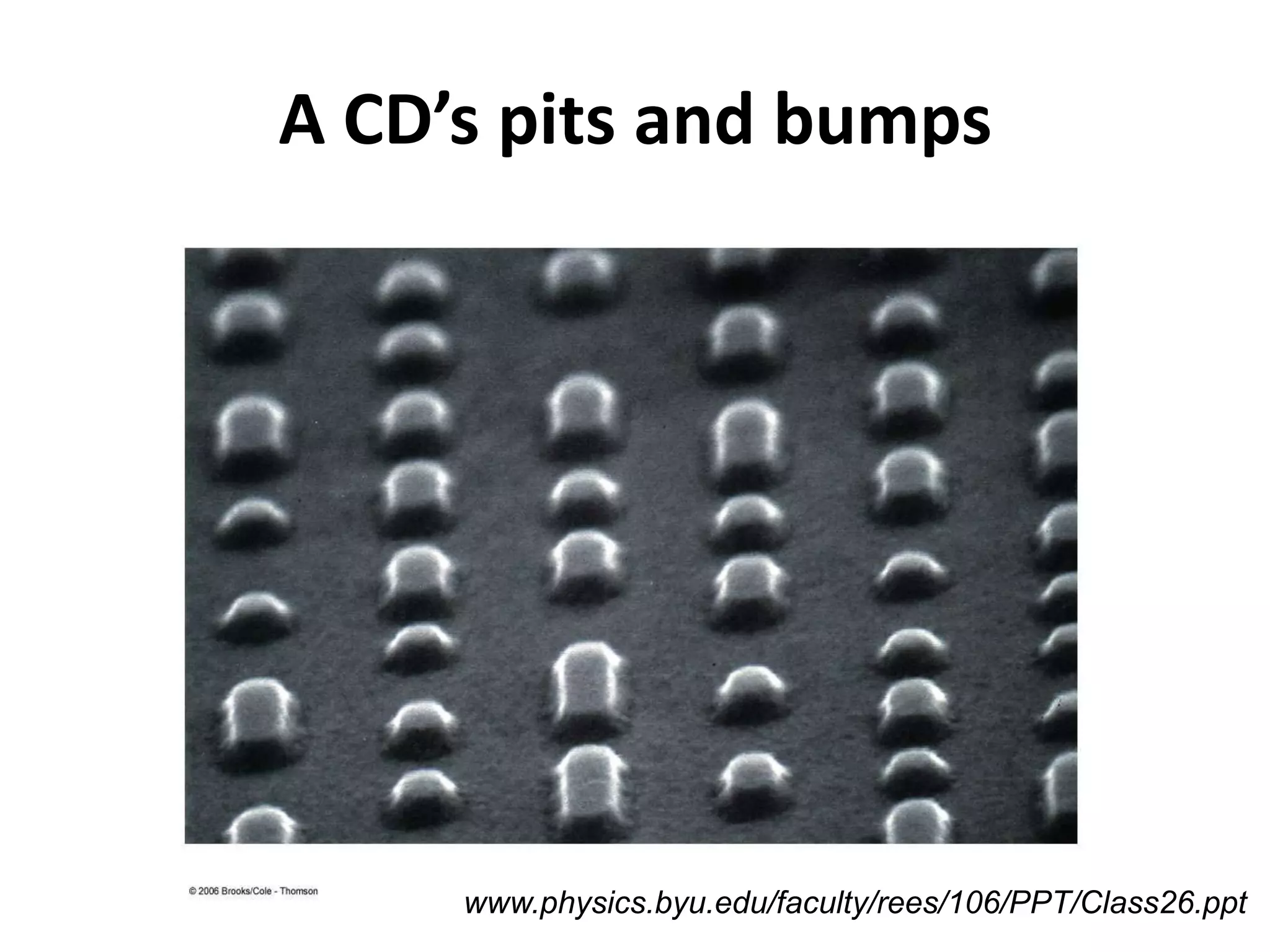
  The tracks consist of a sequence of pits of
  varying length formed in a reflecting
  information layer
2. The laser beam shines on a metallic
   layer through a clear plastic coating
A CD’s pits and bumps


     www.physics.byu.edu/faculty/rees/106/PPT/Class26.ppt
1
   Reading a CD
1. As the disk rotates, the
   laser reflects off the
   sequence of bumps and
   lower areas into a
   photodetector

2. The photodetector
   converts the fluctuating
   reflected light intensity
   into an electrical string
   of zeros and ones
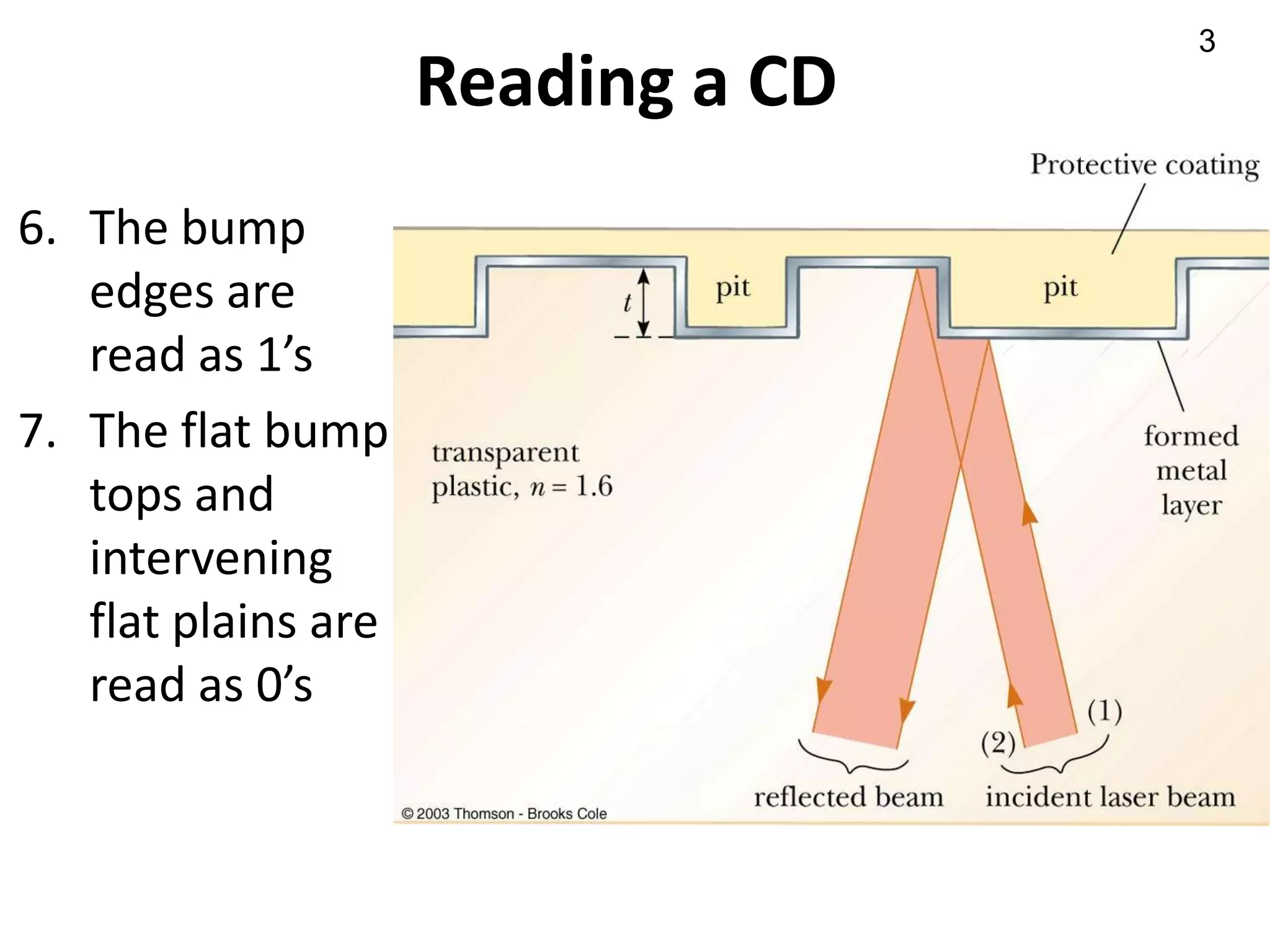
3. The pit depth is made equal to one-quarter of the
   wavelength of the light
2

        Reading a CD


4. When the laser beam hits a rising or falling
   bump edge, part of the beam reflects from
   the top of the bump and part from the lower
   adjacent area
5. Light reflecting from the top and bottom of
   the pit is a half-wavelength out of phase, so
   the intensity drops.
3
                     Reading a CD
6. The bump
   edges are
   read as 1’s
7. The flat bump
   tops and
   intervening
   flat plains are
   read as 0’s
DVD’s
1. DVD’s use shorter wavelength lasers
2. The track separation, pit depth and
   minimum pit length are all smaller
3. Therefore, the DVD can store about 30
   times more information than a CD
Quality?
1. In the case of CD sound, fidelity (the
   similarity between the original wave and the
   DAC's output ) is an important goal, so the
   sampling rate is 44,100 samples per second
   and the number of gradations is 65,536.
2. At this level, the output of the DAC so closely
   matches the original waveform that the
   sound is essentially "perfect" to most human
   ears .
Why is a CD’s capacity approximately 750 MB?
1. One thing about the CD's sampling rate and precision is
   that it produces a lot of data.
2. On a CD, the digital numbers produced by the ADC are
   stored as bytes, and it takes 2 bytes to represent 65,536
   gradations.
3. There are two sound streams being recorded (one for
   each of the speakers on a stereo system).
4. A CD can store up to 74 minutes of music, so the total
   amount of digital data that must be stored on a CD is:

44,100 samples/(channel*second) * 2 bytes/sample * 2 channels *
74 minutes * 60 seconds/minute
                                   = 783,216,000 bytes

Cd's & dvd's

  • 1.
    CD’s and DVD’s. 1.http://electronics.howstuffworks.com/cd.ht m 2. Exploring Sound: Digital Sound Laser discs such as CDs and DVDs carry digital information, which is represented by the binary code -- combinations of 1s and 0s. Any number can be represented in binary code. Learn how this information is encoded in the clip in the above link.
  • 2.
    CD’s and DVD’s 1.Data is stored digitally A series of ones and zeros read by laser light reflected from the disk 2. Strong reflections correspond to constructive interference These reflections are chosen to represent zeros 3. Weak reflections correspond to destructive interference These reflections are chosen to represent ones
  • 3.
    CD’s and ThinFilm Interference 1. A CD has multiple tracks The tracks consist of a sequence of pits of varying length formed in a reflecting information layer 2. The laser beam shines on a metallic layer through a clear plastic coating
  • 4.
    A CD’s pitsand bumps www.physics.byu.edu/faculty/rees/106/PPT/Class26.ppt
  • 5.
    1 Reading a CD 1. As the disk rotates, the laser reflects off the sequence of bumps and lower areas into a photodetector 2. The photodetector converts the fluctuating reflected light intensity into an electrical string of zeros and ones 3. The pit depth is made equal to one-quarter of the wavelength of the light
  • 6.
    2 Reading a CD 4. When the laser beam hits a rising or falling bump edge, part of the beam reflects from the top of the bump and part from the lower adjacent area 5. Light reflecting from the top and bottom of the pit is a half-wavelength out of phase, so the intensity drops.
  • 7.
    3 Reading a CD 6. The bump edges are read as 1’s 7. The flat bump tops and intervening flat plains are read as 0’s
  • 8.
    DVD’s 1. DVD’s useshorter wavelength lasers 2. The track separation, pit depth and minimum pit length are all smaller 3. Therefore, the DVD can store about 30 times more information than a CD
  • 9.
    Quality? 1. In thecase of CD sound, fidelity (the similarity between the original wave and the DAC's output ) is an important goal, so the sampling rate is 44,100 samples per second and the number of gradations is 65,536. 2. At this level, the output of the DAC so closely matches the original waveform that the sound is essentially "perfect" to most human ears .
  • 10.
    Why is aCD’s capacity approximately 750 MB? 1. One thing about the CD's sampling rate and precision is that it produces a lot of data. 2. On a CD, the digital numbers produced by the ADC are stored as bytes, and it takes 2 bytes to represent 65,536 gradations. 3. There are two sound streams being recorded (one for each of the speakers on a stereo system). 4. A CD can store up to 74 minutes of music, so the total amount of digital data that must be stored on a CD is: 44,100 samples/(channel*second) * 2 bytes/sample * 2 channels * 74 minutes * 60 seconds/minute = 783,216,000 bytes