DVD
TECHNOLOGY
By
XXXXXX
12XXXXX
Under the guidance of
XXXXX, XXXXX
ABSTRACT
• DVD stands for digital versatile disc, although it is also commonly
referred to as digital video disc
• DVD technology allows for the storage of a large amount of data
using digital technology.
• DVDs can store up to 17 gigabytes, compared to the storage
capacity of a compact disc (CD)
2DVD Technology
INTRODUCTION
• DVD (sometimes explained as "digital versatile disc" or
"digital video disc") is a digital optical disc storage format.
• DVD-Video became the dominant form of home video
distribution in Japan when it first went on sale in 1995.
3DVD Technology
• Digital Video Disc
• Digital Versatile Disc
• A high-capacity compact disc. This disc can store enough data for a full
length movie. You must have a DVD disc drive or player to use DVD discs.
DVD Technology 4
What is a DVD ?
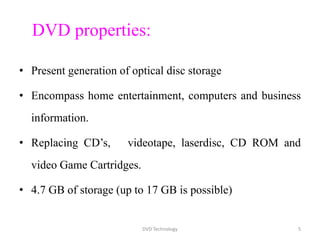
DVD properties:
• Present generation of optical disc storage
• Encompass home entertainment, computers and business
information.
• Replacing CD’s, videotape, laserdisc, CD ROM and
video Game Cartridges.
• 4.7 GB of storage (up to 17 GB is possible)
DVD Technology 5
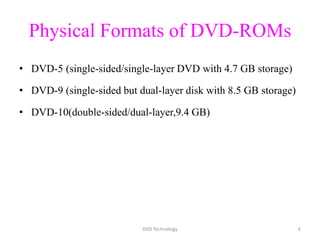
Physical Formats of DVD-ROMs
• DVD-5 (single-sided/single-layer DVD with 4.7 GB storage)
• DVD-9 (single-sided but dual-layer disk with 8.5 GB storage)
• DVD-10(double-sided/dual-layer,9.4 GB)
DVD Technology 6
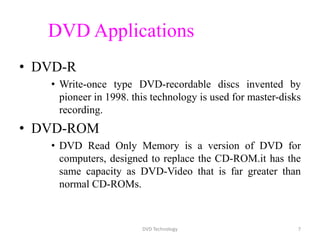
DVD Applications
• DVD-R
• Write-once type DVD-recordable discs invented by
pioneer in 1998. this technology is used for master-disks
recording.
• DVD-ROM
• DVD Read Only Memory is a version of DVD for
computers, designed to replace the CD-ROM.it has the
same capacity as DVD-Video that is far greater than
normal CD-ROMs.
DVD Technology 7
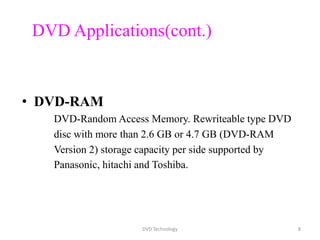
DVD Applications(cont.)
• DVD-RAM
DVD-Random Access Memory. Rewriteable type DVD
disc with more than 2.6 GB or 4.7 GB (DVD-RAM
Version 2) storage capacity per side supported by
Panasonic, hitachi and Toshiba.
DVD Technology 8
DVD Data Storage
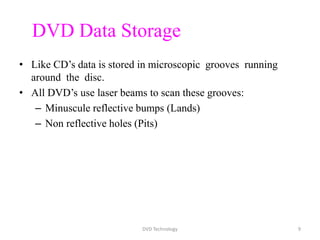
• Like CD’s data is stored in microscopic grooves running
around the disc.
• All DVD’s use laser beams to scan these grooves:
– Minuscule reflective bumps (Lands)
– Non reflective holes (Pits)
DVD Technology 9
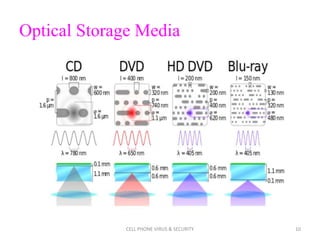
Optical Storage Media
CELL PHONE VIRUS & SECURITY 10
Disadvantages of DVD
• Conversion to DVD
• Incompatibility of discs and players
• Not fully supported by HDTV
• Copy protection
DVD Technology 11
Recordable DVD’s
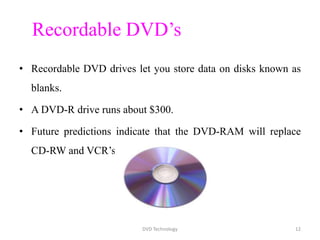
• Recordable DVD drives let you store data on disks known as
blanks.
• A DVD-R drive runs about $300.
• Future predictions indicate that the DVD-RAM will replace
CD-RW and VCR’s.
DVD Technology 12
Educational Uses
• Storage of large amounts of data (Ex. plant I.D for Nursery
Landscape Contest).
• Games (Review Exercises)
• Movie materials
• Everything in one format……eliminating the VCR, Tapes,
Handouts, etc.
DVD Technology 13
Equipment Needed
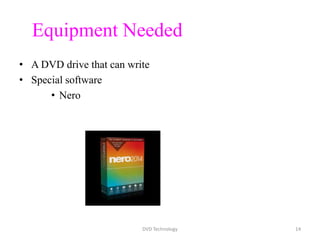
• A DVD drive that can write
• Special software
• Nero
DVD Technology 14
CONCLUSION
DVD Technology has led to advances producing a DVD
capable of holding 15 times as much data as current DVDs.
This high memory density is achieved by adding an additional
film to the DVD, pinpointing the laser beam allowing up to 30
hours of moving images to be stored, using conventional DVD
devices for playback
15DVD Technology
REFERENCES
• "DVD Player". World Public Library.
• "Video software and downloads". videohelp.com.
16DVD Technology
THANK YOU

DVD TECHNOLOGY BY SAIKIRAN PANJALA

  • 1.
  • 2.
    ABSTRACT • DVD standsfor digital versatile disc, although it is also commonly referred to as digital video disc • DVD technology allows for the storage of a large amount of data using digital technology. • DVDs can store up to 17 gigabytes, compared to the storage capacity of a compact disc (CD) 2DVD Technology
  • 3.
    INTRODUCTION • DVD (sometimesexplained as "digital versatile disc" or "digital video disc") is a digital optical disc storage format. • DVD-Video became the dominant form of home video distribution in Japan when it first went on sale in 1995. 3DVD Technology
  • 4.
    • Digital VideoDisc • Digital Versatile Disc • A high-capacity compact disc. This disc can store enough data for a full length movie. You must have a DVD disc drive or player to use DVD discs. DVD Technology 4 What is a DVD ?
  • 5.
    DVD properties: • Presentgeneration of optical disc storage • Encompass home entertainment, computers and business information. • Replacing CD’s, videotape, laserdisc, CD ROM and video Game Cartridges. • 4.7 GB of storage (up to 17 GB is possible) DVD Technology 5
  • 6.
    Physical Formats ofDVD-ROMs • DVD-5 (single-sided/single-layer DVD with 4.7 GB storage) • DVD-9 (single-sided but dual-layer disk with 8.5 GB storage) • DVD-10(double-sided/dual-layer,9.4 GB) DVD Technology 6
  • 7.
    DVD Applications • DVD-R •Write-once type DVD-recordable discs invented by pioneer in 1998. this technology is used for master-disks recording. • DVD-ROM • DVD Read Only Memory is a version of DVD for computers, designed to replace the CD-ROM.it has the same capacity as DVD-Video that is far greater than normal CD-ROMs. DVD Technology 7
  • 8.
    DVD Applications(cont.) • DVD-RAM DVD-RandomAccess Memory. Rewriteable type DVD disc with more than 2.6 GB or 4.7 GB (DVD-RAM Version 2) storage capacity per side supported by Panasonic, hitachi and Toshiba. DVD Technology 8
  • 9.
    DVD Data Storage •Like CD’s data is stored in microscopic grooves running around the disc. • All DVD’s use laser beams to scan these grooves: – Minuscule reflective bumps (Lands) – Non reflective holes (Pits) DVD Technology 9
  • 10.
    Optical Storage Media CELLPHONE VIRUS & SECURITY 10
  • 11.
    Disadvantages of DVD •Conversion to DVD • Incompatibility of discs and players • Not fully supported by HDTV • Copy protection DVD Technology 11
  • 12.
    Recordable DVD’s • RecordableDVD drives let you store data on disks known as blanks. • A DVD-R drive runs about $300. • Future predictions indicate that the DVD-RAM will replace CD-RW and VCR’s. DVD Technology 12
  • 13.
    Educational Uses • Storageof large amounts of data (Ex. plant I.D for Nursery Landscape Contest). • Games (Review Exercises) • Movie materials • Everything in one format……eliminating the VCR, Tapes, Handouts, etc. DVD Technology 13
  • 14.
    Equipment Needed • ADVD drive that can write • Special software • Nero DVD Technology 14
  • 15.
    CONCLUSION DVD Technology hasled to advances producing a DVD capable of holding 15 times as much data as current DVDs. This high memory density is achieved by adding an additional film to the DVD, pinpointing the laser beam allowing up to 30 hours of moving images to be stored, using conventional DVD devices for playback 15DVD Technology
  • 16.
    REFERENCES • "DVD Player".World Public Library. • "Video software and downloads". videohelp.com. 16DVD Technology
  • 17.