PRESENTATION
Application of Gauss’s Law
SUBJECT : ELECTRICITY
AND MAGNETISM
PRESENTED BY : Muhammad Usama
BS Physics 3rd Semester
Roll.NO:10
PRESENTED TO: Sir Yamin
Introduction
Gauss’s law was formulated by German
Scientist Carl Friedrich Gauss in 1835.
Gauss’s Law is relating the distribution of
electric charge to result of electric field.
GAUSS’S LAW
Gauss’s Law states that:
“Electric flux through any Closed surface is equal to
1
𝜀°
time the total charge enclosed by that surface”
Φ =
1
𝜀°
Q
APPLICATION OF GAUSS’S
LAW
1. It is used to find electric field intensity at some
distance due to different charge distribution. over
single isolated charge we used E=k
𝑞
𝑟2 to find electric
field intensity but we can applied this formula for
multiple charge so we use Gauss’s law to find electric
field intensity more than one charge
STEP TO CALCULATE
ELECTRIC FIELD
INTENSITY
1. Draw a suitable Gaussian surface enclosing the
point where we want to calculate electric field
intensity .
Gaussian surface :
It is closed imaginary three dimensional surface
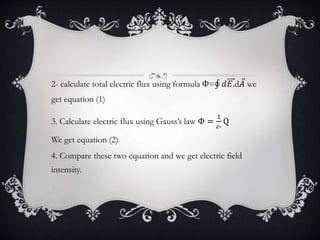
2- calculate total electric flux using formula Φ= 𝑑𝐸.d𝐴 we
get equation (1)
3. Calculate electric flux using Gauss’s law Φ =
1
𝜀°
Q
We get equation (2)
4. Compare these two equation and we get electric field
intensity.
1.ELECTRIC FIELD INTENSITY
INSIDE A HOLLOW SPHERE DUE
TO CHARGE DISTRIBUTED OVER
ITS SURFACE
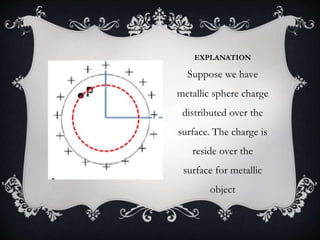
EXPLANATION
Suppose we have
metallic sphere charge
distributed over the
surface. The charge is
reside over the
surface for metallic
object
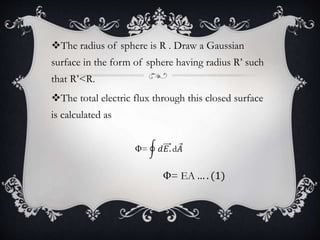
The radius of sphere is R . Draw a Gaussian
surface in the form of sphere having radius R’ such
that R’<R.
The total electric flux through this closed surface
is calculated as
Φ= 𝑑𝐸. d𝐴
Φ= EA … . (1)
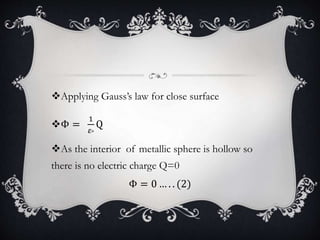
Applying Gauss’s law for close surface
Φ =
1
𝜀°
Q
As the interior of metallic sphere is hollow so
there is no electric charge Q=0
Φ = 0 … . . (2)
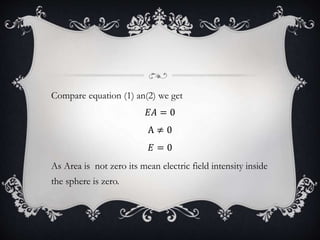
Compare equation (1) an(2) we get
𝐸𝐴 = 0
Α ≠ 0
𝐸 = 0
As Area is not zero its mean electric field intensity inside
the sphere is zero.
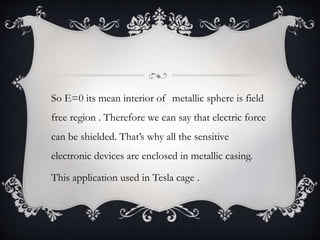
So E=0 its mean interior of metallic sphere is field
free region . Therefore we can say that electric force
can be shielded. That’s why all the sensitive
electronic devices are enclosed in metallic casing.
This application used in Tesla cage .
ELECTRIC FIELD
INTENSITY DUE TO
INFINITE SHEET OF
CHARGE
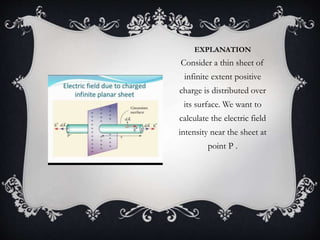
EXPLANATION
Consider a thin sheet of
infinite extent positive
charge is distributed over
its surface. We want to
calculate the electric field
intensity near the sheet at
point P .
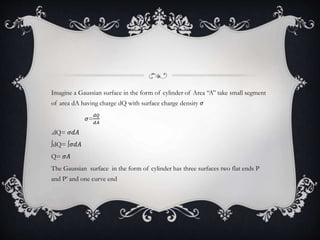
Imagine a Gaussian surface in the form of cylinder of Area “A” take small segment
of area dA having charge dQ with surface charge density 𝜎
𝜎=
𝑑𝑄
𝑑𝐴
.dQ= 𝜎𝑑𝐴
∫dQ= ∫𝜎𝑑𝐴
Q= 𝜎𝐴
The Gaussian surface in the form of cylinder has three surfaces two flat ends P
and P’ and one curve end
FLUX THROUGH FIRST
FLAT END
Φ= 𝑑𝐸. d𝐴
Φ = 𝑑𝐸𝑑𝐴𝑐𝑜𝑠𝜃
𝜃 = 0
Φ= EA … . (1)
FLUX THROUGH FIRST
FLAT END
 Φ= 𝑑𝐸. d𝐴
 Φ = 𝑑𝐸𝑑𝐴𝑐𝑜𝑠𝜃
 𝜃 = 0
 Φ= EA … . (2)
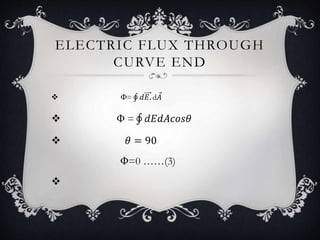
ELECTRIC FLUX THROUGH
CURVE END
 Φ= 𝑑𝐸. d𝐴
 Φ = 𝑑𝐸𝑑𝐴𝑐𝑜𝑠𝜃
 𝜃 = 90
Φ=0 ……(3)

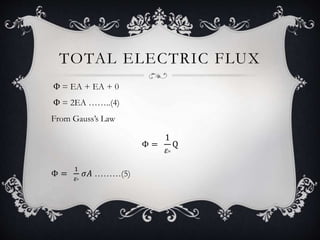
TOTAL ELECTRIC FLUX
Φ = EA + EA + 0
Φ = 2EA ……..(4)
From Gauss’s Law
Φ =
1
𝜀°
Q
Φ =
1
𝜀°
𝜎𝐴 ………(5)
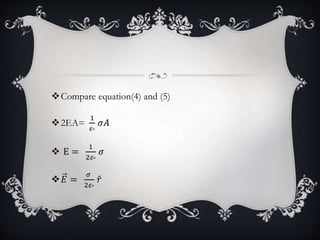
Compare equation(4) and (5)
2EA=
1
𝜀°
𝜎𝐴
 E =
1
2𝜀°
𝜎
𝐸 =
𝜎
2𝜀°
𝑟
THANK YOU
The END

Gauss's Law and its applications

  • 1.
  • 2.
    SUBJECT : ELECTRICITY ANDMAGNETISM PRESENTED BY : Muhammad Usama BS Physics 3rd Semester Roll.NO:10 PRESENTED TO: Sir Yamin
  • 3.
    Introduction Gauss’s law wasformulated by German Scientist Carl Friedrich Gauss in 1835. Gauss’s Law is relating the distribution of electric charge to result of electric field.
  • 4.
    GAUSS’S LAW Gauss’s Lawstates that: “Electric flux through any Closed surface is equal to 1 𝜀° time the total charge enclosed by that surface” Φ = 1 𝜀° Q
  • 5.
    APPLICATION OF GAUSS’S LAW 1.It is used to find electric field intensity at some distance due to different charge distribution. over single isolated charge we used E=k 𝑞 𝑟2 to find electric field intensity but we can applied this formula for multiple charge so we use Gauss’s law to find electric field intensity more than one charge
  • 6.
    STEP TO CALCULATE ELECTRICFIELD INTENSITY 1. Draw a suitable Gaussian surface enclosing the point where we want to calculate electric field intensity . Gaussian surface : It is closed imaginary three dimensional surface
  • 7.
    2- calculate totalelectric flux using formula Φ= 𝑑𝐸.d𝐴 we get equation (1) 3. Calculate electric flux using Gauss’s law Φ = 1 𝜀° Q We get equation (2) 4. Compare these two equation and we get electric field intensity.
  • 8.
    1.ELECTRIC FIELD INTENSITY INSIDEA HOLLOW SPHERE DUE TO CHARGE DISTRIBUTED OVER ITS SURFACE
  • 9.
    EXPLANATION Suppose we have metallicsphere charge distributed over the surface. The charge is reside over the surface for metallic object
  • 10.
    The radius ofsphere is R . Draw a Gaussian surface in the form of sphere having radius R’ such that R’<R. The total electric flux through this closed surface is calculated as Φ= 𝑑𝐸. d𝐴 Φ= EA … . (1)
  • 11.
    Applying Gauss’s lawfor close surface Φ = 1 𝜀° Q As the interior of metallic sphere is hollow so there is no electric charge Q=0 Φ = 0 … . . (2)
  • 12.
    Compare equation (1)an(2) we get 𝐸𝐴 = 0 Α ≠ 0 𝐸 = 0 As Area is not zero its mean electric field intensity inside the sphere is zero.
  • 13.
    So E=0 itsmean interior of metallic sphere is field free region . Therefore we can say that electric force can be shielded. That’s why all the sensitive electronic devices are enclosed in metallic casing. This application used in Tesla cage .
  • 14.
    ELECTRIC FIELD INTENSITY DUETO INFINITE SHEET OF CHARGE
  • 15.
    EXPLANATION Consider a thinsheet of infinite extent positive charge is distributed over its surface. We want to calculate the electric field intensity near the sheet at point P .
  • 16.
    Imagine a Gaussiansurface in the form of cylinder of Area “A” take small segment of area dA having charge dQ with surface charge density 𝜎 𝜎= 𝑑𝑄 𝑑𝐴 .dQ= 𝜎𝑑𝐴 ∫dQ= ∫𝜎𝑑𝐴 Q= 𝜎𝐴 The Gaussian surface in the form of cylinder has three surfaces two flat ends P and P’ and one curve end
  • 17.
    FLUX THROUGH FIRST FLATEND Φ= 𝑑𝐸. d𝐴 Φ = 𝑑𝐸𝑑𝐴𝑐𝑜𝑠𝜃 𝜃 = 0 Φ= EA … . (1)
  • 18.
    FLUX THROUGH FIRST FLATEND  Φ= 𝑑𝐸. d𝐴  Φ = 𝑑𝐸𝑑𝐴𝑐𝑜𝑠𝜃  𝜃 = 0  Φ= EA … . (2)
  • 19.
    ELECTRIC FLUX THROUGH CURVEEND  Φ= 𝑑𝐸. d𝐴  Φ = 𝑑𝐸𝑑𝐴𝑐𝑜𝑠𝜃  𝜃 = 90 Φ=0 ……(3) 
  • 20.
    TOTAL ELECTRIC FLUX Φ= EA + EA + 0 Φ = 2EA ……..(4) From Gauss’s Law Φ = 1 𝜀° Q Φ = 1 𝜀° 𝜎𝐴 ………(5)
  • 21.
    Compare equation(4) and(5) 2EA= 1 𝜀° 𝜎𝐴  E = 1 2𝜀° 𝜎 𝐸 = 𝜎 2𝜀° 𝑟
  • 22.