CAUSAL-COMPARATIVE
&
CORRELATIONAL
RESEARCH
What is causal-comparative research?
• Known as “ex post facto” research. (Latin “after
the fact”).
• Attempt to determine the cause or
consequences of differences that already exist
between or among groups of individuals.
• To identify a causative relationship between an
independent variable and a dependent variable.
Usually a suggested relationship (not proven) as
the researcher do not have complete control
over the independent variable.
• When Independent variables can not be or
The Three Types
• There are 3 types of causal-comparative
research:
–Exploration of Effects
–Exploration of Causes
–Exploration of Consequences
Similarities to Causal Comparative to
Correlational research
• Both lack manipulation
• Both require caution in interpreting results (Causion is
difficult to establish)
• Both are examples of associational research:
• Researchers seek to explore relationships among
variables.
• Both attempt to explain phenomena of interest.
• Both seek to identify variables that are worthy of later
exploration
• Often provide guidance for later experimental
studies.
• Result can lead to testable experimental hypothesis
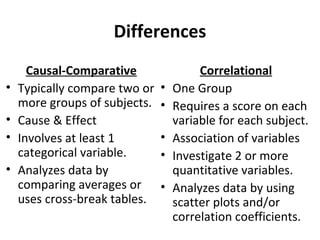
Differences
Causal-Comparative
• Typically compare two or
more groups of subjects.
• Cause & Effect
• Involves at least 1
categorical variable.
• Analyzes data by
comparing averages or
uses cross-break tables.
Correlational
• One Group
• Requires a score on each
variable for each subject.
• Association of variables
• Investigate 2 or more
quantitative variables.
• Analyzes data by using
scatter plots and/or
correlation coefficients.
Similarities of Causal Comparative to
Correlational research
• Neither allow the researcher to manipulate
the variables.
• Both attempt to explore causation.
Similarities of Causal comparative to
Experimental research
• Both require at least one categorical variable.
• Both compare group performances to
determine relationships.
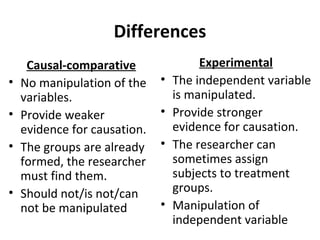
Differences
Causal-comparative
• No manipulation of the
variables.
• Provide weaker
evidence for causation.
• The groups are already
formed, the researcher
must find them.
• Should not/is not/can
not be manipulated
Experimental
• The independent variable
is manipulated.
• Provide stronger
evidence for causation.
• The researcher can
sometimes assign
subjects to treatment
groups.
• Manipulation of
independent variable
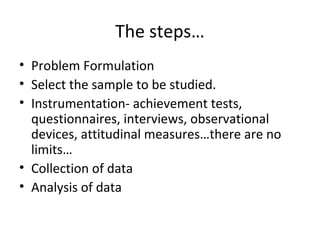
The steps…
• Problem Formulation
• Select the sample to be studied.
• Instrumentation- achievement tests,
questionnaires, interviews, observational
devices, attitudinal measures…there are no
limits…
• Collection of data
• Analysis of data
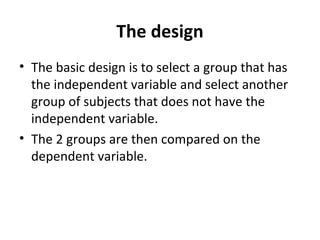
The design
• The basic design is to select a group that has
the independent variable and select another
group of subjects that does not have the
independent variable.
• The 2 groups are then compared on the
dependent variable.
Internal Validity
• Usually 2 weaknesses in the research:
–Lack of randomization
–Inability to manipulate an independent
variable
• Threats
–Oftentimes subject bias occurs
–Location
–Instrumentation
–Loss of subjects
Data Analysis
• Construct frequency polygons.
• Means and standard deviations (only if
variables are quantitative)
• T-test for differences between means.
• Analysis of covariance
Proceed with caution!!!
• The researcher must remember that
demonstrating a relationship between 2
variables (even a very strong relationship)
does not “prove” that one variable actually
causes the other to change in a causal-
comparative study.
Limitations
• There must be a “pre-existing”
independent variable
–Years of study, gender, age, etc.
• There must be active variables- variables
which the research can manipulate
–The length and number of study
sessions, instructional techniques, etc.
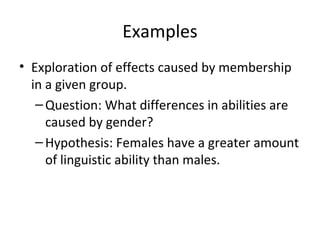
Examples
• Exploration of effects caused by membership
in a given group.
–Question: What differences in abilities are
caused by gender?
–Hypothesis: Females have a greater amount
of linguistic ability than males.
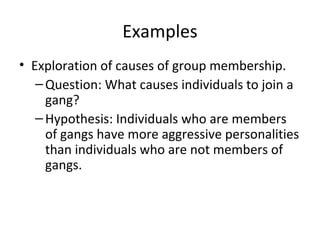
Examples
• Exploration of causes of group membership.
–Question: What causes individuals to join a
gang?
–Hypothesis: Individuals who are members
of gangs have more aggressive personalities
than individuals who are not members of
gangs.
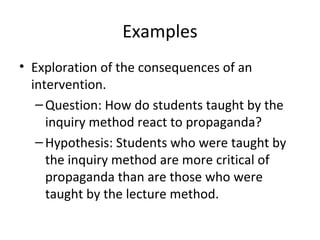
Examples
• Exploration of the consequences of an
intervention.
–Question: How do students taught by the
inquiry method react to propaganda?
–Hypothesis: Students who were taught by
the inquiry method are more critical of
propaganda than are those who were
taught by the lecture method.
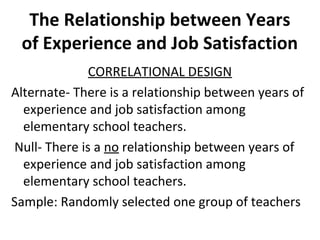
The Relationship between Years
of Experience and Job Satisfaction
CORRELATIONAL DESIGN
Alternate- There is a relationship between years of
experience and job satisfaction among
elementary school teachers.
Null- There is a no relationship between years of
experience and job satisfaction among
elementary school teachers.
Sample: Randomly selected one group of teachers
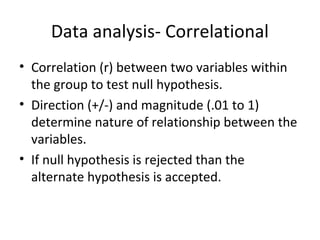
Data analysis- Correlational
• Correlation (r) between two variables within
the group to test null hypothesis.
• Direction (+/-) and magnitude (.01 to 1)
determine nature of relationship between the
variables.
• If null hypothesis is rejected than the
alternate hypothesis is accepted.
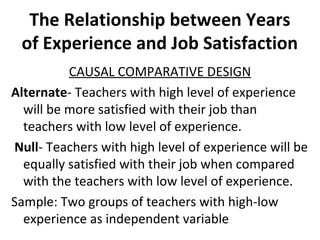
The Relationship between Years
of Experience and Job Satisfaction
CAUSAL COMPARATIVE DESIGN
Alternate- Teachers with high level of experience
will be more satisfied with their job than
teachers with low level of experience.
Null- Teachers with high level of experience will be
equally satisfied with their job when compared
with the teachers with low level of experience.
Sample: Two groups of teachers with high-low
experience as independent variable
Data analysis- Causal Comparative
• Independent variable- years of experience
with dependent variable- job satisfaction
• Comparing variables with mean job
satisfaction scores using t-test, ANOVA or
other tests for both the groups.
• Accepting or rejecting hypothesis based on
the test results will lead to conclusion.

Causal comparative research

  • 1.
  • 2.
    What is causal-comparativeresearch? • Known as “ex post facto” research. (Latin “after the fact”). • Attempt to determine the cause or consequences of differences that already exist between or among groups of individuals. • To identify a causative relationship between an independent variable and a dependent variable. Usually a suggested relationship (not proven) as the researcher do not have complete control over the independent variable. • When Independent variables can not be or
  • 3.
    The Three Types •There are 3 types of causal-comparative research: –Exploration of Effects –Exploration of Causes –Exploration of Consequences
  • 4.
    Similarities to CausalComparative to Correlational research • Both lack manipulation • Both require caution in interpreting results (Causion is difficult to establish) • Both are examples of associational research: • Researchers seek to explore relationships among variables. • Both attempt to explain phenomena of interest. • Both seek to identify variables that are worthy of later exploration • Often provide guidance for later experimental studies. • Result can lead to testable experimental hypothesis
  • 5.
    Differences Causal-Comparative • Typically comparetwo or more groups of subjects. • Cause & Effect • Involves at least 1 categorical variable. • Analyzes data by comparing averages or uses cross-break tables. Correlational • One Group • Requires a score on each variable for each subject. • Association of variables • Investigate 2 or more quantitative variables. • Analyzes data by using scatter plots and/or correlation coefficients.
  • 6.
    Similarities of CausalComparative to Correlational research • Neither allow the researcher to manipulate the variables. • Both attempt to explore causation.
  • 7.
    Similarities of Causalcomparative to Experimental research • Both require at least one categorical variable. • Both compare group performances to determine relationships.
  • 8.
    Differences Causal-comparative • No manipulationof the variables. • Provide weaker evidence for causation. • The groups are already formed, the researcher must find them. • Should not/is not/can not be manipulated Experimental • The independent variable is manipulated. • Provide stronger evidence for causation. • The researcher can sometimes assign subjects to treatment groups. • Manipulation of independent variable
  • 9.
    The steps… • ProblemFormulation • Select the sample to be studied. • Instrumentation- achievement tests, questionnaires, interviews, observational devices, attitudinal measures…there are no limits… • Collection of data • Analysis of data
  • 10.
    The design • Thebasic design is to select a group that has the independent variable and select another group of subjects that does not have the independent variable. • The 2 groups are then compared on the dependent variable.
  • 11.
    Internal Validity • Usually2 weaknesses in the research: –Lack of randomization –Inability to manipulate an independent variable • Threats –Oftentimes subject bias occurs –Location –Instrumentation –Loss of subjects
  • 12.
    Data Analysis • Constructfrequency polygons. • Means and standard deviations (only if variables are quantitative) • T-test for differences between means. • Analysis of covariance
  • 13.
    Proceed with caution!!! •The researcher must remember that demonstrating a relationship between 2 variables (even a very strong relationship) does not “prove” that one variable actually causes the other to change in a causal- comparative study.
  • 14.
    Limitations • There mustbe a “pre-existing” independent variable –Years of study, gender, age, etc. • There must be active variables- variables which the research can manipulate –The length and number of study sessions, instructional techniques, etc.
  • 15.
    Examples • Exploration ofeffects caused by membership in a given group. –Question: What differences in abilities are caused by gender? –Hypothesis: Females have a greater amount of linguistic ability than males.
  • 16.
    Examples • Exploration ofcauses of group membership. –Question: What causes individuals to join a gang? –Hypothesis: Individuals who are members of gangs have more aggressive personalities than individuals who are not members of gangs.
  • 17.
    Examples • Exploration ofthe consequences of an intervention. –Question: How do students taught by the inquiry method react to propaganda? –Hypothesis: Students who were taught by the inquiry method are more critical of propaganda than are those who were taught by the lecture method.
  • 18.
    The Relationship betweenYears of Experience and Job Satisfaction CORRELATIONAL DESIGN Alternate- There is a relationship between years of experience and job satisfaction among elementary school teachers. Null- There is a no relationship between years of experience and job satisfaction among elementary school teachers. Sample: Randomly selected one group of teachers
  • 19.
    Data analysis- Correlational •Correlation (r) between two variables within the group to test null hypothesis. • Direction (+/-) and magnitude (.01 to 1) determine nature of relationship between the variables. • If null hypothesis is rejected than the alternate hypothesis is accepted.
  • 20.
    The Relationship betweenYears of Experience and Job Satisfaction CAUSAL COMPARATIVE DESIGN Alternate- Teachers with high level of experience will be more satisfied with their job than teachers with low level of experience. Null- Teachers with high level of experience will be equally satisfied with their job when compared with the teachers with low level of experience. Sample: Two groups of teachers with high-low experience as independent variable
  • 21.
    Data analysis- CausalComparative • Independent variable- years of experience with dependent variable- job satisfaction • Comparing variables with mean job satisfaction scores using t-test, ANOVA or other tests for both the groups. • Accepting or rejecting hypothesis based on the test results will lead to conclusion.

Editor's Notes

  • #10 Problem formulation involves identifying and defining a particular phenomena of interest and then considering the possible causes for, or consequences of, these phenomena.
  • #11 handout