Media Globalization
and Cultural
Imperialism: Contrary
evidences from Indian
television
Mira K Desai, PhD
University Department of Extension Education
SNDT Women’s University, Juhu Campus, Mumbai
What is Culture?

Artifacts

Food
Culture also is………..
Belonging

Beliefs
Practices

Verbal
Non-verbal
Symbolic codes

Ethos

Attitudes
Values
Globalization -Cultural Imperialism
•
•
•
•
•

LPG and changing patterns of financial flows
Growth in size and power of Corporations
Advances of ICT and Media reach
Changing flow of people
Intersections of Environment-EconomyPolitics-Culture-Society
• American Imperialism on ‘others’
Assumptions of Cultural Imperialism
• Rooted in the realities of the 1970s, depiction of
a hegemonic media pied piper (America) leading
the global media mice (third world countries).
• Corporations have been successful at massifying
non-Western culture into Western values.
• The effects vary according to the type of media.
Capital-intensive media (like TV and film) tend
to be powerful massification forces.
Historically……Cultural Imperialism
• Has roots in New World Information and
Communication Order (NWICO).
• Refers to the spread of one culture at the
expense of others usually because of
differential economic or political influence.
• While mass media and related technology
contribute to the erosion of local
cultures, they are increasingly being used as
media for the outward diffusion of local
cultures.
Western values…..







Individualism and competition for self
interest (opposite of Collective)
Consumerism and materialism
Status consciousness based on wealth
Covert racism (by favouring Western
forms of music, fashion, beauty, etc)
Excessive hedonism, violence, and sex
Cultural Imperialism through TV!
• Structural elements:
• Economic frameworks- Advertising revenue
• Technological bases- Satellite, air travel
• Institutional forms of organization and operation: national
market structures, ownership rules, production incentives
and subsidies, financial rules, frequency assignments,
technical standards, content rules, economic restructuring,
International powers (IMF, WTO)
• Cultural elements:
Regionalization in terms of geography-language and culture,
Formation of language and cultural communities, Creation
and flow of content across globe
TV Globalization!!!
• Operations: national or local-{frequency licensing,
satellite orbit controls, market definition, financial
incentives, cultural policy and advertising, and other
financial controls by nation-states}
• organization: transnational, international, macroregional, national, micro-regional, municipal, local
• Investments: truly global
• Productions: copycat/dubbed/syndicated
• Flows: Geo-linguistics and regionalization
• Impact: Evidences about flow, genre or broadcast
model based impact on audiences
Cultural Imperialism…..
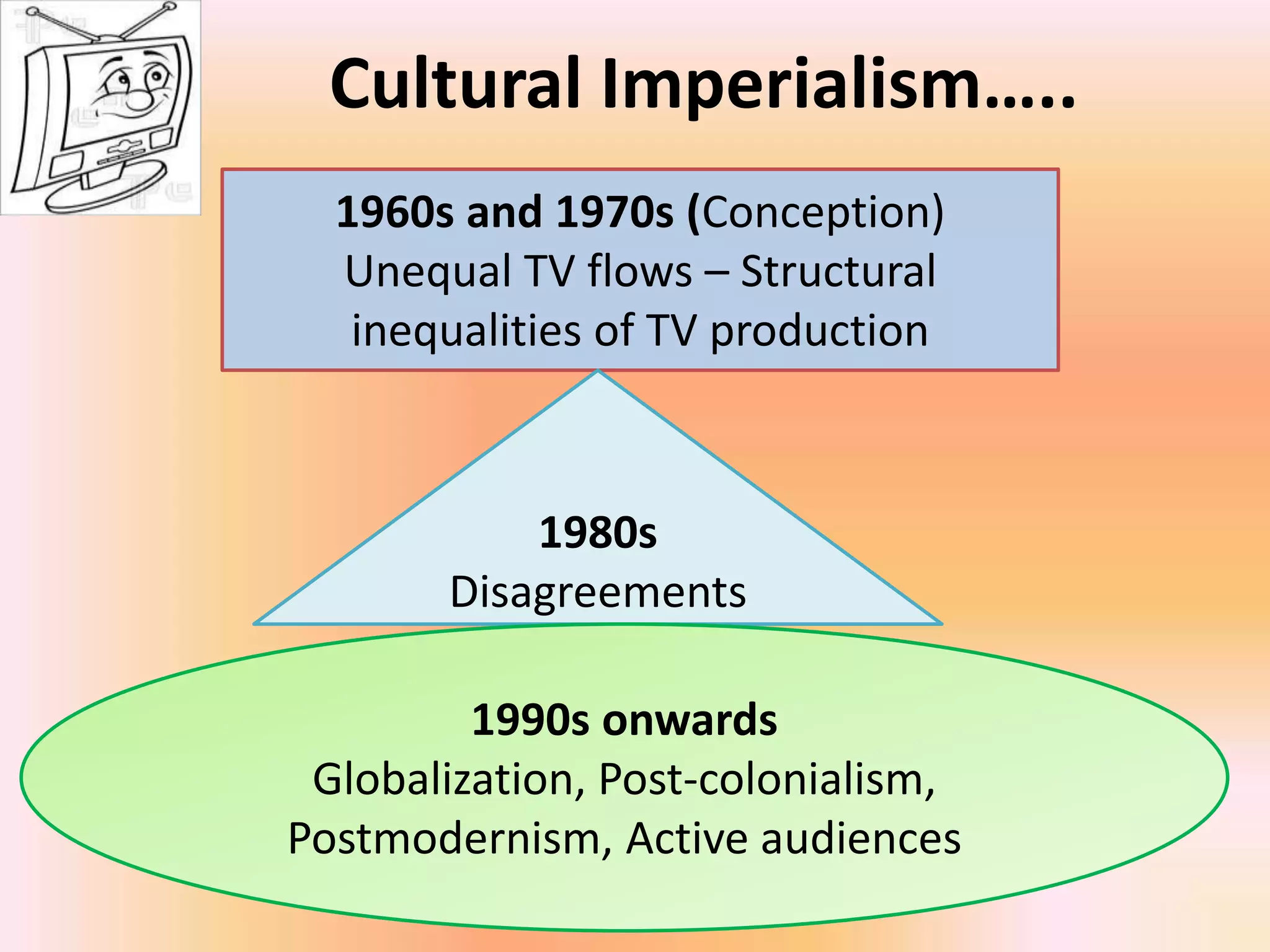
1960s and 1970s (Conception)
Unequal TV flows – Structural
inequalities of TV production

1980s
Disagreements
1990s onwards
Globalization, Post-colonialism,
Postmodernism, Active audiences
Indian Television….The Journey
•
•
•
•
•
•
•
•

From 1959 to 2014 and From B&W to Colour
From 1 channel to 845 channels
From 40 sets to 14 Million TV Sets
From Social Development to Entertainment
From PSB to niche audience and segmented realities
From terrestrial to Cable-STB-DTH-IPTV-Mobile TV
From Neighborhood TV to multiple TV sets in a house
From local- Hum Log to glocal-…KBC……..
Questioning of Cultural Imperialism
• Non-Western rise of soft power: film from India
and Egypt, television from Mexico and Brazil
• Contra-flows: Indian films dominating in Asia
• Globalization of media forms
• Globalization of media Firms (TNCs)
• Global media flows
• Media localization and global/national values
• Nationalism to Transnationalism
Contrary Evidences-1
• Media text: Hybrid programming, Indian
look and Western values
• Transnational Operations: Copycat TV,
Licensed/Syndicated shows, Film
collaborations, content exchange
collaborations
• Media structure ownerships
• Audience Studies with diverse findings
ZEE Story- Local gone Global
• ZEE reaches 169 countries across the globe.
• ZEE Entertainment Enterprises Ltd. launched its
2nd Arabic channel, Zee Alwan, in 2012.
• ZEEL has been syndicating Indian dramas
dubbed in Mandarin to Chinese television
channels since 2006 and became the first Indian
channel to receive landing rights in China in
2012.
Contrary Evidences…2
•
•
•
•
•
•

Regional Networks
Manufacturing of ‘Indian’ identities
Localizing the global and Globalizing the local
Market tensions and negotiated identities
Nation-state may not be decisive category
Ethnically homogenous nation-states sharing
content
FICCI-KPMG 2013 Report….
• GEC channels like Zee TV (169), SET (77), Star Plus
(70) and Colors (50) are available globally.
• Hindi GEC viewership share is 30% (regional GEC20.18%) compared to English entertainment
(0.14%), English news (0.23%) and English movies
(0.88%).
• Hindi and regional GEC is 50% viewership share
• 2012 as DAS-Digital Addressability System year
• TV Advertising spent lesser than expected - 8%
(compared to 12% of 2011 and 17% in 2010)
3 types of Indian Content on move
• Ernest & Young and FICCI report on Indian Content on
Move, 2007 estimates Indian content as 200 USD million
industry and 20 Million NRIs as market
• FIRST, the colour, song, dance and drama that is its
hallmark. It is for Indians and other audiences who are
culturally aligned to Indian sensibilities.
• SECOND is content with an Indian theme. Rich Indian
mythology, culture or characters based in India seeking a
global audience.
• THIRD to serve markets with supply deficiency of local
programming. There fresh programming costs are high
compared with the size of the local audience For eg.
Animation or kids content West Asia, Eastern Europe and
other such markets.
Contrary Evidences-3
• States: employ political power, define aspects
of cultures, license broadcasters, create market
incentives, limit imports through quotas, and
counteract global actors who wish to penetrate
national cultural space.
• Market- size and wealth, National- commercial
structure and financial base, Competition,
Government policies, Other cultural industries,
Producer behaviour,
Cultural Imperialism
PAST

• DominationHegemony
• Media Imperialism
• Discourse of
nationality
• Critique of global
capitalism
• Critique of modernity

•
•
•
•
•
•

PRESENT
Localization
Glocalisation
Counter-flow
Local resistance
Cultural proximity,
economic capital
Hybridisation - music,
fashion, and styles
Thanks for
your time and patience
Feel Free to connect:
drmiradesai@gmail.com
sndtmedia@hotmail.com

Media globalisation and cultural imperialism

  • 1.
    Media Globalization and Cultural Imperialism:Contrary evidences from Indian television Mira K Desai, PhD University Department of Extension Education SNDT Women’s University, Juhu Campus, Mumbai
  • 2.
  • 3.
  • 4.
    Globalization -Cultural Imperialism • • • • • LPGand changing patterns of financial flows Growth in size and power of Corporations Advances of ICT and Media reach Changing flow of people Intersections of Environment-EconomyPolitics-Culture-Society • American Imperialism on ‘others’
  • 5.
    Assumptions of CulturalImperialism • Rooted in the realities of the 1970s, depiction of a hegemonic media pied piper (America) leading the global media mice (third world countries). • Corporations have been successful at massifying non-Western culture into Western values. • The effects vary according to the type of media. Capital-intensive media (like TV and film) tend to be powerful massification forces.
  • 8.
    Historically……Cultural Imperialism • Hasroots in New World Information and Communication Order (NWICO). • Refers to the spread of one culture at the expense of others usually because of differential economic or political influence. • While mass media and related technology contribute to the erosion of local cultures, they are increasingly being used as media for the outward diffusion of local cultures.
  • 9.
    Western values…..      Individualism andcompetition for self interest (opposite of Collective) Consumerism and materialism Status consciousness based on wealth Covert racism (by favouring Western forms of music, fashion, beauty, etc) Excessive hedonism, violence, and sex
  • 10.
    Cultural Imperialism throughTV! • Structural elements: • Economic frameworks- Advertising revenue • Technological bases- Satellite, air travel • Institutional forms of organization and operation: national market structures, ownership rules, production incentives and subsidies, financial rules, frequency assignments, technical standards, content rules, economic restructuring, International powers (IMF, WTO) • Cultural elements: Regionalization in terms of geography-language and culture, Formation of language and cultural communities, Creation and flow of content across globe
  • 11.
    TV Globalization!!! • Operations:national or local-{frequency licensing, satellite orbit controls, market definition, financial incentives, cultural policy and advertising, and other financial controls by nation-states} • organization: transnational, international, macroregional, national, micro-regional, municipal, local • Investments: truly global • Productions: copycat/dubbed/syndicated • Flows: Geo-linguistics and regionalization • Impact: Evidences about flow, genre or broadcast model based impact on audiences
  • 12.
    Cultural Imperialism….. 1960s and1970s (Conception) Unequal TV flows – Structural inequalities of TV production 1980s Disagreements 1990s onwards Globalization, Post-colonialism, Postmodernism, Active audiences
  • 13.
    Indian Television….The Journey • • • • • • • • From1959 to 2014 and From B&W to Colour From 1 channel to 845 channels From 40 sets to 14 Million TV Sets From Social Development to Entertainment From PSB to niche audience and segmented realities From terrestrial to Cable-STB-DTH-IPTV-Mobile TV From Neighborhood TV to multiple TV sets in a house From local- Hum Log to glocal-…KBC……..
  • 14.
    Questioning of CulturalImperialism • Non-Western rise of soft power: film from India and Egypt, television from Mexico and Brazil • Contra-flows: Indian films dominating in Asia • Globalization of media forms • Globalization of media Firms (TNCs) • Global media flows • Media localization and global/national values • Nationalism to Transnationalism
  • 15.
    Contrary Evidences-1 • Mediatext: Hybrid programming, Indian look and Western values • Transnational Operations: Copycat TV, Licensed/Syndicated shows, Film collaborations, content exchange collaborations • Media structure ownerships • Audience Studies with diverse findings
  • 16.
    ZEE Story- Localgone Global • ZEE reaches 169 countries across the globe. • ZEE Entertainment Enterprises Ltd. launched its 2nd Arabic channel, Zee Alwan, in 2012. • ZEEL has been syndicating Indian dramas dubbed in Mandarin to Chinese television channels since 2006 and became the first Indian channel to receive landing rights in China in 2012.
  • 17.
    Contrary Evidences…2 • • • • • • Regional Networks Manufacturingof ‘Indian’ identities Localizing the global and Globalizing the local Market tensions and negotiated identities Nation-state may not be decisive category Ethnically homogenous nation-states sharing content
  • 18.
    FICCI-KPMG 2013 Report…. •GEC channels like Zee TV (169), SET (77), Star Plus (70) and Colors (50) are available globally. • Hindi GEC viewership share is 30% (regional GEC20.18%) compared to English entertainment (0.14%), English news (0.23%) and English movies (0.88%). • Hindi and regional GEC is 50% viewership share • 2012 as DAS-Digital Addressability System year • TV Advertising spent lesser than expected - 8% (compared to 12% of 2011 and 17% in 2010)
  • 19.
    3 types ofIndian Content on move • Ernest & Young and FICCI report on Indian Content on Move, 2007 estimates Indian content as 200 USD million industry and 20 Million NRIs as market • FIRST, the colour, song, dance and drama that is its hallmark. It is for Indians and other audiences who are culturally aligned to Indian sensibilities. • SECOND is content with an Indian theme. Rich Indian mythology, culture or characters based in India seeking a global audience. • THIRD to serve markets with supply deficiency of local programming. There fresh programming costs are high compared with the size of the local audience For eg. Animation or kids content West Asia, Eastern Europe and other such markets.
  • 20.
    Contrary Evidences-3 • States:employ political power, define aspects of cultures, license broadcasters, create market incentives, limit imports through quotas, and counteract global actors who wish to penetrate national cultural space. • Market- size and wealth, National- commercial structure and financial base, Competition, Government policies, Other cultural industries, Producer behaviour,
  • 21.
    Cultural Imperialism PAST • DominationHegemony •Media Imperialism • Discourse of nationality • Critique of global capitalism • Critique of modernity • • • • • • PRESENT Localization Glocalisation Counter-flow Local resistance Cultural proximity, economic capital Hybridisation - music, fashion, and styles
  • 22.
    Thanks for your timeand patience Feel Free to connect: drmiradesai@gmail.com sndtmedia@hotmail.com

Editor's Notes

  • #15 Media globalization for north meant concern about Trade barriers for free flow of American cultural products and problem of media piracy
  • #16 5 MNCs control 95% of all music carried by record stores in America and 50% of the music in Europe. These corporations are- Warner, Bertelsmann, EMI, Universal Music, Sony