Mira K Desai
Associate Professor
University Department of Extension Education
S.N.D.T. Women’s University
Juhu Campus, Mumbai
Understanding Communication
Senses Used in
Communication
Hearing
Seeing
Touching
Tasting
Smelling
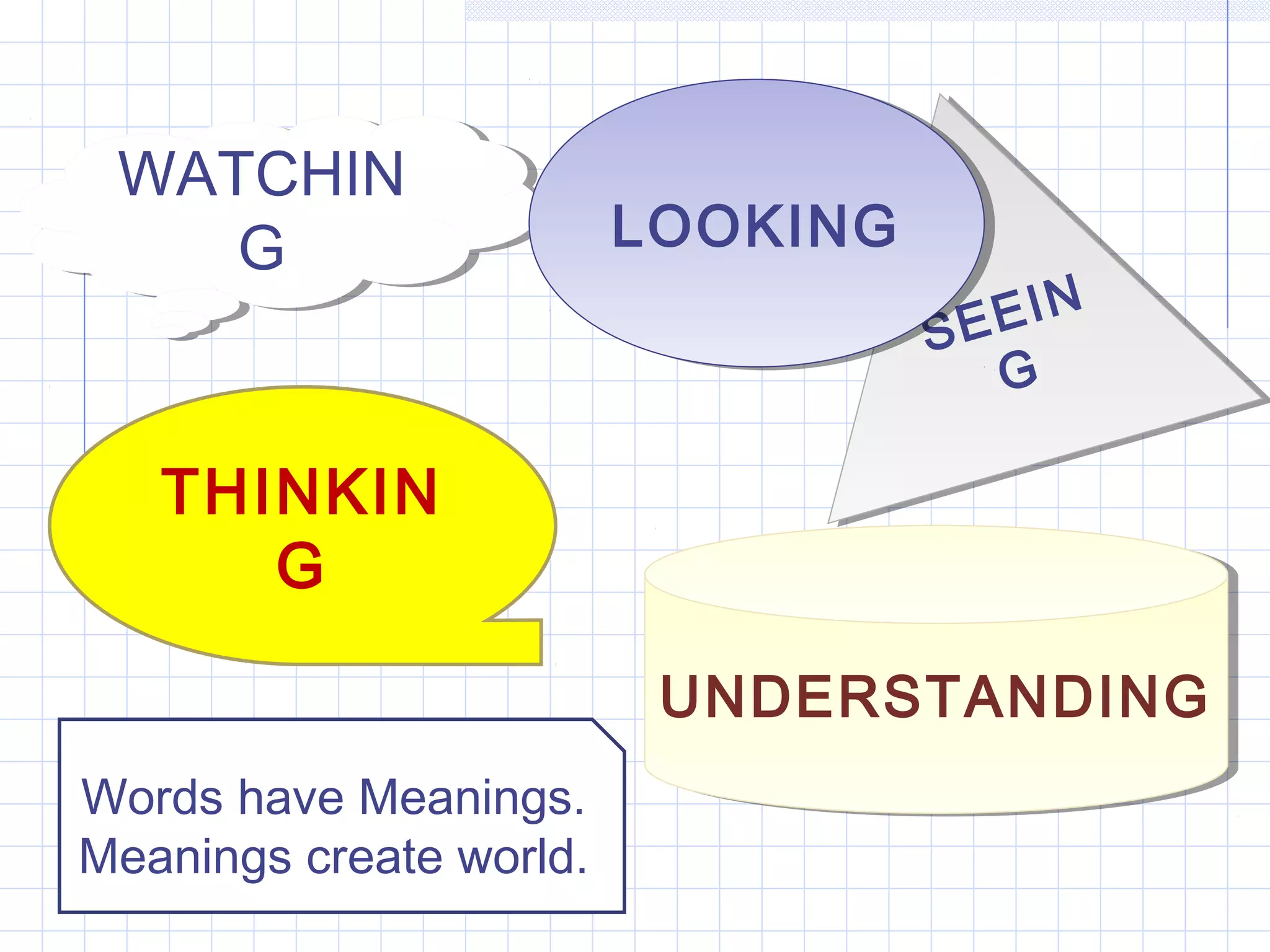
SEEIN
G
SEEIN
G
THINKIN
G
UNDERSTANDINGUNDERSTANDING
Words have Meanings.
Meanings create world.
WATCHIN
G
WATCHIN
G LOOKINGLOOKING
Wonder is not that mankind
comprehends
the world, but that the world
Is comprehensible.
Einstein
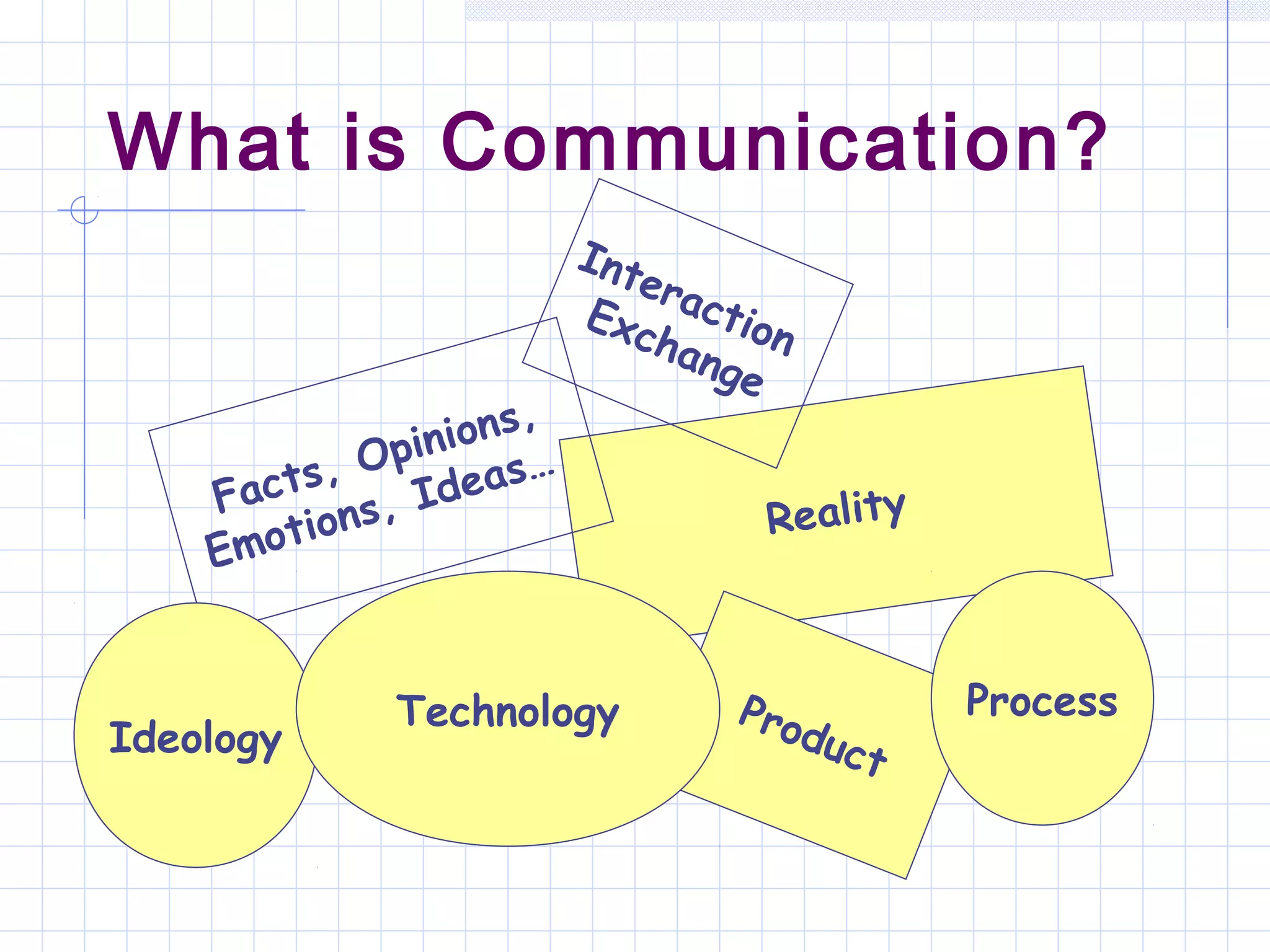
What is Communication?
Reality
Product
Facts, Opinions,
Emotions, Ideas…
Ideology
Technology Process
Interaction
Exchange
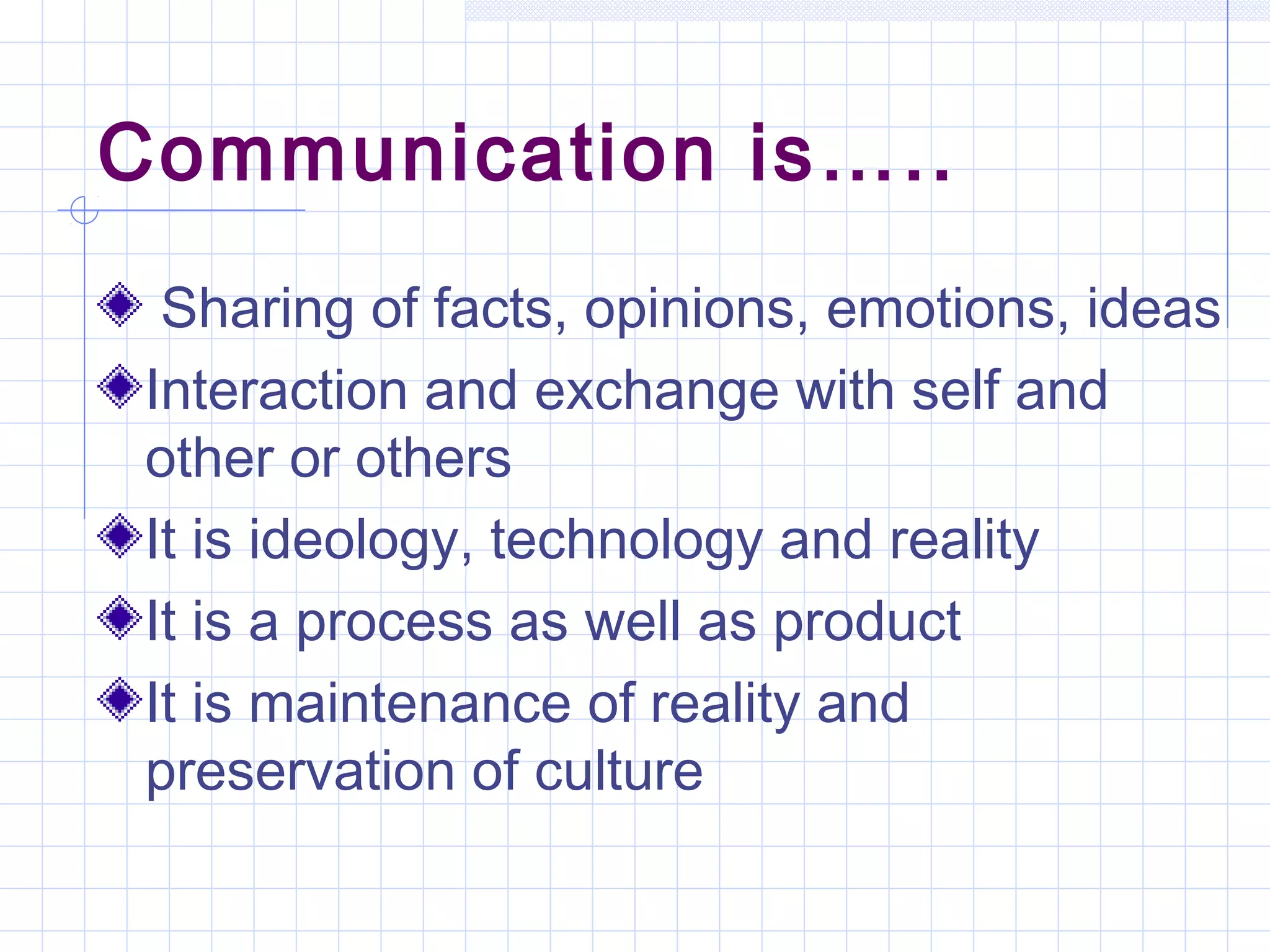
Communication is…..
Sharing of facts, opinions, emotions, ideas
Interaction and exchange with self and
other or others
It is ideology, technology and reality
It is a process as well as product
It is maintenance of reality and
preservation of culture
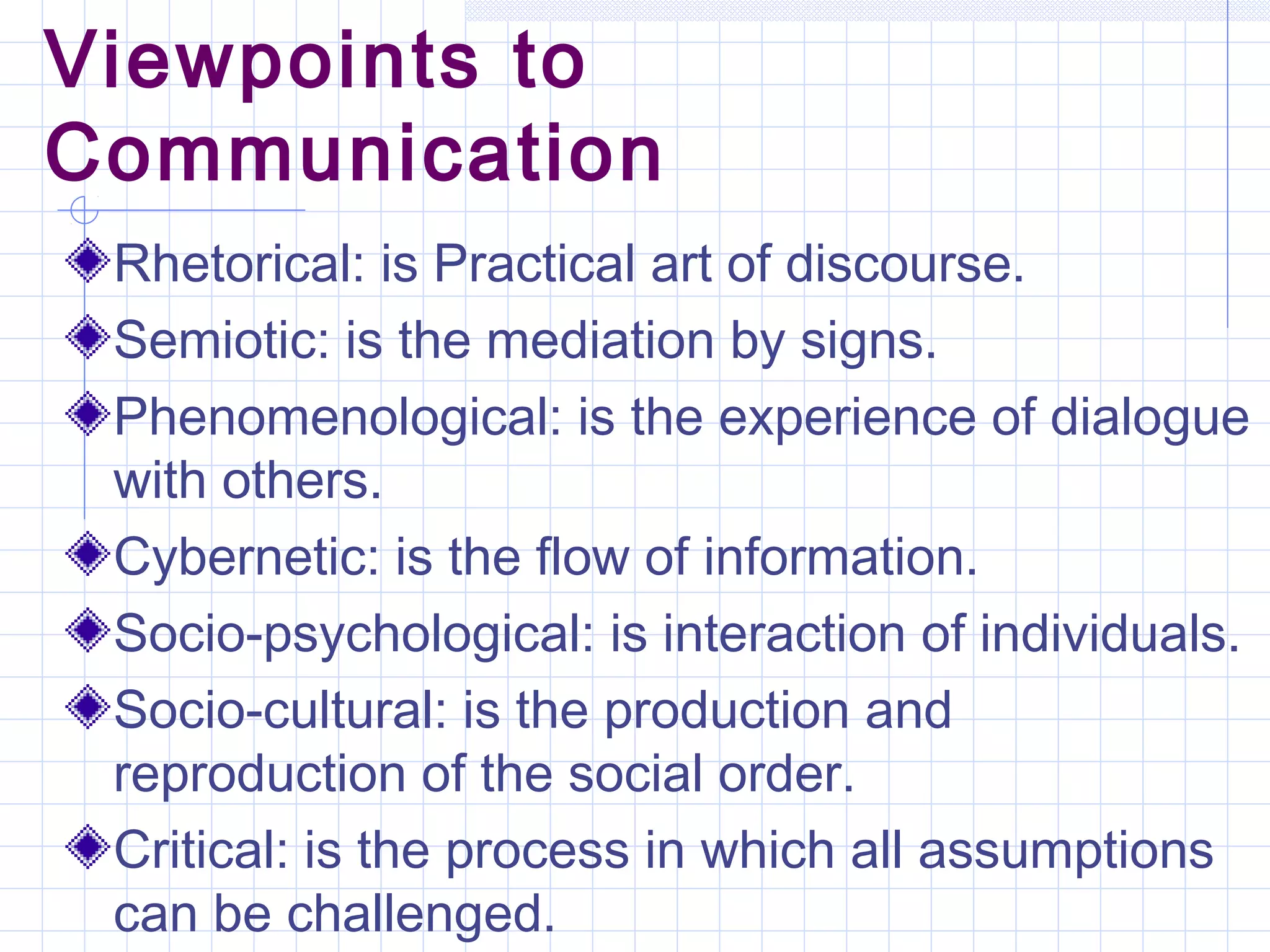
Viewpoints to
Communication
Rhetorical: is Practical art of discourse.
Semiotic: is the mediation by signs.
Phenomenological: is the experience of dialogue
with others.
Cybernetic: is the flow of information.
Socio-psychological: is interaction of individuals.
Socio-cultural: is the production and
reproduction of the social order.
Critical: is the process in which all assumptions
can be challenged.
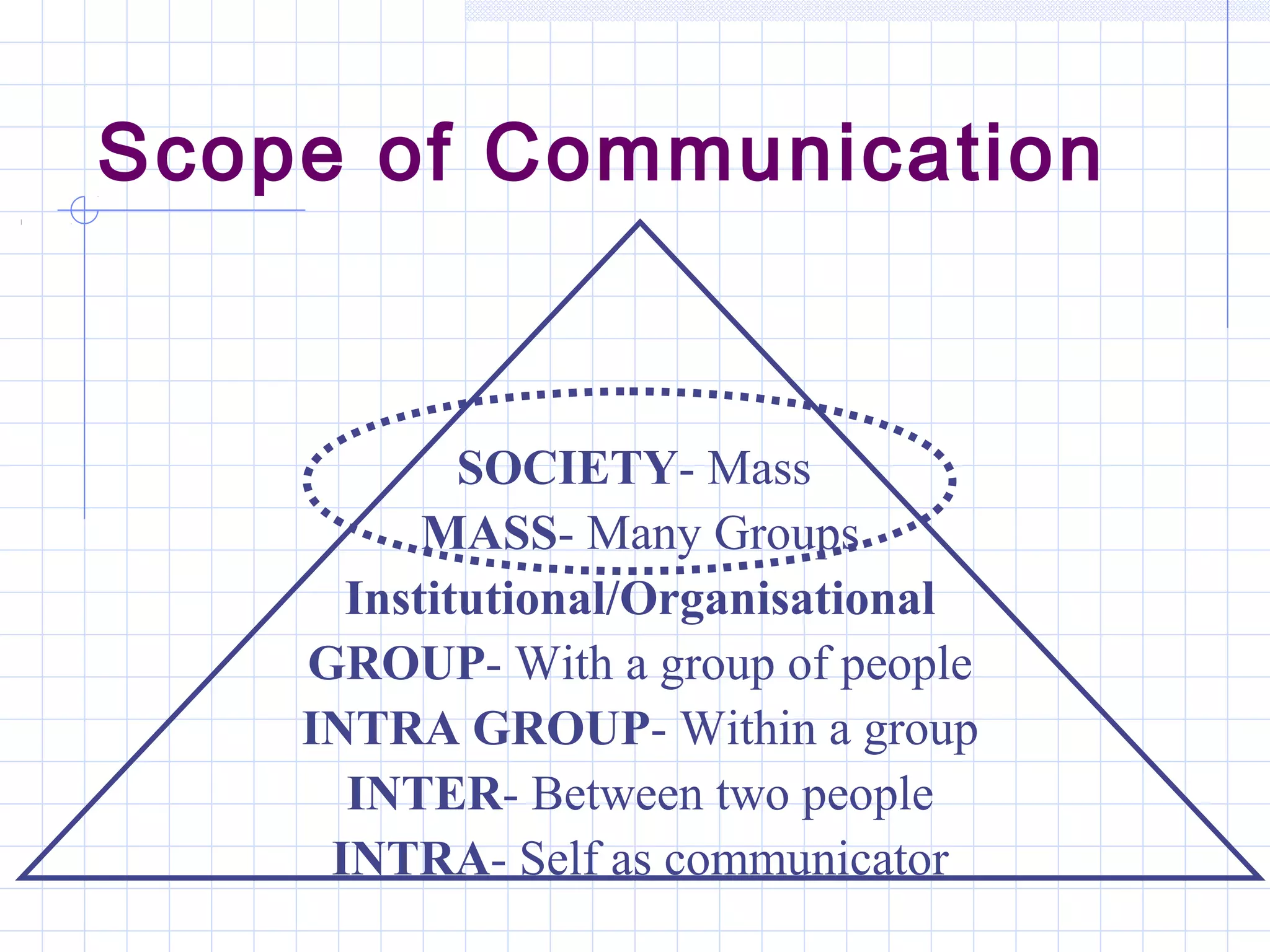
Scope of Communication
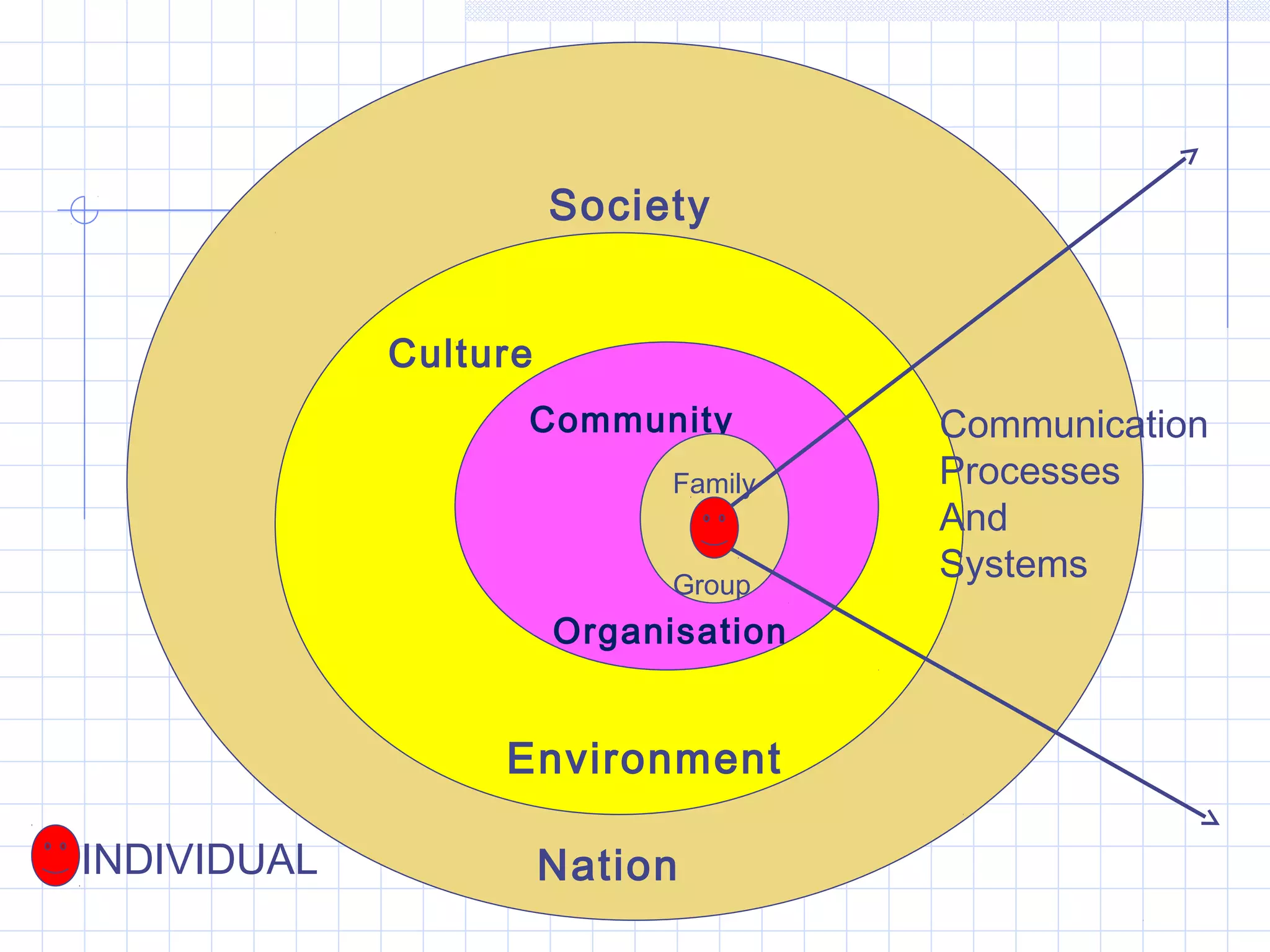
SOCIETY- Mass
MASS- Many Groups
Institutional/Organisational
GROUP- With a group of people
INTRA GROUP- Within a group
INTER- Between two people
INTRA- Self as communicator
Society
Nation
Culture
Environment
Community
Organisation
Family
Group
INDIVIDUAL
Communication
Processes
And
Systems
Scope of Communication
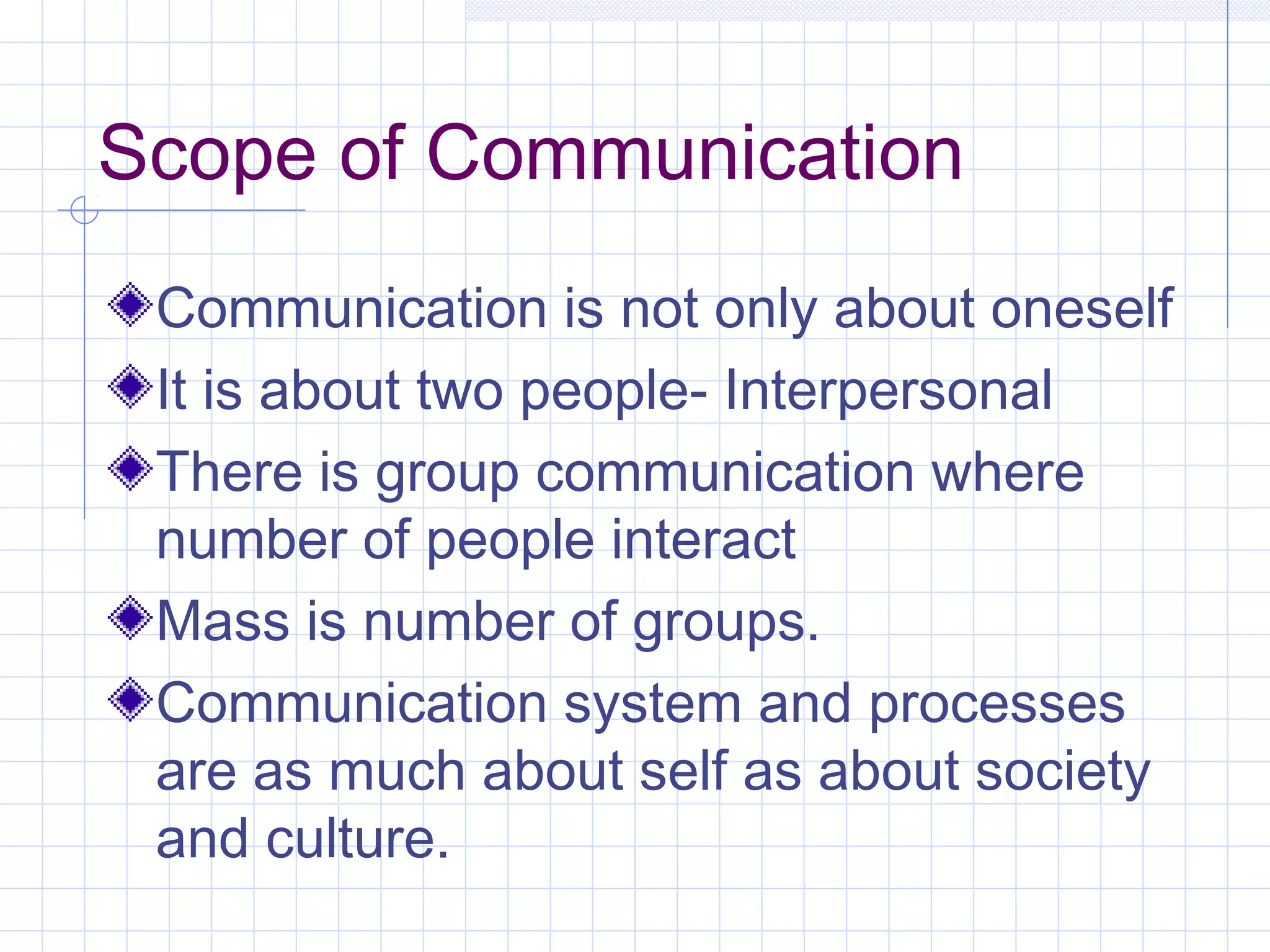
Communication is not only about oneself
It is about two people- Interpersonal
There is group communication where
number of people interact
Mass is number of groups.
Communication system and processes
are as much about self as about society
and culture.
Elements of
Communication
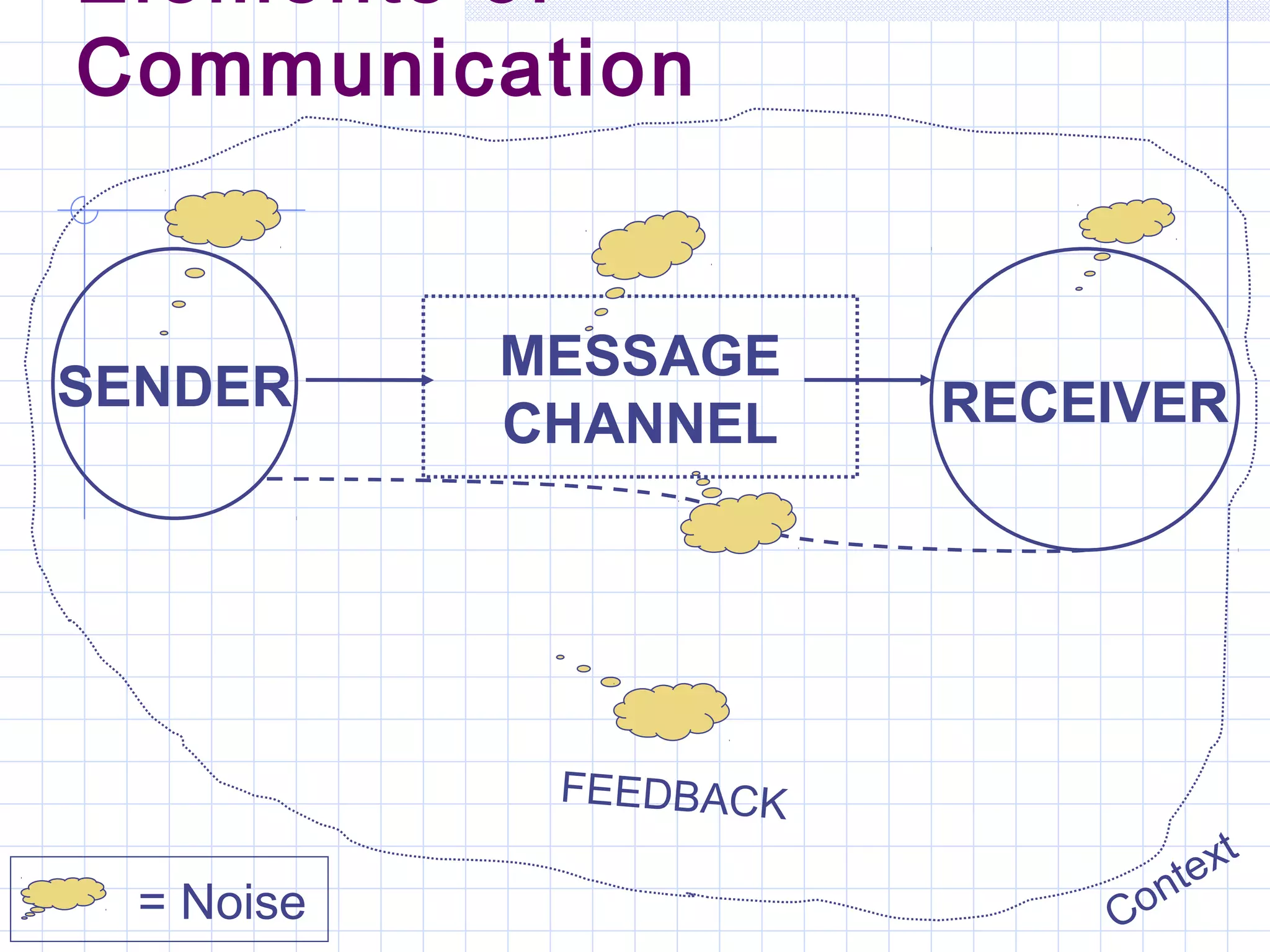
= Noise
SENDER RECEIVER
MESSAGE
CHANNEL
FEEDBACK
Context
Types of Communication
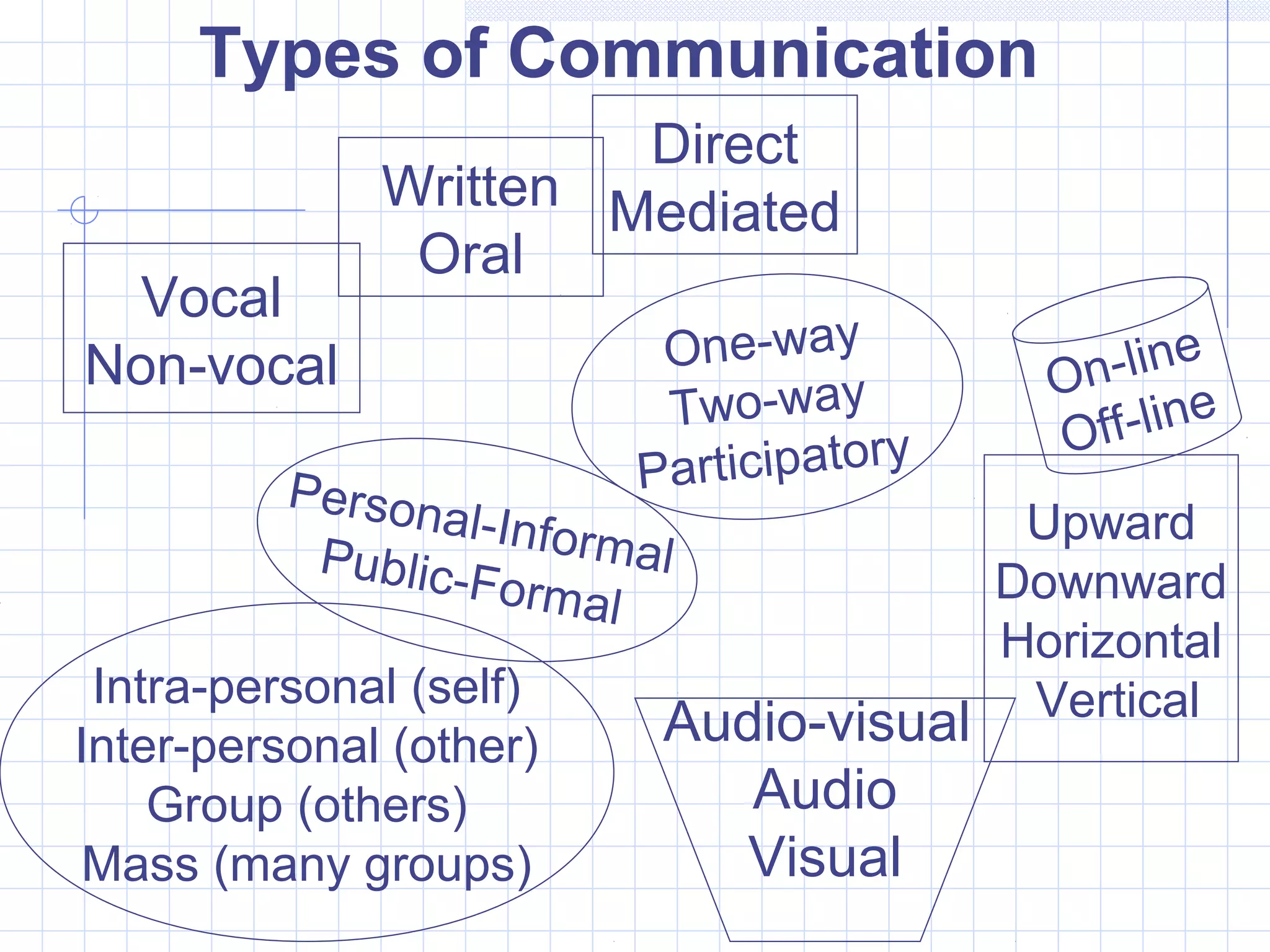
Intra-personal (self)
Inter-personal (other)
Group (others)
Mass (many groups)
Personal-InformalPublic-Formal
Vocal
Non-vocal
Written
Oral
Direct
Mediated
On-line
Off-line
Audio-visual
Audio
Visual
One-way
Two-way
Participatory
Upward
Downward
Horizontal
Vertical
Functions of Communication
Information
Instruction
Entertainment
Persuasion
Debate and discussion
Cultural promotion
Integration
Communication
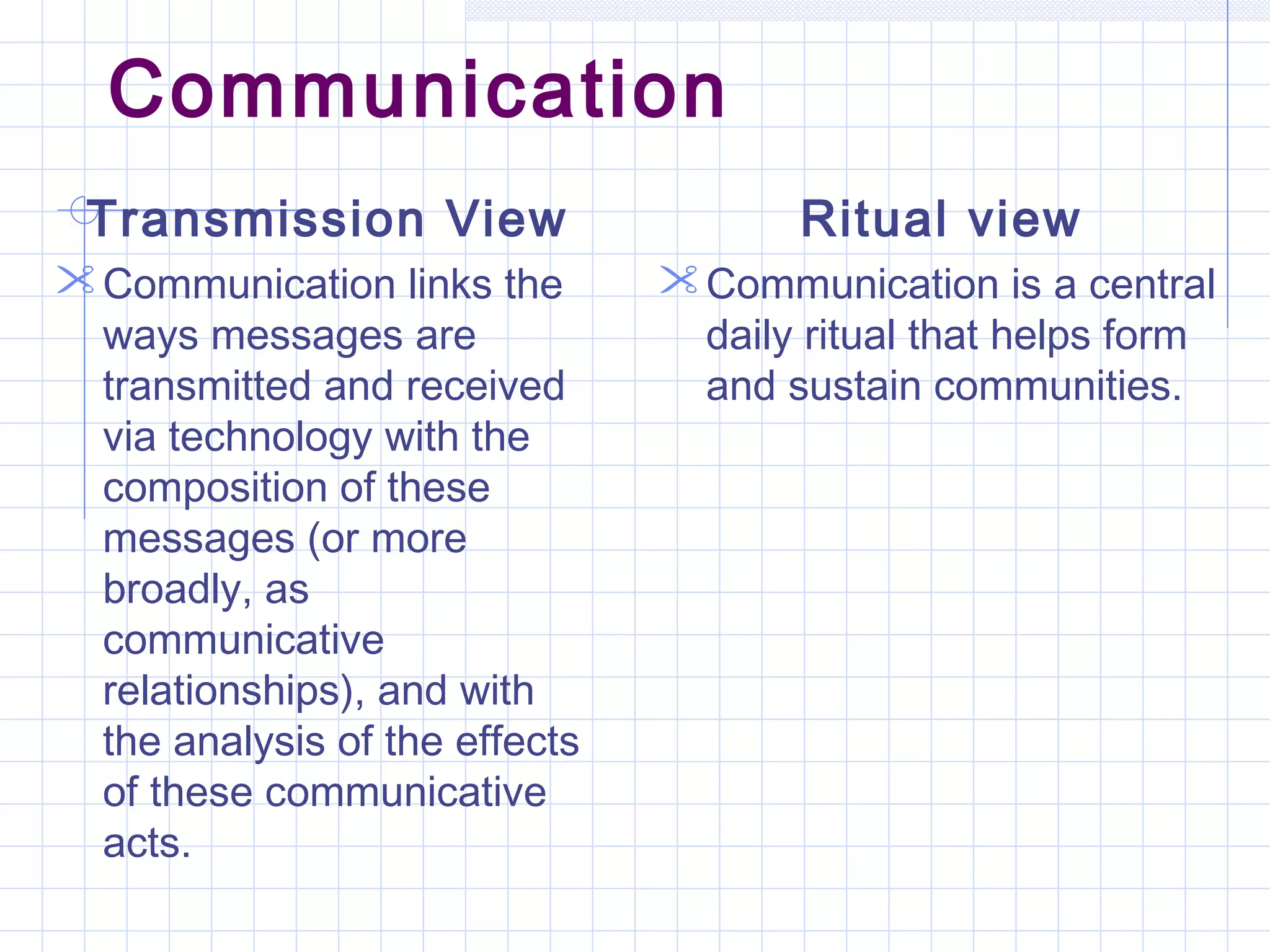
Transmission View
Communication links the
ways messages are
transmitted and received
via technology with the
composition of these
messages (or more
broadly, as
communicative
relationships), and with
the analysis of the effects
of these communicative
acts.
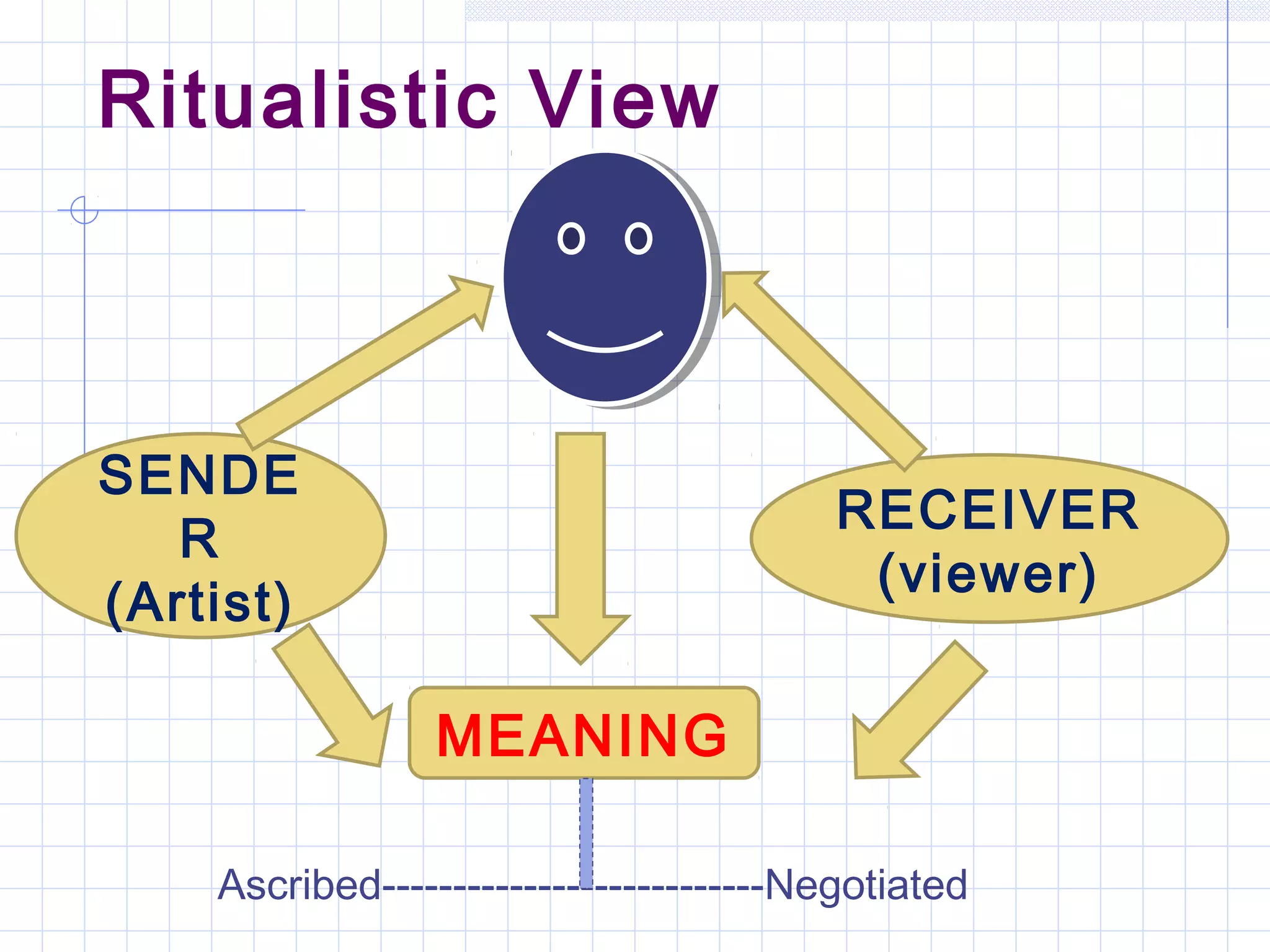
Ritual view
Communication is a central
daily ritual that helps form
and sustain communities.
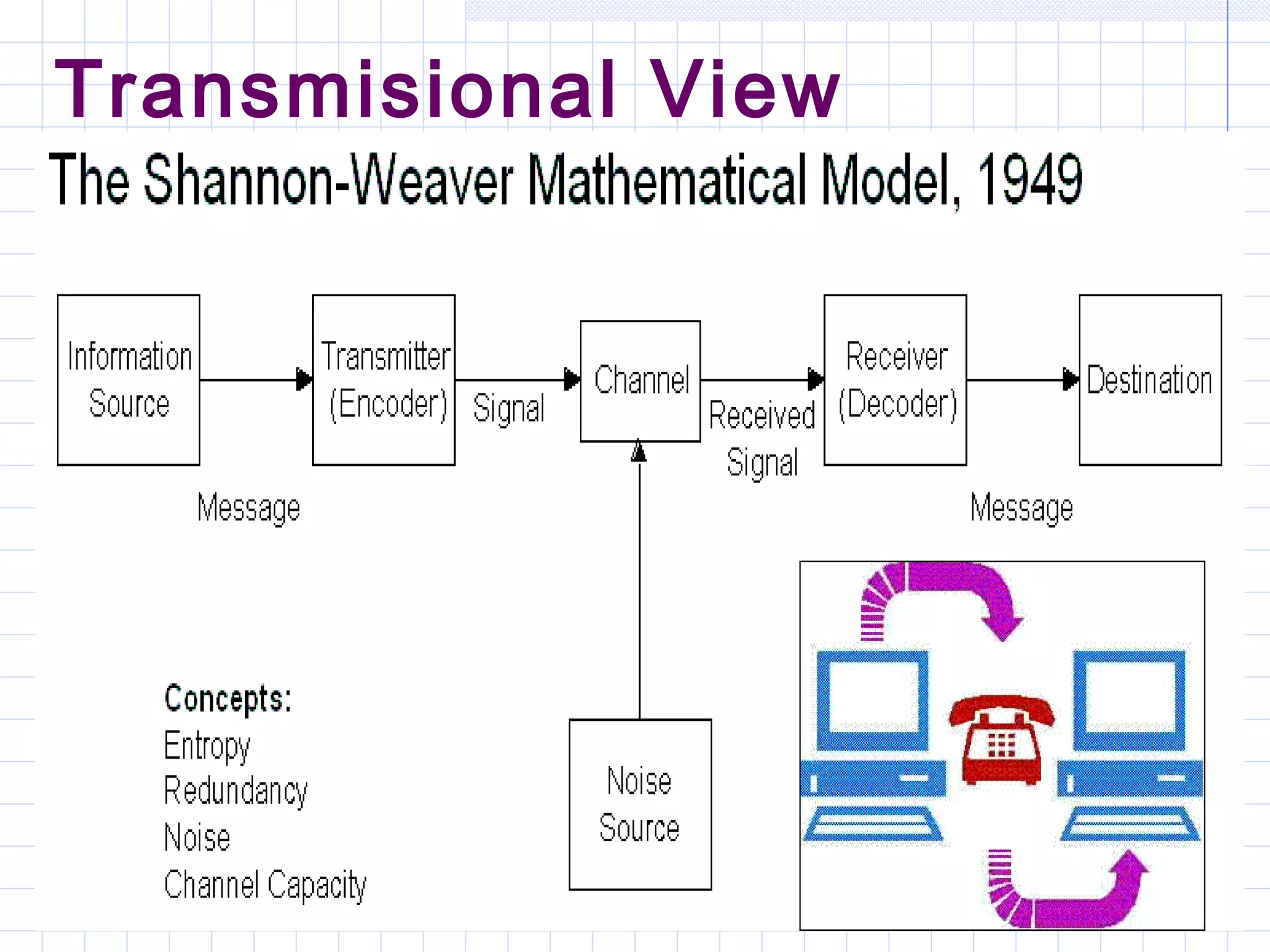
Transmisional View
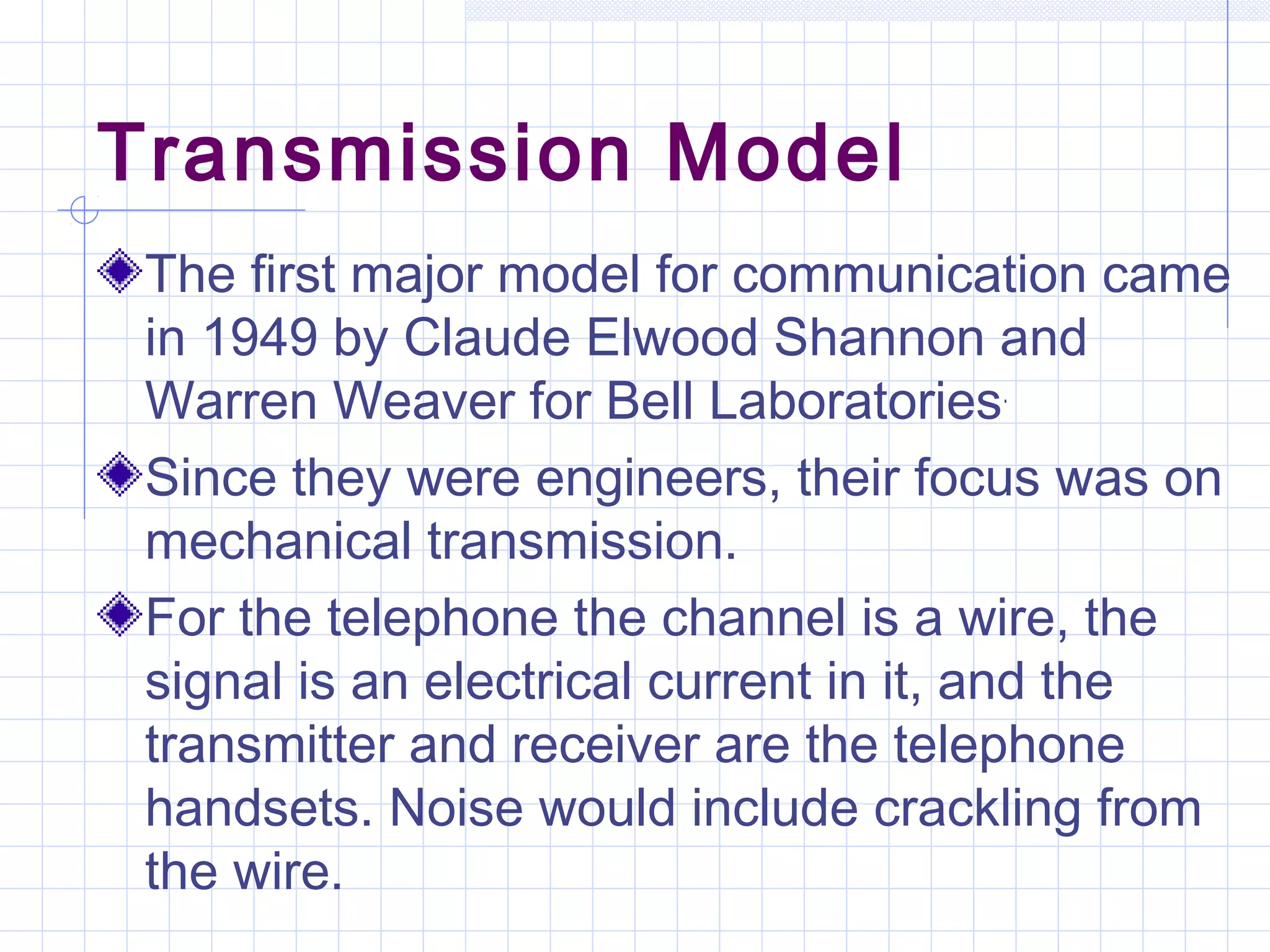
Transmission Model
The first major model for communication came
in 1949 by Claude Elwood Shannon and
Warren Weaver for Bell Laboratories.
Since they were engineers, their focus was on
mechanical transmission.
For the telephone the channel is a wire, the
signal is an electrical current in it, and the
transmitter and receiver are the telephone
handsets. Noise would include crackling from
the wire.
Ritualistic View
SENDE
R
(Artist)
RECEIVER
(viewer)
MEANING
Ascribed---------------------------Negotiated
Communication as
Culture
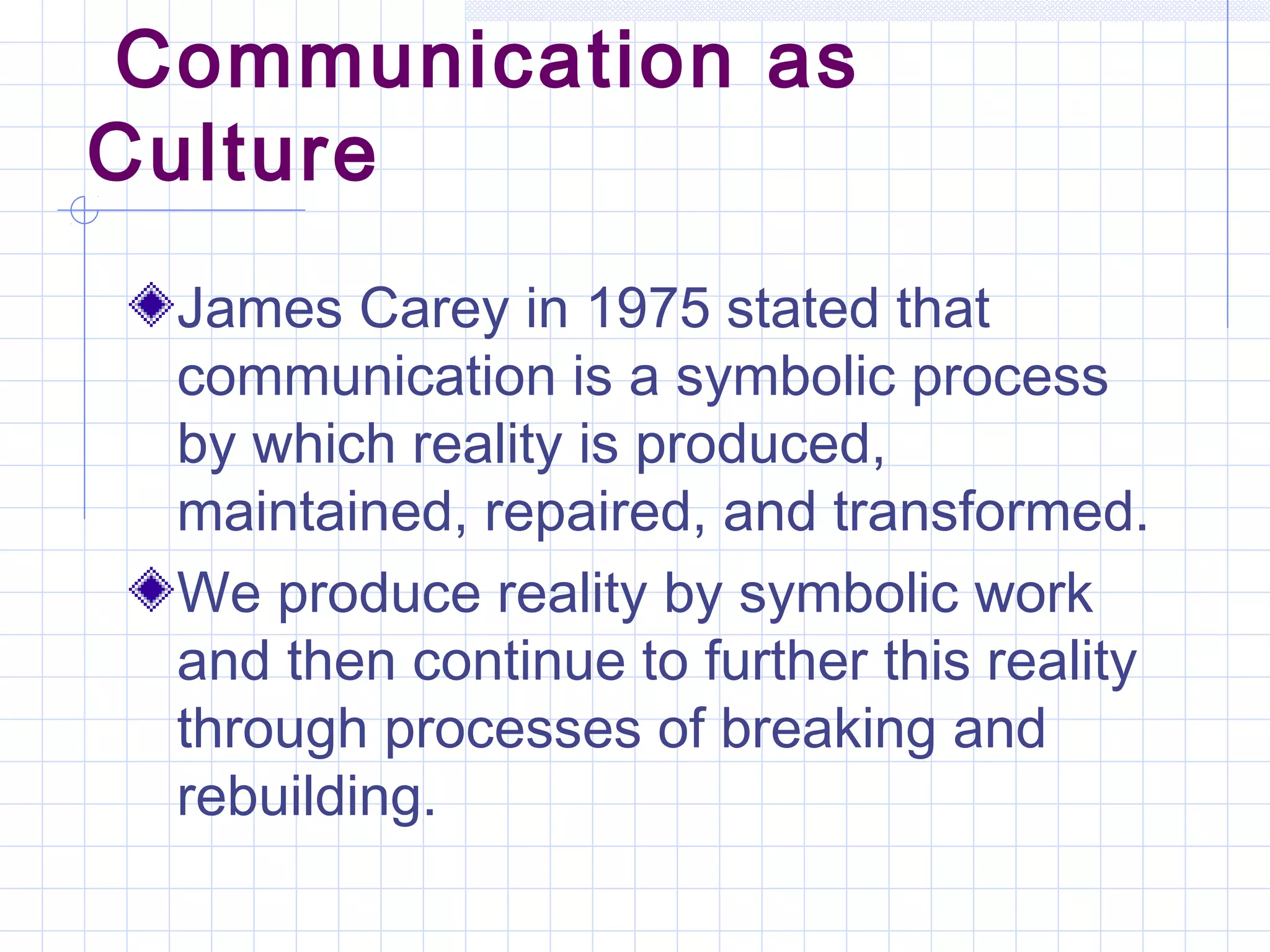
James Carey in 1975 stated that
communication is a symbolic process
by which reality is produced,
maintained, repaired, and transformed.
We produce reality by symbolic work
and then continue to further this reality
through processes of breaking and
rebuilding.
Approaches to
Communication
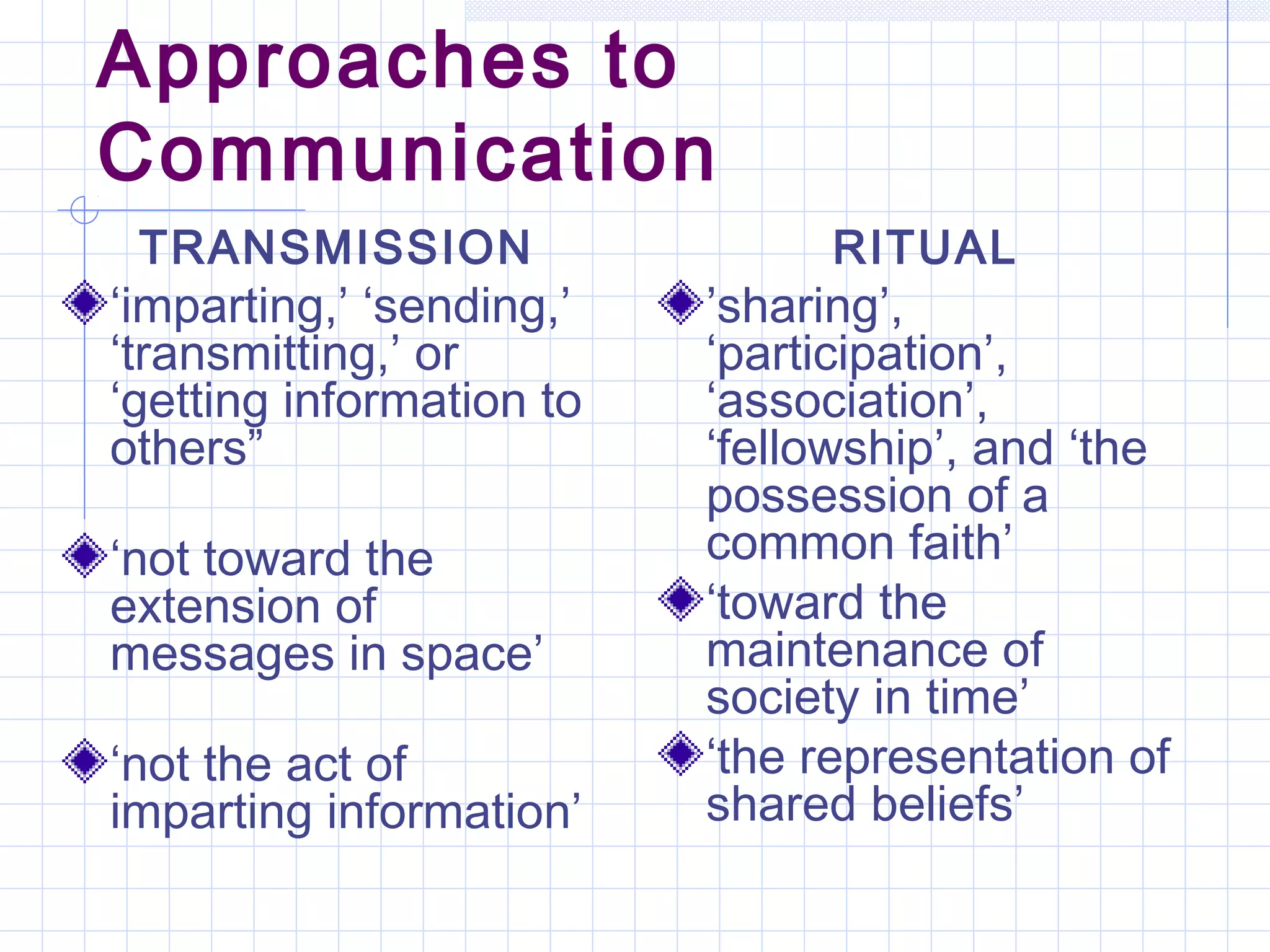
TRANSMISSION
‘imparting,’ ‘sending,’
‘transmitting,’ or
‘getting information to
others”
‘not toward the
extension of
messages in space’
‘not the act of
imparting information’
RITUAL
’sharing’,
‘participation’,
‘association’,
‘fellowship’, and ‘the
possession of a
common faith’
‘toward the
maintenance of
society in time’
‘the representation of
shared beliefs’
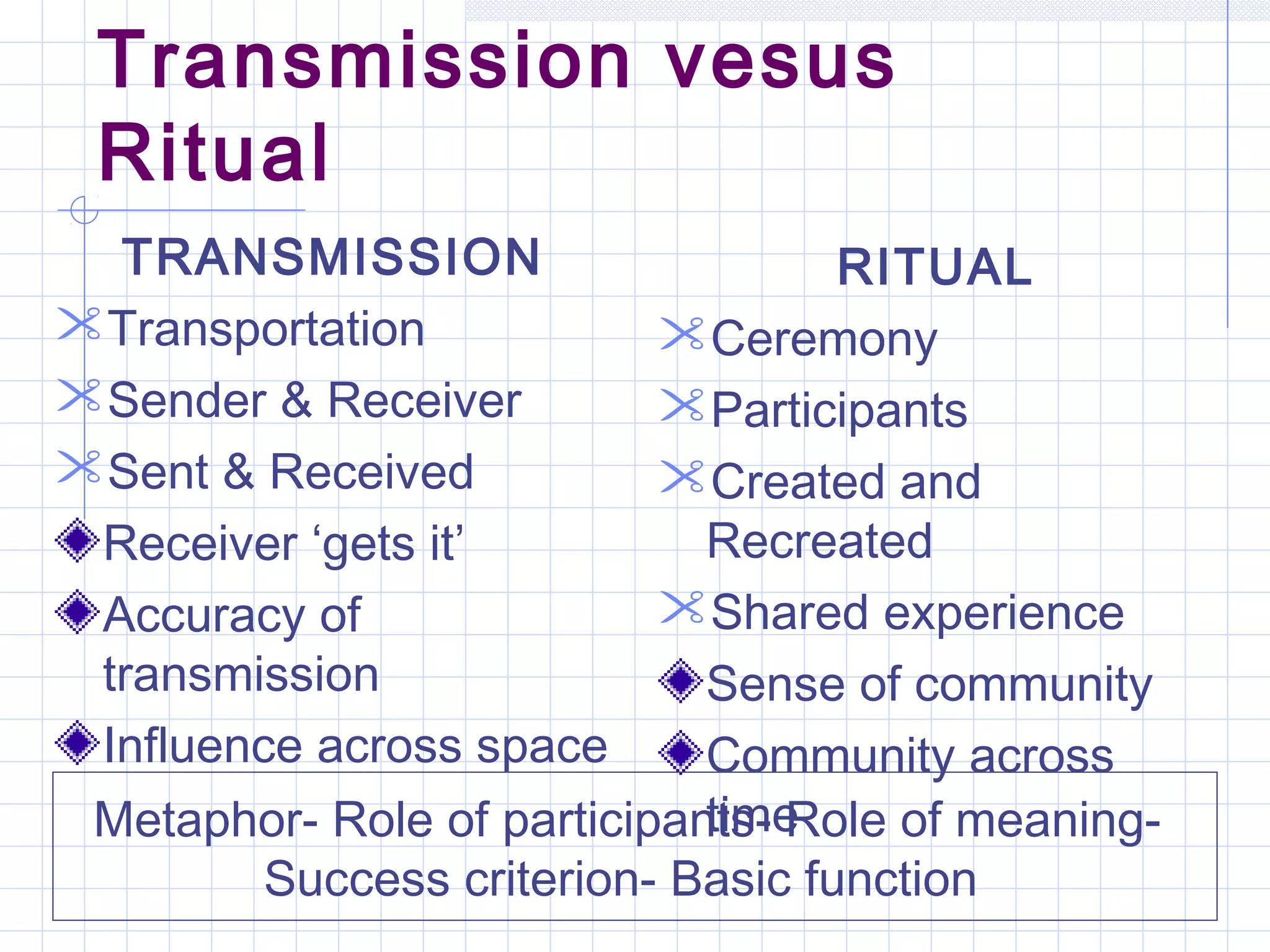
Transmission vesus
Ritual
TRANSMISSION
Transportation
Sender & Receiver
Sent & Received
Receiver ‘gets it’
Accuracy of
transmission
Influence across space
RITUAL
Ceremony
Participants
Created and
Recreated
Shared experience
Sense of community
Community across
timeMetaphor- Role of participants- Role of meaning-
Success criterion- Basic function
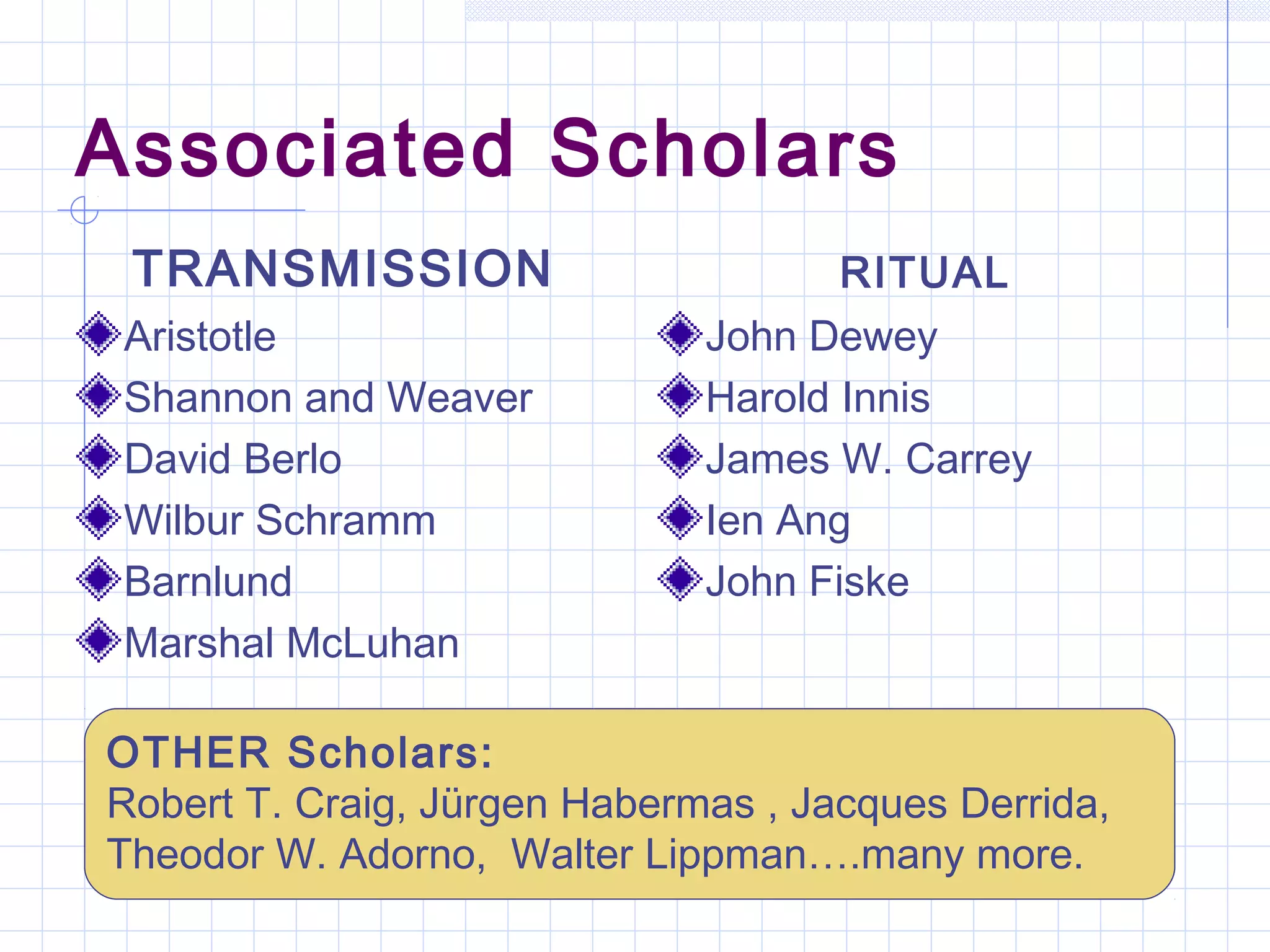
Associated Scholars
TRANSMISSION
Aristotle
Shannon and Weaver
David Berlo
Wilbur Schramm
Barnlund
Marshal McLuhan
RITUAL
John Dewey
Harold Innis
James W. Carrey
Ien Ang
John Fiske
OTHER Scholars:
Robert T. Craig, Jürgen Habermas , Jacques Derrida,
Theodor W. Adorno, Walter Lippman….many more.
SELF & OTHER
in Interpersonal
Communication
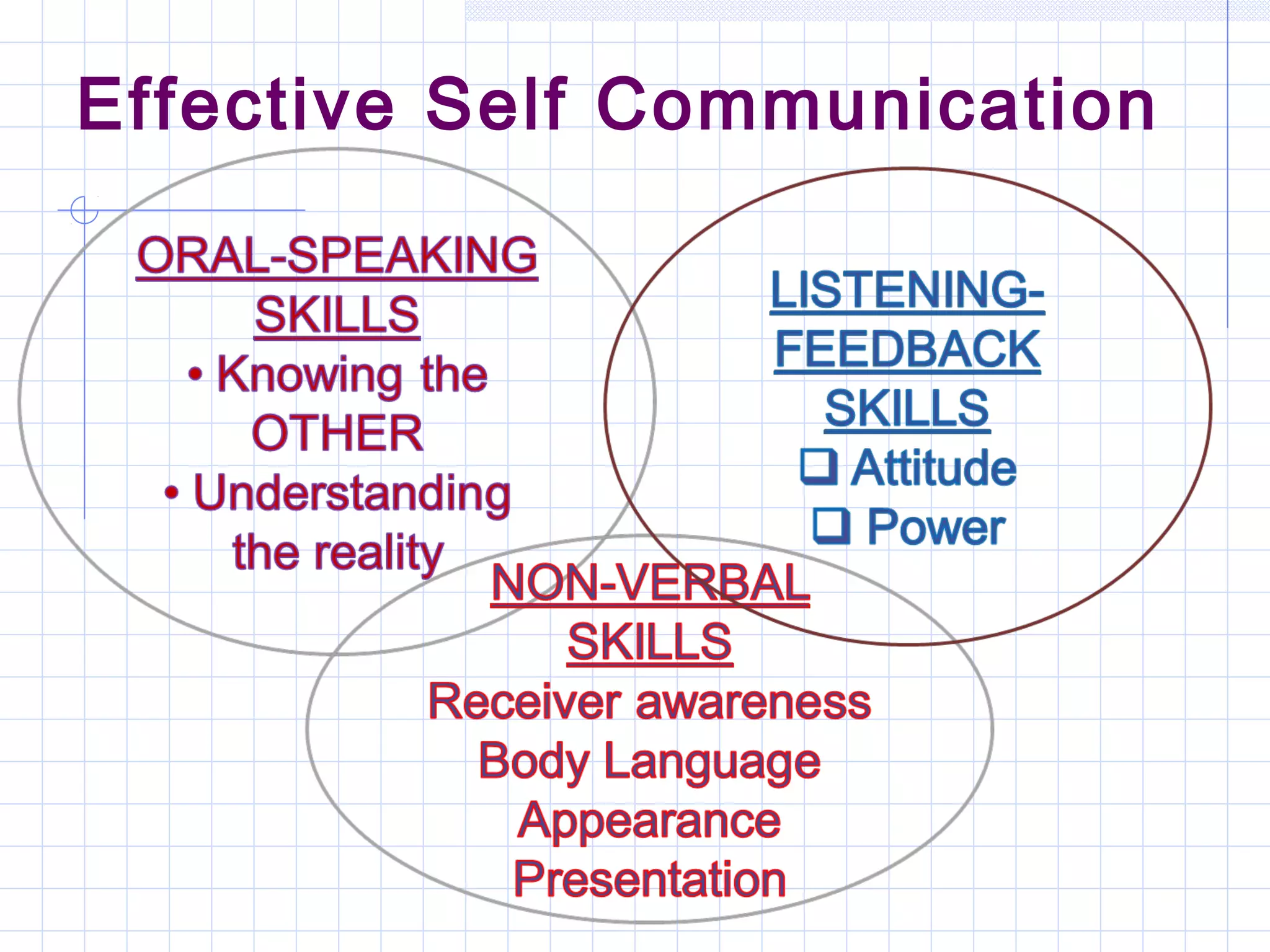
Effective Self Communication
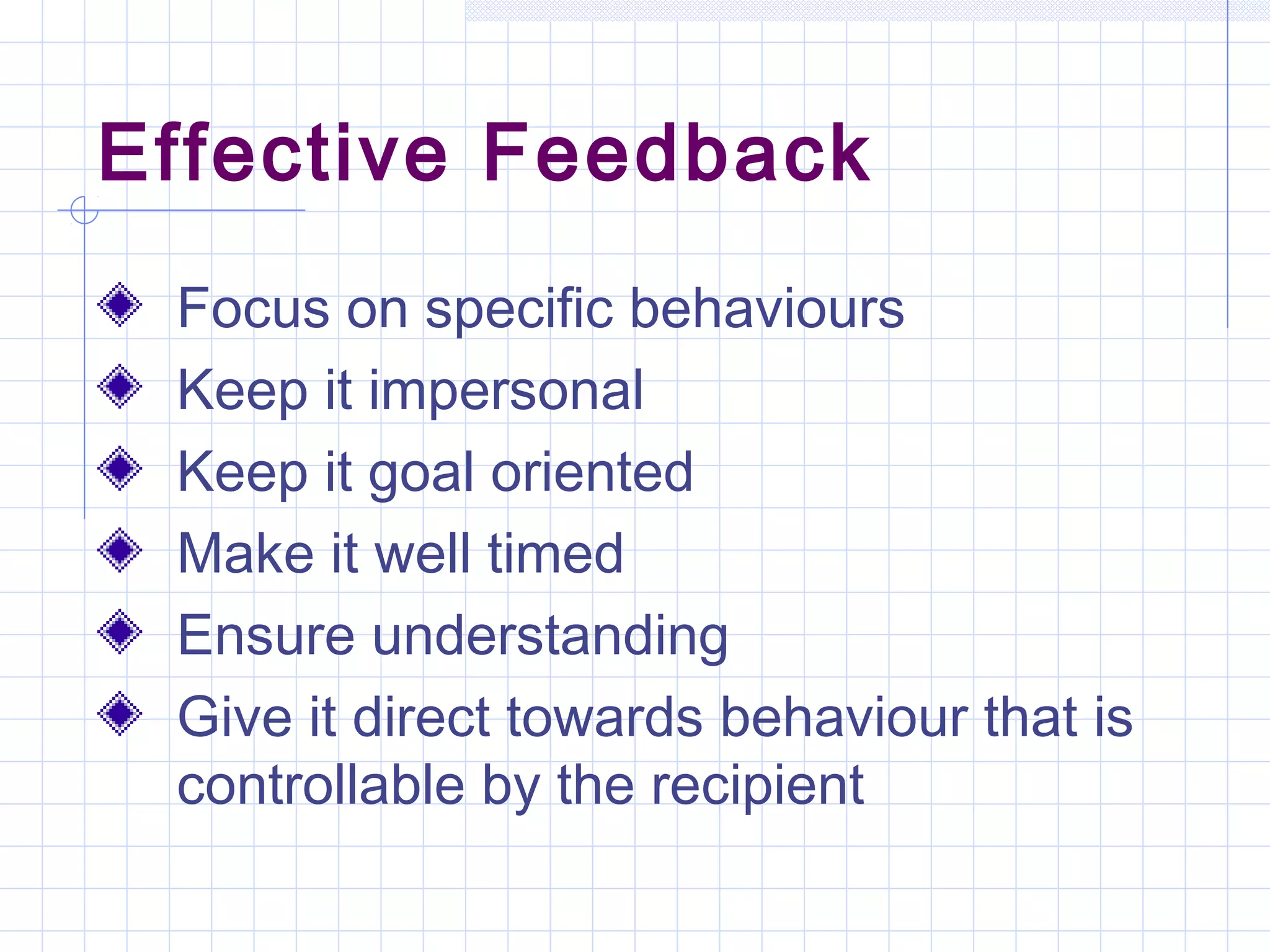
Effective Feedback
Focus on specific behaviours
Keep it impersonal
Keep it goal oriented
Make it well timed
Ensure understanding
Give it direct towards behaviour that is
controllable by the recipient
Process of ‘Listening’
Hearing
Focusing on the message
Comprehending-Understanding-
Interpreting
Analysing and Evaluating
Responding and NOT Reacting
Remembering….remembering….re
membering
Conclusion
We now know that communication is
process as well as product.
Communication is about individual self as
well as society at large.
Transmission school focus on transfer of
information and accuracy of it.
Ritual school focus on cultural and
sociological processes with communication.
Some References:
http://www3.niu.edu/acad/gunkel/coms4
65/carey.html
http://voxygen.net/classes/contemporar
y-public-address/james-carey-
communication-as-culture/
http://counselme.truepath.com/Commun
ic.htm

Understading communication ppt1