Causal Comparative
Research(ex post facto)


    What is it ?
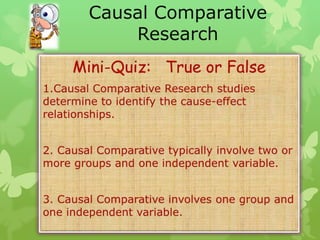
Causal Comparative
              Research
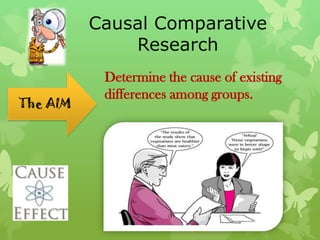
           Determine the cause of existing
           differences among groups.
The AIM
Causal Comparative
              Research
 At least two different groups are
  compared on a dependent variable or
  measure of performance (called the
  “effect”) because the independent
  variable (called the “cause”) has already
  occurred or cannot be manipulated.
 Dependent variable-the change or
  difference occurring as a result of the
  independent variable.
 Independent variable- an activity of
  characteristic believed to make a
  difference with respect to some behavior.
Causal Comparative
               Research
 The researcher attempts to determine the
  cause, or reason, for pre existing differences
  in groups of individuals.
 Attempts to identify cause and effect
  relationships.
 Involve two or more group variables.
 Involve making comparison.
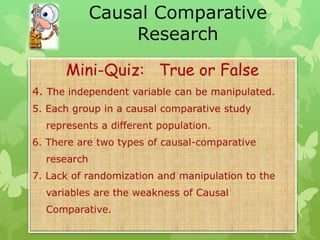
 Individuals are not randomly selected and
  assigned to two or more groups.
 Cannot manipulate the independent variable
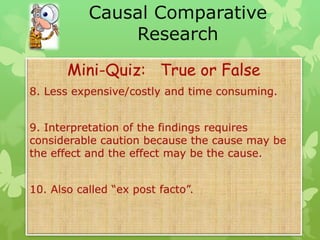
 Less costly and time consuming
Causal Comparative
                       Research


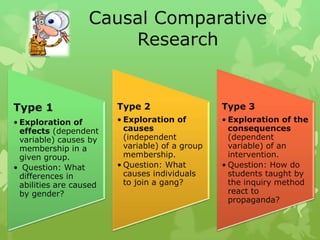
Type 1                   Type 2                   Type 3
• Exploration of         • Exploration of         • Exploration of the
  effects (dependent       causes                   consequences
  variable) causes by      (independent             (dependent
  membership in a          variable) of a group     variable) of an
  given group.             membership.              intervention.
• Question: What         • Question: What         • Question: How do
  differences in           causes individuals       students taught by
  abilities are caused     to join a gang?          the inquiry method
  by gender?                                        react to
                                                    propaganda?
Causal Comparative
            Research


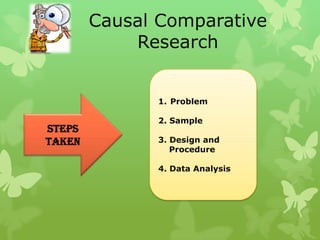
               1. Problem

               2. Sample
STEPS
Taken          3. Design and
                  Procedure

               4. Data Analysis
Causal Comparative
                         Research
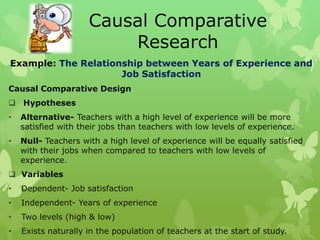
Example: The Relationship between Years of Experience and
                     Job Satisfaction
Causal Comparative Design
 Hypotheses
•   Alternative- Teachers with a high level of experience will be more
    satisfied with their jobs than teachers with low levels of experience.
•   Null- Teachers with a high level of experience will be equally satisfied
    with their jobs when compared to teachers with low levels of
    experience.
 Variables
•   Dependent- Job satisfaction
•   Independent- Years of experience
•   Two levels (high & low)
•   Exists naturally in the population of teachers at the start of study.
Causal Comparative
                          Research
Example: The Relationship between Years of Experience and
                     Job Satisfaction


Causal Comparative Design (cont.)


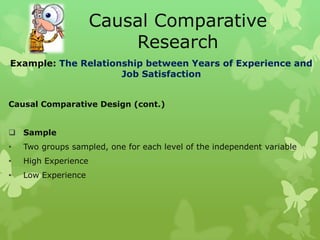
 Sample
•   Two groups sampled, one for each level of the independent variable
•   High Experience
•   Low Experience
Causal Comparative
                         Research
Example: The Relationship between Years of Experience and
                     Job Satisfaction


Causal Comparative Design (cont.)
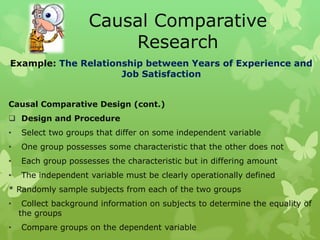
 Design and Procedure
•   Select two groups that differ on some independent variable
•   One group possesses some characteristic that the other does not
•   Each group possesses the characteristic but in differing amount
•   The independent variable must be clearly operationally defined
* Randomly sample subjects from each of the two groups
•    Collect background information on subjects to determine the equality of
    the groups
•   Compare groups on the dependent variable
Causal Comparative
                         Research
    Example: The Relationship between Years of Experience and
                         Job Satisfaction

Causal Comparative Design (cont.)
 Design and Procedure
Control of Extraneous variable
•    What other variable besides years of experience could explain job
    satisfaction among teachers?
•    Matching: Each subject in the high experience group is matched with a
    subject with a low experience group along the variable of class size.
•   Each high experience teacher who teachers a large class is matched
    with a low experience teacher who teaches a large class.
•   Each high experience teacher who teaches a small class is matched
    with a low experience teacher who teaches a small class.
Causal Comparative
                        Research
Example: The Relationship between Years of Experience and
                     Job Satisfaction


Causal Comparative Design (cont.)
 Data Analysis
•    Mean- job satisfaction ratings for High Experience and Low Experience
    subjects are compared using t-test, ANOVA or other appropriate
    statistical test.
• Rejection of the null hypothesis supports the alternative hypothesis that
  years of experience result in increased job satisfaction.
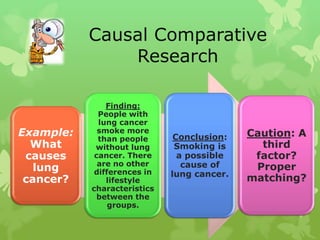
Causal Comparative
               Research

               Finding:
             People with
             lung cancer
Example:     smoke more
                              Conclusion:   Caution: A
             than people
  What      without lung      Smoking is      third
 causes     cancer. There      a possible    factor?
             are no other       cause of
   lung     differences in
                                             Proper
                             lung cancer.
 cancer?       lifestyle                    matching?
           characteristics
             between the
                groups.
Causal Comparative
              Research
        More Examples of Causal
         Comparative Research

• A researcher measured the mathematical
  reasoning ability of young children who
  had enrolled in Montessori schools and
  compared the scores with a group of
  similar children who had not been to
  Montessori schools.
• A researcher measured the frequency of
  students’ misbehavior at schools which
  use corporal punishment and compared
  that to schools which did not use corporal
  punishment.
Causal Comparative
    Research
Causal Comparative
    Research
Causal Comparative
    Research
Causal Comparative
    Research

Causal comparative research ckv

  • 1.
  • 2.
    Causal Comparative Research Determine the cause of existing differences among groups. The AIM
  • 3.
    Causal Comparative Research  At least two different groups are compared on a dependent variable or measure of performance (called the “effect”) because the independent variable (called the “cause”) has already occurred or cannot be manipulated.  Dependent variable-the change or difference occurring as a result of the independent variable.  Independent variable- an activity of characteristic believed to make a difference with respect to some behavior.
  • 4.
    Causal Comparative Research  The researcher attempts to determine the cause, or reason, for pre existing differences in groups of individuals.  Attempts to identify cause and effect relationships.  Involve two or more group variables.  Involve making comparison.  Individuals are not randomly selected and assigned to two or more groups.  Cannot manipulate the independent variable  Less costly and time consuming
  • 5.
    Causal Comparative Research Type 1 Type 2 Type 3 • Exploration of • Exploration of • Exploration of the effects (dependent causes consequences variable) causes by (independent (dependent membership in a variable) of a group variable) of an given group. membership. intervention. • Question: What • Question: What • Question: How do differences in causes individuals students taught by abilities are caused to join a gang? the inquiry method by gender? react to propaganda?
  • 6.
    Causal Comparative Research 1. Problem 2. Sample STEPS Taken 3. Design and Procedure 4. Data Analysis
  • 7.
    Causal Comparative Research Example: The Relationship between Years of Experience and Job Satisfaction Causal Comparative Design  Hypotheses • Alternative- Teachers with a high level of experience will be more satisfied with their jobs than teachers with low levels of experience. • Null- Teachers with a high level of experience will be equally satisfied with their jobs when compared to teachers with low levels of experience.  Variables • Dependent- Job satisfaction • Independent- Years of experience • Two levels (high & low) • Exists naturally in the population of teachers at the start of study.
  • 8.
    Causal Comparative Research Example: The Relationship between Years of Experience and Job Satisfaction Causal Comparative Design (cont.)  Sample • Two groups sampled, one for each level of the independent variable • High Experience • Low Experience
  • 9.
    Causal Comparative Research Example: The Relationship between Years of Experience and Job Satisfaction Causal Comparative Design (cont.)  Design and Procedure • Select two groups that differ on some independent variable • One group possesses some characteristic that the other does not • Each group possesses the characteristic but in differing amount • The independent variable must be clearly operationally defined * Randomly sample subjects from each of the two groups • Collect background information on subjects to determine the equality of the groups • Compare groups on the dependent variable
  • 10.
    Causal Comparative Research Example: The Relationship between Years of Experience and Job Satisfaction Causal Comparative Design (cont.)  Design and Procedure Control of Extraneous variable • What other variable besides years of experience could explain job satisfaction among teachers? • Matching: Each subject in the high experience group is matched with a subject with a low experience group along the variable of class size. • Each high experience teacher who teachers a large class is matched with a low experience teacher who teaches a large class. • Each high experience teacher who teaches a small class is matched with a low experience teacher who teaches a small class.
  • 11.
    Causal Comparative Research Example: The Relationship between Years of Experience and Job Satisfaction Causal Comparative Design (cont.)  Data Analysis • Mean- job satisfaction ratings for High Experience and Low Experience subjects are compared using t-test, ANOVA or other appropriate statistical test. • Rejection of the null hypothesis supports the alternative hypothesis that years of experience result in increased job satisfaction.
  • 12.
    Causal Comparative Research Finding: People with lung cancer Example: smoke more Conclusion: Caution: A than people What without lung Smoking is third causes cancer. There a possible factor? are no other cause of lung differences in Proper lung cancer. cancer? lifestyle matching? characteristics between the groups.
  • 13.
    Causal Comparative Research More Examples of Causal Comparative Research • A researcher measured the mathematical reasoning ability of young children who had enrolled in Montessori schools and compared the scores with a group of similar children who had not been to Montessori schools. • A researcher measured the frequency of students’ misbehavior at schools which use corporal punishment and compared that to schools which did not use corporal punishment.
  • 14.
  • 15.
  • 16.
  • 17.