McGraw-Hill © 2006 The McGraw-Hill Companies, Inc. All rights reserved.
Causal-ComparativeCausal-Comparative
ResearchResearch
Chapter SixteenChapter Sixteen
McGraw-Hill © 2006 The McGraw-Hill Companies, Inc. All rights reserved.
Causal-Comparative ResearchCausal-Comparative Research
Chapter SixteenChapter Sixteen
McGraw-Hill © 2006 The McGraw-Hill Companies, Inc. All rights reserved.
What is Causal-ComparativeWhat is Causal-Comparative
Research?Research?
 Investigators attempt to determine the cause of differences thatInvestigators attempt to determine the cause of differences that
already exist between or among groups of individuals.already exist between or among groups of individuals.
 This is viewed as a form of Associative Research since bothThis is viewed as a form of Associative Research since both
describe conditions that already exist (a.k.a. ex post facto).describe conditions that already exist (a.k.a. ex post facto).
 The group difference variable is either a variable that cannot beThe group difference variable is either a variable that cannot be
manipulated or one that might have been manipulated but for onemanipulated or one that might have been manipulated but for one
reason or another, has not been.reason or another, has not been.
 Studies in medicine and sociology are causal-comparative inStudies in medicine and sociology are causal-comparative in
nature, as are studies of differences between men and women.nature, as are studies of differences between men and women.
McGraw-Hill © 2006 The McGraw-Hill Companies, Inc. All rights reserved.
Similarities and Differences BetweenSimilarities and Differences Between
Causal-Comparative andCausal-Comparative and
Correlational ResearchCorrelational Research
 SimilaritiesSimilarities
 Associative researchAssociative research
 Attempt to explainAttempt to explain
phenomena of interestphenomena of interest
 Seek to identify variablesSeek to identify variables
that are worthy of laterthat are worthy of later
exploration throughexploration through
experimental researchexperimental research
 Neither permits theNeither permits the
manipulation of variablesmanipulation of variables
 Attempt to exploreAttempt to explore
causationcausation
 DifferencesDifferences
 Causal studies compareCausal studies compare
two or more groups oftwo or more groups of
subjectssubjects
 Causal studies involve atCausal studies involve at
least one categoricalleast one categorical
variablevariable
 Causal studies oftenCausal studies often
compare averages or usecompare averages or use
crossbreak tables insteadcrossbreak tables instead
of scatterplots andof scatterplots and
correlations coefficientscorrelations coefficients
McGraw-Hill © 2006 The McGraw-Hill Companies, Inc. All rights reserved.
Similarities and Differences BetweenSimilarities and Differences Between
Causal-Comparative and ExperimentalCausal-Comparative and Experimental
ResearchResearch
 SimilaritiesSimilarities
 Require at least oneRequire at least one
categorical variablecategorical variable
 Both compare groupBoth compare group
performances to determineperformances to determine
relationshipsrelationships
 Both compare separateBoth compare separate
groups of subjectsgroups of subjects
 DifferencesDifferences
 In experimental research,In experimental research,
the independent variable isthe independent variable is
manipulatedmanipulated
 Causal studies are likely toCausal studies are likely to
provide much weakerprovide much weaker
evidence for causationevidence for causation
 In experimental studies,In experimental studies,
researchers can assignresearchers can assign
subjects to treatmentsubjects to treatment
groupsgroups
 The researcher has greaterThe researcher has greater
flexibility in formulating theflexibility in formulating the
structure of the design instructure of the design in
experimental researchexperimental research
McGraw-Hill © 2006 The McGraw-Hill Companies, Inc. All rights reserved.
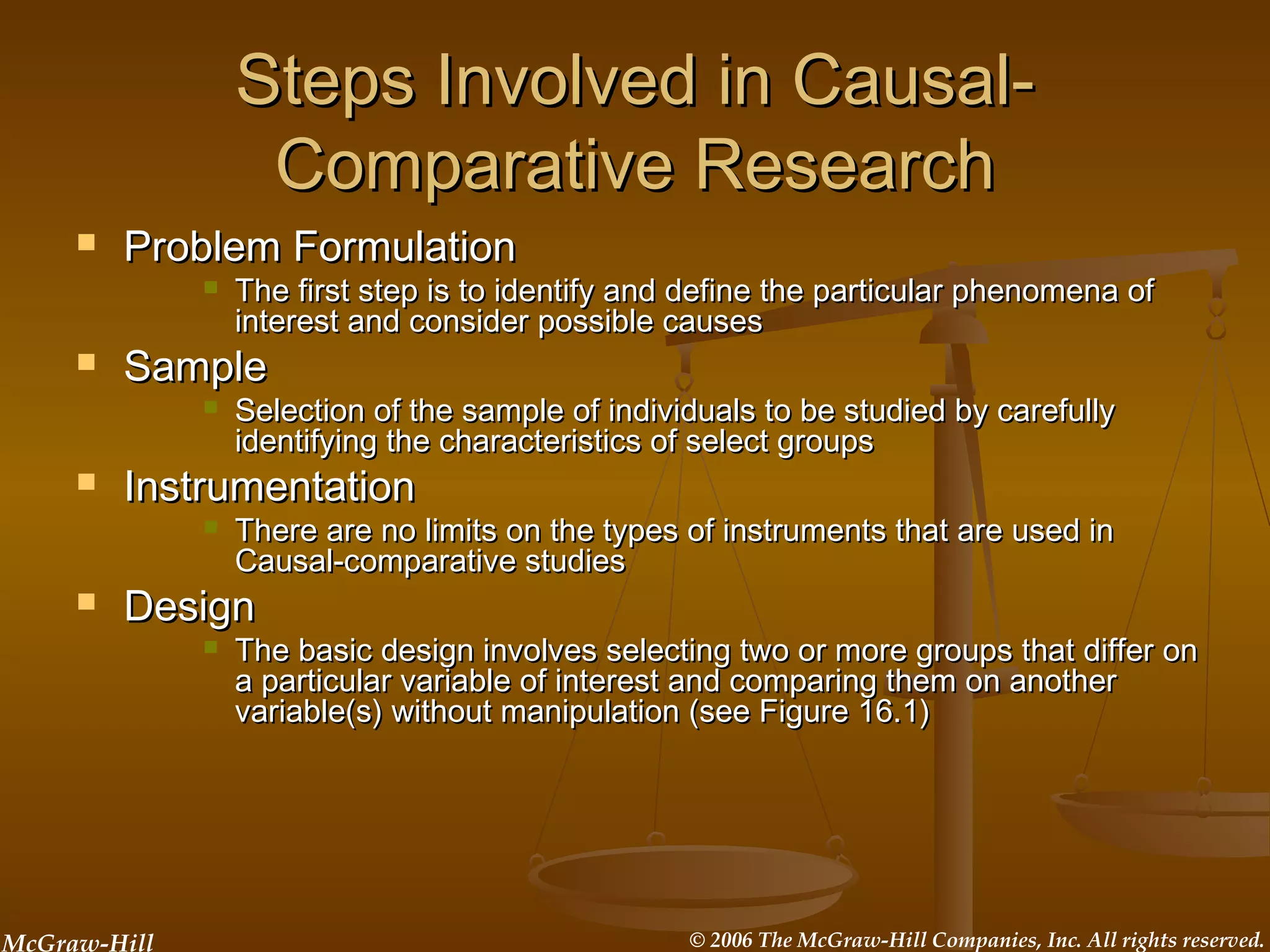
Steps Involved in Causal-Steps Involved in Causal-
Comparative ResearchComparative Research
 Problem FormulationProblem Formulation
 The first step is to identify and define the particular phenomena ofThe first step is to identify and define the particular phenomena of
interest and consider possible causesinterest and consider possible causes
 SampleSample
 Selection of the sample of individuals to be studied by carefullySelection of the sample of individuals to be studied by carefully
identifying the characteristics of select groupsidentifying the characteristics of select groups
 InstrumentationInstrumentation
 There are no limits on the types of instruments that are used inThere are no limits on the types of instruments that are used in
Causal-comparative studiesCausal-comparative studies
 DesignDesign
 The basic design involves selecting two or more groups that differ onThe basic design involves selecting two or more groups that differ on
a particular variable of interest and comparing them on anothera particular variable of interest and comparing them on another
variable(s) without manipulation (see Figure 16.1)variable(s) without manipulation (see Figure 16.1)
McGraw-Hill © 2006 The McGraw-Hill Companies, Inc. All rights reserved.
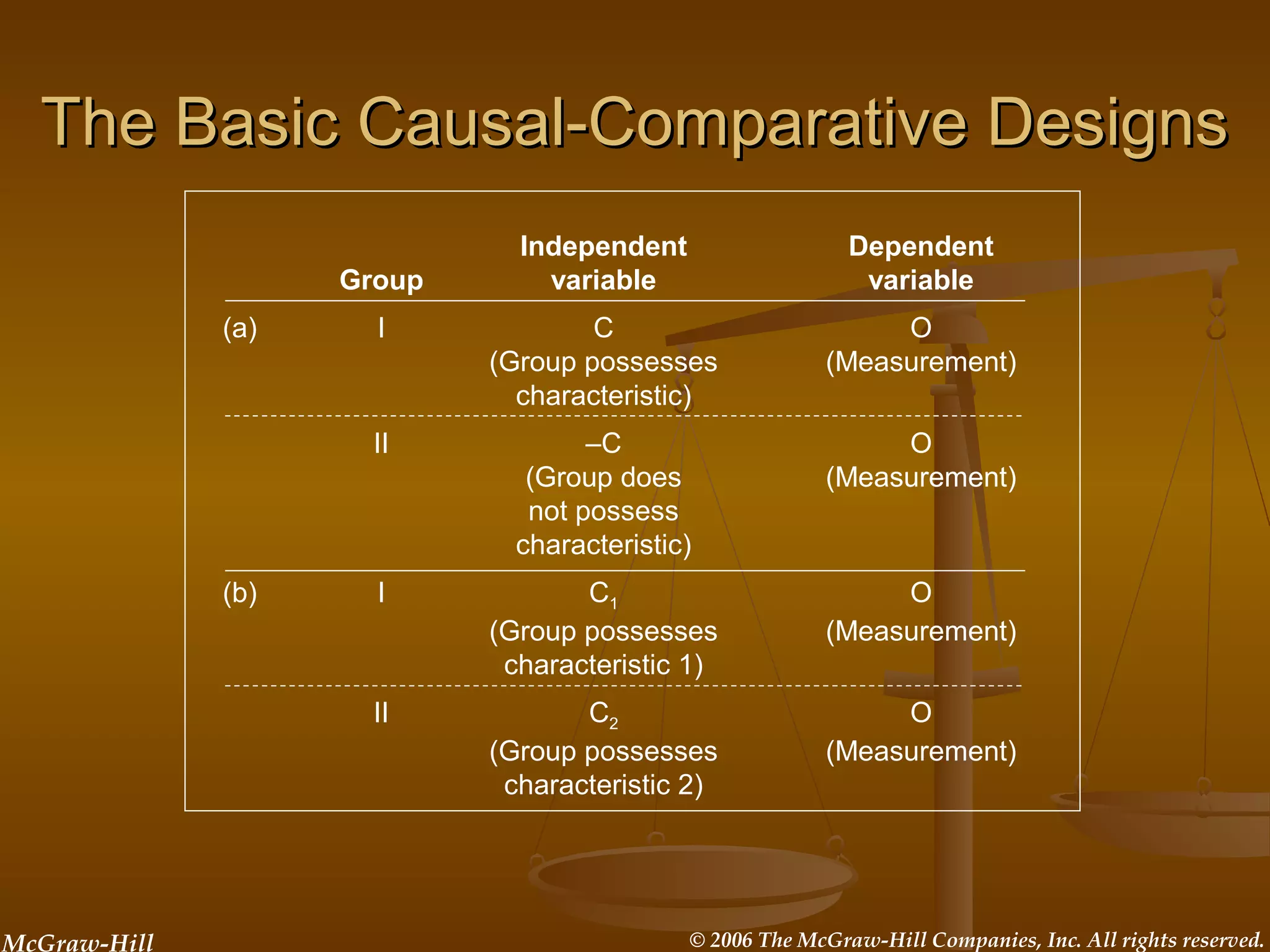
The Basic Causal-Comparative DesignsThe Basic Causal-Comparative Designs
Independent Dependent
Group variable variable
(a) I C O
(Group possesses (Measurement)
characteristic)
II –C O
(Group does (Measurement)
not possess
characteristic)
(b) I C1 O
(Group possesses (Measurement)
characteristic 1)
II C2 O
(Group possesses (Measurement)
characteristic 2)
McGraw-Hill © 2006 The McGraw-Hill Companies, Inc. All rights reserved.
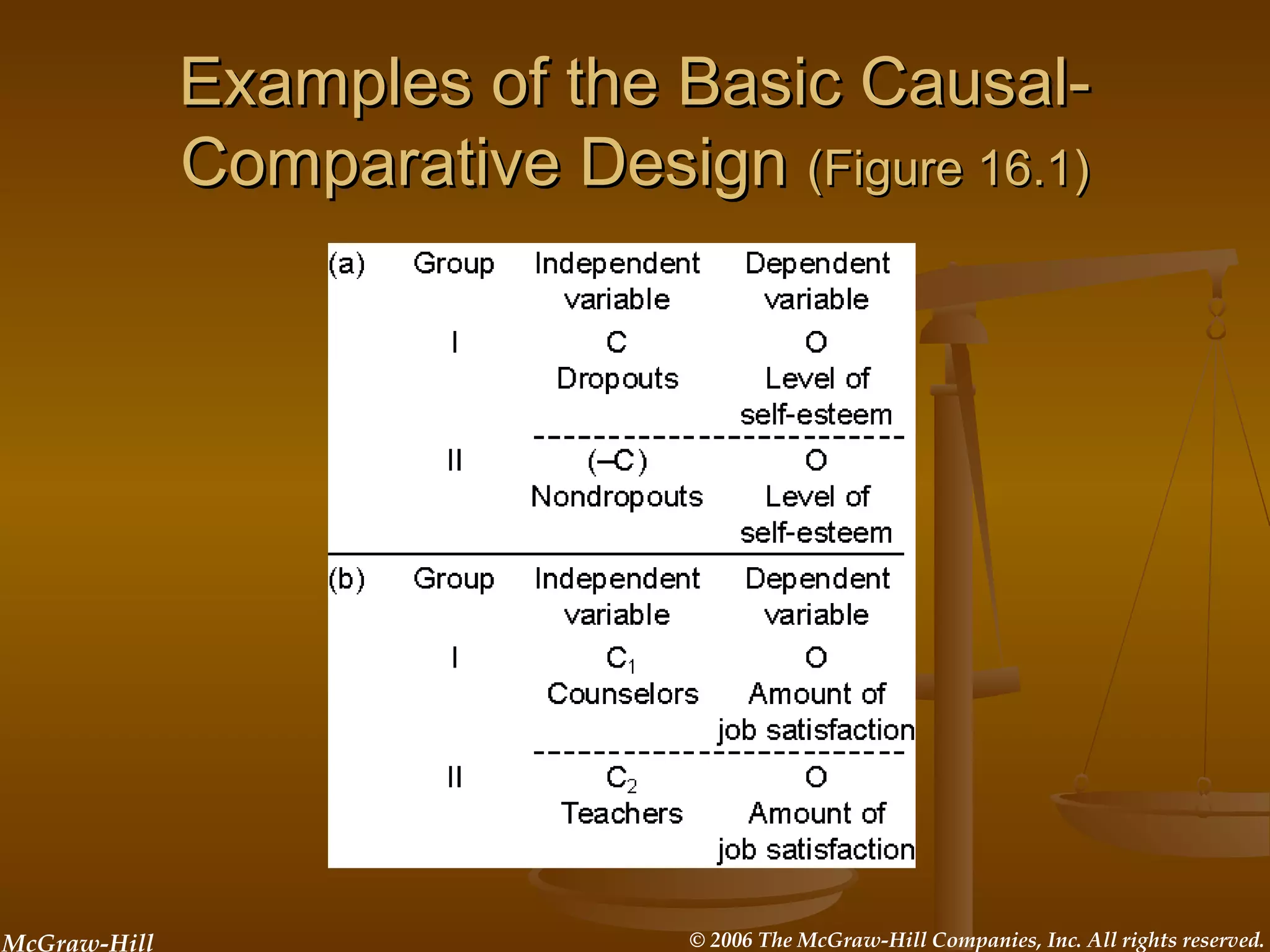
Examples of the Basic Causal-Examples of the Basic Causal-
Comparative DesignComparative Design (Figure 16.1)(Figure 16.1)
McGraw-Hill © 2006 The McGraw-Hill Companies, Inc. All rights reserved.
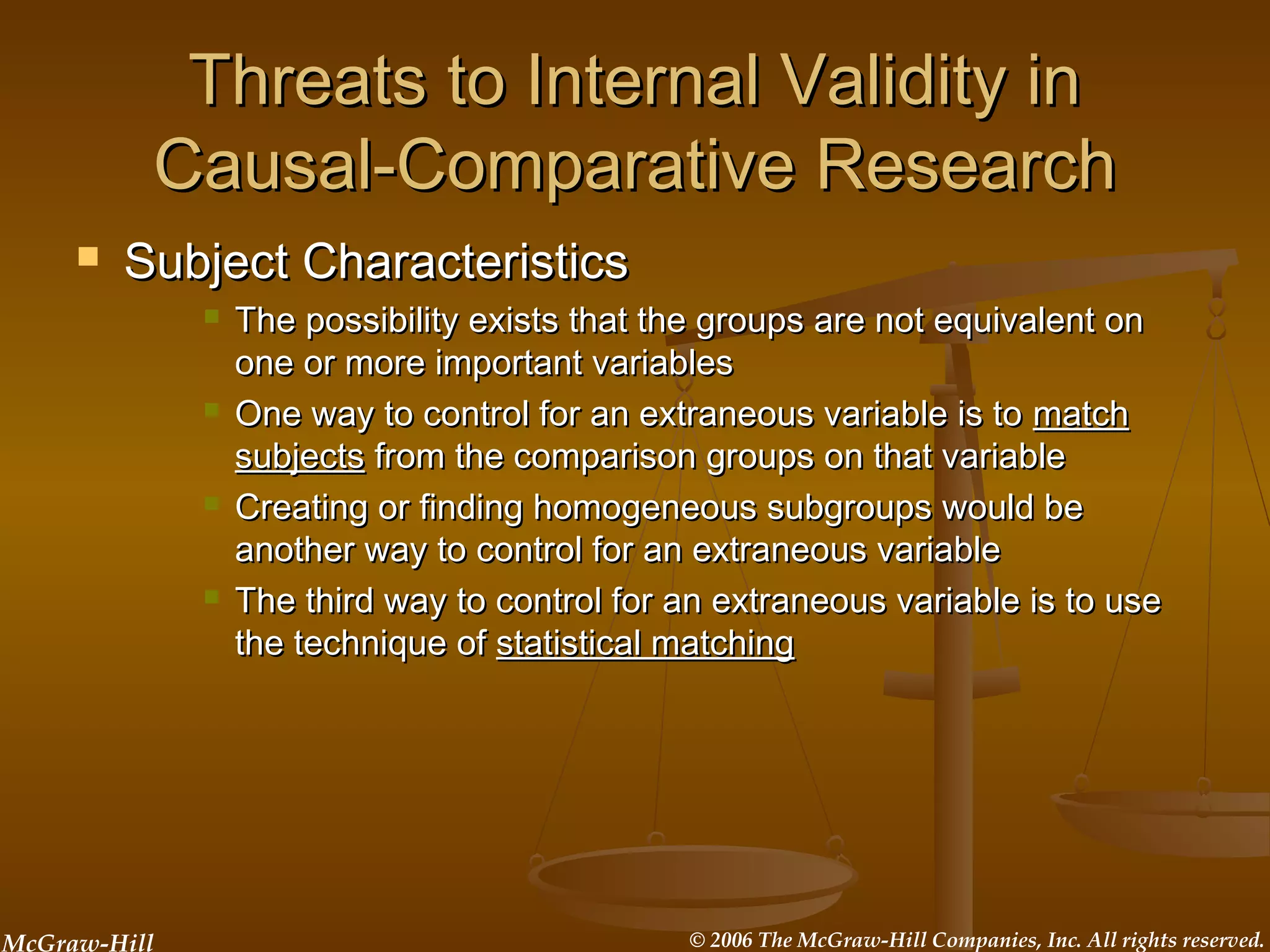
Threats to Internal Validity inThreats to Internal Validity in
Causal-Comparative ResearchCausal-Comparative Research
 Subject CharacteristicsSubject Characteristics
 The possibility exists that the groups are not equivalent onThe possibility exists that the groups are not equivalent on
one or more important variablesone or more important variables
 One way to control for an extraneous variable is toOne way to control for an extraneous variable is to matchmatch
subjectssubjects from the comparison groups on that variablefrom the comparison groups on that variable
 Creating or finding homogeneous subgroups would beCreating or finding homogeneous subgroups would be
another way to control for an extraneous variableanother way to control for an extraneous variable
 The third way to control for an extraneous variable is to useThe third way to control for an extraneous variable is to use
the technique ofthe technique of statistical matchingstatistical matching
McGraw-Hill © 2006 The McGraw-Hill Companies, Inc. All rights reserved.
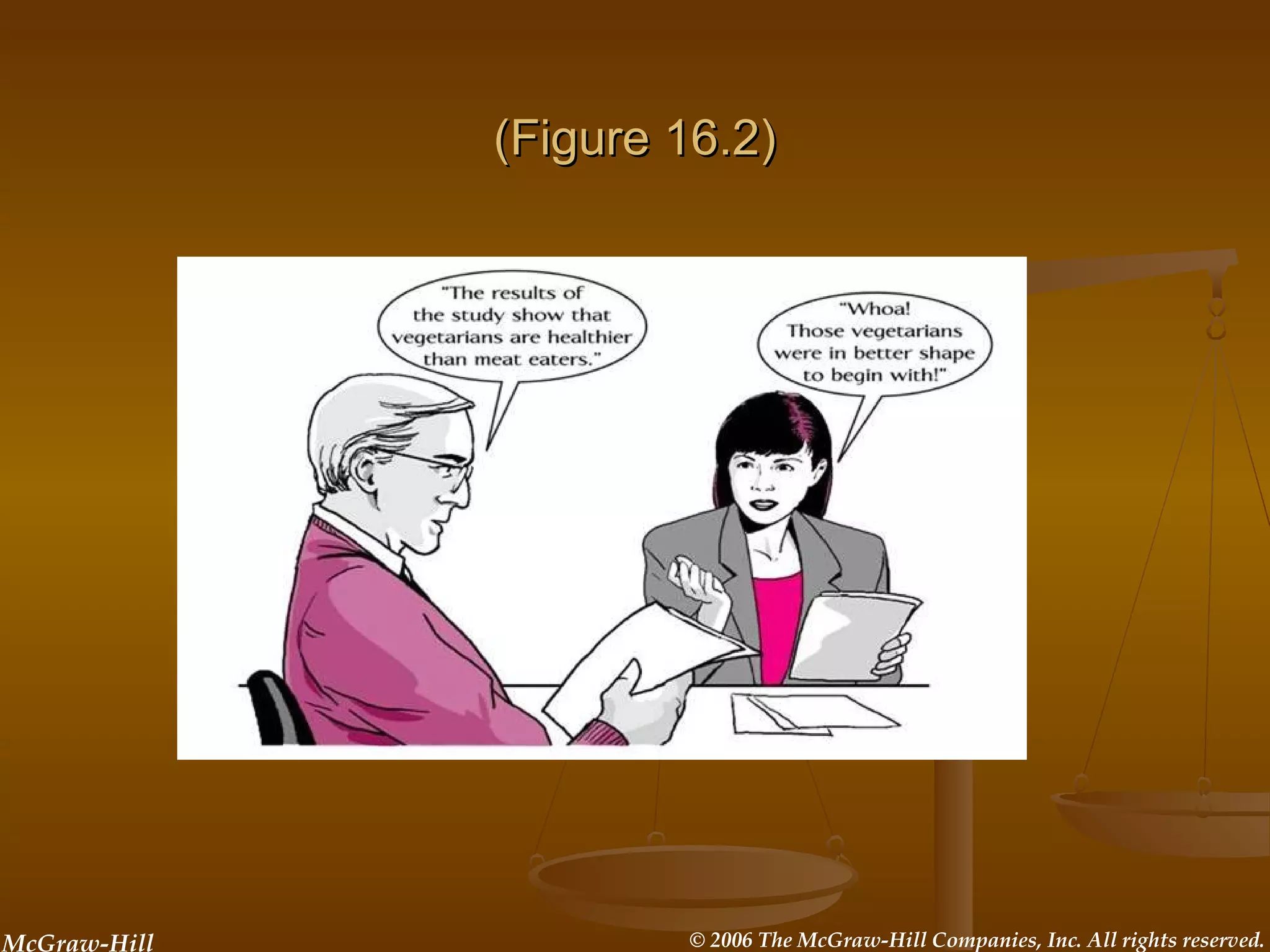
(Figure 16.2)(Figure 16.2)
McGraw-Hill © 2006 The McGraw-Hill Companies, Inc. All rights reserved.
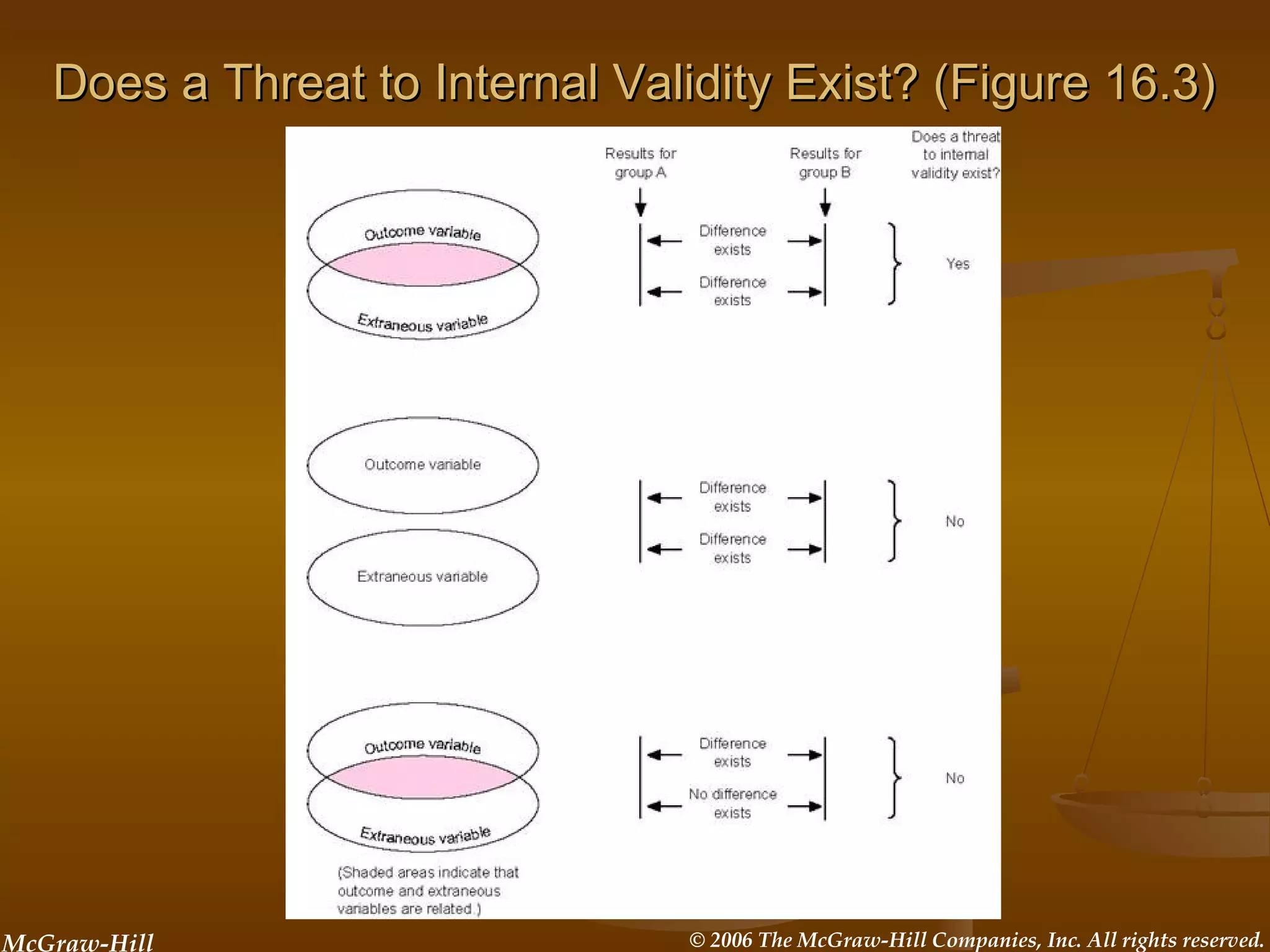
Does a Threat to Internal Validity Exist? (Figure 16.3)Does a Threat to Internal Validity Exist? (Figure 16.3)
McGraw-Hill © 2006 The McGraw-Hill Companies, Inc. All rights reserved.
Other ThreatsOther Threats
 Loss of subjectsLoss of subjects
 LocationLocation
 InstrumentationInstrumentation
 HistoryHistory
 MaturationMaturation
 Data collector biasData collector bias
 Instrument decayInstrument decay
 AttitudeAttitude
 RegressionRegression
 Pre-test/treatmentPre-test/treatment
interaction effectinteraction effect
McGraw-Hill © 2006 The McGraw-Hill Companies, Inc. All rights reserved.
Evaluating Threats to Internal Validity inEvaluating Threats to Internal Validity in
Causal-Comparative StudiesCausal-Comparative Studies
 Involves three sets of steps as shown below:Involves three sets of steps as shown below:
 Step 1: What specific factors are known to affect the variableStep 1: What specific factors are known to affect the variable
on which groups are being compared or may be logically beon which groups are being compared or may be logically be
expected to affect this variable?expected to affect this variable?
 Step 2: What is the likelihood of the comparison groupsStep 2: What is the likelihood of the comparison groups
differing on each of these factors?differing on each of these factors?
 Step 3: Evaluate the threats on the basis of how likely theyStep 3: Evaluate the threats on the basis of how likely they
are to have an effect and plan to control for them.are to have an effect and plan to control for them.
McGraw-Hill © 2006 The McGraw-Hill Companies, Inc. All rights reserved.
Data AnalysisData Analysis
 In a Causal-Comparative Study, the first step is to
construct frequency polygons.
 Means and SD are usually calculated if the variables
involved are quantitative.
 The most commonly used inference test is a t-test for
differences between means.
 ANCOVAs are useful for these types of studies.
 Results should always be interpreted with caution since
they do not prove cause and effect.
McGraw-Hill © 2006 The McGraw-Hill Companies, Inc. All rights reserved.
Associations Between CategoricalAssociations Between Categorical
VariablesVariables
 There are no techniques analogous to partial correlation
or the other techniques that have evolved from
correlational research that can be used with categorical
variables.
 Prediction from crossbreak tables is much less precise
than from scatterplots.
 There are relatively few questions of interest in education
that involve two categorical variables.
 It is common to find researchers who treat quantitative
variables conceptually as if they were categorical, but
nothing is gained by this procedure and it should be
avoided.

Causal comparative study

  • 1.
    McGraw-Hill © 2006The McGraw-Hill Companies, Inc. All rights reserved. Causal-ComparativeCausal-Comparative ResearchResearch Chapter SixteenChapter Sixteen
  • 2.
    McGraw-Hill © 2006The McGraw-Hill Companies, Inc. All rights reserved. Causal-Comparative ResearchCausal-Comparative Research Chapter SixteenChapter Sixteen
  • 3.
    McGraw-Hill © 2006The McGraw-Hill Companies, Inc. All rights reserved. What is Causal-ComparativeWhat is Causal-Comparative Research?Research?  Investigators attempt to determine the cause of differences thatInvestigators attempt to determine the cause of differences that already exist between or among groups of individuals.already exist between or among groups of individuals.  This is viewed as a form of Associative Research since bothThis is viewed as a form of Associative Research since both describe conditions that already exist (a.k.a. ex post facto).describe conditions that already exist (a.k.a. ex post facto).  The group difference variable is either a variable that cannot beThe group difference variable is either a variable that cannot be manipulated or one that might have been manipulated but for onemanipulated or one that might have been manipulated but for one reason or another, has not been.reason or another, has not been.  Studies in medicine and sociology are causal-comparative inStudies in medicine and sociology are causal-comparative in nature, as are studies of differences between men and women.nature, as are studies of differences between men and women.
  • 4.
    McGraw-Hill © 2006The McGraw-Hill Companies, Inc. All rights reserved. Similarities and Differences BetweenSimilarities and Differences Between Causal-Comparative andCausal-Comparative and Correlational ResearchCorrelational Research  SimilaritiesSimilarities  Associative researchAssociative research  Attempt to explainAttempt to explain phenomena of interestphenomena of interest  Seek to identify variablesSeek to identify variables that are worthy of laterthat are worthy of later exploration throughexploration through experimental researchexperimental research  Neither permits theNeither permits the manipulation of variablesmanipulation of variables  Attempt to exploreAttempt to explore causationcausation  DifferencesDifferences  Causal studies compareCausal studies compare two or more groups oftwo or more groups of subjectssubjects  Causal studies involve atCausal studies involve at least one categoricalleast one categorical variablevariable  Causal studies oftenCausal studies often compare averages or usecompare averages or use crossbreak tables insteadcrossbreak tables instead of scatterplots andof scatterplots and correlations coefficientscorrelations coefficients
  • 5.
    McGraw-Hill © 2006The McGraw-Hill Companies, Inc. All rights reserved. Similarities and Differences BetweenSimilarities and Differences Between Causal-Comparative and ExperimentalCausal-Comparative and Experimental ResearchResearch  SimilaritiesSimilarities  Require at least oneRequire at least one categorical variablecategorical variable  Both compare groupBoth compare group performances to determineperformances to determine relationshipsrelationships  Both compare separateBoth compare separate groups of subjectsgroups of subjects  DifferencesDifferences  In experimental research,In experimental research, the independent variable isthe independent variable is manipulatedmanipulated  Causal studies are likely toCausal studies are likely to provide much weakerprovide much weaker evidence for causationevidence for causation  In experimental studies,In experimental studies, researchers can assignresearchers can assign subjects to treatmentsubjects to treatment groupsgroups  The researcher has greaterThe researcher has greater flexibility in formulating theflexibility in formulating the structure of the design instructure of the design in experimental researchexperimental research
  • 6.
    McGraw-Hill © 2006The McGraw-Hill Companies, Inc. All rights reserved. Steps Involved in Causal-Steps Involved in Causal- Comparative ResearchComparative Research  Problem FormulationProblem Formulation  The first step is to identify and define the particular phenomena ofThe first step is to identify and define the particular phenomena of interest and consider possible causesinterest and consider possible causes  SampleSample  Selection of the sample of individuals to be studied by carefullySelection of the sample of individuals to be studied by carefully identifying the characteristics of select groupsidentifying the characteristics of select groups  InstrumentationInstrumentation  There are no limits on the types of instruments that are used inThere are no limits on the types of instruments that are used in Causal-comparative studiesCausal-comparative studies  DesignDesign  The basic design involves selecting two or more groups that differ onThe basic design involves selecting two or more groups that differ on a particular variable of interest and comparing them on anothera particular variable of interest and comparing them on another variable(s) without manipulation (see Figure 16.1)variable(s) without manipulation (see Figure 16.1)
  • 7.
    McGraw-Hill © 2006The McGraw-Hill Companies, Inc. All rights reserved. The Basic Causal-Comparative DesignsThe Basic Causal-Comparative Designs Independent Dependent Group variable variable (a) I C O (Group possesses (Measurement) characteristic) II –C O (Group does (Measurement) not possess characteristic) (b) I C1 O (Group possesses (Measurement) characteristic 1) II C2 O (Group possesses (Measurement) characteristic 2)
  • 8.
    McGraw-Hill © 2006The McGraw-Hill Companies, Inc. All rights reserved. Examples of the Basic Causal-Examples of the Basic Causal- Comparative DesignComparative Design (Figure 16.1)(Figure 16.1)
  • 9.
    McGraw-Hill © 2006The McGraw-Hill Companies, Inc. All rights reserved. Threats to Internal Validity inThreats to Internal Validity in Causal-Comparative ResearchCausal-Comparative Research  Subject CharacteristicsSubject Characteristics  The possibility exists that the groups are not equivalent onThe possibility exists that the groups are not equivalent on one or more important variablesone or more important variables  One way to control for an extraneous variable is toOne way to control for an extraneous variable is to matchmatch subjectssubjects from the comparison groups on that variablefrom the comparison groups on that variable  Creating or finding homogeneous subgroups would beCreating or finding homogeneous subgroups would be another way to control for an extraneous variableanother way to control for an extraneous variable  The third way to control for an extraneous variable is to useThe third way to control for an extraneous variable is to use the technique ofthe technique of statistical matchingstatistical matching
  • 10.
    McGraw-Hill © 2006The McGraw-Hill Companies, Inc. All rights reserved. (Figure 16.2)(Figure 16.2)
  • 11.
    McGraw-Hill © 2006The McGraw-Hill Companies, Inc. All rights reserved. Does a Threat to Internal Validity Exist? (Figure 16.3)Does a Threat to Internal Validity Exist? (Figure 16.3)
  • 12.
    McGraw-Hill © 2006The McGraw-Hill Companies, Inc. All rights reserved. Other ThreatsOther Threats  Loss of subjectsLoss of subjects  LocationLocation  InstrumentationInstrumentation  HistoryHistory  MaturationMaturation  Data collector biasData collector bias  Instrument decayInstrument decay  AttitudeAttitude  RegressionRegression  Pre-test/treatmentPre-test/treatment interaction effectinteraction effect
  • 13.
    McGraw-Hill © 2006The McGraw-Hill Companies, Inc. All rights reserved. Evaluating Threats to Internal Validity inEvaluating Threats to Internal Validity in Causal-Comparative StudiesCausal-Comparative Studies  Involves three sets of steps as shown below:Involves three sets of steps as shown below:  Step 1: What specific factors are known to affect the variableStep 1: What specific factors are known to affect the variable on which groups are being compared or may be logically beon which groups are being compared or may be logically be expected to affect this variable?expected to affect this variable?  Step 2: What is the likelihood of the comparison groupsStep 2: What is the likelihood of the comparison groups differing on each of these factors?differing on each of these factors?  Step 3: Evaluate the threats on the basis of how likely theyStep 3: Evaluate the threats on the basis of how likely they are to have an effect and plan to control for them.are to have an effect and plan to control for them.
  • 14.
    McGraw-Hill © 2006The McGraw-Hill Companies, Inc. All rights reserved. Data AnalysisData Analysis  In a Causal-Comparative Study, the first step is to construct frequency polygons.  Means and SD are usually calculated if the variables involved are quantitative.  The most commonly used inference test is a t-test for differences between means.  ANCOVAs are useful for these types of studies.  Results should always be interpreted with caution since they do not prove cause and effect.
  • 15.
    McGraw-Hill © 2006The McGraw-Hill Companies, Inc. All rights reserved. Associations Between CategoricalAssociations Between Categorical VariablesVariables  There are no techniques analogous to partial correlation or the other techniques that have evolved from correlational research that can be used with categorical variables.  Prediction from crossbreak tables is much less precise than from scatterplots.  There are relatively few questions of interest in education that involve two categorical variables.  It is common to find researchers who treat quantitative variables conceptually as if they were categorical, but nothing is gained by this procedure and it should be avoided.