Educational Research
Causal-Comparative Research
JUVRIANTO CJ
Topics Discussed in this Chapter
 The definition of causal-comparative research
 The purpose of causal-comparative research
 Comparisons with other designs
 Design issues and procedures
 Control
 Data analysis and interpretation
Definition of Causal-
Comparative Research
A form of study that tries to identify and
determine the cause and effects of relationship
between two or more groups. It is a common
form of design in education researches.
The purpose of Causal-
Comparative Research
 Attempts to determine the cause for
preexisting differences in groups of individuals
 The alleged cause and effect have already
occurred
 Orientations
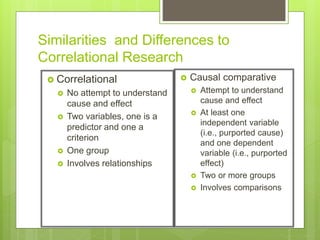
Similarities and Differences to
Correlational Research
 Correlational
 No attempt to understand
cause and effect
 Two variables, one is a
predictor and one a
criterion
 One group
 Involves relationships
 Causal comparative
 Attempt to understand
cause and effect
 At least one
independent variable
(i.e., purported cause)
and one dependent
variable (i.e., purported
effect)
 Two or more groups
 Involves comparisons
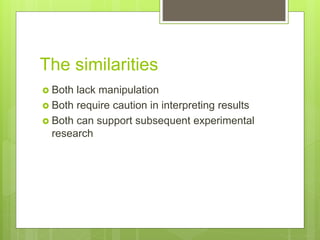
The similarities
 Both lack manipulation
 Both require caution in interpreting results
 Both can support subsequent experimental
research
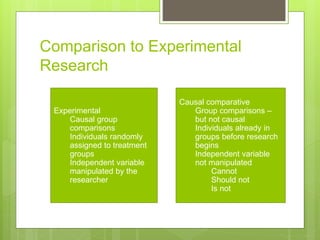
Comparison to Experimental
Research
Experimental
Causal group
comparisons
Individuals randomly
assigned to treatment
groups
Independent variable
manipulated by the
researcher
Causal comparative
Group comparisons –
but not causal
Individuals already in
groups before research
begins
Independent variable
not manipulated
Cannot
Should not
Is not
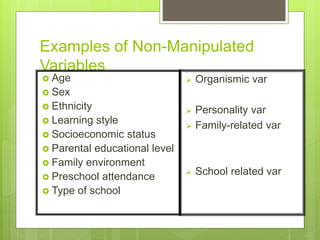
Examples of Non-Manipulated
Variables
 Age
 Sex
 Ethnicity
 Learning style
 Socioeconomic status
 Parental educational level
 Family environment
 Preschool attendance
 Type of school
 Organismic var
 Personality var
 Family-related var
 School related var
The Value of Causal-
Comparative Research
 Permits the investigation of variables that
cannot or should not be manipulated
 Can inform decisions
 Results can lead to experimental studies that
establish causality
 Very cost effective to conduct
Procedures of Causal-
Comparative Research
 Select two groups that differ on some independent
variable
 The independent variable must be clearly
operationally defined
 Randomly sample subjects from each of the two
groups
 Collect background information on subjects to
help determine the equality of the groups
 Compare groups on the dependent variable
Control of Extraneous Variables
 Lack of randomization, manipulation, and
control are all weaknesses of causal
comparative designs
 Three ways to control extraneous
variables
- Matching – pair-wise matching of subjects on
a variable likely to influence performance
- Comparing homogeneous groups – create
groups that are similar on an important
extraneous variable
- Analysis of covariance (ANCOVA)
Data Analysis
A. Descriptive statistics
 Central tendency
 Mean
 Median
 Mode
 Variation
 Standard deviation
B. Inferential statistics
t test
ANOVA
ANCOVA
Chi square
Interpretation of Data
 Difficulty establishing cause and effect
requires caution in interpreting results
 Causality and alternative explanations

Causal-Comparative Research

  • 1.
  • 2.
    Topics Discussed inthis Chapter  The definition of causal-comparative research  The purpose of causal-comparative research  Comparisons with other designs  Design issues and procedures  Control  Data analysis and interpretation
  • 3.
    Definition of Causal- ComparativeResearch A form of study that tries to identify and determine the cause and effects of relationship between two or more groups. It is a common form of design in education researches.
  • 4.
    The purpose ofCausal- Comparative Research  Attempts to determine the cause for preexisting differences in groups of individuals  The alleged cause and effect have already occurred  Orientations
  • 5.
    Similarities and Differencesto Correlational Research  Correlational  No attempt to understand cause and effect  Two variables, one is a predictor and one a criterion  One group  Involves relationships  Causal comparative  Attempt to understand cause and effect  At least one independent variable (i.e., purported cause) and one dependent variable (i.e., purported effect)  Two or more groups  Involves comparisons
  • 6.
    The similarities  Bothlack manipulation  Both require caution in interpreting results  Both can support subsequent experimental research
  • 7.
    Comparison to Experimental Research Experimental Causalgroup comparisons Individuals randomly assigned to treatment groups Independent variable manipulated by the researcher Causal comparative Group comparisons – but not causal Individuals already in groups before research begins Independent variable not manipulated Cannot Should not Is not
  • 8.
    Examples of Non-Manipulated Variables Age  Sex  Ethnicity  Learning style  Socioeconomic status  Parental educational level  Family environment  Preschool attendance  Type of school  Organismic var  Personality var  Family-related var  School related var
  • 9.
    The Value ofCausal- Comparative Research  Permits the investigation of variables that cannot or should not be manipulated  Can inform decisions  Results can lead to experimental studies that establish causality  Very cost effective to conduct
  • 10.
    Procedures of Causal- ComparativeResearch  Select two groups that differ on some independent variable  The independent variable must be clearly operationally defined  Randomly sample subjects from each of the two groups  Collect background information on subjects to help determine the equality of the groups  Compare groups on the dependent variable
  • 11.
    Control of ExtraneousVariables  Lack of randomization, manipulation, and control are all weaknesses of causal comparative designs  Three ways to control extraneous variables - Matching – pair-wise matching of subjects on a variable likely to influence performance - Comparing homogeneous groups – create groups that are similar on an important extraneous variable - Analysis of covariance (ANCOVA)
  • 12.
    Data Analysis A. Descriptivestatistics  Central tendency  Mean  Median  Mode  Variation  Standard deviation B. Inferential statistics t test ANOVA ANCOVA Chi square
  • 13.
    Interpretation of Data Difficulty establishing cause and effect requires caution in interpreting results  Causality and alternative explanations