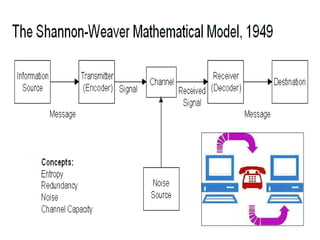
Transmission + Ritual =Communication 
Dr Mira K Desai 
Associate Professor 
University Department of Extension Education 
SNDT Women’s University 
Juhu Campus, Mumbai
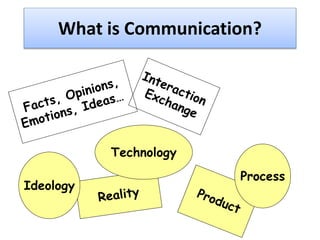
What is Communication? 
Ideology 
Technology 
Process
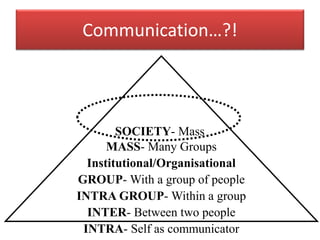
Communication…?! 
SOCIETY- Mass 
MASS- Many Groups 
Institutional/Organisational 
GROUP- With a group of people 
INTRA GROUP- Within a group 
INTER- Between two people 
INTRA- Self as communicator
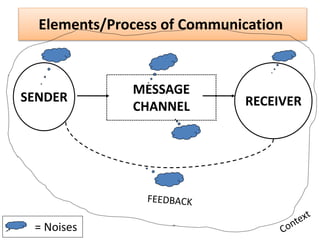
Elements/Process of Communication 
SENDER RECEIVER 
= Noises 
MESSAGE 
CHANNEL
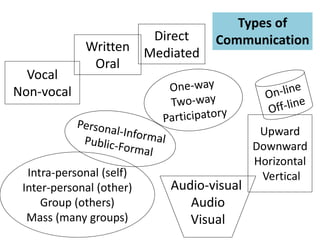
Types of 
Communication 
Vocal 
Non-vocal 
Written 
Oral 
Intra-personal (self) 
Inter-personal (other) 
Group (others) 
Mass (many groups) 
Direct 
Mediated 
Audio-visual 
Audio 
Visual 
Upward 
Downward 
Horizontal 
Vertical
Communication 
Transmission View 
• Communication links the 
ways messages are 
transmitted and received via 
technology with the 
composition of these 
messages (or more broadly, 
as communicative 
relationships), and with the 
analysis of the effects of 
these communicative acts. 
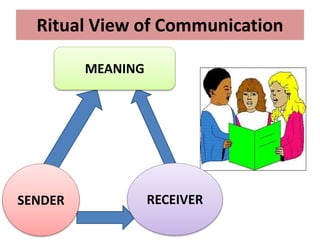
Ritual view 
• Communication is a central 
daily ritual that helps form 
and sustain communities.
Ritual View of Communication 
MEANING 
SENDER RECEIVER
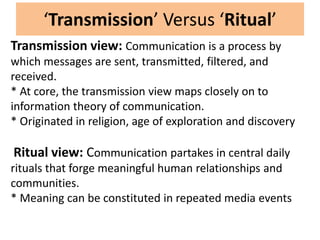
‘Transmission’ Versus ‘Ritual’ 
Transmission view: Communication is a process by 
which messages are sent, transmitted, filtered, and 
received. 
* At core, the transmission view maps closely on to 
information theory of communication. 
* Originated in religion, age of exploration and discovery 
Ritual view: Communication partakes in central daily 
rituals that forge meaningful human relationships and 
communities. 
* Meaning can be constituted in repeated media events
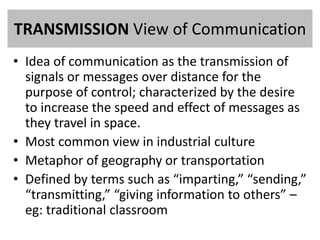
TRANSMISSION View of Communication 
• Idea of communication as the transmission of 
signals or messages over distance for the 
purpose of control; characterized by the desire 
to increase the speed and effect of messages as 
they travel in space. 
• Most common view in industrial culture 
• Metaphor of geography or transportation 
• Defined by terms such as “imparting,” “sending,” 
“transmitting,” “giving information to others” – 
eg: traditional classroom
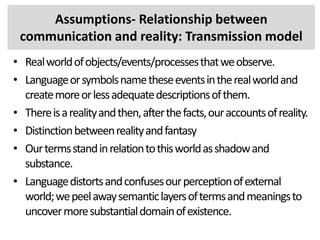
Assumptions- Relationship between 
communication and reality: Transmission model 
• Real world of objects/events/processes that we observe. 
• Language or symbols name these events in the real world and 
create more or less adequate descriptions of them. 
• There is a reality and then, after the facts, our accounts of reality. 
• Distinction between reality and fantasy 
• Our terms stand in relation to this world as shadow and 
substance. 
• Language distorts and confuses our perception of external 
world; we peel away semantic layers of terms and meanings to 
uncover more substantial domain of existence.
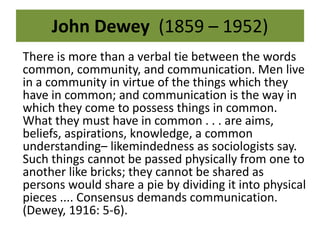
John Dewey (1859 – 1952) 
There is more than a verbal tie between the words 
common, community, and communication. Men live 
in a community in virtue of the things which they 
have in common; and communication is the way in 
which they come to possess things in common. 
What they must have in common . . . are aims, 
beliefs, aspirations, knowledge, a common 
understanding– likemindedness as sociologists say. 
Such things cannot be passed physically from one to 
another like bricks; they cannot be shared as 
persons would share a pie by dividing it into physical 
pieces .... Consensus demands communication. 
(Dewey, 1916: 5-6).
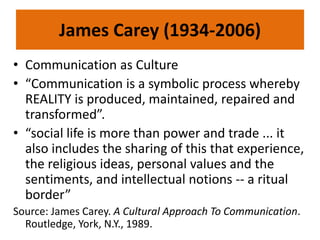
James Carey (1934-2006) 
• Communication as Culture 
• “Communication is a symbolic process whereby 
REALITY is produced, maintained, repaired and 
transformed”. 
• “social life is more than power and trade ... it 
also includes the sharing of this that experience, 
the religious ideas, personal values and the 
sentiments, and intellectual notions -- a ritual 
border” 
Source: James Carey. A Cultural Approach To Communication. 
Routledge, York, N.Y., 1989.
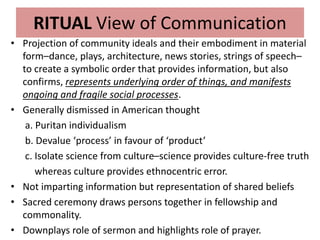
RITUAL View of Communication 
• Projection of community ideals and their embodiment in material 
form–dance, plays, architecture, news stories, strings of speech– 
to create a symbolic order that provides information, but also 
confirms, represents underlying order of things, and manifests 
ongoing and fragile social processes. 
• Generally dismissed in American thought 
a. Puritan individualism 
b. Devalue ‘process’ in favour of ‘product’ 
c. Isolate science from culture–science provides culture-free truth 
whereas culture provides ethnocentric error. 
• Not imparting information but representation of shared beliefs 
• Sacred ceremony draws persons together in fellowship and 
commonality. 
• Downplays role of sermon and highlights role of prayer.
Assumptions- Relationship between 
communication and reality: Ritual model 
• Reality is not given, not humanly existent, 
independent of language and toward which 
language mirrors. 
• Reality is brought into existence, produced by 
communication, by the construction, 
apprehension, and utilization of symbolic forms. 
• Reality is not a mere function of symbolic forms, 
but is produces by humans that focus existence in 
specific terms. 
• Reality is not there to discover in any significant 
detail.
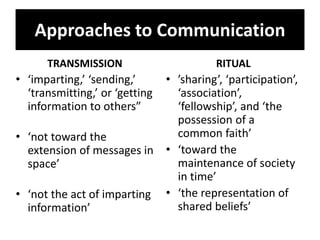
Approaches to Communication 
TRANSMISSION 
• ‘imparting,’ ‘sending,’ 
‘transmitting,’ or ‘getting 
information to others” 
• ‘not toward the 
extension of messages in 
space’ 
• ‘not the act of imparting 
information’ 
RITUAL 
• ’sharing’, ‘participation’, 
‘association’, 
‘fellowship’, and ‘the 
possession of a 
common faith’ 
• ‘toward the 
maintenance of society 
in time’ 
• ‘the representation of 
shared beliefs’
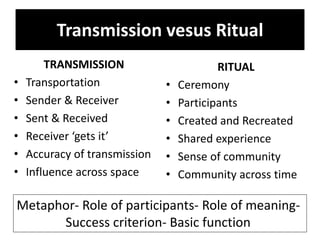
Transmission vesus Ritual 
TRANSMISSION 
• Transportation 
• Sender & Receiver 
• Sent & Received 
• Receiver ‘gets it’ 
• Accuracy of transmission 
• Influence across space 
RITUAL 
• Ceremony 
• Participants 
• Created and Recreated 
• Shared experience 
• Sense of community 
• Community across time 
Metaphor- Role of participants- Role of meaning- 
Success criterion- Basic function
Language 
• Syntactically organized system of signals, such as 
voice sounds, intonations or pitch, gestures or 
written symbols which communicate thoughts or 
feelings. 
• If a language is about communicating with 
signals, voice, sounds, gestures, or written 
symbols, animals have their own language. 
• A language is therefore, so to speak, language 
minus speech: it is at the same time a social 
institution and a system of values.
Semiotics - Science of Signs 
• Semantic: Relation between signs and the things 
they refer to, their denotata. 
• Syntactic: Relation of signs to each other in 
formal structures. 
• Pragmatics: Relation of signs to their impacts on 
those who use them (Also known as general 
semantics) 
• Social semiotics: Social dimensions of meaning in 
any media of communication, its production, 
interpretation and circulation, and its implications 
in social processes, as cause or effect.
Semiotics- Sign Categorisations 
SOCIAL 
CODES TEXTUAL 
CODES 
INTERPRETIVE 
CODES
Social codes: In a broader sense all semiotic 
codes are 'social codes' 
• verbal language (phonological, syntactical, 
lexical, prosodic and paralinguistic sub codes) 
• bodily codes (bodily contact, proximity, physical 
orientation, appearance, facial expression, gaze, 
head nods, gestures and posture) 
• commodity codes (fashions, clothing, cars) 
• behavioural codes (protocols, rituals, role-playing, 
games)
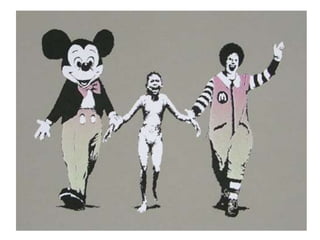
Textual codes- Representational codes 
• Scientific codes: including mathematics 
• Aesthetic codes: within the various expressive 
arts (poetry, drama, painting, sculpture, music, 
etc.) - including classicism, romanticism, realism 
• Genre, rhetorical and stylistic codes: narrative 
(plot, character, action, dialogue, setting, etc.), 
exposition, argument and so on 
• Mass media codes: photographic, televisual, 
filmic, radio, newspaper and magazine codes, 
both technical and conventional (including 
format)
Interpretative codes- There is less 
agreement about these as semiotic codes 
• Perceptual codes: Visual perception (this code 
does not assume intentional communication); 
• Ideological codes: More broadly, these include 
codes for ‘encoding’ and ‘decoding’ texts-dominant 
(or 'hegemonic'), negotiated or 
oppositional. More specifically, we may list the 
'isms', such as individualism, liberalism, 
feminism, racism, materialism, capitalism, 
progressivism, conservatism, socialism, 
objectivism, consumerism and populism; 
(however, all codes can be seen as ideological).
Transmission & Ritual= Communication

Transmission & Ritual= Communication

  • 1.
    Transmission + Ritual=Communication Dr Mira K Desai Associate Professor University Department of Extension Education SNDT Women’s University Juhu Campus, Mumbai
  • 2.
    What is Communication? Ideology Technology Process
  • 3.
    Communication…?! SOCIETY- Mass MASS- Many Groups Institutional/Organisational GROUP- With a group of people INTRA GROUP- Within a group INTER- Between two people INTRA- Self as communicator
  • 4.
    Elements/Process of Communication SENDER RECEIVER = Noises MESSAGE CHANNEL
  • 5.
    Types of Communication Vocal Non-vocal Written Oral Intra-personal (self) Inter-personal (other) Group (others) Mass (many groups) Direct Mediated Audio-visual Audio Visual Upward Downward Horizontal Vertical
  • 6.
    Communication Transmission View • Communication links the ways messages are transmitted and received via technology with the composition of these messages (or more broadly, as communicative relationships), and with the analysis of the effects of these communicative acts. Ritual view • Communication is a central daily ritual that helps form and sustain communities.
  • 8.
    Ritual View ofCommunication MEANING SENDER RECEIVER
  • 9.
    ‘Transmission’ Versus ‘Ritual’ Transmission view: Communication is a process by which messages are sent, transmitted, filtered, and received. * At core, the transmission view maps closely on to information theory of communication. * Originated in religion, age of exploration and discovery Ritual view: Communication partakes in central daily rituals that forge meaningful human relationships and communities. * Meaning can be constituted in repeated media events
  • 10.
    TRANSMISSION View ofCommunication • Idea of communication as the transmission of signals or messages over distance for the purpose of control; characterized by the desire to increase the speed and effect of messages as they travel in space. • Most common view in industrial culture • Metaphor of geography or transportation • Defined by terms such as “imparting,” “sending,” “transmitting,” “giving information to others” – eg: traditional classroom
  • 11.
    Assumptions- Relationship between communication and reality: Transmission model • Real world of objects/events/processes that we observe. • Language or symbols name these events in the real world and create more or less adequate descriptions of them. • There is a reality and then, after the facts, our accounts of reality. • Distinction between reality and fantasy • Our terms stand in relation to this world as shadow and substance. • Language distorts and confuses our perception of external world; we peel away semantic layers of terms and meanings to uncover more substantial domain of existence.
  • 12.
    John Dewey (1859– 1952) There is more than a verbal tie between the words common, community, and communication. Men live in a community in virtue of the things which they have in common; and communication is the way in which they come to possess things in common. What they must have in common . . . are aims, beliefs, aspirations, knowledge, a common understanding– likemindedness as sociologists say. Such things cannot be passed physically from one to another like bricks; they cannot be shared as persons would share a pie by dividing it into physical pieces .... Consensus demands communication. (Dewey, 1916: 5-6).
  • 13.
    James Carey (1934-2006) • Communication as Culture • “Communication is a symbolic process whereby REALITY is produced, maintained, repaired and transformed”. • “social life is more than power and trade ... it also includes the sharing of this that experience, the religious ideas, personal values and the sentiments, and intellectual notions -- a ritual border” Source: James Carey. A Cultural Approach To Communication. Routledge, York, N.Y., 1989.
  • 14.
    RITUAL View ofCommunication • Projection of community ideals and their embodiment in material form–dance, plays, architecture, news stories, strings of speech– to create a symbolic order that provides information, but also confirms, represents underlying order of things, and manifests ongoing and fragile social processes. • Generally dismissed in American thought a. Puritan individualism b. Devalue ‘process’ in favour of ‘product’ c. Isolate science from culture–science provides culture-free truth whereas culture provides ethnocentric error. • Not imparting information but representation of shared beliefs • Sacred ceremony draws persons together in fellowship and commonality. • Downplays role of sermon and highlights role of prayer.
  • 15.
    Assumptions- Relationship between communication and reality: Ritual model • Reality is not given, not humanly existent, independent of language and toward which language mirrors. • Reality is brought into existence, produced by communication, by the construction, apprehension, and utilization of symbolic forms. • Reality is not a mere function of symbolic forms, but is produces by humans that focus existence in specific terms. • Reality is not there to discover in any significant detail.
  • 16.
    Approaches to Communication TRANSMISSION • ‘imparting,’ ‘sending,’ ‘transmitting,’ or ‘getting information to others” • ‘not toward the extension of messages in space’ • ‘not the act of imparting information’ RITUAL • ’sharing’, ‘participation’, ‘association’, ‘fellowship’, and ‘the possession of a common faith’ • ‘toward the maintenance of society in time’ • ‘the representation of shared beliefs’
  • 17.
    Transmission vesus Ritual TRANSMISSION • Transportation • Sender & Receiver • Sent & Received • Receiver ‘gets it’ • Accuracy of transmission • Influence across space RITUAL • Ceremony • Participants • Created and Recreated • Shared experience • Sense of community • Community across time Metaphor- Role of participants- Role of meaning- Success criterion- Basic function
  • 19.
    Language • Syntacticallyorganized system of signals, such as voice sounds, intonations or pitch, gestures or written symbols which communicate thoughts or feelings. • If a language is about communicating with signals, voice, sounds, gestures, or written symbols, animals have their own language. • A language is therefore, so to speak, language minus speech: it is at the same time a social institution and a system of values.
  • 20.
    Semiotics - Scienceof Signs • Semantic: Relation between signs and the things they refer to, their denotata. • Syntactic: Relation of signs to each other in formal structures. • Pragmatics: Relation of signs to their impacts on those who use them (Also known as general semantics) • Social semiotics: Social dimensions of meaning in any media of communication, its production, interpretation and circulation, and its implications in social processes, as cause or effect.
  • 21.
    Semiotics- Sign Categorisations SOCIAL CODES TEXTUAL CODES INTERPRETIVE CODES
  • 22.
    Social codes: Ina broader sense all semiotic codes are 'social codes' • verbal language (phonological, syntactical, lexical, prosodic and paralinguistic sub codes) • bodily codes (bodily contact, proximity, physical orientation, appearance, facial expression, gaze, head nods, gestures and posture) • commodity codes (fashions, clothing, cars) • behavioural codes (protocols, rituals, role-playing, games)
  • 23.
    Textual codes- Representationalcodes • Scientific codes: including mathematics • Aesthetic codes: within the various expressive arts (poetry, drama, painting, sculpture, music, etc.) - including classicism, romanticism, realism • Genre, rhetorical and stylistic codes: narrative (plot, character, action, dialogue, setting, etc.), exposition, argument and so on • Mass media codes: photographic, televisual, filmic, radio, newspaper and magazine codes, both technical and conventional (including format)
  • 24.
    Interpretative codes- Thereis less agreement about these as semiotic codes • Perceptual codes: Visual perception (this code does not assume intentional communication); • Ideological codes: More broadly, these include codes for ‘encoding’ and ‘decoding’ texts-dominant (or 'hegemonic'), negotiated or oppositional. More specifically, we may list the 'isms', such as individualism, liberalism, feminism, racism, materialism, capitalism, progressivism, conservatism, socialism, objectivism, consumerism and populism; (however, all codes can be seen as ideological).