Educational Research:
Causal-Comparative Study
 At least two different groups are compared on a
dependent variable or measure of performance
(called the “effect”) because the independent
variable (called the “cause”) has already occurred
or cannot be manipulated.
 Dependent variable-the change or difference
occurring as a result of the independent variable.
 Independent variable- an activity of characteristic
believed to make a difference with respect to some
behavior.
Purpose of causal comparative
research
 The researcher attempts to determine the cause,
or reason, for pre existing differences in groups
of individuals.
 Attempts to identify cause and effect
relationships.
 Involve two or more group variables.
 Involve making comparison.
 Individuals are not randomly selected and
assigned to two or more groups.
 Cannot manipulate the independent variable
 Less costly and time consuming
Causal Comparative Research
STEPS
Taken
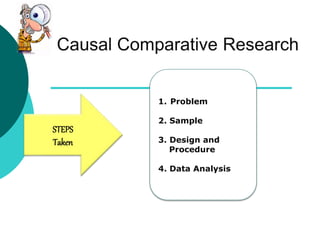
1. Problem
2. Sample
3. Design and
Procedure
4. Data Analysis
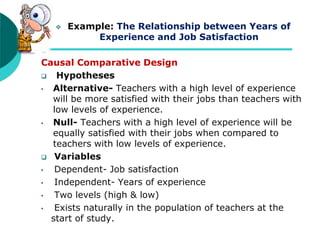
 Example: The Relationship between Years of
Experience and Job Satisfaction

Causal Comparative Design
 Hypotheses
• Alternative- Teachers with a high level of experience
will be more satisfied with their jobs than teachers with
low levels of experience.
• Null- Teachers with a high level of experience will be
equally satisfied with their jobs when compared to
teachers with low levels of experience.
 Variables
• Dependent- Job satisfaction
• Independent- Years of experience
• Two levels (high & low)
• Exists naturally in the population of teachers at the
start of study.
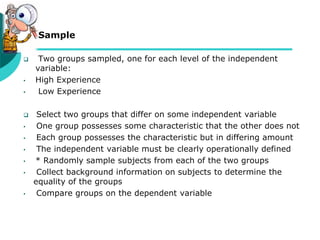
 Sample
 Two groups sampled, one for each level of the independent
variable:
• High Experience
• Low Experience
 Select two groups that differ on some independent variable
• One group possesses some characteristic that the other does not
• Each group possesses the characteristic but in differing amount
• The independent variable must be clearly operationally defined
• * Randomly sample subjects from each of the two groups
• Collect background information on subjects to determine the
equality of the groups
• Compare groups on the dependent variable
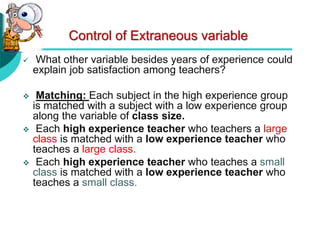
Control of Extraneous variable
 What other variable besides years of experience could
explain job satisfaction among teachers?
 Matching: Each subject in the high experience group
is matched with a subject with a low experience group
along the variable of class size.
 Each high experience teacher who teachers a large
class is matched with a low experience teacher who
teaches a large class.
 Each high experience teacher who teaches a small
class is matched with a low experience teacher who
teaches a small class.
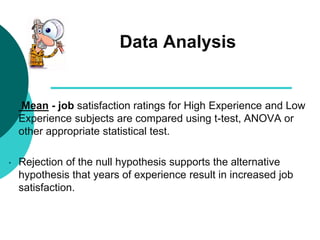
Data Analysis
• Mean - job satisfaction ratings for High Experience and Low
Experience subjects are compared using t-test, ANOVA or
other appropriate statistical test.
• Rejection of the null hypothesis supports the alternative
hypothesis that years of experience result in increased job
satisfaction.
Example of Research Objectives
 To identify the purpose of of Causal
Comparative Research?
 To Identify the meaning of Causal
Comparative Research topics and describe
the basic design?
 To examine the type of Causal Comparative
Research?
Example of Research Questions :
1. What are the strengths of the study?
 Groups are comparable to one another.
 Contrasted statistical with practical significance.
 Large sample size.
 Multiple “replications” of treatment effect.
2. What are the weaknesses of the study?
 Lack of random assignment.
 Focus on standardized test performance.
THANK YOU FOR
LISTENING…..
ANY QUESTION???

Cc rfinal

  • 1.
    Educational Research: Causal-Comparative Study At least two different groups are compared on a dependent variable or measure of performance (called the “effect”) because the independent variable (called the “cause”) has already occurred or cannot be manipulated.  Dependent variable-the change or difference occurring as a result of the independent variable.  Independent variable- an activity of characteristic believed to make a difference with respect to some behavior.
  • 2.
    Purpose of causalcomparative research  The researcher attempts to determine the cause, or reason, for pre existing differences in groups of individuals.  Attempts to identify cause and effect relationships.  Involve two or more group variables.  Involve making comparison.  Individuals are not randomly selected and assigned to two or more groups.  Cannot manipulate the independent variable  Less costly and time consuming
  • 3.
    Causal Comparative Research STEPS Taken 1.Problem 2. Sample 3. Design and Procedure 4. Data Analysis
  • 4.
     Example: TheRelationship between Years of Experience and Job Satisfaction  Causal Comparative Design  Hypotheses • Alternative- Teachers with a high level of experience will be more satisfied with their jobs than teachers with low levels of experience. • Null- Teachers with a high level of experience will be equally satisfied with their jobs when compared to teachers with low levels of experience.  Variables • Dependent- Job satisfaction • Independent- Years of experience • Two levels (high & low) • Exists naturally in the population of teachers at the start of study.
  • 5.
     Sample  Twogroups sampled, one for each level of the independent variable: • High Experience • Low Experience  Select two groups that differ on some independent variable • One group possesses some characteristic that the other does not • Each group possesses the characteristic but in differing amount • The independent variable must be clearly operationally defined • * Randomly sample subjects from each of the two groups • Collect background information on subjects to determine the equality of the groups • Compare groups on the dependent variable
  • 6.
    Control of Extraneousvariable  What other variable besides years of experience could explain job satisfaction among teachers?  Matching: Each subject in the high experience group is matched with a subject with a low experience group along the variable of class size.  Each high experience teacher who teachers a large class is matched with a low experience teacher who teaches a large class.  Each high experience teacher who teaches a small class is matched with a low experience teacher who teaches a small class.
  • 7.
    Data Analysis • Mean- job satisfaction ratings for High Experience and Low Experience subjects are compared using t-test, ANOVA or other appropriate statistical test. • Rejection of the null hypothesis supports the alternative hypothesis that years of experience result in increased job satisfaction.
  • 8.
    Example of ResearchObjectives  To identify the purpose of of Causal Comparative Research?  To Identify the meaning of Causal Comparative Research topics and describe the basic design?  To examine the type of Causal Comparative Research?
  • 9.
    Example of ResearchQuestions : 1. What are the strengths of the study?  Groups are comparable to one another.  Contrasted statistical with practical significance.  Large sample size.  Multiple “replications” of treatment effect. 2. What are the weaknesses of the study?  Lack of random assignment.  Focus on standardized test performance.
  • 10.