MIXED METHOD
RESEARCH
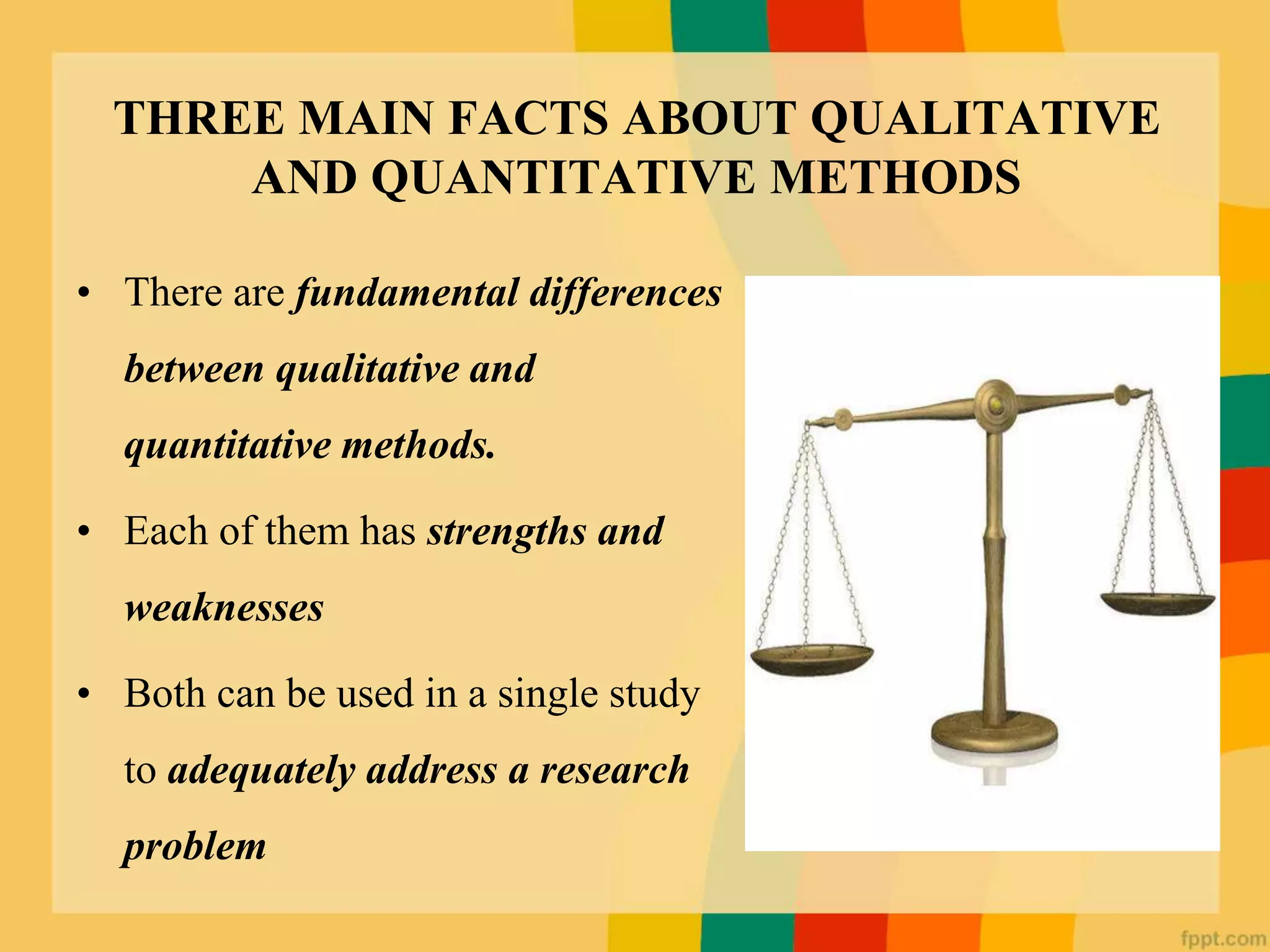
THREE MAIN FACTS ABOUT QUALITATIVE
AND QUANTITATIVE METHODS
• There are fundamental differences
between qualitative and
quantitative methods.
• Each of them has strengths and
weaknesses
• Both can be used in a single study
to adequately address a research
problem
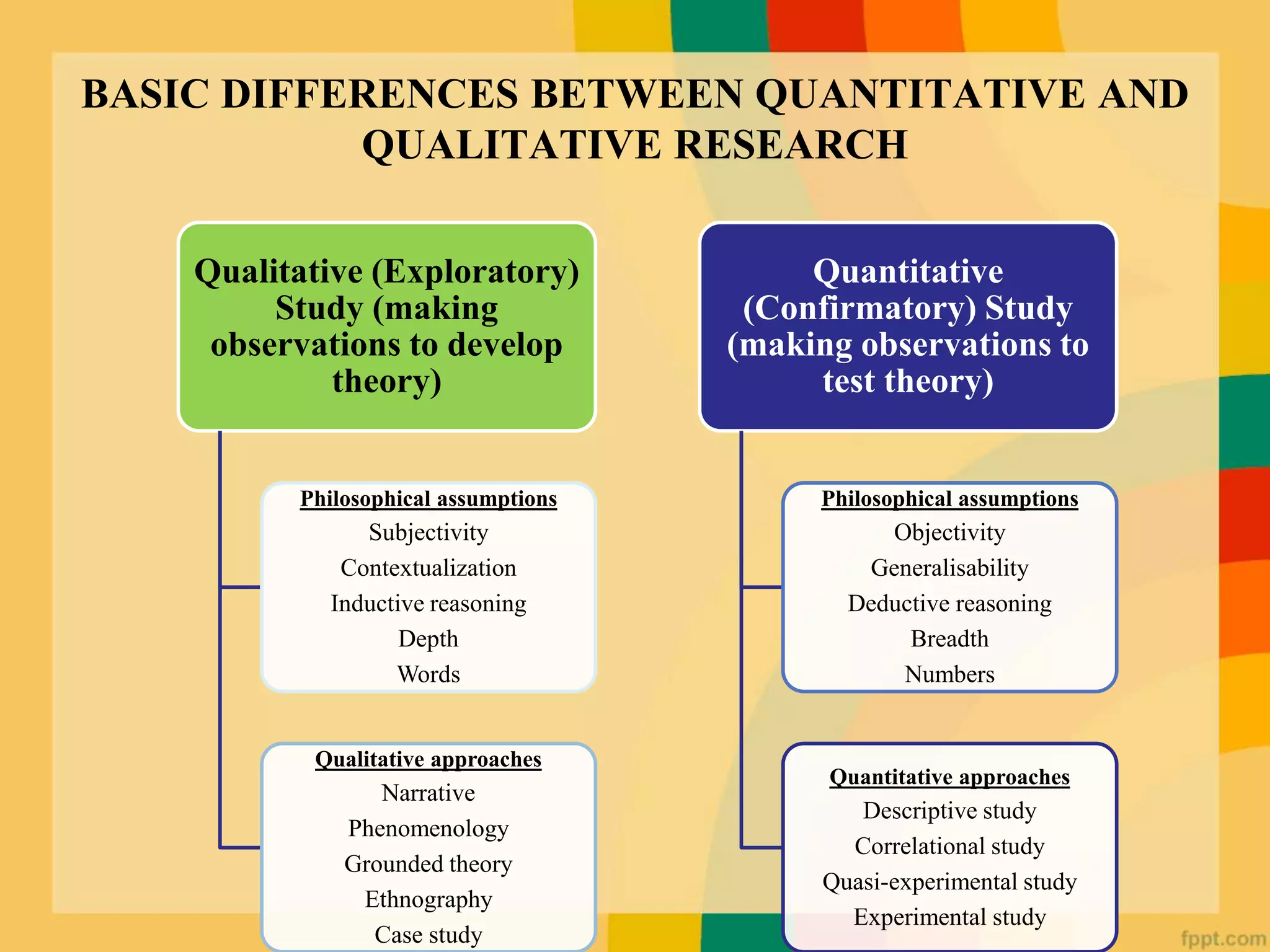
BASIC DIFFERENCES BETWEEN QUANTITATIVE AND
QUALITATIVE RESEARCH
Qualitative (Exploratory)
Study (making
observations to develop
theory)
Philosophical assumptions
Subjectivity
Contextualization
Inductive reasoning
Depth
Words
Qualitative approaches
Narrative
Phenomenology
Grounded theory
Ethnography
Case study
Quantitative
(Confirmatory) Study
(making observations to
test theory)
Philosophical assumptions
Objectivity
Generalisability
Deductive reasoning
Breadth
Numbers
Quantitative approaches
Descriptive study
Correlational study
Quasi-experimental study
Experimental study
INTRODUCTION
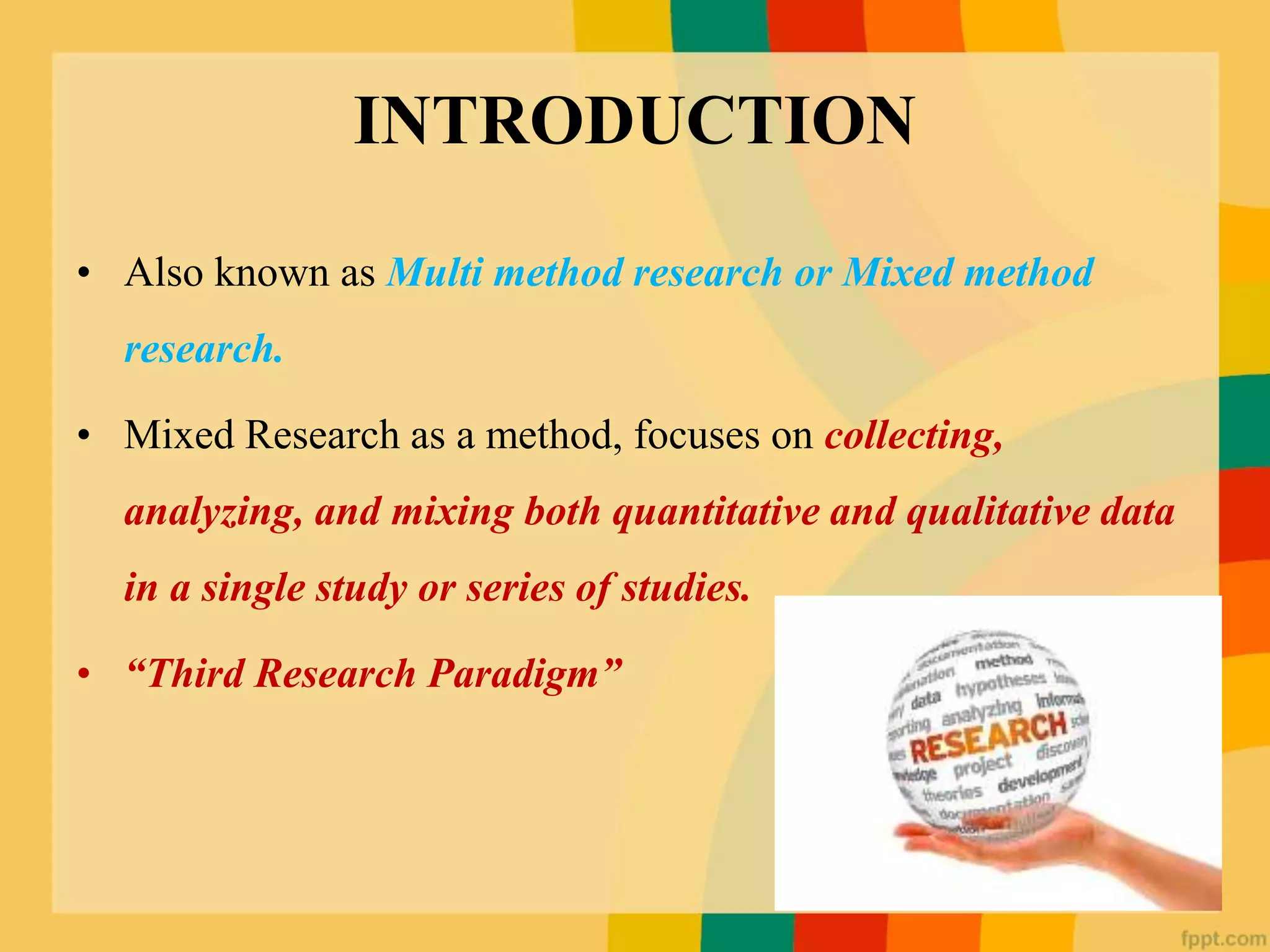
• Also known as Multi method research or Mixed method
research.
• Mixed Research as a method, focuses on collecting,
analyzing, and mixing both quantitative and qualitative data
in a single study or series of studies.
• “Third Research Paradigm”
DEFINITION
Mixed method research is a type of research in which a
researcher combines elements of qualitative and quantitative
research approaches (eg. Use of qualitative and quantitative
viewpoints, data collection, analysis and inference technique)
for the purpose of breadth and depth of understanding and
corroboration.
Johnson et al (2007)
DEFINITION
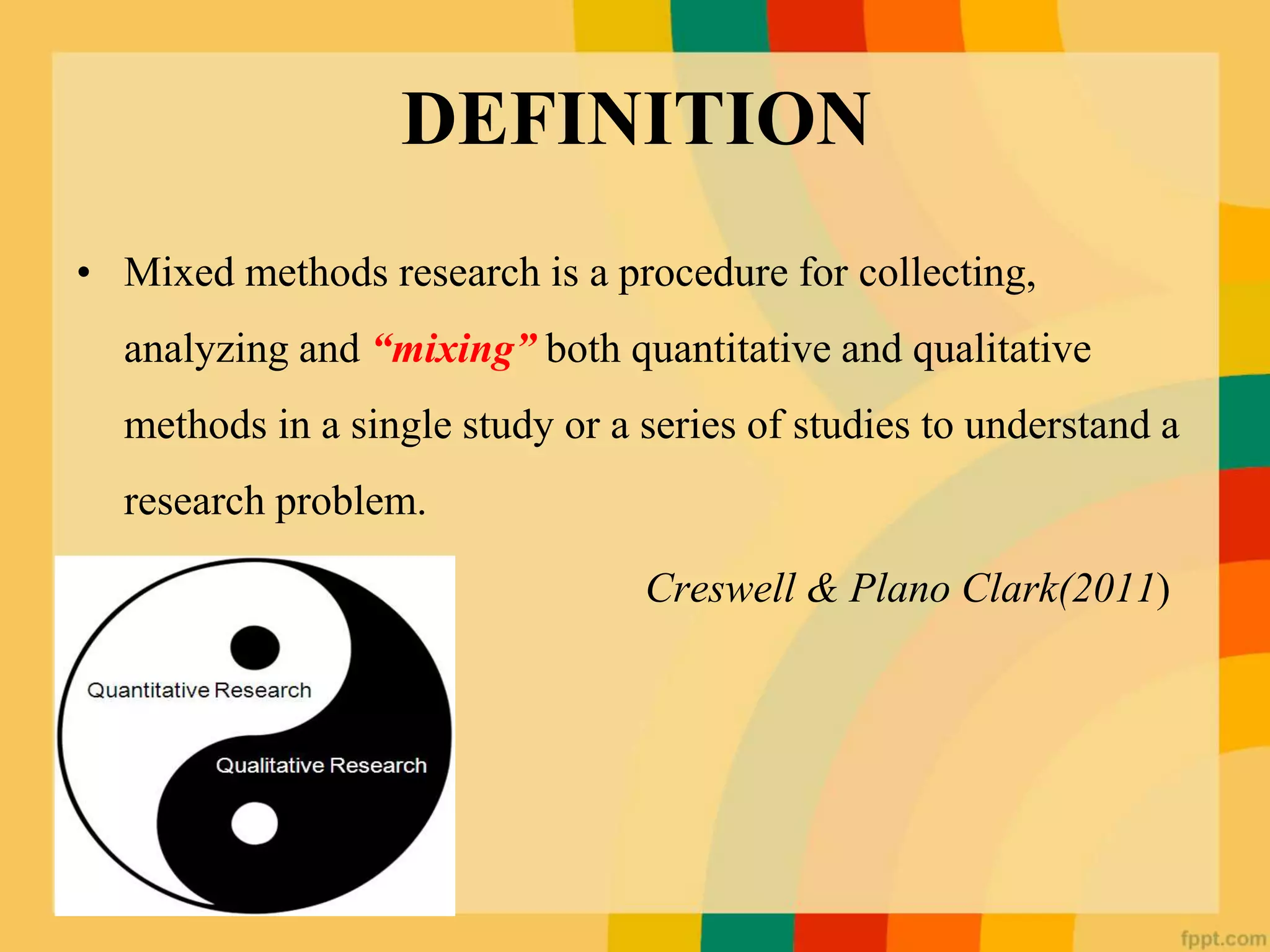
• Mixed methods research is a procedure for collecting,
analyzing and “mixing” both quantitative and qualitative
methods in a single study or a series of studies to understand a
research problem.
Creswell & Plano Clark(2011)
PURPOSE
• The concepts are new and poorly understood and there is a
need for qualitative exploration before more formal,
structured methods can be used.
• Neither a qualitative nor a quantitative approach, by itself, is
adequate in addressing the complexity of the research
problem.
• The findings from one approach can be greatly enhanced with
a second source of data.
• The quantitative results are puzzling and difficult to
interpret and qualitative data can help to explain the
results.
• A particular theoretical perspective might require
both qualitative and quantitative data.
• A multiphase project is needed to attain key
objectives, such as the development and assessment
of an intervention.
ESSENCE OF MIXED METHODS
RESEARCH
1. Enriching the findings
2. Increasing the depth and
breadth
3. Testing a theory or model
4. Seeking for participants’
inputs
5. Improving the trustworthiness
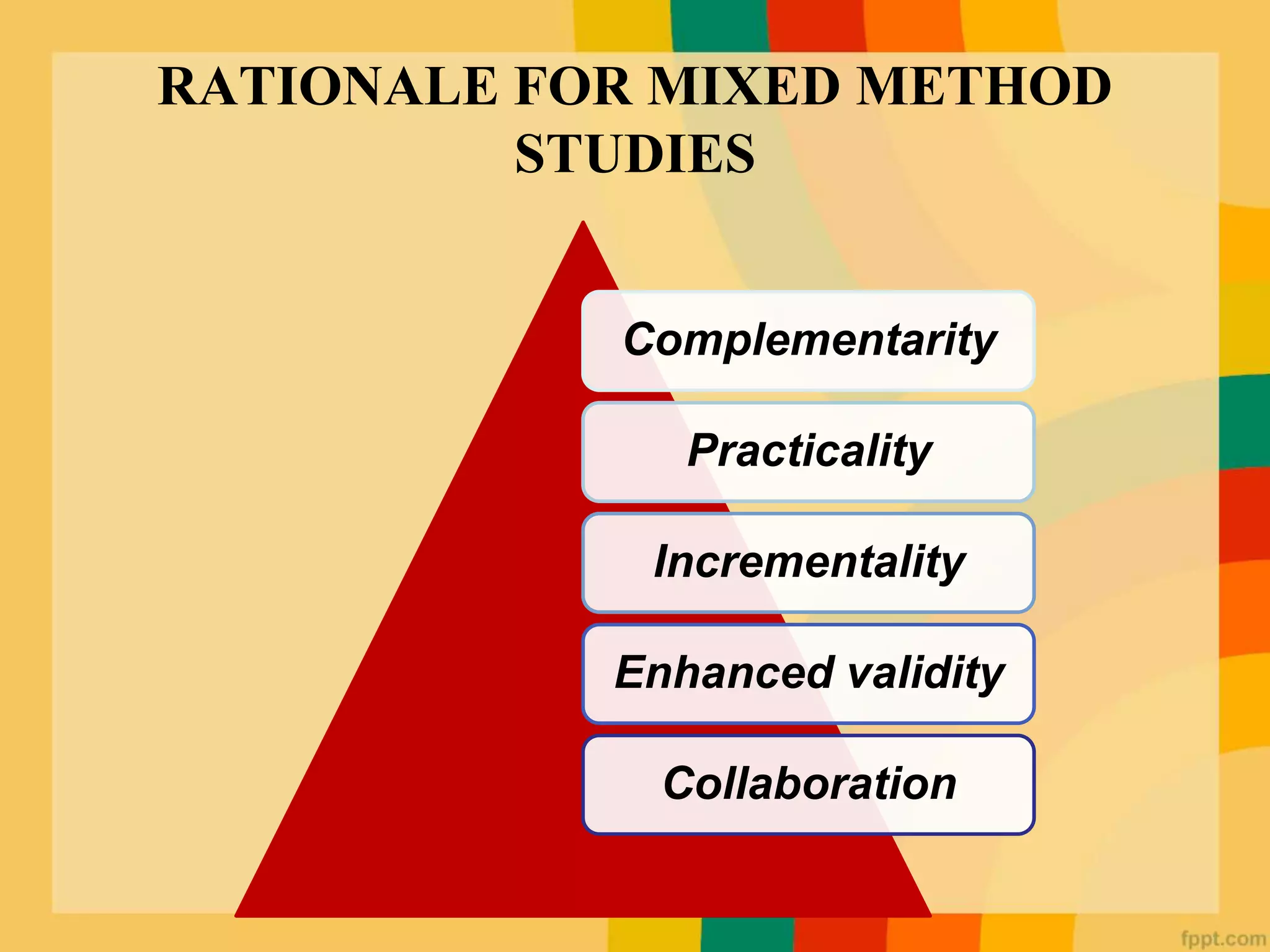
RATIONALE FOR MIXED METHOD
STUDIES
Complementarity
Practicality
Incrementality
Enhanced validity
Collaboration
CHARECTERISTICS
• Collect and analyze both
quantitative and qualitative
data.
• Mix two forms of data in
different ways.
• Give priority to one or both
forms of data.
• Can be in a single study or in
multiple phases of a study.
• Design can be based on either
or both perspectives.
• Research problems can become
research questions and/or hypotheses
based on prior literature, knowledge,
experience, or the research process.
• Sample sizes vary based on methods
used.
• Data collection can involve any
technique available to researchers.
• Interpretation is continual and can
influence stages in the research process.
PLANNING MIXED METHODS
PROCEDURES
TIMING
• Timing of their qualitative and quantitative data collection, whether it will
be in phases (sequentially) or gathered at the same time (concurrently).
• When qualitative data are collected first, the intent is to explore the topic
with participants at sites. Then the researcher expands the understanding
through a second phase in which data are collected from a large number of
people.
• When data are collected concurrently, both quantitative and qualitative data
are gathered at the same time and the implementation is simultaneous.
• Concurrent: Qualitative and quantitative data
collection happens at the same time.
• Sequential: The researcher implements the strands in
two distinct phases.
• Multiphase: The researcher does both concurrent and
sequential data collection and analysis over a longer
period of time.
WEIGHTING
• The right priority given to quantitative or qualitative research
in a particular study.
• In some studies, the weight might be equal; in other studies, it
might emphasize one or the other.
• A priority for one type depends on the interests of the
researcher, the audience for the study (e.g., faculty committee,
professional association), and what the investigator seeks to
emphasize in the study.
MIXING
• Occur at several stages: the data collection, the data
analysis, interpretation, or at all three phases.
• Mixing means either that the qualitative and
quantitative data are actually merged on one end of
the continuum, kept separate on the other end of the
continuum, or combined in some way between these
two extremes.
THEORIZING OR TRANSFORMING
PERSPECTIVES
• Guides the entire design. It may be a theory from the
social sciences or a broad theoretical lens.
• All researchers bring theories and frameworks to their
inquires and these theories may be made explicit in a
mixed methods study or be implicit and not
mentioned.
• In mixed methods studies, the theories are found
typically in the beginning sections as an orienting
lens that shapes the types of questions asked, who
participates in the study, how data are collected, and
the implications made from the study.
NOTATION AND DIGRAMMING
Morse’s notation system
• Designated by upper case and lower case letters
• QUAL/quan designate a mixed methods study in
which the dominant approach is qualitative, while
QUAN/qual designates the reverse.
• If neither approach is dominant (i.e., both are equal),
the notation stipulates QUAL/QUAN.
• Sequencing in this system is indicated by the symbols
+ or →. The arrow designates a sequential approach.
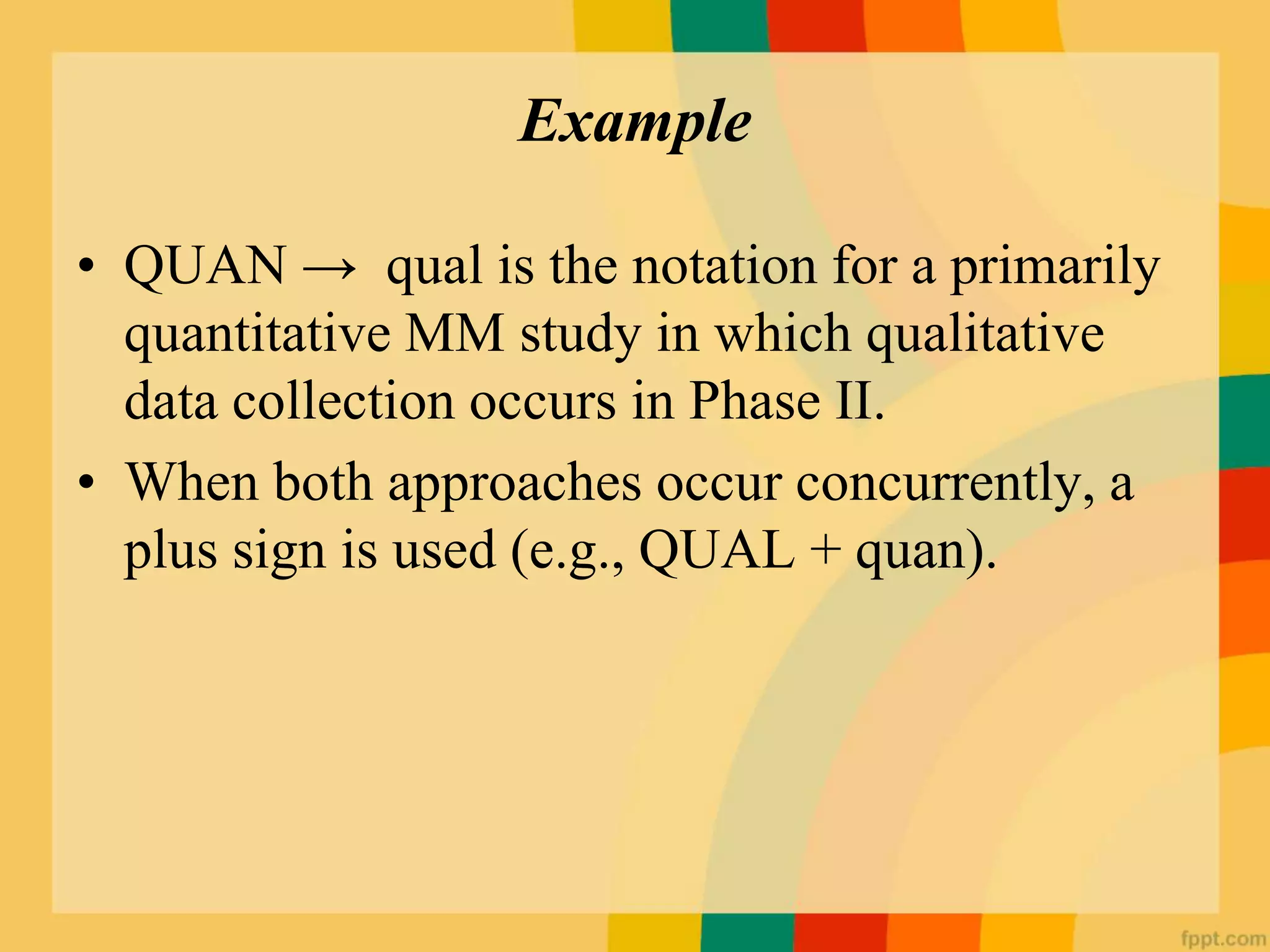
Example
• QUAN → qual is the notation for a primarily
quantitative MM study in which qualitative
data collection occurs in Phase II.
• When both approaches occur concurrently, a
plus sign is used (e.g., QUAL + quan).
Creswell and Plano Clark
• Creswell and Plano Clark (2007) have suggested a
modification of Morse’s notation to include the use of
parentheses, which designate an embedded design structure.
• The notation QUAN(qual) indicates a design in which the
qualitative methods are embedded within a quantitative design.
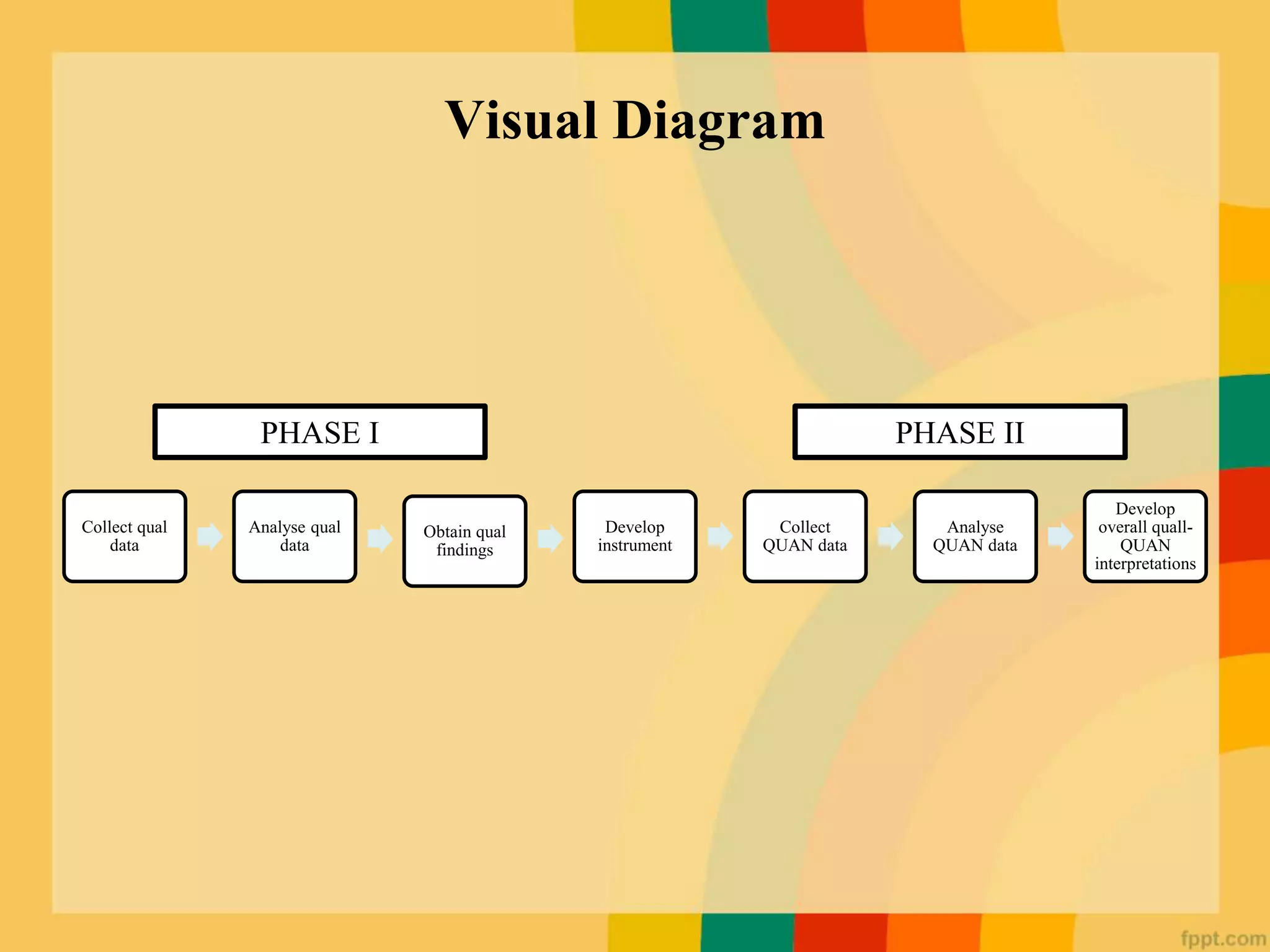
Visual Diagram
Collect qual
data
Analyse qual
data
Obtain qual
findings
Develop
instrument
Collect
QUAN data
Analyse
QUAN data
Develop
overall quall-
QUAN
interpretations
PHASE I PHASE II
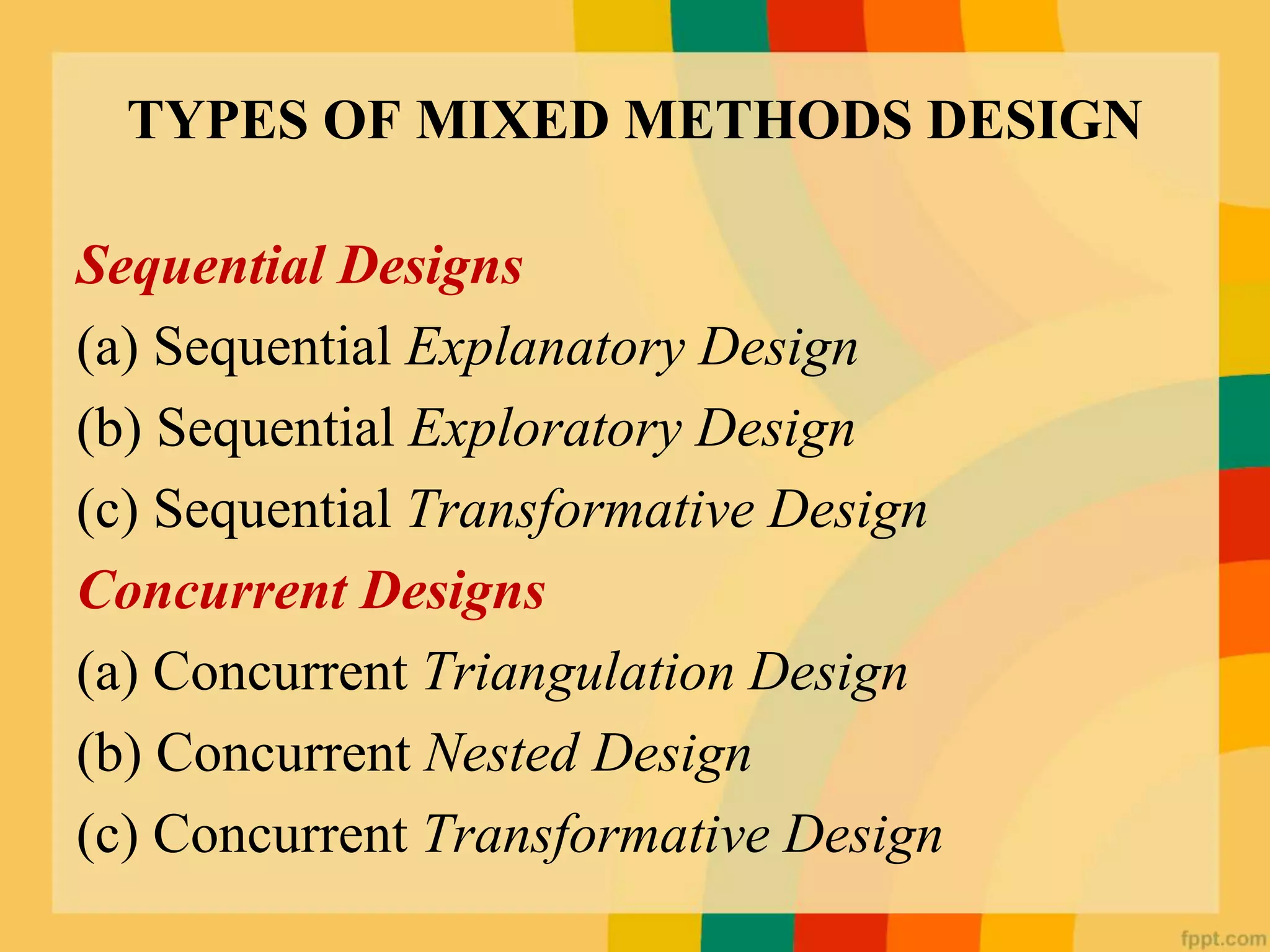
TYPES OF MIXED METHODS DESIGN
Sequential Designs
(a) Sequential Explanatory Design
(b) Sequential Exploratory Design
(c) Sequential Transformative Design
Concurrent Designs
(a) Concurrent Triangulation Design
(b) Concurrent Nested Design
(c) Concurrent Transformative Design
SEQUENTIAL EXPLANATORY
• Characterized by: Collection and analysis of
quantitative data followed by a collection and
analysis of qualitative data.
• Purpose: To use qualitative results to assist in
explaining and interpreting the findings of a
quantitative study.
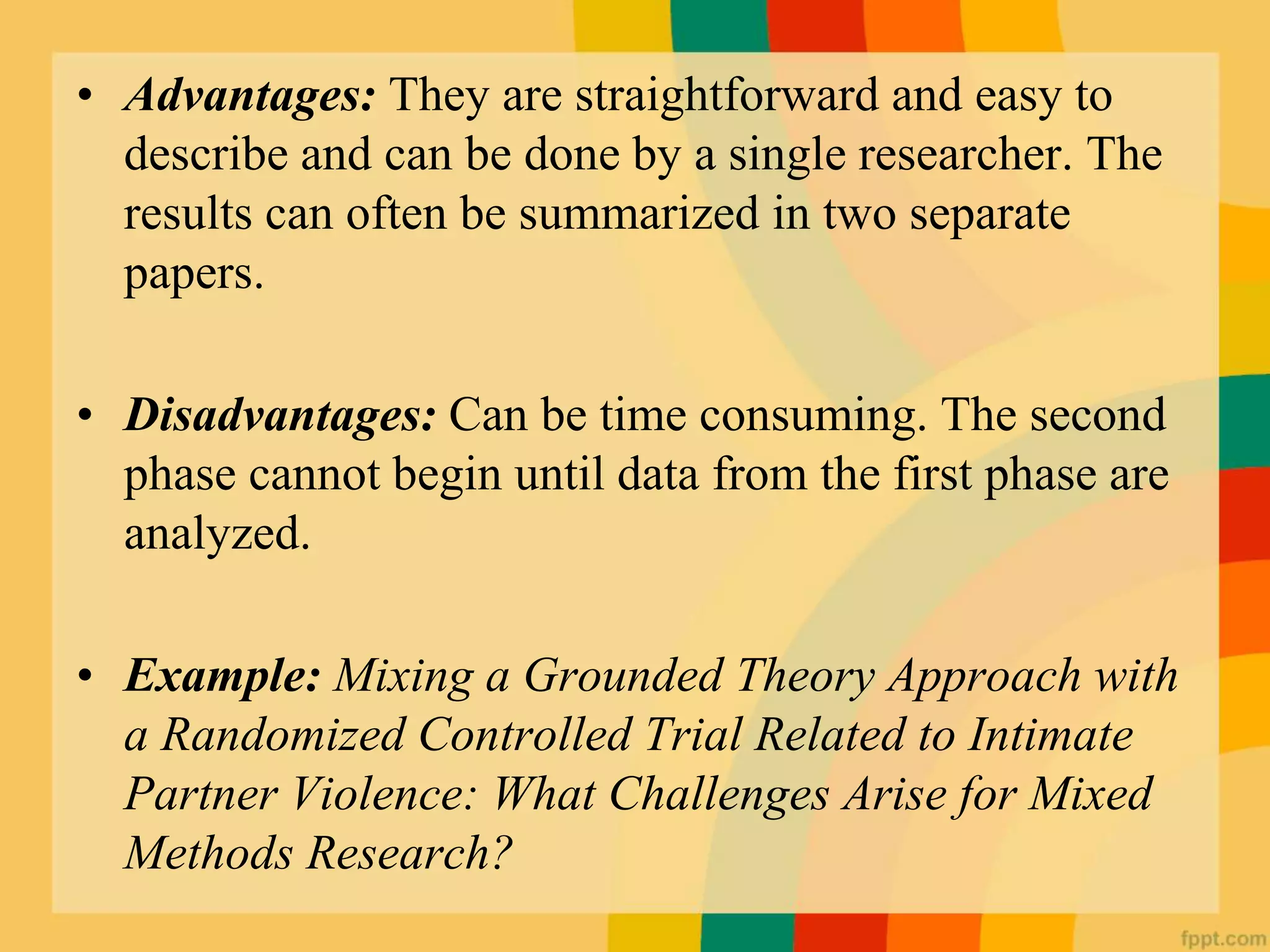
• Advantages: They are straightforward and easy to
describe and can be done by a single researcher. The
results can often be summarized in two separate
papers.
• Disadvantages: Can be time consuming. The second
phase cannot begin until data from the first phase are
analyzed.
• Example: Mixing a Grounded Theory Approach with
a Randomized Controlled Trial Related to Intimate
Partner Violence: What Challenges Arise for Mixed
Methods Research?
When do you use it?
• When you want to explain the quantitative results in
more depth with qualitative data (e.g., statistical
differences among groups, individuals who scored at
extreme levels).
• When you want to identify appropriate participants to
study in more depth qualitatively.
SEQUENTIAL EXPLORATORY
• Characterized by: An initial phase of qualitative data
collection and analysis followed by a phase of
quantitative data collection and analysis.
• Purpose: To explore a phenomenon. This strategy
may also be useful when developing and testing a
new instrument.
Two variants:
• Instrument development model: Data from the qual
phase are used in the development of Quan
instruments.
• Theory development: The researcher identifies
important constructs and develops a theory,
taxonomy or classification system grounded in the in
depth data gathered during the QUAL phase. Then
the quan phase is used to test or explore the taxonomy
or theory with a broader group.
• Advantages: They are straightforward and easy to describe
and can be done by a single researcher. Separate phases make
the inquiry easy to explain, implement and report.
• Disadvantages: Can be time consuming. The second phase
cannot begin until data from the first phase are analyzed.
Difficult to get a front approval from ethics committee.
• Example: Development and psychometric testing of
inflammatory bowel disease fatigue (IBD-F) patient self-
assessment scale.
When do you use it?
• To develop an instrument when one is not available
(first explore, then develop instrument)
• To develop a classification or typology for testing
• To identify the most important variables to study
quantitatively when these variable are not known
SEQUENTIAL TRANSFORMATIVE
• Characterized by: Collection and analysis of either
quantitative or qualitative data first. The results are
integrated in the interpretation phase.
• Purpose: To employ the methods that best serve a
theoretical perspective.
CONCURRENT TRIANGULATION
• Characterized by: Two or more methods used to
confirm, cross-validate, or corroborate findings
within a study. Data collection is concurrent.
• Purpose: Generally, both methods are used to
overcome a weakness in using one method with the
strengths of another.
When do you use it?
• When you want to combine the advantages of quantitative
(trends, large numbers, generalization) with qualitative (detail,
small numbers, in-depth)
• When you want to validate your quantitative findings with
qualitative data
• When you want to expand your quantitative findings with
some open-ended qualitative data (e.g., survey with closed-
and open-ended data)
CONCURRENT NESTED
• Characterized by: A nested approach that gives
priority to one of the methods and guides the project,
while another is embedded or “nested.”
• Purpose: The purpose of the nested method is to
address a different question than the dominant or to
seek information from different levels.
CONCURRENT TRANSFORMATIVE
• Characterized by: The use of a theoretical
perspective reflected in the purpose or research
questions of the study to guide all methodological
choices.
• Purpose: To evaluate a theoretical perspective at
different levels of analysis.
METHODOLOGICAL RATIONALE OF
MIXED METHODS DESIGN
1. Triangulation
2. Complementarity
3. Development
4. Expansion
5. Initiation
(Plano Clark, & Creswell, 2008)
Questions to reflect on
 Why do you plan to use both qualitative and quantitative
methods in your study?
 Why do you plan to use more than one data collection
strategy?
 Why do you plan to collect both qualitative and quantitative
data?
 What are the use of the qualitative and quantitative data or
findings in your study?
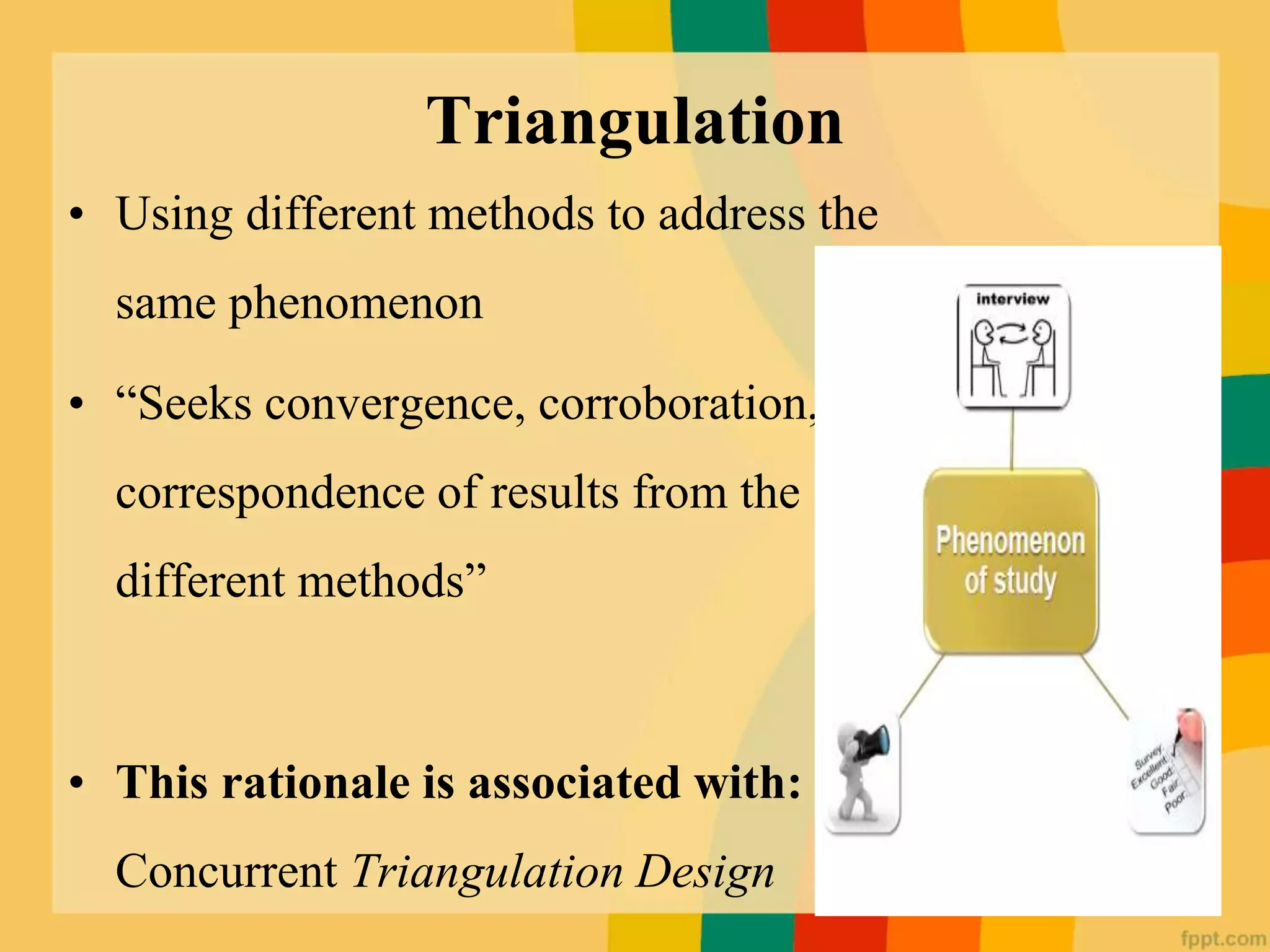
Triangulation
• Using different methods to address the
same phenomenon
• “Seeks convergence, corroboration,
correspondence of results from the
different methods”
• This rationale is associated with:
Concurrent Triangulation Design
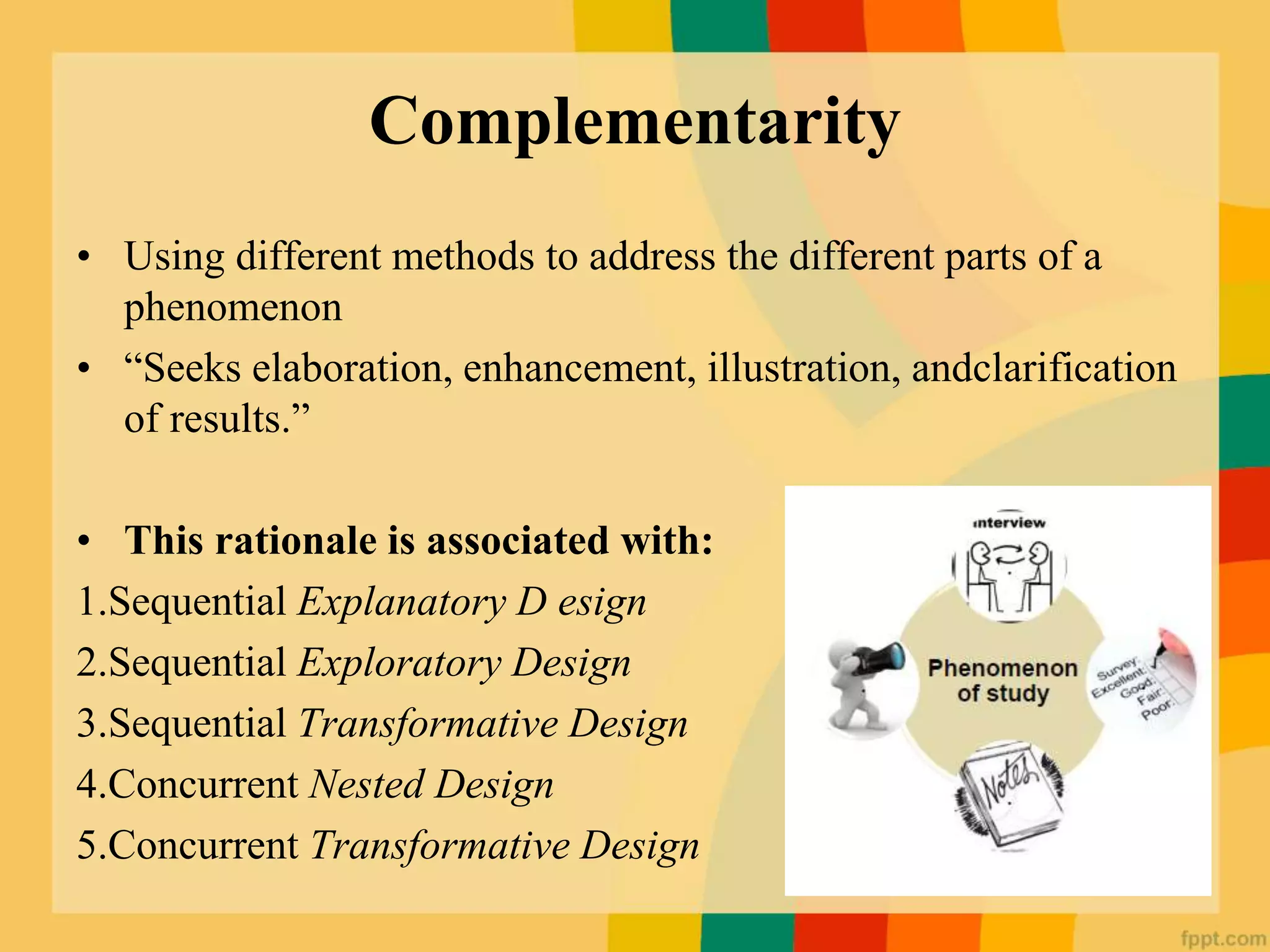
Complementarity
• Using different methods to address the different parts of a
phenomenon
• “Seeks elaboration, enhancement, illustration, andclarification
of results.”
• This rationale is associated with:
1.Sequential Explanatory D esign
2.Sequential Exploratory Design
3.Sequential Transformative Design
4.Concurrent Nested Design
5.Concurrent Transformative Design
Development
• Using the results of one method
to inform the other method
• “Seeks to use the results from
one method to help develop or
inform the other method...”
• This rationale is associated
with:
• 1.Sequential Exploratory Design
• 2.Sequential Transformative
Design
Expansion
• Using different methods to address
the different parts of a phenomenon
• “Seeks to extend the breadth and
range of inquiry.”
• This rationale is associated with:
1.Sequential Exploratory Design
2.Sequential Transformative Design
3.Concurrent Nested Design
4.Concurrent Transformative Design
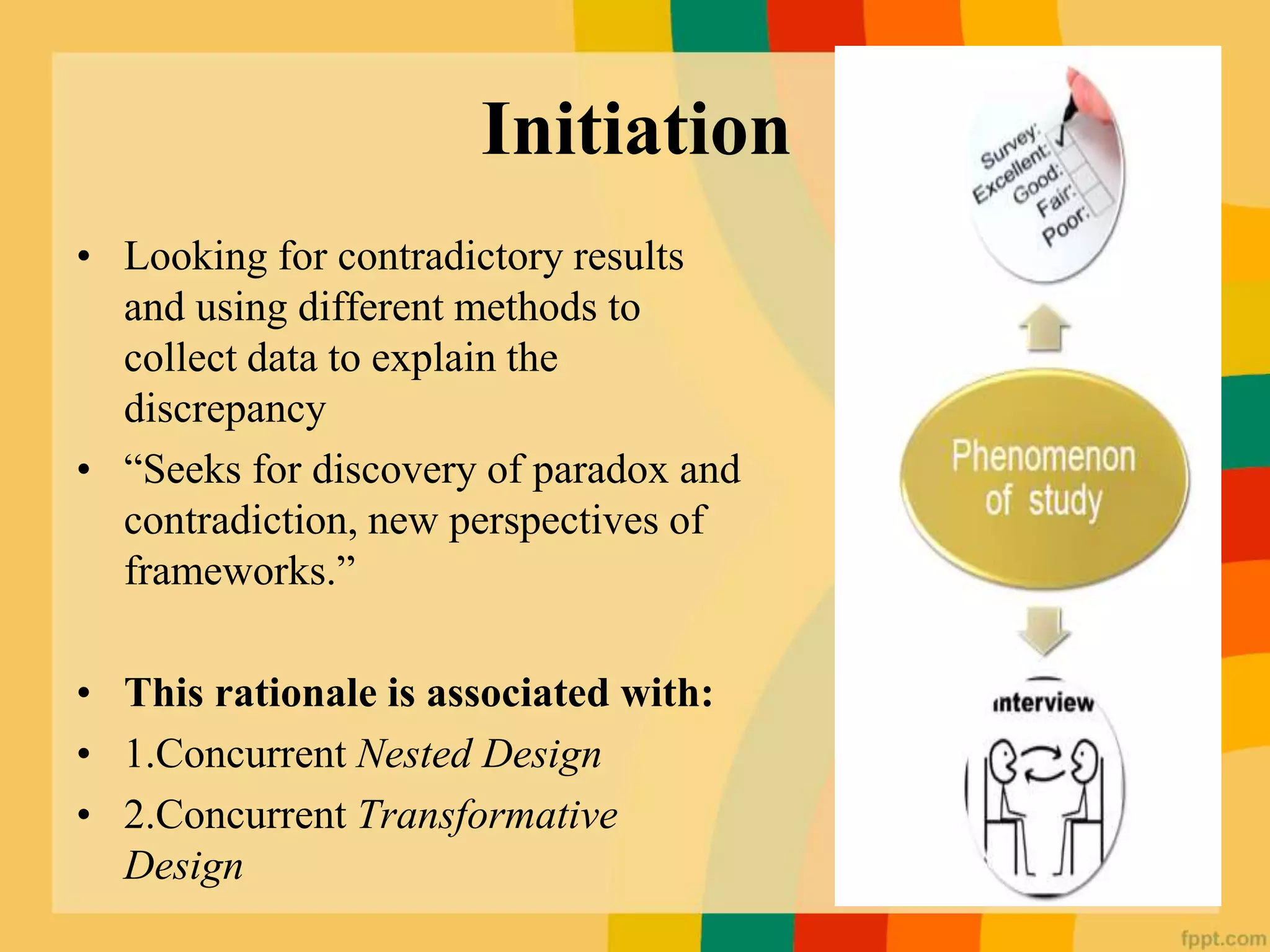
Initiation
• Looking for contradictory results
and using different methods to
collect data to explain the
discrepancy
• “Seeks for discovery of paradox and
contradiction, new perspectives of
frameworks.”
• This rationale is associated with:
• 1.Concurrent Nested Design
• 2.Concurrent Transformative
Design
DETERMINING AN APPROPRIATE MIXED
METHODS DESIGN
• Think about:
a. Sequence of the data collection
b. Kinds of data you plan to collect
c. Source of the data
• Develop research questions
• Determine the roles of qualitative and quantitative
components of the study
• Decide which mixed methods designs with their
rationales best fit the roles of a qualitative and
quantitative component (i.e. determining consistency)
STEP 1
• Think about:
a. Sequence of the data collection
(concurrent or sequential)
b. Kinds of data you plan to collect
c. Source(s) of the data
EXAMPLE
• Purpose Statement
The purpose of the study is to determine the relationship
between mental health stigma and help seeking behaviors
among teens with mental health problems in a low income
neighborhood in Udupi, Mangalore.
In addition, the study will focus on examining how they seek
for help to address their mental health problems.
STEP 2
• Develop Research Questions
1. Is there a correlation between mental health stigma and help
seeking behaviors among teens with mental health problems
in a low income neighborhood in Udupi, Mangalore?
2. How do teens with mental health problems seek for help or
mental heath services?
STEP 3
• Determine the roles of qualitative
and quantitative components of
the study
• Research Questions
1. Is there a correlation between mental
health stigma and help seeking
behaviors among teens with mental
health problems in a low income
neighborhood in Udupi, Mangalore?
1. How do teens with mental health
problem seek for help or mental heath
services?
STEP 4
• Decide which mixed methods designs with their rationales
best fit the roles of qualitative and quantitative components
(i.e. determining consistency)
PROCESS OF CONDUCTING A MIXED
METHOD STUDIES
SAMPLING IN MIXED METHOD
STUDY
• Onwuegbuzie and Collins (2007) have categorized
mixed methods sampling designs according to the
relationship between the quantitative and qualitative
components.
• IDENTICAL RELATIONSHIP
• It occurs when exactly the same person are in both
components of the study.
• This approach might occur if everyone in a survey or
intervention study was asked a series of probing, open ended
questions - or if everyone in a primarily QUAL study was
administered a formal instrument such as a self efficacy scale.
• PARALLEL RELATIONSHIP
• The samples in the two strands are completely different,
although they are usually drawn from the same or a similar
population.
• It can occur in either concurrent or sequential designs and with
any of the prioritization schemes.
• NESTED RELATIONSHIP
• The participants in the qualitative strand are a subset
of the participants in the qualitative strand.
• It is a common sampling approach in MM studies,
especially in those with an explanatory design.
• MULTILEVEL RELATIONSHIP
• It involves selecting samples from different levels of
hierarchy.
• This means sampling from different but related
populations (e.g. hospital administrators, clinical staff
and patients).
DATA COLLECTION
• Can be creatively combined in a mixed method study.
• Possible sources of data for MM studies include group and
individual interviews, psychosocial scales, observations, bio-
physiologic measures, records, diaries, internet postings,
photographs and physical artifacts.
• Johnson and Turner (2003) noted that MM studies can involve both:
 Intramethod mixing (e.g. structured and unstructured self
reports)
 Intermethod mixing (e.g. biophysiologic measures and in-
depth interviews).
ANALYSIS OF MIXED MEHOD
DATA
• Analysis occurs both within the quantitative (descriptive and
inferential numeric analysis) and the qualitative (description
and thematic text or image analysis) approach and often
between the two approaches.
• Data transformation: A researcher may quantify the
qualitative data. This involves creating codes and themes
qualitatively. Then counting the number of times they occur in
the text data .This quantification of qualitative data then
enables a researcher to compare quantitative results with the
qualitative data.
• Explore outliers: In a sequential model or an analysis of
quantitative data in the first phase can yield extreme or outlier
cases.
• Instrument development: In a sequential approach,
obtain themes and specimen from participants in an
initial qualitative data collection.
• In the next, specific items and the themes for scales to
create a survey instrument that is grounded in the
views of the participants.
• A third, final phase might be to validate the
instrument with a large sample representative of a
population.
• Examine multiple levels: In a concurrent embedded
model, conduct a survey at one level (e.g., with
families) to gather quantitative results about a sample.
• At the same time, collect qualitative interviews (e.g.,
with individuals) to explore the phenomenon with
specific individuals in the families.
• Create a meta matrix: When comparing data in a concurrent
type of approach, combine information from both the
quantitative and qualitative data collection into a matrix.
• The horizontal axis of this matrix could be a quantitative
categorical variable (e.g., type of provider-nurse, physician,
and medical assistant)
• The vertical axis would be the qualitative data (e.g., five
themes about caring relationships between providers and
patients).
• Information in the cells could be either quotes from the
qualitative data, counts of the number of codes from the
qualitative data, or some combination.
PILLAR INTERGRATION PROCESS
4 STAGES
STAGE 1- LISTING
• Raw Data/ Group data- “listed” – QUANT DATA/
CATEGORIES or QUAL DATA/CATEGORIES
columns
• Comprehensive listing: all codes or data identified
• Selective listing: Particular codes or data identified
STAGE 2- MATCHING
• Matching process proceeds on the opposite side of the joint
display.
• QUANT DATA: QUAL CODES
• During the matching stage, the researcher matches the opposite
column data reflecting content that relates to the initial listed
data, horizontally aligning similar data, and refining and
organizing categories that had been generated in the two
‘‘categories’’ columns.
• Each list is organized and compared across rows of the joint
display so that the qualitative items reflect patterns, parallels,
similarities, or any other relational quality with the quantitative
items.
STAGE 3- CHECKING/
REFLECTING
• Once the data are matched and the researcher
is satisfied with the accuracy of the match, the
data are checked for quality purposes.
• All data in the four completed outside columns
need to be cross-checked for completeness to
ensure the rows are appropriately matched.
STAGE 4- PILLAR BUILDING
• Compares and contrasts the findings that have
developed from the listing, matching and
checking stages, and conceptualizes the
insights identified from connecting and
integrating the qualitative and quantitative
columns.
• Builds inferences about what patterns, insights,
or themes have emerged and the possible
explanations.
• They locate these themes in the PILLAR
column. The PILLAR holds the integrated
themes from each row.
• When all the themes in the PILLAR column
are viewed together, the researcher can begin
to weave together a meaningful narrative from
the integration of quantitative and qualitative
data.
APPLICATION OF MIXED METHOD
RESEARCH
• Instrument Development
• Intervention Development
STRENGTH OF MIXED METHOD
RESEARCH
• Can be easy to describe and to report
• Can be useful when unexpected results arise from a
prior study
• Can help to generalize qualitative data
• Helpful in designing and validating an instrument
• Can position research in a transformative framework
WEAKNESS OF MIXED METHOD
RESEARCH
• Time required.
• Discrepancies between different types of data.
• Can be difficult to decide when to proceed in
sequential designs.
• Little guidance on transformative method
MIXED METHODS DESIGN DECISION
TOOL (MMDDT)
• Using Mixed Methods Design Decision Tool
(MMDDT) to guide you to choose an appropriate
mixed methods design.
https://www.surveymonkey.com/r/Choosing_Appropriate_Mix
ed_Methods_Design
Czuber-Dochan, W., Norton, C., Bassett, P., Berliner, S., Bredin, F., & Darvell,
M. et al. (2014). Development and psychometric testing of inflammatory
bowel disease fatigue (IBD-F) patient self-assessment scale. Journal Of
Crohn's And Colitis, 8(11), 1398-1406.
http://dx.doi.org/10.1016/j.crohns.2014.04.013
The authors from London used a five-step sequential mixed method design to
develop a fatigue scale specific to the needs and experiences of people with IBD.
The authors implemented a qualitative phase to assess patients' experience of
fatigue and its impact on their lives, and four mixed qualitative – quantitative
phases to refine the scale and to assess its psychometric properties. The participants
in the study confirmed that fatigue in IBD is burdensome. The author concluded
that the items generated and refined by people with IBD-fatigue reflect their
experience and form the basis of this new IBD-fatigue scale, which is
psychometrically robust with reliability estimates which fall within statistically
acceptable ranges. The scale can be used by patients and practitioners to assess
severity and impact of fatigue in people with IBD.
Jacobsen, F., Mekki, T., Førland, O., Folkestad, B., Kirkevold, Ø., & Skår, R. et al.
(2017). A mixed method study of an education intervention to reduce use of restraint
and implement person-centered dementia care in nursing homes. BMC
Nursing, 16(1). http://dx.doi.org/10.1186/s12912-017-0244-0
The author draws on a mixed-method intervention study to investigate which factors hindered or
facilitated staff awareness related to confidence building initiatives based on person-centered
care, as an alternative to restraint in residents with dementia in nursing homes. The education
intervention, consisting of a two-day seminar and monthly coaching sessions for six months,
targeted nursing staff in 24 nursing homes in Western Norway. The authors used P-CAT
(Person-centered Care Assessment Tool) and QPS-Nordic (The General Nordic questionnaire
for psychological and social factors at work) instruments to measure staff effects in terms of
person-centered care and perception of leadership. The qualitative data were collected through
ethnographic fieldwork, qualitative interviews and analysis of 84 reflection notes from eight
persons in the four teams who facilitated the intervention. The study highlighted that
leadership, in interplay with staff culture, turned out to be the most important factor hindering
or promoting staff awareness related to confidence building initiatives, based on person-
centered care. While quantitative data indicated variations across institutions and the extent of
this variation, qualitative data offered insight into the local processes involved. A mixed
method approach enabled understanding of dynamic contextual relationships.
Catallo, C., Jack, S., Ciliska, D., & MacMillan, H. (2013). Mixing a Grounded
Theory Approach with a Randomized Controlled Trial Related to Intimate
Partner Violence: What Challenges Arise for Mixed Methods
Research?. Nursing Research And Practice, 2013, 1-12.
http://dx.doi.org/10.1155/2013/798213
• The authors from MacMaster University employed a two-phase sequential
explanatory mixed methods study in Canada to understand how women decide to
disclose intimate partner violence in emergency department settings. The authors
tried to describe the process of implementing a sequential explanatory mixed
methods study involving a randomized, controlled trial (RCT) with a sub analysis
of quantitative data and a qualitative grounded theory approach. The main highlight
of this study is this study’s use of grounded theory as an equally weighted approach
alongside the RCT to improve the depth and richness of results when examining a
complex intervention. The most significant limitation of this study was beginning
this mixed methods study after the overall RCT was underway. This research areas
in nursing that can benefit from this type of mixed methods design such as the
evaluation of nursing interventions, exploration of patient centered care, in depth
exploration of complex phenomena, and instrument development and testing.
Burns, N., & Grove, S. K. (2008). Understanding Nursing
Research (4 ed.). Missouri: Saunders.
Brockopp, D., Hastings-Tolsma, M..(2003). Fundamentals of
Nursing Research.( 3rd ed). Boston: Jones & Bartlett.
Creswell, J.W. (2009). Research Design- Qualitative, Quantative
& Mixed Method Approach (3rd ed). Sage
Grove, S., Burns, N., Gray, J. (2013). The Practice of Nursing
Research. (7th ed). Missouri: Elsevier.
Parahoo, K. (2006).Nursing research. (2nd ed). S.l.: Palgrave
Macmillan.
Polit, D., Beck, C. (2017). Nursing Research. (10th ed).
Philadelphia: Lippincott Wolters Kluwer.
Sharma, S. (2012). Nursing Research and Statistics. Haryana:
Elsevier.
Wood, G., Haber, J. (2010). Nursing Research. (7th ed).
Missouri: Mosby Elsevier.
Mixed method research

Mixed method research

  • 1.
  • 2.
    THREE MAIN FACTSABOUT QUALITATIVE AND QUANTITATIVE METHODS • There are fundamental differences between qualitative and quantitative methods. • Each of them has strengths and weaknesses • Both can be used in a single study to adequately address a research problem
  • 3.
    BASIC DIFFERENCES BETWEENQUANTITATIVE AND QUALITATIVE RESEARCH Qualitative (Exploratory) Study (making observations to develop theory) Philosophical assumptions Subjectivity Contextualization Inductive reasoning Depth Words Qualitative approaches Narrative Phenomenology Grounded theory Ethnography Case study Quantitative (Confirmatory) Study (making observations to test theory) Philosophical assumptions Objectivity Generalisability Deductive reasoning Breadth Numbers Quantitative approaches Descriptive study Correlational study Quasi-experimental study Experimental study
  • 4.
    INTRODUCTION • Also knownas Multi method research or Mixed method research. • Mixed Research as a method, focuses on collecting, analyzing, and mixing both quantitative and qualitative data in a single study or series of studies. • “Third Research Paradigm”
  • 5.
    DEFINITION Mixed method researchis a type of research in which a researcher combines elements of qualitative and quantitative research approaches (eg. Use of qualitative and quantitative viewpoints, data collection, analysis and inference technique) for the purpose of breadth and depth of understanding and corroboration. Johnson et al (2007)
  • 7.
    DEFINITION • Mixed methodsresearch is a procedure for collecting, analyzing and “mixing” both quantitative and qualitative methods in a single study or a series of studies to understand a research problem. Creswell & Plano Clark(2011)
  • 8.
    PURPOSE • The conceptsare new and poorly understood and there is a need for qualitative exploration before more formal, structured methods can be used. • Neither a qualitative nor a quantitative approach, by itself, is adequate in addressing the complexity of the research problem. • The findings from one approach can be greatly enhanced with a second source of data.
  • 9.
    • The quantitativeresults are puzzling and difficult to interpret and qualitative data can help to explain the results. • A particular theoretical perspective might require both qualitative and quantitative data. • A multiphase project is needed to attain key objectives, such as the development and assessment of an intervention.
  • 10.
    ESSENCE OF MIXEDMETHODS RESEARCH 1. Enriching the findings 2. Increasing the depth and breadth 3. Testing a theory or model 4. Seeking for participants’ inputs 5. Improving the trustworthiness
  • 11.
    RATIONALE FOR MIXEDMETHOD STUDIES Complementarity Practicality Incrementality Enhanced validity Collaboration
  • 12.
    CHARECTERISTICS • Collect andanalyze both quantitative and qualitative data. • Mix two forms of data in different ways. • Give priority to one or both forms of data. • Can be in a single study or in multiple phases of a study. • Design can be based on either or both perspectives.
  • 13.
    • Research problemscan become research questions and/or hypotheses based on prior literature, knowledge, experience, or the research process. • Sample sizes vary based on methods used. • Data collection can involve any technique available to researchers. • Interpretation is continual and can influence stages in the research process.
  • 14.
    PLANNING MIXED METHODS PROCEDURES TIMING •Timing of their qualitative and quantitative data collection, whether it will be in phases (sequentially) or gathered at the same time (concurrently). • When qualitative data are collected first, the intent is to explore the topic with participants at sites. Then the researcher expands the understanding through a second phase in which data are collected from a large number of people. • When data are collected concurrently, both quantitative and qualitative data are gathered at the same time and the implementation is simultaneous.
  • 15.
    • Concurrent: Qualitativeand quantitative data collection happens at the same time. • Sequential: The researcher implements the strands in two distinct phases. • Multiphase: The researcher does both concurrent and sequential data collection and analysis over a longer period of time.
  • 16.
    WEIGHTING • The rightpriority given to quantitative or qualitative research in a particular study. • In some studies, the weight might be equal; in other studies, it might emphasize one or the other. • A priority for one type depends on the interests of the researcher, the audience for the study (e.g., faculty committee, professional association), and what the investigator seeks to emphasize in the study.
  • 17.
    MIXING • Occur atseveral stages: the data collection, the data analysis, interpretation, or at all three phases. • Mixing means either that the qualitative and quantitative data are actually merged on one end of the continuum, kept separate on the other end of the continuum, or combined in some way between these two extremes.
  • 18.
    THEORIZING OR TRANSFORMING PERSPECTIVES •Guides the entire design. It may be a theory from the social sciences or a broad theoretical lens. • All researchers bring theories and frameworks to their inquires and these theories may be made explicit in a mixed methods study or be implicit and not mentioned. • In mixed methods studies, the theories are found typically in the beginning sections as an orienting lens that shapes the types of questions asked, who participates in the study, how data are collected, and the implications made from the study.
  • 19.
  • 20.
    Morse’s notation system •Designated by upper case and lower case letters • QUAL/quan designate a mixed methods study in which the dominant approach is qualitative, while QUAN/qual designates the reverse. • If neither approach is dominant (i.e., both are equal), the notation stipulates QUAL/QUAN. • Sequencing in this system is indicated by the symbols + or →. The arrow designates a sequential approach.
  • 21.
    Example • QUAN →qual is the notation for a primarily quantitative MM study in which qualitative data collection occurs in Phase II. • When both approaches occur concurrently, a plus sign is used (e.g., QUAL + quan).
  • 22.
    Creswell and PlanoClark • Creswell and Plano Clark (2007) have suggested a modification of Morse’s notation to include the use of parentheses, which designate an embedded design structure. • The notation QUAN(qual) indicates a design in which the qualitative methods are embedded within a quantitative design.
  • 23.
    Visual Diagram Collect qual data Analysequal data Obtain qual findings Develop instrument Collect QUAN data Analyse QUAN data Develop overall quall- QUAN interpretations PHASE I PHASE II
  • 24.
    TYPES OF MIXEDMETHODS DESIGN Sequential Designs (a) Sequential Explanatory Design (b) Sequential Exploratory Design (c) Sequential Transformative Design Concurrent Designs (a) Concurrent Triangulation Design (b) Concurrent Nested Design (c) Concurrent Transformative Design
  • 25.
    SEQUENTIAL EXPLANATORY • Characterizedby: Collection and analysis of quantitative data followed by a collection and analysis of qualitative data. • Purpose: To use qualitative results to assist in explaining and interpreting the findings of a quantitative study.
  • 27.
    • Advantages: Theyare straightforward and easy to describe and can be done by a single researcher. The results can often be summarized in two separate papers. • Disadvantages: Can be time consuming. The second phase cannot begin until data from the first phase are analyzed. • Example: Mixing a Grounded Theory Approach with a Randomized Controlled Trial Related to Intimate Partner Violence: What Challenges Arise for Mixed Methods Research?
  • 28.
    When do youuse it? • When you want to explain the quantitative results in more depth with qualitative data (e.g., statistical differences among groups, individuals who scored at extreme levels). • When you want to identify appropriate participants to study in more depth qualitatively.
  • 29.
    SEQUENTIAL EXPLORATORY • Characterizedby: An initial phase of qualitative data collection and analysis followed by a phase of quantitative data collection and analysis. • Purpose: To explore a phenomenon. This strategy may also be useful when developing and testing a new instrument.
  • 31.
    Two variants: • Instrumentdevelopment model: Data from the qual phase are used in the development of Quan instruments. • Theory development: The researcher identifies important constructs and develops a theory, taxonomy or classification system grounded in the in depth data gathered during the QUAL phase. Then the quan phase is used to test or explore the taxonomy or theory with a broader group.
  • 32.
    • Advantages: Theyare straightforward and easy to describe and can be done by a single researcher. Separate phases make the inquiry easy to explain, implement and report. • Disadvantages: Can be time consuming. The second phase cannot begin until data from the first phase are analyzed. Difficult to get a front approval from ethics committee. • Example: Development and psychometric testing of inflammatory bowel disease fatigue (IBD-F) patient self- assessment scale.
  • 33.
    When do youuse it? • To develop an instrument when one is not available (first explore, then develop instrument) • To develop a classification or typology for testing • To identify the most important variables to study quantitatively when these variable are not known
  • 34.
    SEQUENTIAL TRANSFORMATIVE • Characterizedby: Collection and analysis of either quantitative or qualitative data first. The results are integrated in the interpretation phase. • Purpose: To employ the methods that best serve a theoretical perspective.
  • 36.
    CONCURRENT TRIANGULATION • Characterizedby: Two or more methods used to confirm, cross-validate, or corroborate findings within a study. Data collection is concurrent. • Purpose: Generally, both methods are used to overcome a weakness in using one method with the strengths of another.
  • 38.
    When do youuse it? • When you want to combine the advantages of quantitative (trends, large numbers, generalization) with qualitative (detail, small numbers, in-depth) • When you want to validate your quantitative findings with qualitative data • When you want to expand your quantitative findings with some open-ended qualitative data (e.g., survey with closed- and open-ended data)
  • 39.
    CONCURRENT NESTED • Characterizedby: A nested approach that gives priority to one of the methods and guides the project, while another is embedded or “nested.” • Purpose: The purpose of the nested method is to address a different question than the dominant or to seek information from different levels.
  • 41.
    CONCURRENT TRANSFORMATIVE • Characterizedby: The use of a theoretical perspective reflected in the purpose or research questions of the study to guide all methodological choices. • Purpose: To evaluate a theoretical perspective at different levels of analysis.
  • 43.
    METHODOLOGICAL RATIONALE OF MIXEDMETHODS DESIGN 1. Triangulation 2. Complementarity 3. Development 4. Expansion 5. Initiation (Plano Clark, & Creswell, 2008)
  • 44.
    Questions to reflecton  Why do you plan to use both qualitative and quantitative methods in your study?  Why do you plan to use more than one data collection strategy?  Why do you plan to collect both qualitative and quantitative data?  What are the use of the qualitative and quantitative data or findings in your study?
  • 45.
    Triangulation • Using differentmethods to address the same phenomenon • “Seeks convergence, corroboration, correspondence of results from the different methods” • This rationale is associated with: Concurrent Triangulation Design
  • 46.
    Complementarity • Using differentmethods to address the different parts of a phenomenon • “Seeks elaboration, enhancement, illustration, andclarification of results.” • This rationale is associated with: 1.Sequential Explanatory D esign 2.Sequential Exploratory Design 3.Sequential Transformative Design 4.Concurrent Nested Design 5.Concurrent Transformative Design
  • 47.
    Development • Using theresults of one method to inform the other method • “Seeks to use the results from one method to help develop or inform the other method...” • This rationale is associated with: • 1.Sequential Exploratory Design • 2.Sequential Transformative Design
  • 48.
    Expansion • Using differentmethods to address the different parts of a phenomenon • “Seeks to extend the breadth and range of inquiry.” • This rationale is associated with: 1.Sequential Exploratory Design 2.Sequential Transformative Design 3.Concurrent Nested Design 4.Concurrent Transformative Design
  • 49.
    Initiation • Looking forcontradictory results and using different methods to collect data to explain the discrepancy • “Seeks for discovery of paradox and contradiction, new perspectives of frameworks.” • This rationale is associated with: • 1.Concurrent Nested Design • 2.Concurrent Transformative Design
  • 51.
    DETERMINING AN APPROPRIATEMIXED METHODS DESIGN • Think about: a. Sequence of the data collection b. Kinds of data you plan to collect c. Source of the data • Develop research questions • Determine the roles of qualitative and quantitative components of the study • Decide which mixed methods designs with their rationales best fit the roles of a qualitative and quantitative component (i.e. determining consistency)
  • 52.
    STEP 1 • Thinkabout: a. Sequence of the data collection (concurrent or sequential) b. Kinds of data you plan to collect c. Source(s) of the data
  • 53.
    EXAMPLE • Purpose Statement Thepurpose of the study is to determine the relationship between mental health stigma and help seeking behaviors among teens with mental health problems in a low income neighborhood in Udupi, Mangalore. In addition, the study will focus on examining how they seek for help to address their mental health problems.
  • 55.
    STEP 2 • DevelopResearch Questions 1. Is there a correlation between mental health stigma and help seeking behaviors among teens with mental health problems in a low income neighborhood in Udupi, Mangalore? 2. How do teens with mental health problems seek for help or mental heath services?
  • 56.
    STEP 3 • Determinethe roles of qualitative and quantitative components of the study • Research Questions 1. Is there a correlation between mental health stigma and help seeking behaviors among teens with mental health problems in a low income neighborhood in Udupi, Mangalore? 1. How do teens with mental health problem seek for help or mental heath services?
  • 57.
    STEP 4 • Decidewhich mixed methods designs with their rationales best fit the roles of qualitative and quantitative components (i.e. determining consistency)
  • 58.
    PROCESS OF CONDUCTINGA MIXED METHOD STUDIES
  • 59.
    SAMPLING IN MIXEDMETHOD STUDY • Onwuegbuzie and Collins (2007) have categorized mixed methods sampling designs according to the relationship between the quantitative and qualitative components.
  • 60.
    • IDENTICAL RELATIONSHIP •It occurs when exactly the same person are in both components of the study. • This approach might occur if everyone in a survey or intervention study was asked a series of probing, open ended questions - or if everyone in a primarily QUAL study was administered a formal instrument such as a self efficacy scale. • PARALLEL RELATIONSHIP • The samples in the two strands are completely different, although they are usually drawn from the same or a similar population. • It can occur in either concurrent or sequential designs and with any of the prioritization schemes.
  • 61.
    • NESTED RELATIONSHIP •The participants in the qualitative strand are a subset of the participants in the qualitative strand. • It is a common sampling approach in MM studies, especially in those with an explanatory design. • MULTILEVEL RELATIONSHIP • It involves selecting samples from different levels of hierarchy. • This means sampling from different but related populations (e.g. hospital administrators, clinical staff and patients).
  • 62.
    DATA COLLECTION • Canbe creatively combined in a mixed method study. • Possible sources of data for MM studies include group and individual interviews, psychosocial scales, observations, bio- physiologic measures, records, diaries, internet postings, photographs and physical artifacts. • Johnson and Turner (2003) noted that MM studies can involve both:  Intramethod mixing (e.g. structured and unstructured self reports)  Intermethod mixing (e.g. biophysiologic measures and in- depth interviews).
  • 63.
    ANALYSIS OF MIXEDMEHOD DATA • Analysis occurs both within the quantitative (descriptive and inferential numeric analysis) and the qualitative (description and thematic text or image analysis) approach and often between the two approaches.
  • 64.
    • Data transformation:A researcher may quantify the qualitative data. This involves creating codes and themes qualitatively. Then counting the number of times they occur in the text data .This quantification of qualitative data then enables a researcher to compare quantitative results with the qualitative data. • Explore outliers: In a sequential model or an analysis of quantitative data in the first phase can yield extreme or outlier cases.
  • 65.
    • Instrument development:In a sequential approach, obtain themes and specimen from participants in an initial qualitative data collection. • In the next, specific items and the themes for scales to create a survey instrument that is grounded in the views of the participants. • A third, final phase might be to validate the instrument with a large sample representative of a population.
  • 66.
    • Examine multiplelevels: In a concurrent embedded model, conduct a survey at one level (e.g., with families) to gather quantitative results about a sample. • At the same time, collect qualitative interviews (e.g., with individuals) to explore the phenomenon with specific individuals in the families.
  • 67.
    • Create ameta matrix: When comparing data in a concurrent type of approach, combine information from both the quantitative and qualitative data collection into a matrix. • The horizontal axis of this matrix could be a quantitative categorical variable (e.g., type of provider-nurse, physician, and medical assistant) • The vertical axis would be the qualitative data (e.g., five themes about caring relationships between providers and patients). • Information in the cells could be either quotes from the qualitative data, counts of the number of codes from the qualitative data, or some combination.
  • 70.
  • 71.
  • 72.
    STAGE 1- LISTING •Raw Data/ Group data- “listed” – QUANT DATA/ CATEGORIES or QUAL DATA/CATEGORIES columns • Comprehensive listing: all codes or data identified • Selective listing: Particular codes or data identified
  • 73.
    STAGE 2- MATCHING •Matching process proceeds on the opposite side of the joint display. • QUANT DATA: QUAL CODES • During the matching stage, the researcher matches the opposite column data reflecting content that relates to the initial listed data, horizontally aligning similar data, and refining and organizing categories that had been generated in the two ‘‘categories’’ columns. • Each list is organized and compared across rows of the joint display so that the qualitative items reflect patterns, parallels, similarities, or any other relational quality with the quantitative items.
  • 74.
    STAGE 3- CHECKING/ REFLECTING •Once the data are matched and the researcher is satisfied with the accuracy of the match, the data are checked for quality purposes. • All data in the four completed outside columns need to be cross-checked for completeness to ensure the rows are appropriately matched.
  • 75.
    STAGE 4- PILLARBUILDING • Compares and contrasts the findings that have developed from the listing, matching and checking stages, and conceptualizes the insights identified from connecting and integrating the qualitative and quantitative columns.
  • 76.
    • Builds inferencesabout what patterns, insights, or themes have emerged and the possible explanations. • They locate these themes in the PILLAR column. The PILLAR holds the integrated themes from each row. • When all the themes in the PILLAR column are viewed together, the researcher can begin to weave together a meaningful narrative from the integration of quantitative and qualitative data.
  • 77.
    APPLICATION OF MIXEDMETHOD RESEARCH • Instrument Development • Intervention Development
  • 78.
    STRENGTH OF MIXEDMETHOD RESEARCH • Can be easy to describe and to report • Can be useful when unexpected results arise from a prior study • Can help to generalize qualitative data • Helpful in designing and validating an instrument • Can position research in a transformative framework
  • 79.
    WEAKNESS OF MIXEDMETHOD RESEARCH • Time required. • Discrepancies between different types of data. • Can be difficult to decide when to proceed in sequential designs. • Little guidance on transformative method
  • 80.
    MIXED METHODS DESIGNDECISION TOOL (MMDDT) • Using Mixed Methods Design Decision Tool (MMDDT) to guide you to choose an appropriate mixed methods design. https://www.surveymonkey.com/r/Choosing_Appropriate_Mix ed_Methods_Design
  • 82.
    Czuber-Dochan, W., Norton,C., Bassett, P., Berliner, S., Bredin, F., & Darvell, M. et al. (2014). Development and psychometric testing of inflammatory bowel disease fatigue (IBD-F) patient self-assessment scale. Journal Of Crohn's And Colitis, 8(11), 1398-1406. http://dx.doi.org/10.1016/j.crohns.2014.04.013 The authors from London used a five-step sequential mixed method design to develop a fatigue scale specific to the needs and experiences of people with IBD. The authors implemented a qualitative phase to assess patients' experience of fatigue and its impact on their lives, and four mixed qualitative – quantitative phases to refine the scale and to assess its psychometric properties. The participants in the study confirmed that fatigue in IBD is burdensome. The author concluded that the items generated and refined by people with IBD-fatigue reflect their experience and form the basis of this new IBD-fatigue scale, which is psychometrically robust with reliability estimates which fall within statistically acceptable ranges. The scale can be used by patients and practitioners to assess severity and impact of fatigue in people with IBD.
  • 83.
    Jacobsen, F., Mekki,T., Førland, O., Folkestad, B., Kirkevold, Ø., & Skår, R. et al. (2017). A mixed method study of an education intervention to reduce use of restraint and implement person-centered dementia care in nursing homes. BMC Nursing, 16(1). http://dx.doi.org/10.1186/s12912-017-0244-0 The author draws on a mixed-method intervention study to investigate which factors hindered or facilitated staff awareness related to confidence building initiatives based on person-centered care, as an alternative to restraint in residents with dementia in nursing homes. The education intervention, consisting of a two-day seminar and monthly coaching sessions for six months, targeted nursing staff in 24 nursing homes in Western Norway. The authors used P-CAT (Person-centered Care Assessment Tool) and QPS-Nordic (The General Nordic questionnaire for psychological and social factors at work) instruments to measure staff effects in terms of person-centered care and perception of leadership. The qualitative data were collected through ethnographic fieldwork, qualitative interviews and analysis of 84 reflection notes from eight persons in the four teams who facilitated the intervention. The study highlighted that leadership, in interplay with staff culture, turned out to be the most important factor hindering or promoting staff awareness related to confidence building initiatives, based on person- centered care. While quantitative data indicated variations across institutions and the extent of this variation, qualitative data offered insight into the local processes involved. A mixed method approach enabled understanding of dynamic contextual relationships.
  • 84.
    Catallo, C., Jack,S., Ciliska, D., & MacMillan, H. (2013). Mixing a Grounded Theory Approach with a Randomized Controlled Trial Related to Intimate Partner Violence: What Challenges Arise for Mixed Methods Research?. Nursing Research And Practice, 2013, 1-12. http://dx.doi.org/10.1155/2013/798213 • The authors from MacMaster University employed a two-phase sequential explanatory mixed methods study in Canada to understand how women decide to disclose intimate partner violence in emergency department settings. The authors tried to describe the process of implementing a sequential explanatory mixed methods study involving a randomized, controlled trial (RCT) with a sub analysis of quantitative data and a qualitative grounded theory approach. The main highlight of this study is this study’s use of grounded theory as an equally weighted approach alongside the RCT to improve the depth and richness of results when examining a complex intervention. The most significant limitation of this study was beginning this mixed methods study after the overall RCT was underway. This research areas in nursing that can benefit from this type of mixed methods design such as the evaluation of nursing interventions, exploration of patient centered care, in depth exploration of complex phenomena, and instrument development and testing.
  • 85.
    Burns, N., &Grove, S. K. (2008). Understanding Nursing Research (4 ed.). Missouri: Saunders. Brockopp, D., Hastings-Tolsma, M..(2003). Fundamentals of Nursing Research.( 3rd ed). Boston: Jones & Bartlett. Creswell, J.W. (2009). Research Design- Qualitative, Quantative & Mixed Method Approach (3rd ed). Sage Grove, S., Burns, N., Gray, J. (2013). The Practice of Nursing Research. (7th ed). Missouri: Elsevier.
  • 86.
    Parahoo, K. (2006).Nursingresearch. (2nd ed). S.l.: Palgrave Macmillan. Polit, D., Beck, C. (2017). Nursing Research. (10th ed). Philadelphia: Lippincott Wolters Kluwer. Sharma, S. (2012). Nursing Research and Statistics. Haryana: Elsevier. Wood, G., Haber, J. (2010). Nursing Research. (7th ed). Missouri: Mosby Elsevier.