SUBMITTED BY
Vincy Wilson
M.Ed
Roll No. 35
INTRODUCTION
Ex post facto is Latin for
"from a thing done
afterward". ...
Ex post facto research is deal for
conducting social research when is not
possible or acceptable to manipulate the
characteristics of human participants
CHARACTERISTICS OF EX POST
FACTO RESEARCH
a) The research has a control or a
comparison group
b) The behaviour, action, event or
independent variable of the
research cannot be manipulated
c) The research focuses on the effects
d) The research tries to analyse the
‘how’ and ‘what’ aspect of an
event
e) Explores possible effects and
causes
TWO APPROACHES TO EX POST
FACTO RESEARCH
I. One commences with subjects who
differ on an independent variable
II. One commences with subjects who
differ on the dependent variable
STEPS OF EX POST FACTO
RESEARCH
Step 1. Determining the problem
Step 2. Literature Review
Step 3. Formulation of hypothesis
Step 4. Designing the approach
Step 5. Validity of the research
Step 6. Interpretation of the
conclusion
STRENGTHS AND
WEAKNESSES OF EX POST
FACTO RESEARCH
STRENGTHS ARE:
 It is considered as a very relevant method in
those behavioural researches where the
variables can not be manipulated or altered.
 It is more useful than an experimental
research as it can be used in analysing a
cause on basis of the effect, which is
impossible in an experimental research.
It is less time consuming as well as
economical.
Ex-Post Facto Research It gives a chance
to the researcher to analyse on basis of
his personal opinion and then come out
with the best possible conclusion.
WEAKNESSES ARE:
The researcher can not manipulate
the independent variables.
 The researcher can not randomly
assign the subjects to different
groups.
The researcher may not be
able to provide a reasonable
explanation for the relationship
between the independent and
dependent variables under
study
CONCLUSION
An ex post facto research design is a method in
which groups with qualities that already exist
are compared on some dependent variable.
Also known as "after the fact" research, an ex
post facto design is considered quasi-
experimental because the subjects are not
randomly assigned - they are grouped based on
a particular characteristic or trait.
REFERENCES
WWW.dissertationrecipes.com> Ex post facto
research – dissertation recipes
https://www.slideshare.net> emix1028
https://www.slideshare.net> Ex post facto research
method
Kerlinger , F.N. (1986). Foundations of behavioural
research (3rd. Ed.). Fort Worth, TX: Holt, Rinehart, &
Winston.
Kerlinger, F.N., & Rint (1986) Foundations of
Behaviour Research. London: Winston Inc.
ex post fact research - ppt

ex post fact research - ppt

  • 1.
  • 3.
    INTRODUCTION Ex post factois Latin for "from a thing done afterward". ...
  • 4.
    Ex post factoresearch is deal for conducting social research when is not possible or acceptable to manipulate the characteristics of human participants
  • 5.
    CHARACTERISTICS OF EXPOST FACTO RESEARCH a) The research has a control or a comparison group b) The behaviour, action, event or independent variable of the research cannot be manipulated
  • 6.
    c) The researchfocuses on the effects d) The research tries to analyse the ‘how’ and ‘what’ aspect of an event e) Explores possible effects and causes
  • 7.
    TWO APPROACHES TOEX POST FACTO RESEARCH I. One commences with subjects who differ on an independent variable II. One commences with subjects who differ on the dependent variable
  • 8.
    STEPS OF EXPOST FACTO RESEARCH Step 1. Determining the problem Step 2. Literature Review Step 3. Formulation of hypothesis
  • 9.
    Step 4. Designingthe approach Step 5. Validity of the research Step 6. Interpretation of the conclusion
  • 10.
    STRENGTHS AND WEAKNESSES OFEX POST FACTO RESEARCH
  • 11.
    STRENGTHS ARE:  Itis considered as a very relevant method in those behavioural researches where the variables can not be manipulated or altered.  It is more useful than an experimental research as it can be used in analysing a cause on basis of the effect, which is impossible in an experimental research.
  • 12.
    It is lesstime consuming as well as economical. Ex-Post Facto Research It gives a chance to the researcher to analyse on basis of his personal opinion and then come out with the best possible conclusion.
  • 13.
    WEAKNESSES ARE: The researchercan not manipulate the independent variables.  The researcher can not randomly assign the subjects to different groups.
  • 14.
    The researcher maynot be able to provide a reasonable explanation for the relationship between the independent and dependent variables under study
  • 16.
    CONCLUSION An ex postfacto research design is a method in which groups with qualities that already exist are compared on some dependent variable. Also known as "after the fact" research, an ex post facto design is considered quasi- experimental because the subjects are not randomly assigned - they are grouped based on a particular characteristic or trait.
  • 17.
    REFERENCES WWW.dissertationrecipes.com> Ex postfacto research – dissertation recipes https://www.slideshare.net> emix1028 https://www.slideshare.net> Ex post facto research method Kerlinger , F.N. (1986). Foundations of behavioural research (3rd. Ed.). Fort Worth, TX: Holt, Rinehart, & Winston. Kerlinger, F.N., & Rint (1986) Foundations of Behaviour Research. London: Winston Inc.

Editor's Notes

  • #9 STEPS OF EX-POST FACTO RESEARCH The process of ex-post facto research is systematic and follows a definite sequence. As mentioned by Isaac and Michael (1971), the following are the steps involved in the expost facto research— Step 1. Determining the problem In an ex-post facto research, it is necessary for the researcher to focus on the problem that he or she needs to study. They not only need to find out a problem, they also need to determine, analyse and define the problem which they will be dealing with. Step 2. Literature Review Before trying to predict the causal relationships, the researcher needs to study all the related or similar literature and relevant studies, which may help in further analysis, prediction and conclusion of the causal relationship between the variables under study. Step 3. Formulation of hypothesis The third step of the ex-post facto research is to propose the possible solutions or alternatives that might have led to the effect. They need to list out the assumptions which will be the basis of the hypothesis and procedure of the research. 24 Types of Research
  • #10 Step 4. Designing the approach Once the problem has been defined and the hypothesis has been postulated, the researcher needs to select the sample which fits the criteria of the study. They also need to select the scale or construct instrument for collecting the required information / data. Once the designing are all finalised, the researcher analyses the relationship between the variables. Step 5. Validity of the research The researcher needs to validate the significance of their research. They need to be cautious regarding the extent to which their findings would be valid and significant and helpful in interpreting and drawing inferences from the obtained results. Step 6. Interpretation of the conclusionFinally, the researcher needs to analyse, evaluate and interpret the information collected. It is on basis of this step only, the researcher selects the best possible alternative of causes which might have led the effect to occur.
  • #12 It is considered as a very relevant method in those behavioural researches where the variables can not be manipulated or altered. The examples of such researches can include many sociological (e.g. delinquency) as well as educational variables ( e.g. achievements).
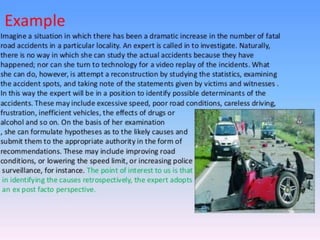
  • #16 EXAMPLE; Imagine a situation in which there has been a dramatic increase in the number of fatal road accidents in a particular locality. An expert is called into investigate. Naturally there is no way in which she can study the actual accidents