



Correlational ResearchCorrelational Research
Inferential/Descriptive Statistic (r)
Describes strength of linear relation between two variables
Strength of relation = degree of association
Does knowing an individual’s score on A tell
you much about that individual’s score on
B? How much does it tell you?
Some properties of r
Ranges between -1 and 1 inclusive
Sign (+ or -) gives direction of relation
Absolute value gives strength
r2
gives proportion of variance accounted for
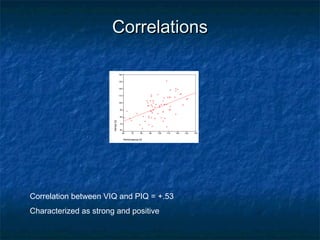
CorrelationsCorrelations
Performance IQ
14013012011010090807060
VerbalIQ
140
130
120
110
100
90
80
70
60
Correlation between VIQ and PIQ = +.53
Characterized as strong and positive
CorrelationsCorrelations
Correlation between C and Behavioral Impulsivity = -.41
Characterized as moderate-strong and negative
underco, i/i, mr, teaimp, eysenck
86420-2-4-6
consicentiousness
8
7
6
5
4
3
2
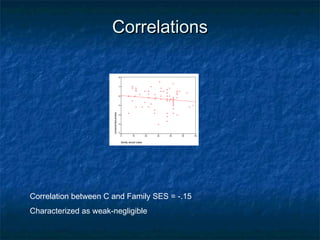
CorrelationsCorrelations
Correlation between C and Family SES = -.15
Characterized as weak-negligible
family social class
6050403020100
consicentiousness
8
7
6
5
4
3
2
Correlational ResearchCorrelational Research
Disadvantages:
1) correlation does not indicate causation
2) problems with self-report method
Advantages:
1) can collect much information from many subjects at one time
2) can study a wide range of variables and their interrelations
3) study variables that are not easily produced in the laboratory
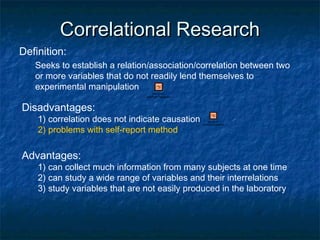
Correlational ResearchCorrelational Research
Definition:
Seeks to establish a relation/association/correlation between two
or more variables that do not readily lend themselves to
experimental manipulation
Disadvantages:
1) correlation does not indicate causation (6slide
causation example)
2) problems with self-report method
Advantages:
1) can collect much information from many subjects at one time
2) can study a wide range of variables and their interrelations
3) study variables that are not easily produced in the laboratory
Microsoft
PowerPoint Presentation
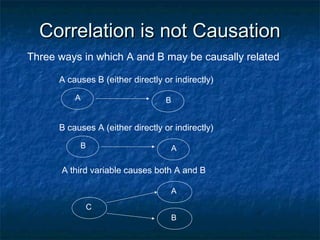
Correlation is not CausationCorrelation is not Causation
Three ways in which A and B may be causally related
A B
A causes B (either directly or indirectly)
B causes A (either directly or indirectly)
B A
A third variable causes both A and B
C
A
B
Correlations Inform CausationCorrelations Inform Causation
Causation implies Correlation
Design or theory informs direction of influence
Specify and measure likely third variables
Control for third variables in model
If association between A and B remains,
then third variable explanation does not hold
If A and B are causally related, they must be correlated
Can model third variable effects
Longitudinal design
Experimental design
Appeal to strong theory
Case In PointCase In Point
Lynam, D.R., Moffitt, T.E., & Stouthamer-Loeber, M.A. (1993).
Explaining the relation between IQ and delinquency:
Class, race, test motivation, school achievement, or self-
control? Journal of Abnormal Psychology, 102, 187-196.
IQ is negatively correlated with delinquency
Think of some ways this relationship could work.
In other words, why or how might lower IQ be
related to delinquency?
What are other possibilities?
Delinquency leads to low IQ?Delinquency leads to low IQ?
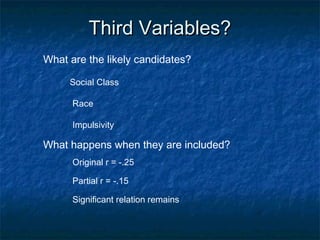
Third Variables?Third Variables?
What are the likely candidates?
Social Class
Impulsivity
Race
What happens when they are included?
Partial r = -.15
Original r = -.25
Significant relation remains
IQIQ Delinquency via SchoolDelinquency via School
Achievement?Achievement?
What happens when school achievement is included?
Correlational ResearchCorrelational Research
Definition:
Seeks to establish a relation/association/correlation between two
or more variables that do not readily lend themselves to
experimental manipulation
Disadvantages:
1) correlation does not indicate causation
2) problems with self-report method
Advantages:
1) can collect much information from many subjects at one time
2) can study a wide range of variables and their interrelations
3) study variables that are not easily produced in the laboratory
Microsoft
PowerPoint Presentation
Microsoft
PowerPoint Presentation
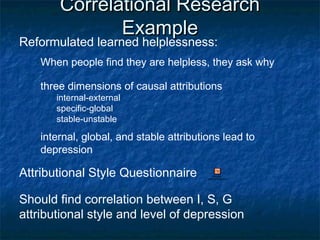
Correlational ResearchCorrelational Research
ExampleExample
Reformulated learned helplessness:
When people find they are helpless, they ask why
three dimensions of causal attributions
internal-external
specific-global
stable-unstable
internal, global, and stable attributions lead to
depression
Attributional Style Questionnaire Microsoft
PowerPoint Presentation
Should find correlation between I, S, G
attributional style and level of depression
Attributional Style QuestionnaireAttributional Style Questionnaire
You have been looking unsuccessfully for a job for some time.
1. Write down one major cause.
2. Is the cause of your unsuccessful job search due to something about you,
or to, something about other people or circumstances ?
Totally due Totally due
to others1 2 3 4 5 6 7 to me
3. In the future, when looking for a job, will this cause again be present?
Will never again Will always
be present1 2 3 4 5 6 7be present
4. Is this cause something that influences just looking for a job, or does it also
influence other areas of your life?
Influences this Influences all
situation 1 2 3 4 5 6 7situations
5. How important would this situation be if it happened to you?
Not at all Extremely
important1 2 3 4 5 6 7important
Quasi-Experimental ResearchQuasi-Experimental Research
Definition:
Blends correlational and experimental approaches. Typically
examines interaction between an individual difference variable and
an experimental manipulation (expericorr example)
Disadvantages: similar to those of correlational research
1 Third variable problem still remains
Advantages: similar to those of correlational research
1 Can tease out cause and effect somewhat better if have
manipulated variable
Microsoft
PowerPoint Presentation
Quasi-experimental ExampleQuasi-experimental Example
Discounting: Tendency to choose smaller,
immediately available rewards over larger,
delayed rewards
Hypothetical Money Choice Task
Choice is offered: smaller, immediately
available reward or larger delayed one
Chooses immediate reward, task is over and
value is recorded
Chooses delayed reward, new choice with larger
immediate reward is offered
Waiting for larger immediate reward
before switching shows less discounting
HMCT (Version 1)HMCT (Version 1)
or
$5 now
You can have:
$100 in 1 week
Which would you choose?
$5 now
$100 in 1 week
HMCT (Version 1)HMCT (Version 1)
or
$10 now
You can have:
$100 in 1 week
Which would you choose?
$10 now
$100 in 1 week
HMCT (Version 1)HMCT (Version 1)
or
$15 now
You can have:
$100 in 1 week
Which would you choose?
$15 now
$100 in 1 week
and so on….
HMCT (Version 2)HMCT (Version 2)
or
$5 now
You can have:
$100 in 1 month
Which would you choose?
$5 now
$100 in 1 month
HMCT (Version 2)HMCT (Version 2)
or
$10 now
You can have:
$100 in 1 month
Which would you choose?
$10 now
$100 in 1 month
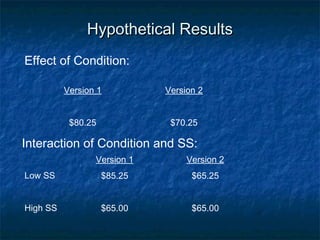
Hypothetical ResultsHypothetical Results
Effect of Condition:
Version 1
$80.25
Version 2
$65.25
$65.00
Interaction of Condition and SS:
Version 1
$85.25
$65.00
Version 2
$70.25
Low SS
High SS
Quasi-Experimental ResearchQuasi-Experimental Research
Definition:
Blends correlational and experimental approaches. Typically
examines interaction between an individual difference variable and
an experimental manipulation
Disadvantages: similar to those of correlational research
1 Third variable problem still remains
Advantages: similar to those of correlational research
1 Can tease out cause and effect somewhat better if have
manipulated variable
Locus of Control ScaleLocus of Control Scale
For each pair of statements, choose the one with which you most agree:
1a. Many of the unhappy things in people's lives are due partly to bad luck.
1b. People's misfortunes result from the mistakes they make.
2a. One of the major reasons we have wars is that people don't take enough
interest in politics.
2b. There will always be wars, no matter how hard people try to prevent them.
3a. Sometimes I can't understand how teachers arrive at the grades they give.
3b. There is a direct connection between how hard I study and the grades I get.
4a. The average citizen can have an influence in government decisions.
4b. This world is run by the few people in power and there isn't much the little
guy can do about it.
Scoring: Give yourself one point for each of the following: 1a, 2b, 3a, 4b
Quasi-Experimental ResearchQuasi-Experimental Research
Locus of Control
Beliefs about one’s ability to influence outcomes
Similar to learned helplessness
Assessed with LOC scale
Selected participants to be high or low in external LOC
Randomly assigned participants to one of two conditions
Performance task with shock that is very easy to learn to avoid
Performance task with shock that is hard to learn to avoid
Findings in line with hypotheses
In easy task most people learned how to avoid shock
In harder task, Ps with high external LOC were less likely to learn
Microsoft
PowerPoint Presentation
Problems to Look ForProblems to Look For
Experimental confound: when another variable is allowed
to vary with the independent variable.
Third variable problem
Nonrandom samples: when samples are selected so that
not everyone has an equal opportunity to participate.
Failure to replicate: single experiments do not constitute
facts.
Failure to include relevant comparison groups: lack an
adequate baseline or normative data. (Example)
Failure to Include ComparisonFailure to Include Comparison
Make people happy or sad and examine effects on
aggression:
Sad Happy
Aggression 7.5 3.0
The meaning depends on a control group:
Sad Control Happy
1) 7.5 7.5 3.0
2) 7.5 5.0 3.0
3) 7.5 3.0 3.0

Correlational research

  • 1.
    Correlational ResearchCorrelational Research Inferential/DescriptiveStatistic (r) Describes strength of linear relation between two variables Strength of relation = degree of association Does knowing an individual’s score on A tell you much about that individual’s score on B? How much does it tell you? Some properties of r Ranges between -1 and 1 inclusive Sign (+ or -) gives direction of relation Absolute value gives strength r2 gives proportion of variance accounted for
  • 2.
  • 3.
    CorrelationsCorrelations Correlation between Cand Behavioral Impulsivity = -.41 Characterized as moderate-strong and negative underco, i/i, mr, teaimp, eysenck 86420-2-4-6 consicentiousness 8 7 6 5 4 3 2
  • 4.
    CorrelationsCorrelations Correlation between Cand Family SES = -.15 Characterized as weak-negligible family social class 6050403020100 consicentiousness 8 7 6 5 4 3 2
  • 5.
    Correlational ResearchCorrelational Research Disadvantages: 1)correlation does not indicate causation 2) problems with self-report method Advantages: 1) can collect much information from many subjects at one time 2) can study a wide range of variables and their interrelations 3) study variables that are not easily produced in the laboratory
  • 6.
    Correlational ResearchCorrelational Research Definition: Seeksto establish a relation/association/correlation between two or more variables that do not readily lend themselves to experimental manipulation Disadvantages: 1) correlation does not indicate causation (6slide causation example) 2) problems with self-report method Advantages: 1) can collect much information from many subjects at one time 2) can study a wide range of variables and their interrelations 3) study variables that are not easily produced in the laboratory Microsoft PowerPoint Presentation
  • 7.
    Correlation is notCausationCorrelation is not Causation Three ways in which A and B may be causally related A B A causes B (either directly or indirectly) B causes A (either directly or indirectly) B A A third variable causes both A and B C A B
  • 8.
    Correlations Inform CausationCorrelationsInform Causation Causation implies Correlation Design or theory informs direction of influence Specify and measure likely third variables Control for third variables in model If association between A and B remains, then third variable explanation does not hold If A and B are causally related, they must be correlated Can model third variable effects Longitudinal design Experimental design Appeal to strong theory
  • 9.
    Case In PointCaseIn Point Lynam, D.R., Moffitt, T.E., & Stouthamer-Loeber, M.A. (1993). Explaining the relation between IQ and delinquency: Class, race, test motivation, school achievement, or self- control? Journal of Abnormal Psychology, 102, 187-196. IQ is negatively correlated with delinquency Think of some ways this relationship could work. In other words, why or how might lower IQ be related to delinquency? What are other possibilities?
  • 10.
    Delinquency leads tolow IQ?Delinquency leads to low IQ?
  • 11.
    Third Variables?Third Variables? Whatare the likely candidates? Social Class Impulsivity Race What happens when they are included? Partial r = -.15 Original r = -.25 Significant relation remains
  • 12.
    IQIQ Delinquency viaSchoolDelinquency via School Achievement?Achievement? What happens when school achievement is included?
  • 13.
    Correlational ResearchCorrelational Research Definition: Seeksto establish a relation/association/correlation between two or more variables that do not readily lend themselves to experimental manipulation Disadvantages: 1) correlation does not indicate causation 2) problems with self-report method Advantages: 1) can collect much information from many subjects at one time 2) can study a wide range of variables and their interrelations 3) study variables that are not easily produced in the laboratory Microsoft PowerPoint Presentation Microsoft PowerPoint Presentation
  • 14.
    Correlational ResearchCorrelational Research ExampleExample Reformulatedlearned helplessness: When people find they are helpless, they ask why three dimensions of causal attributions internal-external specific-global stable-unstable internal, global, and stable attributions lead to depression Attributional Style Questionnaire Microsoft PowerPoint Presentation Should find correlation between I, S, G attributional style and level of depression
  • 15.
    Attributional Style QuestionnaireAttributionalStyle Questionnaire You have been looking unsuccessfully for a job for some time. 1. Write down one major cause. 2. Is the cause of your unsuccessful job search due to something about you, or to, something about other people or circumstances ? Totally due Totally due to others1 2 3 4 5 6 7 to me 3. In the future, when looking for a job, will this cause again be present? Will never again Will always be present1 2 3 4 5 6 7be present 4. Is this cause something that influences just looking for a job, or does it also influence other areas of your life? Influences this Influences all situation 1 2 3 4 5 6 7situations 5. How important would this situation be if it happened to you? Not at all Extremely important1 2 3 4 5 6 7important
  • 16.
    Quasi-Experimental ResearchQuasi-Experimental Research Definition: Blendscorrelational and experimental approaches. Typically examines interaction between an individual difference variable and an experimental manipulation (expericorr example) Disadvantages: similar to those of correlational research 1 Third variable problem still remains Advantages: similar to those of correlational research 1 Can tease out cause and effect somewhat better if have manipulated variable Microsoft PowerPoint Presentation
  • 17.
    Quasi-experimental ExampleQuasi-experimental Example Discounting:Tendency to choose smaller, immediately available rewards over larger, delayed rewards Hypothetical Money Choice Task Choice is offered: smaller, immediately available reward or larger delayed one Chooses immediate reward, task is over and value is recorded Chooses delayed reward, new choice with larger immediate reward is offered Waiting for larger immediate reward before switching shows less discounting
  • 18.
    HMCT (Version 1)HMCT(Version 1) or $5 now You can have: $100 in 1 week Which would you choose? $5 now $100 in 1 week
  • 19.
    HMCT (Version 1)HMCT(Version 1) or $10 now You can have: $100 in 1 week Which would you choose? $10 now $100 in 1 week
  • 20.
    HMCT (Version 1)HMCT(Version 1) or $15 now You can have: $100 in 1 week Which would you choose? $15 now $100 in 1 week and so on….
  • 21.
    HMCT (Version 2)HMCT(Version 2) or $5 now You can have: $100 in 1 month Which would you choose? $5 now $100 in 1 month
  • 22.
    HMCT (Version 2)HMCT(Version 2) or $10 now You can have: $100 in 1 month Which would you choose? $10 now $100 in 1 month
  • 23.
    Hypothetical ResultsHypothetical Results Effectof Condition: Version 1 $80.25 Version 2 $65.25 $65.00 Interaction of Condition and SS: Version 1 $85.25 $65.00 Version 2 $70.25 Low SS High SS
  • 24.
    Quasi-Experimental ResearchQuasi-Experimental Research Definition: Blendscorrelational and experimental approaches. Typically examines interaction between an individual difference variable and an experimental manipulation Disadvantages: similar to those of correlational research 1 Third variable problem still remains Advantages: similar to those of correlational research 1 Can tease out cause and effect somewhat better if have manipulated variable
  • 25.
    Locus of ControlScaleLocus of Control Scale For each pair of statements, choose the one with which you most agree: 1a. Many of the unhappy things in people's lives are due partly to bad luck. 1b. People's misfortunes result from the mistakes they make. 2a. One of the major reasons we have wars is that people don't take enough interest in politics. 2b. There will always be wars, no matter how hard people try to prevent them. 3a. Sometimes I can't understand how teachers arrive at the grades they give. 3b. There is a direct connection between how hard I study and the grades I get. 4a. The average citizen can have an influence in government decisions. 4b. This world is run by the few people in power and there isn't much the little guy can do about it. Scoring: Give yourself one point for each of the following: 1a, 2b, 3a, 4b
  • 26.
    Quasi-Experimental ResearchQuasi-Experimental Research Locusof Control Beliefs about one’s ability to influence outcomes Similar to learned helplessness Assessed with LOC scale Selected participants to be high or low in external LOC Randomly assigned participants to one of two conditions Performance task with shock that is very easy to learn to avoid Performance task with shock that is hard to learn to avoid Findings in line with hypotheses In easy task most people learned how to avoid shock In harder task, Ps with high external LOC were less likely to learn Microsoft PowerPoint Presentation
  • 27.
    Problems to LookForProblems to Look For Experimental confound: when another variable is allowed to vary with the independent variable. Third variable problem Nonrandom samples: when samples are selected so that not everyone has an equal opportunity to participate. Failure to replicate: single experiments do not constitute facts. Failure to include relevant comparison groups: lack an adequate baseline or normative data. (Example)
  • 28.
    Failure to IncludeComparisonFailure to Include Comparison Make people happy or sad and examine effects on aggression: Sad Happy Aggression 7.5 3.0 The meaning depends on a control group: Sad Control Happy 1) 7.5 7.5 3.0 2) 7.5 5.0 3.0 3) 7.5 3.0 3.0