Survey Research
Chapter 17
© 2012 The McGraw-Hill Companies,
Inc.
All rights reserved.
What is a Survey?




Researchers are often interested in the
opinions of a large group of people about a
particular topic or issue.
There are three major characteristics that
most surveys possess:
1)

2)

3)

Information is collected from a group of people
in order to describe some aspect of the
population
Information is collected by asking questions of
the members of the selected group
Information is collected from a sample rather
than from every member of the population
Why Are Surveys Conducted?
The purpose of surveys is to describe the
characteristics of a population.
 Researchers find out how the members of a
population distribute themselves on one or
more variables.
 A selected sample is surveyed and the
description of the population is inferred from
what is found out about the sample.
 In descriptive surveys, researchers are not as
concerned about why the observed distribution
exists as with what the distribution is.

Types of Surveys
There are two types of surveys:
1) Cross-sectional survey
 Collects information from a sample that has been drawn
from a predetermined population
 Information is collected at just one point in time, even
though it could take days to gather all the data
 A census is when the entire population is surveyed
2) Longitudinal survey
 Information is collected at different points in time in
order to study changes over time
 Three types are employed:
1)
2)
3)

Trend study
Cohort Study
Panel Study
Survey Research and
Correlational Research
Techniques of Correlational Research can be
tied in with Survey Research.
 Researchers could look at the relationship of
responses to one question (survey) to
another, or of a score based on one set of
questions to another set.
 The use of calculating correlation coefficients or
contingency tables could be determined and
implemented.

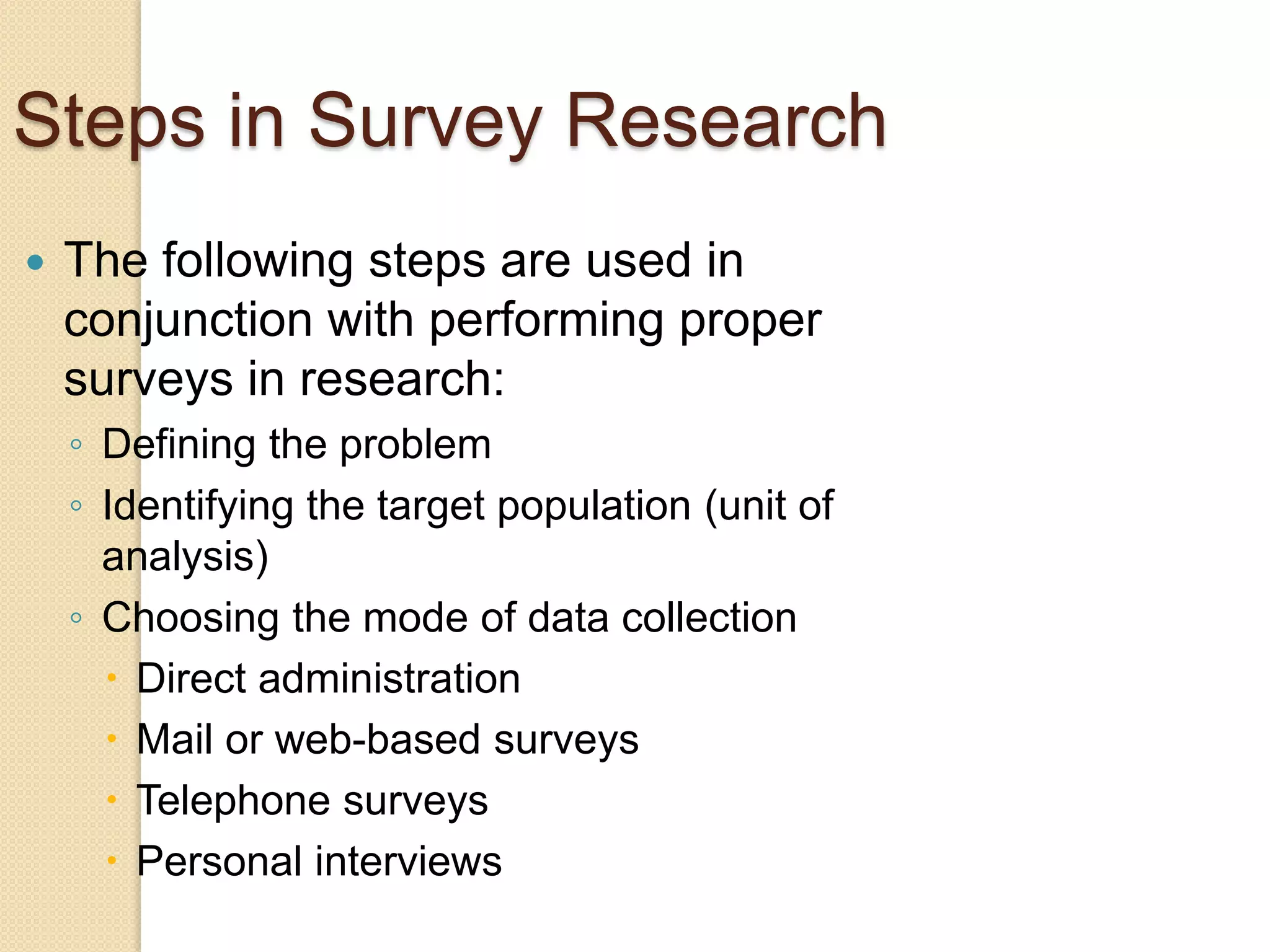
Steps in Survey Research


The following steps are used in
conjunction with performing proper
surveys in research:
◦ Defining the problem
◦ Identifying the target population (unit of
analysis)
◦ Choosing the mode of data collection
 Direct administration
 Mail or web-based surveys
 Telephone surveys
 Personal interviews
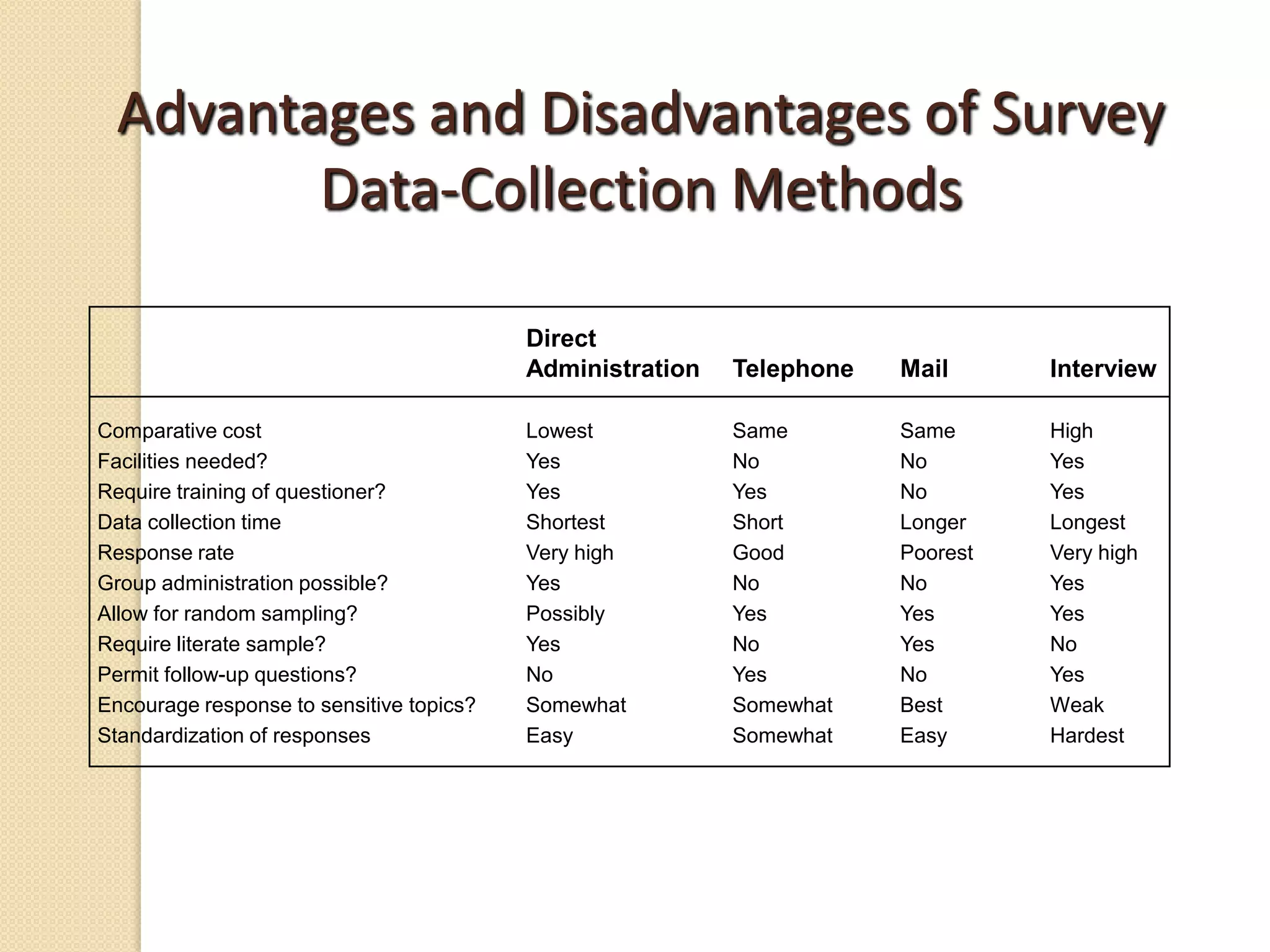
Advantages and Disadvantages of Survey
Data-Collection Methods
Direct
Administration
Comparative cost
Facilities needed?
Require training of questioner?
Data collection time
Response rate
Group administration possible?
Allow for random sampling?
Require literate sample?
Permit follow-up questions?
Encourage response to sensitive topics?
Standardization of responses

Telephone

Mail

Interview

Lowest
Yes
Yes
Shortest
Very high
Yes
Possibly
Yes
No
Somewhat
Easy

Same
No
Yes
Short
Good
No
Yes
No
Yes
Somewhat
Somewhat

Same
No
No
Longer
Poorest
No
Yes
Yes
No
Best
Easy

High
Yes
Yes
Longest
Very high
Yes
Yes
No
Yes
Weak
Hardest
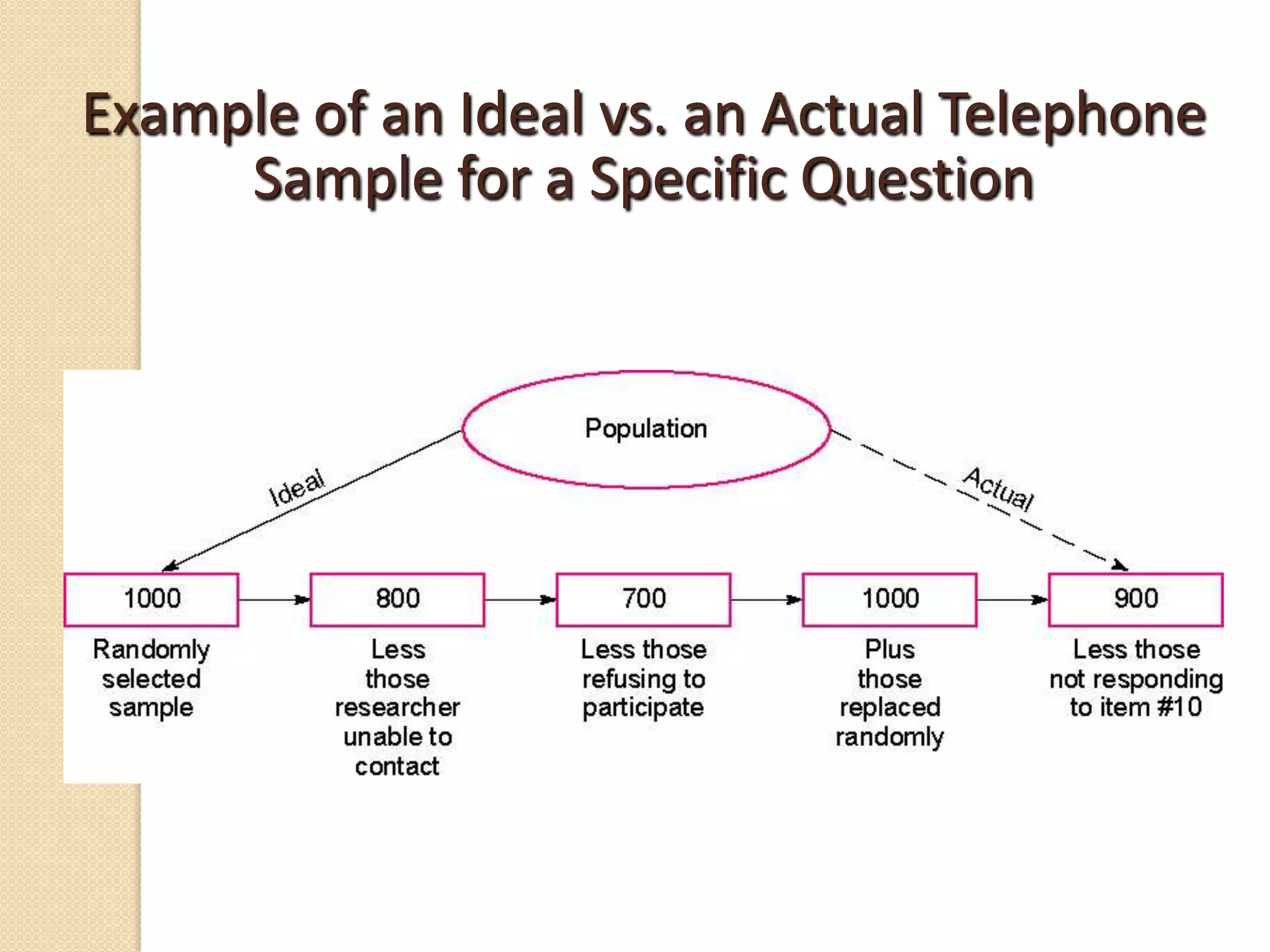
Example of an Ideal vs. an Actual Telephone
Sample for a Specific Question
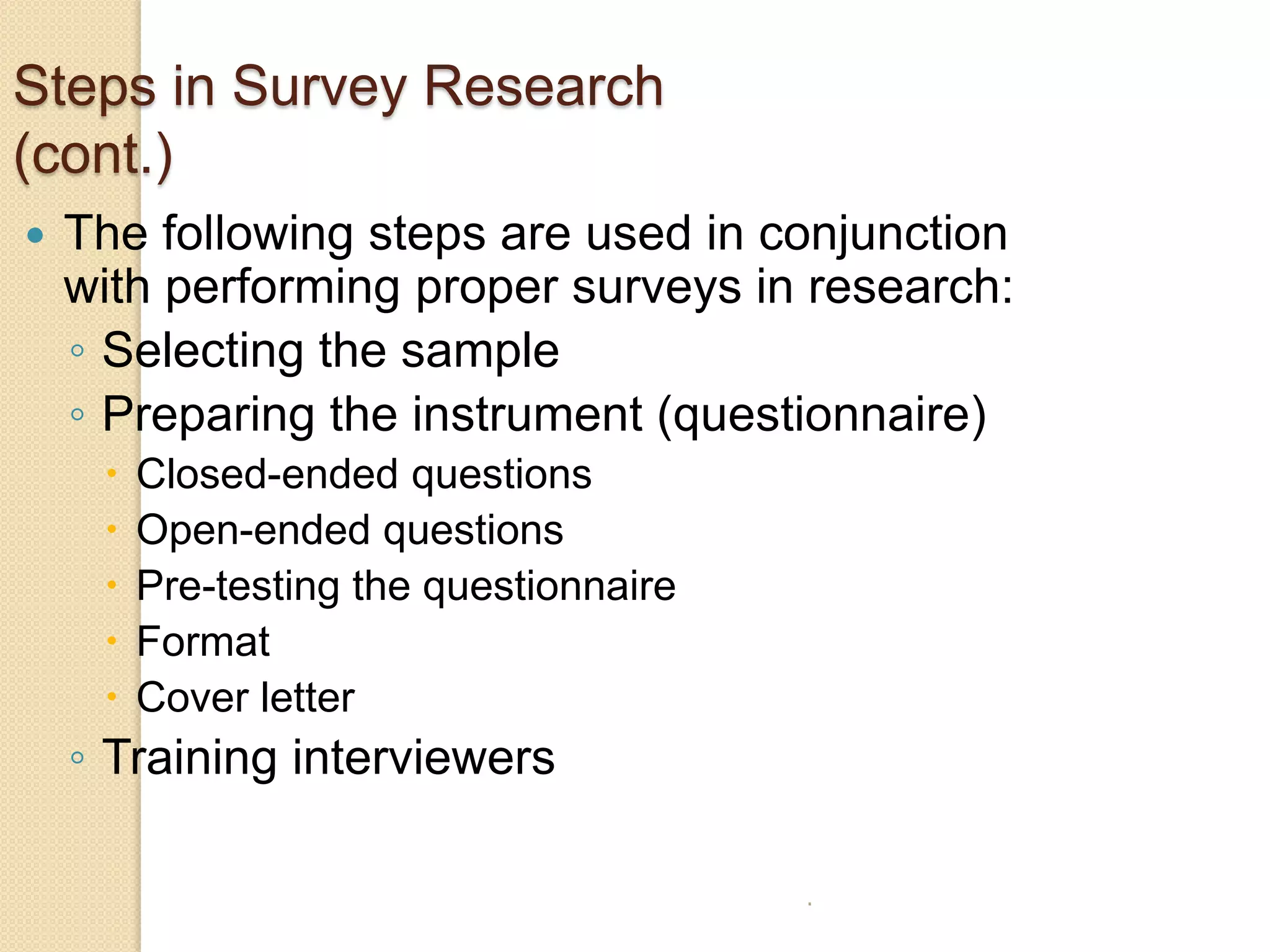
Steps in Survey Research
(cont.)


The following steps are used in conjunction
with performing proper surveys in research:
◦ Selecting the sample
◦ Preparing the instrument (questionnaire)






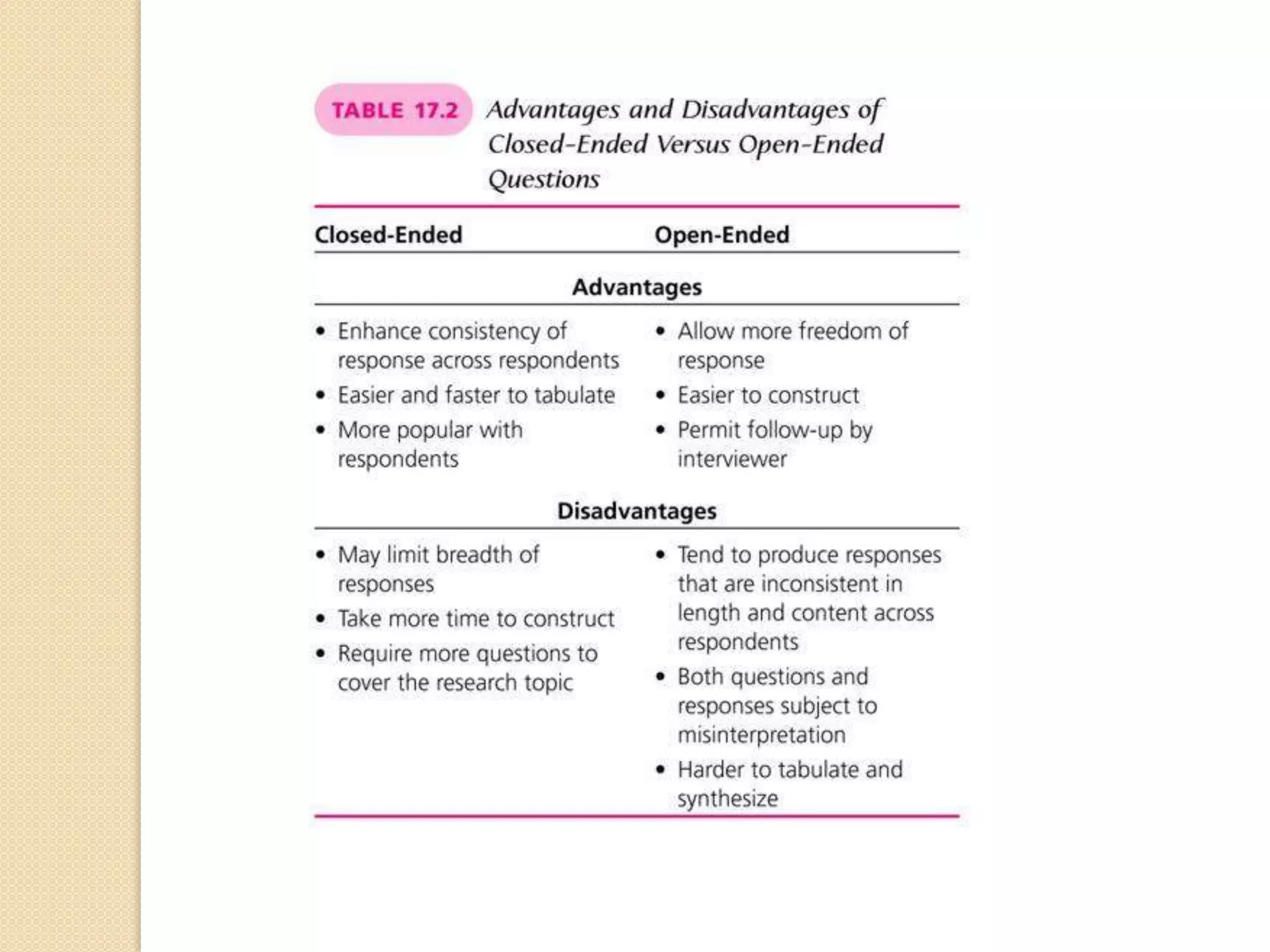
Closed-ended questions
Open-ended questions
Pre-testing the questionnaire
Format
Cover letter

◦ Training interviewers
.
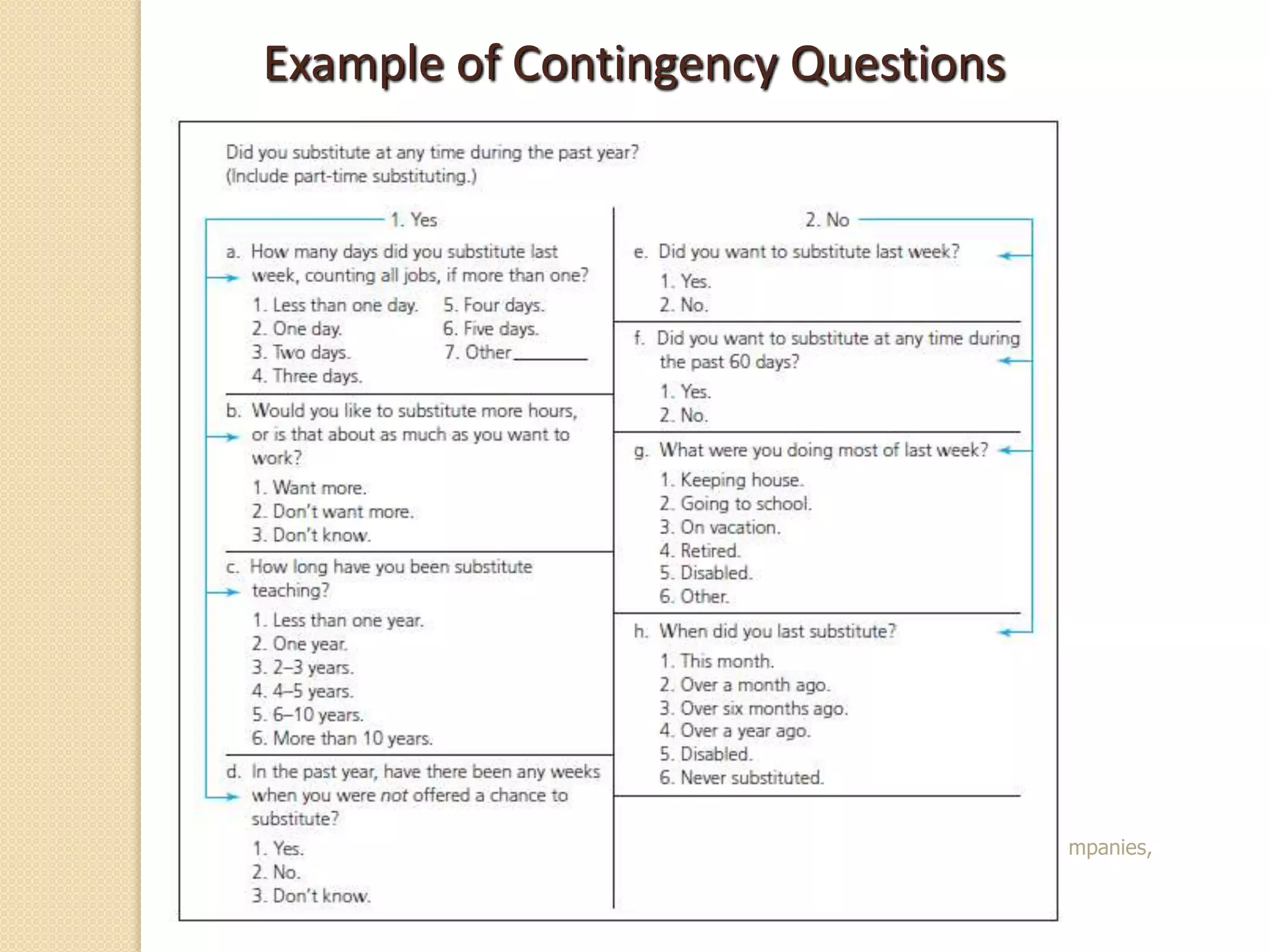
Example of Contingency Questions

© 2012 The McGraw-Hill Companies,
Inc.
All rights reserved.
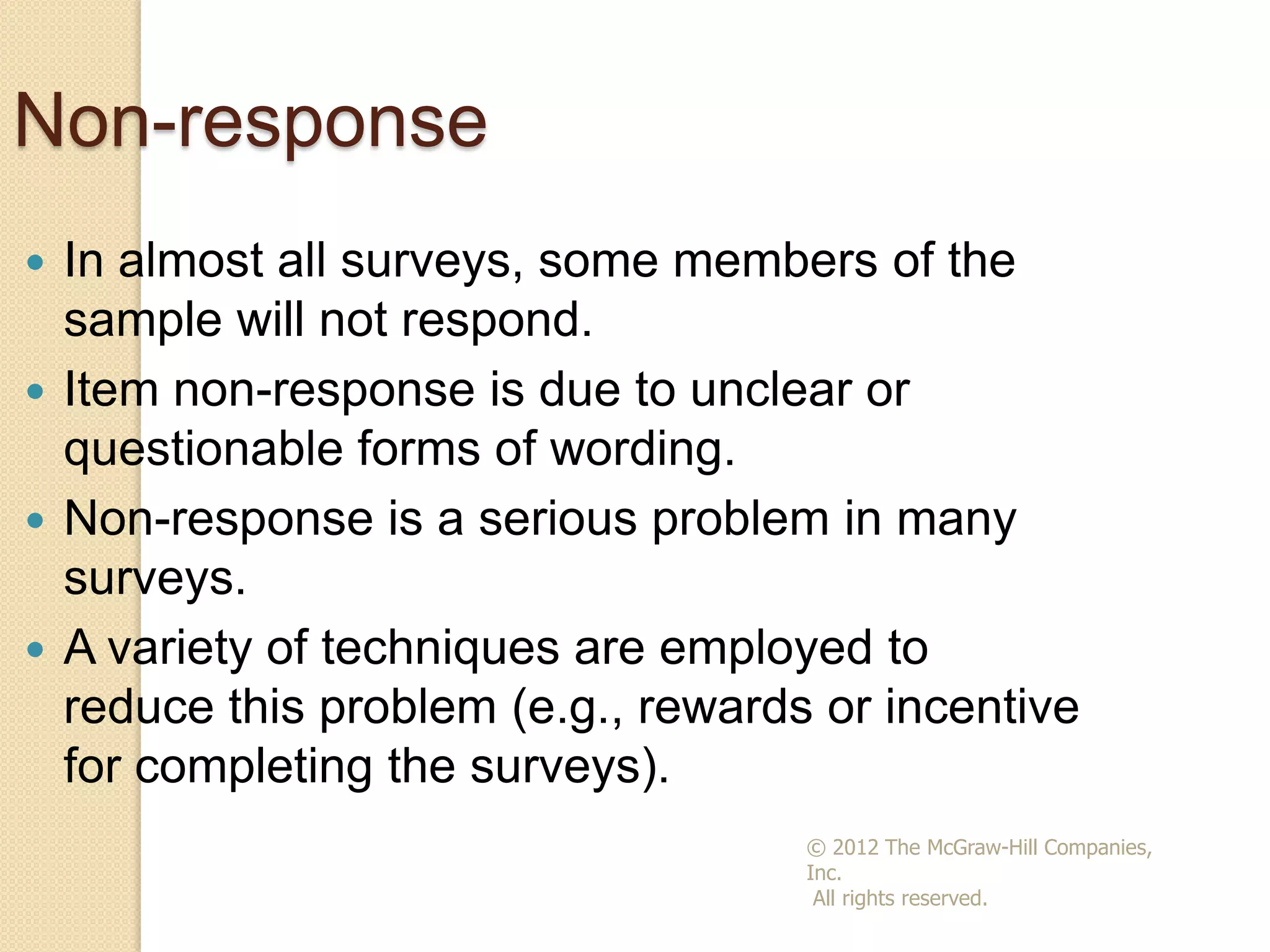
Non-response
In almost all surveys, some members of the
sample will not respond.
 Item non-response is due to unclear or
questionable forms of wording.
 Non-response is a serious problem in many
surveys.
 A variety of techniques are employed to
reduce this problem (e.g., rewards or incentive
for completing the surveys).


© 2012 The McGraw-Hill Companies,
Inc.
All rights reserved.
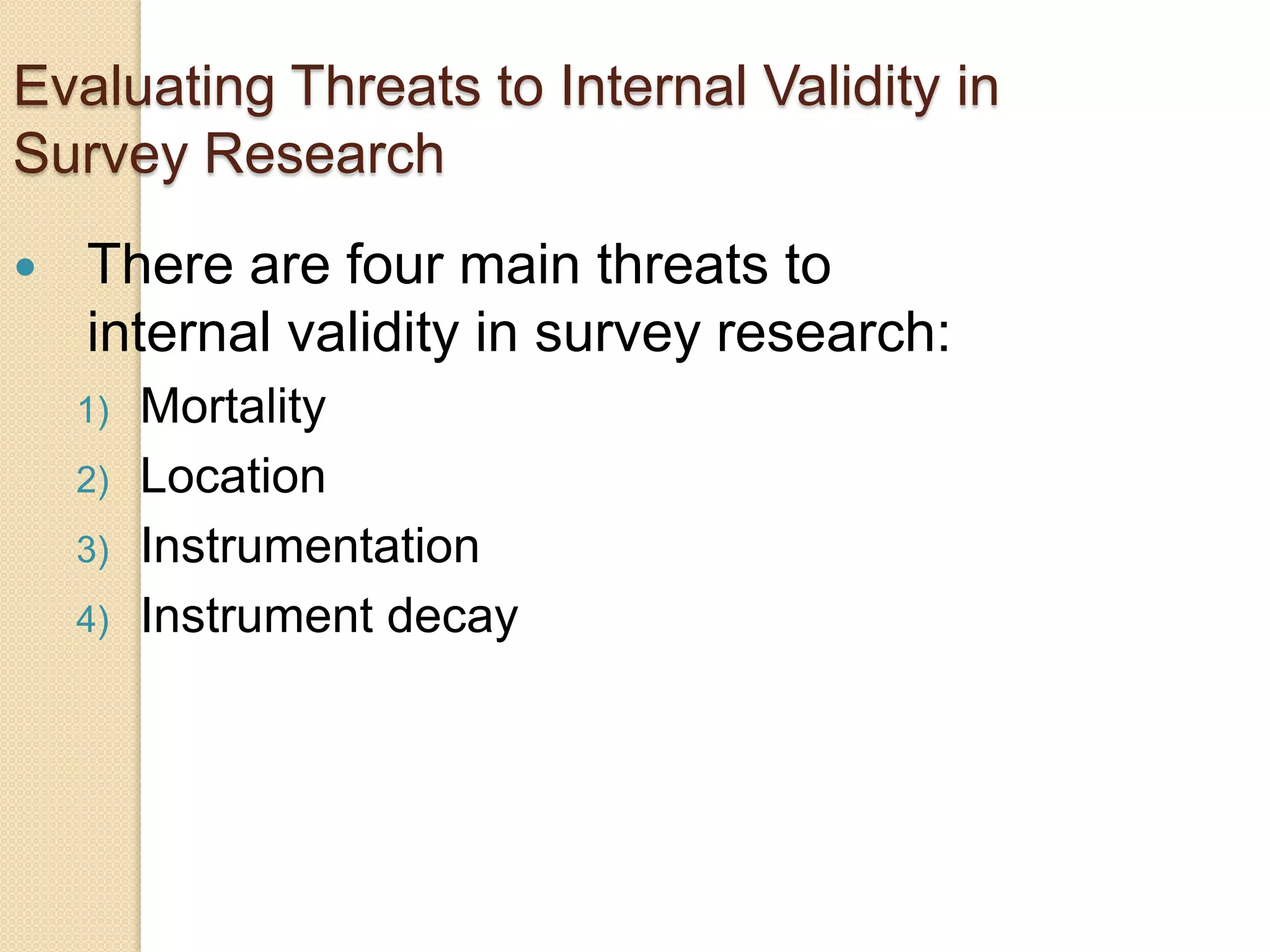
Evaluating Threats to Internal Validity in
Survey Research


There are four main threats to
internal validity in survey research:
1)
2)
3)
4)

Mortality
Location
Instrumentation
Instrument decay
Data Analysis in Survey Research
After researchers receive the completed
questionnaires, the task of summarizing the
results remains.
 The total size of the sample and total
percentage of returns should be reported.
 The percentage of the total sample responding
for each item should be reported.
 The percentage of respondents who chose each
alternative for each question should be given.

Survey Research
Chapter 17

Survey Research

  • 1.
  • 2.
    © 2012 TheMcGraw-Hill Companies, Inc. All rights reserved.
  • 3.
    What is aSurvey?   Researchers are often interested in the opinions of a large group of people about a particular topic or issue. There are three major characteristics that most surveys possess: 1) 2) 3) Information is collected from a group of people in order to describe some aspect of the population Information is collected by asking questions of the members of the selected group Information is collected from a sample rather than from every member of the population
  • 4.
    Why Are SurveysConducted? The purpose of surveys is to describe the characteristics of a population.  Researchers find out how the members of a population distribute themselves on one or more variables.  A selected sample is surveyed and the description of the population is inferred from what is found out about the sample.  In descriptive surveys, researchers are not as concerned about why the observed distribution exists as with what the distribution is. 
  • 5.
    Types of Surveys Thereare two types of surveys: 1) Cross-sectional survey  Collects information from a sample that has been drawn from a predetermined population  Information is collected at just one point in time, even though it could take days to gather all the data  A census is when the entire population is surveyed 2) Longitudinal survey  Information is collected at different points in time in order to study changes over time  Three types are employed: 1) 2) 3) Trend study Cohort Study Panel Study
  • 6.
    Survey Research and CorrelationalResearch Techniques of Correlational Research can be tied in with Survey Research.  Researchers could look at the relationship of responses to one question (survey) to another, or of a score based on one set of questions to another set.  The use of calculating correlation coefficients or contingency tables could be determined and implemented. 
  • 7.
    Steps in SurveyResearch  The following steps are used in conjunction with performing proper surveys in research: ◦ Defining the problem ◦ Identifying the target population (unit of analysis) ◦ Choosing the mode of data collection  Direct administration  Mail or web-based surveys  Telephone surveys  Personal interviews
  • 8.
    Advantages and Disadvantagesof Survey Data-Collection Methods Direct Administration Comparative cost Facilities needed? Require training of questioner? Data collection time Response rate Group administration possible? Allow for random sampling? Require literate sample? Permit follow-up questions? Encourage response to sensitive topics? Standardization of responses Telephone Mail Interview Lowest Yes Yes Shortest Very high Yes Possibly Yes No Somewhat Easy Same No Yes Short Good No Yes No Yes Somewhat Somewhat Same No No Longer Poorest No Yes Yes No Best Easy High Yes Yes Longest Very high Yes Yes No Yes Weak Hardest
  • 9.
    Example of anIdeal vs. an Actual Telephone Sample for a Specific Question
  • 10.
    Steps in SurveyResearch (cont.)  The following steps are used in conjunction with performing proper surveys in research: ◦ Selecting the sample ◦ Preparing the instrument (questionnaire)      Closed-ended questions Open-ended questions Pre-testing the questionnaire Format Cover letter ◦ Training interviewers .
  • 12.
    Example of ContingencyQuestions © 2012 The McGraw-Hill Companies, Inc. All rights reserved.
  • 13.
    Non-response In almost allsurveys, some members of the sample will not respond.  Item non-response is due to unclear or questionable forms of wording.  Non-response is a serious problem in many surveys.  A variety of techniques are employed to reduce this problem (e.g., rewards or incentive for completing the surveys).  © 2012 The McGraw-Hill Companies, Inc. All rights reserved.
  • 14.
    Evaluating Threats toInternal Validity in Survey Research  There are four main threats to internal validity in survey research: 1) 2) 3) 4) Mortality Location Instrumentation Instrument decay
  • 15.
    Data Analysis inSurvey Research After researchers receive the completed questionnaires, the task of summarizing the results remains.  The total size of the sample and total percentage of returns should be reported.  The percentage of the total sample responding for each item should be reported.  The percentage of respondents who chose each alternative for each question should be given. 
  • 16.