CAUSALCOMPARATIVE
RESEARCH
Prepared for:
Dr.Johan @ Eddy Luaran
Prepared by:
Nur Hazwani Mohd Nor (2013833994)
Noriziati Abd Halim (2013277906)
Noor fadzilah binti Adnan (2013663406)
Abdul Aqib Iqbal bin Abdul Aziz (2013210324)
Muhammad Azizan bin Rozman(2013446662)
What is Causal-Comparative
Research?
O Determined cause or consequences to the

existing research.
O Something referred as ‘ex post facto’
O Two different type:
O can be manipulated
O manipulate
O example of type:
O exploration of effects

O exploration of causes
O exploration of consequent

O Similarity & differences between

correlational research and experimental
research to causal-comparative research
STEP
CAUSAL
COMPARATIVE
RESEARCH
STEP
Interest
i. Identify
ii. Define

Consider
i. Causes
ii. Consequences
STEP
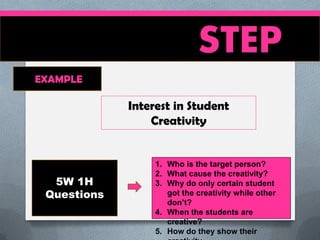
EXAMPLE

Interest in Student
Creativity

5W 1H
Questions

1. Who is the target person?
2. What cause the creativity?
3. Why do only certain student
got the creativity while other
don’t?
4. When the students are
creative?
5. How do they show their
STEP
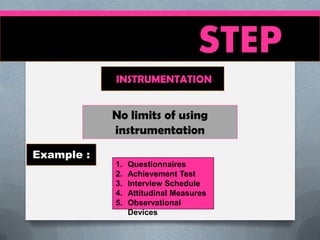
INSTRUMENTATION

No limits of using
instrumentation
Example :
1.
2.
3.
4.
5.

Questionnaires
Achievement Test
Interview Schedule
Attitudinal Measures
Observational
Devices
STEP
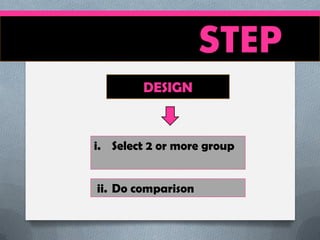
DESIGN

i. Select 2 or more group
ii. Do comparison
STEP

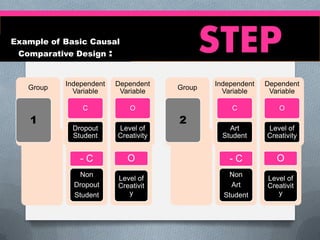
Example of Basic Causal
Comparative Design

Group

1
Group

:

Independent
Variable

Dependent
Variable

Independent
Variable

Dependent
Variable

C

O

C

O

Dropout
Student
Independent

Level of
Creativity
Dependent

Art
Student
Independent

Level of
Creativity
Dependent

Variable

Variable

Variable

Variable

-C

O

-C

O

Non
Dropout
Student

Level of
Creativit
y

Non
Art
Student

Level of
Creativit
y

Group

2
Group
Threats to Internal Validity in
Causal-Comparative
Research
O Divided into two threats:
O Subject Characteristics
O Other threats

O Have two weaknesses:
O Lack of randomization – since the groups

are already formed.
O Inability to manipulate an independent
variable – the groups have already been
exposed to the independent variable.
O Subject Characteristics:
O The major threats to the internal validity of

a causal-comparative study
O The researcher has had no say in either
the selection or formation of the
comparison groups, there is always the
likelihood that the groups are not
equivalent on one or more important
variables other than the identified group
membership variable.
O Three types of procedures can be use to
reduce the chance of this threats which is:
O Matching of Subjects
O Finding or Creating Homogeneous

Subgroups
O Statistical Matching
O Matching of Subjects:
O To control for an extraneous variable is to

match subjects from the comparison
groups on that variable.
O Pairs of subjects, one from each group, are
found that are similar on that variable.
O Eliminate/reduced the particular subject if
match cannot be found.
O Finding or Creating Homogenous

Subgroups:
O Create groups that are relatively

homogenous on that variables – to control
for an extraneous variable.
O Find two groups that have similar subject –
form subgroups that represent various
levels of the extraneous variable (eg. high,
middle, low) – compare the comparable
subgroups.
O Statistical Matching:
O To control for an important extraneous

variable.
O Adjusts scores on a posttest for initial
differences on some other variable that
assumed to be related to performance on
the dependent variable.
O Other Threats:
O Depends on the type of study being

considered.
O Eg. In non invention studies, If the persons
who are lost to data collection are different
from those who remain (as is often
probable) and if more are lost from one
group than the other(s), internal validity is
threatened.
O If unequal numbers are lost, an effort
should be made to determine the probable
reasons.
O Conclusion:
O Subject Characteristics:
O Deal with only four – socioeconomic level of

the family, gender, ethnicity, and marketable
job skills.
Evaluating threats to internal Validity
in Causal-Comparatives Studies
O -involves a set of steps similar for

experimental studies
O Step 1: the researcher need to be concerned
with factors unrelated to what is being studied.
O Step 2 : What is the likelihood of comparison
groups differing on each of these factors?
(that different between group cannot be
explained away by factor that is the same for
all group)
O Step 3 : Evaluate the threats on the basis of
how likely they are to have an effect and plan
to control for them.
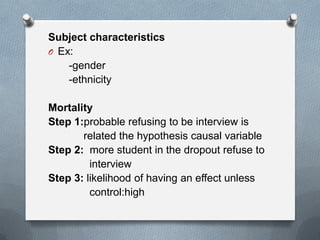
Subject characteristics
O Ex:
-gender
-ethnicity

Mortality
Step 1:probable refusing to be interview is
related the hypothesis causal variable
Step 2: more student in the dropout refuse to
interview
Step 3: likelihood of having an effect unless
control:high
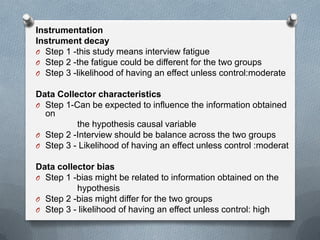
Instrumentation
Instrument decay
O Step 1 -this study means interview fatigue
O Step 2 -the fatigue could be different for the two groups
O Step 3 -likelihood of having an effect unless control:moderate

Data Collector characteristics
O Step 1-Can be expected to influence the information obtained
on
the hypothesis causal variable
O Step 2 -Interview should be balance across the two groups
O Step 3 - Likelihood of having an effect unless control :moderat
Data collector bias
O Step 1 -bias might be related to information obtained on the
hypothesis
O Step 2 -bias might differ for the two groups
O Step 3 - likelihood of having an effect unless control: high
Other treats
O -implementation, history, maturation, attitudinal and
regression threats
O -trick to identifying threats to internal validity in
causal study
O -based on evidence or experience
O -can be greatly reduced if causal comparative are
replicated
Data Analysis
Causal-comparative research
Analyzing data
O

O

First step in analyzing data in causal
comparative study is :
To construct frequency polygons and
then calculate the mean and standard
deviation of each group.
Means and standard deviation are
usually calculated if the variables
involved are quantitative.
O Commonly used test in causal-

comparative studies is a :
O t –test : its for differences between means.
O When more than 2 groups are used, then
either an analysis of variance or an
analysis of covariance is the appropriate
test.
• Analysis of covariance
• -The Analysis of Covariance (generally

known as ANCOVA) is a technique that
sits between analysis of variance and
regression analysis.
• Particularly helpful in causal-comparative
research.
• Its provide a way to match group on such
variable as age, socioeconomic, status
and so on.
O Before analysis of covariance can be used

the data involved need to satisfy certain
assumptions.
O The result must be interpreted with
caution.
O Causal-comparative studies are good at
indentifying relationship between variable
but do not prove cause and effect.
2 ways to strengthen the interpretability of
casual-comparative studies
O First, alternative hypothesis should be

formulated and investigated.
O Second, if the dependent variable
involved are categorical the study should
be examined using the technique of
discriminant function analysis.
O The most powerful way to check on
possible causes is perform an experiment.
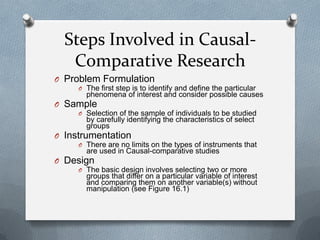
Steps Involved in CausalComparative Research
O Problem Formulation
O The first step is to identify and define the particular

phenomena of interest and consider possible causes

O Sample
O Selection of the sample of individuals to be studied

by carefully identifying the characteristics of select
groups

O Instrumentation
O There are no limits on the types of instruments that

are used in Causal-comparative studies

O Design
O The basic design involves selecting two or more

groups that differ on a particular variable of interest
and comparing them on another variable(s) without
manipulation (see Figure 16.1)
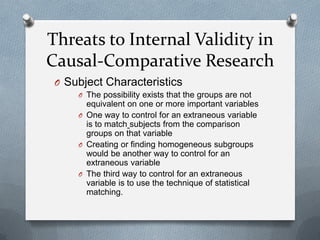
Threats to Internal Validity in
Causal-Comparative Research
O Subject Characteristics
O The possibility exists that the groups are not

equivalent on one or more important variables
O One way to control for an extraneous variable
is to match subjects from the comparison
groups on that variable
O Creating or finding homogeneous subgroups
would be another way to control for an
extraneous variable
O The third way to control for an extraneous
variable is to use the technique of statistical
matching.
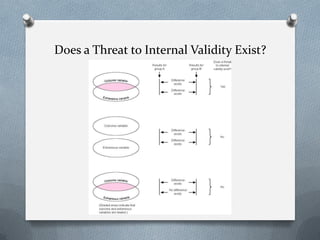
Does a Threat to Internal Validity Exist?
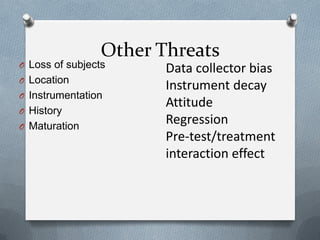
Other Threats

O Loss of subjects

O Location
O Instrumentation
O History
O Maturation

Data collector bias
Instrument decay
Attitude
Regression
Pre-test/treatment
interaction effect

Causal comparative research

  • 1.
    CAUSALCOMPARATIVE RESEARCH Prepared for: Dr.Johan @Eddy Luaran Prepared by: Nur Hazwani Mohd Nor (2013833994) Noriziati Abd Halim (2013277906) Noor fadzilah binti Adnan (2013663406) Abdul Aqib Iqbal bin Abdul Aziz (2013210324) Muhammad Azizan bin Rozman(2013446662)
  • 2.
    What is Causal-Comparative Research? ODetermined cause or consequences to the existing research. O Something referred as ‘ex post facto’ O Two different type: O can be manipulated O manipulate
  • 3.
    O example oftype: O exploration of effects O exploration of causes O exploration of consequent O Similarity & differences between correlational research and experimental research to causal-comparative research
  • 4.
  • 5.
  • 6.
    STEP EXAMPLE Interest in Student Creativity 5W1H Questions 1. Who is the target person? 2. What cause the creativity? 3. Why do only certain student got the creativity while other don’t? 4. When the students are creative? 5. How do they show their
  • 7.
    STEP INSTRUMENTATION No limits ofusing instrumentation Example : 1. 2. 3. 4. 5. Questionnaires Achievement Test Interview Schedule Attitudinal Measures Observational Devices
  • 8.
    STEP DESIGN i. Select 2or more group ii. Do comparison
  • 9.
    STEP Example of BasicCausal Comparative Design Group 1 Group : Independent Variable Dependent Variable Independent Variable Dependent Variable C O C O Dropout Student Independent Level of Creativity Dependent Art Student Independent Level of Creativity Dependent Variable Variable Variable Variable -C O -C O Non Dropout Student Level of Creativit y Non Art Student Level of Creativit y Group 2 Group
  • 10.
    Threats to InternalValidity in Causal-Comparative Research O Divided into two threats: O Subject Characteristics O Other threats O Have two weaknesses: O Lack of randomization – since the groups are already formed. O Inability to manipulate an independent variable – the groups have already been exposed to the independent variable.
  • 11.
    O Subject Characteristics: OThe major threats to the internal validity of a causal-comparative study O The researcher has had no say in either the selection or formation of the comparison groups, there is always the likelihood that the groups are not equivalent on one or more important variables other than the identified group membership variable. O Three types of procedures can be use to reduce the chance of this threats which is: O Matching of Subjects O Finding or Creating Homogeneous Subgroups O Statistical Matching
  • 12.
    O Matching ofSubjects: O To control for an extraneous variable is to match subjects from the comparison groups on that variable. O Pairs of subjects, one from each group, are found that are similar on that variable. O Eliminate/reduced the particular subject if match cannot be found.
  • 13.
    O Finding orCreating Homogenous Subgroups: O Create groups that are relatively homogenous on that variables – to control for an extraneous variable. O Find two groups that have similar subject – form subgroups that represent various levels of the extraneous variable (eg. high, middle, low) – compare the comparable subgroups.
  • 14.
    O Statistical Matching: OTo control for an important extraneous variable. O Adjusts scores on a posttest for initial differences on some other variable that assumed to be related to performance on the dependent variable.
  • 15.
    O Other Threats: ODepends on the type of study being considered. O Eg. In non invention studies, If the persons who are lost to data collection are different from those who remain (as is often probable) and if more are lost from one group than the other(s), internal validity is threatened. O If unequal numbers are lost, an effort should be made to determine the probable reasons.
  • 16.
    O Conclusion: O SubjectCharacteristics: O Deal with only four – socioeconomic level of the family, gender, ethnicity, and marketable job skills.
  • 17.
    Evaluating threats tointernal Validity in Causal-Comparatives Studies O -involves a set of steps similar for experimental studies O Step 1: the researcher need to be concerned with factors unrelated to what is being studied. O Step 2 : What is the likelihood of comparison groups differing on each of these factors? (that different between group cannot be explained away by factor that is the same for all group) O Step 3 : Evaluate the threats on the basis of how likely they are to have an effect and plan to control for them.
  • 18.
    Subject characteristics O Ex: -gender -ethnicity Mortality Step1:probable refusing to be interview is related the hypothesis causal variable Step 2: more student in the dropout refuse to interview Step 3: likelihood of having an effect unless control:high
  • 19.
    Instrumentation Instrument decay O Step1 -this study means interview fatigue O Step 2 -the fatigue could be different for the two groups O Step 3 -likelihood of having an effect unless control:moderate Data Collector characteristics O Step 1-Can be expected to influence the information obtained on the hypothesis causal variable O Step 2 -Interview should be balance across the two groups O Step 3 - Likelihood of having an effect unless control :moderat Data collector bias O Step 1 -bias might be related to information obtained on the hypothesis O Step 2 -bias might differ for the two groups O Step 3 - likelihood of having an effect unless control: high
  • 20.
    Other treats O -implementation,history, maturation, attitudinal and regression threats O -trick to identifying threats to internal validity in causal study O -based on evidence or experience O -can be greatly reduced if causal comparative are replicated
  • 21.
  • 22.
    Analyzing data O O First stepin analyzing data in causal comparative study is : To construct frequency polygons and then calculate the mean and standard deviation of each group. Means and standard deviation are usually calculated if the variables involved are quantitative.
  • 23.
    O Commonly usedtest in causal- comparative studies is a : O t –test : its for differences between means. O When more than 2 groups are used, then either an analysis of variance or an analysis of covariance is the appropriate test.
  • 24.
    • Analysis ofcovariance • -The Analysis of Covariance (generally known as ANCOVA) is a technique that sits between analysis of variance and regression analysis. • Particularly helpful in causal-comparative research. • Its provide a way to match group on such variable as age, socioeconomic, status and so on.
  • 25.
    O Before analysisof covariance can be used the data involved need to satisfy certain assumptions. O The result must be interpreted with caution. O Causal-comparative studies are good at indentifying relationship between variable but do not prove cause and effect.
  • 26.
    2 ways tostrengthen the interpretability of casual-comparative studies O First, alternative hypothesis should be formulated and investigated. O Second, if the dependent variable involved are categorical the study should be examined using the technique of discriminant function analysis. O The most powerful way to check on possible causes is perform an experiment.
  • 27.
    Steps Involved inCausalComparative Research O Problem Formulation O The first step is to identify and define the particular phenomena of interest and consider possible causes O Sample O Selection of the sample of individuals to be studied by carefully identifying the characteristics of select groups O Instrumentation O There are no limits on the types of instruments that are used in Causal-comparative studies O Design O The basic design involves selecting two or more groups that differ on a particular variable of interest and comparing them on another variable(s) without manipulation (see Figure 16.1)
  • 28.
    Threats to InternalValidity in Causal-Comparative Research O Subject Characteristics O The possibility exists that the groups are not equivalent on one or more important variables O One way to control for an extraneous variable is to match subjects from the comparison groups on that variable O Creating or finding homogeneous subgroups would be another way to control for an extraneous variable O The third way to control for an extraneous variable is to use the technique of statistical matching.
  • 29.
    Does a Threatto Internal Validity Exist?
  • 30.
    Other Threats O Lossof subjects O Location O Instrumentation O History O Maturation Data collector bias Instrument decay Attitude Regression Pre-test/treatment interaction effect