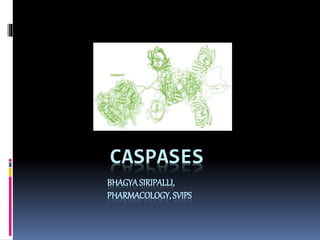
CASPASES
BHAGYASIRIPALLI,
PHARMACOLOGY, SVIPS
CONTENTS
1. Introduction
2. Types Of Caspase
3. Caspases cascade
4. Therapeutic potential
5. Recent Advances
6. Opportunities & Challenges
 Caspases (cysteine-aspartic proteases, cysteine aspartases or cysteine-
dependent aspartate-directed proteases) are a family of protease enzymes
playing essential roles in programmed cell
death (including apoptosis, pyroptosis and necroptosis) and inflammation.
 They are named caspases due to their specific cysteine protease activity –
a cysteine in its active site nucleophilically attacks and cleaves a target
protein only after an aspartic acid residue.
 The role of these enzymes in programmed cell death was first identified in
1993, with their functions in apoptosis well characterised. This is a form
of programmed cell death, occurring widely during development, and
throughout life to maintain cell homeostasis.
INTRODUCTION
Caspases have other identified roles in programmed cell death such
as pyroptosis and necroptosis. These forms of cell death are important for
protecting an organism from stress signals and pathogenic attack.
Caspases have the characteristics of high specificity for substrates
containing Asp, and use a Cys for catalyzing peptide bond cleavage.
Synthesized in the cell as precursors named procaspase.
Caspases are the major executioners in apoptosis.
Activation of caspases ensures that the cellular components are degraded
in a controlled manner, carrying out cell death with minimal effect on
surrounding tissues.
INTRODUCTION
CASPASES and diseases
-Too much apoptosis: neurodegenerative diseases, such as Parkinson’s
diseases, Alzheimer’s diseases, spinal muscular atrophy.
- Too little apoptosis: Cancers (virus infection or DNA mutations) &
autoimmune diseases
- Some cardiovascular diseases and liver diseases are also related to apoptosis.
- Many toxins and other cellular stresses can also trigger apoptosis, such as
oxidative stress, alcohol.
Caspase Structure
 NH2-terminal domain
 Large subunit (~20kD)
– (lavender)
 Small subunit (~10kD) –
(gray)
Caspase Activation
CASPASE ROLE INAPOPTOSIS
 Cut off contact with surrounding cells
 Reorganize cytoskeleton
 Shut down DNA replication and repair
 Interrupt splicing
 Destroy DNA
 Disrupt nuclear structure
 Induce cell to display signals marking it for
phagocytosis
 Disintegrate cells into apoptotic bodies.
Caspases…
Two types:
- Those related to cytokine activation during inflammation :
Caspases1,
Caspases4,
Caspases5,
- Those involved in apoptosis:
Initiators – activate downstream effector caspases to initate
activation cascades:
Caspases2
Caspases9
Caspases8
Caspases10
Effectors - cleave target proteins resulting in morphological
and biochemical markers of apoptosis:
Caspases3
Caspases6
Caspases7
Caspases14
Initiator CaspaseActivation
 Initiator Caspases are activated by either internal
(DNA damage) or external signals (ligand
binding)
 External: caspase-8, an initiator caspase is
activated by binding to it’s specific cofactor,
FADD (Fas-associated protein with death domain)
Executioner/Effector CaspaseActivation
 Effector caspase are activated generally by other
caspases.
 Caspase activation results in proteolytic cascade
which is self-amplifying and irreversible.
 Caspase-3 is an effector caspase
Caspase Pathways
Intrinsic pathway – mitochondria mediated
Extrinsic pathway– involves death receptor
(TNF receptor, Fas)
ROLE OF CASPASES IN ALZHEIMER'S DISEASE
Role of Caspases inAMYOTROPIC LATERALSCLEROSIS
Role of Caspases in HUNTINGTON DISEASE
3
Recentadvances
 Caspase inhibitors such as N-benzyloxycarbonyl-Val-Ala-Asp
fluoromethyl-ketone (Z-VAD) were being investigated for the
treatment of a number of neurodegenerative disorders including:-
 Alzheimer disease,
 amyotrophic lateral sclerosis (ALS) ,
 Huntington’s disease ,
 Parkinson’s disease (PD) ,
 and finally acute neurologic diseases including ischemia or traumatic
injury .
Unfortunately, clinical development of Z-VAD was
discontinued following the recognition that metabolism of Z-VAD
produces liver damage following the production of the toxic
compound, fluoroacetate .
Recentadvances
 Following the disappointment of Z-VAD, a number of other caspase
inhibitors have been developed with the goal in mind of being safer and more
selective-
Quinolyl-valyl-Omethylaspartyl-[- 2, 6-difluorophenoxy]-methyl ketone
(QVD-OPh)-
-Q-VD-OPh appears to be able to cross the blood-brain barrier, which is
always a central issue when developing a drug for treatment of a CNS
disorder.
-including greater potency, selectivity,stability and cell permeability
-After acute treatment of mice with Q-VD-OPh, all organs were normal
suggesting a lack of toxicity.
-Evidence for neuroprotection included studies demonstrating efficacy of Q-
VD-OPh in animal models of AD, PD, HD, spinal cord injury and stroke.
-It remains to be established whether Q-VD-OPh affects microglia activation
in those disease models and contributes to the neuroprotective effect in that
manner.
Recentadvances
 Another promising compound that is currently under evaluation is
Minocycline, a second-generation tetracycline. In comparison to Q-VD-
OPh, minocycline is much further along as an investigational drug for the
treatment of neurodegenerative disorders and in some cases human clinical
trials have begun. For example,
- Phase II for PD
- Phase I/II for spinal cord injury
- Phase III trail for ALS
 Unfortunately, the results of the trial were negative as the authors found
that patients on minocycline declined at a more rapid rate than the placebo
group.
 In one study by Choi et al., the authors reported that minocycline
administration improved behavior deficits in AmyloidBeta infused rats. So,
authors suggest minocycline may be a suitable treatment option for AD.
Recentadvances
2. Caspase inhibitors may be one of the agents to be used for the
treatment of spinal cord injury:
3. Study demonstrate a 17-fold increase in caspase-1 activity in traumatized spinal
cord samples when compared with samples from sham-operated mice. Caspase-1
and caspase-3 activation were also detected by western blot following spinal cord
injury, which was significantly inhibited by the broad caspase inhibitor N-
benzyloxycarbonyl-Val-Ala-Asp-fluoromethylketone(Z-VAD).
N-Benzyloxycarbonyl-Val-Ala-Asp-fluoromethylketone treated mice, and
transgenic mice expressing a caspase-1 dominant negative mutant, demonstrated a
significant improvement of motor function and a reduction of lesion size compared
with vehicle-treated mice.
Conclusion:results demonstrate that both caspase-1 and caspase-3 are
activated in neurons following spinal cord injury, and that caspase inhibition
reduces post-traumatic lesion size and improves motor performance. Caspase
inhibitors may be one of the agents to be used for the treatment of spinal cord
injury.
Opportunities
 Based on caspase properties, determining caspase activity can be
used for investigating the mechanisms of diseases.
 Based on the selectivity and specificity in caspase substrate, rational
design caspase triggers and inhibitors for treating diseases related to
caspase activity.
 Determining caspase activity in real time in cells or in vivo can be
used for tracking the process of diseases and effects of treatments or for
screening caspase inhibitors in drug development.
Challenges
Some oncoproteins can activate caspases and induce apoptosis, however,
transfected cells can still survive, therefore, the apoptosis pathways still need
to be further investigated and completed in transfected cells.
 Although several classes of selectively potent reversible and irreversible
caspase inhibitors have been identified, it is still a difficult task to develop
selective small-molecular nonpeptide inhibitors for pharmaceutical uses.
 Caspase activity determination in cells or in vivo in real time is still a big
challenge.
Caspases

Caspases

  • 1.
  • 2.
    CONTENTS 1. Introduction 2. TypesOf Caspase 3. Caspases cascade 4. Therapeutic potential 5. Recent Advances 6. Opportunities & Challenges
  • 3.
     Caspases (cysteine-asparticproteases, cysteine aspartases or cysteine- dependent aspartate-directed proteases) are a family of protease enzymes playing essential roles in programmed cell death (including apoptosis, pyroptosis and necroptosis) and inflammation.  They are named caspases due to their specific cysteine protease activity – a cysteine in its active site nucleophilically attacks and cleaves a target protein only after an aspartic acid residue.  The role of these enzymes in programmed cell death was first identified in 1993, with their functions in apoptosis well characterised. This is a form of programmed cell death, occurring widely during development, and throughout life to maintain cell homeostasis. INTRODUCTION
  • 4.
    Caspases have otheridentified roles in programmed cell death such as pyroptosis and necroptosis. These forms of cell death are important for protecting an organism from stress signals and pathogenic attack. Caspases have the characteristics of high specificity for substrates containing Asp, and use a Cys for catalyzing peptide bond cleavage. Synthesized in the cell as precursors named procaspase. Caspases are the major executioners in apoptosis. Activation of caspases ensures that the cellular components are degraded in a controlled manner, carrying out cell death with minimal effect on surrounding tissues. INTRODUCTION
  • 5.
    CASPASES and diseases -Toomuch apoptosis: neurodegenerative diseases, such as Parkinson’s diseases, Alzheimer’s diseases, spinal muscular atrophy. - Too little apoptosis: Cancers (virus infection or DNA mutations) & autoimmune diseases - Some cardiovascular diseases and liver diseases are also related to apoptosis. - Many toxins and other cellular stresses can also trigger apoptosis, such as oxidative stress, alcohol.
  • 6.
    Caspase Structure  NH2-terminaldomain  Large subunit (~20kD) – (lavender)  Small subunit (~10kD) – (gray)
  • 7.
  • 8.
    CASPASE ROLE INAPOPTOSIS Cut off contact with surrounding cells  Reorganize cytoskeleton  Shut down DNA replication and repair  Interrupt splicing  Destroy DNA  Disrupt nuclear structure  Induce cell to display signals marking it for phagocytosis  Disintegrate cells into apoptotic bodies.
  • 9.
    Caspases… Two types: - Thoserelated to cytokine activation during inflammation : Caspases1, Caspases4, Caspases5, - Those involved in apoptosis: Initiators – activate downstream effector caspases to initate activation cascades: Caspases2 Caspases9 Caspases8 Caspases10 Effectors - cleave target proteins resulting in morphological and biochemical markers of apoptosis: Caspases3 Caspases6 Caspases7 Caspases14
  • 10.
    Initiator CaspaseActivation  InitiatorCaspases are activated by either internal (DNA damage) or external signals (ligand binding)  External: caspase-8, an initiator caspase is activated by binding to it’s specific cofactor, FADD (Fas-associated protein with death domain)
  • 11.
    Executioner/Effector CaspaseActivation  Effectorcaspase are activated generally by other caspases.  Caspase activation results in proteolytic cascade which is self-amplifying and irreversible.  Caspase-3 is an effector caspase
  • 12.
    Caspase Pathways Intrinsic pathway– mitochondria mediated
  • 13.
    Extrinsic pathway– involvesdeath receptor (TNF receptor, Fas)
  • 15.
    ROLE OF CASPASESIN ALZHEIMER'S DISEASE
  • 16.
    Role of CaspasesinAMYOTROPIC LATERALSCLEROSIS
  • 17.
    Role of Caspasesin HUNTINGTON DISEASE 3
  • 18.
    Recentadvances  Caspase inhibitorssuch as N-benzyloxycarbonyl-Val-Ala-Asp fluoromethyl-ketone (Z-VAD) were being investigated for the treatment of a number of neurodegenerative disorders including:-  Alzheimer disease,  amyotrophic lateral sclerosis (ALS) ,  Huntington’s disease ,  Parkinson’s disease (PD) ,  and finally acute neurologic diseases including ischemia or traumatic injury . Unfortunately, clinical development of Z-VAD was discontinued following the recognition that metabolism of Z-VAD produces liver damage following the production of the toxic compound, fluoroacetate .
  • 19.
    Recentadvances  Following thedisappointment of Z-VAD, a number of other caspase inhibitors have been developed with the goal in mind of being safer and more selective- Quinolyl-valyl-Omethylaspartyl-[- 2, 6-difluorophenoxy]-methyl ketone (QVD-OPh)- -Q-VD-OPh appears to be able to cross the blood-brain barrier, which is always a central issue when developing a drug for treatment of a CNS disorder. -including greater potency, selectivity,stability and cell permeability -After acute treatment of mice with Q-VD-OPh, all organs were normal suggesting a lack of toxicity. -Evidence for neuroprotection included studies demonstrating efficacy of Q- VD-OPh in animal models of AD, PD, HD, spinal cord injury and stroke. -It remains to be established whether Q-VD-OPh affects microglia activation in those disease models and contributes to the neuroprotective effect in that manner.
  • 20.
    Recentadvances  Another promisingcompound that is currently under evaluation is Minocycline, a second-generation tetracycline. In comparison to Q-VD- OPh, minocycline is much further along as an investigational drug for the treatment of neurodegenerative disorders and in some cases human clinical trials have begun. For example, - Phase II for PD - Phase I/II for spinal cord injury - Phase III trail for ALS  Unfortunately, the results of the trial were negative as the authors found that patients on minocycline declined at a more rapid rate than the placebo group.  In one study by Choi et al., the authors reported that minocycline administration improved behavior deficits in AmyloidBeta infused rats. So, authors suggest minocycline may be a suitable treatment option for AD.
  • 21.
    Recentadvances 2. Caspase inhibitorsmay be one of the agents to be used for the treatment of spinal cord injury: 3. Study demonstrate a 17-fold increase in caspase-1 activity in traumatized spinal cord samples when compared with samples from sham-operated mice. Caspase-1 and caspase-3 activation were also detected by western blot following spinal cord injury, which was significantly inhibited by the broad caspase inhibitor N- benzyloxycarbonyl-Val-Ala-Asp-fluoromethylketone(Z-VAD). N-Benzyloxycarbonyl-Val-Ala-Asp-fluoromethylketone treated mice, and transgenic mice expressing a caspase-1 dominant negative mutant, demonstrated a significant improvement of motor function and a reduction of lesion size compared with vehicle-treated mice. Conclusion:results demonstrate that both caspase-1 and caspase-3 are activated in neurons following spinal cord injury, and that caspase inhibition reduces post-traumatic lesion size and improves motor performance. Caspase inhibitors may be one of the agents to be used for the treatment of spinal cord injury.
  • 22.
    Opportunities  Based oncaspase properties, determining caspase activity can be used for investigating the mechanisms of diseases.  Based on the selectivity and specificity in caspase substrate, rational design caspase triggers and inhibitors for treating diseases related to caspase activity.  Determining caspase activity in real time in cells or in vivo can be used for tracking the process of diseases and effects of treatments or for screening caspase inhibitors in drug development.
  • 23.
    Challenges Some oncoproteins canactivate caspases and induce apoptosis, however, transfected cells can still survive, therefore, the apoptosis pathways still need to be further investigated and completed in transfected cells.  Although several classes of selectively potent reversible and irreversible caspase inhibitors have been identified, it is still a difficult task to develop selective small-molecular nonpeptide inhibitors for pharmaceutical uses.  Caspase activity determination in cells or in vivo in real time is still a big challenge.