NEUROPEPTIDE Y
Bhagya Siripalli, Pharmacology,
SVIPS.
Introduction
 36 amino acid peptide with structural similarities to Peptide YY
(PYY) and pancreatic polypeptide (PP).
 Widely distributed throughput CNS and ANS.
 Five subtypes- Y1, Y2, Y4, Y5, Y6
 Diverse functions including food intake, blood pressure, circadian
rhythms, stress pain, hormone secretion, reproduction, alcohol
consumption.
 Also implicated in number of disorders such as feeding disorders ,
seizures, hypertension, pain, depression, anxiety.
Discovery
o Identified in the porcine brain extracts.
o 1978- novel method developed for the detection of biologically
active peptides based on C- terminal amide structure.
o 1980- 2 peptide amide- HI (PHI) AND PYY
o 1982- peptide with C- terminal tyrosine amide-NPY
o 1983- Galanin
o 1985- NPK
o 1986- Pancreastitin.
Distribution
 CNS
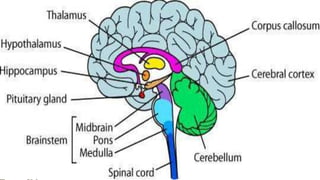
• brain- cortex, hippocampus, hindbrain, hypothalamus
 ANS
• high levels of NPY found in sympathetic ganglia and in tissues receiving a
dense sympathetic innervations, such as
o Vas deferens
oHeart atrium
oBlood vessels, spleen
oKidney
oRespiratory
oUrogenitary tracts
oVisceral smooth muscle
o Neuronal elements of gut and pancreas.
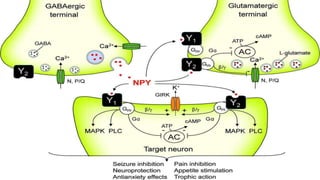
Receptors
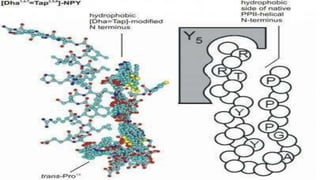
o NPY operates on is a G protein-coupled receptor in the rhodopsin
like 7-transmembrane GPCR family.
o Five subtypes of the NPY receptor have been identified in
mammals, four of which are functional in humans.
o Subtypes Y1 and Y5 have known roles in the stimulation of
feeding
o Subtypes Y2 and Y4 seem to have roles in appetite inhibition
(satiety).
o Some of these receptors are among the most highly conserved
neuropeptide receptors.
Functions
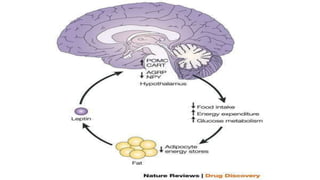
 Role in food intake
- it stimulates food intake with preferential effect on
carbohydrate
- it decreases latency to eat, increases motivation to
eat, delays satiety by augmenting meal size.
 Role in obesity
-an increase in glucocorticosteroid concentrations in
plasma;
-insensitivity or resistance to insulin;
-mutation of leptin receptor; and
-an increase in NPY mRNA and NPY release.
 Role in alcoholism
-NPY might protect against alcoholism
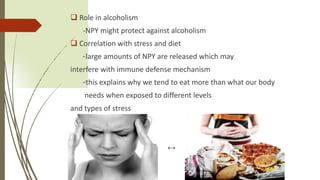
 Correlation with stress and diet
-large amounts of NPY are released which may
interfere with immune defense mechanism
-this explains why we tend to eat more than what our body
needs when exposed to different levels
and types of stress
↔
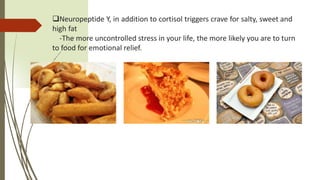
Neuropeptide Y, in addition to cortisol triggers crave for salty, sweet and
high fat
-The more uncontrolled stress in your life, the more likely you are to turn
to food for emotional relief.
Thank you

Neuropeptide y

  • 1.
  • 2.
    Introduction  36 aminoacid peptide with structural similarities to Peptide YY (PYY) and pancreatic polypeptide (PP).  Widely distributed throughput CNS and ANS.  Five subtypes- Y1, Y2, Y4, Y5, Y6  Diverse functions including food intake, blood pressure, circadian rhythms, stress pain, hormone secretion, reproduction, alcohol consumption.  Also implicated in number of disorders such as feeding disorders , seizures, hypertension, pain, depression, anxiety.
  • 4.
    Discovery o Identified inthe porcine brain extracts. o 1978- novel method developed for the detection of biologically active peptides based on C- terminal amide structure. o 1980- 2 peptide amide- HI (PHI) AND PYY o 1982- peptide with C- terminal tyrosine amide-NPY o 1983- Galanin o 1985- NPK o 1986- Pancreastitin.
  • 5.
    Distribution  CNS • brain-cortex, hippocampus, hindbrain, hypothalamus  ANS • high levels of NPY found in sympathetic ganglia and in tissues receiving a dense sympathetic innervations, such as o Vas deferens oHeart atrium oBlood vessels, spleen oKidney oRespiratory oUrogenitary tracts oVisceral smooth muscle o Neuronal elements of gut and pancreas.
  • 7.
    Receptors o NPY operateson is a G protein-coupled receptor in the rhodopsin like 7-transmembrane GPCR family. o Five subtypes of the NPY receptor have been identified in mammals, four of which are functional in humans. o Subtypes Y1 and Y5 have known roles in the stimulation of feeding o Subtypes Y2 and Y4 seem to have roles in appetite inhibition (satiety). o Some of these receptors are among the most highly conserved neuropeptide receptors.
  • 9.
    Functions  Role infood intake - it stimulates food intake with preferential effect on carbohydrate - it decreases latency to eat, increases motivation to eat, delays satiety by augmenting meal size.  Role in obesity -an increase in glucocorticosteroid concentrations in plasma; -insensitivity or resistance to insulin; -mutation of leptin receptor; and -an increase in NPY mRNA and NPY release.
  • 11.
     Role inalcoholism -NPY might protect against alcoholism  Correlation with stress and diet -large amounts of NPY are released which may interfere with immune defense mechanism -this explains why we tend to eat more than what our body needs when exposed to different levels and types of stress ↔
  • 12.
    Neuropeptide Y, inaddition to cortisol triggers crave for salty, sweet and high fat -The more uncontrolled stress in your life, the more likely you are to turn to food for emotional relief.
  • 13.