Bhagya Siripalli,
Department of pharmacology, SVIPS
 A phosphodiesterase (PDE) is an enzyme that breaks a phosphodiester
bond. Usually, phosphodiesterase refers to cyclic
nucleotide phosphodiesterases.
 However, there are many other families of phosphodiesterases,
including phospholipases C and D, autotaxin, sphingomyelin
phosphodiesterase, DNases, RNases, and restriction endonucleases (which
all break the phosphodiester backbone of DNA or RNA), as well as
numerous less-well-characterized small-molecule phosphodiesterases.
 The cyclic nucleotide phosphodiesterases comprise a group of enzymes that
degrade the phosphodiester bond in the second
messenger molecules cAMP and cGMP.
 They regulate the localization, duration, and amplitude of cyclic nucleotide
signaling within subcellular domains.
 PDEs are therefore important regulators of signal transduction mediated by
these second messenger molecules.
PDE MAINTISSUE LOCALIZATION
1 Brain,heart, vascular smooth muscle
2 Adrenal cortex,brain, heart, corpus cavernosum
3 Heart, corpus cavernosum, vascular smooth muscle, platelets, liver pancreas
4 Lung, mast cells,vascular smooth muscle
5 Corpus cavernosum, lung, vascular smooth muscle,platelets, brain, esophagus
6 Retina
7 Skeletalmuscle,T cells
8 Testis,thyroid
9 Broadly expressed,not wellcharacterized
10 Brain,testes
11 Skeletalmuscle, prostate, liver,kidney,pituitary,testis
• Drugs that block subtypes of the enzyme
phosphodiesterase (PDE).
• Therefore preventing the inactivation of the intracellular
second messengers cyclic adenosine monophosphate
(cAMP) and cyclic guanosine monophosphate (cGMP) by
the respective PDEsubtype(s).
• They are classified into non-selective PDE inhibitors and
selective PDE.
PDE4 selectiveinhibitors
• Mesembrine, Rolipram, Ibudilast, Piclamilast, Luteolin,
Drotaverine.
PDE5 Inhibitors
• Sildenafil, Tadalafil,Vardenafil (10 times more potent
than sildenafil) Udenafil ,Avanafil,Lodenafil
 PDE inhibitors have been identified as new potential therapeutics in areas
such as pulmonary arterial hypertension, coronary heart
disease, dementia, depression, asthma, COPD, protozoal infections
(including malaria) and schizophrenia.
 PDE also are important in seizure incidence. For example, PDE
compromised the antiepileptic activity of adenosine. In addition, using of a
PDE inhibitor (pentoxifylline) in pentylenetetrazole-induced seizure
indicated the antiepileptic effect by increasing the time latency to seizure
incidence and decreasing the seizure duration in vivo.
 Cilostazol (Pletal) inhibits PDE3. This inhibition allows red blood cells to
be more able to bend. This is useful in conditions such as intermittent
claudication, as the cells can maneuver through constricted veins and
arteries more easily.
 Dipyridamole inhibits PDE-3 and PDE-5. This leads to intraplatelet
accumulation of cAMP and/or cGMP, inhibiting platelet aggregation.
 Zaprinast inhibits the growth of asexual blood-stage malaria parasites (P.
falciparum) in vitro with an ED50 value of 35 μM, and inhibits PfPDE1, a P.
falciparum cGMP-specific phosphodiesterase, with an IC50 value of 3.8
μM.
 Xanthines such as caffeine and theobromine are cAMP-phosphodiesterase
inhibitors. However, the inhibitory effect of xanthines on
phosphodiesterases are only seen at dosages higher than what people
normally consume.
 Sildenafil, Tadalafil and Vardenafil are PDE-5 inhibitors and are widely
used in the treatment of erectile dysfunction.
 Phosphodiesterase enzymes have been shown to be different in different
types of cells, including normal and leukemic lymphocytes and are often
targets for pharmacological inhibition due to their unique tissue distribution,
structural properties, and functional properties.
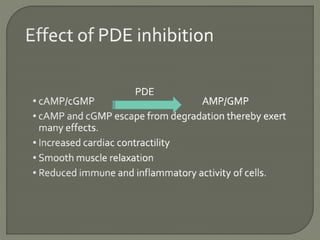
 Inhibitors of PDE can prolong or enhance the effects of physiological
processes mediated by cAMP or cGMP by inhibition of their degradation by
PDE.
 Sildenafil (Viagra) is an inhibitor of cGMP-specific phosphodiesterase type
5, which enhances the vasodilatory effects of cGMP in the corpus
cavernosum and is used to treat erectile dysfunction. Sildenafil is also
currently being investigated for its myo- and cardioprotective effects, with
particular interest being given to the compound's therapeutic value in the
treatment of Duchenne muscular dystrophy and benign prostatic
hyperplasia.
 Paraxanthine, the main metabolite of caffeine, is another cGMP-specific
phosphodiesterase inhibitor which inhibits PDE9, a cGMP preferring
phosphodiesterase. PDE9 is expressed as high as PDE5 in the corpus
cavernosum.
Phosphodiesterases
Phosphodiesterases

Phosphodiesterases

  • 1.
  • 2.
     A phosphodiesterase(PDE) is an enzyme that breaks a phosphodiester bond. Usually, phosphodiesterase refers to cyclic nucleotide phosphodiesterases.  However, there are many other families of phosphodiesterases, including phospholipases C and D, autotaxin, sphingomyelin phosphodiesterase, DNases, RNases, and restriction endonucleases (which all break the phosphodiester backbone of DNA or RNA), as well as numerous less-well-characterized small-molecule phosphodiesterases.  The cyclic nucleotide phosphodiesterases comprise a group of enzymes that degrade the phosphodiester bond in the second messenger molecules cAMP and cGMP.  They regulate the localization, duration, and amplitude of cyclic nucleotide signaling within subcellular domains.  PDEs are therefore important regulators of signal transduction mediated by these second messenger molecules.
  • 9.
    PDE MAINTISSUE LOCALIZATION 1Brain,heart, vascular smooth muscle 2 Adrenal cortex,brain, heart, corpus cavernosum 3 Heart, corpus cavernosum, vascular smooth muscle, platelets, liver pancreas 4 Lung, mast cells,vascular smooth muscle 5 Corpus cavernosum, lung, vascular smooth muscle,platelets, brain, esophagus 6 Retina 7 Skeletalmuscle,T cells 8 Testis,thyroid 9 Broadly expressed,not wellcharacterized 10 Brain,testes 11 Skeletalmuscle, prostate, liver,kidney,pituitary,testis
  • 11.
    • Drugs thatblock subtypes of the enzyme phosphodiesterase (PDE). • Therefore preventing the inactivation of the intracellular second messengers cyclic adenosine monophosphate (cAMP) and cyclic guanosine monophosphate (cGMP) by the respective PDEsubtype(s). • They are classified into non-selective PDE inhibitors and selective PDE.
  • 15.
    PDE4 selectiveinhibitors • Mesembrine,Rolipram, Ibudilast, Piclamilast, Luteolin, Drotaverine. PDE5 Inhibitors • Sildenafil, Tadalafil,Vardenafil (10 times more potent than sildenafil) Udenafil ,Avanafil,Lodenafil
  • 16.
     PDE inhibitorshave been identified as new potential therapeutics in areas such as pulmonary arterial hypertension, coronary heart disease, dementia, depression, asthma, COPD, protozoal infections (including malaria) and schizophrenia.  PDE also are important in seizure incidence. For example, PDE compromised the antiepileptic activity of adenosine. In addition, using of a PDE inhibitor (pentoxifylline) in pentylenetetrazole-induced seizure indicated the antiepileptic effect by increasing the time latency to seizure incidence and decreasing the seizure duration in vivo.  Cilostazol (Pletal) inhibits PDE3. This inhibition allows red blood cells to be more able to bend. This is useful in conditions such as intermittent claudication, as the cells can maneuver through constricted veins and arteries more easily.
  • 17.
     Dipyridamole inhibitsPDE-3 and PDE-5. This leads to intraplatelet accumulation of cAMP and/or cGMP, inhibiting platelet aggregation.  Zaprinast inhibits the growth of asexual blood-stage malaria parasites (P. falciparum) in vitro with an ED50 value of 35 μM, and inhibits PfPDE1, a P. falciparum cGMP-specific phosphodiesterase, with an IC50 value of 3.8 μM.  Xanthines such as caffeine and theobromine are cAMP-phosphodiesterase inhibitors. However, the inhibitory effect of xanthines on phosphodiesterases are only seen at dosages higher than what people normally consume.  Sildenafil, Tadalafil and Vardenafil are PDE-5 inhibitors and are widely used in the treatment of erectile dysfunction.
  • 21.
     Phosphodiesterase enzymeshave been shown to be different in different types of cells, including normal and leukemic lymphocytes and are often targets for pharmacological inhibition due to their unique tissue distribution, structural properties, and functional properties.  Inhibitors of PDE can prolong or enhance the effects of physiological processes mediated by cAMP or cGMP by inhibition of their degradation by PDE.  Sildenafil (Viagra) is an inhibitor of cGMP-specific phosphodiesterase type 5, which enhances the vasodilatory effects of cGMP in the corpus cavernosum and is used to treat erectile dysfunction. Sildenafil is also currently being investigated for its myo- and cardioprotective effects, with particular interest being given to the compound's therapeutic value in the treatment of Duchenne muscular dystrophy and benign prostatic hyperplasia.  Paraxanthine, the main metabolite of caffeine, is another cGMP-specific phosphodiesterase inhibitor which inhibits PDE9, a cGMP preferring phosphodiesterase. PDE9 is expressed as high as PDE5 in the corpus cavernosum.