 Cholecystokinin is a peptide hormone of the gastrointestinal
system responsible for stimulating the digestion of fat and protein.
 Cholecystokinin, officially called pancreozymin, is synthesized and
secreted by enteroendocrine cells in the duodenum, the first segment of
the small intestine.
 Its presence causes the release of digestive enzymes and bile from
the pancreas and gallbladder, respectively, and also acts as a hunger
suppressant.
 It was discovered in 1943 by A.C. Ivy and E. Olberg. It is a member of the
gastrin/cholecystokinin family of peptide hormones and is very similar in
structure to gastrin, another gastrointestinal hormone.
 CCK and gastrin share the same five C-terminal amino acids. CCK is
composed of varying numbers of amino acids depending on post-
translational modification of the 150-amino acid precursor,
preprocholecystokinin.
 Thus, the CCK peptide hormone exists in several forms, each identified
by the number of amino acids it contains, e.g., CCK58, CCK33, CCK22 and
CCK8. CCK58 assumes a helix-turn-helix configuration.
 Biological activity resides in the C-terminus of the peptide. Most CCK
peptides have a sulfate group attached to a tyrosine located seven
residues from the C-terminus (see tyrosine sulfation). This modification is
crucial for the ability of CCK to activate the cholecystokinin A receptor.
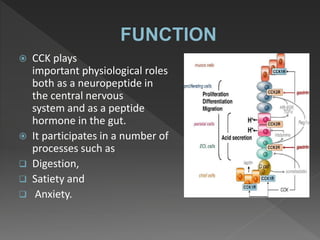
 CCK plays
important physiological roles
both as a neuropeptide in
the central nervous
system and as a peptide
hormone in the gut.
 It participates in a number of
processes such as
 Digestion,
 Satiety and
 Anxiety.
Gastrointestinal
 CCK is synthesized and released by enteroendocrine cells in the
mucosal lining of the small intestine (mostly in the duodenum and
jejunum), called I cells, neurons of the enteric nervous system, and
neurons in the brain.
 It is released rapidly into the circulation in response to a meal.
 The greatest stimulator of CCK release is the presence of fatty
acids and/or certain amino acids in the chyme entering
the duodenum.
 In addition, release of CCK is stimulated by monitor
peptide (released by pancreatic acinar cells), CCK-releasing
protein (via paracrine signalling mediated by enterocytes in
the gastric and intestinal mucosa), and acetylcholine (released by
the parasympathetic nerve fibers of the vagus nerve).
Digestion
 CCK mediates digestion in the small intestine by inhibiting gastric
emptying. It stimulates the acinar cells of the pancreas to release a juice
rich in pancreatic digestive enzymes (hence an alternate
name, pancreozymin) that catalyze the digestion of fat, protein, and
carbohydrates.
 Thus, as the levels of the substances that stimulated the release of CCK
drop, the concentration of the hormone drops as well.
 The release of CCK is also inhibited by somatostatin and pancreatic
peptide. Trypsin, a protease released by pancreatic acinar cells,
hydrolyzes CCK-releasing peptide and monitor peptide, in effect turning
off the additional signals to secrete CCK.
 CCK also causes the increased production of hepatic bile, and stimulates
the contraction of the gall bladder and the relaxation of the sphincter of
Oddi (Glisson's sphincter), resulting in the delivery of bile into the
duodenal part of the small intestine.
 Bile salts form amphipathic lipids, micelles that emulsify fats, aiding in
their digestion and absorption.
Satiety
 As a peptide hormone, CCK mediates satiety by acting on
the CCK receptors distributed widely throughout the central
nervous system. The mechanism for hunger suppression is
thought to be a decrease in the rate of gastric emptying.
 CCK also has stimulatory effects on the vagus nerve, effects
that can be inhibited by capsaicin.
 The stimulatory effects of CCK oppose those of ghrelin,
which has been shown to inhibit the vagus nerve.
Anxiogenic
 In both humans and rodents, studies clearly indicate that
elevated CCK levels causes increased anxiety.
 The site of the anxiety-inducing effects of CCK seems to be
central with specific targets being the basolateral
amygdala, hippocampus, hypothalamus, peraqueductal grey,
and cortical regions.
Panicogenic
 The CCK tetrapeptide fragment CCK-4 (Trp-Met-Asp-Phe-NH2)
reliably causes anxiety and panic attacks (panicogenic effect)
when administered to humans and is commonly used in
scientific research for this purpose of in order to test
new anxiolytic drugs.
Neurological
 CCK is found extensively throughout the central nervous
system, witH high concentrations found in the limbic system.
 CCK is synthesized as a 115 amino acid preprohormone, that is
then converted into multiple isoforms.
 The predominant form of CCK in the central nervous system is
the sulfated octapeptide, CCK-8S.
Hallucinogenic
 Several studies have implicated CCK as a cause of visual
hallucinations in Parkinson’s disease.
 Mutations in CCK receptors in combination with mutated CCK
genes potentiate this association. These studies also uncovered
potential racial/ethnic differences in the distribution of mutated
CCK genes
 CCK has been shown to interact with the Cholecystokinin A
receptor located mainly on pancreatic acinar cells
and Cholecystokinin B receptor mostly in the brain and stomach.
 CCKB receptor also binds gastrin, a gastrointestinal hormone
involved in stimulating gastric acid release and growth of the
gastric mucosa.
 CCK has also been shown to interact with calcineurin in the
pancreas.
 CCK can be stimulated by a diet high in protein, or by protease
inhibitors.
 CCK has been shown to interact with orexin neurons, which control
appetite and wakefulness (sleep). CCK can have indirect effects on
sleep regulation.
 CCK in the body cannot cross the blood-brain barrier, but certain
parts of the hypothalamus and brainstem are not protected by the
barrier.
THANK YOU

Cholecystokinin

  • 2.
     Cholecystokinin isa peptide hormone of the gastrointestinal system responsible for stimulating the digestion of fat and protein.  Cholecystokinin, officially called pancreozymin, is synthesized and secreted by enteroendocrine cells in the duodenum, the first segment of the small intestine.  Its presence causes the release of digestive enzymes and bile from the pancreas and gallbladder, respectively, and also acts as a hunger suppressant.
  • 3.
     It wasdiscovered in 1943 by A.C. Ivy and E. Olberg. It is a member of the gastrin/cholecystokinin family of peptide hormones and is very similar in structure to gastrin, another gastrointestinal hormone.  CCK and gastrin share the same five C-terminal amino acids. CCK is composed of varying numbers of amino acids depending on post- translational modification of the 150-amino acid precursor, preprocholecystokinin.  Thus, the CCK peptide hormone exists in several forms, each identified by the number of amino acids it contains, e.g., CCK58, CCK33, CCK22 and CCK8. CCK58 assumes a helix-turn-helix configuration.  Biological activity resides in the C-terminus of the peptide. Most CCK peptides have a sulfate group attached to a tyrosine located seven residues from the C-terminus (see tyrosine sulfation). This modification is crucial for the ability of CCK to activate the cholecystokinin A receptor.
  • 4.
     CCK plays importantphysiological roles both as a neuropeptide in the central nervous system and as a peptide hormone in the gut.  It participates in a number of processes such as  Digestion,  Satiety and  Anxiety.
  • 5.
    Gastrointestinal  CCK issynthesized and released by enteroendocrine cells in the mucosal lining of the small intestine (mostly in the duodenum and jejunum), called I cells, neurons of the enteric nervous system, and neurons in the brain.  It is released rapidly into the circulation in response to a meal.  The greatest stimulator of CCK release is the presence of fatty acids and/or certain amino acids in the chyme entering the duodenum.  In addition, release of CCK is stimulated by monitor peptide (released by pancreatic acinar cells), CCK-releasing protein (via paracrine signalling mediated by enterocytes in the gastric and intestinal mucosa), and acetylcholine (released by the parasympathetic nerve fibers of the vagus nerve).
  • 6.
    Digestion  CCK mediatesdigestion in the small intestine by inhibiting gastric emptying. It stimulates the acinar cells of the pancreas to release a juice rich in pancreatic digestive enzymes (hence an alternate name, pancreozymin) that catalyze the digestion of fat, protein, and carbohydrates.  Thus, as the levels of the substances that stimulated the release of CCK drop, the concentration of the hormone drops as well.  The release of CCK is also inhibited by somatostatin and pancreatic peptide. Trypsin, a protease released by pancreatic acinar cells, hydrolyzes CCK-releasing peptide and monitor peptide, in effect turning off the additional signals to secrete CCK.  CCK also causes the increased production of hepatic bile, and stimulates the contraction of the gall bladder and the relaxation of the sphincter of Oddi (Glisson's sphincter), resulting in the delivery of bile into the duodenal part of the small intestine.  Bile salts form amphipathic lipids, micelles that emulsify fats, aiding in their digestion and absorption.
  • 7.
    Satiety  As apeptide hormone, CCK mediates satiety by acting on the CCK receptors distributed widely throughout the central nervous system. The mechanism for hunger suppression is thought to be a decrease in the rate of gastric emptying.  CCK also has stimulatory effects on the vagus nerve, effects that can be inhibited by capsaicin.  The stimulatory effects of CCK oppose those of ghrelin, which has been shown to inhibit the vagus nerve.
  • 8.
    Anxiogenic  In bothhumans and rodents, studies clearly indicate that elevated CCK levels causes increased anxiety.  The site of the anxiety-inducing effects of CCK seems to be central with specific targets being the basolateral amygdala, hippocampus, hypothalamus, peraqueductal grey, and cortical regions. Panicogenic  The CCK tetrapeptide fragment CCK-4 (Trp-Met-Asp-Phe-NH2) reliably causes anxiety and panic attacks (panicogenic effect) when administered to humans and is commonly used in scientific research for this purpose of in order to test new anxiolytic drugs.
  • 9.
    Neurological  CCK isfound extensively throughout the central nervous system, witH high concentrations found in the limbic system.  CCK is synthesized as a 115 amino acid preprohormone, that is then converted into multiple isoforms.  The predominant form of CCK in the central nervous system is the sulfated octapeptide, CCK-8S. Hallucinogenic  Several studies have implicated CCK as a cause of visual hallucinations in Parkinson’s disease.  Mutations in CCK receptors in combination with mutated CCK genes potentiate this association. These studies also uncovered potential racial/ethnic differences in the distribution of mutated CCK genes
  • 10.
     CCK hasbeen shown to interact with the Cholecystokinin A receptor located mainly on pancreatic acinar cells and Cholecystokinin B receptor mostly in the brain and stomach.  CCKB receptor also binds gastrin, a gastrointestinal hormone involved in stimulating gastric acid release and growth of the gastric mucosa.  CCK has also been shown to interact with calcineurin in the pancreas.  CCK can be stimulated by a diet high in protein, or by protease inhibitors.  CCK has been shown to interact with orexin neurons, which control appetite and wakefulness (sleep). CCK can have indirect effects on sleep regulation.  CCK in the body cannot cross the blood-brain barrier, but certain parts of the hypothalamus and brainstem are not protected by the barrier.
  • 11.