A New Apo-Caspase-6 Crystal Form Reveals the Active
Conformation of the Apoenzyme
Ilka Müller1
, Marieke B. A. C. Lamers1
, Alison J. Ritchie1
,
Hyunsun Park2
, Celia Dominguez2
, Ignacio Munoz-Sanjuan2
,
Michel Maillard2
and Alex Kiselyov2
⁎
1
BioFocus, Chesterford Research Park, Saffron Walden, Essex CB10 1XL, UK
2
CHDI Foundation, Inc., Suite 100, 6080 Center Drive, Los Angeles, CA 90045, USA
Received 4 February 2011;
received in revised form
12 May 2011;
accepted 13 May 2011
Available online
20 May 2011
Edited by G. Schulz
Keywords:
caspases;
Huntington's disease;
Alzheimer's disease;
caspase-6;
crystal structure
Caspase-6 has been identified as a key component in the pathway of
neurodegenerative diseases such as Alzheimer's disease and Huntington's
disease. It has been the focus of drug development for some time, but only
recently have structural data become available. The first study identified a
novel noncanonical conformation of apo-caspase-6 contrasting with the
typical caspase conformation. Then, the structures of both caspase-6
zymogen and the Ac-VEID-CHO peptide inhibitor complex described
caspase-6 in the canonical conformation, raising the question of why the
intermediate between these two structures (mature apo-caspase-6) would
adopt the noncanonical conformation. In this study, we present a new
crystal form of the apoenzyme in the canonical conformation by identifying
the previous apostructure as a pH-inactivated form of caspase-6. Our new
apostructure is further compared to the Ac-VEID-CHO caspase-6 inhibitor
complex. The structural comparison allows us to visualize the organization
of loops L2, L3, and L4 upon ligand binding and how the catalytic groove
forms to accommodate the inhibitor.
© 2011 Elsevier Ltd. All rights reserved.
Introduction
Caspases or cysteinyl-aspartate-specific proteases
are critical components of apoptosis signaling
pathways. Deregulation of their activity has been
associated with a variety of conditions, including
cardiovascular, tumorigenic, and neurodegenera-
tive disorders.1
It is generally accepted that extra-
cellular apoptotic signals are transduced by two
distinct classes of caspases2,3
—initiator and effector
caspases4
—that, as their names suggest, play
distinct roles in the cell death signaling relay.
Initiator caspases include caspase-2, caspase-8,
caspase-9, and caspase-10. Effector or ‘executioner’
caspases are activated by initiator caspases and are
represented by caspase-3, caspase-6, and caspase-7.
Effector caspases cleave a multitude of functional
substrates, leading to organized cessation of cellular
functions and ultimately cell death.5
The resulting
proteolytic fragments themselves amplify the pro-
apoptotic signal and thus need to be kept under
tight control. In the context of the central nervous
system, this leads to neuronal cell death, with
aberrant effector caspase activity being associated
with neurodegenerative diseases such as Alzhei-
mer's disease and Huntington's disease (HD).6–10
Specifically for Alzheimer's disease, caspase-3 was
shown to process the amyloid precursor protein,
leading to coprecipitation of cleaved fragments with
amyloid plaques11 and excessive neuronal death.
For HD, caspase-6 took central stage as a key
processing enzyme of mutant huntingtin (mHTT)
protein, which features expanded polyglutamine
*Corresponding author. E-mail address:
Alex.Kiselyov@CHDIFoundation.org.
Abbreviations used: HD, Huntington's disease; mHTT,
mutant huntingtin; PDB, Protein Data Bank.
doi:10.1016/j.jmb.2011.05.020 J. Mol. Biol. (2011) 410, 307–315
Contents lists available at www.sciencedirect.com
Journal of Molecular Biology
journal homepage: http://ees.elsevier.com.jmb
0022-2836/$ - see front matter © 2011 Elsevier Ltd. All rights reserved.
repeats at its N-terminus. mHTT cleavage at
position 586 reportedly produces “toxic” fragments
that contribute to HD pathology.12,13
This notion has
been further supported by in vivo evidence indicat-
ing that administration of diverse neurotoxic xeno-
biotics affected neither normal neuronal nor striatal
functions in mice expressing caspase-6-resistant, but
not caspase-3-resistant, mHTT.14 It was concluded
that the specific blockage of caspase-6 proteolytic
activity may be neuroprotective in this disease
context.
Significant attention has been paid to identify
potent and specific caspase inhibitors that feature
favorable pharmacokinetic and toxicology profiles
that consider specific therapeutic indication(s).
Although numerous classes of caspase inhibitors
have been reported (for reviews, see Ivachtchenko et
al.15
and Okun et al.16
), their isoform specificity
remains to be one of the main issues in the field.17,18
Regardless of the specific chemical nature of these
inhibitors, they feature an electrophilic moiety (e.g.,
carbonyl or fluoromethyl ketone group) that in-
teracts with Cys163 at the active site, as well as a
substrate-mimetic recognition motif (e.g., tetrapep-
tide, pentapeptide, or aryl pharmacophore). The
majority of the reported caspase-6 inhibitors are
peptide based. Unfortunately, these agents do not
display favorable pharmacokinetic profiles, namely
stability and blood–brain barrier permeability.19
Isatin sulfonamide analogues that feature 2-fold to
10-fold selectivity for caspase-6 over caspase-1,
caspase-3, caspase-7, and caspase-8 isoforms have
been described.20
Caspase-6 has been the focus of drug develop-
ment (Chu et al.20
and references cited therein), but
only recently have structural data become available.
The first structural study of apo-caspase-621
showed
the enzyme to be a constitutive p20/p10 dimer, with
the cleaved interdomain linker partially inserted in
the central groove of the p202/p102 tetramer.
Distinct features of this apo-caspase-6 structure
include a misaligned catalytic machinery and the
lack of several structural elements required for
substrate recognition. The same noncanonical con-
formation has also been reported in a study
comparing the structures of apo-caspase-6 with
and without the intersubunit linker.22
The first
report on caspase-6 in the canonical caspase
conformation compared the caspase-6 zymogen
with the Ac-VEID-CHO-bound form,23
deducing
the mechanism of intramolecular self-cleavage.
These structures raised the question of why mature
apo-caspase-6 would adopt a noncanonical confor-
mation, being the intermediate between caspase-6
zymogen and the ligand-bound caspase-6, and in
turn questioned whether this apostructure was
indeed physiologically relevant. To address this
question, we solved the structure of mature apo-
caspase-6 in a new crystal form, which for the first
time shows the canonical caspase conformation also
for apo-caspase-6. A further comparison with the
Ac-VEID-CHO caspase-6 inhibitor complex23
illus-
trates the organization of loops L2, L3, and L4 upon
ligand binding and how the catalytic groove forms
to accommodate the inhibitor.
Results and Discussion
It is generally recognized that effector caspases
undergo proteolytic cleavage of the inactive
zymogen at a specific aspartate residue, resulting
in a large N-terminal p20 polypeptide chain and a
small C-terminal p10 polypeptide chain, leading to
a p202/p102 tetramer.24,25 In caspase-6, subunits
p20 and p10 comprise residues 24–179 and 194–
293, respectively. The structure recently reported
for the mature apo-caspase-6 also features a p202/
p102 tetramer;21 however, it exhibits notable
differences in the arrangement of several loop
regions around the active site as compared to the
caspase-6 zymogen and the ligand-free crystal
structures of the closely related effector caspases,
caspase-3 and caspase-7 (sequence identities of
41% and 38%, respectively, and sequence similar-
ities of 58% and 54%, respectively). In particular,
residues forming a short anti-parallel β-sheet that
mediates substrate interactions in other caspases
are found to elongate the central α-helix, blocking
the canonical P1 substrate binding site and
dissociating the His121/Cys163 catalytic histi-
dine/cysteine dyad. Caspase-6 activity was con-
firmed prior to crystallization of the target protein,
and it is therefore presumed that the observed
atypical misalignment of the active site could be
an artifact of the crystallization procedure. The
protein had been crystallized in the presence of
0.1 M sodium acetate at pH 4.5. Caspase-6 activity
is known to be optimal around neutral pH and is
almost entirely lost at pH 5 and below.26
We
speculated that this pH dependence was reflected
in the reported crystal structure of caspase-6, and
we performed screens for crystallization conditions
near the optimum pH for caspase-6 activity. A
new crystal form was obtained in the presence of
0.1 M Tris (pH 7.4). The crystals exhibit the
monoclinic space group P21 with four p202/p102
tetramers in the asymmetric unit. The structure
was refined to a resolution of 2.53 Å with R-factors
of 20.8% and 26.8%, respectively (Table 1).
The overall structure of mature apo-caspase-6
Within the four caspase-6 p202/p102 tetramers in
the asymmetric unit, all of the eight p20/p10
heterodimers are highly similar and can be super-
imposed with RMSDs of between 0.26 and 0.36 Å for
202 Cα
atoms. For further discussion, we will refer to
308 X-ray Structure of Active Caspase-6
the tetramer consisting of chains A/B and C/D (Fig.
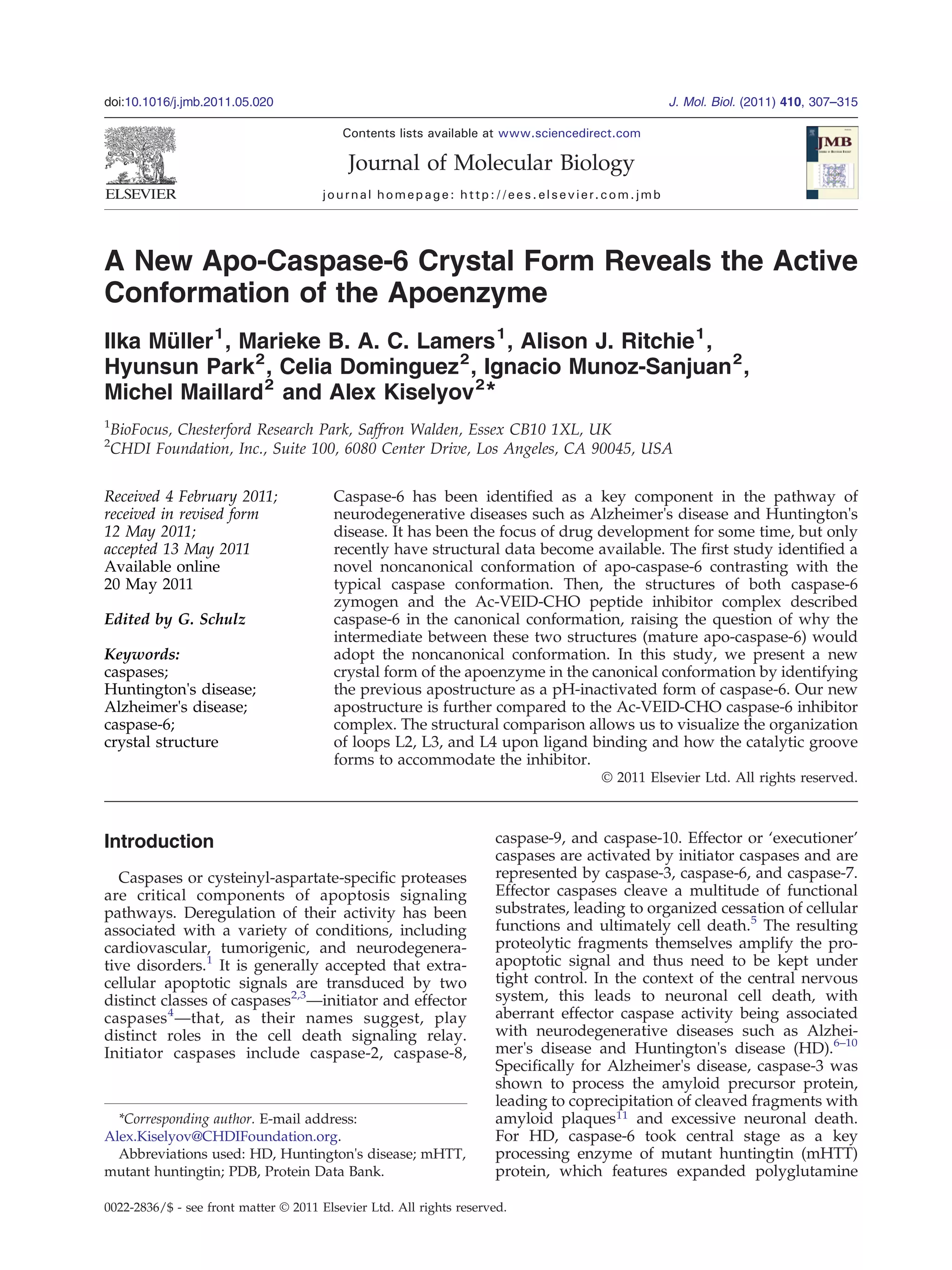
1a). The overall topology of caspase-6 at pH 7.4
closely resembles the caspase-6 zymogen structure
[Protein Data Bank (PDB) ID: 3NR2; RMSD of 0.74 Å
for 205 Cα
atoms within the p20/p10 dimer; Fig. 1b]
and the mature ligand-free caspase-7 (PDB ID: 1K86;
196 topologically equivalent Cα
atoms within the
p20/p10 dimer superimposing with an RMSD of
0.85 Å; Fig. 1c), with a central six-stranded mixed
β-sheet flanked by five α-helices. It is distinct from
the structure reported for caspase-6 at pH 4.6 (PDB
ID: 2WDP; RMSD of 3.3 Å for 203 Cα
atoms within
the p20/p10 dimer; Fig. 1d), leading to our
hypothesis that crystallization of caspase-6 at low
pH likely sequestered a pH-inactivated form, which
had not been observed when caspase-3 or caspase-7
was crystallized at pH b5 (i.e., PDB IDs: 2C1E and
1KMC29
). We will subsequently refer to the struc-
tures obtained at pH 4.5 and pH 7.4 as low-pH and
physiological-pH mature apo-caspase-6 structures,
respectively.
The caspase-6 protein used for crystallization at
physiological pH comprised residues 24–179 and
194–293 after self-cleavage of the expressed caspase-6
zymogen. Caspase activity was confirmed prior to
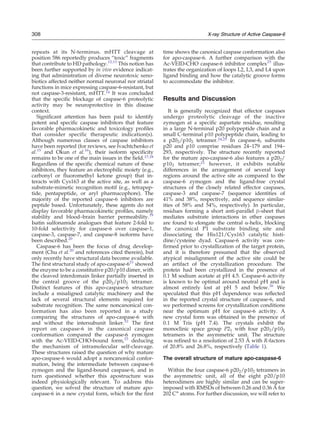
crystallization (Fig. 2). The electron density is well
defined for residues Phe31-Cys163 in the p20
subunit, residues Tyr198-Val212 and Thr222-
Arg260, and residues Gln274-Lys291 in the p10
subunit. Consequently, the first seven residues of
the N-terminus of the p20 subunit, as well as the last
two residues of the p10 subunit, were absent from
the electron density maps, and the loops constitut-
ing the catalytic grooves L2 (residues 163–179), L3
(212–222), and L4 (257–275) were found to be
disordered.
The L2′ loop
For inhibitor-bound caspase-3 and caspase-7, the
conformation of the loops forming the catalytic
groove has been shown to be stabilized by
interactions with the cleaved interdomain linker
loop L2′ of the adjacent p20/p10 dimer;30,31
however, in the structure of the pro-caspase-7
zymogen and the ligand-free caspase-7, the L2′
loop is folded back and located at the interface
between the two p10 subunits of the p202/p102
tetramer.32,33
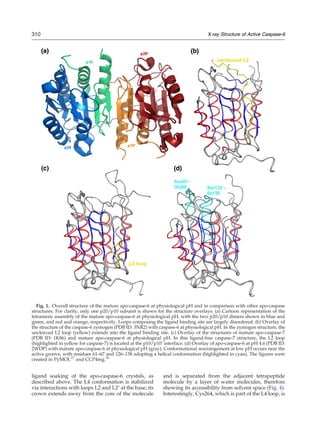
In the apo-caspase-6 structure at
physiological pH, the L2′ loop is also oriented
towards the p10/p10′ interface (Fig. 3). It has
been proposed that the presence of inhibitor or
substrate triggers flipping of the L2′ loop.34
In
support of this hypothesis, apo-crystal structures
of caspase-3 and caspase-7 obtained in the
presence of inhibitor35,36
showed that the L2′
loop folded against the L2 and L4 loops. This was
in contrast to the zymogen-like conformation of
the L2′ loop in the previously reported apo-
caspase-7 structure crystallized in the absence of
inhibitor.33
These studies on caspase-3 and cas-
pase-7 suggest ligand-induced dynamics of the
L2′ loop. Our crystallography-based insight into
the mature apo-caspase-6 and literature evidence
further support the presence of multiple apostruc-
tures that are likely to result from the inherent
conformational freedom of the enzyme and could
be stabilized by ligand binding. In the apo-
caspase-6 crystals, the ligand binding site is
located at a large solvent channel through the
crystal and should be accessible to the ligand via
soaking. Furthermore, the conformation of the L4
loop is not restricted by crystal packing; thus,
rearrangement upon ligand binding should be
feasible. Based on this insight, we soaked an
inhibitor into the apo-caspase-6 crystals. Unfortu-
nately, this approach failed; specifically, longer
soaking times resulted in complete crystal decay,
whereas shorter exposure to the molecule afforded
low compound occupancy. We propose that
within the crystal packing context, the L2′ loop
in its locked position at the dimer interface is
not able to reorient towards, and to stabilize,
the L4 loop in a conformation required for
ligand binding, as observed in the Ac-VEID-CHO
caspase-6 complex. (Further details can be found
in Supplementary Material.)
Comparison with the Ac-VEID-CHO caspase-6
complex
In the Ac-VEID-CHO caspase-6 complex (PDB ID:
3OD523
), the L2′ loop is flipped by 180° and oriented
towards the L2/L4 loop interface of the neighboring
p20/p10 dimer (Fig. 3). The conformation of loops L2
and L3 closely resembles the one observed after the
Table 1. Data processing and refinement statistics
Parameter Apo-caspase-6
PDB ID 3P45
Space group P21
Cell dimensions
a, b, c (Å) 81.23, 161.24, 88.92
α, β, γ (°) 90.0, 94.80, 90.0
Resolution (Å) 30–2.53
Rmerge
a
(%) 10.1 (55.0)
Mean I/σIa
8.0 (2.0)
Completenessa
(%) 99.8 (99.8)
Multiplicity 2.9
Refinement
Number of reflections 75,784
Rwork/Rfree (%) 20.7/26.4
B-factors
Protein 10.3
Water 8.7
RMSD
Bond lengths (Å) 0.019
Bond angles (°) 1.742
a
Values in parentheses are for the highest-resolution shell.
309X-ray Structure of Active Caspase-6
ligand soaking of the apo-caspase-6 crystals, as
described above. The L4 conformation is stabilized
via interactions with loops L2 and L2′ at the base; its
crown extends away from the core of the molecule
and is separated from the adjacent tetrapeptide
molecule by a layer of water molecules, therefore
showing its accessibility from solvent space (Fig. 4).
Interestingly, Cys264, which is part of the L4 loop, is
Fig. 1. Overall structure of the mature apo-caspase-6 at physiological pH and in comparison with other apo-caspase
structures. For clarity, only one p20/p10 subunit is shown for the structure overlays. (a) Cartoon representation of the
tetrameric assembly of the mature apo-caspase-6 at physiological pH, with the two p20/p10 dimers shown in blue and
green, and red and orange, respectively. Loops composing the ligand binding site are largely disordered. (b) Overlay of
the structure of the caspase-6 zymogen (PDB ID: 3NR2) with caspase-6 at physiological pH. In the zymogen structure, the
uncleaved L2 loop (yellow) extends into the ligand binding site. (c) Overlay of the structures of mature apo-caspase-7
(PDB ID: 1K86) and mature apo-caspase-6 at physiological pH. In this ligand-free caspase-7 structure, the L2 loop
(highlighted in yellow for caspase-7) is located at the p10/p10′ interface. (d) Overlay of apo-caspase-6 at pH 4.6 (PDB ID:
2WDP) with mature apo-caspase-6 at physiological pH (gray). Conformational rearrangement at low pH occurs near the
active groove, with residues 61–67 and 126–138 adopting a helical conformation (highlighted in cyan). The figures were
created in PyMOL27
and CCP4mg.28
310 X-ray Structure of Active Caspase-6
one of four surface cysteine residues for which
cacodylation has been observed in the crystal
structure of the Ac-VEID-CHO caspase-6 complex.
The complex had been crystallized in the presence of
DTT and sodium cacodylate, a mixture that had been
previously reported to lead to the formation of the
S-(dimethylarsenic) cysteine adduct.37
Since the
protein was incubated with the inhibitor prior to
crystallization, it is reasonable to assume that the Ac-
VEID-CHO caspase-6 complex was formed prior to
cacodylate exposure. This is in agreement with the
observation that the active site Cys163, which
appears to be accessible to covalent modification in
the apocomplex but is blocked after peptide binding,
is not cacodylated. The residue has to be accessible to
allow for reactivity at Cys264; therefore, it seems
unlikely that the L4 loop is packed tightly against the
peptide in the cacodylate-free complex. Based on this
observation, we believe that solvent separation
between the peptide and the L4 loop is a genuine
feature of the Ac-VEID-CHO caspase-6 complex that
distinguishes caspase-6 from caspase-3 and caspase-7.
In the Ac-DEVD-CHO caspase-3 complex (PDB ID:
2H5I38
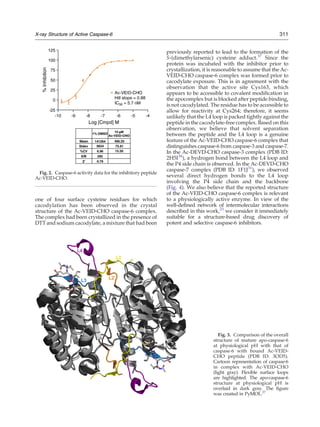
), a hydrogen bond between the L4 loop and
the P4 side chain is observed. In the Ac-DEVD-CHO
caspase-7 complex (PDB ID: 1F1J31
), we observed
several direct hydrogen bonds to the L4 loop
involving the P4 side chain and the backbone
(Fig. 4). We also believe that the reported structure
of the Ac-VEID-CHO caspase-6 complex is relevant
to a physiologically active enzyme. In view of the
well-defined network of intermolecular interactions
described in this work,23
we consider it immediately
suitable for a structure-based drug discovery of
potent and selective caspase-6 inhibitors.
Fig. 3. Comparison of the overall
structure of mature apo-caspase-6
at physiological pH with that of
caspase-6 with bound Ac-VEID-
CHO peptide (PDB ID: 3OD5).
Cartoon representation of caspase-6
in complex with Ac-VEID-CHO
(light gray). Flexible surface loops
are highlighted. The apo-caspase-6
structure at physiological pH is
overlaid in dark gray. The figure
was created in PyMOL.27
Fig. 2. Caspase-6 activity data for the inhibitory peptide
Ac-VEID-CHO.
311X-ray Structure of Active Caspase-6
In conclusion, this article describes the structures
of caspase-6 in its apo form at physiological pH. It
closely resembles mature ligand-free caspase-7 with
a central six-stranded mixed β-sheet flanked by five
α-helices. Loops L2, L3, and L4, which constitute the
ligand binding site in the Ac-VEID-CHO caspase-6
complex, are disordered, and the L2′ loop resides at
the p10/p10′ interface as observed in the caspase-6
zymogen structure. Our results indicate that the
presence of ligand induces loop L2′ to reorient
towards, and to stabilize, the L2 and L4 loops of the
neighboring p20/p10 dimer, with the L2′ flip
required for ligand binding. The overall topology
of the apostructure at physiological pH is distinct
from the structural data previously reported for
caspase-6 at pH 4.5. Even though its noncanonical
fold does not impair inhibitor binding, we think that
it does not represent a physiologically relevant
conformation that would provide an allosteric site
for drug development.
Materials and Methods
Gene construction and protein expression
Oligonucleotides were designed to amplify the cata-
lytic domain (amino acid residues 24–293) of human
caspase-6 for cloning into a BioFocus in-house expres-
sion vector. cDNA products of the correct size for
caspase-6 were obtained from polymerase chain reaction
experiments using cDNA encoding full-length caspase-6.
Products were successfully cloned into the BioFocus
vector pT7-CH for Escherichia coli expression under the
control of the T7 promoter. The vector–insert combina-
tion provided a C-terminal hexa-histidine purification
tag on the expressed protein. For large-scale expression,
recombinant human caspase-6 was expressed in Rosetta
E. coli cells grown overnight at 37 °C from glycerol
stock. The next day, 6×1 L cultures were inoculated
with 50 ml of overnight starter cultures. Cells were
grown at 37 °C until an OD600 of 1.2 had been reached.
Cells were cooled to 25 °C, induced with 0.5 mM IPTG,
and shaken overnight before being harvested. Cell
pellets were harvested, washed with phosphate-buffered
saline, and then stored at −80 °C. We found that the
temperature had clearly an effect on the yield of fully
processed caspase-6 protein, as induction at 25 °C,
compared to 37 °C, resulted in higher yields. In addition,
increased protein yields were also obtained when the
cells were induced at a higher cell density.
Protein purification
Cell paste from 6×1 L cultures was resuspended on ice
in 100 ml of 25 mM Tris (pH 8.0) containing 25 mM
imidazole, 100 mM NaCl, 10% glycerol, and 0.1% 3-[(3-
cholamidopropyl)dimethylammonio]propanesulfonic
acid. Following mechanical disruption of the cells, the
soluble fraction was harvested by centrifugation at
60,000g for 30 min. The cleared supernatant was incubated
batchwise with 0.5 ml of NiNTA (Qiagen) for 2 h at 4 °C to
allow binding. The resin was collected by centrifugation at
400g and washed once with buffer A [25 mM Tris (pH 8.0)
containing 25 mM imidazole, 100 mM NaCl, 10% glycerol,
and 0.1% 3-[(3-cholamidopropyl)dimethylammonio]pro-
panesulfonic acid] before being loaded into an Omnifit
column. The column was attached to an ÄKTAexpress,
run through IMAC elution (using buffer A supplemented
with 500 mM imidazole and 10 mM DTT), and then
subjected to size-exclusion chromatography [with a
Superdex 200 16/60 column equilibrated in 20 mM
sodium acetate (pH 5.5) containing 50 mM NaCl and
10 mM DTT], as the protein was most stable for storage
under these conditions. After size-exclusion chromatog-
raphy, the fractions were collected and analyzed by SDS-
PAGE stained with Coomassie brilliant blue. The purest
fractions were pooled, concentrated to 8.2 mg/ml by
ultrafiltration, and used for crystallization. DTT (10 mM)
was added to the concentrated protein prior to crystalli-
zation. Protein concentration was determined with
Fig. 4. Comparison of inhibitor-bound caspase-3, caspase-6, and caspase-7 structures. Interaction of the L4 loop
residues with the P4 site of bound peptide in the Ac-VEID-CHO caspase-6 (PDB ID: 3OD5; gray), Ac-DEVD-CHO
caspase-3 (PDB ID: 2H5I; magenta), and Ac-DEVD-CHO caspase-7 (PDB ID: 1F1J; blue) complexes, respectively. In
contrast to the caspase-3 and caspase-7 complexes, all hydrogen bonds between the L4 loop and the inhibitor peptide are
water mediated in the caspase-6 complex. The figures were created in PyMOL.27
312 X-ray Structure of Active Caspase-6
Coomassie Plus reagent, measuring optical absorbance at
595 nm.
Protein activity
Caspase-6 activity was confirmed using an assay that is
based on the protolytic cleavage of a fluorogenic substrate.
This substrate consists of two caspase-6 recognition
peptide molecules that are covalently linked to two
amine groups of the fluorescent dye rhodamine 110
(Z-VEID-R110; Invitrogen), which suppresses R110 fluo-
rescence. During proteolysis, both recognition peptides
are cleaved off, and subsequent dequenching of the dye
indicates enzymatic activity. Pipes (20 mM; pH 7.4),
100 mM NaCl, 0.03% Pluronic®, 10% sucrose, 1 mM
ethylenediaminetetraacetic acid, and 5 mM glutathione
were used as assay buffer. The enzyme concentration was
determined with Coomassie Plus reagent, measuring
optical absorbance at 595 nm. Recombinant caspase-6
activity was detected by measuring the R110 release from
Z-VEID-R110 at 37 °C using a Perkin-Elmer EnVision® at
an excitation wavelength of 485±14 nm and at an
emission wavelength of 535±25 nm. The enzyme prepa-
ration used in the enzymatic studies was titrated using the
substrate Z-VEID-R110 and was found to be active (results
not shown). The inhibitor concentration that results in 50%
inhibition (IC50) was determined for the reported caspase-
6-competitive and caspase-6-reversible inhibitor Ac-VEID-
CHO.39,40
The inhibitor was resuspended in dimethyl
sulfoxide, serially diluted in assay buffer, and combined
with 1 pg of caspase-6 on a 96-well plate. The maximum
dimethyl sulfoxide concentration was 1%, and the
caspase-6 substrate was used at a concentration of 10 μM.
Crystallization and data collection
Crystals of mature apo-caspase-6 were obtained with
hanging-drop vapor diffusion on 24-well plates (VDXm;
Hampton Research) at 20 °C by mixing 1.0 μl of protein
solution [in 20 mM sodium acetate (pH 5.5), 50 mM NaCl,
and 0.5 mM Tris(hydroxypropyl)phosphine] with 1.0 μl of
reservoir solution (0.5 ml) consisting of 3.3 M sodium
nitrate, 0.1 M Tris (pH 7.4), 0.5% ethyl acetate, and 5 mM
Tris(hydroxypropyl)phosphine. Single crystals
(0.5 mm×0.3 mm×0.1 mm) grew by microseeding
straight into the drop after setup within 1 week at 20 °C.
The crystallization drop was overlaid with 3 μl of
cryoprotectant containing 20% ethylene glycol, 3.5 M
sodium nitrate, and 0.1 M Tris–HCl (pH 7.4), and a crystal
was harvested for data collection. The crystal was flash
frozen in liquid nitrogen, and X-ray data collection was
carried out at 100 K on a Rigaku R-Axis IV image plate
detector, with data indexed, integrated, and scaled using
MOSFLM and SCALA (CCP4),41–43
respectively.
Structure solution and refinement
Chain A of the pH-inactivated caspase-6 model com-
prising residues 31–293, representing one p20/p10 dimer,
was used for molecular replacement using Phaser,44
locating eight p20/p10 subunits in the asymmetric unit.
The resulting model was given two rounds of atomic
refinement with tight geometric weights using
REFMAC5.45
The electron density maps calculated after
molecular replacement and initial refinement were exam-
ined, and residues with a poor fit to the electron density
map were omitted from the model. The truncated model
was used as a starting model for automated model
building in Buccaneer.46
Possibly due to the disorder of
a large number of surface loops and hence chain breaks
around the active site, automated model building failed to
improve the initial model. In an alternative approach,
NCS-averaged electron density maps were calculated in
PARROT47 and used to rebuild missing residues manually
in Coot.48
The resulting extended model was then refined
using REFMAC5. To account for differences in thermal
motion, we performed TLS refinement on the completed
model, with one TLS group per p10/p20 heterodimer.
Water molecules were then added using the water
placement option in Coot and refined using REFMAC5.
For all eight heterodimer molecules in the asymmetric
unit, chain breaks are observed between ~Ala162 and
Tyr198, between ~Val212 and Thr222, and between
~Arg260 and Gln274, and the residues were omitted
from the model. Structural geometry was checked using
PROCHECK and MolProbity.49,50
Accession number
Atomic coordinates and structure factors have been
deposited in the PDB under accession code 3P45.
Supplementary Data
Supplementary data associated with this article
can be found, in the online version, at doi:10.1016/
j.jmb.2011.05.020
References
1. Li, J. & Yuan, J. (2008). Caspases in apoptosis and
beyond. Caspases in apoptosis and non-apoptotic
processes. Oncogene, 27, 6194–6206.
2. Lavrik, I. N., Golks, A. & Krammer, P. H. (2005).
Caspases: pharmacological manipulation of cell death.
J. Clin. Invest. 115, 2665–2672.
3. Mykles, D. L. (2001). Proteinase families and their
inhibitors. Methods Cell Biol. 66, 247–287.
4. Earnshaw, W. C., Martins, L. M. & Kaufmann, S. H.
(1999). Mammalian caspases: structure, activation,
substrates, and functions during apoptosis. Annu.
Rev. Biochem. 68, 383–424.
5. Thornberry, N. A. & Lazebnik, Y. (1998). Caspases:
enemies within. Science, 281, 1312–1316.
6. de Calignon, A., Fox, L. M., Pitstick, R., Carlson, G. A.,
Bacskai, B. J., Spires-Jones, T. L. & Hyman, B. T. (2010).
Caspase activation precedes and leads to tangles.
Nature, 464, 1201–1204.
7. Guo, H., Albrecht, S., Bourdeau, M., Petzke, T.,
Bergeron, C. & LeBlanc, A. C. (2004). Active caspase-6
and caspase-6-cleaved tau in neuropil threads, neuritic
plaques, and neurofibrillary tangles of Alzheimer's
disease. Am. J. Pathol. 165, 523–531.
313X-ray Structure of Active Caspase-6
8. Klaiman, G., Petzke, T. L., Hammond, J. & LeBlanc,
A. C. (2008). Targets of caspase-6 activity in human
neurons and Alzheimer disease. Mol. Cell. Proteomics,
7, 1541–1555.
9. Warby, S. C., Doty, C. N., Graham, R. K., Carroll, J. B.,
Yang, Y.-Z., Singaraja, R. R. et al. (2008). Activated
caspase-6 and caspase-6-cleaved fragments of hun-
tingtin specifically colocalize in the nucleus. Hum. Mol.
Gene, 17, 2390–2404.
10. Fryer, J. D. & Zoghbi, H. Y. (2006). Huntingtin's
critical cleavage. Nat. Neurosci, 9, 1088–1089.
11. Gervais, F. G., Xu, D., Robertson, G. S., Vaillancourt,
J. P., Zhu, Y., Huang, J. et al. (1999). Involvement of
caspases in proteolytic cleavage of Alzheimer's
amyloid-beta precursor protein and amyloidogenic
A beta peptide formation. Cell, 97, 395–406.
12. Albrecht, S., Bourdeau, M., Bennett, D., Mufson, E. J.,
Bhattacharjee, M. & LeBlanc, A. C. (2007). Activation
of caspase-6 in aging and mild cognitive impairment.
Am. J. Pathol. 170, 1200–1209.
13. Wellington, C. L., Singaraja, R., Ellerby, L., Savill, J.,
Roy, S., Leavitt, B. et al. (2000). Inhibiting caspase
cleavage of huntingtin reduces toxicity and aggregate
formation in neuronal and nonneuronal cells. J. Biol.
Chem. 275, 19831–19838.
14. Graham, R. K., Deng, Y., Slow, E. J., Haigh, B., Bissada,
N., Lu, G. et al. (2006). Cleavage at the caspase-6 site is
required for neuronal dysfunction and degeneration
due to mutant huntingtin. Cell, 125, 1179–1191.
15. Ivachtchenko, A. V., Okun, I., Tkachenko, S. E.,
Kiselyov, A. S., Ivanenkov, Y. A. & Balakin, K. V.
(2009). Nonpeptide small molecule inhibitors of
caspases. In Design of Caspase Inhibitors as Potential
Clinical Agents (O'Brian, T. & Linton, S. D., eds),
pp. 93–122, CRC Press, Boca Raton, FL.
16. Okun, I., Balakin, K. V., Tkachenko, S. E. &
Ivachtchenko, A. V. (2008). Anti-cancer agents.
Med. Chem. 8, 322–341.
17. Nyormoi, O., Wang, Z. & Bar-Eli, M. (2003). Sequence-
based discovery of a synthetic peptide inhibitor of
caspase-6. Apoptosis, 8, 371–376.
18. Wolf, B. B. & Green, D. R. (1999). Suicidal
tendencies: apoptotic cell death by caspase family
proteinases. J. Biol. Chem. 274, 20049–20052.
19. Graczyk, P. P. (2002). Caspase inhibitors as anti-
inflammatory and anti-apoptotic agents. Prog. Med.
Chem. 39, 1–72.
20. Chu, W., Rothfuss, J., Chu, Y., Zhu, D. & Mach, R. H.
(2009). Synthesis and in vitro evaluation of sulfon-
amide isatin Michael acceptors as small molecule
inhibitors of caspase-6. J. Med. Chem. 52, 2188–2191.
21. Baumgartner, R., Meder, G., Briand, C., Decock, A.,
D'Arcy, A., Hassiepen, U. et al. (2009). The crystal
structure of caspase-6, a selective effector of axonal
degeneration. Biochem. J. 423, 429–439.
22. Vaidya, S., Velázquez-Delgado, E. M., Abbruzzese, G.
& Hardy, J. A. (2011). Substrate-induced conforma-
tional changes occur in all cleaved forms of caspase-6.
J. Mol. Biol. 406, 75–91.
23. Wang, X. J., Cao, Q., Liu, X., Wang, K. T., Mi,
W., Zhang, Y. et al. (2010). Crystal structures of
human caspase 6 reveal a new mechanism for
intramolecular cleavage self-activation. EMBO Rep.
11, 841–847.
24. Thornberry, N. A., Bull, H. G., Calaycay, J. R.,
Chapman, K. T., Howard, A. D., Kostura, M. J. et al.
(1992). A novel heterodimeric cysteine protease is
required for interleukin-1 beta processing in mono-
cytes. Nature, 356, 768–774.
25. Ayala, J. M., Yamin, T. T., Egger, L. A., Chin, J.,
Kostura, M. J. & Miller, D. K. (1994). IL-1 beta-
converting enzyme is present in monocytic cells as an
inactive 45-kDa precursor. J. Immunol. 153, 2592–2599.
26. Stennicke, H. R. & Salvesen, G. S. (1997). Biochemical
characteristics of caspases-3, -6, -7 and -8. J. Biol. Chem.
272, 25719–25723.
27. DeLano, W. L. (2002). The PyMOL Molecular Graphics
System. Delano Scientific, San Carlos, CA.
28. Potterton, E., McNicholas, S., Krissinel, E., Cowtan, K.
& Noble, M. (2002). The CCP4 molecular-graphics
project. Acta Crystallogr. Sect. D, 58, 1955–1957.
29. Ekici, O. D., Li, Z. Z., Campbell, A. J., James, K. E.,
Asgian, J. L., Mikolajczyk, J. et al. (2006). Design,
synthesis, and evaluation of aza-peptide Michael
acceptors as selective and potent inhibitors of cas-
pases-2, -3, -6, -7, -8, -9, and -10. J. Med. Chem. 49,
5728–5749.
30. Rotonda, J., Nicholson, D. W., Fazil, K. M., Gallant,
M., Gareau, Y., Labelle, M. et al. (1996). The three-
dimensional structure of apopain/CPP32, a key
mediator of apoptosis. Nat. Struct. Biol. 3, 619–625.
31. Wei, Y., Fox, T., Chambers, S. P., Sintchak, J., Coll,
J. T., Golec, J. M. et al. (2000). The structures of
caspases-1, -3, -7 and -8 reveal the basis for substrate
and inhibitor selectivity. Chem. Biol. 7, 423–432.
32. Riedl, S. J., Fuentes-Prior, P., Renatus, M., Kairies, N.,
Krapp, S., Huber, R. et al. (2001). Structural basis for
the activation of human procaspase-7. Proc. Natl Acad.
Sci. 98, 14790–14795.
33. Chai, J., Wu, Q., Shiozaki, E., Srinivasa, M. S.,
Alnemri, E. S. & Shi, Y. (2001). Crystal structure of
procaspase-7 zymogen: mechanism of activation and
substrate binding. Cell, 107, 399–407.
34. Fuentes-Prior, P. & Salvesen, G. S. (2004). The protein
structures that shape caspase activity, specificity,
activation and inhibition. Biochem. J. 384, 201–232.
35. Agniswamy, J., Fang, B. & Weber, I. T. (2009).
Conformational similarity in the activation of caspase-3
and -7 revealed by the unliganded and inhibited
structures of caspase-7. Apoptosis, 14, 1135–1144.
36. Ni, C. Z., Li, C. Y., Wu, J. C., Spada, A. P. & Ely, K. R.
(2003). Conformational restriction in the active site of
unliganded human caspase-3. J. Mol. Recognit. 16,
121–124.
37. Goldgur, Y., Dyda, F., Hickman, A. B., Jenkins, T. M.,
Craigie, R. & Davies, D. R. (1998). Three new
structures of the core domain of HIV-1 integrase: an
active site that binds magnesium. Proc. Natl Acad. Sci.
95, 9150–9154.
38. Fang, B., Boross, P. I., Tozser, J. & Weber, I. T. (2006).
Structural and kinetic analysis of caspase-3 reveals
role for s5 binding site in substrate recognition. J. Mol.
Biol. 360, 654–666.
39. http://www.promega.com/tbs/tb366/tb366.pdf.
40. Allsopp, T. E., McLuckie, J., Kerr, L. E., Macleod, M.,
Sharkey, J. & Kelly, J. S. (2000). Caspase 6 activity
initiates caspase 3 activation in cerebellar granule cell
apoptosis. Cell Death Differ. 7, 984–993.
314 X-ray Structure of Active Caspase-6
41. Leslie, A. G. W. (2006). The integration of macromo-
lecular diffraction data. Acta Crystallogr. Sect. D, 62,
48–57.
42. Evans, P. (2006). Scaling and assessment of data
quality. Acta Crystallogr. Sect. D, 62, 72–82.
43. Collaborative Computational Project, Number 4.
(1994). The CCP4 Suite: programs for protein
crystallography. Acta Crystallogr. Sect. D, 50,
760–763.
44. McCoy, A. J., Grosse-Kunstleve, R. W., Adams, P. D.,
Winn, M. D., Storoni, L. C. & Read, R. J. (2007). Phaser
crystallographic software. J. Appl. Crystallogr. 40,
658–674.
45. Murshudov, G. N., Vagin, A. A. & Dodson, E. J.
(1997). Refinement of macromolecular structures by
the maximum-likelihood method. Acta Crystallogr.
Sect. D, 53, 240–255.
46. Cowtan, K. (2006). The Buccaneer software for
automated model building. Acta Crystallogr. Sect. D,
62, 1002–1011.
47. Zhang, K. Y. J., Cowtan, K. & Main, P. (1997).
Combining constraints for electron-density modifica-
tion. Methods Enzymol. 277, 53–64.
48. Emsley, P. & Cowtan, K. (2004). Coot: model-building
tools for molecular graphics. Acta Crystallogr. Sect. D,
60, 2126–2132.
49. Laskowski, R. A., MacArthur, M. W., Moss, D. S. &
Thornton, J. A. (1993). PROCHECK: a program to
check the stereochemical quality of protein structures.
J. Appl. Crystallogr. 26, 283–291.
50. Chen, V. B., Arendall, W. B., Headd, J. J., Keedy, D. A.,
Immormino, R. M., Kapral, G. J. et al. (2010). MolProbity:
all-atom structure validation for macromolecular crys-
tallography. Acta Crystallogr. Sect. D, 66, 12–21.
315X-ray Structure of Active Caspase-6

casp6 paper JMB2011

  • 1.
    A New Apo-Caspase-6Crystal Form Reveals the Active Conformation of the Apoenzyme Ilka Müller1 , Marieke B. A. C. Lamers1 , Alison J. Ritchie1 , Hyunsun Park2 , Celia Dominguez2 , Ignacio Munoz-Sanjuan2 , Michel Maillard2 and Alex Kiselyov2 ⁎ 1 BioFocus, Chesterford Research Park, Saffron Walden, Essex CB10 1XL, UK 2 CHDI Foundation, Inc., Suite 100, 6080 Center Drive, Los Angeles, CA 90045, USA Received 4 February 2011; received in revised form 12 May 2011; accepted 13 May 2011 Available online 20 May 2011 Edited by G. Schulz Keywords: caspases; Huntington's disease; Alzheimer's disease; caspase-6; crystal structure Caspase-6 has been identified as a key component in the pathway of neurodegenerative diseases such as Alzheimer's disease and Huntington's disease. It has been the focus of drug development for some time, but only recently have structural data become available. The first study identified a novel noncanonical conformation of apo-caspase-6 contrasting with the typical caspase conformation. Then, the structures of both caspase-6 zymogen and the Ac-VEID-CHO peptide inhibitor complex described caspase-6 in the canonical conformation, raising the question of why the intermediate between these two structures (mature apo-caspase-6) would adopt the noncanonical conformation. In this study, we present a new crystal form of the apoenzyme in the canonical conformation by identifying the previous apostructure as a pH-inactivated form of caspase-6. Our new apostructure is further compared to the Ac-VEID-CHO caspase-6 inhibitor complex. The structural comparison allows us to visualize the organization of loops L2, L3, and L4 upon ligand binding and how the catalytic groove forms to accommodate the inhibitor. © 2011 Elsevier Ltd. All rights reserved. Introduction Caspases or cysteinyl-aspartate-specific proteases are critical components of apoptosis signaling pathways. Deregulation of their activity has been associated with a variety of conditions, including cardiovascular, tumorigenic, and neurodegenera- tive disorders.1 It is generally accepted that extra- cellular apoptotic signals are transduced by two distinct classes of caspases2,3 —initiator and effector caspases4 —that, as their names suggest, play distinct roles in the cell death signaling relay. Initiator caspases include caspase-2, caspase-8, caspase-9, and caspase-10. Effector or ‘executioner’ caspases are activated by initiator caspases and are represented by caspase-3, caspase-6, and caspase-7. Effector caspases cleave a multitude of functional substrates, leading to organized cessation of cellular functions and ultimately cell death.5 The resulting proteolytic fragments themselves amplify the pro- apoptotic signal and thus need to be kept under tight control. In the context of the central nervous system, this leads to neuronal cell death, with aberrant effector caspase activity being associated with neurodegenerative diseases such as Alzhei- mer's disease and Huntington's disease (HD).6–10 Specifically for Alzheimer's disease, caspase-3 was shown to process the amyloid precursor protein, leading to coprecipitation of cleaved fragments with amyloid plaques11 and excessive neuronal death. For HD, caspase-6 took central stage as a key processing enzyme of mutant huntingtin (mHTT) protein, which features expanded polyglutamine *Corresponding author. E-mail address: Alex.Kiselyov@CHDIFoundation.org. Abbreviations used: HD, Huntington's disease; mHTT, mutant huntingtin; PDB, Protein Data Bank. doi:10.1016/j.jmb.2011.05.020 J. Mol. Biol. (2011) 410, 307–315 Contents lists available at www.sciencedirect.com Journal of Molecular Biology journal homepage: http://ees.elsevier.com.jmb 0022-2836/$ - see front matter © 2011 Elsevier Ltd. All rights reserved.
  • 2.
    repeats at itsN-terminus. mHTT cleavage at position 586 reportedly produces “toxic” fragments that contribute to HD pathology.12,13 This notion has been further supported by in vivo evidence indicat- ing that administration of diverse neurotoxic xeno- biotics affected neither normal neuronal nor striatal functions in mice expressing caspase-6-resistant, but not caspase-3-resistant, mHTT.14 It was concluded that the specific blockage of caspase-6 proteolytic activity may be neuroprotective in this disease context. Significant attention has been paid to identify potent and specific caspase inhibitors that feature favorable pharmacokinetic and toxicology profiles that consider specific therapeutic indication(s). Although numerous classes of caspase inhibitors have been reported (for reviews, see Ivachtchenko et al.15 and Okun et al.16 ), their isoform specificity remains to be one of the main issues in the field.17,18 Regardless of the specific chemical nature of these inhibitors, they feature an electrophilic moiety (e.g., carbonyl or fluoromethyl ketone group) that in- teracts with Cys163 at the active site, as well as a substrate-mimetic recognition motif (e.g., tetrapep- tide, pentapeptide, or aryl pharmacophore). The majority of the reported caspase-6 inhibitors are peptide based. Unfortunately, these agents do not display favorable pharmacokinetic profiles, namely stability and blood–brain barrier permeability.19 Isatin sulfonamide analogues that feature 2-fold to 10-fold selectivity for caspase-6 over caspase-1, caspase-3, caspase-7, and caspase-8 isoforms have been described.20 Caspase-6 has been the focus of drug develop- ment (Chu et al.20 and references cited therein), but only recently have structural data become available. The first structural study of apo-caspase-621 showed the enzyme to be a constitutive p20/p10 dimer, with the cleaved interdomain linker partially inserted in the central groove of the p202/p102 tetramer. Distinct features of this apo-caspase-6 structure include a misaligned catalytic machinery and the lack of several structural elements required for substrate recognition. The same noncanonical con- formation has also been reported in a study comparing the structures of apo-caspase-6 with and without the intersubunit linker.22 The first report on caspase-6 in the canonical caspase conformation compared the caspase-6 zymogen with the Ac-VEID-CHO-bound form,23 deducing the mechanism of intramolecular self-cleavage. These structures raised the question of why mature apo-caspase-6 would adopt a noncanonical confor- mation, being the intermediate between caspase-6 zymogen and the ligand-bound caspase-6, and in turn questioned whether this apostructure was indeed physiologically relevant. To address this question, we solved the structure of mature apo- caspase-6 in a new crystal form, which for the first time shows the canonical caspase conformation also for apo-caspase-6. A further comparison with the Ac-VEID-CHO caspase-6 inhibitor complex23 illus- trates the organization of loops L2, L3, and L4 upon ligand binding and how the catalytic groove forms to accommodate the inhibitor. Results and Discussion It is generally recognized that effector caspases undergo proteolytic cleavage of the inactive zymogen at a specific aspartate residue, resulting in a large N-terminal p20 polypeptide chain and a small C-terminal p10 polypeptide chain, leading to a p202/p102 tetramer.24,25 In caspase-6, subunits p20 and p10 comprise residues 24–179 and 194– 293, respectively. The structure recently reported for the mature apo-caspase-6 also features a p202/ p102 tetramer;21 however, it exhibits notable differences in the arrangement of several loop regions around the active site as compared to the caspase-6 zymogen and the ligand-free crystal structures of the closely related effector caspases, caspase-3 and caspase-7 (sequence identities of 41% and 38%, respectively, and sequence similar- ities of 58% and 54%, respectively). In particular, residues forming a short anti-parallel β-sheet that mediates substrate interactions in other caspases are found to elongate the central α-helix, blocking the canonical P1 substrate binding site and dissociating the His121/Cys163 catalytic histi- dine/cysteine dyad. Caspase-6 activity was con- firmed prior to crystallization of the target protein, and it is therefore presumed that the observed atypical misalignment of the active site could be an artifact of the crystallization procedure. The protein had been crystallized in the presence of 0.1 M sodium acetate at pH 4.5. Caspase-6 activity is known to be optimal around neutral pH and is almost entirely lost at pH 5 and below.26 We speculated that this pH dependence was reflected in the reported crystal structure of caspase-6, and we performed screens for crystallization conditions near the optimum pH for caspase-6 activity. A new crystal form was obtained in the presence of 0.1 M Tris (pH 7.4). The crystals exhibit the monoclinic space group P21 with four p202/p102 tetramers in the asymmetric unit. The structure was refined to a resolution of 2.53 Å with R-factors of 20.8% and 26.8%, respectively (Table 1). The overall structure of mature apo-caspase-6 Within the four caspase-6 p202/p102 tetramers in the asymmetric unit, all of the eight p20/p10 heterodimers are highly similar and can be super- imposed with RMSDs of between 0.26 and 0.36 Å for 202 Cα atoms. For further discussion, we will refer to 308 X-ray Structure of Active Caspase-6
  • 3.
    the tetramer consistingof chains A/B and C/D (Fig. 1a). The overall topology of caspase-6 at pH 7.4 closely resembles the caspase-6 zymogen structure [Protein Data Bank (PDB) ID: 3NR2; RMSD of 0.74 Å for 205 Cα atoms within the p20/p10 dimer; Fig. 1b] and the mature ligand-free caspase-7 (PDB ID: 1K86; 196 topologically equivalent Cα atoms within the p20/p10 dimer superimposing with an RMSD of 0.85 Å; Fig. 1c), with a central six-stranded mixed β-sheet flanked by five α-helices. It is distinct from the structure reported for caspase-6 at pH 4.6 (PDB ID: 2WDP; RMSD of 3.3 Å for 203 Cα atoms within the p20/p10 dimer; Fig. 1d), leading to our hypothesis that crystallization of caspase-6 at low pH likely sequestered a pH-inactivated form, which had not been observed when caspase-3 or caspase-7 was crystallized at pH b5 (i.e., PDB IDs: 2C1E and 1KMC29 ). We will subsequently refer to the struc- tures obtained at pH 4.5 and pH 7.4 as low-pH and physiological-pH mature apo-caspase-6 structures, respectively. The caspase-6 protein used for crystallization at physiological pH comprised residues 24–179 and 194–293 after self-cleavage of the expressed caspase-6 zymogen. Caspase activity was confirmed prior to crystallization (Fig. 2). The electron density is well defined for residues Phe31-Cys163 in the p20 subunit, residues Tyr198-Val212 and Thr222- Arg260, and residues Gln274-Lys291 in the p10 subunit. Consequently, the first seven residues of the N-terminus of the p20 subunit, as well as the last two residues of the p10 subunit, were absent from the electron density maps, and the loops constitut- ing the catalytic grooves L2 (residues 163–179), L3 (212–222), and L4 (257–275) were found to be disordered. The L2′ loop For inhibitor-bound caspase-3 and caspase-7, the conformation of the loops forming the catalytic groove has been shown to be stabilized by interactions with the cleaved interdomain linker loop L2′ of the adjacent p20/p10 dimer;30,31 however, in the structure of the pro-caspase-7 zymogen and the ligand-free caspase-7, the L2′ loop is folded back and located at the interface between the two p10 subunits of the p202/p102 tetramer.32,33 In the apo-caspase-6 structure at physiological pH, the L2′ loop is also oriented towards the p10/p10′ interface (Fig. 3). It has been proposed that the presence of inhibitor or substrate triggers flipping of the L2′ loop.34 In support of this hypothesis, apo-crystal structures of caspase-3 and caspase-7 obtained in the presence of inhibitor35,36 showed that the L2′ loop folded against the L2 and L4 loops. This was in contrast to the zymogen-like conformation of the L2′ loop in the previously reported apo- caspase-7 structure crystallized in the absence of inhibitor.33 These studies on caspase-3 and cas- pase-7 suggest ligand-induced dynamics of the L2′ loop. Our crystallography-based insight into the mature apo-caspase-6 and literature evidence further support the presence of multiple apostruc- tures that are likely to result from the inherent conformational freedom of the enzyme and could be stabilized by ligand binding. In the apo- caspase-6 crystals, the ligand binding site is located at a large solvent channel through the crystal and should be accessible to the ligand via soaking. Furthermore, the conformation of the L4 loop is not restricted by crystal packing; thus, rearrangement upon ligand binding should be feasible. Based on this insight, we soaked an inhibitor into the apo-caspase-6 crystals. Unfortu- nately, this approach failed; specifically, longer soaking times resulted in complete crystal decay, whereas shorter exposure to the molecule afforded low compound occupancy. We propose that within the crystal packing context, the L2′ loop in its locked position at the dimer interface is not able to reorient towards, and to stabilize, the L4 loop in a conformation required for ligand binding, as observed in the Ac-VEID-CHO caspase-6 complex. (Further details can be found in Supplementary Material.) Comparison with the Ac-VEID-CHO caspase-6 complex In the Ac-VEID-CHO caspase-6 complex (PDB ID: 3OD523 ), the L2′ loop is flipped by 180° and oriented towards the L2/L4 loop interface of the neighboring p20/p10 dimer (Fig. 3). The conformation of loops L2 and L3 closely resembles the one observed after the Table 1. Data processing and refinement statistics Parameter Apo-caspase-6 PDB ID 3P45 Space group P21 Cell dimensions a, b, c (Å) 81.23, 161.24, 88.92 α, β, γ (°) 90.0, 94.80, 90.0 Resolution (Å) 30–2.53 Rmerge a (%) 10.1 (55.0) Mean I/σIa 8.0 (2.0) Completenessa (%) 99.8 (99.8) Multiplicity 2.9 Refinement Number of reflections 75,784 Rwork/Rfree (%) 20.7/26.4 B-factors Protein 10.3 Water 8.7 RMSD Bond lengths (Å) 0.019 Bond angles (°) 1.742 a Values in parentheses are for the highest-resolution shell. 309X-ray Structure of Active Caspase-6
  • 4.
    ligand soaking ofthe apo-caspase-6 crystals, as described above. The L4 conformation is stabilized via interactions with loops L2 and L2′ at the base; its crown extends away from the core of the molecule and is separated from the adjacent tetrapeptide molecule by a layer of water molecules, therefore showing its accessibility from solvent space (Fig. 4). Interestingly, Cys264, which is part of the L4 loop, is Fig. 1. Overall structure of the mature apo-caspase-6 at physiological pH and in comparison with other apo-caspase structures. For clarity, only one p20/p10 subunit is shown for the structure overlays. (a) Cartoon representation of the tetrameric assembly of the mature apo-caspase-6 at physiological pH, with the two p20/p10 dimers shown in blue and green, and red and orange, respectively. Loops composing the ligand binding site are largely disordered. (b) Overlay of the structure of the caspase-6 zymogen (PDB ID: 3NR2) with caspase-6 at physiological pH. In the zymogen structure, the uncleaved L2 loop (yellow) extends into the ligand binding site. (c) Overlay of the structures of mature apo-caspase-7 (PDB ID: 1K86) and mature apo-caspase-6 at physiological pH. In this ligand-free caspase-7 structure, the L2 loop (highlighted in yellow for caspase-7) is located at the p10/p10′ interface. (d) Overlay of apo-caspase-6 at pH 4.6 (PDB ID: 2WDP) with mature apo-caspase-6 at physiological pH (gray). Conformational rearrangement at low pH occurs near the active groove, with residues 61–67 and 126–138 adopting a helical conformation (highlighted in cyan). The figures were created in PyMOL27 and CCP4mg.28 310 X-ray Structure of Active Caspase-6
  • 5.
    one of foursurface cysteine residues for which cacodylation has been observed in the crystal structure of the Ac-VEID-CHO caspase-6 complex. The complex had been crystallized in the presence of DTT and sodium cacodylate, a mixture that had been previously reported to lead to the formation of the S-(dimethylarsenic) cysteine adduct.37 Since the protein was incubated with the inhibitor prior to crystallization, it is reasonable to assume that the Ac- VEID-CHO caspase-6 complex was formed prior to cacodylate exposure. This is in agreement with the observation that the active site Cys163, which appears to be accessible to covalent modification in the apocomplex but is blocked after peptide binding, is not cacodylated. The residue has to be accessible to allow for reactivity at Cys264; therefore, it seems unlikely that the L4 loop is packed tightly against the peptide in the cacodylate-free complex. Based on this observation, we believe that solvent separation between the peptide and the L4 loop is a genuine feature of the Ac-VEID-CHO caspase-6 complex that distinguishes caspase-6 from caspase-3 and caspase-7. In the Ac-DEVD-CHO caspase-3 complex (PDB ID: 2H5I38 ), a hydrogen bond between the L4 loop and the P4 side chain is observed. In the Ac-DEVD-CHO caspase-7 complex (PDB ID: 1F1J31 ), we observed several direct hydrogen bonds to the L4 loop involving the P4 side chain and the backbone (Fig. 4). We also believe that the reported structure of the Ac-VEID-CHO caspase-6 complex is relevant to a physiologically active enzyme. In view of the well-defined network of intermolecular interactions described in this work,23 we consider it immediately suitable for a structure-based drug discovery of potent and selective caspase-6 inhibitors. Fig. 3. Comparison of the overall structure of mature apo-caspase-6 at physiological pH with that of caspase-6 with bound Ac-VEID- CHO peptide (PDB ID: 3OD5). Cartoon representation of caspase-6 in complex with Ac-VEID-CHO (light gray). Flexible surface loops are highlighted. The apo-caspase-6 structure at physiological pH is overlaid in dark gray. The figure was created in PyMOL.27 Fig. 2. Caspase-6 activity data for the inhibitory peptide Ac-VEID-CHO. 311X-ray Structure of Active Caspase-6
  • 6.
    In conclusion, thisarticle describes the structures of caspase-6 in its apo form at physiological pH. It closely resembles mature ligand-free caspase-7 with a central six-stranded mixed β-sheet flanked by five α-helices. Loops L2, L3, and L4, which constitute the ligand binding site in the Ac-VEID-CHO caspase-6 complex, are disordered, and the L2′ loop resides at the p10/p10′ interface as observed in the caspase-6 zymogen structure. Our results indicate that the presence of ligand induces loop L2′ to reorient towards, and to stabilize, the L2 and L4 loops of the neighboring p20/p10 dimer, with the L2′ flip required for ligand binding. The overall topology of the apostructure at physiological pH is distinct from the structural data previously reported for caspase-6 at pH 4.5. Even though its noncanonical fold does not impair inhibitor binding, we think that it does not represent a physiologically relevant conformation that would provide an allosteric site for drug development. Materials and Methods Gene construction and protein expression Oligonucleotides were designed to amplify the cata- lytic domain (amino acid residues 24–293) of human caspase-6 for cloning into a BioFocus in-house expres- sion vector. cDNA products of the correct size for caspase-6 were obtained from polymerase chain reaction experiments using cDNA encoding full-length caspase-6. Products were successfully cloned into the BioFocus vector pT7-CH for Escherichia coli expression under the control of the T7 promoter. The vector–insert combina- tion provided a C-terminal hexa-histidine purification tag on the expressed protein. For large-scale expression, recombinant human caspase-6 was expressed in Rosetta E. coli cells grown overnight at 37 °C from glycerol stock. The next day, 6×1 L cultures were inoculated with 50 ml of overnight starter cultures. Cells were grown at 37 °C until an OD600 of 1.2 had been reached. Cells were cooled to 25 °C, induced with 0.5 mM IPTG, and shaken overnight before being harvested. Cell pellets were harvested, washed with phosphate-buffered saline, and then stored at −80 °C. We found that the temperature had clearly an effect on the yield of fully processed caspase-6 protein, as induction at 25 °C, compared to 37 °C, resulted in higher yields. In addition, increased protein yields were also obtained when the cells were induced at a higher cell density. Protein purification Cell paste from 6×1 L cultures was resuspended on ice in 100 ml of 25 mM Tris (pH 8.0) containing 25 mM imidazole, 100 mM NaCl, 10% glycerol, and 0.1% 3-[(3- cholamidopropyl)dimethylammonio]propanesulfonic acid. Following mechanical disruption of the cells, the soluble fraction was harvested by centrifugation at 60,000g for 30 min. The cleared supernatant was incubated batchwise with 0.5 ml of NiNTA (Qiagen) for 2 h at 4 °C to allow binding. The resin was collected by centrifugation at 400g and washed once with buffer A [25 mM Tris (pH 8.0) containing 25 mM imidazole, 100 mM NaCl, 10% glycerol, and 0.1% 3-[(3-cholamidopropyl)dimethylammonio]pro- panesulfonic acid] before being loaded into an Omnifit column. The column was attached to an ÄKTAexpress, run through IMAC elution (using buffer A supplemented with 500 mM imidazole and 10 mM DTT), and then subjected to size-exclusion chromatography [with a Superdex 200 16/60 column equilibrated in 20 mM sodium acetate (pH 5.5) containing 50 mM NaCl and 10 mM DTT], as the protein was most stable for storage under these conditions. After size-exclusion chromatog- raphy, the fractions were collected and analyzed by SDS- PAGE stained with Coomassie brilliant blue. The purest fractions were pooled, concentrated to 8.2 mg/ml by ultrafiltration, and used for crystallization. DTT (10 mM) was added to the concentrated protein prior to crystalli- zation. Protein concentration was determined with Fig. 4. Comparison of inhibitor-bound caspase-3, caspase-6, and caspase-7 structures. Interaction of the L4 loop residues with the P4 site of bound peptide in the Ac-VEID-CHO caspase-6 (PDB ID: 3OD5; gray), Ac-DEVD-CHO caspase-3 (PDB ID: 2H5I; magenta), and Ac-DEVD-CHO caspase-7 (PDB ID: 1F1J; blue) complexes, respectively. In contrast to the caspase-3 and caspase-7 complexes, all hydrogen bonds between the L4 loop and the inhibitor peptide are water mediated in the caspase-6 complex. The figures were created in PyMOL.27 312 X-ray Structure of Active Caspase-6
  • 7.
    Coomassie Plus reagent,measuring optical absorbance at 595 nm. Protein activity Caspase-6 activity was confirmed using an assay that is based on the protolytic cleavage of a fluorogenic substrate. This substrate consists of two caspase-6 recognition peptide molecules that are covalently linked to two amine groups of the fluorescent dye rhodamine 110 (Z-VEID-R110; Invitrogen), which suppresses R110 fluo- rescence. During proteolysis, both recognition peptides are cleaved off, and subsequent dequenching of the dye indicates enzymatic activity. Pipes (20 mM; pH 7.4), 100 mM NaCl, 0.03% Pluronic®, 10% sucrose, 1 mM ethylenediaminetetraacetic acid, and 5 mM glutathione were used as assay buffer. The enzyme concentration was determined with Coomassie Plus reagent, measuring optical absorbance at 595 nm. Recombinant caspase-6 activity was detected by measuring the R110 release from Z-VEID-R110 at 37 °C using a Perkin-Elmer EnVision® at an excitation wavelength of 485±14 nm and at an emission wavelength of 535±25 nm. The enzyme prepa- ration used in the enzymatic studies was titrated using the substrate Z-VEID-R110 and was found to be active (results not shown). The inhibitor concentration that results in 50% inhibition (IC50) was determined for the reported caspase- 6-competitive and caspase-6-reversible inhibitor Ac-VEID- CHO.39,40 The inhibitor was resuspended in dimethyl sulfoxide, serially diluted in assay buffer, and combined with 1 pg of caspase-6 on a 96-well plate. The maximum dimethyl sulfoxide concentration was 1%, and the caspase-6 substrate was used at a concentration of 10 μM. Crystallization and data collection Crystals of mature apo-caspase-6 were obtained with hanging-drop vapor diffusion on 24-well plates (VDXm; Hampton Research) at 20 °C by mixing 1.0 μl of protein solution [in 20 mM sodium acetate (pH 5.5), 50 mM NaCl, and 0.5 mM Tris(hydroxypropyl)phosphine] with 1.0 μl of reservoir solution (0.5 ml) consisting of 3.3 M sodium nitrate, 0.1 M Tris (pH 7.4), 0.5% ethyl acetate, and 5 mM Tris(hydroxypropyl)phosphine. Single crystals (0.5 mm×0.3 mm×0.1 mm) grew by microseeding straight into the drop after setup within 1 week at 20 °C. The crystallization drop was overlaid with 3 μl of cryoprotectant containing 20% ethylene glycol, 3.5 M sodium nitrate, and 0.1 M Tris–HCl (pH 7.4), and a crystal was harvested for data collection. The crystal was flash frozen in liquid nitrogen, and X-ray data collection was carried out at 100 K on a Rigaku R-Axis IV image plate detector, with data indexed, integrated, and scaled using MOSFLM and SCALA (CCP4),41–43 respectively. Structure solution and refinement Chain A of the pH-inactivated caspase-6 model com- prising residues 31–293, representing one p20/p10 dimer, was used for molecular replacement using Phaser,44 locating eight p20/p10 subunits in the asymmetric unit. The resulting model was given two rounds of atomic refinement with tight geometric weights using REFMAC5.45 The electron density maps calculated after molecular replacement and initial refinement were exam- ined, and residues with a poor fit to the electron density map were omitted from the model. The truncated model was used as a starting model for automated model building in Buccaneer.46 Possibly due to the disorder of a large number of surface loops and hence chain breaks around the active site, automated model building failed to improve the initial model. In an alternative approach, NCS-averaged electron density maps were calculated in PARROT47 and used to rebuild missing residues manually in Coot.48 The resulting extended model was then refined using REFMAC5. To account for differences in thermal motion, we performed TLS refinement on the completed model, with one TLS group per p10/p20 heterodimer. Water molecules were then added using the water placement option in Coot and refined using REFMAC5. For all eight heterodimer molecules in the asymmetric unit, chain breaks are observed between ~Ala162 and Tyr198, between ~Val212 and Thr222, and between ~Arg260 and Gln274, and the residues were omitted from the model. Structural geometry was checked using PROCHECK and MolProbity.49,50 Accession number Atomic coordinates and structure factors have been deposited in the PDB under accession code 3P45. Supplementary Data Supplementary data associated with this article can be found, in the online version, at doi:10.1016/ j.jmb.2011.05.020 References 1. Li, J. & Yuan, J. (2008). Caspases in apoptosis and beyond. Caspases in apoptosis and non-apoptotic processes. Oncogene, 27, 6194–6206. 2. Lavrik, I. N., Golks, A. & Krammer, P. H. (2005). Caspases: pharmacological manipulation of cell death. J. Clin. Invest. 115, 2665–2672. 3. Mykles, D. L. (2001). Proteinase families and their inhibitors. Methods Cell Biol. 66, 247–287. 4. Earnshaw, W. C., Martins, L. M. & Kaufmann, S. H. (1999). Mammalian caspases: structure, activation, substrates, and functions during apoptosis. Annu. Rev. Biochem. 68, 383–424. 5. Thornberry, N. A. & Lazebnik, Y. (1998). Caspases: enemies within. Science, 281, 1312–1316. 6. de Calignon, A., Fox, L. M., Pitstick, R., Carlson, G. A., Bacskai, B. J., Spires-Jones, T. L. & Hyman, B. T. (2010). Caspase activation precedes and leads to tangles. Nature, 464, 1201–1204. 7. Guo, H., Albrecht, S., Bourdeau, M., Petzke, T., Bergeron, C. & LeBlanc, A. C. (2004). Active caspase-6 and caspase-6-cleaved tau in neuropil threads, neuritic plaques, and neurofibrillary tangles of Alzheimer's disease. Am. J. Pathol. 165, 523–531. 313X-ray Structure of Active Caspase-6
  • 8.
    8. Klaiman, G.,Petzke, T. L., Hammond, J. & LeBlanc, A. C. (2008). Targets of caspase-6 activity in human neurons and Alzheimer disease. Mol. Cell. Proteomics, 7, 1541–1555. 9. Warby, S. C., Doty, C. N., Graham, R. K., Carroll, J. B., Yang, Y.-Z., Singaraja, R. R. et al. (2008). Activated caspase-6 and caspase-6-cleaved fragments of hun- tingtin specifically colocalize in the nucleus. Hum. Mol. Gene, 17, 2390–2404. 10. Fryer, J. D. & Zoghbi, H. Y. (2006). Huntingtin's critical cleavage. Nat. Neurosci, 9, 1088–1089. 11. Gervais, F. G., Xu, D., Robertson, G. S., Vaillancourt, J. P., Zhu, Y., Huang, J. et al. (1999). Involvement of caspases in proteolytic cleavage of Alzheimer's amyloid-beta precursor protein and amyloidogenic A beta peptide formation. Cell, 97, 395–406. 12. Albrecht, S., Bourdeau, M., Bennett, D., Mufson, E. J., Bhattacharjee, M. & LeBlanc, A. C. (2007). Activation of caspase-6 in aging and mild cognitive impairment. Am. J. Pathol. 170, 1200–1209. 13. Wellington, C. L., Singaraja, R., Ellerby, L., Savill, J., Roy, S., Leavitt, B. et al. (2000). Inhibiting caspase cleavage of huntingtin reduces toxicity and aggregate formation in neuronal and nonneuronal cells. J. Biol. Chem. 275, 19831–19838. 14. Graham, R. K., Deng, Y., Slow, E. J., Haigh, B., Bissada, N., Lu, G. et al. (2006). Cleavage at the caspase-6 site is required for neuronal dysfunction and degeneration due to mutant huntingtin. Cell, 125, 1179–1191. 15. Ivachtchenko, A. V., Okun, I., Tkachenko, S. E., Kiselyov, A. S., Ivanenkov, Y. A. & Balakin, K. V. (2009). Nonpeptide small molecule inhibitors of caspases. In Design of Caspase Inhibitors as Potential Clinical Agents (O'Brian, T. & Linton, S. D., eds), pp. 93–122, CRC Press, Boca Raton, FL. 16. Okun, I., Balakin, K. V., Tkachenko, S. E. & Ivachtchenko, A. V. (2008). Anti-cancer agents. Med. Chem. 8, 322–341. 17. Nyormoi, O., Wang, Z. & Bar-Eli, M. (2003). Sequence- based discovery of a synthetic peptide inhibitor of caspase-6. Apoptosis, 8, 371–376. 18. Wolf, B. B. & Green, D. R. (1999). Suicidal tendencies: apoptotic cell death by caspase family proteinases. J. Biol. Chem. 274, 20049–20052. 19. Graczyk, P. P. (2002). Caspase inhibitors as anti- inflammatory and anti-apoptotic agents. Prog. Med. Chem. 39, 1–72. 20. Chu, W., Rothfuss, J., Chu, Y., Zhu, D. & Mach, R. H. (2009). Synthesis and in vitro evaluation of sulfon- amide isatin Michael acceptors as small molecule inhibitors of caspase-6. J. Med. Chem. 52, 2188–2191. 21. Baumgartner, R., Meder, G., Briand, C., Decock, A., D'Arcy, A., Hassiepen, U. et al. (2009). The crystal structure of caspase-6, a selective effector of axonal degeneration. Biochem. J. 423, 429–439. 22. Vaidya, S., Velázquez-Delgado, E. M., Abbruzzese, G. & Hardy, J. A. (2011). Substrate-induced conforma- tional changes occur in all cleaved forms of caspase-6. J. Mol. Biol. 406, 75–91. 23. Wang, X. J., Cao, Q., Liu, X., Wang, K. T., Mi, W., Zhang, Y. et al. (2010). Crystal structures of human caspase 6 reveal a new mechanism for intramolecular cleavage self-activation. EMBO Rep. 11, 841–847. 24. Thornberry, N. A., Bull, H. G., Calaycay, J. R., Chapman, K. T., Howard, A. D., Kostura, M. J. et al. (1992). A novel heterodimeric cysteine protease is required for interleukin-1 beta processing in mono- cytes. Nature, 356, 768–774. 25. Ayala, J. M., Yamin, T. T., Egger, L. A., Chin, J., Kostura, M. J. & Miller, D. K. (1994). IL-1 beta- converting enzyme is present in monocytic cells as an inactive 45-kDa precursor. J. Immunol. 153, 2592–2599. 26. Stennicke, H. R. & Salvesen, G. S. (1997). Biochemical characteristics of caspases-3, -6, -7 and -8. J. Biol. Chem. 272, 25719–25723. 27. DeLano, W. L. (2002). The PyMOL Molecular Graphics System. Delano Scientific, San Carlos, CA. 28. Potterton, E., McNicholas, S., Krissinel, E., Cowtan, K. & Noble, M. (2002). The CCP4 molecular-graphics project. Acta Crystallogr. Sect. D, 58, 1955–1957. 29. Ekici, O. D., Li, Z. Z., Campbell, A. J., James, K. E., Asgian, J. L., Mikolajczyk, J. et al. (2006). Design, synthesis, and evaluation of aza-peptide Michael acceptors as selective and potent inhibitors of cas- pases-2, -3, -6, -7, -8, -9, and -10. J. Med. Chem. 49, 5728–5749. 30. Rotonda, J., Nicholson, D. W., Fazil, K. M., Gallant, M., Gareau, Y., Labelle, M. et al. (1996). The three- dimensional structure of apopain/CPP32, a key mediator of apoptosis. Nat. Struct. Biol. 3, 619–625. 31. Wei, Y., Fox, T., Chambers, S. P., Sintchak, J., Coll, J. T., Golec, J. M. et al. (2000). The structures of caspases-1, -3, -7 and -8 reveal the basis for substrate and inhibitor selectivity. Chem. Biol. 7, 423–432. 32. Riedl, S. J., Fuentes-Prior, P., Renatus, M., Kairies, N., Krapp, S., Huber, R. et al. (2001). Structural basis for the activation of human procaspase-7. Proc. Natl Acad. Sci. 98, 14790–14795. 33. Chai, J., Wu, Q., Shiozaki, E., Srinivasa, M. S., Alnemri, E. S. & Shi, Y. (2001). Crystal structure of procaspase-7 zymogen: mechanism of activation and substrate binding. Cell, 107, 399–407. 34. Fuentes-Prior, P. & Salvesen, G. S. (2004). The protein structures that shape caspase activity, specificity, activation and inhibition. Biochem. J. 384, 201–232. 35. Agniswamy, J., Fang, B. & Weber, I. T. (2009). Conformational similarity in the activation of caspase-3 and -7 revealed by the unliganded and inhibited structures of caspase-7. Apoptosis, 14, 1135–1144. 36. Ni, C. Z., Li, C. Y., Wu, J. C., Spada, A. P. & Ely, K. R. (2003). Conformational restriction in the active site of unliganded human caspase-3. J. Mol. Recognit. 16, 121–124. 37. Goldgur, Y., Dyda, F., Hickman, A. B., Jenkins, T. M., Craigie, R. & Davies, D. R. (1998). Three new structures of the core domain of HIV-1 integrase: an active site that binds magnesium. Proc. Natl Acad. Sci. 95, 9150–9154. 38. Fang, B., Boross, P. I., Tozser, J. & Weber, I. T. (2006). Structural and kinetic analysis of caspase-3 reveals role for s5 binding site in substrate recognition. J. Mol. Biol. 360, 654–666. 39. http://www.promega.com/tbs/tb366/tb366.pdf. 40. Allsopp, T. E., McLuckie, J., Kerr, L. E., Macleod, M., Sharkey, J. & Kelly, J. S. (2000). Caspase 6 activity initiates caspase 3 activation in cerebellar granule cell apoptosis. Cell Death Differ. 7, 984–993. 314 X-ray Structure of Active Caspase-6
  • 9.
    41. Leslie, A.G. W. (2006). The integration of macromo- lecular diffraction data. Acta Crystallogr. Sect. D, 62, 48–57. 42. Evans, P. (2006). Scaling and assessment of data quality. Acta Crystallogr. Sect. D, 62, 72–82. 43. Collaborative Computational Project, Number 4. (1994). The CCP4 Suite: programs for protein crystallography. Acta Crystallogr. Sect. D, 50, 760–763. 44. McCoy, A. J., Grosse-Kunstleve, R. W., Adams, P. D., Winn, M. D., Storoni, L. C. & Read, R. J. (2007). Phaser crystallographic software. J. Appl. Crystallogr. 40, 658–674. 45. Murshudov, G. N., Vagin, A. A. & Dodson, E. J. (1997). Refinement of macromolecular structures by the maximum-likelihood method. Acta Crystallogr. Sect. D, 53, 240–255. 46. Cowtan, K. (2006). The Buccaneer software for automated model building. Acta Crystallogr. Sect. D, 62, 1002–1011. 47. Zhang, K. Y. J., Cowtan, K. & Main, P. (1997). Combining constraints for electron-density modifica- tion. Methods Enzymol. 277, 53–64. 48. Emsley, P. & Cowtan, K. (2004). Coot: model-building tools for molecular graphics. Acta Crystallogr. Sect. D, 60, 2126–2132. 49. Laskowski, R. A., MacArthur, M. W., Moss, D. S. & Thornton, J. A. (1993). PROCHECK: a program to check the stereochemical quality of protein structures. J. Appl. Crystallogr. 26, 283–291. 50. Chen, V. B., Arendall, W. B., Headd, J. J., Keedy, D. A., Immormino, R. M., Kapral, G. J. et al. (2010). MolProbity: all-atom structure validation for macromolecular crys- tallography. Acta Crystallogr. Sect. D, 66, 12–21. 315X-ray Structure of Active Caspase-6