HISTAMINE
Bhagya Siripalli,
Pharmacology department,
SVIPS
History
The properties of histamine, then called β-iminazolylethylamine, were first
described in 1910 by the British scientists Henry H. Dale and P.P. Laidlaw. By 1913
the name histamine was in use, using combining forms of histo- + amine, yielding
"tissue amine".
H substance or "substance H" are occasionally used in medical literature for
histamine or a hypothetical histamine-like diffusible substance released in allergic
reactions of skin and in the responses of tissue to inflammation.
INTRODUCTION
Histamine, meaning ' tissue a m i n e '
(histos- tissue)
Histamine is an organic nitrogenous compound involved in local immune responses,
as well as regulating physiological function in the gut and acting as
a neurotransmitter for the brain, spinal cord, and uterus.
Histamine is involved in the inflammatory response and has a central role as a
mediator of itching. As part of an immune response to foreign pathogens, histamine is
produced by basophils and by mast cells found in nearby connective tissues.
Histamine increases the permeability of the capillaries to white blood cells and
some proteins, to allow them to engage pathogens in the infected tissues. It consists of
an imidazole ring attached to an ethylamine chain; under physiological conditions,
the amino group of the side-chain is protonated.
SYNTHESIS, STORAGE AND
DESTRUCTION
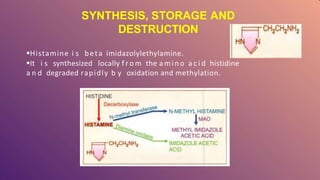
Histamine i s beta imidazolylethylamine.
It i s synthesized locally f ro m the amino a c i d histidine
a n d degraded rapidly b y oxidation and methylation.
Most histamine in the body is generated in granules in mast cells and in white blood cells (leukocytes)
called basophils.
Mast cells are especially numerous at sites of potential injury — the nose, mouth, and feet, internal
body surfaces, and blood vessels.
Non-mast cell histamine is found in several tissues, including the hypothalamus a region of the brain,
where it functions as a neurotransmitter. Another important site of histamine storage and release is
the enterochromaffin-like (ECL) cell of the stomach.
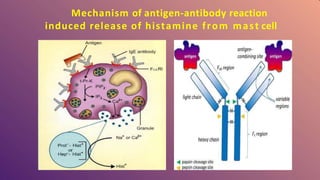
The most important pathophysiologic mechanism of mast cell and basophil histamine release
is immunologic. These cells, if sensitized by IgE antibodies attached to
their membranes, degranulate when exposed to the appropriate antigen.
Certain amines and alkaloids, including such drugs as morphine, and curare alkaloids, can displace
histamine in granules and cause its release. Antibiotics like polymyxin are also found to stimulate
histamine release.
Histamine release occurs when allergens bind to mast-cell-bound IgE antibodies. Reduction of IgE
overproduction may lower the likelihood of allergens finding sufficient free IgE to trigger a mast-cell-
release of histamine.
Mechanism of antigen-antibody reaction
induced release of histamine from mast cell
Criteria H1 H2 H3
Selective agonists 2-Methyl histamine Dimaprit (R) a-Methyl histamine
2-Pyridylethylamine Lmpromidine Lmetit
2-Thiazolyl ethylamine
Selective Mepyramine Cimetidine Thioperamide, Lmpromidine
antagonists Chlorpheniramine Ranitidine Tiprolisant, Clobenpropit
Receptor type Gq-protein coupled Gs-protein coupled Gi/Go-protein coupled
Effector pathway PIP2 hydrolysis • IP/ DAG: Adenylyl cyclase activation - a. Restricting Ca2+ influx
Release of Ca2+
• from intracellular stores;
cAMP-phosphorylation of
specific proteins
b. K+ channelactivation
c. cAMP↓
Protein kinase-C activation
NOrelease• cGMP
Distribution in a. Smooth muscle (intestine, airway, a. Gastric glands-acid secretion a. Brain (presynaptic)-inhibition
body: uterus)- Contraction b. Blood vessels of histamine release-sedation
actions mediated b. Blood vessels (smooth muscle)- dilatation b. Lung, spleen, skin, gastric
• Endothelium: Release of NOand, c. Heart mucosa -decrease histamine
PGI2- vasodilatation. Atria: +ive chronotropy release
widening of gap junctions--- increased Ventricles: +ive inotropy c. Ileum-inhibition of ACh
capillary permeability d. Uterus (rat)-relaxation release from myenteric plexus
• Smooth muscle of larger vessels--- vaso- e. Brain (postsynaptic)-impulse neurones
constriction. d. Certain blood vessels-inhibit
c. Afferent nerve endings-stimulation. NArelease-vasodilatation
d. Ganglionic cell-stimulation.
e. Adrenal medulla-release of CAs.
f. Brain (postsynaptic)-impulse.
Roles in body
•Although histamine is small compared to other biological molecules
(containing only 17 atoms), it plays an important role in the body.
•It is known to be involved in 23 different physiological functions.
•Histamine is known to be involved in many physiological functions
because of its chemical properties that allow it to be versatile in
binding.
• It is Coulombic (able to carry a charge), conformational, and
flexible. This allows it to interact and bind more easily.
Vasodilation and fall in blood pressure:
It has been known for more than one hundred years that an intravenous injection of histamine
causes a fall in the blood pressure. The underlying mechanism concerns both vascular hyper
permeability and vasodilatation.
 Histamine binding to endothelial cells causes them to contract, thus increasing vascular leak. It
also stimulates synthesis and release of various vascular smooth muscle cell relaxants, such
as nitric oxide, endothelium-derived hyperpolarizing factors and other compounds, resulting in
blood vessel dilation.
Effects on nasal mucous membrane:
Increased vascular permeability causes fluid to escape from capillaries into the tissues, which
leads to the classic symptoms of an allergic reaction: a runny nose and watery eyes.
Allergens can bind to IgE-loaded mast cells in the nasal cavity's mucous membranes. This can
lead to three clinical responses: 1. sneezing due to histamine-associated sensory neural
stimulation hyper-secretion from glandular tissue, 2. nasal congestion due to vascular
engorgement associated with vasodilation and 3. increased capillary permeability.
Sleep-wake regulation
Histamine is a neurotransmitter that is released from histaminergic neurons which project out of
the mammalian hypothalamus.
The cell bodies of these neurons are located in a portion of the posterior hypothalamus known
as the tuberomammillary nucleus (TMN). The histamine neurons in this region comprise the brain's
histamine system, which projects widely throughout the brain and includes axonal projections to
the cortex, medial forebrain bundle, and elsewhere.
The histamine neurons in the TMN are involved in regulating the sleep-wake cycle and promote
arousal when activated. The neural firing rate of histamine neurons in the TMN is
strongly positively correlated with an individual's state of arousal. These neurons fire rapidly
during periods of wakefulness, fire more slowly during periods of relaxation/tiredness, and stop
firing altogether during REM and NREM (non-REM) sleep.
Protective effects
While histamine has stimulatory effects upon neurons, it also has suppressive ones that protect
against the susceptibility to convulsion, drug sensitization, denervation supersensitivity, ischemic
lesions and stress. It has also been suggested that histamine controls the mechanisms by which
memories and learning are forgotten
Gastric acid release
Enterochromaffin-like cells, located within the gastric glands of the stomach, release histamine
that stimulates nearby parietal cells by binding to the apical H2 receptor.
Stimulation of the parietal cell induces the uptake of carbon dioxide and water from the blood,
which is then converted to carbonic acid by the enzyme carbonic anhydrase. Inside the cytoplasm
of the parietal cell, the carbonic acid readily dissociates into hydrogen and bicarbonate ions. The
bicarbonate ions diffuse back through the basilar membrane and into the bloodstream, while the
hydrogen ions are pumped into the lumen of the stomach via a K+/H+ ATPase pump. Histamine
release is halted when the pH of the stomach starts to decrease.
 Antagonist molecules, like ranitidine, block the H2 receptor and prevent histamine from binding,
causing decreased hydrogen ion secretion.
Erection and sexual function
Libido loss and erectile failure can occur during treatment with histamine H2 receptor
antagonists such as cimetidine, ranitidine, and risperidone.
The injection of histamine into the corpus cavernosum in men with psychogenic impotence
produces full or partial erections in 74% of them.
 It has been suggested that H2 antagonists may cause sexual difficulties by reducing the
functional binding of testosterone to its endogenous receptors.
Schizophrenia
Metabolites of histamine are increased in the cerebrospinal fluid of people with schizophrenia,
while the efficiency of H1 receptor binding sites is decreased.
Many atypical antipsychotic medications have the effect of increasing histamine production,
because histamine levels seem to be imbalanced in people with that disorder.
Multiple sclerosis
Histamine therapy for treatment of multiple sclerosis is currently being studied. The different H
receptors have been known to have different effects on the treatment of this disease.
The H1 and H4 receptors, in one study, have been shown to be counterproductive in the
treatment of MS. The H1 and H4 receptors are thought to increase permeability in the blood-brain
barrier, thus increasing infiltration of unwanted cells in the central nervous system. This can cause
inflammation, and MS symptom worsening.
The H2 and H3 receptors are thought to be helpful when treating MS patients. Histamine has
been shown to help with T-cell differentiation. This is important because in MS, the body's immune
system attacks its own myelin sheaths on nerve cells (which causes loss of signaling function and
eventual nerve degeneration). By helping T cells to differentiate, the T cells will be less likely to
attack the body's own cells, and instead, attack invaders.
DISORDERS
As an integral part of the immune system, histamine may be
involved in immune system disorders and allergies.
Mastocytosis is a rare disease in which there is a proliferation of
mast cells that produce excess histamine.
O

Histamine

  • 1.
  • 2.
    History The properties ofhistamine, then called β-iminazolylethylamine, were first described in 1910 by the British scientists Henry H. Dale and P.P. Laidlaw. By 1913 the name histamine was in use, using combining forms of histo- + amine, yielding "tissue amine". H substance or "substance H" are occasionally used in medical literature for histamine or a hypothetical histamine-like diffusible substance released in allergic reactions of skin and in the responses of tissue to inflammation.
  • 3.
    INTRODUCTION Histamine, meaning 'tissue a m i n e ' (histos- tissue) Histamine is an organic nitrogenous compound involved in local immune responses, as well as regulating physiological function in the gut and acting as a neurotransmitter for the brain, spinal cord, and uterus. Histamine is involved in the inflammatory response and has a central role as a mediator of itching. As part of an immune response to foreign pathogens, histamine is produced by basophils and by mast cells found in nearby connective tissues. Histamine increases the permeability of the capillaries to white blood cells and some proteins, to allow them to engage pathogens in the infected tissues. It consists of an imidazole ring attached to an ethylamine chain; under physiological conditions, the amino group of the side-chain is protonated.
  • 4.
    SYNTHESIS, STORAGE AND DESTRUCTION Histaminei s beta imidazolylethylamine. It i s synthesized locally f ro m the amino a c i d histidine a n d degraded rapidly b y oxidation and methylation.
  • 5.
    Most histamine inthe body is generated in granules in mast cells and in white blood cells (leukocytes) called basophils. Mast cells are especially numerous at sites of potential injury — the nose, mouth, and feet, internal body surfaces, and blood vessels. Non-mast cell histamine is found in several tissues, including the hypothalamus a region of the brain, where it functions as a neurotransmitter. Another important site of histamine storage and release is the enterochromaffin-like (ECL) cell of the stomach. The most important pathophysiologic mechanism of mast cell and basophil histamine release is immunologic. These cells, if sensitized by IgE antibodies attached to their membranes, degranulate when exposed to the appropriate antigen. Certain amines and alkaloids, including such drugs as morphine, and curare alkaloids, can displace histamine in granules and cause its release. Antibiotics like polymyxin are also found to stimulate histamine release. Histamine release occurs when allergens bind to mast-cell-bound IgE antibodies. Reduction of IgE overproduction may lower the likelihood of allergens finding sufficient free IgE to trigger a mast-cell- release of histamine.
  • 6.
    Mechanism of antigen-antibodyreaction induced release of histamine from mast cell
  • 7.
    Criteria H1 H2H3 Selective agonists 2-Methyl histamine Dimaprit (R) a-Methyl histamine 2-Pyridylethylamine Lmpromidine Lmetit 2-Thiazolyl ethylamine Selective Mepyramine Cimetidine Thioperamide, Lmpromidine antagonists Chlorpheniramine Ranitidine Tiprolisant, Clobenpropit Receptor type Gq-protein coupled Gs-protein coupled Gi/Go-protein coupled Effector pathway PIP2 hydrolysis • IP/ DAG: Adenylyl cyclase activation - a. Restricting Ca2+ influx Release of Ca2+ • from intracellular stores; cAMP-phosphorylation of specific proteins b. K+ channelactivation c. cAMP↓ Protein kinase-C activation NOrelease• cGMP Distribution in a. Smooth muscle (intestine, airway, a. Gastric glands-acid secretion a. Brain (presynaptic)-inhibition body: uterus)- Contraction b. Blood vessels of histamine release-sedation actions mediated b. Blood vessels (smooth muscle)- dilatation b. Lung, spleen, skin, gastric • Endothelium: Release of NOand, c. Heart mucosa -decrease histamine PGI2- vasodilatation. Atria: +ive chronotropy release widening of gap junctions--- increased Ventricles: +ive inotropy c. Ileum-inhibition of ACh capillary permeability d. Uterus (rat)-relaxation release from myenteric plexus • Smooth muscle of larger vessels--- vaso- e. Brain (postsynaptic)-impulse neurones constriction. d. Certain blood vessels-inhibit c. Afferent nerve endings-stimulation. NArelease-vasodilatation d. Ganglionic cell-stimulation. e. Adrenal medulla-release of CAs. f. Brain (postsynaptic)-impulse.
  • 8.
    Roles in body •Althoughhistamine is small compared to other biological molecules (containing only 17 atoms), it plays an important role in the body. •It is known to be involved in 23 different physiological functions. •Histamine is known to be involved in many physiological functions because of its chemical properties that allow it to be versatile in binding. • It is Coulombic (able to carry a charge), conformational, and flexible. This allows it to interact and bind more easily.
  • 9.
    Vasodilation and fallin blood pressure: It has been known for more than one hundred years that an intravenous injection of histamine causes a fall in the blood pressure. The underlying mechanism concerns both vascular hyper permeability and vasodilatation.  Histamine binding to endothelial cells causes them to contract, thus increasing vascular leak. It also stimulates synthesis and release of various vascular smooth muscle cell relaxants, such as nitric oxide, endothelium-derived hyperpolarizing factors and other compounds, resulting in blood vessel dilation. Effects on nasal mucous membrane: Increased vascular permeability causes fluid to escape from capillaries into the tissues, which leads to the classic symptoms of an allergic reaction: a runny nose and watery eyes. Allergens can bind to IgE-loaded mast cells in the nasal cavity's mucous membranes. This can lead to three clinical responses: 1. sneezing due to histamine-associated sensory neural stimulation hyper-secretion from glandular tissue, 2. nasal congestion due to vascular engorgement associated with vasodilation and 3. increased capillary permeability.
  • 10.
    Sleep-wake regulation Histamine isa neurotransmitter that is released from histaminergic neurons which project out of the mammalian hypothalamus. The cell bodies of these neurons are located in a portion of the posterior hypothalamus known as the tuberomammillary nucleus (TMN). The histamine neurons in this region comprise the brain's histamine system, which projects widely throughout the brain and includes axonal projections to the cortex, medial forebrain bundle, and elsewhere. The histamine neurons in the TMN are involved in regulating the sleep-wake cycle and promote arousal when activated. The neural firing rate of histamine neurons in the TMN is strongly positively correlated with an individual's state of arousal. These neurons fire rapidly during periods of wakefulness, fire more slowly during periods of relaxation/tiredness, and stop firing altogether during REM and NREM (non-REM) sleep. Protective effects While histamine has stimulatory effects upon neurons, it also has suppressive ones that protect against the susceptibility to convulsion, drug sensitization, denervation supersensitivity, ischemic lesions and stress. It has also been suggested that histamine controls the mechanisms by which memories and learning are forgotten
  • 11.
    Gastric acid release Enterochromaffin-likecells, located within the gastric glands of the stomach, release histamine that stimulates nearby parietal cells by binding to the apical H2 receptor. Stimulation of the parietal cell induces the uptake of carbon dioxide and water from the blood, which is then converted to carbonic acid by the enzyme carbonic anhydrase. Inside the cytoplasm of the parietal cell, the carbonic acid readily dissociates into hydrogen and bicarbonate ions. The bicarbonate ions diffuse back through the basilar membrane and into the bloodstream, while the hydrogen ions are pumped into the lumen of the stomach via a K+/H+ ATPase pump. Histamine release is halted when the pH of the stomach starts to decrease.  Antagonist molecules, like ranitidine, block the H2 receptor and prevent histamine from binding, causing decreased hydrogen ion secretion. Erection and sexual function Libido loss and erectile failure can occur during treatment with histamine H2 receptor antagonists such as cimetidine, ranitidine, and risperidone. The injection of histamine into the corpus cavernosum in men with psychogenic impotence produces full or partial erections in 74% of them.  It has been suggested that H2 antagonists may cause sexual difficulties by reducing the functional binding of testosterone to its endogenous receptors.
  • 12.
    Schizophrenia Metabolites of histamineare increased in the cerebrospinal fluid of people with schizophrenia, while the efficiency of H1 receptor binding sites is decreased. Many atypical antipsychotic medications have the effect of increasing histamine production, because histamine levels seem to be imbalanced in people with that disorder. Multiple sclerosis Histamine therapy for treatment of multiple sclerosis is currently being studied. The different H receptors have been known to have different effects on the treatment of this disease. The H1 and H4 receptors, in one study, have been shown to be counterproductive in the treatment of MS. The H1 and H4 receptors are thought to increase permeability in the blood-brain barrier, thus increasing infiltration of unwanted cells in the central nervous system. This can cause inflammation, and MS symptom worsening. The H2 and H3 receptors are thought to be helpful when treating MS patients. Histamine has been shown to help with T-cell differentiation. This is important because in MS, the body's immune system attacks its own myelin sheaths on nerve cells (which causes loss of signaling function and eventual nerve degeneration). By helping T cells to differentiate, the T cells will be less likely to attack the body's own cells, and instead, attack invaders.
  • 13.
    DISORDERS As an integralpart of the immune system, histamine may be involved in immune system disorders and allergies. Mastocytosis is a rare disease in which there is a proliferation of mast cells that produce excess histamine.
  • 14.