Apoptosis: Influence of the
Xenobiotics and Diseases conditions
Dr. Naveen Kumar
PhD Scholar
Veterinary Pharmacology and Toxicology
College of Veterinary and Animal Sciences,
G.B.P.U.A. & T., Pantnagar-263145,
Uttarakhand, INDIA
Email: knaveen7v@gmail.com
 Apoptosis derived from Greek "falling off" (as for autumn leaves)
 A distinct reaction pattern which represents programmed single-cell
suicide
 Cells actually expend energy in order to die
 The physiological way for a cell to die
What is Apoptosis
A peculiar well controlled individual cell death that is
caspase mediated
Fragmentation of the cell and organelles
Engulfed by macrophages
 The Nobel prize in physiology or medicine 2002 was awarded jointly- for
their discoveries concerning “genetic regulation of organ development and
programmed cell death” .
PRIZED
Sydney Brenner H. Robert Horvitz John E. Sulston
Importance of ApoptosisImportance of Apoptosis
1) Crucial for embryonic development
Errors in Apoptosis can lead to Birth Defects
2) Important for maintaining homeostasis
Cell death is balanced with mitosis to regulate cell number.
3) Improper regulation contributes to human disease
- Neurodegenerative diseases
Parkinson’s
Alzheimer’s
- Cancer
- Autoimmune diseases e.g. (diabetes type I)
- Viral diseases
CharacteristicsCharacteristics
An active cytological process
It is programmed or controlled by genetic protocol
It may be triggered by intrinsic or extrinsic stimuli
It occurs in almost all living creatures
Morphology
• Cell shrinkage (condensation of cytoplasm)
 Breakdown of mitochondria; release of cytochrome C
 Nuclear condensation
 Nuclear fragmentation
 Cell membrane blebbing
 Fragmentation; apoptotic body formation: membrane-bound
cellular fragments, which often lack nuclei
 Phagocytosis
APOPTOSIS: important in embryogenesis
Morphogenesis (eliminates excess cells):
Selection (eliminates non-functional cells):
APOPTOSIS: important in adults
Tissue remodeling (eliminates cells no longer needed):
Virgin mammary gland Late pregnancy, lactation Involution
(non-pregnant, non-lactating)
Apoptosis
Apoptosis
- Testosterone
Prostate gland
Programmed Cell Death in Neuronal DevelopmentProgrammed Cell Death in Neuronal Development
 The cells in the tadpole tail are induced to undergo apoptosis stimulated by
the increases in thyroid hormone that occurs during metamorphosis
Apoptosis during the metamorphosis of a tadpole into a frog
Apoptosis in the development of the nervous system
STAGES OF CLASSIC APOPTOSISSTAGES OF CLASSIC APOPTOSIS
Healthy cell
DEATH SIGNAL (extrinsic or intrinsic)
Commitment to die (reversible)
EXECUTION (irreversible)
Dead cell (condensed, crosslinked)
ENGULFMENT (macrophages, neighboring cells)
DEGRADATION
How Apoptosis Differs from Necrosis?How Apoptosis Differs from Necrosis?
Cellular changes associated with apoptosisCellular changes associated with apoptosis
Early: Chromosome
condensation, cell body shrink
Later: Blebbing, Nucleus and
cytoplasm fragment-Apoptotic
bodies
At last: Phagocytosed
Necrosis
Apoptosis
Sequence in ultra structure change in apoptosis (2-6)
and necrosis (7-8)
Apoptosis versus Necrosis
Normal white blood cell Apoptotic white blood cell
During apoptosis (programmed cell death) cells bleb
and eventually break apart without releasing contents.
Stimuli for Apoptotic Cell DeathStimuli for Apoptotic Cell Death
(in Mammals)(in Mammals)
I. Growth factor deficiencies
II. Ionizing radiation and anticancer drugs damage DNA and
apoptosis follows ( p53 expression)
i. Viral infection (eg.-HIV- infected cells make high levels of
FasL which will induce apoptosis in HIV-uninfected T cells)
ii. Free radical toxicity
i. Hypoxia- apoptosis (if mild) or necrosis if the hypoxia is severe
or prolonged
ii. Death receptor activation (such as Fas or CD95
triggering)
iii. Metabolic or cell cycle perturbation
iv. Misfolded proteins
Stimuli for Apoptotic Cell DeathStimuli for Apoptotic Cell Death
Biochemical Events in ApoptosisBiochemical Events in Apoptosis
Caspases (cysteine proteases) cleave the cytoskeleton and
activate DNAses and other enzymes
DNA breaks into 50- to 300-kilobase pieces; further broken
into multiples of 200 base pairs by endonucleases (Ca++
and Mg++)- demonstrated as a “ladder pattern” on agarose
gel; also proteases.
Phosphatidylserine is exposed and attracts macrophages
with little “collateral damage””
Apoptosis - mechanismsApoptosis - mechanisms
Four stages of apoptosis:
i. Committment to death by extracellular or intracellular
triggers/signals
ii. Cell killing (execution) by activation of intracellular
proteases (caspases)
iii. Engulfment of cell corpse by other cells
iv. Degradation of the cell corpse within the lysosomes of
phagocytic cells
Extrinsic factors
 E.g. by members of
the TNF family
Intrinsic
mechanisms
 E.g. hormone
withdrawal
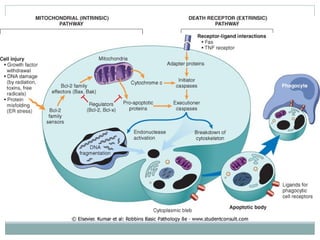
The two major pathways for caspase activation in
mammalian cells
Maniati et al. 2008. The molecular basis of apoptosis in mammals. Simplified overview
There are two
major pathways
of apoptosis
intrinsic
pathway
extrinsic
pathway
Engulfment of apoptotic cellsEngulfment of apoptotic cells
Binding
Recognition
Phagocytosis
Internalization
Stages of
engulfment of
apoptotic cells can
be divided into 4
stages
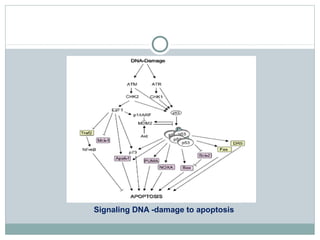
DNA-damage and Apoptosis
Radiation or chemotherapy damages DNA
p53 accumulates
Cell cycle arrested at G1 (allows repair)
If repair fails, p53 triggers apoptosis
Eukaryotic Cell Cycle
 M phase
(mitotic phase)
 G1 phase
(Gap 1)
 S phase
(synthesis
phase)
 G2 phase
(Gap 2)
Tumor Necrosis Factor and Cytotoxic Lymphocytes
in Apoptosis
 Fas (CD95) –FasL induces apoptosis in lymphocytes that recognize
“self”; Fas/FasL mutations may cause autoimmune disease
 TNF/TNFR1-TRADD-FADD causes caspase activation and
APOPTOSIS; TNF also activates NF-kB which aids cell SURVIVAL and
is antiapoptotic
 Foreign Ag-CTLs- lymphocytes produce PERFORMIN which allows
entry of GRANZYME which activates caspases; CTLs kill target cells
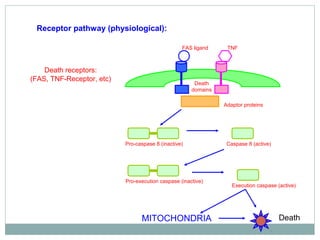
Receptor pathway (physiological):
Death receptors:
(FAS, TNF-Receptor, etc)
FAS ligand TNF
Death
domains
Adaptor proteins
Pro-caspase 8 (inactive) Caspase 8 (active)
Pro-execution caspase (inactive)
Execution caspase (active)
DeathMITOCHONDRIA
Intrinsic pathway (damage):
Mitochondria
Cytochrome c release
Pro-caspase 9 cleavage
Pro-execution caspase (3) cleavage
Caspase (3) cleavage of cellular proteins,
nuclease activation,
etc.
Death
BAX
BAK
BOK
BCL-Xs
BAD
BID
B IK
BIM
NIP3
BNIP3
BCL-2
BCL-XL
BCL-W
MCL1
BFL1
DIVA
NR-13
Several
viral
proteins
Physiological Intrinsic
receptor pathway damage pathway
MITOCHONDRIAL SIGNALS
Caspase cleavage cascade
Orderly cleavage of proteins and DNA
CROSSLINKING OF CELL CORPSES; ENGULFMENT
(no inflammation)
Signaling DNA -damage to apoptosis
Apoptosis in model systems
 Molecular mechanisms of apoptosis in
mammalian cells
 mitochondrial pathway (intrinsic)
& cell death receptor pathway (extrinsic).
 bcl-2 gene family.
 Caspases.
bcl-2 gene family
Bcl-2 Family & IAP Family (Inhibitor of Apoptosis)
are critical regulators of cell death
Bcl-2 Family – Regulate whether MOMPs Occurs
Anti-Apoptotic Factors - Death Inhibitors
 Function to Inhibit MOMPs
by Pro Apoptotic Factors
Pro-Apoptotic Factors- Death Activators
 Bind and inhibit Death Inhibitors
 Directly cause Permeabilization of MOM to Stimulate
Release of Cytochrome C ( BAX and BAK)
 The translocated bcl-2 gene is under the control of an active
immunoglobulin promoter that drives high levels of constitutive
expression
 The oncogenic version is formed through a reciprocal chromosomal
translocation in which parts of the chromosome 14 and chromosome 18
are exchanged
 We now know that there are at least 24 Bcl-2-related proteins, 6 are
anti-apoptotic and 18 are pro-apoptotic.
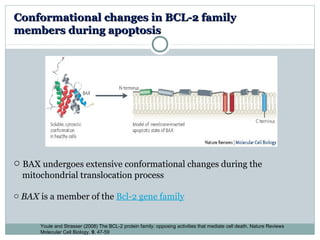
Conformational changes in BCL-2 familyConformational changes in BCL-2 family
members during apoptosismembers during apoptosis
o BAX undergoes extensive conformational changes during the
mitochondrial translocation process
o BAX is a member of the Bcl-2 gene family
Youle and Strasser (2008) The BCL-2 protein family: opposing activities that mediate cell death. Nature Reviews
Molecular Cell Biology, 9, 47-59
Active site: Cysteine
Cleavage site: Asparatic
acid
Cysteine Asparatic
acid specific
protease
Aps-Xxx
caspase - a proteolytic system
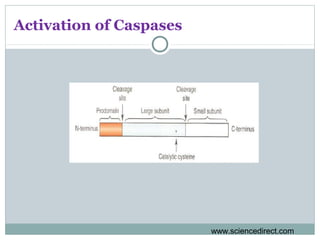
Caspase?
Single chain of pro-enzymes
Contains an N-terminal domain, a small subunit and
a large subunit (similar to a ribosome)
Apoptotic stimulus Activation Substrate
Cleavage Enzyme
Activation of Caspases
www.sciencedirect.com
Caspases involved in apoptosis
3 Types of Caspases
 Inflammatory Caspases: -1, -4, and -5
 Initiator Caspases: -2, -8, -9, and -10
 Long N-terminal domain
 Interact with effector caspases
 Effector Caspases: -3, -6, and -7
 Little to no N-terminal domain
 Initiate cell death
Main Pathways Regulating Caspase Activation
During Apoptosis
 Two Caspase Pathways:
Intrinsic Pathway & Extrinsic Pathway
I. Intrinsic Pathway-
 Mitochondrial mediated major pathway in mammalian
cells
o Outer Mitochondrial Membrane Permeabilization (MOMP)
o Release of cytochrome C from mitochondrial intermembrane
space into cytosol
o Apoptosome Formation- Activation of Initiator Caspase
o Effector Caspases activated
1. Intrinsic Pathway

Mitochondria

Cytochrome C

Apoptosome
Complex

Caspases

Cell Death
II. Extrinsic Pathway-
 Signaling through Death Receptors
o Ligand bound death receptors
o Adaptor protein association
o Initiator caspase recruitment and activation
o Effector caspases activated
2. Extrinsic
Pathway

Death Ligand

Death Receptors

Caspases

Cell Death
The Biology of Cancer (Garland Science 2007)
IAPs
Inhibitor of Apoptosis
Proteins (IAPs)
 Bind Pro-caspases
prevent activation of
apoptosis
 Bind Caspases
and inhibit Activity
Inhibit one part in the
cascade = failure to
apoptose
 Natural phenolic compounds , in herbs and diet play an
important role in cancer prevention and treatment.
Eg., phenolic acids, flavonoids, tannins, stilbenes, curcuminoids,
coumarins, lignans, quinones, etc.
 They are responsible for their chemopreventive properties
like
 anticarcinogenic
 antimutagenic
 antioxidant &
 anti-inflammatory effects
Herbs and Dietary FactorsHerbs and Dietary Factors
 Phenolic compounds inducing apoptosis
 arresting cell cycle
 regulating carcinogen metabolism and ontogenesis
expression
 inhibiting DNA binding
 cell adhesion, migration, proliferation or
differentiation &
 blocking signalling pathways.
Wu-Yang Huang and Yi-Zhong Cai .(2010).Natural Phenolic Compounds From Medicinal Herbs and Dietary Plants: Potential Use for
Cancer Prevention. Nutrition and Cancer, 62(1), 1–20
 The majority of polyphenols present in food are flavonoids and phenolic
acids that are an integral part of the human diet
 Flavonoids (such as epigallocatechin-3-gallete (EGCG), quercetin, and
curcumin) act by induction of apoptosis
 Certain natural products have been shown to inhibit the activation of nuclear
factor kappa B (NF-κB) and Akt signaling pathways, both of which are known
to maintain a homeostatic balance between cell survival and apoptosis
 Dietary factors affecting apoptosis can influence carcinogenesis
 Activation of apoptosis in pre-cancerous cells is one of the most
important mechanisms of cancer chemoprevention by dietary factors*
* Martin, K.R. (2006) Targeting apoptosis with dietary bioactive agents. Experimental Biolology and Medicine (Maywood), 231, 117-129.
Induction of apoptosis by combining natural compounds and anticancer
drugs/radiation (through NF-κB or PI3K/ Akt pathway) in vivo
Epigallocatechin gallete (EGCG)
A partial list of the agents that have been reported to
induce or inhibit apoptosis
Disease associated with induction and inhibition of
apoptotic cell death
Chemicals that induced apoptosis
 Most of the environmental toxin induce apoptosis by oxidative stress
(OS) mediated
Compound Genes/ Proteins Involved Proposed Mechanisms
Bisphenol
↑Fas, ↑FasL, ↑caspase-3
Fas-signaling pathway triggers
Leydig cell apoptosis that then
induces germ cell apoptosis
↑Degradation of late spermatids
and seminiferous tubules,
↔testosterone
Direct cell damage
Ethanol
↓pAkt, ↓pErk1/2, ↓Bad
Suppression of survival-signaling
pathway
↑FasL Fas-signaling pathway
Methoxychlor ↑Fas, FasL, caspase-3, NF-↑ ↑ ↓
κB
Mitochondria and FasL-
mediated signaling pathway
1,3-Dinitrobenzene ↑Bax, ↓Bcl-2
Alteration of Bcl-2/Bax ratio
triggers mitochondrial pathway
Lindane
↑cyt c, ↑caspase-9, ↑caspase-3,
↑Fas, ↑FasL
Mitochondrial pathway, Fas-
signaling pathway
Polycyclic aromatic
hydrocarbons
↑Bax, ↑PARP cleveage Mitochondrial pathway
Mathur et al. (2011). Environmental Toxicants and Testicular Apoptosis . The Open Reproductive Science Journal, Volume 3
Role in Diseases:Role in Diseases:
TOO MUCH: Tissue atrophy
Neurodegeneration
Thin skin
etc
TOO LITTLE: Hyperplasia
Cancer
Athersclerosis
etc
Problem can be solved:
Activate apoptosis in cancer cells
- if apoptosis is improperly activated or regulated, result may cause
cancer
Finding useful mechanisms
Needs to be selective pathways (trail)
Treatment OptionsTreatment Options
Apoptosis

Apoptosis

  • 1.
    Apoptosis: Influence ofthe Xenobiotics and Diseases conditions Dr. Naveen Kumar PhD Scholar Veterinary Pharmacology and Toxicology College of Veterinary and Animal Sciences, G.B.P.U.A. & T., Pantnagar-263145, Uttarakhand, INDIA Email: knaveen7v@gmail.com
  • 2.
     Apoptosis derivedfrom Greek "falling off" (as for autumn leaves)  A distinct reaction pattern which represents programmed single-cell suicide  Cells actually expend energy in order to die  The physiological way for a cell to die What is Apoptosis
  • 3.
    A peculiar wellcontrolled individual cell death that is caspase mediated Fragmentation of the cell and organelles Engulfed by macrophages
  • 4.
     The Nobelprize in physiology or medicine 2002 was awarded jointly- for their discoveries concerning “genetic regulation of organ development and programmed cell death” . PRIZED Sydney Brenner H. Robert Horvitz John E. Sulston
  • 5.
    Importance of ApoptosisImportanceof Apoptosis 1) Crucial for embryonic development Errors in Apoptosis can lead to Birth Defects 2) Important for maintaining homeostasis Cell death is balanced with mitosis to regulate cell number. 3) Improper regulation contributes to human disease - Neurodegenerative diseases Parkinson’s Alzheimer’s - Cancer - Autoimmune diseases e.g. (diabetes type I) - Viral diseases
  • 6.
    CharacteristicsCharacteristics An active cytologicalprocess It is programmed or controlled by genetic protocol It may be triggered by intrinsic or extrinsic stimuli It occurs in almost all living creatures
  • 7.
    Morphology • Cell shrinkage(condensation of cytoplasm)  Breakdown of mitochondria; release of cytochrome C  Nuclear condensation  Nuclear fragmentation  Cell membrane blebbing  Fragmentation; apoptotic body formation: membrane-bound cellular fragments, which often lack nuclei  Phagocytosis
  • 8.
    APOPTOSIS: important inembryogenesis Morphogenesis (eliminates excess cells): Selection (eliminates non-functional cells):
  • 9.
    APOPTOSIS: important inadults Tissue remodeling (eliminates cells no longer needed): Virgin mammary gland Late pregnancy, lactation Involution (non-pregnant, non-lactating) Apoptosis Apoptosis - Testosterone Prostate gland
  • 10.
    Programmed Cell Deathin Neuronal DevelopmentProgrammed Cell Death in Neuronal Development  The cells in the tadpole tail are induced to undergo apoptosis stimulated by the increases in thyroid hormone that occurs during metamorphosis Apoptosis during the metamorphosis of a tadpole into a frog
  • 11.
    Apoptosis in thedevelopment of the nervous system
  • 12.
    STAGES OF CLASSICAPOPTOSISSTAGES OF CLASSIC APOPTOSIS Healthy cell DEATH SIGNAL (extrinsic or intrinsic) Commitment to die (reversible) EXECUTION (irreversible) Dead cell (condensed, crosslinked) ENGULFMENT (macrophages, neighboring cells) DEGRADATION
  • 13.
    How Apoptosis Differsfrom Necrosis?How Apoptosis Differs from Necrosis?
  • 14.
    Cellular changes associatedwith apoptosisCellular changes associated with apoptosis Early: Chromosome condensation, cell body shrink Later: Blebbing, Nucleus and cytoplasm fragment-Apoptotic bodies At last: Phagocytosed
  • 15.
    Necrosis Apoptosis Sequence in ultrastructure change in apoptosis (2-6) and necrosis (7-8) Apoptosis versus Necrosis
  • 16.
    Normal white bloodcell Apoptotic white blood cell During apoptosis (programmed cell death) cells bleb and eventually break apart without releasing contents.
  • 17.
    Stimuli for ApoptoticCell DeathStimuli for Apoptotic Cell Death (in Mammals)(in Mammals) I. Growth factor deficiencies II. Ionizing radiation and anticancer drugs damage DNA and apoptosis follows ( p53 expression) i. Viral infection (eg.-HIV- infected cells make high levels of FasL which will induce apoptosis in HIV-uninfected T cells) ii. Free radical toxicity
  • 18.
    i. Hypoxia- apoptosis(if mild) or necrosis if the hypoxia is severe or prolonged ii. Death receptor activation (such as Fas or CD95 triggering) iii. Metabolic or cell cycle perturbation iv. Misfolded proteins
  • 19.
    Stimuli for ApoptoticCell DeathStimuli for Apoptotic Cell Death
  • 20.
    Biochemical Events inApoptosisBiochemical Events in Apoptosis Caspases (cysteine proteases) cleave the cytoskeleton and activate DNAses and other enzymes DNA breaks into 50- to 300-kilobase pieces; further broken into multiples of 200 base pairs by endonucleases (Ca++ and Mg++)- demonstrated as a “ladder pattern” on agarose gel; also proteases. Phosphatidylserine is exposed and attracts macrophages with little “collateral damage””
  • 21.
    Apoptosis - mechanismsApoptosis- mechanisms Four stages of apoptosis: i. Committment to death by extracellular or intracellular triggers/signals ii. Cell killing (execution) by activation of intracellular proteases (caspases) iii. Engulfment of cell corpse by other cells iv. Degradation of the cell corpse within the lysosomes of phagocytic cells
  • 23.
    Extrinsic factors  E.g.by members of the TNF family Intrinsic mechanisms  E.g. hormone withdrawal The two major pathways for caspase activation in mammalian cells
  • 24.
    Maniati et al.2008. The molecular basis of apoptosis in mammals. Simplified overview There are two major pathways of apoptosis intrinsic pathway extrinsic pathway
  • 25.
    Engulfment of apoptoticcellsEngulfment of apoptotic cells Binding Recognition Phagocytosis Internalization Stages of engulfment of apoptotic cells can be divided into 4 stages
  • 26.
    DNA-damage and Apoptosis Radiationor chemotherapy damages DNA p53 accumulates Cell cycle arrested at G1 (allows repair) If repair fails, p53 triggers apoptosis
  • 27.
    Eukaryotic Cell Cycle M phase (mitotic phase)  G1 phase (Gap 1)  S phase (synthesis phase)  G2 phase (Gap 2)
  • 28.
    Tumor Necrosis Factorand Cytotoxic Lymphocytes in Apoptosis  Fas (CD95) –FasL induces apoptosis in lymphocytes that recognize “self”; Fas/FasL mutations may cause autoimmune disease  TNF/TNFR1-TRADD-FADD causes caspase activation and APOPTOSIS; TNF also activates NF-kB which aids cell SURVIVAL and is antiapoptotic  Foreign Ag-CTLs- lymphocytes produce PERFORMIN which allows entry of GRANZYME which activates caspases; CTLs kill target cells
  • 29.
    Receptor pathway (physiological): Deathreceptors: (FAS, TNF-Receptor, etc) FAS ligand TNF Death domains Adaptor proteins Pro-caspase 8 (inactive) Caspase 8 (active) Pro-execution caspase (inactive) Execution caspase (active) DeathMITOCHONDRIA
  • 30.
    Intrinsic pathway (damage): Mitochondria Cytochromec release Pro-caspase 9 cleavage Pro-execution caspase (3) cleavage Caspase (3) cleavage of cellular proteins, nuclease activation, etc. Death BAX BAK BOK BCL-Xs BAD BID B IK BIM NIP3 BNIP3 BCL-2 BCL-XL BCL-W MCL1 BFL1 DIVA NR-13 Several viral proteins
  • 31.
    Physiological Intrinsic receptor pathwaydamage pathway MITOCHONDRIAL SIGNALS Caspase cleavage cascade Orderly cleavage of proteins and DNA CROSSLINKING OF CELL CORPSES; ENGULFMENT (no inflammation)
  • 32.
  • 33.
    Apoptosis in modelsystems  Molecular mechanisms of apoptosis in mammalian cells  mitochondrial pathway (intrinsic) & cell death receptor pathway (extrinsic).  bcl-2 gene family.  Caspases.
  • 34.
    bcl-2 gene family Bcl-2Family & IAP Family (Inhibitor of Apoptosis) are critical regulators of cell death Bcl-2 Family – Regulate whether MOMPs Occurs Anti-Apoptotic Factors - Death Inhibitors  Function to Inhibit MOMPs by Pro Apoptotic Factors Pro-Apoptotic Factors- Death Activators  Bind and inhibit Death Inhibitors  Directly cause Permeabilization of MOM to Stimulate Release of Cytochrome C ( BAX and BAK)
  • 35.
     The translocatedbcl-2 gene is under the control of an active immunoglobulin promoter that drives high levels of constitutive expression  The oncogenic version is formed through a reciprocal chromosomal translocation in which parts of the chromosome 14 and chromosome 18 are exchanged  We now know that there are at least 24 Bcl-2-related proteins, 6 are anti-apoptotic and 18 are pro-apoptotic.
  • 36.
    Conformational changes inBCL-2 familyConformational changes in BCL-2 family members during apoptosismembers during apoptosis o BAX undergoes extensive conformational changes during the mitochondrial translocation process o BAX is a member of the Bcl-2 gene family Youle and Strasser (2008) The BCL-2 protein family: opposing activities that mediate cell death. Nature Reviews Molecular Cell Biology, 9, 47-59
  • 37.
    Active site: Cysteine Cleavagesite: Asparatic acid Cysteine Asparatic acid specific protease Aps-Xxx caspase - a proteolytic system Caspase?
  • 38.
    Single chain ofpro-enzymes Contains an N-terminal domain, a small subunit and a large subunit (similar to a ribosome) Apoptotic stimulus Activation Substrate Cleavage Enzyme
  • 39.
  • 40.
    Caspases involved inapoptosis 3 Types of Caspases  Inflammatory Caspases: -1, -4, and -5  Initiator Caspases: -2, -8, -9, and -10  Long N-terminal domain  Interact with effector caspases  Effector Caspases: -3, -6, and -7  Little to no N-terminal domain  Initiate cell death
  • 41.
    Main Pathways RegulatingCaspase Activation During Apoptosis  Two Caspase Pathways: Intrinsic Pathway & Extrinsic Pathway I. Intrinsic Pathway-  Mitochondrial mediated major pathway in mammalian cells o Outer Mitochondrial Membrane Permeabilization (MOMP) o Release of cytochrome C from mitochondrial intermembrane space into cytosol o Apoptosome Formation- Activation of Initiator Caspase o Effector Caspases activated
  • 42.
    1. Intrinsic Pathway  Mitochondria  CytochromeC  Apoptosome Complex  Caspases  Cell Death
  • 43.
    II. Extrinsic Pathway- Signaling through Death Receptors o Ligand bound death receptors o Adaptor protein association o Initiator caspase recruitment and activation o Effector caspases activated
  • 44.
    2. Extrinsic Pathway  Death Ligand  DeathReceptors  Caspases  Cell Death
  • 45.
    The Biology ofCancer (Garland Science 2007)
  • 46.
    IAPs Inhibitor of Apoptosis Proteins(IAPs)  Bind Pro-caspases prevent activation of apoptosis  Bind Caspases and inhibit Activity Inhibit one part in the cascade = failure to apoptose
  • 47.
     Natural phenoliccompounds , in herbs and diet play an important role in cancer prevention and treatment. Eg., phenolic acids, flavonoids, tannins, stilbenes, curcuminoids, coumarins, lignans, quinones, etc.  They are responsible for their chemopreventive properties like  anticarcinogenic  antimutagenic  antioxidant &  anti-inflammatory effects Herbs and Dietary FactorsHerbs and Dietary Factors
  • 48.
     Phenolic compoundsinducing apoptosis  arresting cell cycle  regulating carcinogen metabolism and ontogenesis expression  inhibiting DNA binding  cell adhesion, migration, proliferation or differentiation &  blocking signalling pathways. Wu-Yang Huang and Yi-Zhong Cai .(2010).Natural Phenolic Compounds From Medicinal Herbs and Dietary Plants: Potential Use for Cancer Prevention. Nutrition and Cancer, 62(1), 1–20
  • 49.
     The majorityof polyphenols present in food are flavonoids and phenolic acids that are an integral part of the human diet  Flavonoids (such as epigallocatechin-3-gallete (EGCG), quercetin, and curcumin) act by induction of apoptosis  Certain natural products have been shown to inhibit the activation of nuclear factor kappa B (NF-κB) and Akt signaling pathways, both of which are known to maintain a homeostatic balance between cell survival and apoptosis  Dietary factors affecting apoptosis can influence carcinogenesis  Activation of apoptosis in pre-cancerous cells is one of the most important mechanisms of cancer chemoprevention by dietary factors* * Martin, K.R. (2006) Targeting apoptosis with dietary bioactive agents. Experimental Biolology and Medicine (Maywood), 231, 117-129.
  • 50.
    Induction of apoptosisby combining natural compounds and anticancer drugs/radiation (through NF-κB or PI3K/ Akt pathway) in vivo Epigallocatechin gallete (EGCG)
  • 51.
    A partial listof the agents that have been reported to induce or inhibit apoptosis
  • 52.
    Disease associated withinduction and inhibition of apoptotic cell death
  • 53.
    Chemicals that inducedapoptosis  Most of the environmental toxin induce apoptosis by oxidative stress (OS) mediated Compound Genes/ Proteins Involved Proposed Mechanisms Bisphenol ↑Fas, ↑FasL, ↑caspase-3 Fas-signaling pathway triggers Leydig cell apoptosis that then induces germ cell apoptosis ↑Degradation of late spermatids and seminiferous tubules, ↔testosterone Direct cell damage Ethanol ↓pAkt, ↓pErk1/2, ↓Bad Suppression of survival-signaling pathway ↑FasL Fas-signaling pathway Methoxychlor ↑Fas, FasL, caspase-3, NF-↑ ↑ ↓ κB Mitochondria and FasL- mediated signaling pathway 1,3-Dinitrobenzene ↑Bax, ↓Bcl-2 Alteration of Bcl-2/Bax ratio triggers mitochondrial pathway Lindane ↑cyt c, ↑caspase-9, ↑caspase-3, ↑Fas, ↑FasL Mitochondrial pathway, Fas- signaling pathway Polycyclic aromatic hydrocarbons ↑Bax, ↑PARP cleveage Mitochondrial pathway Mathur et al. (2011). Environmental Toxicants and Testicular Apoptosis . The Open Reproductive Science Journal, Volume 3
  • 54.
    Role in Diseases:Rolein Diseases: TOO MUCH: Tissue atrophy Neurodegeneration Thin skin etc TOO LITTLE: Hyperplasia Cancer Athersclerosis etc
  • 55.
    Problem can besolved: Activate apoptosis in cancer cells - if apoptosis is improperly activated or regulated, result may cause cancer Finding useful mechanisms Needs to be selective pathways (trail) Treatment OptionsTreatment Options

Editor's Notes

  • #3 In the human body about 100,000 cells are produced every second by mitosis and a similar number die by apoptosis !!!
  • #4 Leads to fragmentation of the cell and organelles into numerous small buds, which are then engulfed by macrophages without surrounding inflammation
  • #7 It is an active cytological process in which energy is consumed (ATP dependent). It is programmed or controlled by genetic protocol or program (control of enzymes, cell membrane surface proteins & cytoplasmic molecules, signal transduction, gene expression). It occurs in almost all living creatures since their early stages of embryological development.
  • #8 There are a number of mechanisms through which apoptosis can be induced in cells. The sensitivity of cells to any of these stimuli can vary depending on a number of factors such as the expression of pro- and anti-apoptotic proteins (eg. the Bcl-2 proteins or the Inhibitor of Apoptosis Proteins), the severity of the stimulus and the stage of the cell cycle. Some of the major stimuli that can induce apoptosis are outlined in the illustration below.
  • #11 Also, in adult multicellular organisms cell death is a regular occurrence. In humans EACH HOUR we lose many many BILLIONS of cells via apoptosis. Most of these are healthy cells which have no defects. WHY? Development and regulation controls.
  • #24 The two major pathways for caspase activation in mammalian cells are outlined. The extrinsic pathway (left) can be induced by members of the TNF family of cytokine receptors that are present at the surface of many cells. Upon activation, these receptors recruit adapter proteins to their cytosolic "death domains" (DD), including Fadd, which then bind and cleave pro-caspases, particularly pro-caspase-8. The intrinsic pathway (right) can be induced by various stimuli (discussed below), resulting in the release of cytochrome c from mitochondria. In the cytosol, cytochrome c binds and activates Apaf-1, allowing it to bind and activate pro-caspase-9. Active caspase-9 (intrinsic pathway) and caspase-8 (extrinsic pathway) have each been shown to directly cleave and activate the effector protease, caspase-3. Other caspases can also become involved in these pathways. The two pathways are not mutually exclusive; both may become activated in response to an insult. Thus, this schematic represents an oversimplification of the events that occur in vivo.
  • #30 Extrinsic pathway
  • #37 BAX undergoes extensive conformational changes during the mitochondrial translocation process. The protein changes from a soluble cytoplasmic protein in healthy cells to one that appears to have at least 3 helices inserted in the mitochondrial membrane in apoptotic cells.
  • #38 (1) Why called caspase?, Apoptosis is carried out by a proteolytic system